Marlborough School   Science College   Wednesday 28 th  March 2006 Year 9  End of Key Stage 3 Tests  Revision Evening
The Purpose Of The Tests: To show progression from key stage 2 To celebrate student achievements To help with setting in year 10 To set challenging yet realistic targets for future achievements National Benchmarks ‘ Outstanding Learning Opportunities for All’
Why should I revise? You are doing this for yourself, not for your parents or the school Your brain forgets details of the work you did months ago, But… You need these details to answer the questions in the exam, So… You need to ‘top-up’, by using the correct revision technique. Revise using different learning styles, there are lots of different ways to revise. Rewards (external motivation) These test results are one factor in determining setting in year 10
What should I revise? List of topics in revision guides Study what you don’t know (code work: ✔   or  ?   or  S Do a small amount of comfort revision
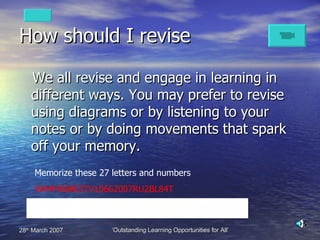
How should I revise We all revise and engage in learning in different ways. You may prefer to revise using diagrams or by listening to your notes or by doing movements that spark off your memory. Memorize these 27 letters and numbers W84MEBBCITV10662007RU2BL84T
When should I revise? Use a clock Set a realistic timetable and stick to it 20 -30 minutes chunks
Suppose you start work at  6 pm . You should decide, looking at your clock or watch, to stop at  6.25 pm  --and no later. Then at 6.25 pm have a break for  5-10  minutes. When you start again,  look at the clock and decide to work until  7 pm  exactly, and then have another break. For example,
Time management 8.30 – 9.00 7.45 – 8.15 Dinner diary diary diary diary 6- 6.20 5.10-5.40 Maths 4.30-5 School Science Eng Science Maths Eng 7-7.30 Weekend Fri Thurs Weds Tue Mon Times For the week of  Mon __ March
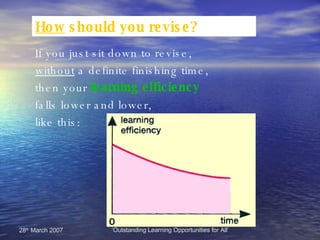
How  should you revise? If you just sit down to revise,  without  a definite finishing time,  then your  learning efficiency   falls lower and lower, like this:
How can you improve this? If you decide  at the beginning how lon g you will work for,  with a clock , then as your brain  knows  the end is coming, the graph  rises  towards the end
How often  should you revise? The graph below: It shows how much your brain can recall later. It rises for about 10 minutes …and then  falls . if you quickly re-revise after 10 minutes, then it falls  more slowl y!
If you quickly re-revise  again , after  1 day , then it falls even more slowly!  Even better , if you quickly re-revise  again , after  1 week , then it falls even more slowly!
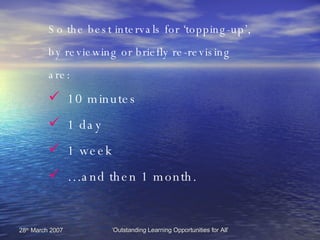
10 minutes 1 day 1 week … and then 1 month. So the best intervals for ‘topping-up’, by reviewing or briefly re-revising are:
Where  should you revise? In a quiet room, perhaps a bedroom, Warm and well-lit,  With a table to work at, Ideally, with a table-lamp, to help you  to focus on the page, With a clock for timing Your study area… Is it Well lit? Comfortable but not too comfortable? Ventilated? Quiet? Without distractions?
Where  should you revise?
How can parents help? Provide ‘brain’ food (water, foods that release slowly over time) Ensure they have all the correct equipment Access to the Internet and videos  Test them, read over essays etc Ensure they have a work/leisure balance
Allow for Brain Food Get plenty of sleep Drink lots of water Eat a balanced diet Exercise your body Exercise your mind Avoid too much Your brain needs time to sort out the information it has come across during the day The brain is made mostly of water and dehydration will lead to headaches and tiredness Eat plenty of fruit and veg ‘brain food’ The brain uses 20% of the oxygen in the blood so make sure your body gets enough Use brain gym, puzzles etc Avoid too much chocolate, coke, caffeine and foods with lots of additives
Friends Share knowledge Reinforce by teaching Swap strengths Test each other Who should I revise with?
Top 10 Tips for revising If you don’t understand ask a teacher Have an emergency number of a friend Do the worst first Have a revision timetable and stick to it Check you have all the correct equipment  Use different learning styles Revise what you don’t know! Take regular breaks Use memorising techniques Eat a healthy balanced diet
Support for Students Letter   home informing parents of the importance of year 9 and the end of key stage 3 tests Analysis of grade card information and early identification of students with concerns Success cards ‘ Outstanding Learning Opportunities   for All’
Reward letters Interviews with students who were underachieving Revision Booklet Trial tests Analysis of trial test results Consultation evening Revision information evening Reward trip ‘ Outstanding Learning Opportunities for All’
On Going Support Mentoring of some students Easter Revision Assembly by Examinations Officer Revision in lessons and help with examination technique Revision notes and booklets ‘ Outstanding Learning Opportunities for All’
What you need to do Follow the guidance you have been given Set up a revision timetable Revise Ask if you need help  Turn up for the exams on time Be prepared (sleep, food, water, equipment) Do your best  ‘ Outstanding Learning Opportunities for All’
Remember The End of Key Stage 3 Tests take place from Tuesday 8 th  May to Friday 11 th  May The following are useful websites for revision: www.samlearning.com www.bbc.co.uk/bitesize www.mymaths.co.uk

Yr 9 Revision evening

  • 1.
  • 2.
    MarlboroughSchool Science College Wednesday 28 th March 2006 Year 9 End of Key Stage 3 Tests Revision Evening
  • 3.
    The Purpose OfThe Tests: To show progression from key stage 2 To celebrate student achievements To help with setting in year 10 To set challenging yet realistic targets for future achievements National Benchmarks ‘ Outstanding Learning Opportunities for All’
  • 4.
    Why should Irevise? You are doing this for yourself, not for your parents or the school Your brain forgets details of the work you did months ago, But… You need these details to answer the questions in the exam, So… You need to ‘top-up’, by using the correct revision technique. Revise using different learning styles, there are lots of different ways to revise. Rewards (external motivation) These test results are one factor in determining setting in year 10
  • 5.
    What should Irevise? List of topics in revision guides Study what you don’t know (code work: ✔ or ? or S Do a small amount of comfort revision
  • 6.
    How should Irevise We all revise and engage in learning in different ways. You may prefer to revise using diagrams or by listening to your notes or by doing movements that spark off your memory. Memorize these 27 letters and numbers W84MEBBCITV10662007RU2BL84T
  • 7.
    When should Irevise? Use a clock Set a realistic timetable and stick to it 20 -30 minutes chunks
  • 8.
    Suppose you startwork at 6 pm . You should decide, looking at your clock or watch, to stop at 6.25 pm --and no later. Then at 6.25 pm have a break for 5-10 minutes. When you start again, look at the clock and decide to work until 7 pm exactly, and then have another break. For example,
  • 9.
    Time management 8.30– 9.00 7.45 – 8.15 Dinner diary diary diary diary 6- 6.20 5.10-5.40 Maths 4.30-5 School Science Eng Science Maths Eng 7-7.30 Weekend Fri Thurs Weds Tue Mon Times For the week of Mon __ March
  • 10.
    How shouldyou revise? If you just sit down to revise, without a definite finishing time, then your learning efficiency falls lower and lower, like this:
  • 11.
    How can youimprove this? If you decide at the beginning how lon g you will work for, with a clock , then as your brain knows the end is coming, the graph rises towards the end
  • 12.
    How often should you revise? The graph below: It shows how much your brain can recall later. It rises for about 10 minutes …and then falls . if you quickly re-revise after 10 minutes, then it falls more slowl y!
  • 13.
    If you quicklyre-revise again , after 1 day , then it falls even more slowly! Even better , if you quickly re-revise again , after 1 week , then it falls even more slowly!
  • 14.
    10 minutes 1day 1 week … and then 1 month. So the best intervals for ‘topping-up’, by reviewing or briefly re-revising are:
  • 15.
    Where shouldyou revise? In a quiet room, perhaps a bedroom, Warm and well-lit, With a table to work at, Ideally, with a table-lamp, to help you to focus on the page, With a clock for timing Your study area… Is it Well lit? Comfortable but not too comfortable? Ventilated? Quiet? Without distractions?
  • 16.
    Where shouldyou revise?
  • 17.
    Where shouldyou revise?
  • 18.
    How can parentshelp? Provide ‘brain’ food (water, foods that release slowly over time) Ensure they have all the correct equipment Access to the Internet and videos Test them, read over essays etc Ensure they have a work/leisure balance
  • 19.
    Allow for BrainFood Get plenty of sleep Drink lots of water Eat a balanced diet Exercise your body Exercise your mind Avoid too much Your brain needs time to sort out the information it has come across during the day The brain is made mostly of water and dehydration will lead to headaches and tiredness Eat plenty of fruit and veg ‘brain food’ The brain uses 20% of the oxygen in the blood so make sure your body gets enough Use brain gym, puzzles etc Avoid too much chocolate, coke, caffeine and foods with lots of additives
  • 20.
    Friends Share knowledgeReinforce by teaching Swap strengths Test each other Who should I revise with?
  • 21.
    Top 10 Tipsfor revising If you don’t understand ask a teacher Have an emergency number of a friend Do the worst first Have a revision timetable and stick to it Check you have all the correct equipment Use different learning styles Revise what you don’t know! Take regular breaks Use memorising techniques Eat a healthy balanced diet
  • 22.
    Support for StudentsLetter home informing parents of the importance of year 9 and the end of key stage 3 tests Analysis of grade card information and early identification of students with concerns Success cards ‘ Outstanding Learning Opportunities for All’
  • 23.
    Reward letters Interviewswith students who were underachieving Revision Booklet Trial tests Analysis of trial test results Consultation evening Revision information evening Reward trip ‘ Outstanding Learning Opportunities for All’
  • 24.
    On Going SupportMentoring of some students Easter Revision Assembly by Examinations Officer Revision in lessons and help with examination technique Revision notes and booklets ‘ Outstanding Learning Opportunities for All’
  • 25.
    What you needto do Follow the guidance you have been given Set up a revision timetable Revise Ask if you need help Turn up for the exams on time Be prepared (sleep, food, water, equipment) Do your best ‘ Outstanding Learning Opportunities for All’
  • 26.
    Remember The Endof Key Stage 3 Tests take place from Tuesday 8 th May to Friday 11 th May The following are useful websites for revision: www.samlearning.com www.bbc.co.uk/bitesize www.mymaths.co.uk