We can do it!


          Year 11
 Preparing for the final stage of your GCSEs
You have had your mock results. You are
either feeling:
  –   Elated
  –   Disappointed
  –   Quietly confident
  –   In a state of panic

Hopefully, none of you are feeling nothing!

Let’s take a few moments to reflect on
and learn from mock results day.
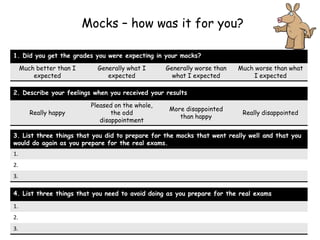
Mocks – how was it for you?

1. Did you get the grades you were expecting in your mocks?

     Much better than I      Generally what I      Generally worse than   Much worse than what
         expected               expected             what I expected          I expected

2. Describe your feelings when you received your results

                           Pleased on the whole,
                                                    More disappointed
        Really happy              the odd                                  Really disappointed
                                                       than happy
                              disappointment

3. List three things that you did to prepare for the mocks that went really well and that you
would do again as you prepare for the real exams.
1.
2.
3.

4. List three things that you need to avoid doing as you prepare for the real exams

1.
2.
3.
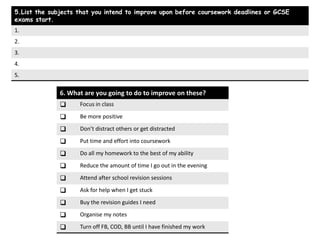
5.List the subjects that you intend to improve upon before coursework deadlines or GCSE
exams start.
1.
2.
3.
4.
5.

              6. What are you going to do to improve on these?
                   Focus in class

                   Be more positive

                   Don’t distract others or get distracted

                   Put time and effort into coursework

                   Do all my homework to the best of my ability

                   Reduce the amount of time I go out in the evening

                   Attend after school revision sessions

                   Ask for help when I get stuck

                   Buy the revision guides I need

                   Organise my notes

                   Turn off FB, COD, BB until I have finished my work
Either way, it is absolutely crucial that
you approach the final stages of your
GCSEs focused, motivated and with a
clear idea how to time manage for
coursework assignments and how to
prepare thoroughly and effectively for
your exams.
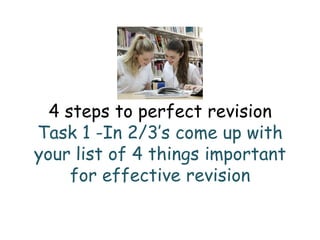
4 steps to perfect revision
Task 1 -In 2/3’s come up with
your list of 4 things important
     for effective revision
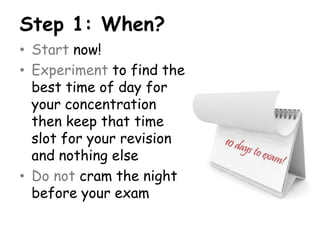
Step 1: When?
• Start now!
• Experiment to find the
  best time of day for
  your concentration
  then keep that time
  slot for your revision
  and nothing else
• Do not cram the night
  before your exam
GCSE Timelines
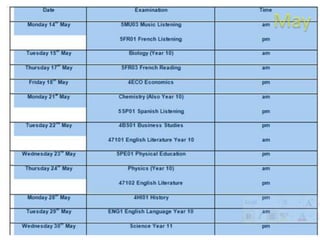
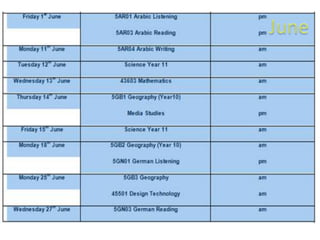
Monday 14th May – Wednesday 27th June

             From Today
          13 ½ school weeks
       (we are currently 13 ½ weeks in)


            68 School Days
          (we have done 70 so far)
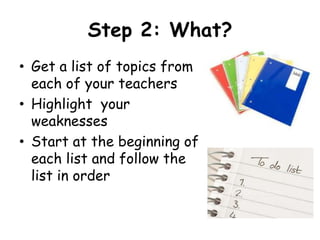
Step 2: What?
• Get a list of topics from
  each of your teachers
• Highlight your
  weaknesses
• Start at the beginning of
  each list and follow the
  list in order
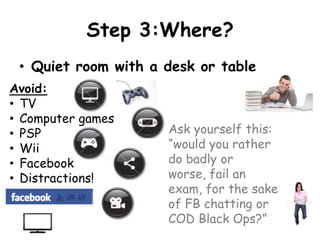
Step 3:Where?
 • Quiet room with a desk or table
Avoid:
• TV
• Computer games
• PSP                Ask yourself this:
• Wii                “would you rather
• Facebook           do badly or
• Distractions!      worse, fail an
                     exam, for the sake
                     of FB chatting or
                     COD Black Ops?”
Step 4:How? part (i)
• Plan your time – make a revision
  timetable
• Get the things you will need – revision
  guides, class notes, helpful websites,
  past papers, equipment especially pen
  and paper
• Revise for 40 minute slots then have a
  break
Step 4: How? part (ii)
• Re-write notes
• Condense notes into bullet points
  or mind maps
• Highlight important information
• Use silly stories or mnemonics to
  memorise lists of information or
  facts
• Read notes out loud
• Test yourself or get someone to test you
• Re-read your notes
• Attempt a past paper. Get it marked and ask for
  feedback
• Ask your teacher for help if you get stuck
Today is the first day of the rest of
  your GCSEs, so let’s make a start.
Task 1
Highlight your exams on the exam calendar on the next page.

Task 2
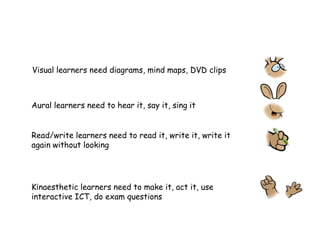
Can you recall your learning style, what does it mean?

Task 3
Working backwards from each exam date, complete your
revision timetable.

Task 4
Start your revision this week. Use the top tips from your
subject teachers to help you.
Being clear about what your schedule will be for the months ahead will
help you to prepare both mentally and physically for the exam season.


 Provisional Exams Calendar
Visual learners need diagrams, mind maps, DVD clips


Aural learners need to hear it, say it, sing it


Read/write learners need to read it, write it, write it
again without looking


Kinaesthetic learners need to make it, act it, use
interactive ICT, do exam questions
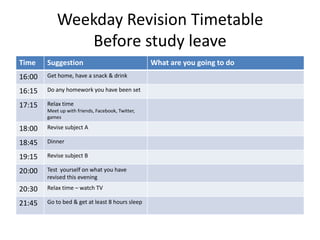
Weekday Revision Timetable
               Before study leave
Time    Suggestion                                 What are you going to do
16:00   Get home, have a snack & drink

16:15   Do any homework you have been set

17:15   Relax time
        Meet up with friends, Facebook, Twitter,
        games

18:00   Revise subject A

18:45   Dinner

19:15   Revise subject B

20:00   Test yourself on what you have
        revised this evening
20:30   Relax time – watch TV

21:45   Go to bed & get at least 8 hours sleep
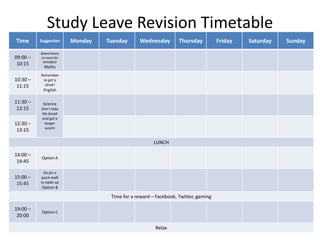
Study Leave Revision Timetable
Time      Suggestion     Monday   Tuesday      Wednesday         Thursday          Friday   Saturday   Sunday
          Baked beans
09:00 –   on toast for
           breakfast
 10:15
            Maths
          Remember
10:30 –    to get a
 11:15      drink!
           English

11:30 –    Science
 12:15    Don’t take
          the break
          and get a
12:30 –     longer
            lunch!
 13:15

                                                      LUNCH

14:00 –
           Option A
 14:45

            Go for a
15:00 –   quick walk
 15:45    to wake up
           Option B

                                   Time for a reward – Facebook, Twitter, gaming

19:00 –
           Option C
 20:00

                                                      Relax

Y11 Mock Results & Summer Timetable

  • 1.
    We can doit! Year 11 Preparing for the final stage of your GCSEs
  • 2.
    You have hadyour mock results. You are either feeling: – Elated – Disappointed – Quietly confident – In a state of panic Hopefully, none of you are feeling nothing! Let’s take a few moments to reflect on and learn from mock results day.
  • 3.
    Mocks – howwas it for you? 1. Did you get the grades you were expecting in your mocks? Much better than I Generally what I Generally worse than Much worse than what expected expected what I expected I expected 2. Describe your feelings when you received your results Pleased on the whole, More disappointed Really happy the odd Really disappointed than happy disappointment 3. List three things that you did to prepare for the mocks that went really well and that you would do again as you prepare for the real exams. 1. 2. 3. 4. List three things that you need to avoid doing as you prepare for the real exams 1. 2. 3.
  • 4.
    5.List the subjectsthat you intend to improve upon before coursework deadlines or GCSE exams start. 1. 2. 3. 4. 5. 6. What are you going to do to improve on these?  Focus in class  Be more positive  Don’t distract others or get distracted  Put time and effort into coursework  Do all my homework to the best of my ability  Reduce the amount of time I go out in the evening  Attend after school revision sessions  Ask for help when I get stuck  Buy the revision guides I need  Organise my notes  Turn off FB, COD, BB until I have finished my work
  • 5.
    Either way, itis absolutely crucial that you approach the final stages of your GCSEs focused, motivated and with a clear idea how to time manage for coursework assignments and how to prepare thoroughly and effectively for your exams.
  • 6.
    4 steps toperfect revision Task 1 -In 2/3’s come up with your list of 4 things important for effective revision
  • 7.
    Step 1: When? •Start now! • Experiment to find the best time of day for your concentration then keep that time slot for your revision and nothing else • Do not cram the night before your exam
  • 8.
    GCSE Timelines Monday 14thMay – Wednesday 27th June From Today 13 ½ school weeks (we are currently 13 ½ weeks in) 68 School Days (we have done 70 so far)
  • 9.
    Step 2: What? •Get a list of topics from each of your teachers • Highlight your weaknesses • Start at the beginning of each list and follow the list in order
  • 10.
    Step 3:Where? •Quiet room with a desk or table Avoid: • TV • Computer games • PSP Ask yourself this: • Wii “would you rather • Facebook do badly or • Distractions! worse, fail an exam, for the sake of FB chatting or COD Black Ops?”
  • 11.
    Step 4:How? part(i) • Plan your time – make a revision timetable • Get the things you will need – revision guides, class notes, helpful websites, past papers, equipment especially pen and paper • Revise for 40 minute slots then have a break
  • 12.
    Step 4: How?part (ii) • Re-write notes • Condense notes into bullet points or mind maps • Highlight important information • Use silly stories or mnemonics to memorise lists of information or facts • Read notes out loud • Test yourself or get someone to test you • Re-read your notes • Attempt a past paper. Get it marked and ask for feedback • Ask your teacher for help if you get stuck
  • 13.
    Today is thefirst day of the rest of your GCSEs, so let’s make a start. Task 1 Highlight your exams on the exam calendar on the next page. Task 2 Can you recall your learning style, what does it mean? Task 3 Working backwards from each exam date, complete your revision timetable. Task 4 Start your revision this week. Use the top tips from your subject teachers to help you.
  • 14.
    Being clear aboutwhat your schedule will be for the months ahead will help you to prepare both mentally and physically for the exam season. Provisional Exams Calendar
  • 17.
    Visual learners needdiagrams, mind maps, DVD clips Aural learners need to hear it, say it, sing it Read/write learners need to read it, write it, write it again without looking Kinaesthetic learners need to make it, act it, use interactive ICT, do exam questions
  • 18.
    Weekday Revision Timetable Before study leave Time Suggestion What are you going to do 16:00 Get home, have a snack & drink 16:15 Do any homework you have been set 17:15 Relax time Meet up with friends, Facebook, Twitter, games 18:00 Revise subject A 18:45 Dinner 19:15 Revise subject B 20:00 Test yourself on what you have revised this evening 20:30 Relax time – watch TV 21:45 Go to bed & get at least 8 hours sleep
  • 19.
    Study Leave RevisionTimetable Time Suggestion Monday Tuesday Wednesday Thursday Friday Saturday Sunday Baked beans 09:00 – on toast for breakfast 10:15 Maths Remember 10:30 – to get a 11:15 drink! English 11:30 – Science 12:15 Don’t take the break and get a 12:30 – longer lunch! 13:15 LUNCH 14:00 – Option A 14:45 Go for a 15:00 – quick walk 15:45 to wake up Option B Time for a reward – Facebook, Twitter, gaming 19:00 – Option C 20:00 Relax