Teacher’s Notes This sequence of slides is designed to introduce, or revise,  some key concepts about  revision , as explained on  pages 382-383 in  Physics for You , 2001, 2006 & 2011 editions. Note :  When you start this PowerPoint if you see a message about “Read-only embedded fonts” then you are recommended to select “ Open Read-Only ” as this (i) gives a clearer font for those at the back of the room and (ii) ensures that the text-highlighting of key words is correct. On each slide the key points are revealed step by step, at the click  of your mouse (or the press of a key such as the space-bar). Before making the next mouse-click you can ask questions of the  class or make statements about what is about to be revealed. This should help students to become more efficient with their revision. Naturally it pays to have quick practice-run first. To start the slide-show, press function-key  F5   (or right-click->Full Screen) (to return to ‘normal view’ press the <Esc> key). For more (free) PowerPoint presentations, visit  www.physics 4u .co.uk
Revision Technique
Some ways of revising are better than other ways, For the best results, your revision needs to take place at the right intervals of time. Learning Objectives You should learn that:
Why  should you revise? Where  should you revise? When  should you revise? How  should you revise? How often  should you revise? We will look at:
Why  should you revise? Your brain forgets details of the work you did months ago, But… You need these details to answer the questions in the exam, So… You need to ‘top-up’, by using the correct revision technique.
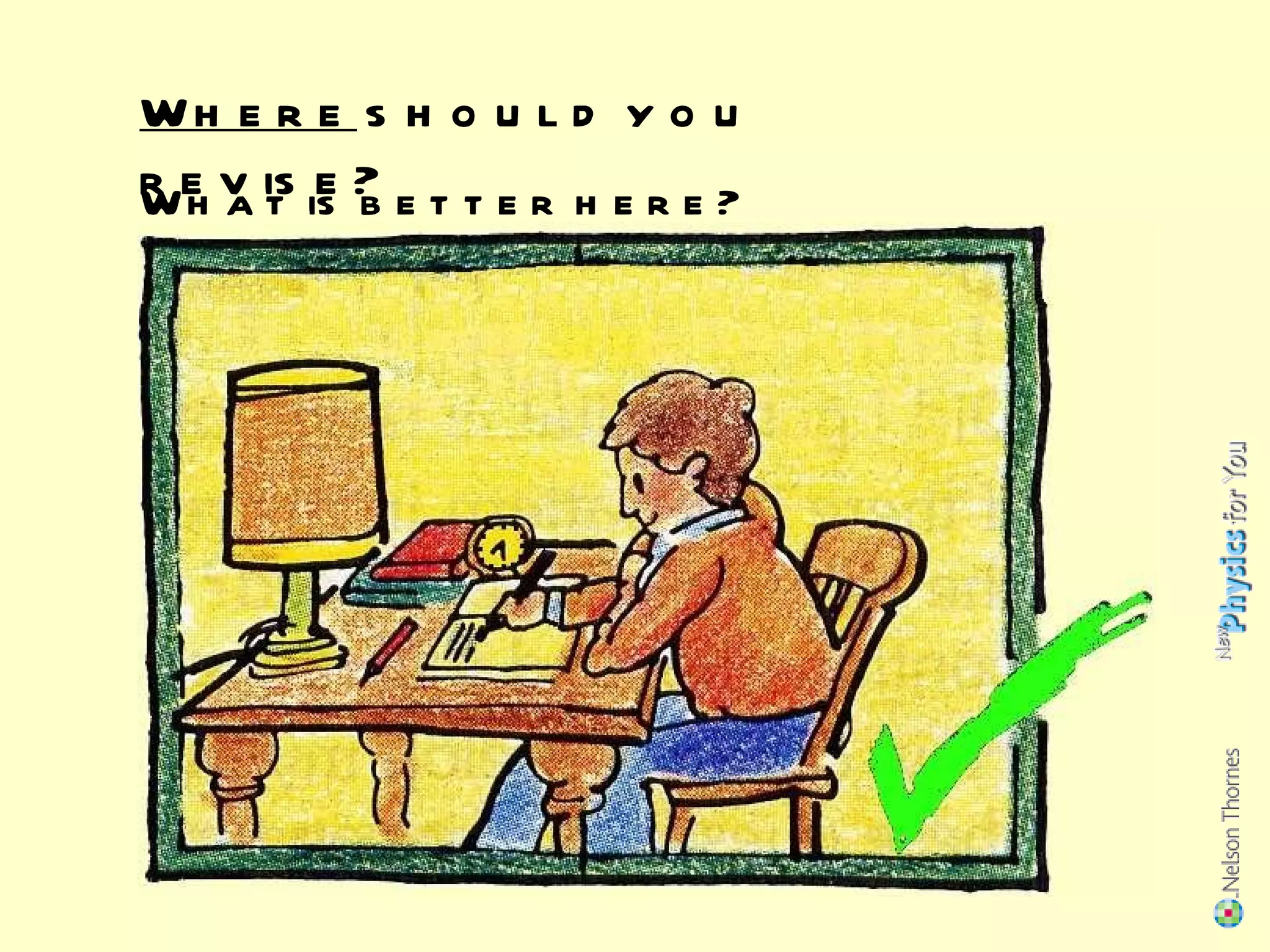
Where  should you revise? In a quiet room, perhaps a bedroom, Warm and well-lit,  With a table to work at, Ideally, with a table-lamp, to help you  to focus on the page, With a clock for timing (as described later).
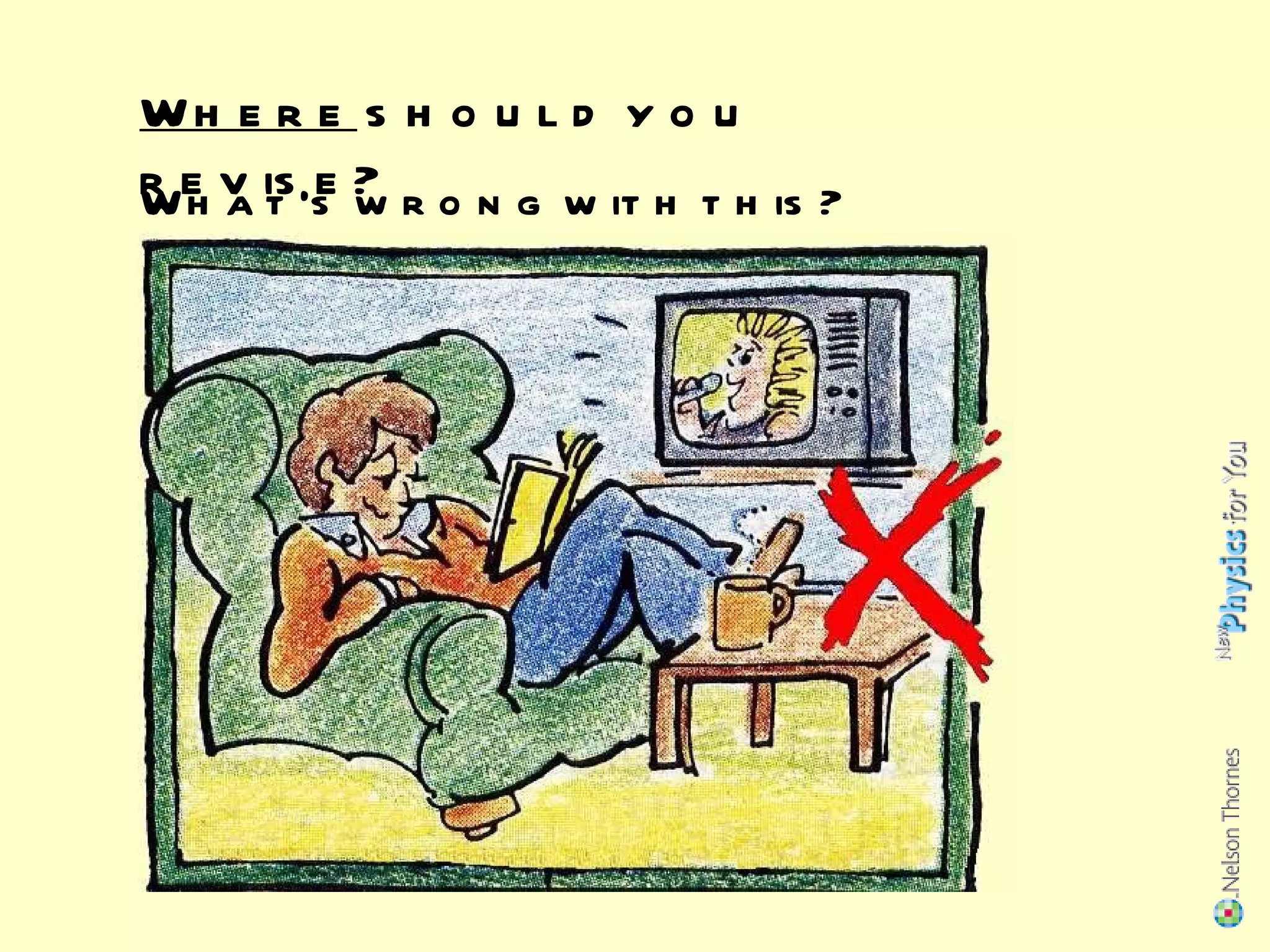
Where  should you revise? What’s wrong with this?
Where  should you revise? What is better here?
When  should you revise? Start your revision early each evening, before your brain gets tired.
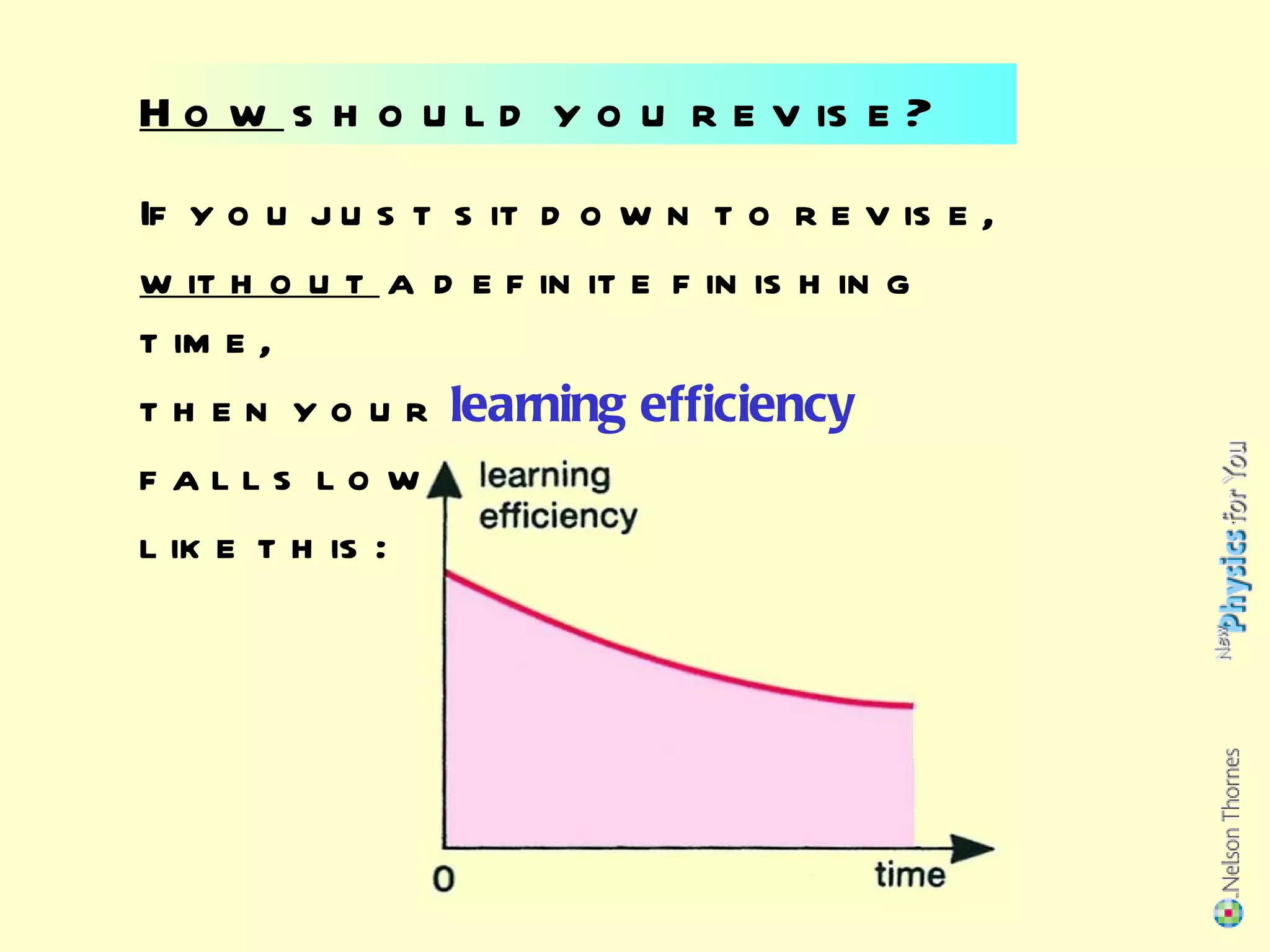
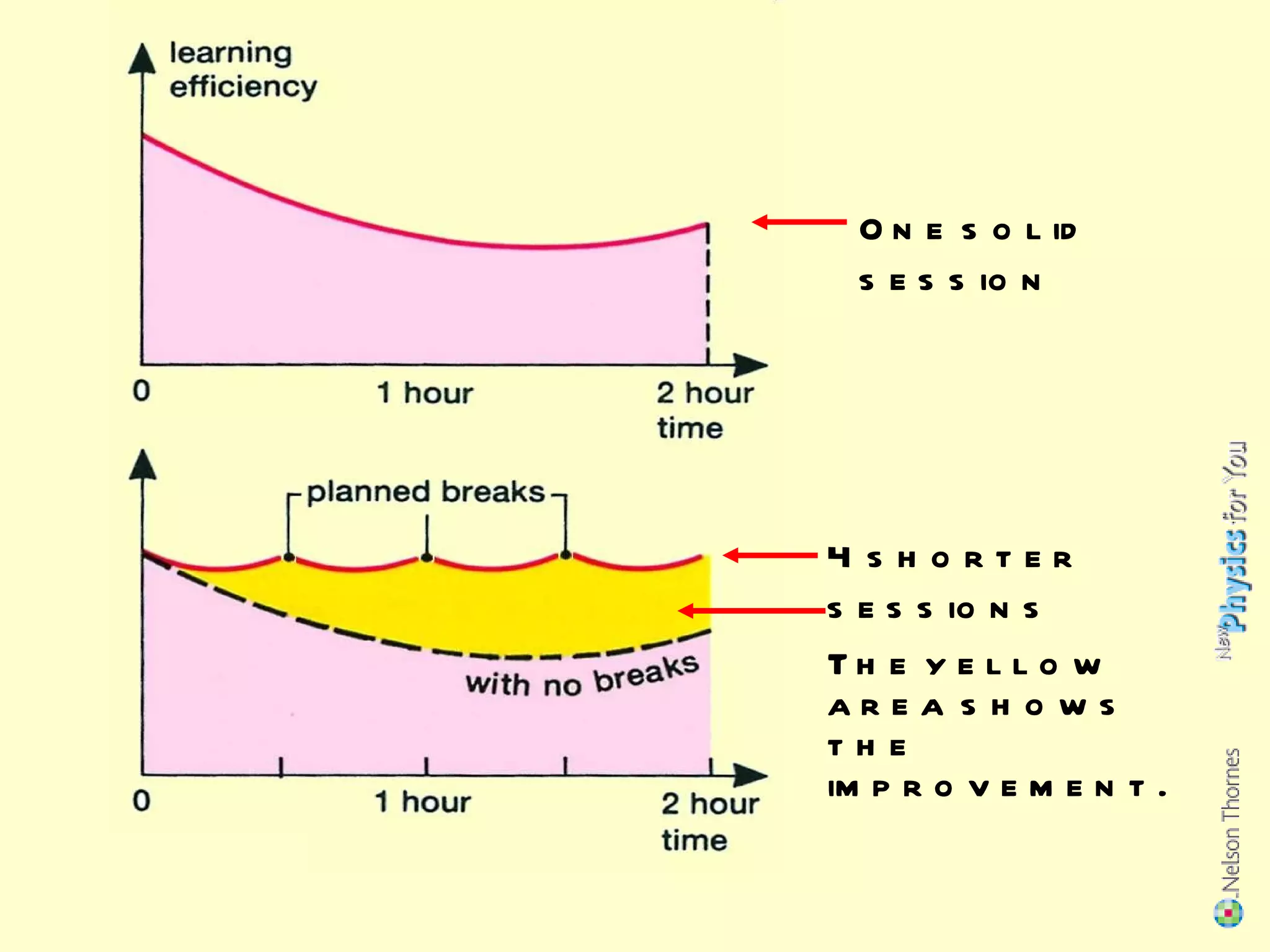
How  should you revise? If you just sit down to revise,  without  a definite finishing time,  then your  learning efficiency   falls lower and lower, like this:
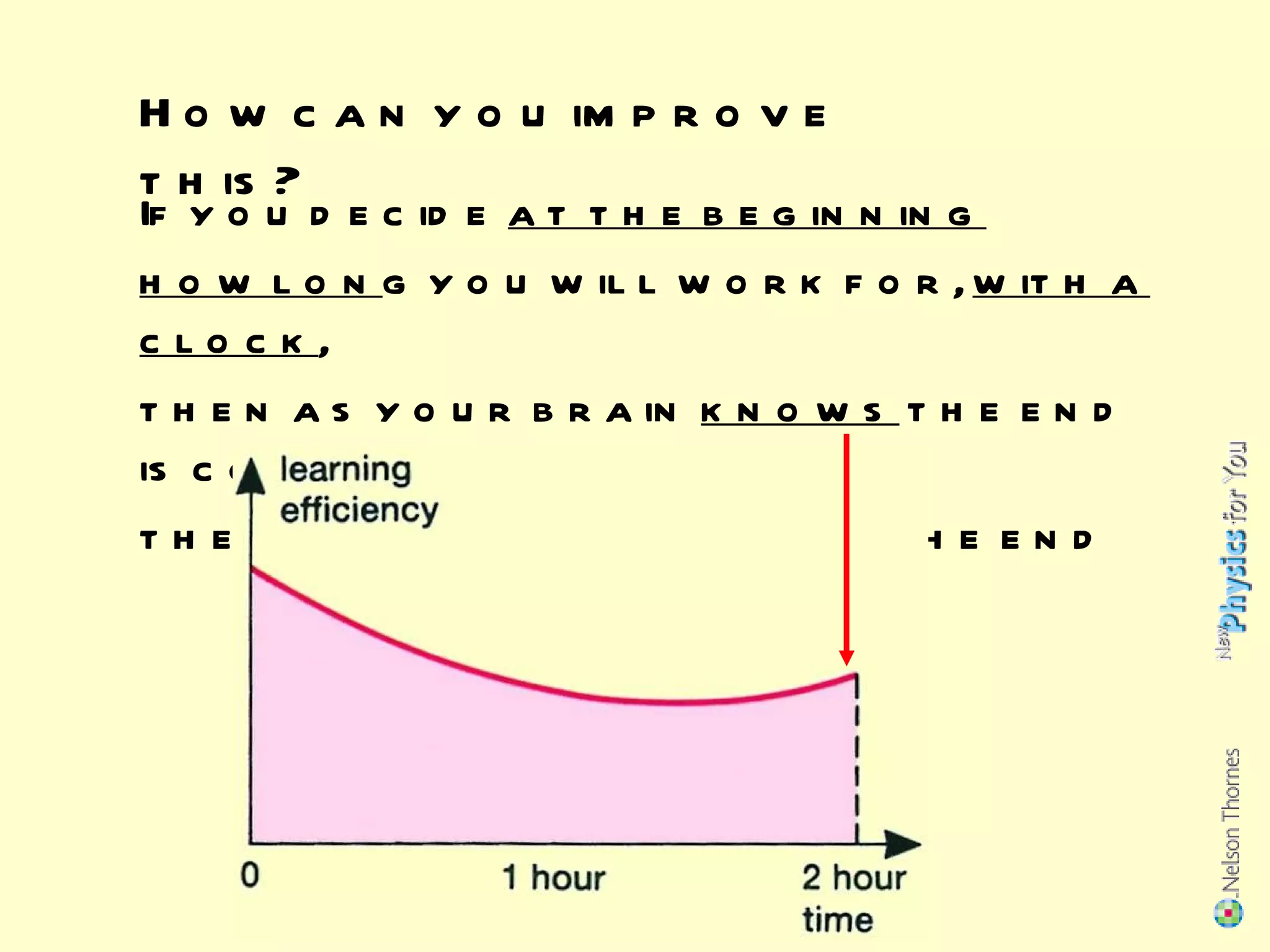
How can you improve this? If you decide  at the beginning how lon g you will work for,  with a clock , then as your brain  knows  the end is coming, the graph  rises  towards the end
How can you improve this even more? If you break up a 2-hour session, into 4 shorter sessions, each of about 25-minutes, with a short  planned  break between them, then it is even better. Compare the next 2 graphs:
One solid session 4 shorter sessions The yellow area shows the improvement.
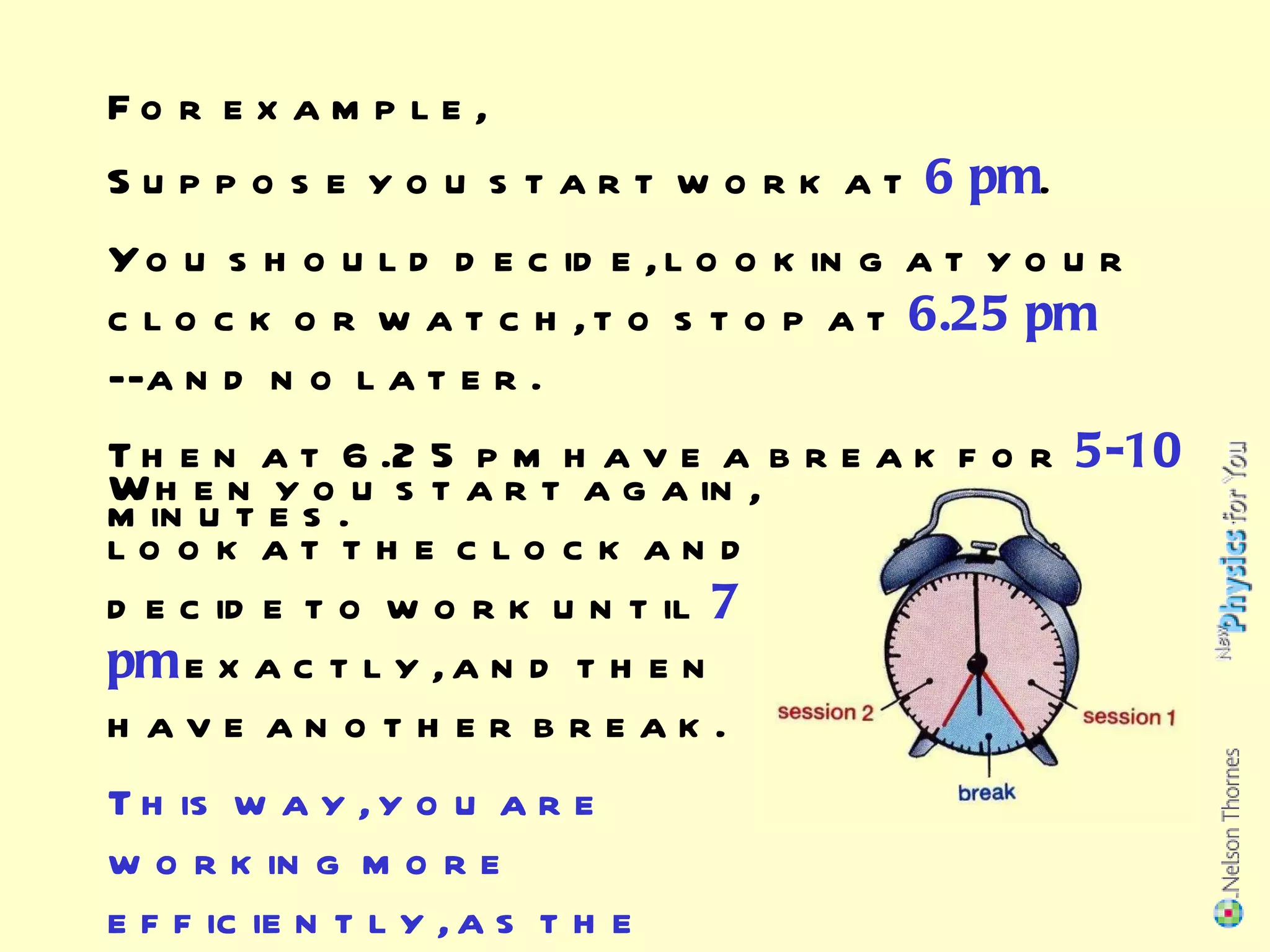
Suppose you start work at  6 pm . You should decide, looking at your clock or watch, to stop at  6.25 pm  --and no later. Then at 6.25 pm have a break for  5-10  minutes. When you start again,  look at the clock and decide to work until  7 pm  exactly, and then have another break. This way, you are working more efficiently, as the previous slide showed. For example,
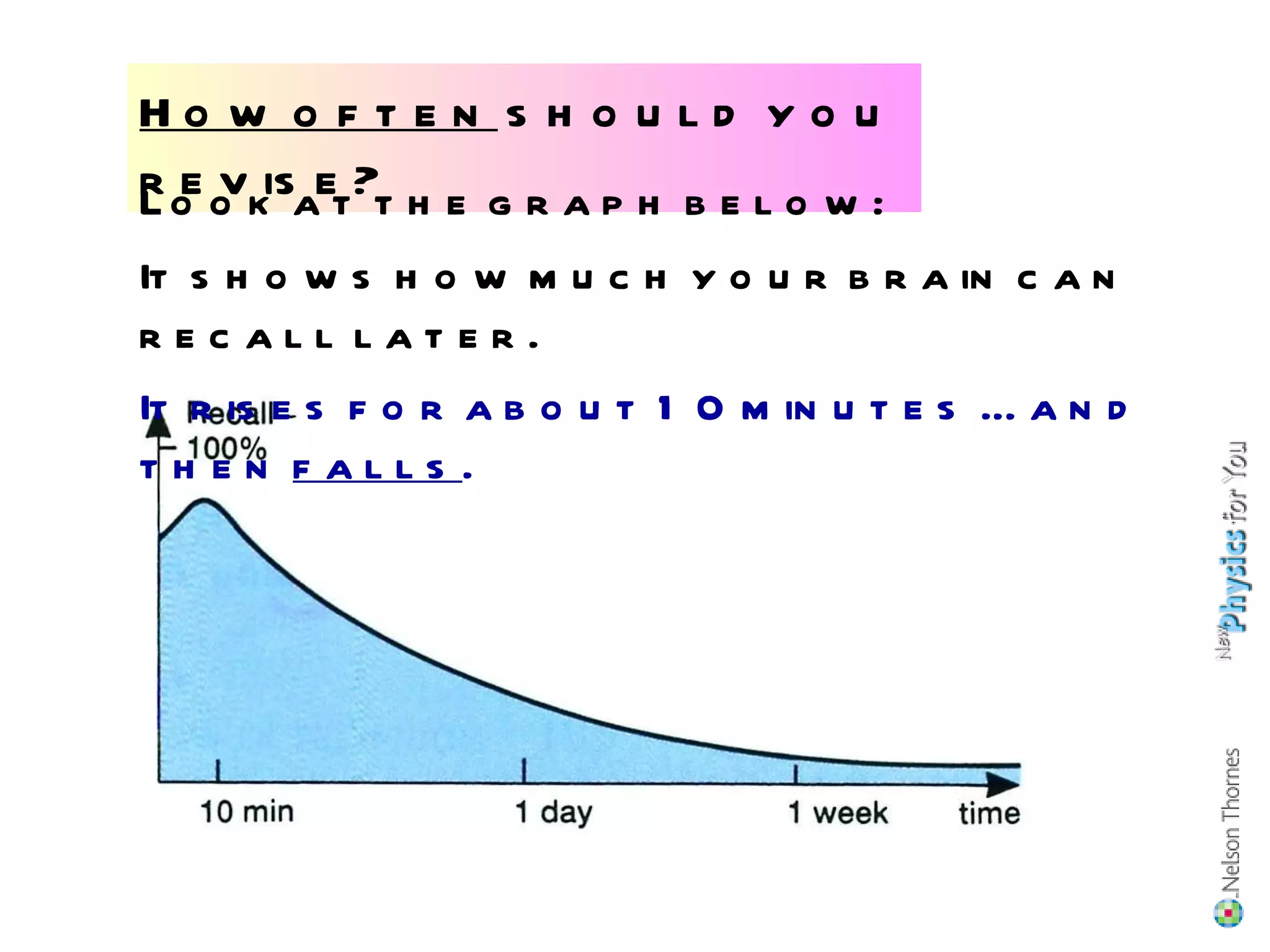
How often  should you revise? Look at the graph below: It shows how much your brain can recall later. It rises for about 10 minutes …and then  falls .
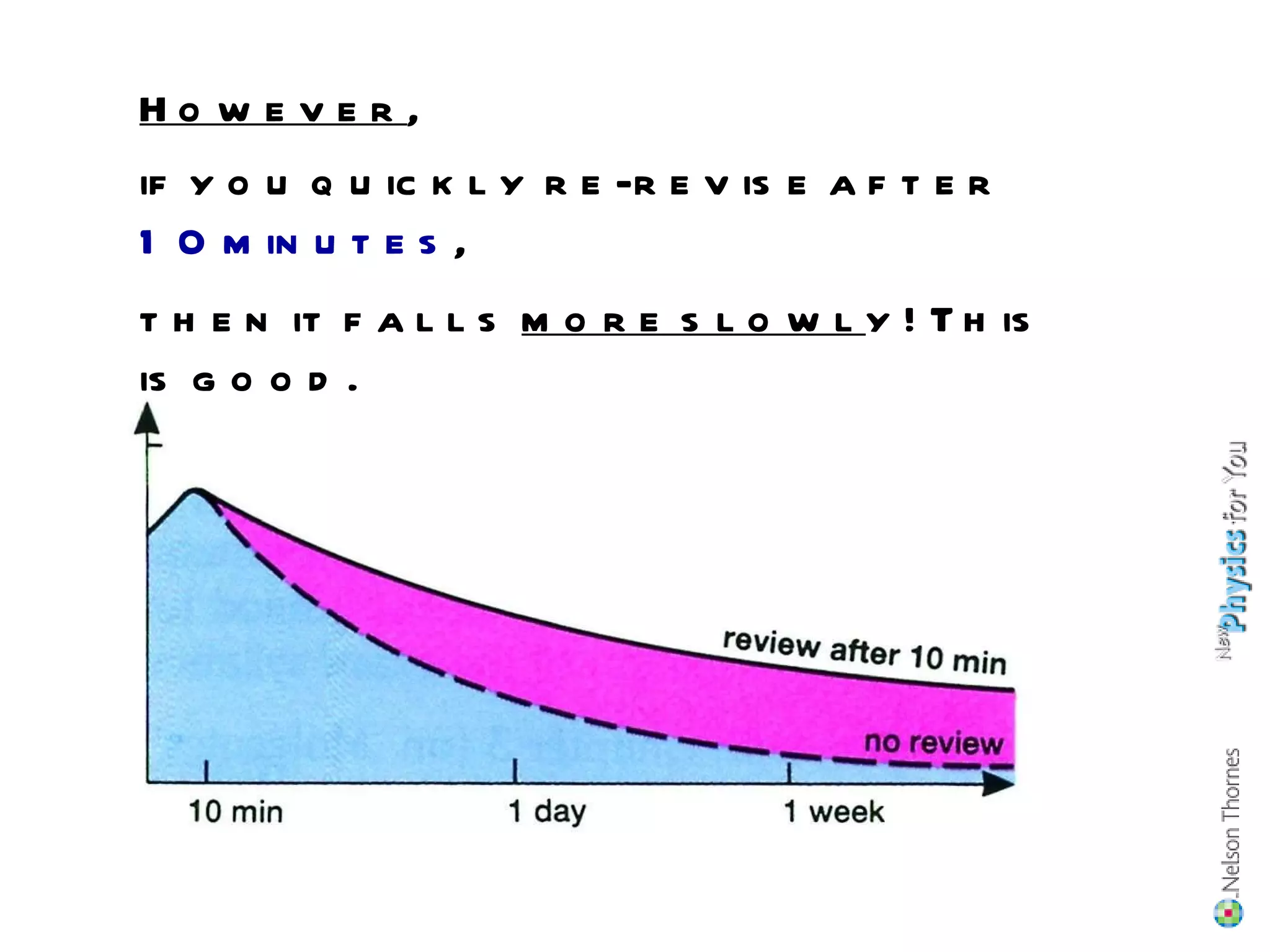
if you quickly re-revise after  10 minutes , then it falls  more slowl y!  This is good. Analyse the new graph: However ,
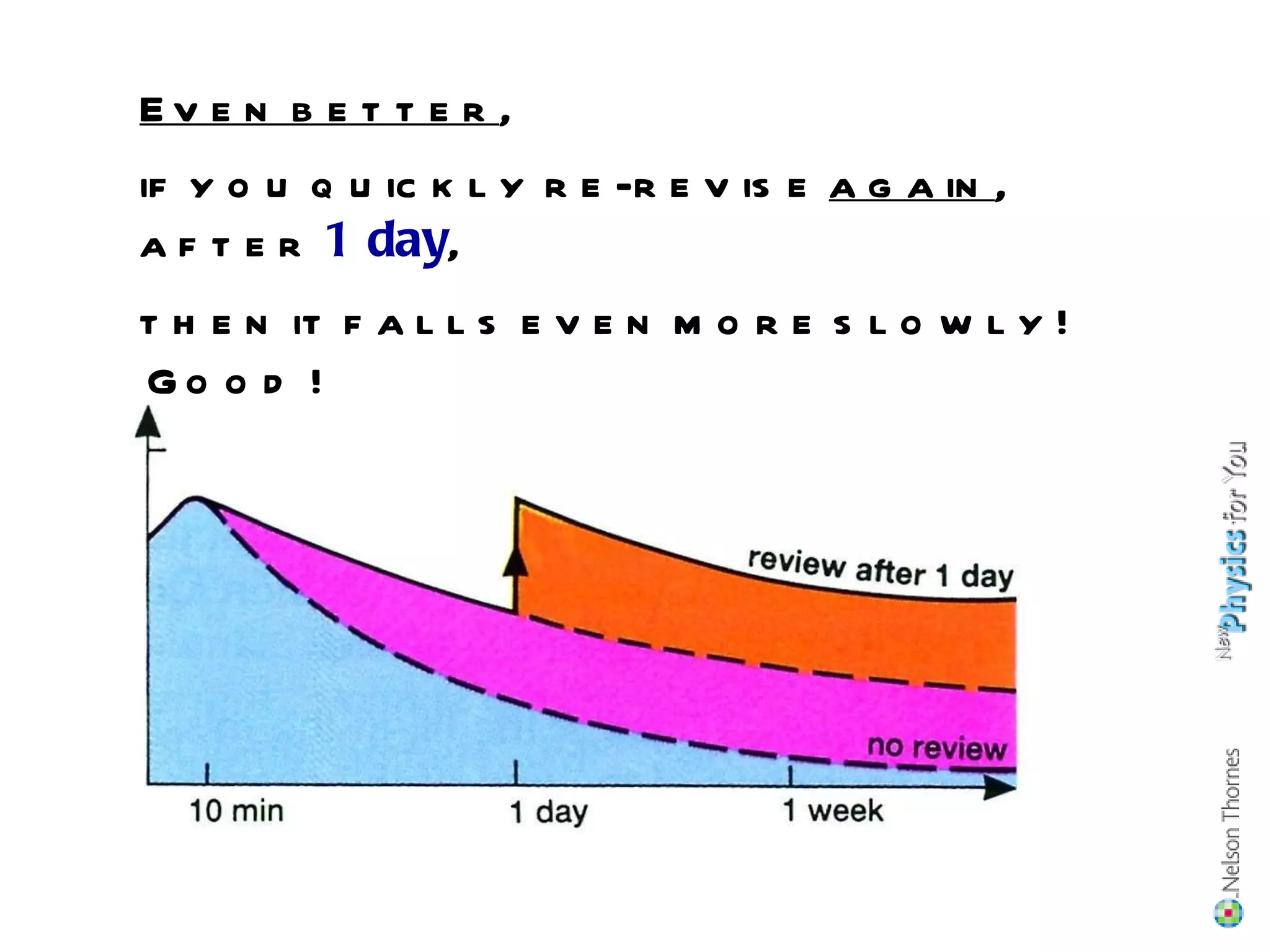
if you quickly re-revise  again , after  1 day , then it falls even more slowly!  Good ! Analyse the new graph: Even better ,
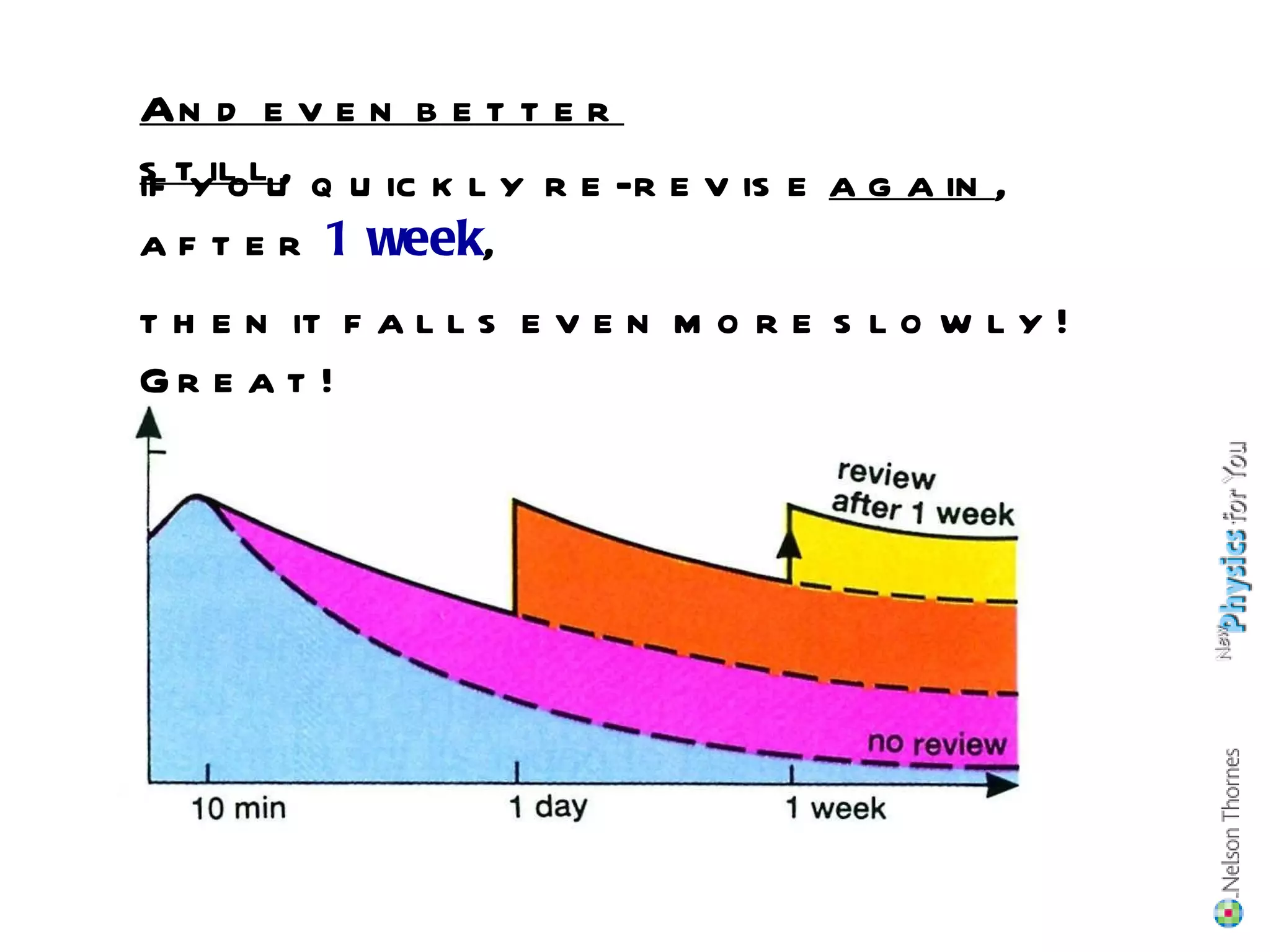
if you quickly re-revise  again , after  1 week , then it falls even more slowly!  Great! Analyse the new graph: And even better still ,
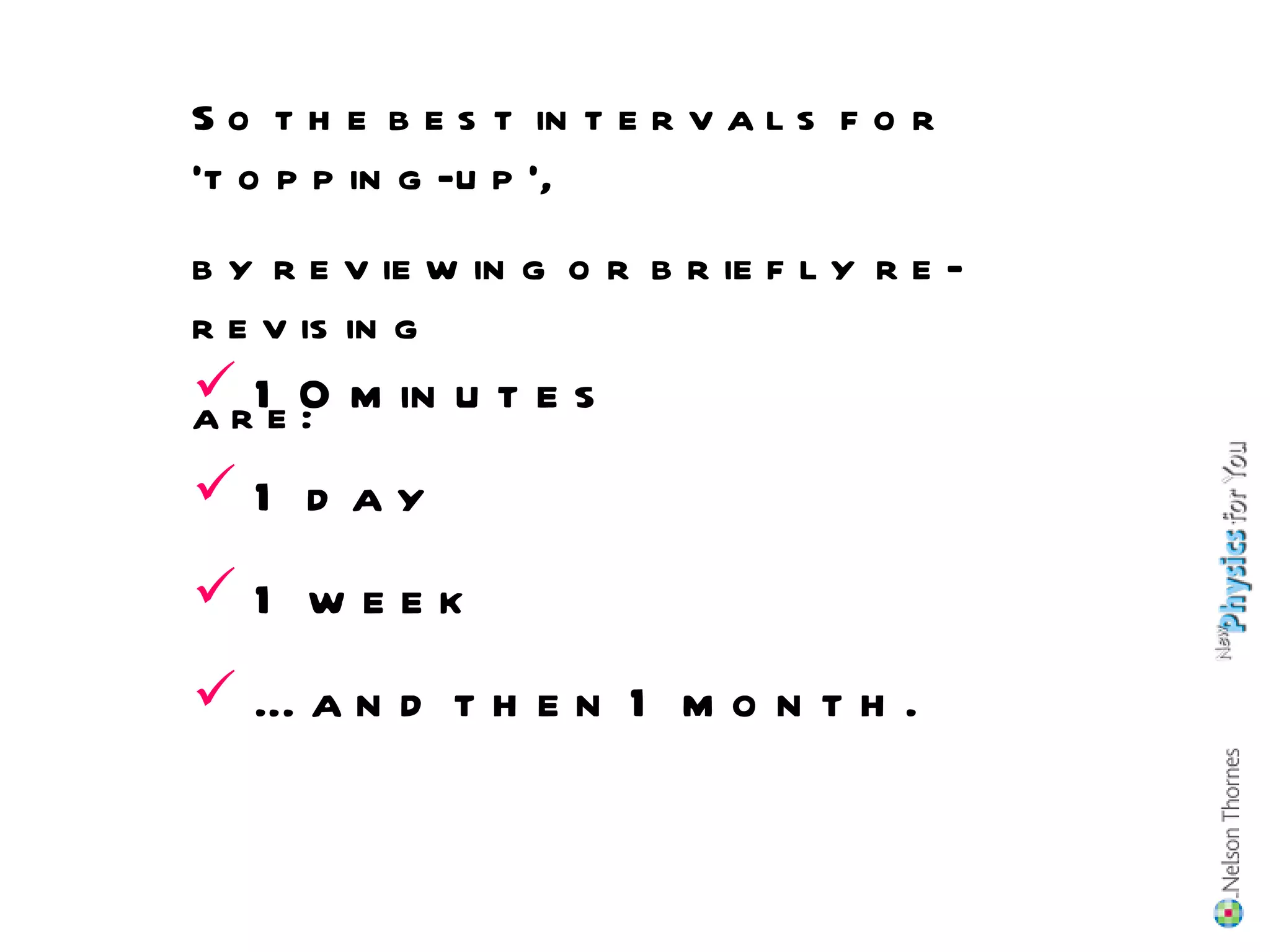
10 minutes 1 day 1 week … and then 1 month. So the best intervals for ‘topping-up’, by reviewing or briefly re-revising are:
For more details of Revision Technique, see: New Physics for You , pages 382 - 385 The web-site at  www.physics 4u .co.uk
The best conditions for revising efficiently, The advantage of deciding  planned  breaks, The best  intervals  for reviewing your work. Learning Outcomes You should now know:
If you are connected to the web at the moment, click below to see what’s available: http://www.physics4u.co.uk/


Revision technique

  • 1.
    Teacher’s Notes Thissequence of slides is designed to introduce, or revise, some key concepts about revision , as explained on pages 382-383 in Physics for You , 2001, 2006 & 2011 editions. Note : When you start this PowerPoint if you see a message about “Read-only embedded fonts” then you are recommended to select “ Open Read-Only ” as this (i) gives a clearer font for those at the back of the room and (ii) ensures that the text-highlighting of key words is correct. On each slide the key points are revealed step by step, at the click of your mouse (or the press of a key such as the space-bar). Before making the next mouse-click you can ask questions of the class or make statements about what is about to be revealed. This should help students to become more efficient with their revision. Naturally it pays to have quick practice-run first. To start the slide-show, press function-key F5 (or right-click->Full Screen) (to return to ‘normal view’ press the <Esc> key). For more (free) PowerPoint presentations, visit www.physics 4u .co.uk
  • 2.
  • 3.
    Some ways ofrevising are better than other ways, For the best results, your revision needs to take place at the right intervals of time. Learning Objectives You should learn that:
  • 4.
    Why shouldyou revise? Where should you revise? When should you revise? How should you revise? How often should you revise? We will look at:
  • 5.
    Why shouldyou revise? Your brain forgets details of the work you did months ago, But… You need these details to answer the questions in the exam, So… You need to ‘top-up’, by using the correct revision technique.
  • 6.
    Where shouldyou revise? In a quiet room, perhaps a bedroom, Warm and well-lit, With a table to work at, Ideally, with a table-lamp, to help you to focus on the page, With a clock for timing (as described later).
  • 7.
    Where shouldyou revise? What’s wrong with this?
  • 8.
    Where shouldyou revise? What is better here?
  • 9.
    When shouldyou revise? Start your revision early each evening, before your brain gets tired.
  • 10.
    How shouldyou revise? If you just sit down to revise, without a definite finishing time, then your learning efficiency falls lower and lower, like this:
  • 11.
    How can youimprove this? If you decide at the beginning how lon g you will work for, with a clock , then as your brain knows the end is coming, the graph rises towards the end
  • 12.
    How can youimprove this even more? If you break up a 2-hour session, into 4 shorter sessions, each of about 25-minutes, with a short planned break between them, then it is even better. Compare the next 2 graphs:
  • 13.
    One solid session4 shorter sessions The yellow area shows the improvement.
  • 14.
    Suppose you startwork at 6 pm . You should decide, looking at your clock or watch, to stop at 6.25 pm --and no later. Then at 6.25 pm have a break for 5-10 minutes. When you start again, look at the clock and decide to work until 7 pm exactly, and then have another break. This way, you are working more efficiently, as the previous slide showed. For example,
  • 15.
    How often should you revise? Look at the graph below: It shows how much your brain can recall later. It rises for about 10 minutes …and then falls .
  • 16.
    if you quicklyre-revise after 10 minutes , then it falls more slowl y! This is good. Analyse the new graph: However ,
  • 17.
    if you quicklyre-revise again , after 1 day , then it falls even more slowly! Good ! Analyse the new graph: Even better ,
  • 18.
    if you quicklyre-revise again , after 1 week , then it falls even more slowly! Great! Analyse the new graph: And even better still ,
  • 19.
    10 minutes 1day 1 week … and then 1 month. So the best intervals for ‘topping-up’, by reviewing or briefly re-revising are:
  • 20.
    For more detailsof Revision Technique, see: New Physics for You , pages 382 - 385 The web-site at www.physics 4u .co.uk
  • 21.
    The best conditionsfor revising efficiently, The advantage of deciding planned breaks, The best intervals for reviewing your work. Learning Outcomes You should now know:
  • 22.
    If you areconnected to the web at the moment, click below to see what’s available: http://www.physics4u.co.uk/
  • 23.
  • 24.