REVISION
GUIDE 2023
YEAR 7
Tougher Minds: 12 tips to boost revision
success
1. Improve your sleep, diet and exercise every day to minimise stress
and maximise learning.
2. Set your BIG goals, e.g. write down which grade you want to
achieve in each subject.
3. Write a revision plan.
4. Use the 20:20 principle to boost learning.
5. Practice recalling information, and writing it down, or saying it out
loud. Do not just read over your notes and highlight key words –
you will need to know the information and understand it in your
exam!
6. Repetition is essential for successful learning, so repeat to
remember, and remember to repeat – R2R. Using exam-style
questions to test yourself is the best way to use the R2R method.
7. It can be difficult to get started so start revising now, and stick to
your plan. The more you learn, the more you will be motivated to
keep it up.
8. Build your confidence by writing down what you have learned in
each subject, and what is going well with your revision.
9. Reward yourself if you are genuinely working hard.
10. Make sure that you are at the correct Activation Level, otherwise
you will not be able to learn anything!
11. Do not be afraid to experiment with your revision strategies.
12. Use a Performance Planner every day to build helpful revision
habits.
End-of-year Exam Revision Advice
Preparing for effective revision
Anyone can have goals but successful people have a plan.
• Reflect
Read the subject revision guides, highlighting each topic depending on your
confidence levels as:
o Pink – Learning
o Yellow – Revising
o Green – Extending
• Plan
Create a revision timetable.
• Shop!
Make sure that you have everything you need to revise: textbooks, notes, flashcards,
paper, pens, highlighters, post-it notes.
Doing effective revision
• Be focused
Set up a quiet area for your studying. Put electronic devices in a different room. Set
a countdown timer for the length of your revision session and keep going until the
timer goes off. Plan your breaks.
• Be active
Don’t just read through notes. See the next page for ideas on how to make revision
active.
• Be thorough
If you find something that you don’t understand then do something about it – look it
up, ask a friend, ask your teacher. Your teachers are here to help you, please use us!
Maximising exam performance
• Be calm
It will help to be on time with all equipment ready, including a water bottle.
• Be focused
Good sleep, food and exercise will help with this.
• Be aware
Read all the instructions before you start. Keep an eye on the time and make sure
that you answer all questions, particularly for essay subjects.
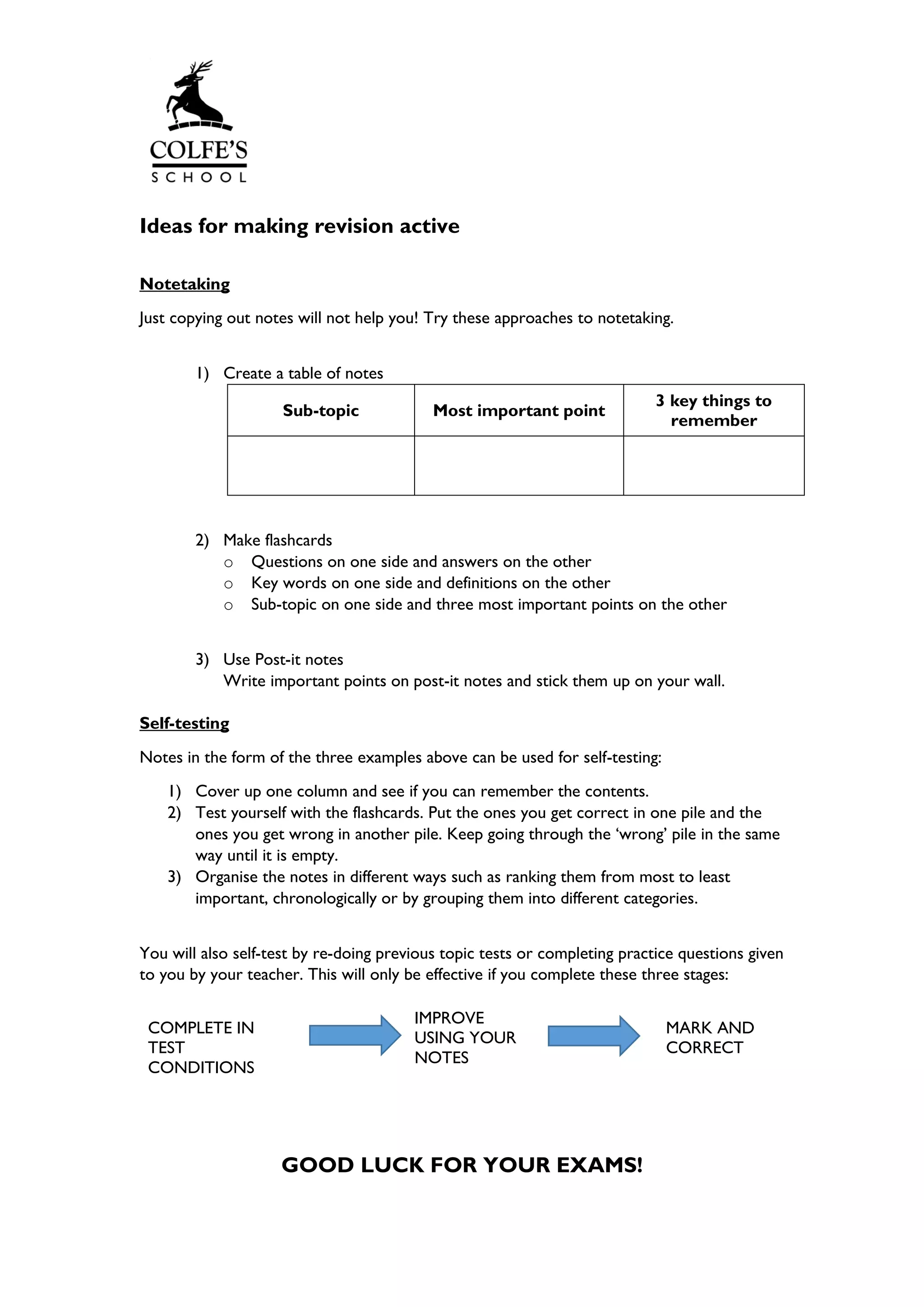
Ideas for making revision active
Notetaking
Just copying out notes will not help you! Try these approaches to notetaking.
1) Create a table of notes
Sub-topic Most important point
3 key things to
remember
2) Make flashcards
o Questions on one side and answers on the other
o Key words on one side and definitions on the other
o Sub-topic on one side and three most important points on the other
3) Use Post-it notes
Write important points on post-it notes and stick them up on your wall.
Self-testing
Notes in the form of the three examples above can be used for self-testing:
1) Cover up one column and see if you can remember the contents.
2) Test yourself with the flashcards. Put the ones you get correct in one pile and the
ones you get wrong in another pile. Keep going through the ‘wrong’ pile in the same
way until it is empty.
3) Organise the notes in different ways such as ranking them from most to least
important, chronologically or by grouping them into different categories.
You will also self-test by re-doing previous topic tests or completing practice questions given
to you by your teacher. This will only be effective if you complete these three stages:
COMPLETE IN
TEST
CONDITIONS
IMPROVE
USING YOUR
NOTES
MARK AND
CORRECT
GOOD LUCK FOR YOUR EXAMS!
Easter and May half term revision
recommendations
We recommend starting your revision in the Easter holiday by completing 1.5 hours of
revision per subject.
In term time after Easter set aside a little time each week to revise. Have specific times each
week when you do this and focus this time on the subjects which need some extra revision.
Then complete your revision by doing 1.5 hours per subject over the May half term break.
This still leaves plenty of time to have a rest and to relax in both holidays and it is important
to do this too!
Recommendations
• Follow your teachers’ advice and guidance about what and how to revise.
• Avoid leaving all your work until near the end of the holiday.
• Aim to get some revision done in the morning so that you can have guilt free time
to relax in the afternoon.
• Try to spread out your work so that you get to do two separate sessions on each
subject at different points in each holiday. This is called spaced practice and it helps
you to remember more material.
Good luck Year 7!
A Guide to Summer Internal Examinations
The following information provides you with all the details that you will need for your first set of summer
internal examinations at Colfe’s School. Please read it carefully.
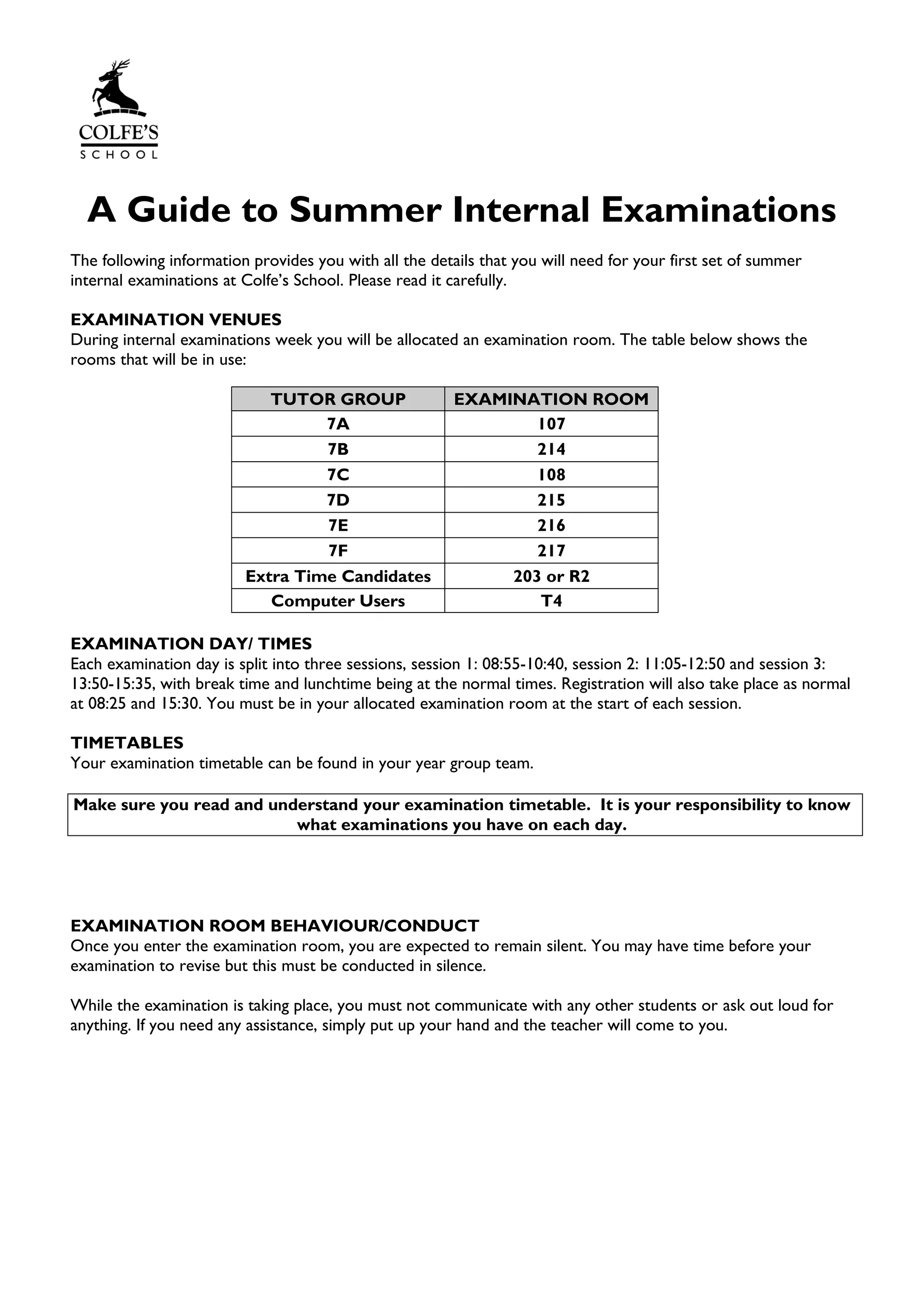
EXAMINATION VENUES
During internal examinations week you will be allocated an examination room. The table below shows the
rooms that will be in use:
EXAMINATION DAY/ TIMES
Each examination day is split into three sessions, session 1: 08:55-10:40, session 2: 11:05-12:50 and session 3:
13:50-15:35, with break time and lunchtime being at the normal times. Registration will also take place as normal
at 08:25 and 15:30. You must be in your allocated examination room at the start of each session.
TIMETABLES
Your examination timetable can be found in your year group team.
Make sure you read and understand your examination timetable. It is your responsibility to know
what examinations you have on each day.
EXAMINATION ROOM BEHAVIOUR/CONDUCT
Once you enter the examination room, you are expected to remain silent. You may have time before your
examination to revise but this must be conducted in silence.
While the examination is taking place, you must not communicate with any other students or ask out loud for
anything. If you need any assistance, simply put up your hand and the teacher will come to you.
TUTOR GROUP EXAMINATION ROOM
7A 107
7B 214
7C 108
7D 215
7E 216
7F 217
Extra Time Candidates 203 or R2
Computer Users T4
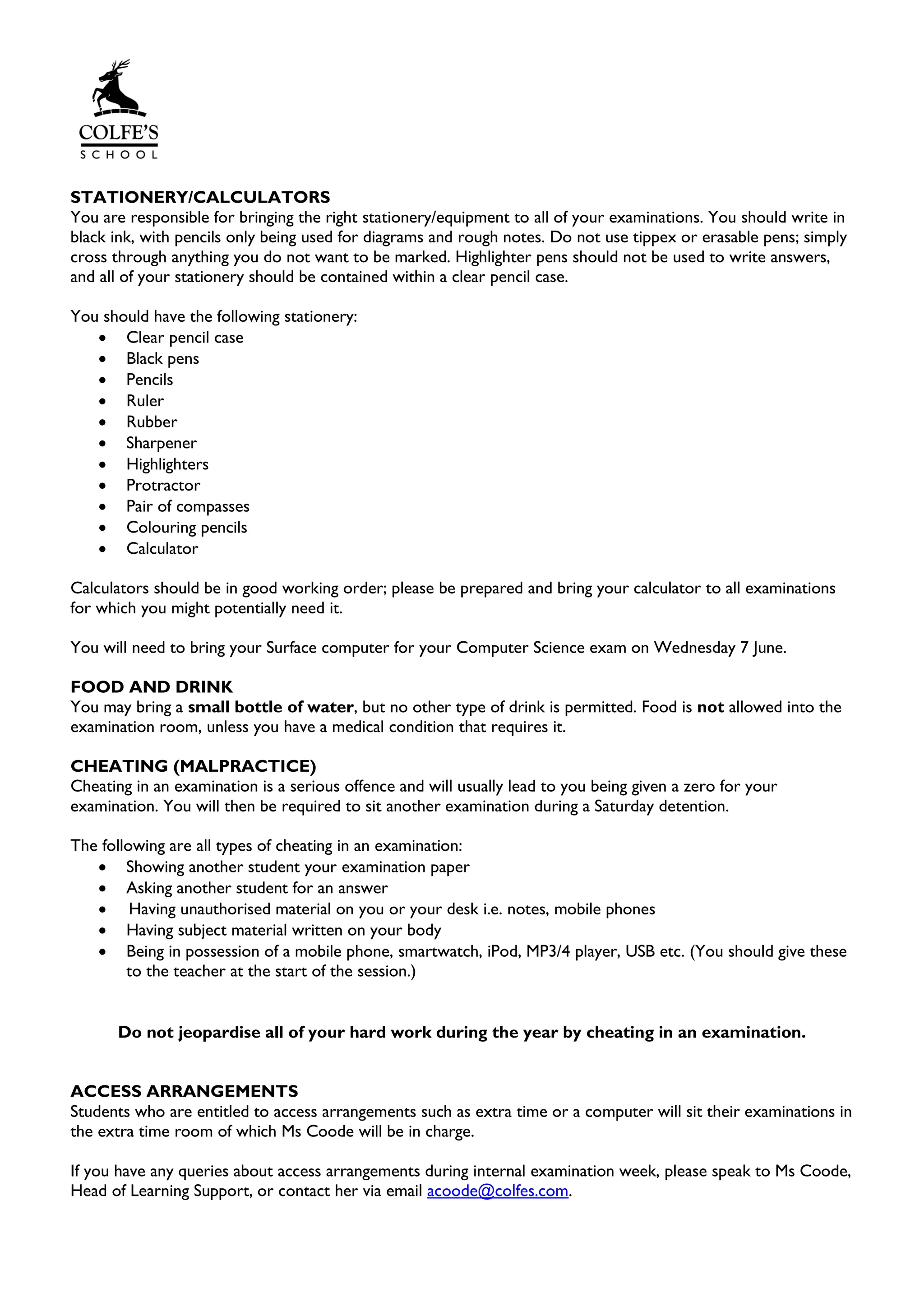
STATIONERY/CALCULATORS
You are responsible for bringing the right stationery/equipment to all of your examinations. You should write in
black ink, with pencils only being used for diagrams and rough notes. Do not use tippex or erasable pens; simply
cross through anything you do not want to be marked. Highlighter pens should not be used to write answers,
and all of your stationery should be contained within a clear pencil case.
You should have the following stationery:
• Clear pencil case
• Black pens
• Pencils
• Ruler
• Rubber
• Sharpener
• Highlighters
• Protractor
• Pair of compasses
• Colouring pencils
• Calculator
Calculators should be in good working order; please be prepared and bring your calculator to all examinations
for which you might potentially need it.
You will need to bring your Surface computer for your Computer Science exam on Wednesday 7 June.
FOOD AND DRINK
You may bring a small bottle of water, but no other type of drink is permitted. Food is not allowed into the
examination room, unless you have a medical condition that requires it.
CHEATING (MALPRACTICE)
Cheating in an examination is a serious offence and will usually lead to you being given a zero for your
examination. You will then be required to sit another examination during a Saturday detention.
The following are all types of cheating in an examination:
• Showing another student your examination paper
• Asking another student for an answer
• Having unauthorised material on you or your desk i.e. notes, mobile phones
• Having subject material written on your body
• Being in possession of a mobile phone, smartwatch, iPod, MP3/4 player, USB etc. (You should give these
to the teacher at the start of the session.)
Do not jeopardise all of your hard work during the year by cheating in an examination.
ACCESS ARRANGEMENTS
Students who are entitled to access arrangements such as extra time or a computer will sit their examinations in
the extra time room of which Ms Coode will be in charge.
If you have any queries about access arrangements during internal examination week, please speak to Ms Coode,
Head of Learning Support, or contact her via email acoode@colfes.com.
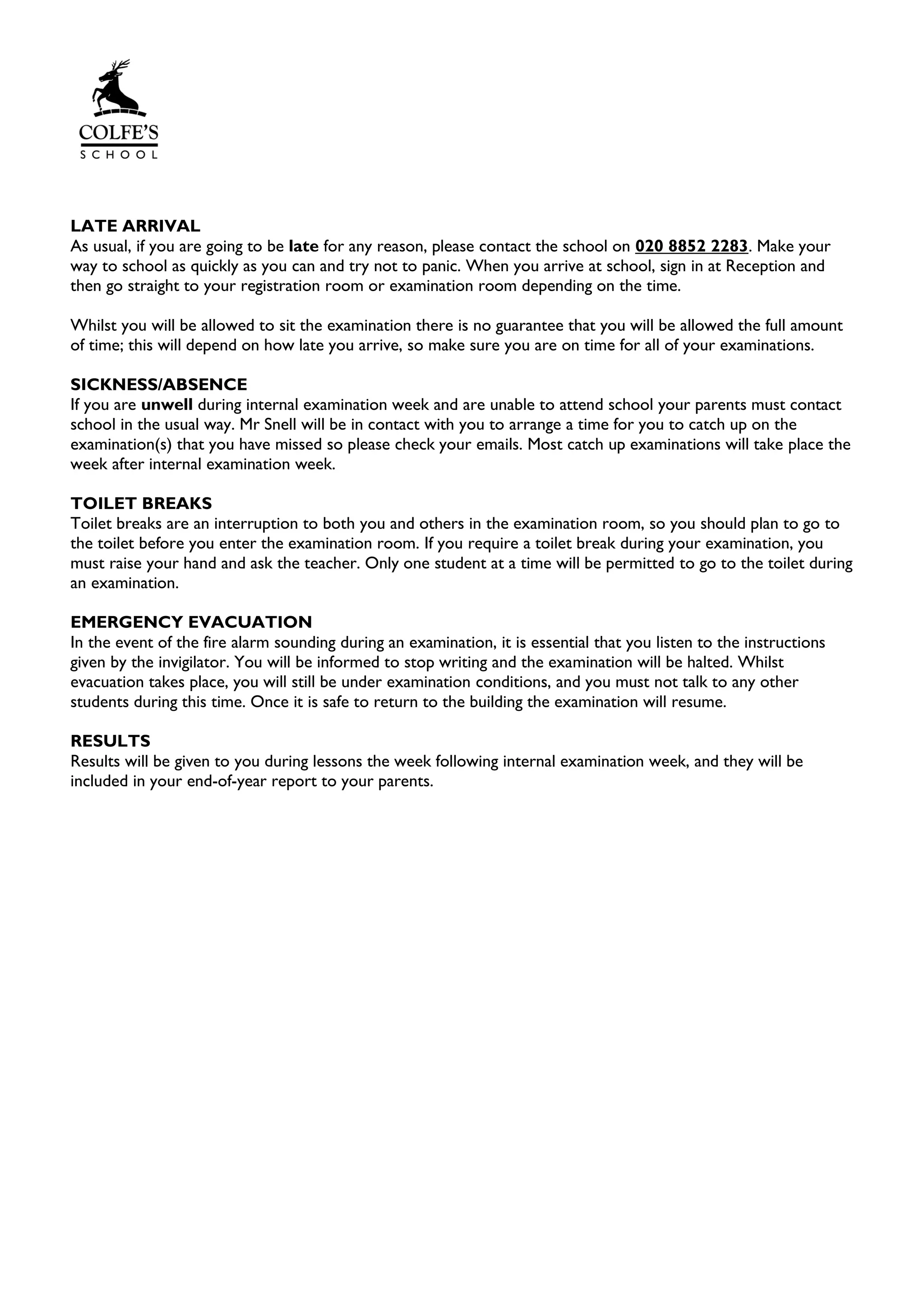
LATE ARRIVAL
As usual, if you are going to be late for any reason, please contact the school on 020 8852 2283. Make your
way to school as quickly as you can and try not to panic. When you arrive at school, sign in at Reception and
then go straight to your registration room or examination room depending on the time.
Whilst you will be allowed to sit the examination there is no guarantee that you will be allowed the full amount
of time; this will depend on how late you arrive, so make sure you are on time for all of your examinations.
SICKNESS/ABSENCE
If you are unwell during internal examination week and are unable to attend school your parents must contact
school in the usual way. Mr Snell will be in contact with you to arrange a time for you to catch up on the
examination(s) that you have missed so please check your emails. Most catch up examinations will take place the
week after internal examination week.
TOILET BREAKS
Toilet breaks are an interruption to both you and others in the examination room, so you should plan to go to
the toilet before you enter the examination room. If you require a toilet break during your examination, you
must raise your hand and ask the teacher. Only one student at a time will be permitted to go to the toilet during
an examination.
EMERGENCY EVACUATION
In the event of the fire alarm sounding during an examination, it is essential that you listen to the instructions
given by the invigilator. You will be informed to stop writing and the examination will be halted. Whilst
evacuation takes place, you will still be under examination conditions, and you must not talk to any other
students during this time. Once it is safe to return to the building the examination will resume.
RESULTS
Results will be given to you during lessons the week following internal examination week, and they will be
included in your end-of-year report to your parents.
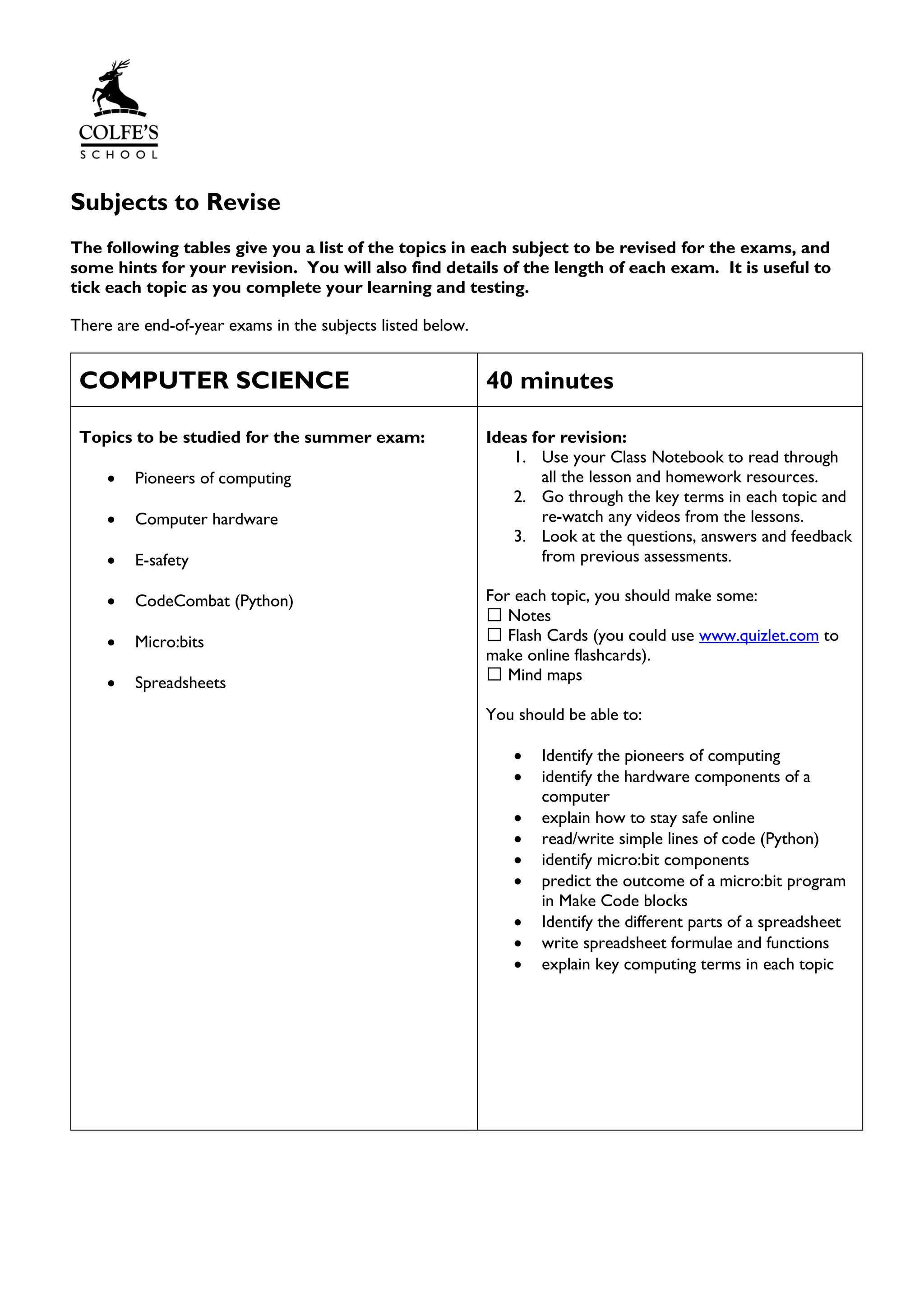
Subjects to Revise
The following tables give you a list of the topics in each subject to be revised for the exams, and
some hints for your revision. You will also find details of the length of each exam. It is useful to
tick each topic as you complete your learning and testing.
There are end-of-year exams in the subjects listed below.
COMPUTER SCIENCE 40 minutes
Topics to be studied for the summer exam:
• Pioneers of computing
• Computer hardware
• E-safety
• CodeCombat (Python)
• Micro:bits
• Spreadsheets
Ideas for revision:
1. Use your Class Notebook to read through
all the lesson and homework resources.
2. Go through the key terms in each topic and
re-watch any videos from the lessons.
3. Look at the questions, answers and feedback
from previous assessments.
For each topic, you should make some:
Notes
Flash Cards (you could use www.quizlet.com to
make online flashcards).
Mind maps
You should be able to:
• Identify the pioneers of computing
• identify the hardware components of a
computer
• explain how to stay safe online
• read/write simple lines of code (Python)
• identify micro:bit components
• predict the outcome of a micro:bit program
in Make Code blocks
• Identify the different parts of a spreadsheet
• write spreadsheet formulae and functions
• explain key computing terms in each topic
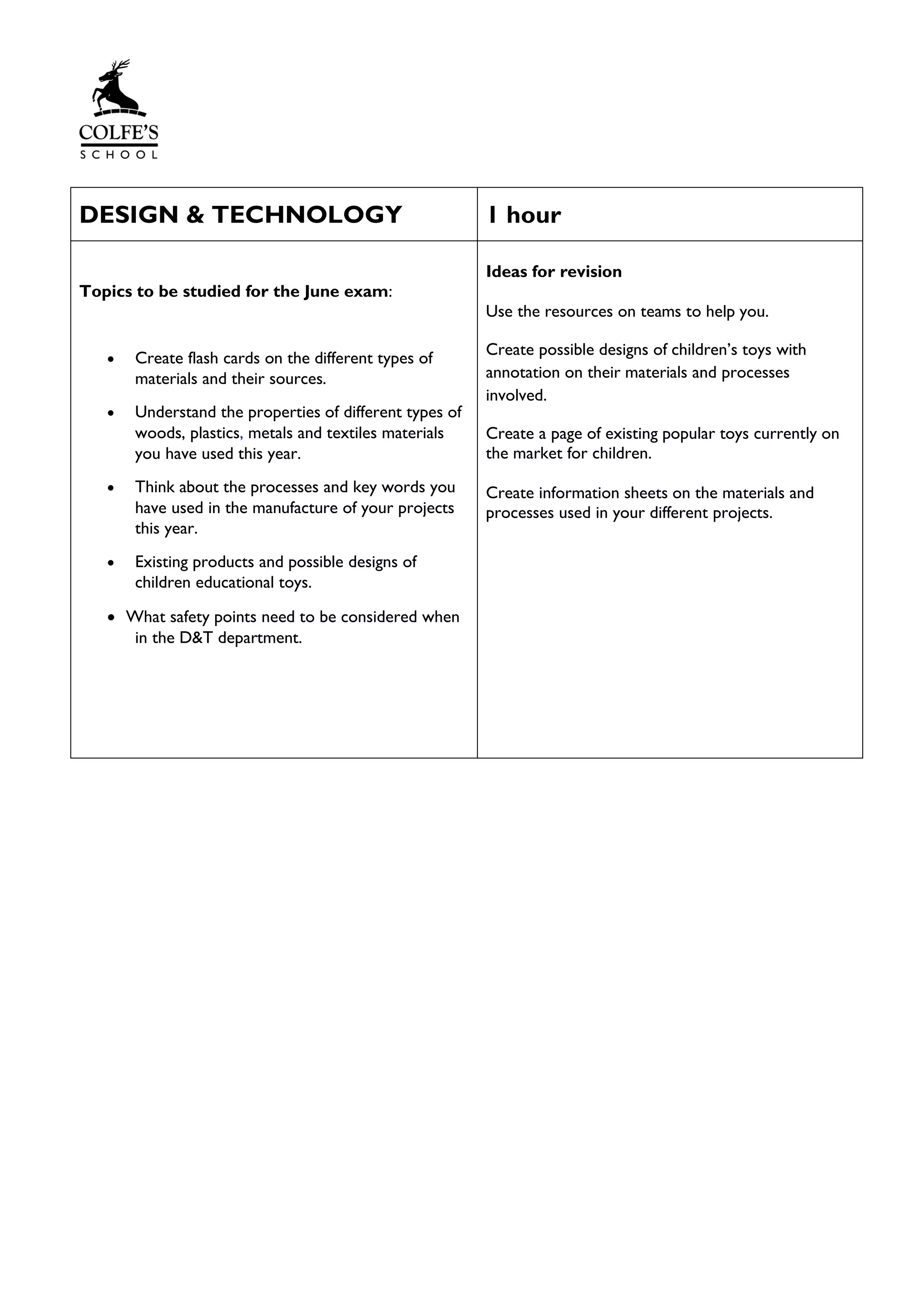
DESIGN & TECHNOLOGY 1 hour
Topics to be studied for the June exam:
• Create flash cards on the different types of
materials and their sources.
• Understand the properties of different types of
woods, plastics, metals and textiles materials
you have used this year.
• Think about the processes and key words you
have used in the manufacture of your projects
this year.
• Existing products and possible designs of
children educational toys.
• What safety points need to be considered when
in the D&T department.
Ideas for revision
Use the resources on teams to help you.
Create possible designs of children’s toys with
annotation on their materials and processes
involved.
Create a page of existing popular toys currently on
the market for children.
Create information sheets on the materials and
processes used in your different projects.
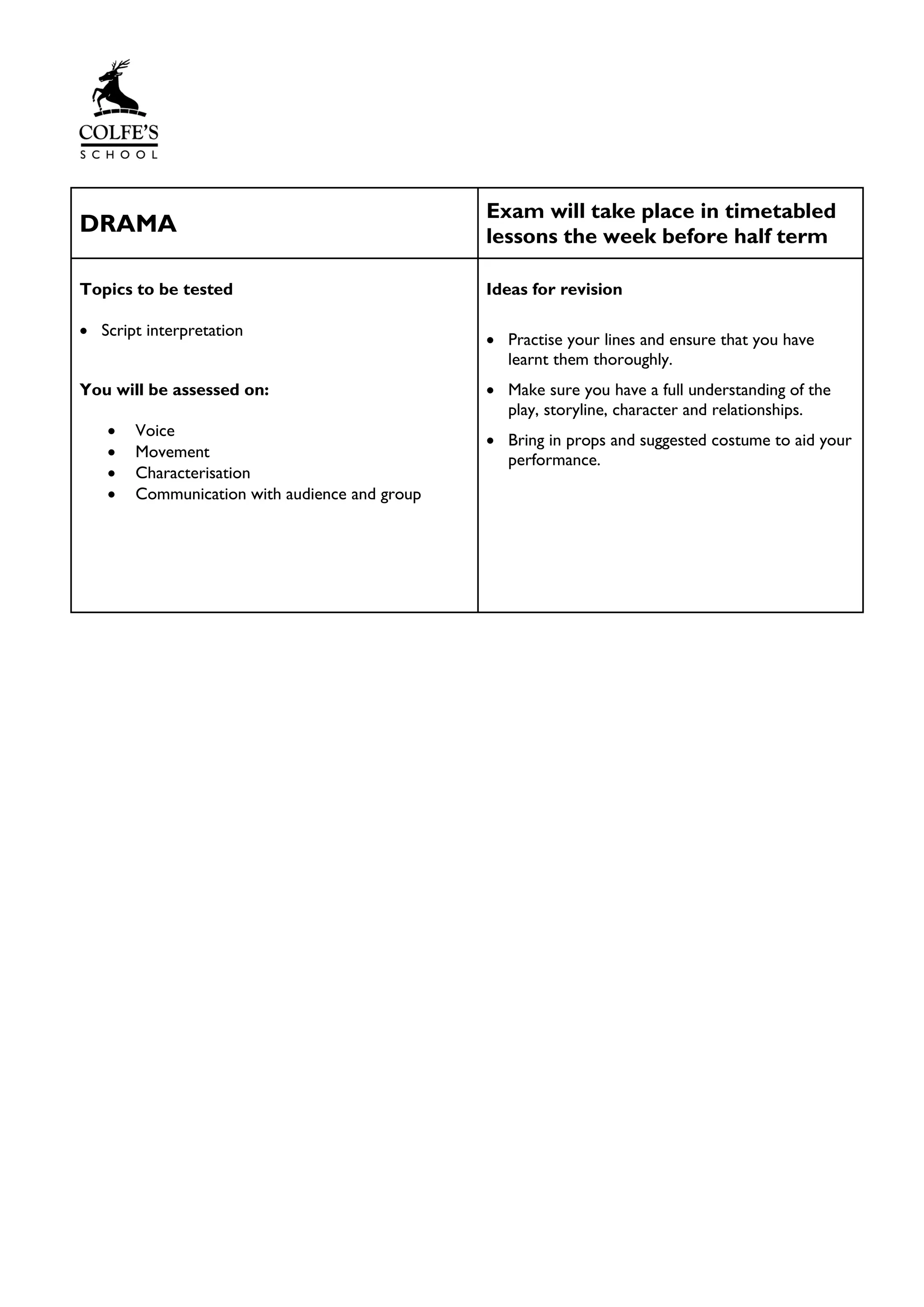
DRAMA
Exam will take place in timetabled
lessons the week before half term
Topics to be tested
• Script interpretation
You will be assessed on:
• Voice
• Movement
• Characterisation
• Communication with audience and group
Ideas for revision
• Practise your lines and ensure that you have
learnt them thoroughly.
• Make sure you have a full understanding of the
play, storyline, character and relationships.
• Bring in props and suggested costume to aid your
performance.
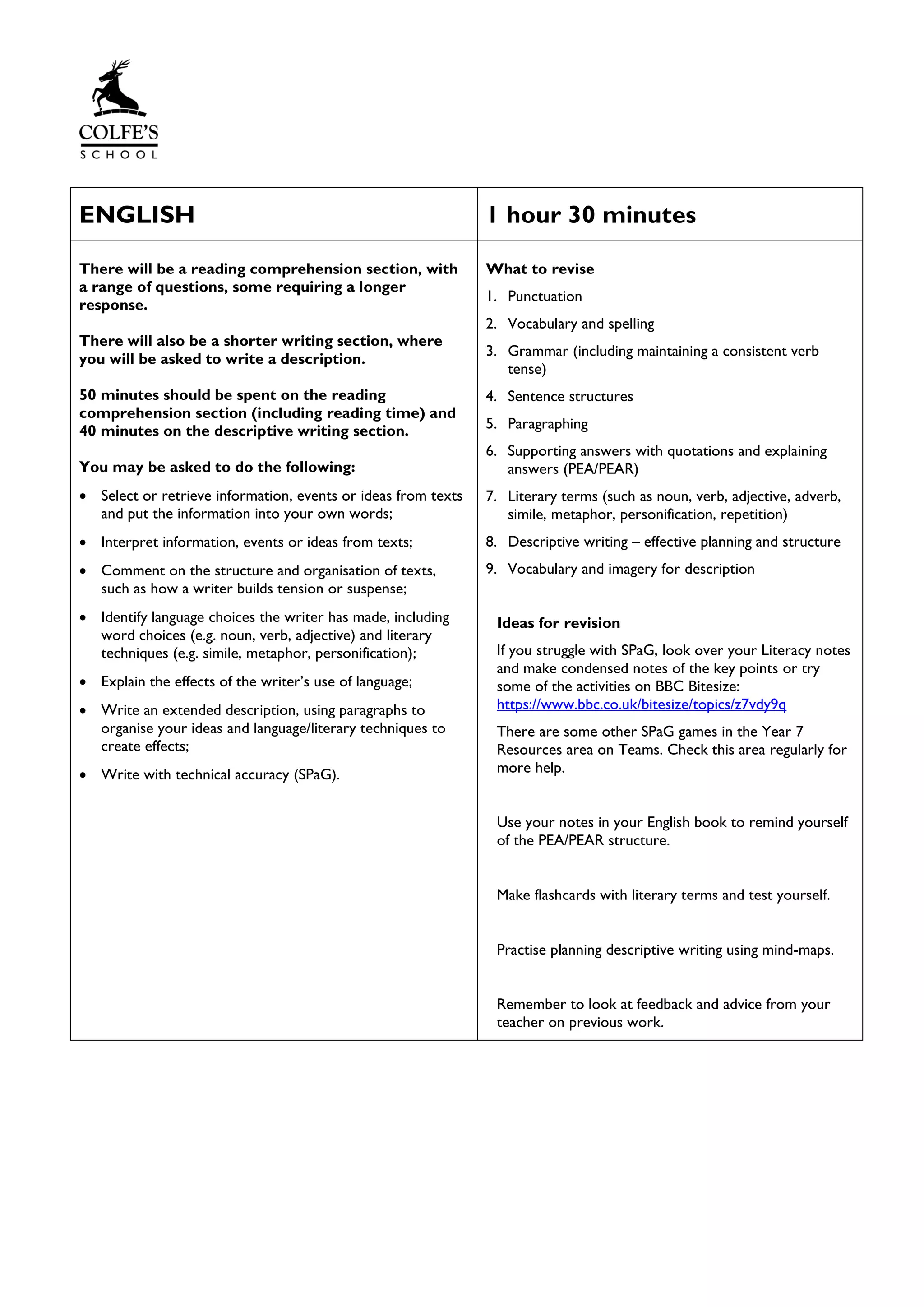
ENGLISH 1 hour 30 minutes
There will be a reading comprehension section, with
a range of questions, some requiring a longer
response.
There will also be a shorter writing section, where
you will be asked to write a description.
50 minutes should be spent on the reading
comprehension section (including reading time) and
40 minutes on the descriptive writing section.
You may be asked to do the following:
• Select or retrieve information, events or ideas from texts
and put the information into your own words;
• Interpret information, events or ideas from texts;
• Comment on the structure and organisation of texts,
such as how a writer builds tension or suspense;
• Identify language choices the writer has made, including
word choices (e.g. noun, verb, adjective) and literary
techniques (e.g. simile, metaphor, personification);
• Explain the effects of the writer’s use of language;
• Write an extended description, using paragraphs to
organise your ideas and language/literary techniques to
create effects;
• Write with technical accuracy (SPaG).
What to revise
1. Punctuation
2. Vocabulary and spelling
3. Grammar (including maintaining a consistent verb
tense)
4. Sentence structures
5. Paragraphing
6. Supporting answers with quotations and explaining
answers (PEA/PEAR)
7. Literary terms (such as noun, verb, adjective, adverb,
simile, metaphor, personification, repetition)
8. Descriptive writing – effective planning and structure
9. Vocabulary and imagery for description
Ideas for revision
If you struggle with SPaG, look over your Literacy notes
and make condensed notes of the key points or try
some of the activities on BBC Bitesize:
https://www.bbc.co.uk/bitesize/topics/z7vdy9q
There are some other SPaG games in the Year 7
Resources area on Teams. Check this area regularly for
more help.
Use your notes in your English book to remind yourself
of the PEA/PEAR structure.
Make flashcards with literary terms and test yourself.
Practise planning descriptive writing using mind-maps.
Remember to look at feedback and advice from your
teacher on previous work.
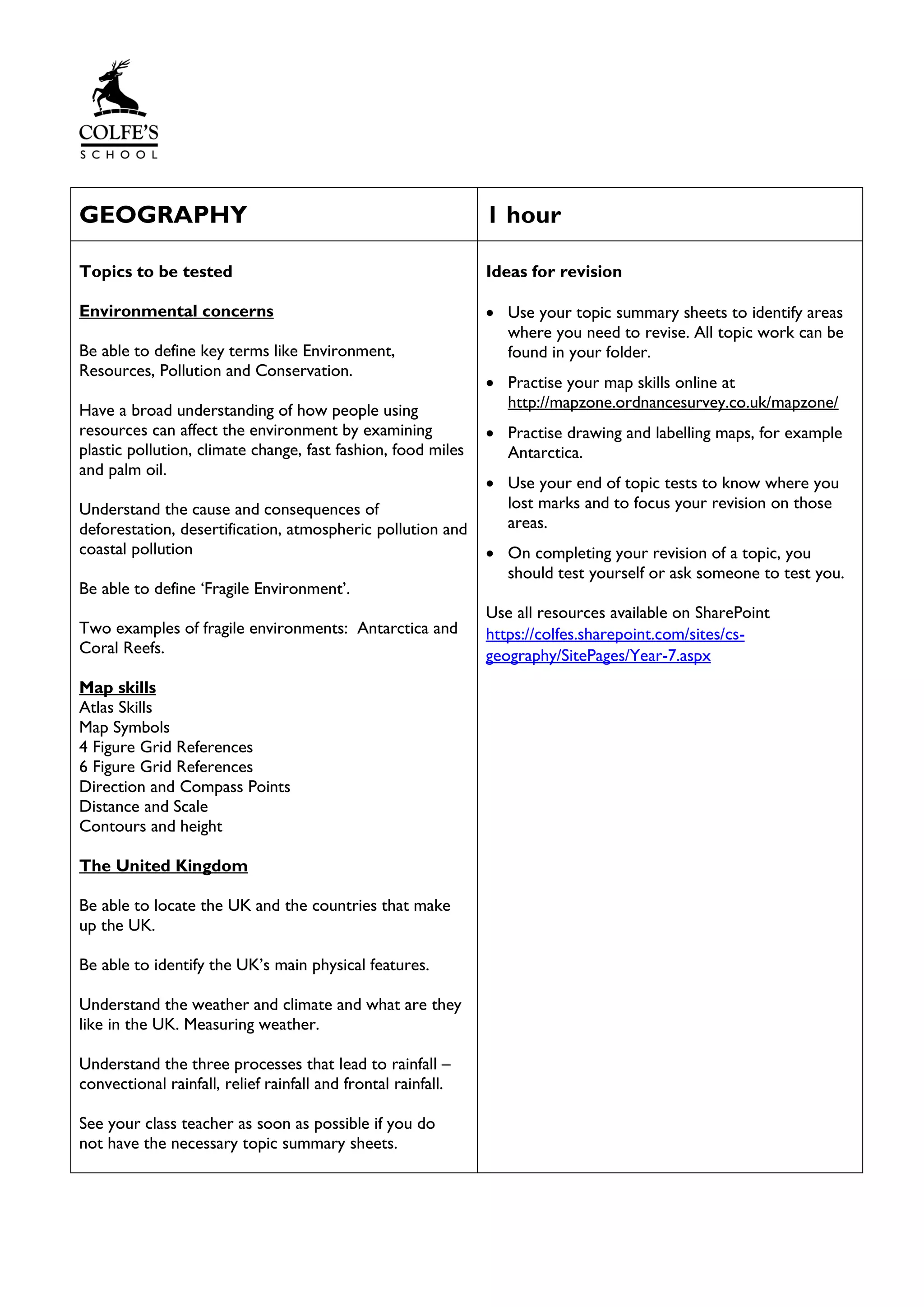
GEOGRAPHY 1 hour
Topics to be tested
Environmental concerns
Be able to define key terms like Environment,
Resources, Pollution and Conservation.
Have a broad understanding of how people using
resources can affect the environment by examining
plastic pollution, climate change, fast fashion, food miles
and palm oil.
Understand the cause and consequences of
deforestation, desertification, atmospheric pollution and
coastal pollution
Be able to define ‘Fragile Environment’.
Two examples of fragile environments: Antarctica and
Coral Reefs.
Map skills
Atlas Skills
Map Symbols
4 Figure Grid References
6 Figure Grid References
Direction and Compass Points
Distance and Scale
Contours and height
The United Kingdom
Be able to locate the UK and the countries that make
up the UK.
Be able to identify the UK’s main physical features.
Understand the weather and climate and what are they
like in the UK. Measuring weather.
Understand the three processes that lead to rainfall –
convectional rainfall, relief rainfall and frontal rainfall.
See your class teacher as soon as possible if you do
not have the necessary topic summary sheets.
Ideas for revision
• Use your topic summary sheets to identify areas
where you need to revise. All topic work can be
found in your folder.
• Practise your map skills online at
http://mapzone.ordnancesurvey.co.uk/mapzone/
• Practise drawing and labelling maps, for example
Antarctica.
• Use your end of topic tests to know where you
lost marks and to focus your revision on those
areas.
• On completing your revision of a topic, you
should test yourself or ask someone to test you.
Use all resources available on SharePoint
https://colfes.sharepoint.com/sites/cs-
geography/SitePages/Year-7.aspx
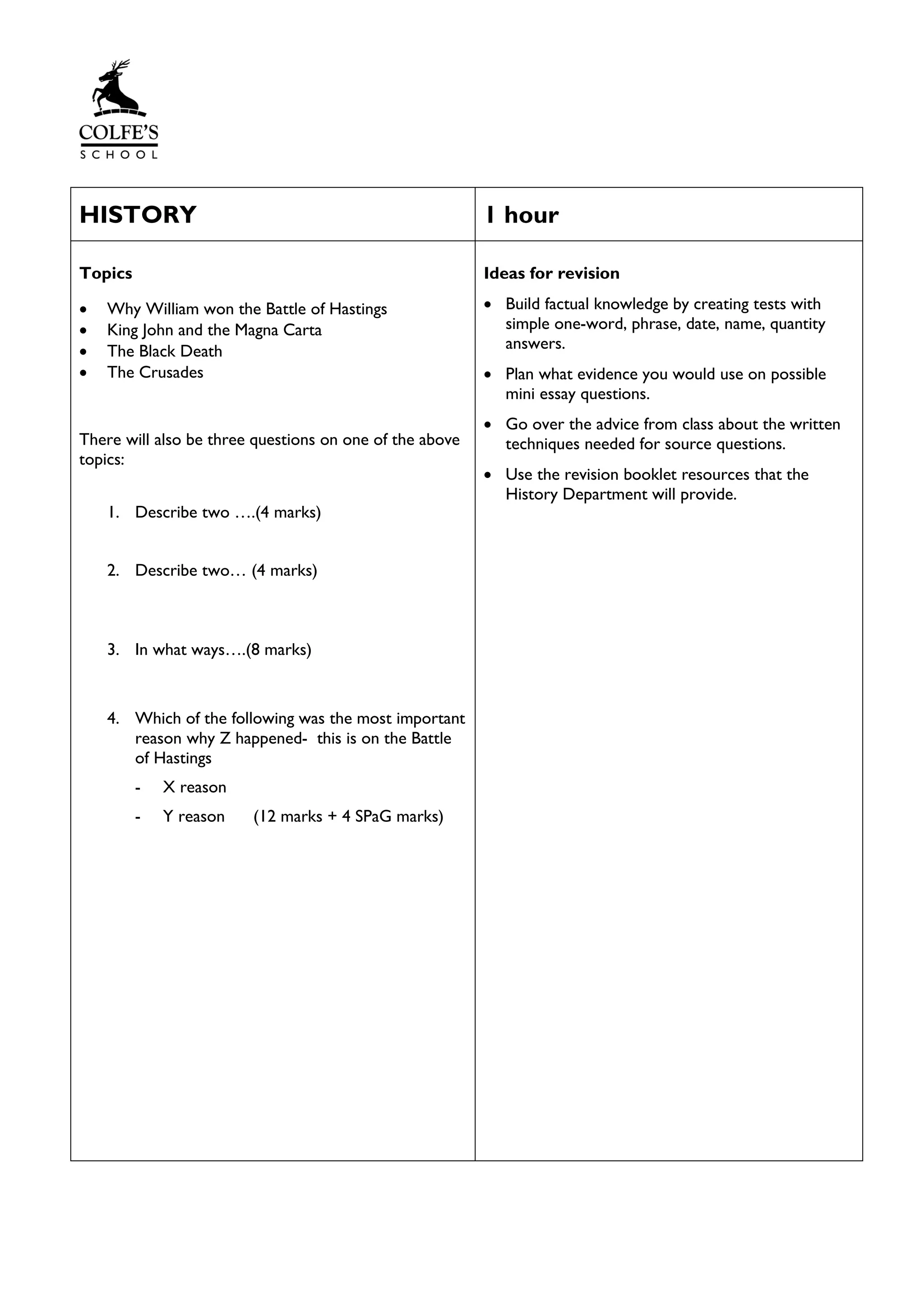
HISTORY 1 hour
Topics
• Why William won the Battle of Hastings
• King John and the Magna Carta
• The Black Death
• The Crusades
There will also be three questions on one of the above
topics:
1. Describe two ….(4 marks)
2. Describe two… (4 marks)
3. In what ways….(8 marks)
4. Which of the following was the most important
reason why Z happened- this is on the Battle
of Hastings
- X reason
- Y reason (12 marks + 4 SPaG marks)
Ideas for revision
• Build factual knowledge by creating tests with
simple one-word, phrase, date, name, quantity
answers.
• Plan what evidence you would use on possible
mini essay questions.
• Go over the advice from class about the written
techniques needed for source questions.
• Use the revision booklet resources that the
History Department will provide.
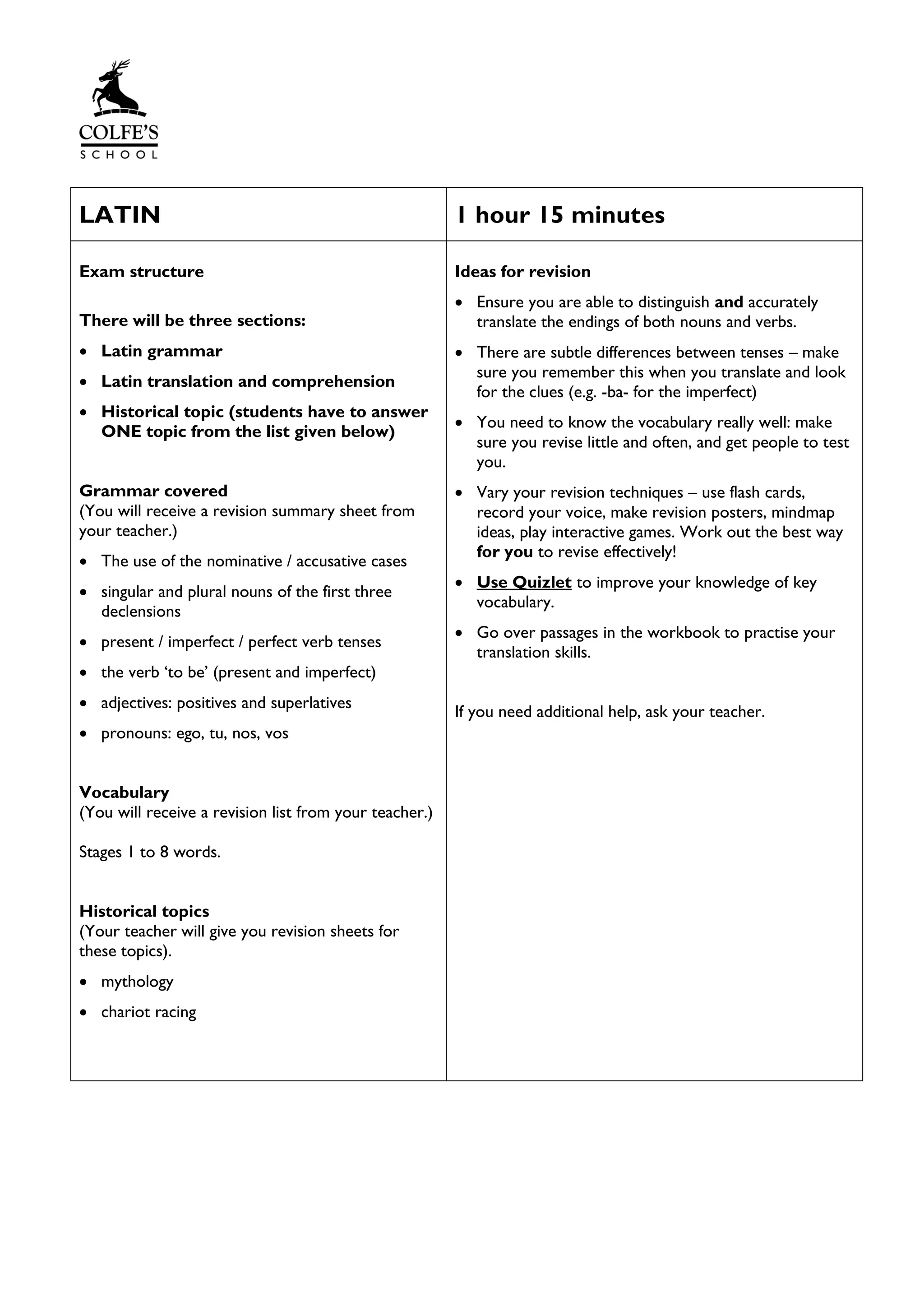
LATIN 1 hour 15 minutes
Exam structure
There will be three sections:
• Latin grammar
• Latin translation and comprehension
• Historical topic (students have to answer
ONE topic from the list given below)
Grammar covered
(You will receive a revision summary sheet from
your teacher.)
• The use of the nominative / accusative cases
• singular and plural nouns of the first three
declensions
• present / imperfect / perfect verb tenses
• the verb ‘to be’ (present and imperfect)
• adjectives: positives and superlatives
• pronouns: ego, tu, nos, vos
Vocabulary
(You will receive a revision list from your teacher.)
Stages 1 to 8 words.
Historical topics
(Your teacher will give you revision sheets for
these topics).
• mythology
• chariot racing
Ideas for revision
• Ensure you are able to distinguish and accurately
translate the endings of both nouns and verbs.
• There are subtle differences between tenses – make
sure you remember this when you translate and look
for the clues (e.g. -ba- for the imperfect)
• You need to know the vocabulary really well: make
sure you revise little and often, and get people to test
you.
• Vary your revision techniques – use flash cards,
record your voice, make revision posters, mindmap
ideas, play interactive games. Work out the best way
for you to revise effectively!
• Use Quizlet to improve your knowledge of key
vocabulary.
• Go over passages in the workbook to practise your
translation skills.
If you need additional help, ask your teacher.
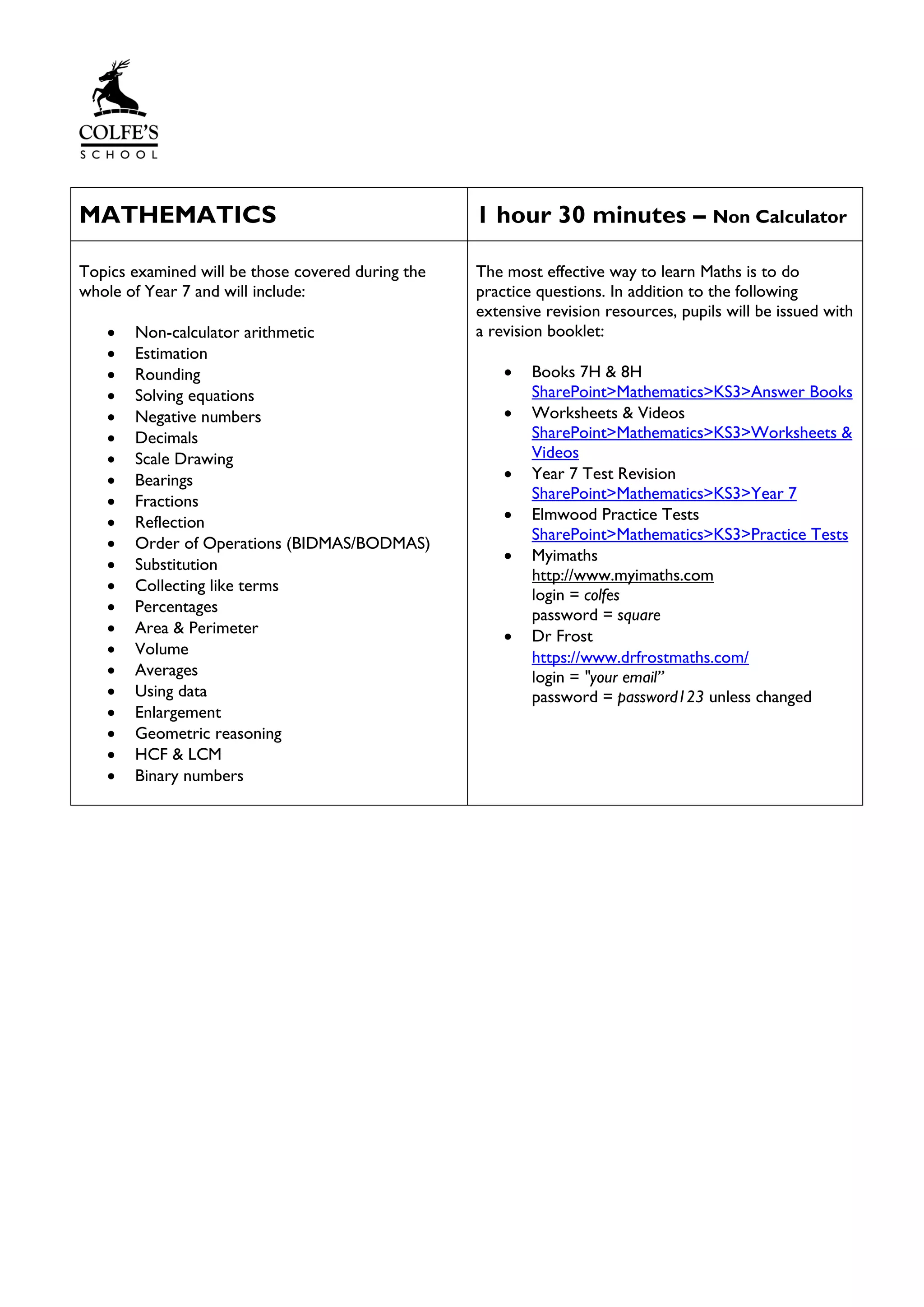
MATHEMATICS 1 hour 30 minutes – Non Calculator
Topics examined will be those covered during the
whole of Year 7 and will include:
• Non-calculator arithmetic
• Estimation
• Rounding
• Solving equations
• Negative numbers
• Decimals
• Scale Drawing
• Bearings
• Fractions
• Reflection
• Order of Operations (BIDMAS/BODMAS)
• Substitution
• Collecting like terms
• Percentages
• Area & Perimeter
• Volume
• Averages
• Using data
• Enlargement
• Geometric reasoning
• HCF & LCM
• Binary numbers
The most effective way to learn Maths is to do
practice questions. In addition to the following
extensive revision resources, pupils will be issued with
a revision booklet:
• Books 7H & 8H
SharePoint>Mathematics>KS3>Answer Books
• Worksheets & Videos
SharePoint>Mathematics>KS3>Worksheets &
Videos
• Year 7 Test Revision
SharePoint>Mathematics>KS3>Year 7
• Elmwood Practice Tests
SharePoint>Mathematics>KS3>Practice Tests
• Myimaths
http://www.myimaths.com
login = colfes
password = square
• Dr Frost
https://www.drfrostmaths.com/
login = "your email”
password = password123 unless changed
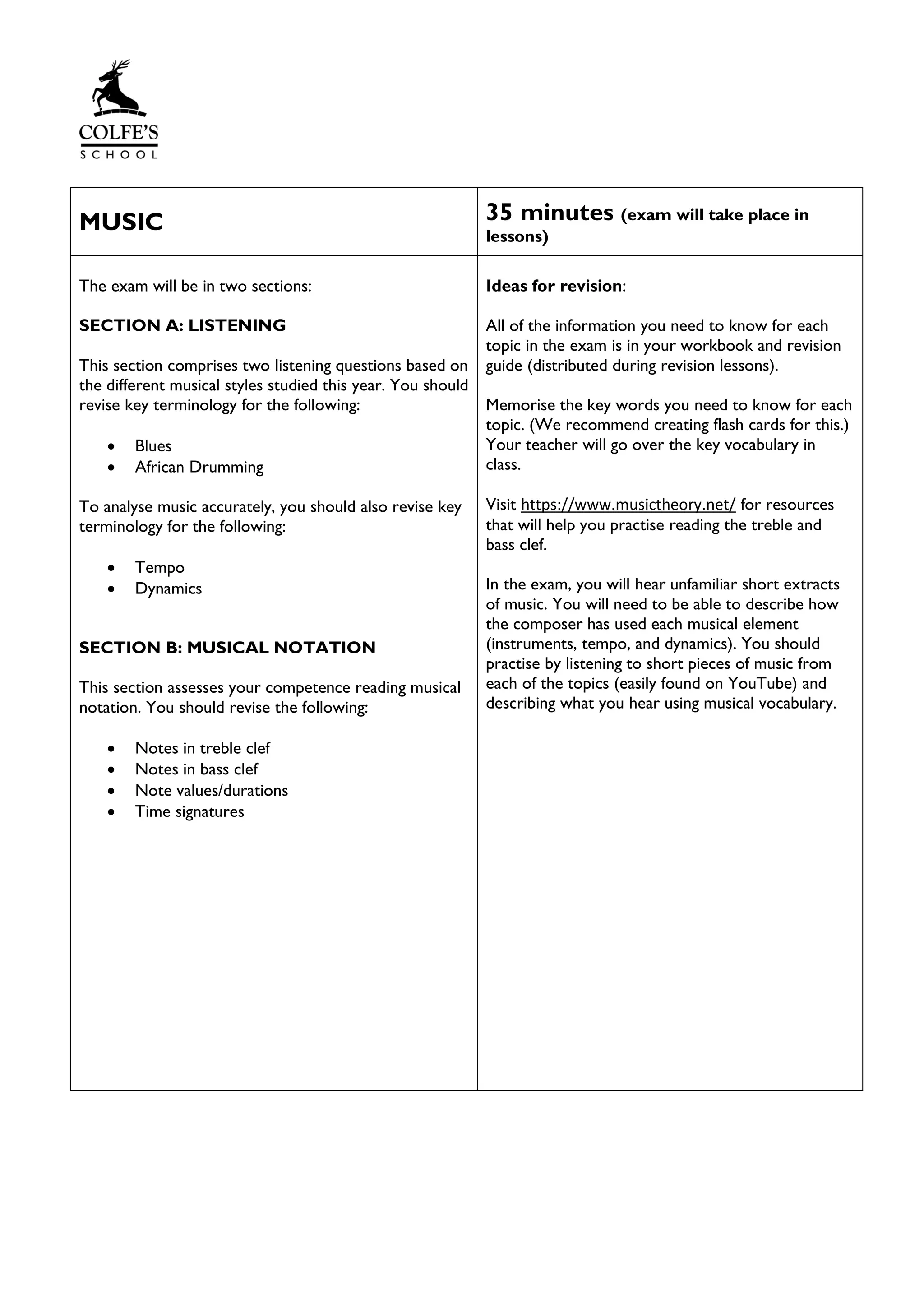
MUSIC 35 minutes (exam will take place in
lessons)
The exam will be in two sections:
SECTION A: LISTENING
This section comprises two listening questions based on
the different musical styles studied this year. You should
revise key terminology for the following:
• Blues
• African Drumming
To analyse music accurately, you should also revise key
terminology for the following:
• Tempo
• Dynamics
SECTION B: MUSICAL NOTATION
This section assesses your competence reading musical
notation. You should revise the following:
• Notes in treble clef
• Notes in bass clef
• Note values/durations
• Time signatures
Ideas for revision:
All of the information you need to know for each
topic in the exam is in your workbook and revision
guide (distributed during revision lessons).
Memorise the key words you need to know for each
topic. (We recommend creating flash cards for this.)
Your teacher will go over the key vocabulary in
class.
Visit https://www.musictheory.net/ for resources
that will help you practise reading the treble and
bass clef.
In the exam, you will hear unfamiliar short extracts
of music. You will need to be able to describe how
the composer has used each musical element
(instruments, tempo, and dynamics). You should
practise by listening to short pieces of music from
each of the topics (easily found on YouTube) and
describing what you hear using musical vocabulary.
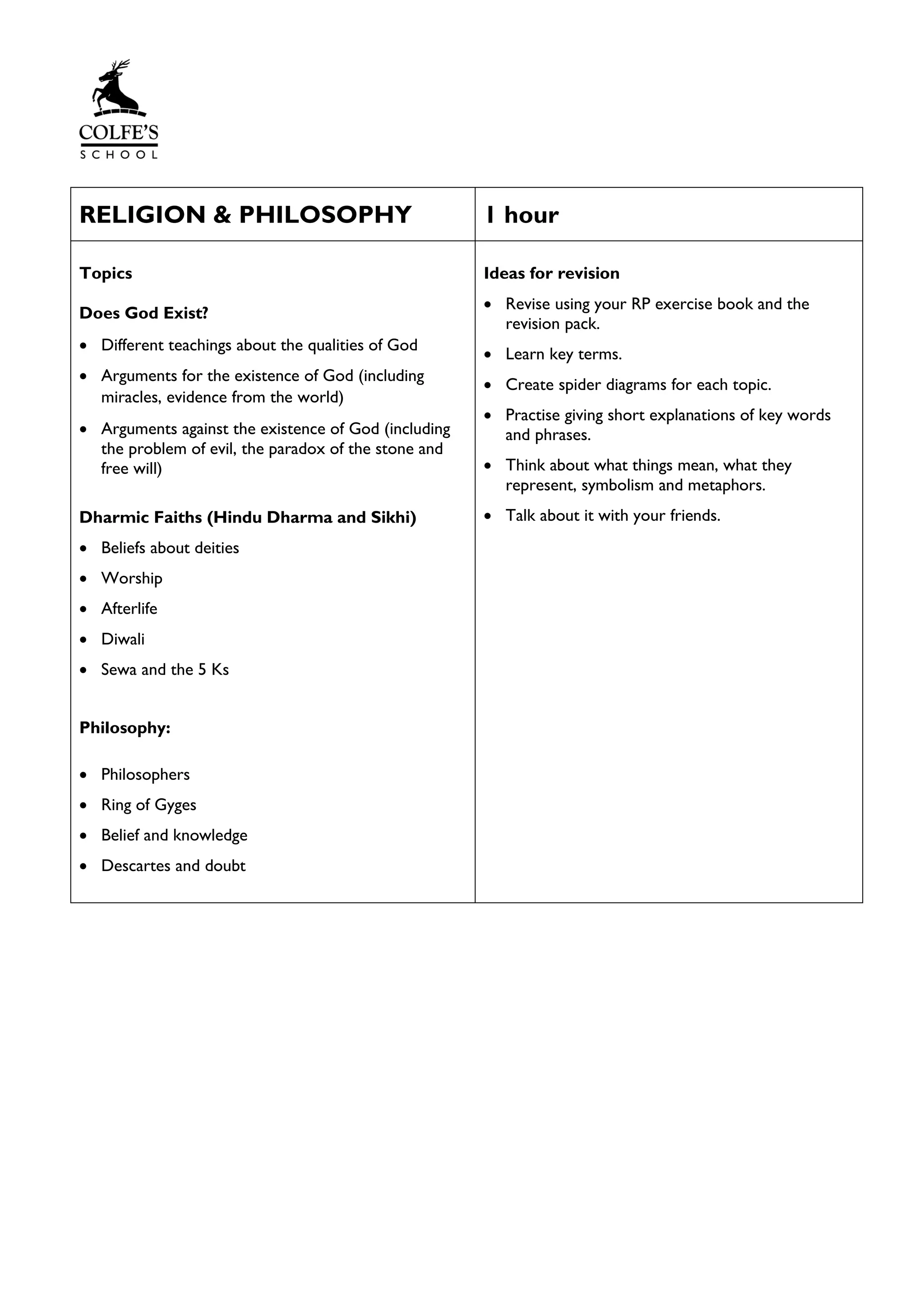
RELIGION & PHILOSOPHY 1 hour
Topics
Does God Exist?
• Different teachings about the qualities of God
• Arguments for the existence of God (including
miracles, evidence from the world)
• Arguments against the existence of God (including
the problem of evil, the paradox of the stone and
free will)
Dharmic Faiths (Hindu Dharma and Sikhi)
• Beliefs about deities
• Worship
• Afterlife
• Diwali
• Sewa and the 5 Ks
Philosophy:
• Philosophers
• Ring of Gyges
• Belief and knowledge
• Descartes and doubt
Ideas for revision
• Revise using your RP exercise book and the
revision pack.
• Learn key terms.
• Create spider diagrams for each topic.
• Practise giving short explanations of key words
and phrases.
• Think about what things mean, what they
represent, symbolism and metaphors.
• Talk about it with your friends.
SCIENCE 1 hour 30 Minutes
Topics
Scientific skills
• Scientific equipment
• Variables
• Planning experiments
• Recording and presenting data
• Analysing and explaining data
Biology
• Cells and microscopes
• Levels of organisation
• The skeleton and movement
• Variation
• Adaptations
• Adolescence
• Human reproduction
• Plant reproduction
Physics
• Forces
• Speed
• Distance-time graphs
• Gravity
• Sound waves
• Hearing
• Light waves
Chemistry
• Atoms, elements and compounds
• The particle model
• Changes of state
• The periodic table
• Chemical formulae
• Chemical reactions
• Acids and alkalis
• Reactions of metals and non-metals
Ideas for revision
1. Make notes on the most important points from your
summary revision sheets on each unit.
2. Use your CGP KS3 Science revision guide
3. Test yourself using the word lists; read a word, cover
the meaning column and try to remember the
explanation, look at the meaning column and check to
see if it is correct or not.
4. Practise drawing special diagrams, for example, nerve
cell or plant cell, etc.
5. Try questions again from your ‘old’ unit tests.
6. Remember that your online kerboodle textbook is a
useful resource for checking facts.
7. Resit educake tests online or set yourself extra
questions on topics you want to focus on.
8. Check TEAMS - for each topic, there is a revision
section where you will find a glossary, power points,
BBC Bitesize revision links and the answers for the
questions in your textbook.

Y7 End of Year exam revision guide 2023.pdf

  • 1.
  • 2.
    Tougher Minds: 12tips to boost revision success 1. Improve your sleep, diet and exercise every day to minimise stress and maximise learning. 2. Set your BIG goals, e.g. write down which grade you want to achieve in each subject. 3. Write a revision plan. 4. Use the 20:20 principle to boost learning. 5. Practice recalling information, and writing it down, or saying it out loud. Do not just read over your notes and highlight key words – you will need to know the information and understand it in your exam! 6. Repetition is essential for successful learning, so repeat to remember, and remember to repeat – R2R. Using exam-style questions to test yourself is the best way to use the R2R method. 7. It can be difficult to get started so start revising now, and stick to your plan. The more you learn, the more you will be motivated to keep it up. 8. Build your confidence by writing down what you have learned in each subject, and what is going well with your revision. 9. Reward yourself if you are genuinely working hard. 10. Make sure that you are at the correct Activation Level, otherwise you will not be able to learn anything! 11. Do not be afraid to experiment with your revision strategies. 12. Use a Performance Planner every day to build helpful revision habits.
  • 4.
    End-of-year Exam RevisionAdvice Preparing for effective revision Anyone can have goals but successful people have a plan. • Reflect Read the subject revision guides, highlighting each topic depending on your confidence levels as: o Pink – Learning o Yellow – Revising o Green – Extending • Plan Create a revision timetable. • Shop! Make sure that you have everything you need to revise: textbooks, notes, flashcards, paper, pens, highlighters, post-it notes. Doing effective revision • Be focused Set up a quiet area for your studying. Put electronic devices in a different room. Set a countdown timer for the length of your revision session and keep going until the timer goes off. Plan your breaks. • Be active Don’t just read through notes. See the next page for ideas on how to make revision active. • Be thorough If you find something that you don’t understand then do something about it – look it up, ask a friend, ask your teacher. Your teachers are here to help you, please use us! Maximising exam performance • Be calm It will help to be on time with all equipment ready, including a water bottle. • Be focused Good sleep, food and exercise will help with this. • Be aware Read all the instructions before you start. Keep an eye on the time and make sure that you answer all questions, particularly for essay subjects.
  • 5.
    Ideas for makingrevision active Notetaking Just copying out notes will not help you! Try these approaches to notetaking. 1) Create a table of notes Sub-topic Most important point 3 key things to remember 2) Make flashcards o Questions on one side and answers on the other o Key words on one side and definitions on the other o Sub-topic on one side and three most important points on the other 3) Use Post-it notes Write important points on post-it notes and stick them up on your wall. Self-testing Notes in the form of the three examples above can be used for self-testing: 1) Cover up one column and see if you can remember the contents. 2) Test yourself with the flashcards. Put the ones you get correct in one pile and the ones you get wrong in another pile. Keep going through the ‘wrong’ pile in the same way until it is empty. 3) Organise the notes in different ways such as ranking them from most to least important, chronologically or by grouping them into different categories. You will also self-test by re-doing previous topic tests or completing practice questions given to you by your teacher. This will only be effective if you complete these three stages: COMPLETE IN TEST CONDITIONS IMPROVE USING YOUR NOTES MARK AND CORRECT GOOD LUCK FOR YOUR EXAMS!
  • 6.
    Easter and Mayhalf term revision recommendations We recommend starting your revision in the Easter holiday by completing 1.5 hours of revision per subject. In term time after Easter set aside a little time each week to revise. Have specific times each week when you do this and focus this time on the subjects which need some extra revision. Then complete your revision by doing 1.5 hours per subject over the May half term break. This still leaves plenty of time to have a rest and to relax in both holidays and it is important to do this too! Recommendations • Follow your teachers’ advice and guidance about what and how to revise. • Avoid leaving all your work until near the end of the holiday. • Aim to get some revision done in the morning so that you can have guilt free time to relax in the afternoon. • Try to spread out your work so that you get to do two separate sessions on each subject at different points in each holiday. This is called spaced practice and it helps you to remember more material.
  • 7.
  • 8.
    A Guide toSummer Internal Examinations The following information provides you with all the details that you will need for your first set of summer internal examinations at Colfe’s School. Please read it carefully. EXAMINATION VENUES During internal examinations week you will be allocated an examination room. The table below shows the rooms that will be in use: EXAMINATION DAY/ TIMES Each examination day is split into three sessions, session 1: 08:55-10:40, session 2: 11:05-12:50 and session 3: 13:50-15:35, with break time and lunchtime being at the normal times. Registration will also take place as normal at 08:25 and 15:30. You must be in your allocated examination room at the start of each session. TIMETABLES Your examination timetable can be found in your year group team. Make sure you read and understand your examination timetable. It is your responsibility to know what examinations you have on each day. EXAMINATION ROOM BEHAVIOUR/CONDUCT Once you enter the examination room, you are expected to remain silent. You may have time before your examination to revise but this must be conducted in silence. While the examination is taking place, you must not communicate with any other students or ask out loud for anything. If you need any assistance, simply put up your hand and the teacher will come to you. TUTOR GROUP EXAMINATION ROOM 7A 107 7B 214 7C 108 7D 215 7E 216 7F 217 Extra Time Candidates 203 or R2 Computer Users T4
  • 9.
    STATIONERY/CALCULATORS You are responsiblefor bringing the right stationery/equipment to all of your examinations. You should write in black ink, with pencils only being used for diagrams and rough notes. Do not use tippex or erasable pens; simply cross through anything you do not want to be marked. Highlighter pens should not be used to write answers, and all of your stationery should be contained within a clear pencil case. You should have the following stationery: • Clear pencil case • Black pens • Pencils • Ruler • Rubber • Sharpener • Highlighters • Protractor • Pair of compasses • Colouring pencils • Calculator Calculators should be in good working order; please be prepared and bring your calculator to all examinations for which you might potentially need it. You will need to bring your Surface computer for your Computer Science exam on Wednesday 7 June. FOOD AND DRINK You may bring a small bottle of water, but no other type of drink is permitted. Food is not allowed into the examination room, unless you have a medical condition that requires it. CHEATING (MALPRACTICE) Cheating in an examination is a serious offence and will usually lead to you being given a zero for your examination. You will then be required to sit another examination during a Saturday detention. The following are all types of cheating in an examination: • Showing another student your examination paper • Asking another student for an answer • Having unauthorised material on you or your desk i.e. notes, mobile phones • Having subject material written on your body • Being in possession of a mobile phone, smartwatch, iPod, MP3/4 player, USB etc. (You should give these to the teacher at the start of the session.) Do not jeopardise all of your hard work during the year by cheating in an examination. ACCESS ARRANGEMENTS Students who are entitled to access arrangements such as extra time or a computer will sit their examinations in the extra time room of which Ms Coode will be in charge. If you have any queries about access arrangements during internal examination week, please speak to Ms Coode, Head of Learning Support, or contact her via email acoode@colfes.com.
  • 10.
    LATE ARRIVAL As usual,if you are going to be late for any reason, please contact the school on 020 8852 2283. Make your way to school as quickly as you can and try not to panic. When you arrive at school, sign in at Reception and then go straight to your registration room or examination room depending on the time. Whilst you will be allowed to sit the examination there is no guarantee that you will be allowed the full amount of time; this will depend on how late you arrive, so make sure you are on time for all of your examinations. SICKNESS/ABSENCE If you are unwell during internal examination week and are unable to attend school your parents must contact school in the usual way. Mr Snell will be in contact with you to arrange a time for you to catch up on the examination(s) that you have missed so please check your emails. Most catch up examinations will take place the week after internal examination week. TOILET BREAKS Toilet breaks are an interruption to both you and others in the examination room, so you should plan to go to the toilet before you enter the examination room. If you require a toilet break during your examination, you must raise your hand and ask the teacher. Only one student at a time will be permitted to go to the toilet during an examination. EMERGENCY EVACUATION In the event of the fire alarm sounding during an examination, it is essential that you listen to the instructions given by the invigilator. You will be informed to stop writing and the examination will be halted. Whilst evacuation takes place, you will still be under examination conditions, and you must not talk to any other students during this time. Once it is safe to return to the building the examination will resume. RESULTS Results will be given to you during lessons the week following internal examination week, and they will be included in your end-of-year report to your parents.
  • 11.
    Subjects to Revise Thefollowing tables give you a list of the topics in each subject to be revised for the exams, and some hints for your revision. You will also find details of the length of each exam. It is useful to tick each topic as you complete your learning and testing. There are end-of-year exams in the subjects listed below. COMPUTER SCIENCE 40 minutes Topics to be studied for the summer exam: • Pioneers of computing • Computer hardware • E-safety • CodeCombat (Python) • Micro:bits • Spreadsheets Ideas for revision: 1. Use your Class Notebook to read through all the lesson and homework resources. 2. Go through the key terms in each topic and re-watch any videos from the lessons. 3. Look at the questions, answers and feedback from previous assessments. For each topic, you should make some: Notes Flash Cards (you could use www.quizlet.com to make online flashcards). Mind maps You should be able to: • Identify the pioneers of computing • identify the hardware components of a computer • explain how to stay safe online • read/write simple lines of code (Python) • identify micro:bit components • predict the outcome of a micro:bit program in Make Code blocks • Identify the different parts of a spreadsheet • write spreadsheet formulae and functions • explain key computing terms in each topic
  • 12.
    DESIGN & TECHNOLOGY1 hour Topics to be studied for the June exam: • Create flash cards on the different types of materials and their sources. • Understand the properties of different types of woods, plastics, metals and textiles materials you have used this year. • Think about the processes and key words you have used in the manufacture of your projects this year. • Existing products and possible designs of children educational toys. • What safety points need to be considered when in the D&T department. Ideas for revision Use the resources on teams to help you. Create possible designs of children’s toys with annotation on their materials and processes involved. Create a page of existing popular toys currently on the market for children. Create information sheets on the materials and processes used in your different projects.
  • 13.
    DRAMA Exam will takeplace in timetabled lessons the week before half term Topics to be tested • Script interpretation You will be assessed on: • Voice • Movement • Characterisation • Communication with audience and group Ideas for revision • Practise your lines and ensure that you have learnt them thoroughly. • Make sure you have a full understanding of the play, storyline, character and relationships. • Bring in props and suggested costume to aid your performance.
  • 14.
    ENGLISH 1 hour30 minutes There will be a reading comprehension section, with a range of questions, some requiring a longer response. There will also be a shorter writing section, where you will be asked to write a description. 50 minutes should be spent on the reading comprehension section (including reading time) and 40 minutes on the descriptive writing section. You may be asked to do the following: • Select or retrieve information, events or ideas from texts and put the information into your own words; • Interpret information, events or ideas from texts; • Comment on the structure and organisation of texts, such as how a writer builds tension or suspense; • Identify language choices the writer has made, including word choices (e.g. noun, verb, adjective) and literary techniques (e.g. simile, metaphor, personification); • Explain the effects of the writer’s use of language; • Write an extended description, using paragraphs to organise your ideas and language/literary techniques to create effects; • Write with technical accuracy (SPaG). What to revise 1. Punctuation 2. Vocabulary and spelling 3. Grammar (including maintaining a consistent verb tense) 4. Sentence structures 5. Paragraphing 6. Supporting answers with quotations and explaining answers (PEA/PEAR) 7. Literary terms (such as noun, verb, adjective, adverb, simile, metaphor, personification, repetition) 8. Descriptive writing – effective planning and structure 9. Vocabulary and imagery for description Ideas for revision If you struggle with SPaG, look over your Literacy notes and make condensed notes of the key points or try some of the activities on BBC Bitesize: https://www.bbc.co.uk/bitesize/topics/z7vdy9q There are some other SPaG games in the Year 7 Resources area on Teams. Check this area regularly for more help. Use your notes in your English book to remind yourself of the PEA/PEAR structure. Make flashcards with literary terms and test yourself. Practise planning descriptive writing using mind-maps. Remember to look at feedback and advice from your teacher on previous work.
  • 15.
    GEOGRAPHY 1 hour Topicsto be tested Environmental concerns Be able to define key terms like Environment, Resources, Pollution and Conservation. Have a broad understanding of how people using resources can affect the environment by examining plastic pollution, climate change, fast fashion, food miles and palm oil. Understand the cause and consequences of deforestation, desertification, atmospheric pollution and coastal pollution Be able to define ‘Fragile Environment’. Two examples of fragile environments: Antarctica and Coral Reefs. Map skills Atlas Skills Map Symbols 4 Figure Grid References 6 Figure Grid References Direction and Compass Points Distance and Scale Contours and height The United Kingdom Be able to locate the UK and the countries that make up the UK. Be able to identify the UK’s main physical features. Understand the weather and climate and what are they like in the UK. Measuring weather. Understand the three processes that lead to rainfall – convectional rainfall, relief rainfall and frontal rainfall. See your class teacher as soon as possible if you do not have the necessary topic summary sheets. Ideas for revision • Use your topic summary sheets to identify areas where you need to revise. All topic work can be found in your folder. • Practise your map skills online at http://mapzone.ordnancesurvey.co.uk/mapzone/ • Practise drawing and labelling maps, for example Antarctica. • Use your end of topic tests to know where you lost marks and to focus your revision on those areas. • On completing your revision of a topic, you should test yourself or ask someone to test you. Use all resources available on SharePoint https://colfes.sharepoint.com/sites/cs- geography/SitePages/Year-7.aspx
  • 16.
    HISTORY 1 hour Topics •Why William won the Battle of Hastings • King John and the Magna Carta • The Black Death • The Crusades There will also be three questions on one of the above topics: 1. Describe two ….(4 marks) 2. Describe two… (4 marks) 3. In what ways….(8 marks) 4. Which of the following was the most important reason why Z happened- this is on the Battle of Hastings - X reason - Y reason (12 marks + 4 SPaG marks) Ideas for revision • Build factual knowledge by creating tests with simple one-word, phrase, date, name, quantity answers. • Plan what evidence you would use on possible mini essay questions. • Go over the advice from class about the written techniques needed for source questions. • Use the revision booklet resources that the History Department will provide.
  • 17.
    LATIN 1 hour15 minutes Exam structure There will be three sections: • Latin grammar • Latin translation and comprehension • Historical topic (students have to answer ONE topic from the list given below) Grammar covered (You will receive a revision summary sheet from your teacher.) • The use of the nominative / accusative cases • singular and plural nouns of the first three declensions • present / imperfect / perfect verb tenses • the verb ‘to be’ (present and imperfect) • adjectives: positives and superlatives • pronouns: ego, tu, nos, vos Vocabulary (You will receive a revision list from your teacher.) Stages 1 to 8 words. Historical topics (Your teacher will give you revision sheets for these topics). • mythology • chariot racing Ideas for revision • Ensure you are able to distinguish and accurately translate the endings of both nouns and verbs. • There are subtle differences between tenses – make sure you remember this when you translate and look for the clues (e.g. -ba- for the imperfect) • You need to know the vocabulary really well: make sure you revise little and often, and get people to test you. • Vary your revision techniques – use flash cards, record your voice, make revision posters, mindmap ideas, play interactive games. Work out the best way for you to revise effectively! • Use Quizlet to improve your knowledge of key vocabulary. • Go over passages in the workbook to practise your translation skills. If you need additional help, ask your teacher.
  • 18.
    MATHEMATICS 1 hour30 minutes – Non Calculator Topics examined will be those covered during the whole of Year 7 and will include: • Non-calculator arithmetic • Estimation • Rounding • Solving equations • Negative numbers • Decimals • Scale Drawing • Bearings • Fractions • Reflection • Order of Operations (BIDMAS/BODMAS) • Substitution • Collecting like terms • Percentages • Area & Perimeter • Volume • Averages • Using data • Enlargement • Geometric reasoning • HCF & LCM • Binary numbers The most effective way to learn Maths is to do practice questions. In addition to the following extensive revision resources, pupils will be issued with a revision booklet: • Books 7H & 8H SharePoint>Mathematics>KS3>Answer Books • Worksheets & Videos SharePoint>Mathematics>KS3>Worksheets & Videos • Year 7 Test Revision SharePoint>Mathematics>KS3>Year 7 • Elmwood Practice Tests SharePoint>Mathematics>KS3>Practice Tests • Myimaths http://www.myimaths.com login = colfes password = square • Dr Frost https://www.drfrostmaths.com/ login = "your email” password = password123 unless changed
  • 19.
    MUSIC 35 minutes(exam will take place in lessons) The exam will be in two sections: SECTION A: LISTENING This section comprises two listening questions based on the different musical styles studied this year. You should revise key terminology for the following: • Blues • African Drumming To analyse music accurately, you should also revise key terminology for the following: • Tempo • Dynamics SECTION B: MUSICAL NOTATION This section assesses your competence reading musical notation. You should revise the following: • Notes in treble clef • Notes in bass clef • Note values/durations • Time signatures Ideas for revision: All of the information you need to know for each topic in the exam is in your workbook and revision guide (distributed during revision lessons). Memorise the key words you need to know for each topic. (We recommend creating flash cards for this.) Your teacher will go over the key vocabulary in class. Visit https://www.musictheory.net/ for resources that will help you practise reading the treble and bass clef. In the exam, you will hear unfamiliar short extracts of music. You will need to be able to describe how the composer has used each musical element (instruments, tempo, and dynamics). You should practise by listening to short pieces of music from each of the topics (easily found on YouTube) and describing what you hear using musical vocabulary.
  • 20.
    RELIGION & PHILOSOPHY1 hour Topics Does God Exist? • Different teachings about the qualities of God • Arguments for the existence of God (including miracles, evidence from the world) • Arguments against the existence of God (including the problem of evil, the paradox of the stone and free will) Dharmic Faiths (Hindu Dharma and Sikhi) • Beliefs about deities • Worship • Afterlife • Diwali • Sewa and the 5 Ks Philosophy: • Philosophers • Ring of Gyges • Belief and knowledge • Descartes and doubt Ideas for revision • Revise using your RP exercise book and the revision pack. • Learn key terms. • Create spider diagrams for each topic. • Practise giving short explanations of key words and phrases. • Think about what things mean, what they represent, symbolism and metaphors. • Talk about it with your friends.
  • 21.
    SCIENCE 1 hour30 Minutes Topics Scientific skills • Scientific equipment • Variables • Planning experiments • Recording and presenting data • Analysing and explaining data Biology • Cells and microscopes • Levels of organisation • The skeleton and movement • Variation • Adaptations • Adolescence • Human reproduction • Plant reproduction Physics • Forces • Speed • Distance-time graphs • Gravity • Sound waves • Hearing • Light waves Chemistry • Atoms, elements and compounds • The particle model • Changes of state • The periodic table • Chemical formulae • Chemical reactions • Acids and alkalis • Reactions of metals and non-metals Ideas for revision 1. Make notes on the most important points from your summary revision sheets on each unit. 2. Use your CGP KS3 Science revision guide 3. Test yourself using the word lists; read a word, cover the meaning column and try to remember the explanation, look at the meaning column and check to see if it is correct or not. 4. Practise drawing special diagrams, for example, nerve cell or plant cell, etc. 5. Try questions again from your ‘old’ unit tests. 6. Remember that your online kerboodle textbook is a useful resource for checking facts. 7. Resit educake tests online or set yourself extra questions on topics you want to focus on. 8. Check TEAMS - for each topic, there is a revision section where you will find a glossary, power points, BBC Bitesize revision links and the answers for the questions in your textbook.