HOW TO STUDY
EFFECTIVELY
By the SSTC
Part 1

Setting Personal Goals
   Staying Focused
 Why Learn to Study?
   Now is the Time
Setting Goals
   Why set goals for your life?
     goals bring meaning to our lives
     goals give direction to our lives

     goals bring order to our lives
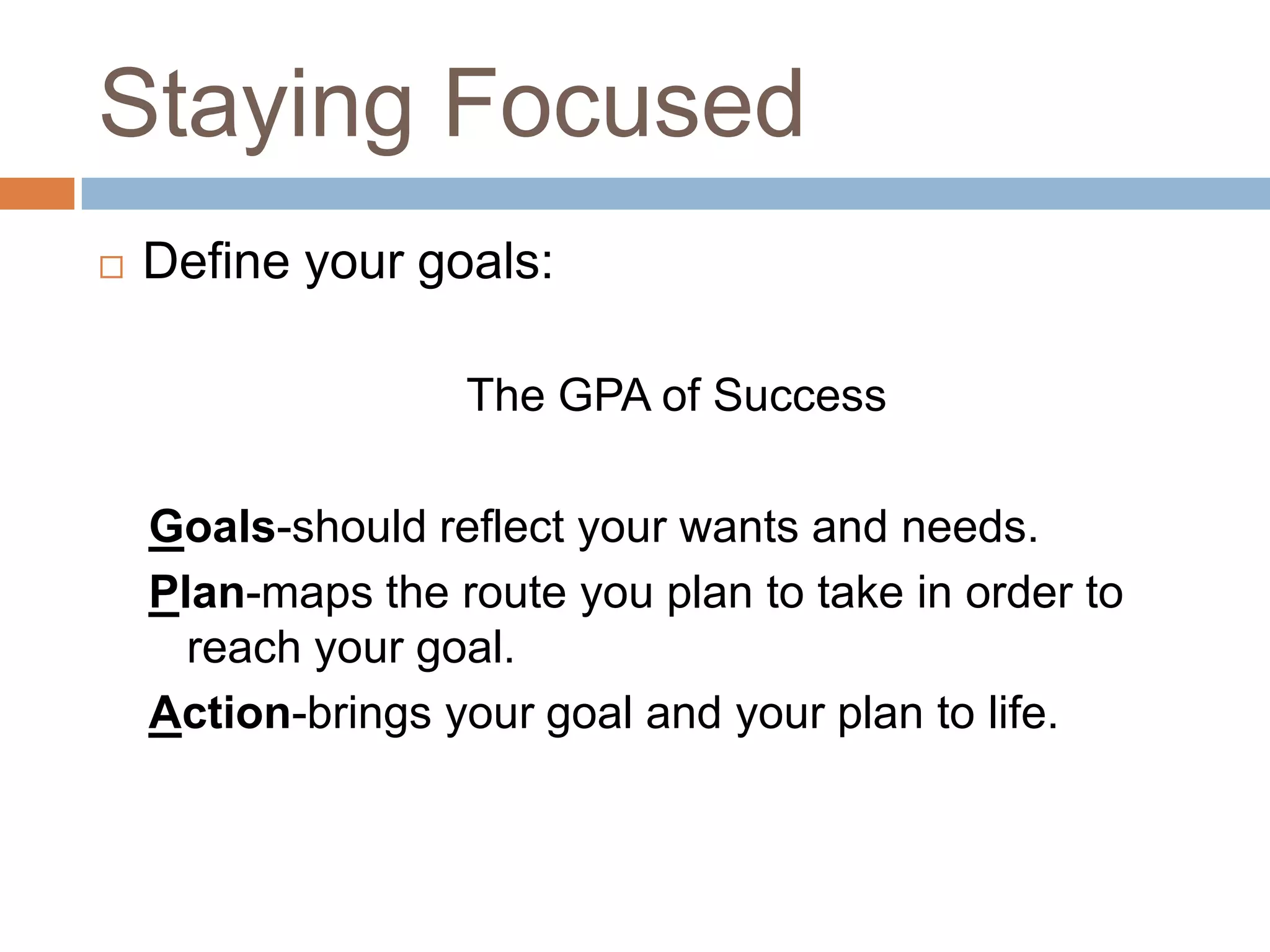
Staying Focused
   Define your goals:

                   The GPA of Success

    Goals-should reflect your wants and needs.
    Plan-maps the route you plan to take in order to
      reach your goal.
    Action-brings your goal and your plan to life.
What if the problem is that
I can’t concentrate?
   Clear your mind
   Focus
   Don’t worry
   Switch subjects frequently
   Do not get disturbed by other people/things
   Get enough sleep!
Now is the time!

   Setting a goal to obtain a college education, or
    to gain marketable skills will require learning
    how to study. The first goal for being
    successful in your academic journey and
    accomplishments is learning how to study
    effectively.
Why learn to study?
   Because tests are a part of life and taking tests will
    continue throughout your career

   Recertification tests are required in the medical and
    teaching professions, as well as for realtors and
    counselors

   Hairdressers, electricians, and plumbers must
    recertify themselves,

   Tests are required for many professions in obtaining
    higher salaries and more prominent positions within
    corporations and institutions
Part 2

Defining the Term
Study Environment
  Concentration
What is studying?
   The act of applying the mind so as to acquire
    knowledge or understanding as by
    reading, investigating, and examination of any
    subject or event

   An earnest effort of the mind or a state of
    mental absorption

   Application of mental faculties to the
    acquisition of knowledge
Your study environment.
   A study is a place to study, create your own
    study, make it a place you really want to spend
    time.

   Your study space should also be a place you
    can GET WORK DONE!
Concentration
   Warm up your brain by reviewing your notes and text
    reading assignment

   Summarizing what you have learned

   Decide what you will accomplish and how much time
    you spend on a particular subject

   Take a short break every 30-40 minutes

   If your mind resists or begins to wander, tell it to “be
    here now.”
Part 3

                    SQR3
   S-Survey

   Q-Questions

   R3-Read, Recite, Review
Survey
   Quickly preview the chapter and devise a plan
    for reading

   Note the chapter headings

   Notice any
    maps, charts, graphs, diagrams, pictures, etc.

   Pay attention to bold terms and vocabulary
Questions
   Discover if there are any discussion questions
    at the end of the chapter and keep them in
    mind while you are doing reading assignments

   Headings and vocabulary terms
R-3 Read

 Start reading. Seriously, start
 reading!
R-3 Recite
   Say out loud what you are learning

   Discuss what you are learning with friends and
    family

   Use a tape recorder to recite information and play
    it back to yourself

   Anything that can give you an auditory connection
    with the subject
R-3 Review
   Review your notes as many times as it takes
     until
          you can actually see the information in your
      mind
     hear the information in you head


   Re-read your notes right after class to make
    sure they make sense

   Review notes at least once a week to help
    enforce memory and retain concepts
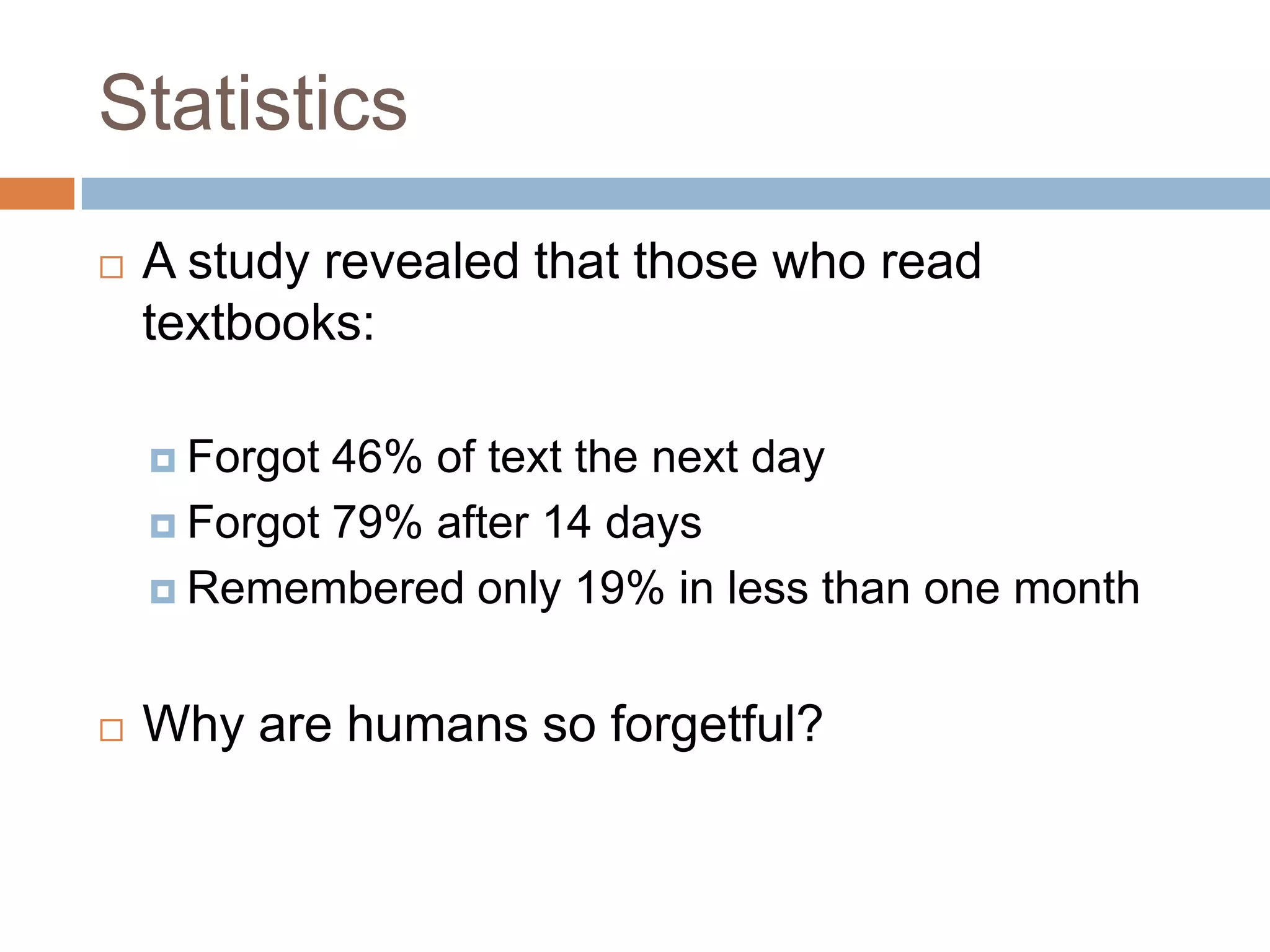
Statistics
   A study revealed that those who read
    textbooks:

     Forgot 46% of text the next day
     Forgot 79% after 14 days

     Remembered only 19% in less than one month


   Why are humans so forgetful?
Improving Your Memory
   Using mnemonic devices

     Acrostics

     Acronyms

     Methods     of loci
     Rhyming
Remember: More to college
success than just studying!
   Keep a good relationship with your professor

   Keep a good relationship with your classmates

   Keep dedicated to your class work and
    commitment to the class

   College life
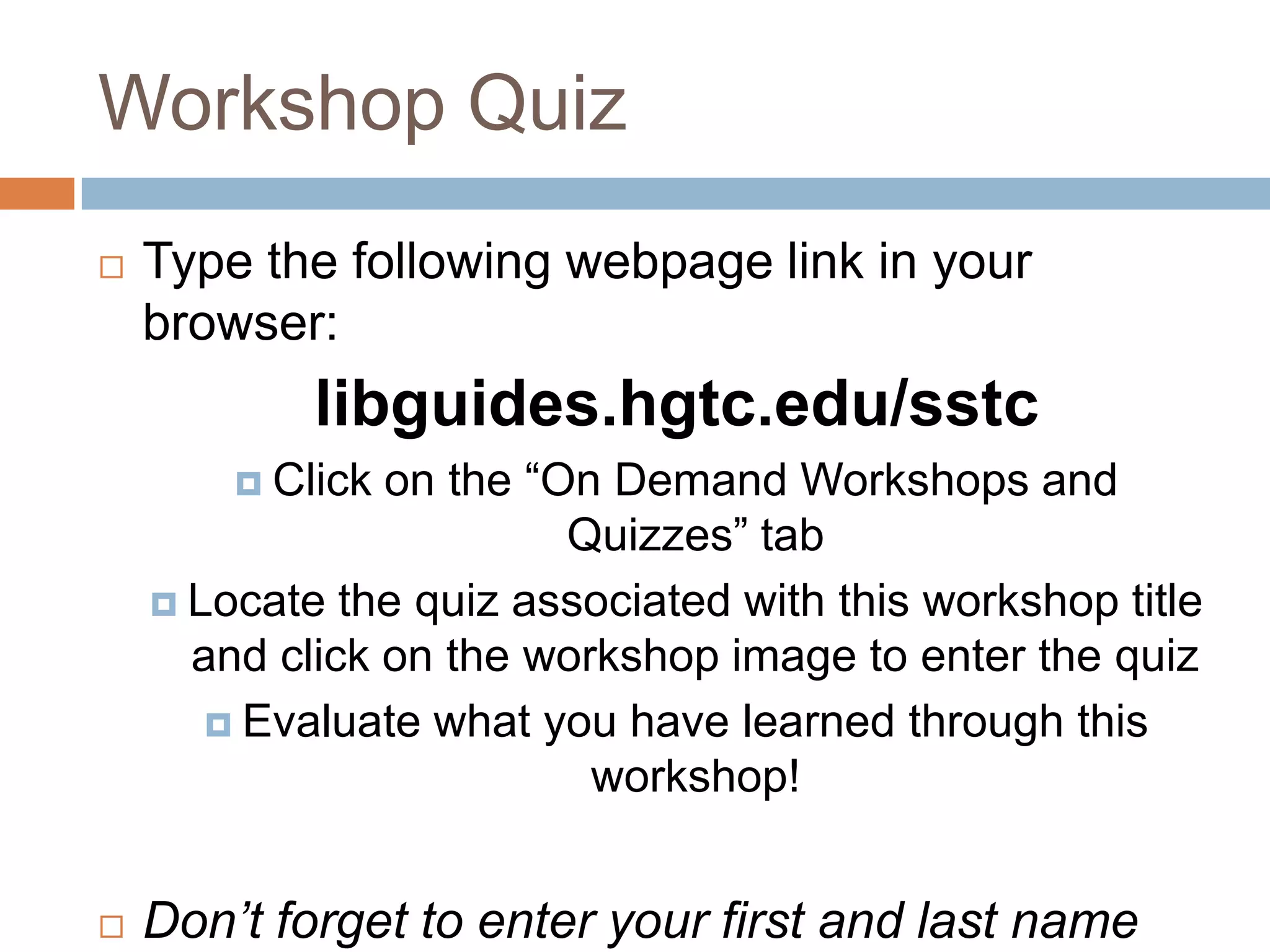
Workshop Quiz
   Type the following webpage link in your
    browser:
            libguides.hgtc.edu/sstc
         Click on the “On Demand Workshops and
                         Quizzes” tab
     Locate the quiz associated with this workshop title
      and click on the workshop image to enter the quiz
        Evaluate what you have learned through this
                          workshop!


   Don’t forget to enter your first and last name

How to Study Effectively Workshop

  • 1.
  • 2.
    Part 1 Setting PersonalGoals Staying Focused Why Learn to Study? Now is the Time
  • 3.
    Setting Goals  Why set goals for your life?  goals bring meaning to our lives  goals give direction to our lives  goals bring order to our lives
  • 4.
    Staying Focused  Define your goals: The GPA of Success Goals-should reflect your wants and needs. Plan-maps the route you plan to take in order to reach your goal. Action-brings your goal and your plan to life.
  • 5.
    What if theproblem is that I can’t concentrate?  Clear your mind  Focus  Don’t worry  Switch subjects frequently  Do not get disturbed by other people/things  Get enough sleep!
  • 6.
    Now is thetime!  Setting a goal to obtain a college education, or to gain marketable skills will require learning how to study. The first goal for being successful in your academic journey and accomplishments is learning how to study effectively.
  • 7.
    Why learn tostudy?  Because tests are a part of life and taking tests will continue throughout your career  Recertification tests are required in the medical and teaching professions, as well as for realtors and counselors  Hairdressers, electricians, and plumbers must recertify themselves,  Tests are required for many professions in obtaining higher salaries and more prominent positions within corporations and institutions
  • 8.
    Part 2 Defining theTerm Study Environment Concentration
  • 9.
    What is studying?  The act of applying the mind so as to acquire knowledge or understanding as by reading, investigating, and examination of any subject or event  An earnest effort of the mind or a state of mental absorption  Application of mental faculties to the acquisition of knowledge
  • 10.
    Your study environment.  A study is a place to study, create your own study, make it a place you really want to spend time.  Your study space should also be a place you can GET WORK DONE!
  • 11.
    Concentration  Warm up your brain by reviewing your notes and text reading assignment  Summarizing what you have learned  Decide what you will accomplish and how much time you spend on a particular subject  Take a short break every 30-40 minutes  If your mind resists or begins to wander, tell it to “be here now.”
  • 12.
    Part 3 SQR3  S-Survey  Q-Questions  R3-Read, Recite, Review
  • 13.
    Survey  Quickly preview the chapter and devise a plan for reading  Note the chapter headings  Notice any maps, charts, graphs, diagrams, pictures, etc.  Pay attention to bold terms and vocabulary
  • 14.
    Questions  Discover if there are any discussion questions at the end of the chapter and keep them in mind while you are doing reading assignments  Headings and vocabulary terms
  • 15.
    R-3 Read Startreading. Seriously, start reading!
  • 16.
    R-3 Recite  Say out loud what you are learning  Discuss what you are learning with friends and family  Use a tape recorder to recite information and play it back to yourself  Anything that can give you an auditory connection with the subject
  • 17.
    R-3 Review  Review your notes as many times as it takes  until you can actually see the information in your mind  hear the information in you head  Re-read your notes right after class to make sure they make sense  Review notes at least once a week to help enforce memory and retain concepts
  • 18.
    Statistics  A study revealed that those who read textbooks:  Forgot 46% of text the next day  Forgot 79% after 14 days  Remembered only 19% in less than one month  Why are humans so forgetful?
  • 19.
    Improving Your Memory  Using mnemonic devices  Acrostics  Acronyms  Methods of loci  Rhyming
  • 20.
    Remember: More tocollege success than just studying!  Keep a good relationship with your professor  Keep a good relationship with your classmates  Keep dedicated to your class work and commitment to the class  College life
  • 21.
    Workshop Quiz  Type the following webpage link in your browser: libguides.hgtc.edu/sstc  Click on the “On Demand Workshops and Quizzes” tab  Locate the quiz associated with this workshop title and click on the workshop image to enter the quiz  Evaluate what you have learned through this workshop!  Don’t forget to enter your first and last name

Editor's Notes

  • #2 This is a webinar on how to study effectively. It was created by the Student Success and technology center at Horry georgetown technical college.
  • #3 The first part of this webinar will focus on setting personal goals, staying focused, the purpose of studying, and acting now.
  • #4 Setting goals give us a reason to get up in the morning and goals motivate us to work hard. Setting goals help us learn patience, perseverance, and once achieved offer us great satisfaction.
  • #5 Start by defining your goals. We call this the GPA of Success.Goals-should reflect your wants and needs. Make it large and ambitious without being vague. Write it down.Plan-maps the route you plan to take in order to reach your goal. It should be efficient and specific. Good advice and personal experience combine to create most effective plans.Action-brings your goal and your plan to life. Requires confidence, self-discipline, and a power over procrastination.
  • #6 If you can’t concentrate, try to start byClear your mind – jot down a ‘to-do’ listFocus – tell yourself that you will study hard right now for this test, and later is time to daydreamDon’t worry – set any personal problems aside that you are experiencingSwitch subjects frequently- this will keep yourself interested in what you are studyingDo not get disturbed by other people/things- make sure it is known you are studying: this will create less interruptions. Get enough sleep! At least 8 hours a night- or what you are studying won’t stick!
  • #7 Now is the time! Don’t wait to set your goals.
  • #9 In part 2 we are going to discuss what it means to study, what study environments offer the most success, and methods of concentration
  • #10 The New World Dictionary of the American language and Webster’s Collegiate Dictionary defines studying and gives us an idea of how dynamic the exercise of studying can be. Studying requires physical and mental exertion. It is not a passive state of mind.
  • #11 Find a place where you will not be tempted to fall asleepA large flat surface provides a place where you can organize your books, computer, notebooks, etc.A comfortable chair, but not too comfortableGood lighting and clock Eliminate all devices that are distractions: cell phones, ipods, make sure you are not available online for IM, turn off the TV
  • #12 Creating a study area where you can study will help you to be able to concentrate for sustained periods of time. When you arrive at your “study” to study, practice these warm ups.
  • #13 A proven step-by-step process for studying involves surveying the material as a whole, asking and discovering new questions about the material, and finally reading, reciting and reviewing said materials.
  • #14 When beginning a topic or chapter in your text: Quickly preview the chapter and devise a plan for reading Note the chapter headingsNotice any maps, charts, graphs, diagrams, pictures, etc.Pay attention to bold terms and vocabulary
  • #15 Discover if there are any discussion questions at the end of the chapter and keep them in mind while you are doing reading assignmentsYou can turn the headings, vocabulary terms and other information into questions. Often, this is where your professor may get questions for quizzes and tests.
  • #16 Time to start reading!Read with a pen in your hand for underlining and making comments in the margins, this practice maintains concentration, or use a highlighter for isolating parts of the text that you feel are important.
  • #18 Review your notes as many times as it takesuntil you can actually see the information in your mind hear the information in you headAsk yourself: have those initial questions about the chapter been answered? If not, you should probably review the chapter again.
  • #19 This may be because textbooks are not as interesting reading as other types of print. Statistics are even more discouraging when one is listening.
  • #20 You can also:Be selective – remember key factsRepeat out loud what you need to rememberIntend to remember – same way a waiter decides to remember your order Like what you learn – details are then easier to rememberFind meaning in the information you study
  • #21 Keep a good relationship with your professorLearn from him or herLet him or her help you learn easierKeep a good relationship with your classmatesSet up study groups, if possibleReinforce ideas and concepts in class Keep dedicated to your class work and commitment to the class College lifeGet involved! Be active in all areas of your lifeGet a well-rounded education