BY: PURBASA MAITI
MSc MICROBIOLOGY
DEFINITION
PRINCIPLE
TYPES OF CENTRIFUGE
DIFFERENTIAL
CENTRIFUGATION
DENSITY GRADIENT
CENTRIFUGATION
DEFINITION
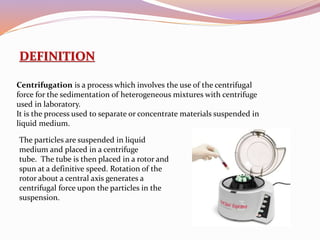
Centrifugation is a process which involves the use of the centrifugal
force for the sedimentation of heterogeneous mixtures with centrifuge
used in laboratory.
It is the process used to separate or concentrate materials suspended in
liquid medium.
The particles are suspended in liquid
medium and placed in a centrifuge
tube. The tube is then placed in a rotor and
spun at a definitive speed. Rotation of the
rotor about a central axis generates a
centrifugal force upon the particles in the
suspension.
PRINCIPLE
If the particle size in dispersion is 5 micro meter or less then they undergo Brownian motion
hence don't sediment under gravity. Therefore a stronger force , centrifugal force is applied
to separate the suspended particles.
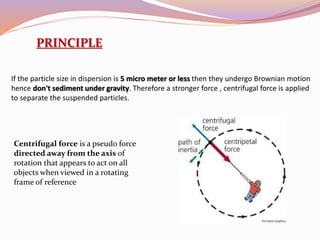
Centrifugal force is a pseudo force
directed away from the axis of
rotation that appears to act on all
objects when viewed in a rotating
frame of reference..
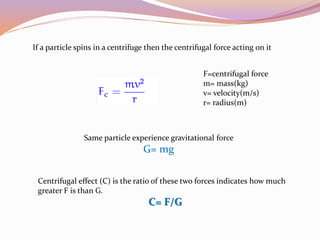
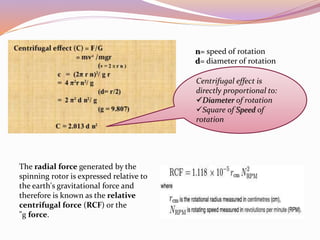
If a particle spins in a centrifuge then the centrifugal force acting on it
F=centrifugal force
m= mass(kg)
v= velocity(m/s)
r= radius(m)
Same particle experience gravitational force
G= mg
Centrifugal effect (C) is the ratio of these two forces indicates how much
greater F is than G.
C= F/G
n= speed of rotation
d= diameter of rotation
Centrifugal effect is
directly proportional to:
Diameter of rotation
Square of Speed of
rotation
The radial force generated by the
spinning rotor is expressed relative to
the earth's gravitational force and
therefore is known as the relative
centrifugal force (RCF) or the
"g force.
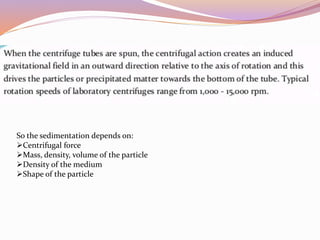
So the sedimentation depends on:
Centrifugal force
Mass, density, volume of the particle
Density of the medium
Shape of the particle
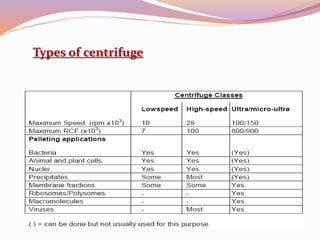
Types of centrifuge
Differential centrifugation
Differential centrifugation is a
common procedure in microbiology
and cytology used to separate
certain organelles from whole cells .
In the process, a tissue sample is
first lysed to break the cell membranes and
mix up the cell contents.
The homogenate is then subjected to
repeated centrifugations, each time
removing the pallet and increasing the
centrifugal force.
Separation is achieved based on the size
of the particle: larger particle will sediment
first.
LIMITATION
The centrifugal force necessary to pellet the larger particles
from the top of the solution is also often sufficient to pallet
the smaller particles near the bottom of the tube.
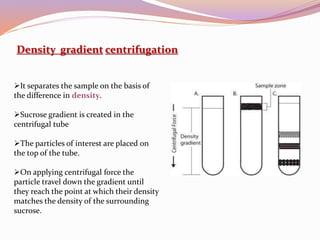
Density gradient centrifugation
It separates the sample on the basis of
the difference in density.
Sucrose gradient is created in the
centrifugal tube
The particles of interest are placed on
the top of the tube.
On applying centrifugal force the
particle travel down the gradient until
they reach the point at which their density
matches the density of the surrounding
sucrose.

Centrifugation

  • 1.
  • 2.
  • 3.
    DEFINITION Centrifugation is aprocess which involves the use of the centrifugal force for the sedimentation of heterogeneous mixtures with centrifuge used in laboratory. It is the process used to separate or concentrate materials suspended in liquid medium. The particles are suspended in liquid medium and placed in a centrifuge tube. The tube is then placed in a rotor and spun at a definitive speed. Rotation of the rotor about a central axis generates a centrifugal force upon the particles in the suspension.
  • 4.
    PRINCIPLE If the particlesize in dispersion is 5 micro meter or less then they undergo Brownian motion hence don't sediment under gravity. Therefore a stronger force , centrifugal force is applied to separate the suspended particles. Centrifugal force is a pseudo force directed away from the axis of rotation that appears to act on all objects when viewed in a rotating frame of reference..
  • 5.
    If a particlespins in a centrifuge then the centrifugal force acting on it F=centrifugal force m= mass(kg) v= velocity(m/s) r= radius(m) Same particle experience gravitational force G= mg Centrifugal effect (C) is the ratio of these two forces indicates how much greater F is than G. C= F/G
  • 6.
    n= speed ofrotation d= diameter of rotation Centrifugal effect is directly proportional to: Diameter of rotation Square of Speed of rotation The radial force generated by the spinning rotor is expressed relative to the earth's gravitational force and therefore is known as the relative centrifugal force (RCF) or the "g force.
  • 7.
    So the sedimentationdepends on: Centrifugal force Mass, density, volume of the particle Density of the medium Shape of the particle
  • 8.
  • 9.
    Differential centrifugation Differential centrifugationis a common procedure in microbiology and cytology used to separate certain organelles from whole cells . In the process, a tissue sample is first lysed to break the cell membranes and mix up the cell contents. The homogenate is then subjected to repeated centrifugations, each time removing the pallet and increasing the centrifugal force. Separation is achieved based on the size of the particle: larger particle will sediment first.
  • 10.
    LIMITATION The centrifugal forcenecessary to pellet the larger particles from the top of the solution is also often sufficient to pallet the smaller particles near the bottom of the tube.
  • 11.
    Density gradient centrifugation Itseparates the sample on the basis of the difference in density. Sucrose gradient is created in the centrifugal tube The particles of interest are placed on the top of the tube. On applying centrifugal force the particle travel down the gradient until they reach the point at which their density matches the density of the surrounding sucrose.