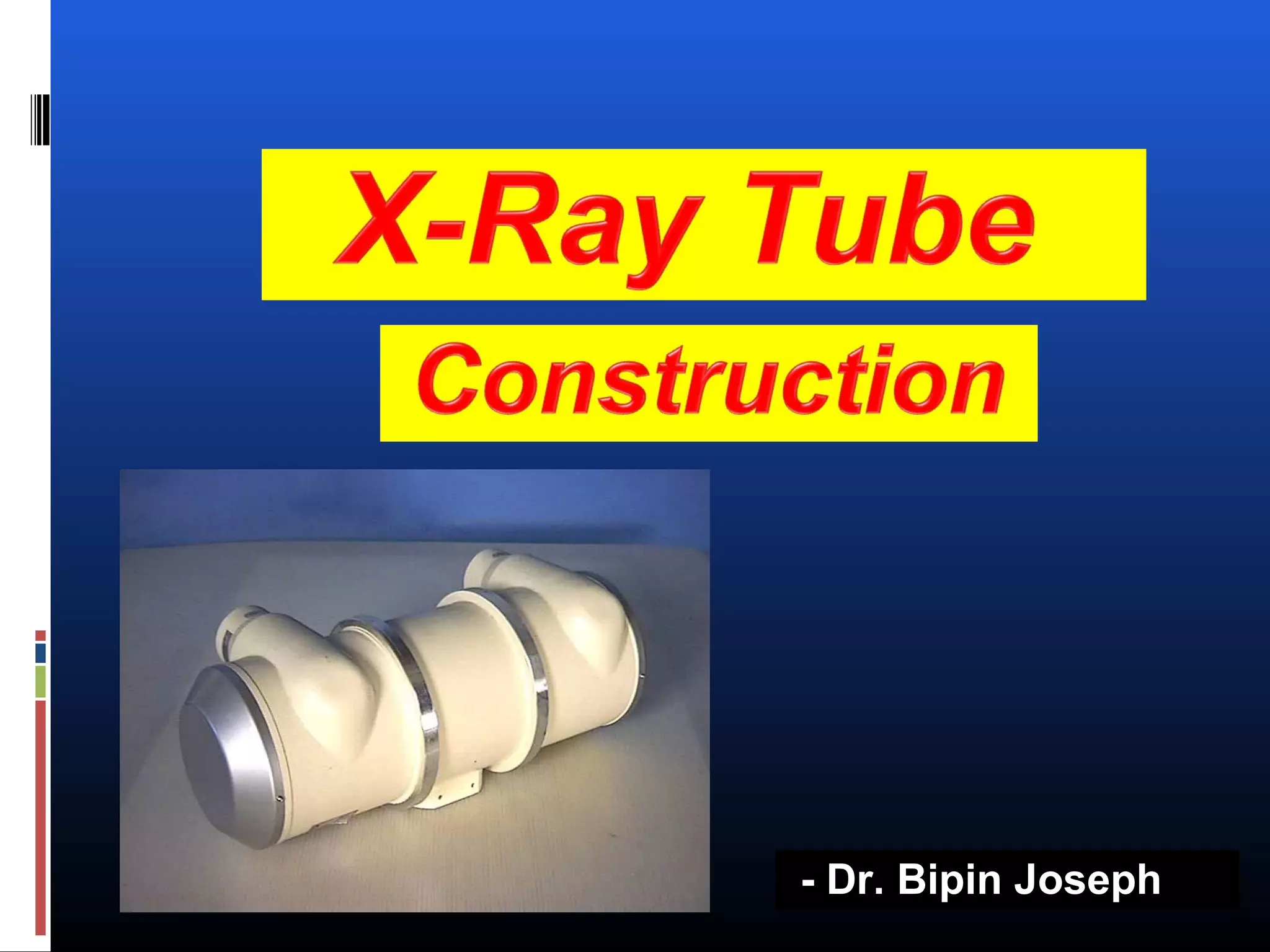
- Dr. Bipin Joseph
The X-Ray Tube
Development
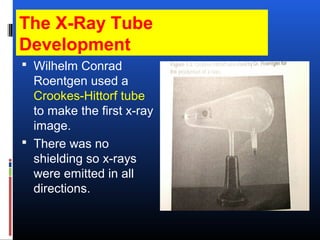
 Wilhelm Conrad
Roentgen used a
Crookes-Hittorf tube
to make the first x-ray
image.
 There was no
shielding so x-rays
were emitted in all
directions.
The X-Ray Tube
Development
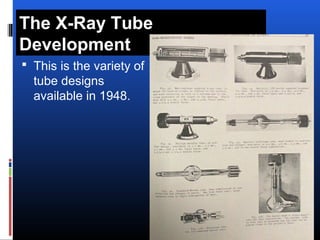
 This is the variety of
tube designs
available in 1948.
The X-Ray Tube Development
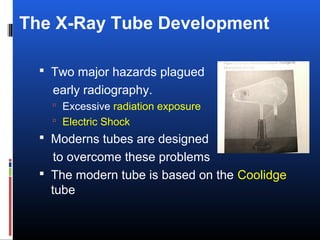
 Two major hazards plagued
early radiography.
 Excessive radiation exposure
 Electric Shock
 Moderns tubes are designed
to overcome these problems
 The modern tube is based on the Coolidge
tube
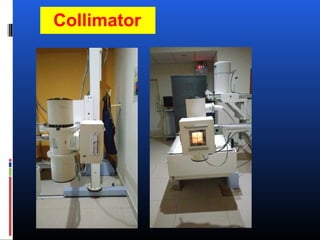
Collimator
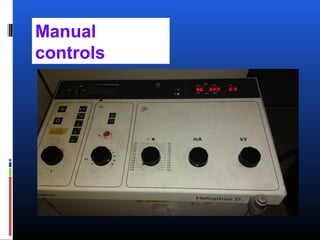
Manual
controls
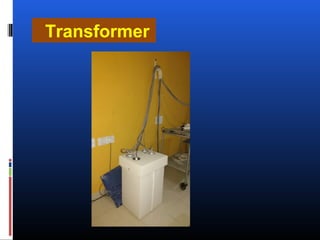
Transformer
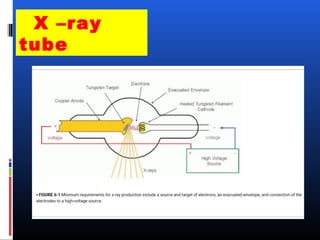
X –ray
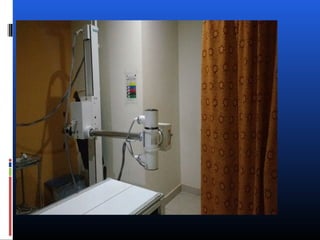
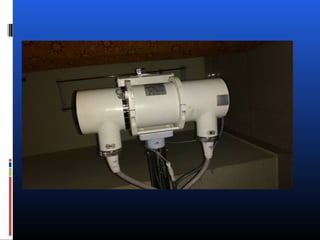
tube
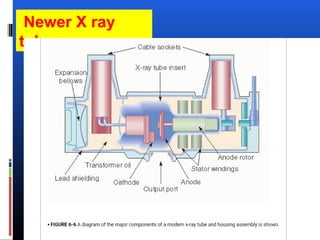
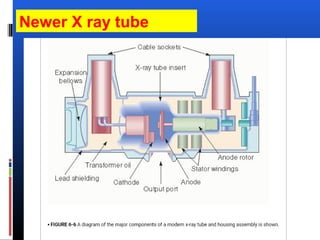
Newer X ray
tube
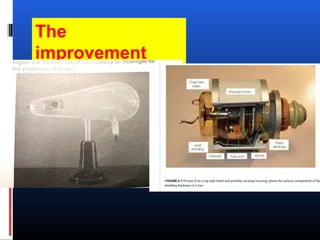
The
improvement
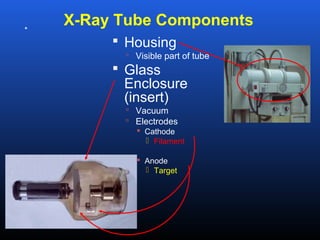
X-Ray Tube Components
 Housing
 Visible part of tube
 Glass
Enclosure
(insert)
 Vacuum
 Electrodes
 Cathode
 Filament
 Anode
 Target
*
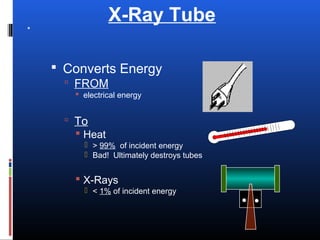
X-Ray Tube
 Converts Energy
 FROM
 electrical energy
 To
 Heat
 > 99% of incident energy
 Bad! Ultimately destroys tubes
 X-Rays
 < 1% of incident energy
*
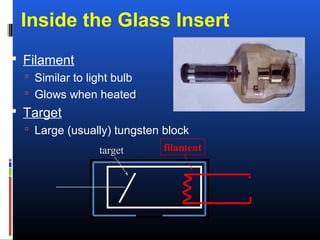
Inside the Glass Insert
 Filament
 Similar to light bulb
 Glows when heated
 Target
 Large (usually) tungsten block
target filament
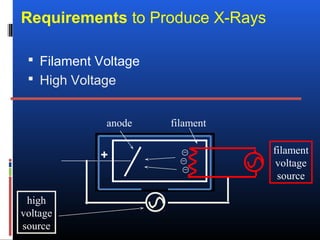
Requirements to Produce X-Rays
 Filament Voltage
 High Voltage
+
filamentanode
filament
voltage
source
high
voltage
source
X-Ray Tube Principle
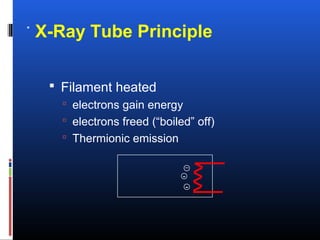
 Filament heated
 electrons gain energy
 electrons freed (“boiled” off)
 Thermionic emission
-
-
*
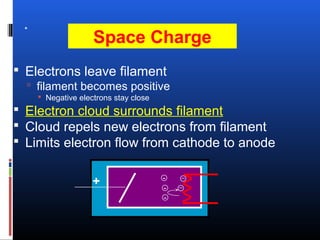
Space Charge
 Electrons leave filament
 filament becomes positive
 Negative electrons stay close
 Electron cloud surrounds filament
 Cloud repels new electrons from filament
 Limits electron flow from cathode to anode
+ -
-
-
*
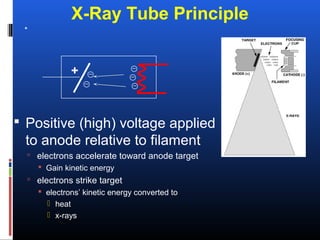
X-Ray Tube Principle
 Positive (high) voltage applied
to anode relative to filament
 electrons accelerate toward anode target
 Gain kinetic energy
 electrons strike target
 electrons’ kinetic energy converted to
 heat
 x-rays
+
*
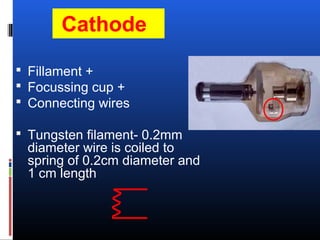
Cathode
 Fillament +
 Focussing cup +
 Connecting wires
 Tungsten filament- 0.2mm
diameter wire is coiled to
spring of 0.2cm diameter and
1 cm length
Cathode (filament)
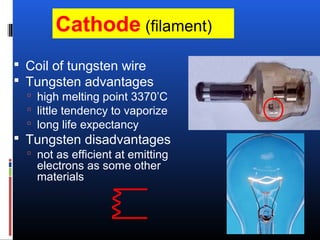
 Coil of tungsten wire
 Tungsten advantages
 high melting point 3370’C
 little tendency to vaporize
 long life expectancy
 Tungsten disadvantages
 not as efficient at emitting
electrons as some other
materials
Cathode (filament)
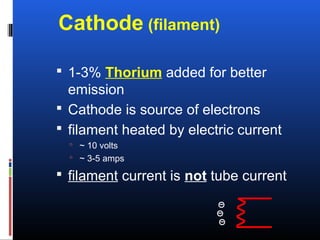
 1-3% Thorium added for better
emission
 Cathode is source of electrons
 filament heated by electric current
 ~ 10 volts
 ~ 3-5 amps
 filament current is not tube current
Filament (cont.)
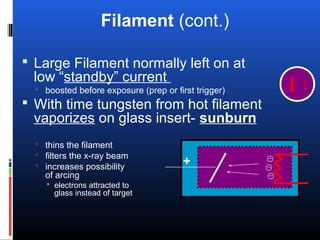
 Large Filament normally left on at
low “standby” current
 boosted before exposure (prep or first trigger)
 With time tungsten from hot filament
vaporizes on glass insert- sunburn
 thins the filament
 filters the x-ray beam
 increases possibility
of arcing
 electrons attracted to
glass instead of target
+
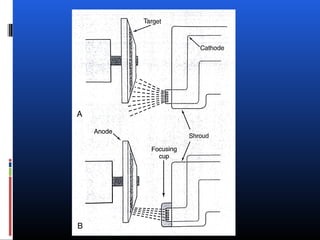
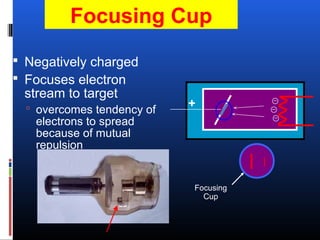
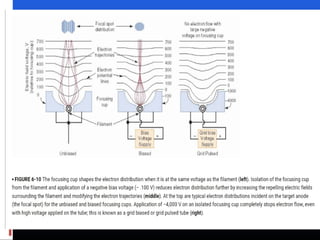
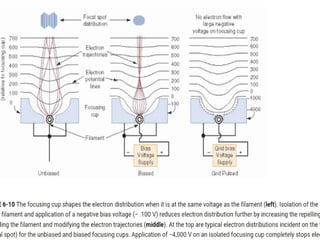
Focusing Cup
 Negatively charged
 Focuses electron
stream to target
 overcomes tendency of
electrons to spread
because of mutual
repulsion
+
Focusing
Cup
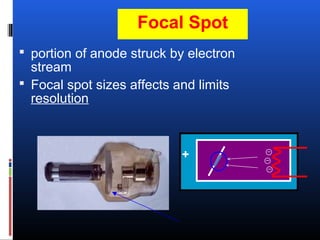
Focal Spot
 portion of anode struck by electron
stream
 Focal spot sizes affects and limits
resolution
+
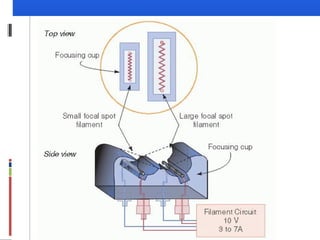
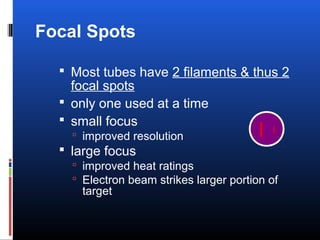
Focal Spots
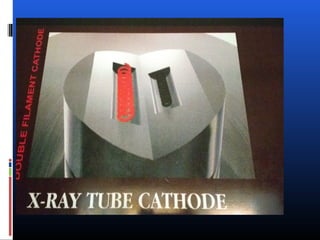
 Most tubes have 2 filaments & thus 2
focal spots
 only one used at a time
 small focus
 improved resolution
 large focus
 improved heat ratings
 Electron beam strikes larger portion of
target
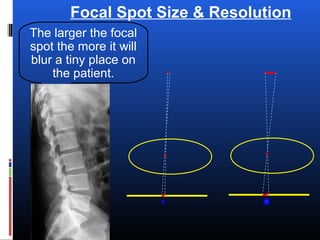
Focal Spot Size & Resolution
The larger the focal
spot the more it will
blur a tiny place on
the patient.
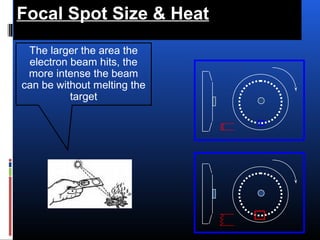
Focal Spot Size & Heat
The larger the area the
electron beam hits, the
more intense the beam
can be without melting the
target
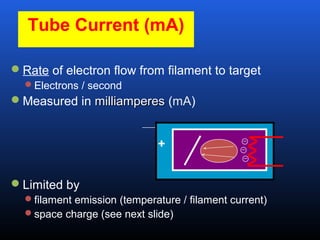
Tube Current (mA)
Rate of electron flow from filament to target
Electrons / second
Measured in milliamperesmilliamperes (mA)
Limited by
filament emission (temperature / filament current)
space charge (see next slide)
+
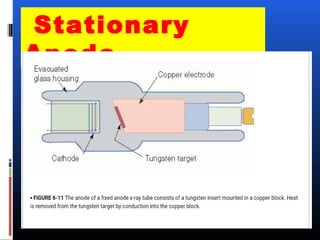
Stationary
Anode
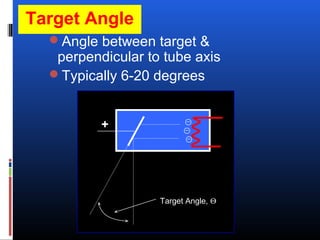
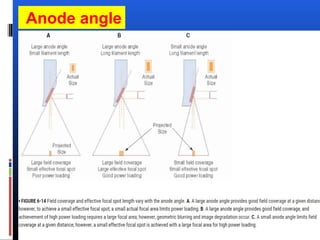
Target Angle
Angle between target &
perpendicular to tube axis
Typically 6-20 degrees
+
Target Angle, Θ
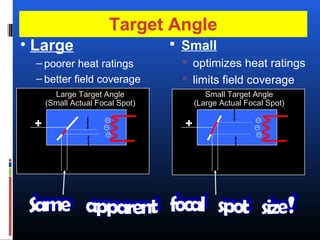
Target Angle
 Small
 optimizes heat ratings
 limits field coverage
+
Large Target Angle
(Small Actual Focal Spot)
+
Small Target Angle
(Large Actual Focal Spot)
• Large
– poorer heat ratings
– better field coverage
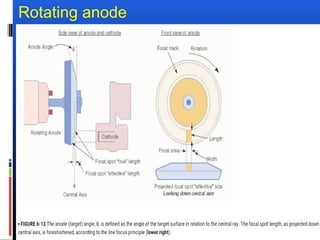
Anode angle
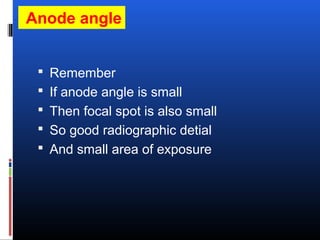
Anode angle
 Remember
 If anode angle is small
 Then focal spot is also small
 So good radiographic detial
 And small area of exposure
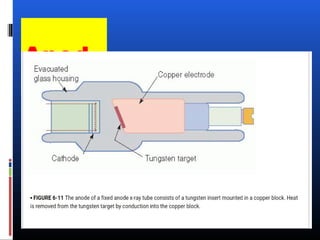
Anod
e
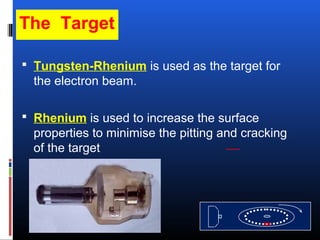
The Target
 Tungsten-Rhenium is used as the target for
the electron beam.
 Rhenium is used to increase the surface
properties to minimise the pitting and cracking
of the target
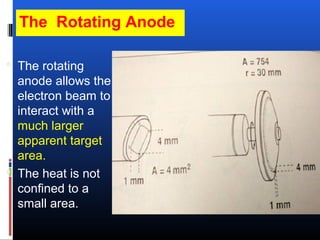
The Rotating Anode
 The rotating
anode allows the
electron beam to
interact with a
much larger
apparent target
area.
 The heat is not
confined to a
small area.
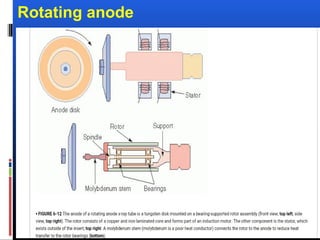
Rotating anode
Rotating anode
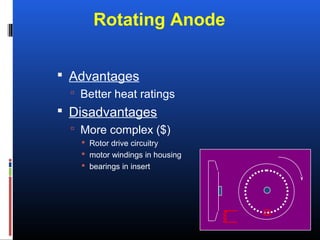
Rotating Anode
 Advantages
 Better heat ratings
 Disadvantages
 More complex ($)
 Rotor drive circuitry
 motor windings in housing
 bearings in insert
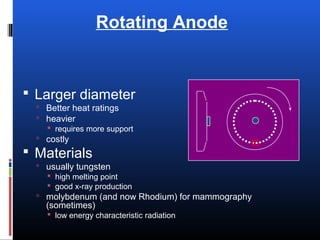
Rotating Anode
 Larger diameter
 Better heat ratings
 heavier
 requires more support
 costly
 Materials
 usually tungsten
 high melting point
 good x-ray production
 molybdenum (and now Rhodium) for mammography
(sometimes)
 low energy characteristic radiation
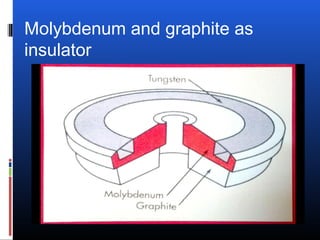
Molybdenum and graphite as
insulator
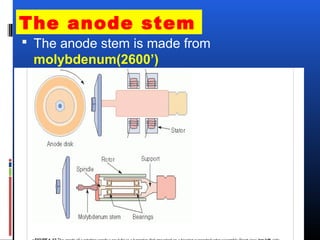
The anode stem
 The anode stem is made from
molybdenum(2600’)
 It is made appropriately thin as to
minimize the heat conduction towards
the rotor
Lubricatio
n
 Not oil
 Not graphite
 Silver is the best available in high vaccum,
bearing wear is negligible
Safety circuit
 Delay of 0.5-1second for anode to reach
full speed
Breaking The Rotating Anode
 When the anode is spinning at the correct
speed, the exposure can be made.
 After the exposure is completed, it slows
by reversing the motor.
 This is necessary to avoid excessive wear
and tear of the bearings
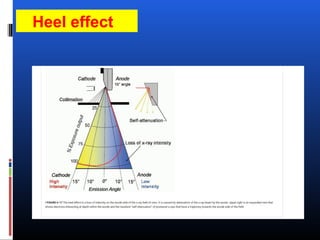
Heel effect
Beam Intensity
 Product of
 # photons in beam
 energy per photon
 Units
 Roentgens (R) per unit time
 Measure of ionization rate of air
 Depends on
 kVp
 mA
 target material
 filtration
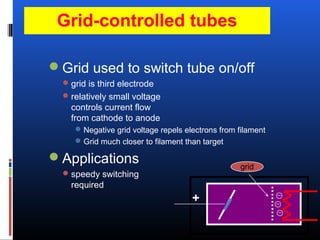
Grid-controlled tubes
Grid used to switch tube on/off
grid is third electrode
relatively small voltage
controls current flow
from cathode to anode
Negative grid voltage repels electrons from filament
Grid much closer to filament than target
Applications
speedy switching
required
+
grid
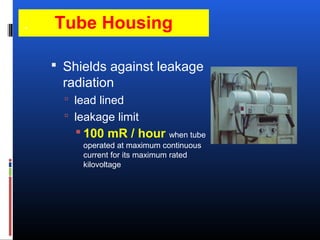
Tube Housing
 Shields against leakage
radiation
 lead lined
 leakage limit
 100 mR / hour when tube
operated at maximum continuous
current for its maximum rated
kilovoltage
*
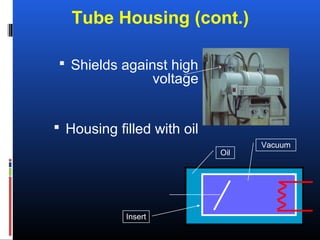
Tube Housing (cont.)
 Shields against high
voltage
 Housing filled with oil
Oil
Vacuum
Insert
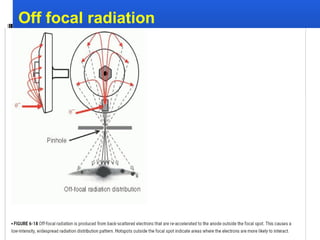
Off focal radiation
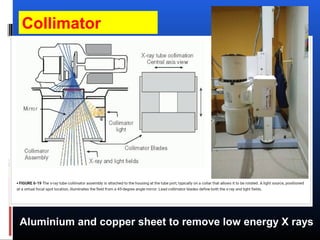
Collimator
Aluminium and copper sheet to remove low energy X rays
Dissipation of heat from the target
 Even with the anode rotating, some melting
occurs.
 The heat must be rapidly dissipated from the
target.
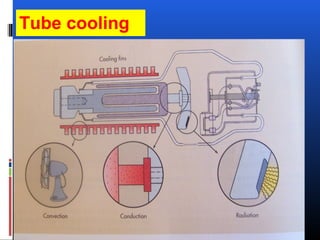
 The anode dissipates heat by radiating
towards the glass envelop
Tube cooling
Newer X ray tube
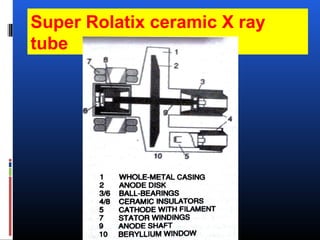
Super Rolatix ceramic X ray
tube
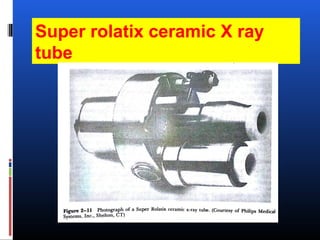
Super rolatix ceramic X ray
tube
Summary
 Earliest X ray tubes
 Basic principle
 Cathode
 Focusing cup
 Stationary anode
 Anode angle
 Rotating Anode
 Anode stem
 Grid control
 Tube housing
 Collimator
 Tube cooling
 Super rolatix tube
Thank you
Wilhelm Conrad Roentgen

X ray tube

  • 1.
  • 2.
    The X-Ray Tube Development Wilhelm Conrad Roentgen used a Crookes-Hittorf tube to make the first x-ray image.  There was no shielding so x-rays were emitted in all directions.
  • 3.
    The X-Ray Tube Development This is the variety of tube designs available in 1948.
  • 4.
    The X-Ray TubeDevelopment  Two major hazards plagued early radiography.  Excessive radiation exposure  Electric Shock  Moderns tubes are designed to overcome these problems  The modern tube is based on the Coolidge tube
  • 7.
  • 8.
  • 9.
  • 10.
  • 11.
  • 12.
  • 13.
    X-Ray Tube Components Housing  Visible part of tube  Glass Enclosure (insert)  Vacuum  Electrodes  Cathode  Filament  Anode  Target *
  • 14.
    X-Ray Tube  ConvertsEnergy  FROM  electrical energy  To  Heat  > 99% of incident energy  Bad! Ultimately destroys tubes  X-Rays  < 1% of incident energy *
  • 15.
    Inside the GlassInsert  Filament  Similar to light bulb  Glows when heated  Target  Large (usually) tungsten block target filament
  • 16.
    Requirements to ProduceX-Rays  Filament Voltage  High Voltage + filamentanode filament voltage source high voltage source
  • 17.
    X-Ray Tube Principle Filament heated  electrons gain energy  electrons freed (“boiled” off)  Thermionic emission - - *
  • 18.
    Space Charge  Electronsleave filament  filament becomes positive  Negative electrons stay close  Electron cloud surrounds filament  Cloud repels new electrons from filament  Limits electron flow from cathode to anode + - - - *
  • 19.
    X-Ray Tube Principle Positive (high) voltage applied to anode relative to filament  electrons accelerate toward anode target  Gain kinetic energy  electrons strike target  electrons’ kinetic energy converted to  heat  x-rays + *
  • 20.
    Cathode  Fillament + Focussing cup +  Connecting wires  Tungsten filament- 0.2mm diameter wire is coiled to spring of 0.2cm diameter and 1 cm length
  • 21.
    Cathode (filament)  Coilof tungsten wire  Tungsten advantages  high melting point 3370’C  little tendency to vaporize  long life expectancy  Tungsten disadvantages  not as efficient at emitting electrons as some other materials
  • 22.
    Cathode (filament)  1-3%Thorium added for better emission  Cathode is source of electrons  filament heated by electric current  ~ 10 volts  ~ 3-5 amps  filament current is not tube current
  • 24.
    Filament (cont.)  LargeFilament normally left on at low “standby” current  boosted before exposure (prep or first trigger)  With time tungsten from hot filament vaporizes on glass insert- sunburn  thins the filament  filters the x-ray beam  increases possibility of arcing  electrons attracted to glass instead of target +
  • 26.
    Focusing Cup  Negativelycharged  Focuses electron stream to target  overcomes tendency of electrons to spread because of mutual repulsion + Focusing Cup
  • 29.
    Focal Spot  portionof anode struck by electron stream  Focal spot sizes affects and limits resolution +
  • 30.
    Focal Spots  Mosttubes have 2 filaments & thus 2 focal spots  only one used at a time  small focus  improved resolution  large focus  improved heat ratings  Electron beam strikes larger portion of target
  • 31.
    Focal Spot Size& Resolution The larger the focal spot the more it will blur a tiny place on the patient.
  • 32.
    Focal Spot Size& Heat The larger the area the electron beam hits, the more intense the beam can be without melting the target
  • 33.
    Tube Current (mA) Rateof electron flow from filament to target Electrons / second Measured in milliamperesmilliamperes (mA) Limited by filament emission (temperature / filament current) space charge (see next slide) +
  • 34.
  • 35.
    Target Angle Angle betweentarget & perpendicular to tube axis Typically 6-20 degrees + Target Angle, Θ
  • 36.
    Target Angle  Small optimizes heat ratings  limits field coverage + Large Target Angle (Small Actual Focal Spot) + Small Target Angle (Large Actual Focal Spot) • Large – poorer heat ratings – better field coverage
  • 37.
  • 38.
    Anode angle  Remember If anode angle is small  Then focal spot is also small  So good radiographic detial  And small area of exposure
  • 39.
  • 40.
    The Target  Tungsten-Rheniumis used as the target for the electron beam.  Rhenium is used to increase the surface properties to minimise the pitting and cracking of the target
  • 41.
    The Rotating Anode The rotating anode allows the electron beam to interact with a much larger apparent target area.  The heat is not confined to a small area.
  • 42.
  • 43.
  • 44.
    Rotating Anode  Advantages Better heat ratings  Disadvantages  More complex ($)  Rotor drive circuitry  motor windings in housing  bearings in insert
  • 45.
    Rotating Anode  Largerdiameter  Better heat ratings  heavier  requires more support  costly  Materials  usually tungsten  high melting point  good x-ray production  molybdenum (and now Rhodium) for mammography (sometimes)  low energy characteristic radiation
  • 46.
  • 47.
    The anode stem The anode stem is made from molybdenum(2600’)  It is made appropriately thin as to minimize the heat conduction towards the rotor
  • 48.
    Lubricatio n  Not oil Not graphite  Silver is the best available in high vaccum, bearing wear is negligible
  • 49.
    Safety circuit  Delayof 0.5-1second for anode to reach full speed
  • 50.
    Breaking The RotatingAnode  When the anode is spinning at the correct speed, the exposure can be made.  After the exposure is completed, it slows by reversing the motor.  This is necessary to avoid excessive wear and tear of the bearings
  • 51.
  • 52.
    Beam Intensity  Productof  # photons in beam  energy per photon  Units  Roentgens (R) per unit time  Measure of ionization rate of air  Depends on  kVp  mA  target material  filtration
  • 53.
    Grid-controlled tubes Grid usedto switch tube on/off grid is third electrode relatively small voltage controls current flow from cathode to anode Negative grid voltage repels electrons from filament Grid much closer to filament than target Applications speedy switching required + grid
  • 55.
    Tube Housing  Shieldsagainst leakage radiation  lead lined  leakage limit  100 mR / hour when tube operated at maximum continuous current for its maximum rated kilovoltage *
  • 56.
    Tube Housing (cont.) Shields against high voltage  Housing filled with oil Oil Vacuum Insert
  • 57.
  • 58.
    Collimator Aluminium and coppersheet to remove low energy X rays
  • 59.
    Dissipation of heatfrom the target  Even with the anode rotating, some melting occurs.  The heat must be rapidly dissipated from the target.  The anode dissipates heat by radiating towards the glass envelop
  • 60.
  • 61.
  • 62.
  • 63.
  • 64.
    Summary  Earliest Xray tubes  Basic principle  Cathode  Focusing cup  Stationary anode  Anode angle  Rotating Anode  Anode stem  Grid control  Tube housing  Collimator  Tube cooling  Super rolatix tube
  • 65.

Editor's Notes

  • #2 .
  • #3 Nov 8,1895
  • #4 .
  • #5 .
  • #6 X ray tube and stand
  • #7 Anode n cathode
  • #8 Controls to adjust exposure and focus
  • #9 .
  • #10 Step up transformer to produce 50,000 to 150,000 V
  • #11 Vaccum avoid ionisation…… See the change
  • #12 Connecting wires of alloys with same coefficient of expansion as pyrex glass
  • #13 2mm lead thickness
  • #14 .
  • #15 We need mechanisms to dissipate heat n heat resistant materials
  • #16 .
  • #18 High voltage applied
  • #19 Overcome by raising kVp, emission limited, saturation voltage
  • #20 .
  • #21 Add something for better emission…. Something more unstable…
  • #22 Add something for better emission…. Something more unstable…
  • #23 .
  • #24 2 filaments in focusing cup
  • #25 standby” current 5mA…. Automatic filament boosting circuit for exposure……arcing puncture.. so Metal enclosures used now
  • #26 Negative charge repel and spread
  • #27 .
  • #28 Surrounds filament… nickel
  • #29 Negative charge…. Modify e- trajectories…. 1st equal, 2nd more
  • #30 .
  • #31 Target dosent get damaged… next page importance
  • #32 Look sharpness of vertebrae… L2,3 clear border since x rays focussed here
  • #33 .
  • #34 Current flow anode to cathode
  • #35 Target is angulated
  • #36 .
  • #37 .
  • #38 .
  • #39 More vertical
  • #40 Tungsten 2-3mm thick n &amp;gt;1cm dimensions… fixed to copper(conductor)… repeated bombarding caused pitting…
  • #41 There was need to increase focal spot size… to distribute heat…. Without blurring
  • #42 Bevelled edge, 3000rpm, exposed every 1/60th second, total area = ht of e- beam* circumference
  • #43 Rotor on principle of electro-magnetic induction
  • #44 .
  • #45 .
  • #46 Heat dissipation was still a problem
  • #47 Tungsten rhenium target embedded, back coated carbon black, slits n grooves for expansion
  • #48 Molybdenum poor conductor high melting 2600’…avoid expansion and jamming rotor. Length minimum…… for heavy anode to decrease inertia
  • #52 Ant anode pneumonic
  • #53 .
  • #54 Speedy switching
  • #55 .
  • #56 Protect unnecessary exposure n fogging of film…. High voltage cables
  • #57 housing also contains oil seal without air that provides more electrical insulation and a thermal Convection to metal shield, compact tubes, microswitch..Never hold the tube during an exposure.Never use the cables or terminals as handles. Some housing have a fan for cooling.
  • #58 Many e- hit other areas on the anode n thus different areas on the patient
  • #59 .
  • #60 .
  • #61 .
  • #62 Oil convection and expand …. So expansion bellows….. Heavy large anode best… but support insufficient… so add more support
  • #63 2 ball bearings,, larger better anode…. Metal protective casing
  • #64 philips