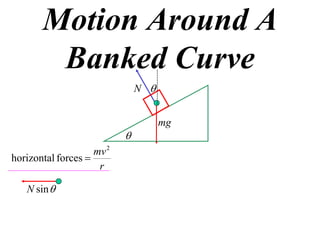
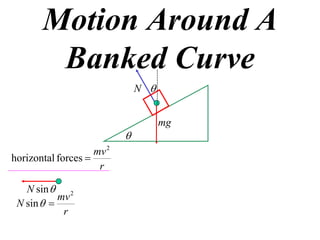
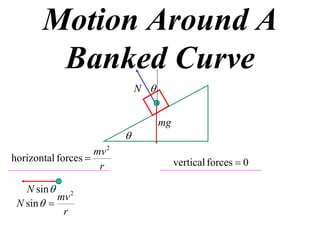
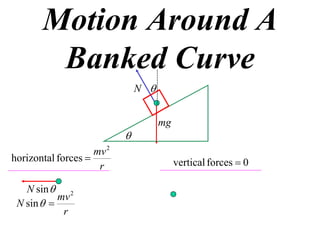
Motion Around A
 Banked Curve
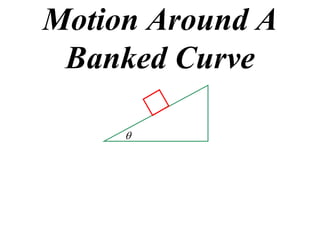
Motion Around A
 Banked Curve

     
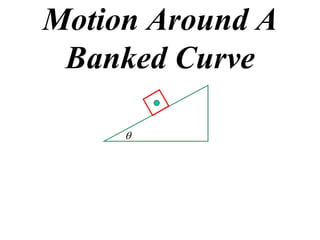
Motion Around A
 Banked Curve

     
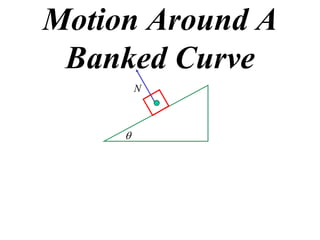
Motion Around A
 Banked Curve
         N


     
Motion Around A
 Banked Curve
         N


             mg
     
Motion Around A
        Banked Curve
                               N


                                   mg
                           
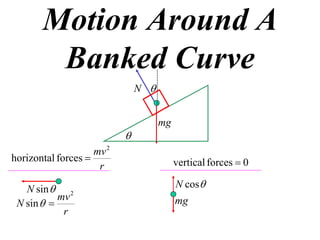
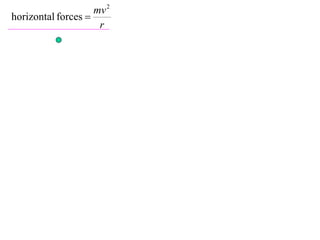
                    mv 2
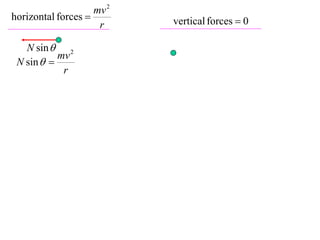
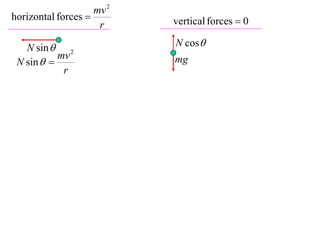
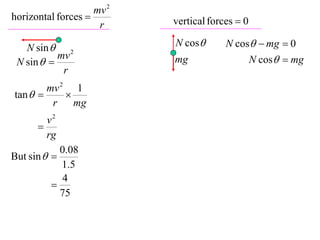
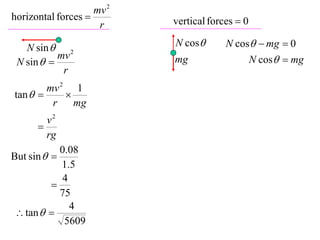
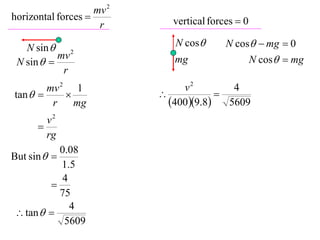
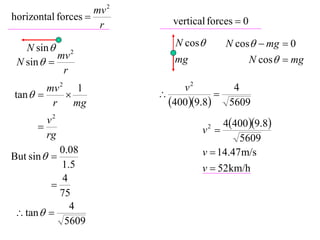
horizontal forces 
                     r
Motion Around A
        Banked Curve
                               N


                                   mg
                           
                    mv 2
horizontal forces 
                     r
Motion Around A
        Banked Curve
                               N 


                                     mg
                           
                    mv 2
horizontal forces 
                     r
Motion Around A
        Banked Curve
                               N 


                                     mg
                           
                    mv 2
horizontal forces 
                     r

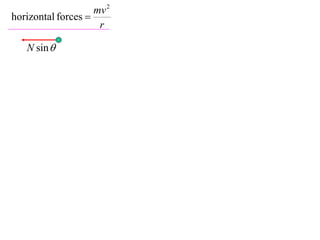
   N sin 
Motion Around A
        Banked Curve
                               N 


                                     mg
                           
                    mv 2
horizontal forces 
                     r

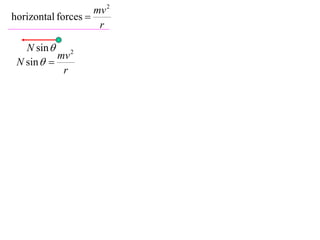
   N sin  2
           mv
 N sin  
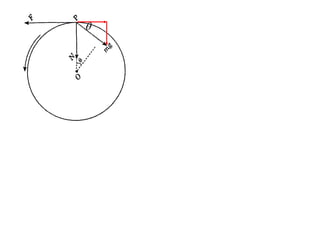
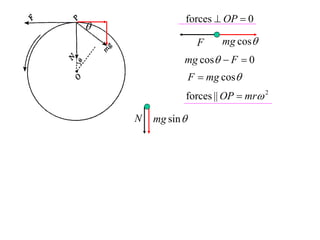
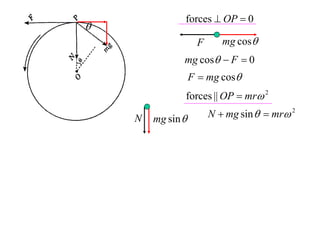
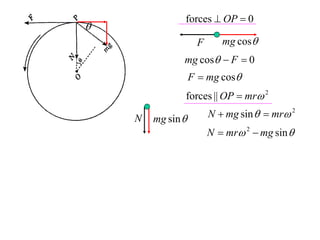
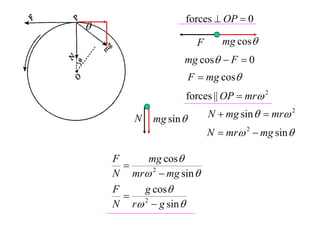
            r
Motion Around A
        Banked Curve
                               N 


                                     mg
                           
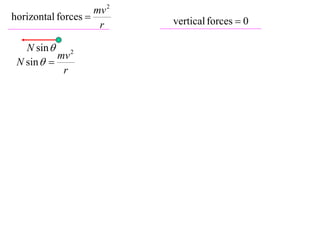
                    mv 2
horizontal forces                        vertical forces  0
                     r

   N sin  2
           mv
 N sin  
            r
Motion Around A
        Banked Curve
                               N 


                                     mg
                           
                    mv 2
horizontal forces                        vertical forces  0
                     r

   N sin  2
           mv
 N sin  
            r
Motion Around A
        Banked Curve
                               N 


                                     mg
                           
                    mv 2
horizontal forces                        vertical forces  0
                     r

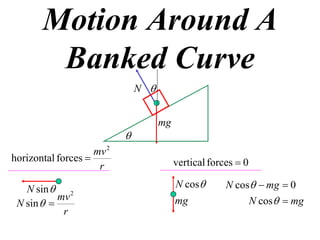
   N sin  2                              N cos
           mv
 N sin                                  mg
            r
Motion Around A
        Banked Curve
                               N 


                                     mg
                           
                    mv 2
horizontal forces                        vertical forces  0
                     r

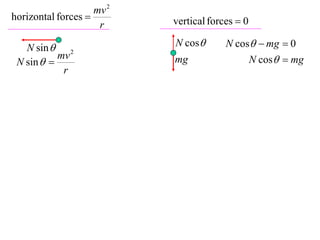
   N sin  2                              N cos       N cos  mg  0
           mv                                                   N cos  mg
 N sin                                  mg
            r
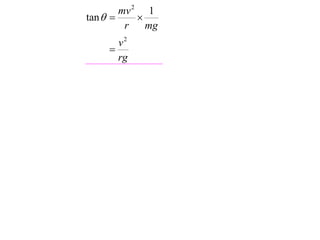
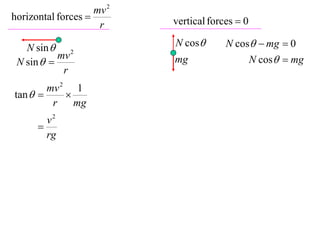
mv 2 1
tan       
         r    mg
       v2
     
       rg
mv 2 1
                   tan       
                            r    mg
                             v2
                          
                             rg
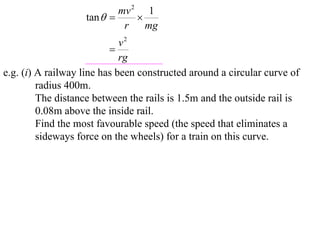
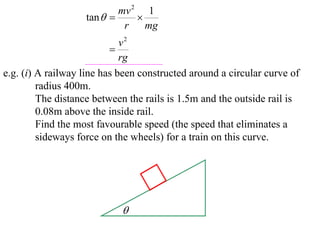
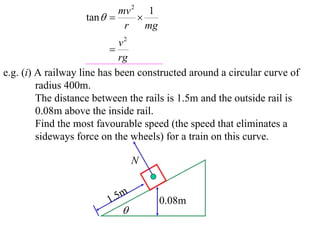
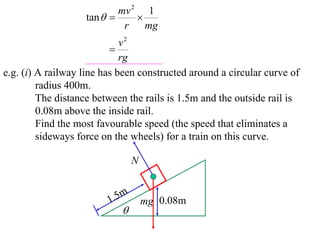
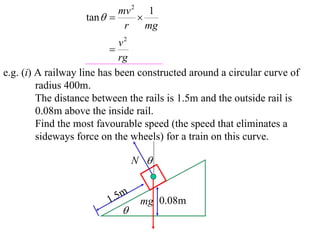
e.g. (i) A railway line has been constructed around a circular curve of
         radius 400m.
         The distance between the rails is 1.5m and the outside rail is
         0.08m above the inside rail.
         Find the most favourable speed (the speed that eliminates a
         sideways force on the wheels) for a train on this curve.
mv 2 1
                   tan       
                            r    mg
                             v2
                          
                             rg
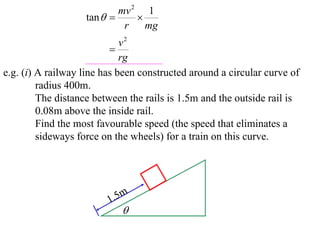
e.g. (i) A railway line has been constructed around a circular curve of
         radius 400m.
         The distance between the rails is 1.5m and the outside rail is
         0.08m above the inside rail.
         Find the most favourable speed (the speed that eliminates a
         sideways force on the wheels) for a train on this curve.


                            
mv 2 1
                   tan       
                            r    mg
                             v2
                          
                             rg
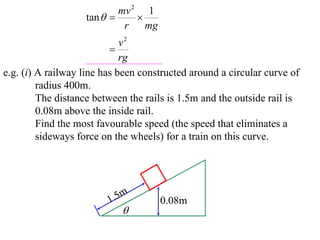
e.g. (i) A railway line has been constructed around a circular curve of
         radius 400m.
         The distance between the rails is 1.5m and the outside rail is
         0.08m above the inside rail.
         Find the most favourable speed (the speed that eliminates a
         sideways force on the wheels) for a train on this curve.


                         1 .5m
                            
mv 2 1
                   tan       
                            r    mg
                             v2
                          
                             rg
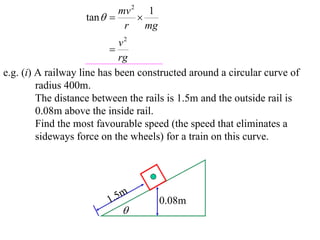
e.g. (i) A railway line has been constructed around a circular curve of
         radius 400m.
         The distance between the rails is 1.5m and the outside rail is
         0.08m above the inside rail.
         Find the most favourable speed (the speed that eliminates a
         sideways force on the wheels) for a train on this curve.


                         1 .5m        0.08m
                            
mv 2 1
                   tan       
                            r    mg
                             v2
                          
                             rg
e.g. (i) A railway line has been constructed around a circular curve of
         radius 400m.
         The distance between the rails is 1.5m and the outside rail is
         0.08m above the inside rail.
         Find the most favourable speed (the speed that eliminates a
         sideways force on the wheels) for a train on this curve.


                         1 .5m        0.08m
                            
mv 2 1
                   tan       
                            r    mg
                             v2
                          
                             rg
e.g. (i) A railway line has been constructed around a circular curve of
         radius 400m.
         The distance between the rails is 1.5m and the outside rail is
         0.08m above the inside rail.
         Find the most favourable speed (the speed that eliminates a
         sideways force on the wheels) for a train on this curve.

                                 N


                         1 .5m        0.08m
                            
mv 2 1
                   tan       
                            r    mg
                             v2
                          
                             rg
e.g. (i) A railway line has been constructed around a circular curve of
         radius 400m.
         The distance between the rails is 1.5m and the outside rail is
         0.08m above the inside rail.
         Find the most favourable speed (the speed that eliminates a
         sideways force on the wheels) for a train on this curve.

                                 N


                         1 .5m       mg 0.08m
                            
mv 2 1
                   tan       
                            r    mg
                             v2
                          
                             rg
e.g. (i) A railway line has been constructed around a circular curve of
         radius 400m.
         The distance between the rails is 1.5m and the outside rail is
         0.08m above the inside rail.
         Find the most favourable speed (the speed that eliminates a
         sideways force on the wheels) for a train on this curve.

                                 N 


                         1 .5m    mg 0.08m
                            
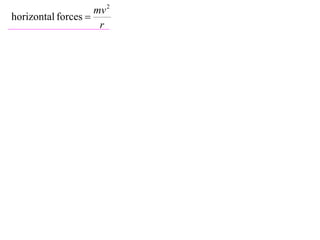
mv 2
horizontal forces 
                     r
mv 2
horizontal forces 
                     r
mv 2
horizontal forces 
                     r

   N sin 
mv 2
horizontal forces 
                     r

   N sin  2
           mv
 N sin  
            r
mv 2
horizontal forces         vertical forces  0
                     r

   N sin  2
           mv
 N sin  
            r
mv 2
horizontal forces         vertical forces  0
                     r

   N sin  2
           mv
 N sin  
            r
mv 2
horizontal forces         vertical forces  0
                     r

   N sin  2               N cos
           mv
 N sin                   mg
            r
mv 2
horizontal forces         vertical forces  0
                     r

   N sin  2               N cos       N cos  mg  0
           mv                                    N cos  mg
 N sin                   mg
            r
mv 2
horizontal forces         vertical forces  0
                     r

   N sin  2               N cos       N cos  mg  0
           mv                                    N cos  mg
 N sin                   mg
            r
        mv 2 1
tan       
         r    mg
        v2
      
        rg
mv 2
horizontal forces         vertical forces  0
                     r

   N sin  2               N cos       N cos  mg  0
           mv                                    N cos  mg
 N sin                   mg
            r
        mv 2 1
tan       
         r    mg
        v2
      
        rg
            0.08
But sin  
            1.5
             4
          
            75
mv 2
horizontal forces         vertical forces  0
                     r

   N sin  2               N cos       N cos  mg  0
           mv                                    N cos  mg
 N sin                   mg
            r
        mv 2 1
tan       
         r    mg
        v2
      
        rg
            0.08
But sin  
            1.5
             4
          
            75
               4
  tan  
             5609
mv 2
horizontal forces           vertical forces  0
                     r

   N sin  2                  N cos      N cos  mg  0
           mv                                      N cos  mg
 N sin                      mg
            r
        mv 2 1                  v2       4
tan                                
         r    mg             4009.8 5609
        v2
      
        rg
          0.08
But sin  
          1.5
           4
        
          75
             4
 tan  
           5609
mv 2
horizontal forces           vertical forces  0
                     r

   N sin  2                  N cos       N cos  mg  0
           mv                                      N cos  mg
 N sin                      mg
            r
        mv 2 1                  v2       4
tan                                
         r    mg             4009.8 5609
      
        v2                               4400 9.8
        rg                          v2 
                                             5609
          0.08
But sin                           v  14.47 m/s
          1.5                       v  52km/h
           4
        
          75
             4
 tan  
           5609
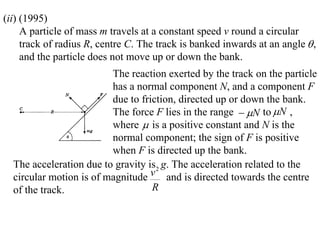
(ii) (1995)
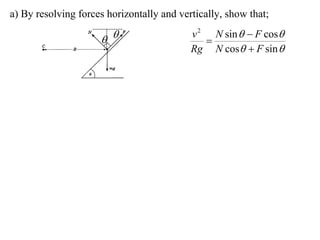
     A particle of mass m travels at a constant speed v round a circular
     track of radius R, centre C. The track is banked inwards at an angle  ,
     and the particle does not move up or down the bank.
                         The reaction exerted by the track on the particle
                         has a normal component N, and a component F
                         due to friction, directed up or down the bank.
                         The force F lies in the range  N to N ,
                         where  is a positive constant and N is the
                         normal component; the sign of F is positive
                         when F is directed up the bank.
  The acceleration due to gravity is2 g. The acceleration related to the
  circular motion is of magnitude v and is directed towards the centre
  of the track.                    R
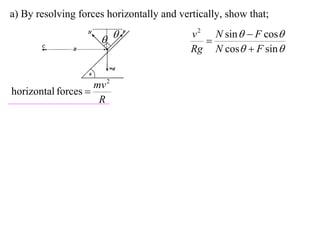
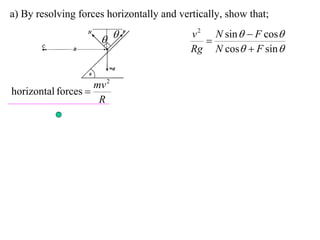
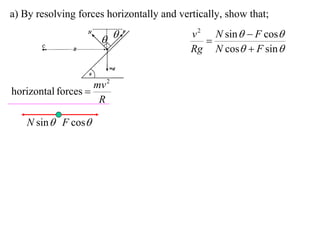
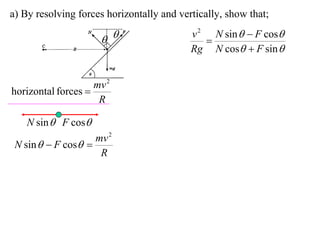
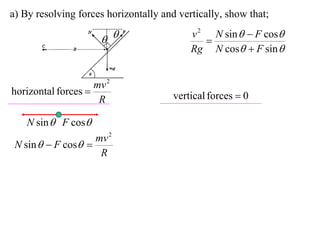
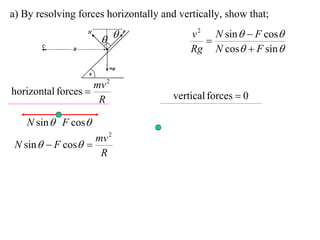
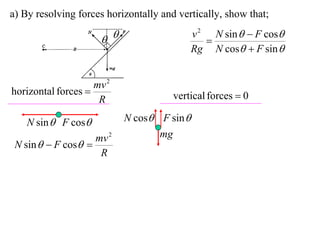
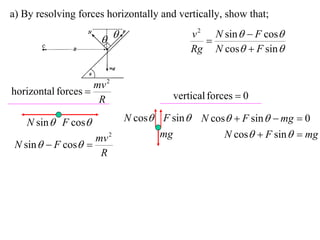
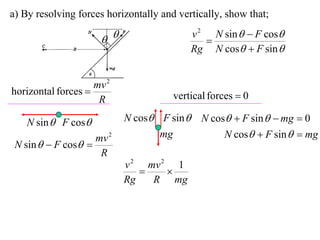
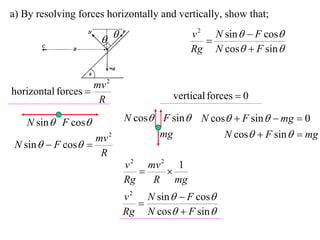
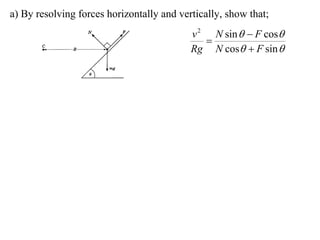
a) By resolving forces horizontally and vertically, show that;
                                           v 2 N sin   F cos
                                              
                                           Rg N cos  F sin 
a) By resolving forces horizontally and vertically, show that;
                                           v 2 N sin   F cos
                                            
                                           Rg N cos  F sin 
a) By resolving forces horizontally and vertically, show that;
                                           v 2 N sin   F cos
                                            
                                           Rg N cos  F sin 


                    mv 2
horizontal forces 
                     R
a) By resolving forces horizontally and vertically, show that;
                                           v 2 N sin   F cos
                                            
                                           Rg N cos  F sin 


                    mv 2
horizontal forces 
                     R
a) By resolving forces horizontally and vertically, show that;
                                           v 2 N sin   F cos
                                            
                                           Rg N cos  F sin 


                    mv 2
horizontal forces 
                     R

    N sin  F cos
a) By resolving forces horizontally and vertically, show that;
                                           v 2 N sin   F cos
                                            
                                           Rg N cos  F sin 


                    mv 2
horizontal forces 
                     R

    N sin  F cos
                    mv 2
 N sin   F cos 
                     R
a) By resolving forces horizontally and vertically, show that;
                                           v 2 N sin   F cos
                                            
                                           Rg N cos  F sin 


                    mv 2
horizontal forces                     vertical forces  0
                     R

    N sin  F cos
                    mv 2
 N sin   F cos 
                     R
a) By resolving forces horizontally and vertically, show that;
                                           v 2 N sin   F cos
                                            
                                           Rg N cos  F sin 


                    mv 2
horizontal forces                     vertical forces  0
                     R

    N sin  F cos
                    mv 2
 N sin   F cos 
                     R
a) By resolving forces horizontally and vertically, show that;
                                            v 2 N sin   F cos
                                             
                                            Rg N cos  F sin 


                    mv 2
horizontal forces                     vertical forces  0
                     R

    N sin  F cos         N cos F sin 
                    mv 2          mg
 N sin   F cos 
                     R
a) By resolving forces horizontally and vertically, show that;
                                           v 2 N sin   F cos
                                            
                                           Rg N cos  F sin 


                    mv 2
horizontal forces                     vertical forces  0
                     R

    N sin  F cos         N cos F sin  N cos  F sin   mg  0
                    mv 2          mg           N cos  F sin   mg
 N sin   F cos 
                     R
a) By resolving forces horizontally and vertically, show that;
                                           v 2 N sin   F cos
                                            
                                           Rg N cos  F sin 


                    mv 2
horizontal forces                     vertical forces  0
                     R

    N sin  F cos         N cos F sin  N cos  F sin   mg  0
                    mv 2          mg           N cos  F sin   mg
 N sin   F cos 
                     R
                           v 2 mv 2 1
                                  
                           Rg   R mg
a) By resolving forces horizontally and vertically, show that;
                                           v 2 N sin   F cos
                                            
                                           Rg N cos  F sin 


                    mv 2
horizontal forces                     vertical forces  0
                     R

    N sin  F cos         N cos F sin  N cos  F sin   mg  0
                    mv 2          mg           N cos  F sin   mg
 N sin   F cos 
                     R
                           v 2 mv 2 1
                                  
                           Rg   R mg
                           v 2 N sin   F cos
                              
                           Rg N cos  F sin 
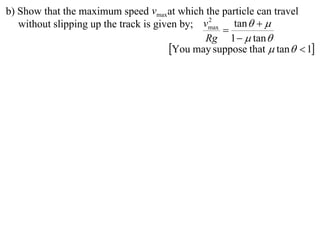
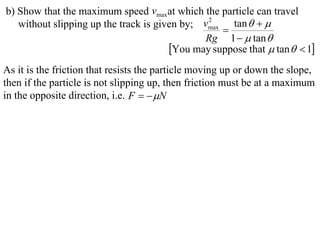
b) Show that the maximum speed vmaxat which the particle can travel
   without slipping up the track is given by; vmax tan   
                                               2
                                                  
                                              Rg 1   tan 
                                       You may suppose that  tan   1
b) Show that the maximum speed vmaxat which the particle can travel
   without slipping up the track is given by; vmax tan   
                                               2
                                                  
                                              Rg 1   tan 
                                       You may suppose that  tan   1
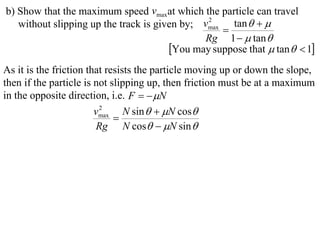
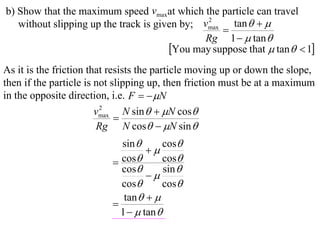
As it is the friction that resists the particle moving up or down the slope,
then if the particle is not slipping up, then friction must be at a maximum
in the opposite direction, i.e. F   N
b) Show that the maximum speed vmaxat which the particle can travel
   without slipping up the track is given by; vmax tan   
                                               2
                                                  
                                              Rg 1   tan 
                                       You may suppose that  tan   1
As it is the friction that resists the particle moving up or down the slope,
then if the particle is not slipping up, then friction must be at a maximum
in the opposite direction, i.e. F   N
                        vmax N sin   N cos
                         2
                             
                        Rg N cos  N sin 
b) Show that the maximum speed vmaxat which the particle can travel
   without slipping up the track is given by; vmax tan   
                                               2
                                                  
                                              Rg 1   tan 
                                       You may suppose that  tan   1
As it is the friction that resists the particle moving up or down the slope,
then if the particle is not slipping up, then friction must be at a maximum
in the opposite direction, i.e. F   N
                        vmax N sin   N cos
                         2
                             
                        Rg N cos  N sin 
                            sin        cos
                                   
                           cos        cos
                            cos        sin 
                                   
                            cos        cos
                             tan   
                          
                            1   tan 
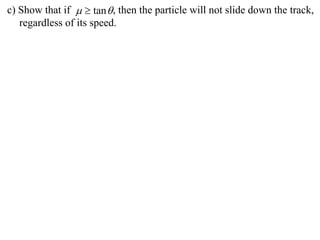
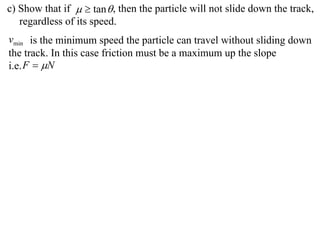
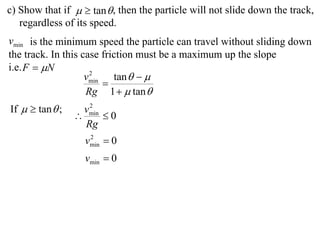
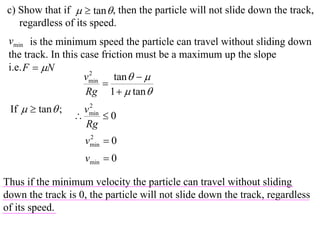
c) Show that if   tan  , then the particle will not slide down the track,
   regardless of its speed.
c) Show that if   tan  , then the particle will not slide down the track,
   regardless of its speed.
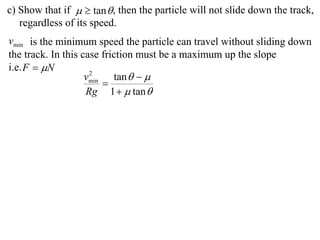
vmin is the minimum speed the particle can travel without sliding down
the track. In this case friction must be a maximum up the slope
i.e. F  N
c) Show that if   tan  , then the particle will not slide down the track,
   regardless of its speed.
vmin is the minimum speed the particle can travel without sliding down
the track. In this case friction must be a maximum up the slope
i.e. F  N
                    vmin tan   
                     2
                        
                    Rg 1   tan 
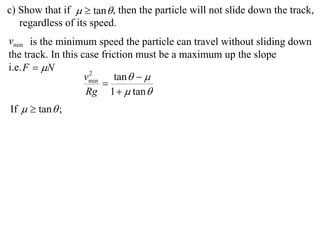
c) Show that if   tan  , then the particle will not slide down the track,
   regardless of its speed.
vmin is the minimum speed the particle can travel without sliding down
the track. In this case friction must be a maximum up the slope
i.e. F  N
                    vmin tan   
                     2
                        
                    Rg 1   tan 
If   tan  ;
c) Show that if   tan  , then the particle will not slide down the track,
   regardless of its speed.
vmin is the minimum speed the particle can travel without sliding down
the track. In this case friction must be a maximum up the slope
i.e. F  N
                    vmin tan   
                     2
                        
                    Rg 1   tan 
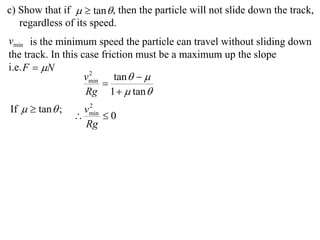
If   tan  ;      2
                   vmin
                       0
                   Rg
c) Show that if   tan  , then the particle will not slide down the track,
   regardless of its speed.
vmin is the minimum speed the particle can travel without sliding down
the track. In this case friction must be a maximum up the slope
i.e. F  N
                    vmin tan   
                     2
                        
                    Rg 1   tan 
If   tan  ;      2
                   vmin
                       0
                   Rg
                   vmin  0
                    2


                   vmin  0
c) Show that if   tan  , then the particle will not slide down the track,
   regardless of its speed.
 vmin is the minimum speed the particle can travel without sliding down
 the track. In this case friction must be a maximum up the slope
 i.e. F  N
                     vmin tan   
                      2
                         
                     Rg 1   tan 
 If   tan  ;      2
                    vmin
                        0
                    Rg
                    vmin  0
                     2


                    vmin  0

Thus if the minimum velocity the particle can travel without sliding
down the track is 0, the particle will not slide down the track, regardless
of its speed.
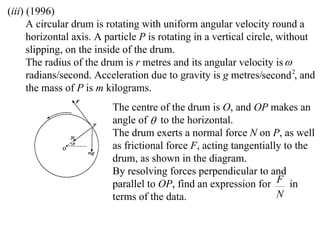
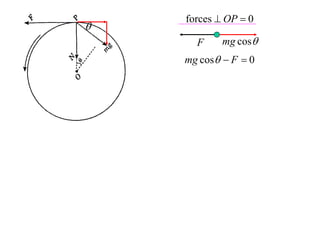
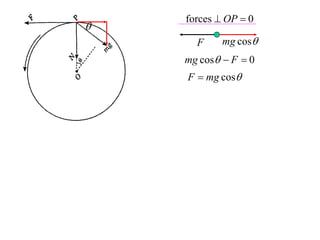
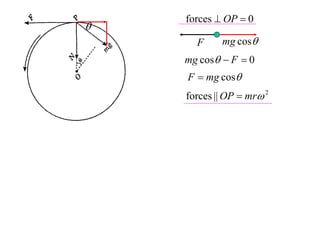
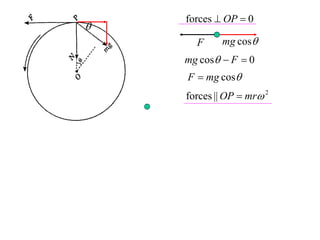
(iii) (1996)
      A circular drum is rotating with uniform angular velocity round a
      horizontal axis. A particle P is rotating in a vertical circle, without
      slipping, on the inside of the drum.
      The radius of the drum is r metres and its angular velocity is 
      radians/second. Acceleration due to gravity is g metres/second 2, and
      the mass of P is m kilograms.
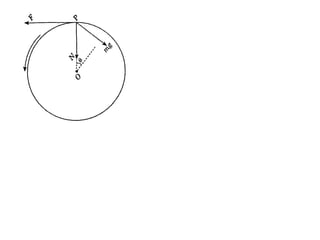
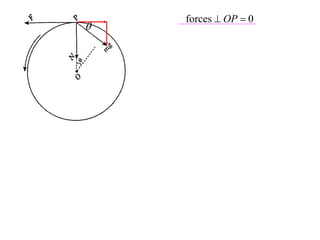
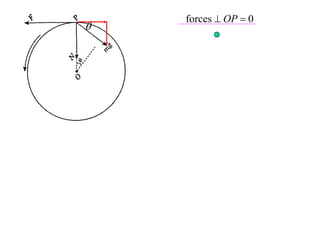
                          The centre of the drum is O, and OP makes an
                          angle of  to the horizontal.
                          The drum exerts a normal force N on P, as well
                          as frictional force F, acting tangentially to the
                          drum, as shown in the diagram.
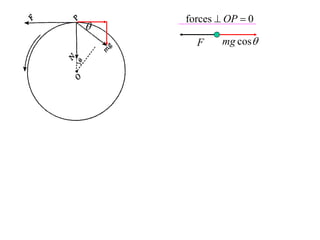
                          By resolving forces perpendicular to and
                          parallel to OP, find an expression for F in
                          terms of the data.                       N

forces  OP  0

forces  OP  0

forces  OP  0

      F     mg cos
forces  OP  0

      F     mg cos
    mg cos  F  0
forces  OP  0

      F     mg cos
    mg cos  F  0
    F  mg cos
forces  OP  0

      F     mg cos
    mg cos  F  0
    F  mg cos
    forces || OP  mr 2
forces  OP  0

      F     mg cos
    mg cos  F  0
    F  mg cos
    forces || OP  mr 2
forces  OP  0

                    F     mg cos
               mg cos  F  0
                   F  mg cos
               forces || OP  mr 2

    N   mg sin 
forces  OP  0

                    F      mg cos
               mg cos  F  0
                   F  mg cos
               forces || OP  mr 2

    N   mg sin         N  mg sin   mr 2
forces  OP  0

                    F      mg cos
               mg cos  F  0
                   F  mg cos
               forces || OP  mr 2

    N   mg sin         N  mg sin   mr 2
                        N  mr 2  mg sin 
forces  OP  0

                        F      mg cos
                   mg cos  F  0
                       F  mg cos
                   forces || OP  mr 2

        N   mg sin         N  mg sin   mr 2
                            N  mr 2  mg sin 

    F     mg cos
      
    N mr 2  mg sin 
    F   g cos
       2
    N r  g sin 
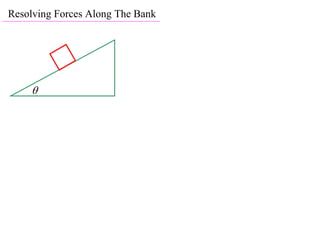
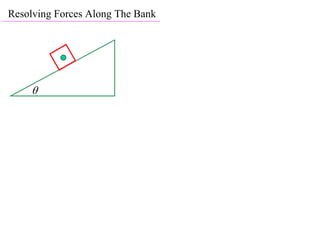
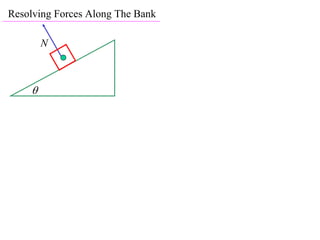
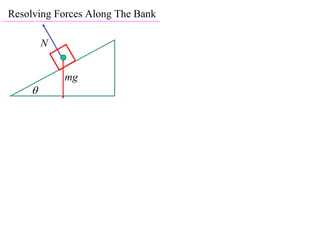
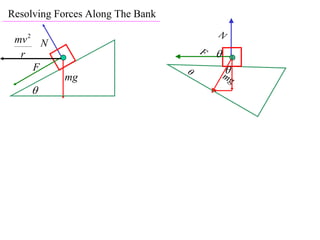
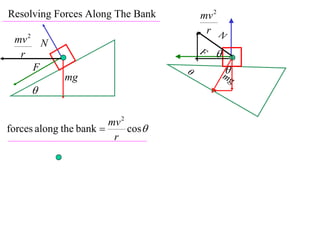
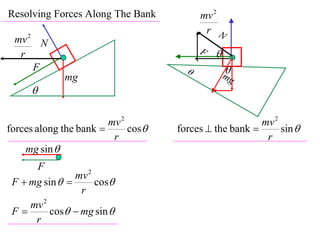
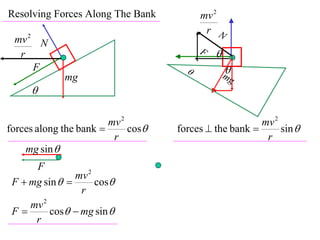
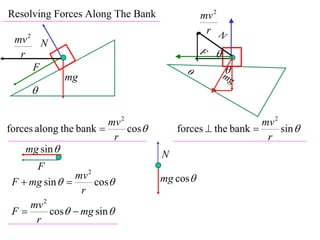
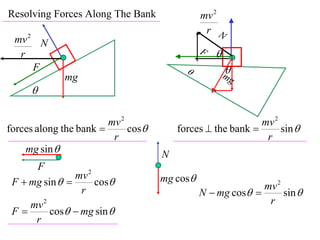
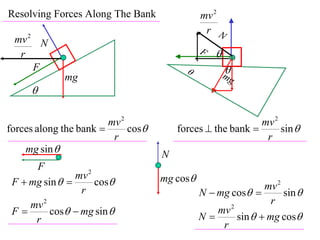
Resolving Forces Along The Bank


    
Resolving Forces Along The Bank


    
Resolving Forces Along The Bank

        N


    
Resolving Forces Along The Bank

        N


            mg
    
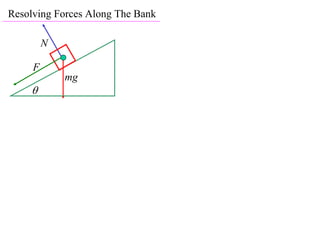
Resolving Forces Along The Bank

         N

     F
             mg
    
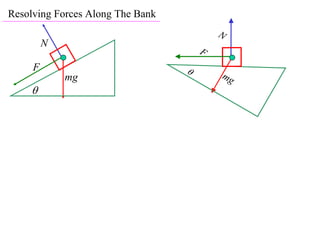
Resolving Forces Along The Bank
                                          N
         N
                                      F
     F                            
             mg                           mg
    
Resolving Forces Along The Bank
                                          N
         N
                                      F   
     F                                       
                                              mg
             mg
    
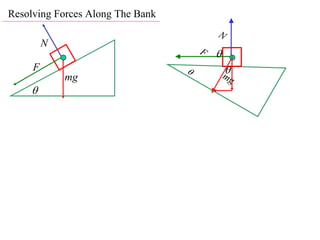
Resolving Forces Along The Bank
                                          N
 mv 2 N
  r                                   F   
     F                                       
                                              mg
           mg
    
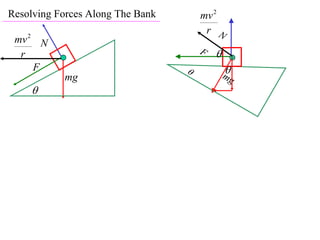
Resolving Forces Along The Bank       mv 2
                                       r N
 mv 2 N
  r                                   F   
     F                                       
                                              mg
           mg
    
Resolving Forces Along The Bank       mv 2
                                       r N
 mv 2 N
  r                                   F   
     F                                       
                                              mg
           mg
    
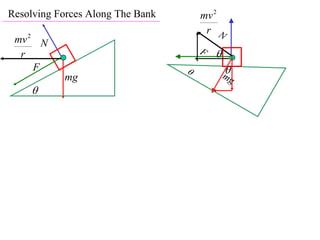
Resolving Forces Along The Bank         mv 2
                                         r N
 mv 2 N
  r                                     F   
     F                                         
                                                mg
             mg
     

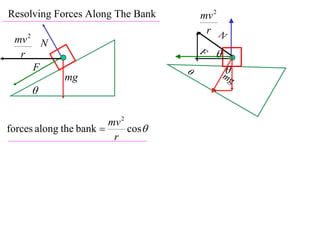
                        mv 2
forces along the bank       cos
                         r
Resolving Forces Along The Bank         mv 2
                                         r N
 mv 2 N
  r                                     F   
     F                                         
                                                mg
             mg
     

                        mv 2
forces along the bank       cos
                         r
Resolving Forces Along The Bank         mv 2
                                         r N
 mv 2 N
  r                                     F   
     F                                         
                                                mg
             mg
     

                        mv 2
forces along the bank       cos
                         r
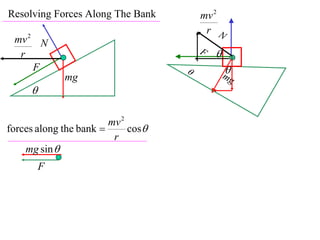
    mg sin 
         F
Resolving Forces Along The Bank         mv 2
                                         r N
 mv 2 N
  r                                     F   
     F                                         
                                                mg
             mg
     

                        mv 2
forces along the bank       cos
                         r
    mg sin 
      F
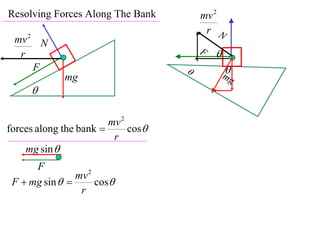
                mv 2
 F  mg sin        cos
                 r
Resolving Forces Along The Bank         mv 2
                                         r N
 mv 2 N
  r                                     F   
     F                                         
                                                mg
             mg
     

                        mv 2
forces along the bank       cos
                         r
    mg sin 
      F
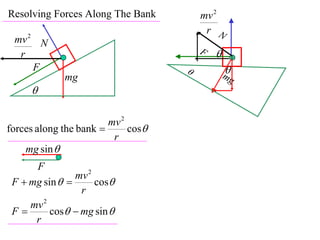
                mv 2
 F  mg sin        cos
                 r
     mv 2
 F       cos  mg sin 
      r
Resolving Forces Along The Bank           mv 2
                                           r N
 mv 2 N
  r                                       F   
     F                                           
                                                  mg
             mg
     

                        mv 2                            mv 2
forces along the bank       cos   forces  the bank       sin 
                         r                               r
    mg sin 
      F
                mv 2
 F  mg sin        cos
                 r
     mv 2
 F       cos  mg sin 
      r
Resolving Forces Along The Bank           mv 2
                                           r N
 mv 2 N
  r                                       F   
     F                                           
                                                  mg
             mg
     

                        mv 2                            mv 2
forces along the bank       cos   forces  the bank       sin 
                         r                               r
    mg sin 
      F
                mv 2
 F  mg sin        cos
                 r
     mv 2
 F       cos  mg sin 
      r
Resolving Forces Along The Bank               mv 2
                                               r N
 mv 2 N
  r                                           F   
     F                                               
                                                      mg
             mg
     

                        mv 2                                mv 2
forces along the bank       cos       forces  the bank       sin 
                         r                                   r
    mg sin                         N
      F
                mv 2                mg cos
 F  mg sin        cos
                 r
     mv 2
 F       cos  mg sin 
      r
Resolving Forces Along The Bank               mv 2
                                               r N
 mv 2 N
  r                                           F   
     F                                               
                                                      mg
             mg
     

                        mv 2                                mv 2
forces along the bank       cos       forces  the bank       sin 
                         r                                   r
    mg sin                         N
      F
                mv 2                mg cos
 F  mg sin        cos                                   mv 2
                 r                            N  mg cos       sin 
     mv 2                                                    r
 F       cos  mg sin 
      r
Resolving Forces Along The Bank               mv 2
                                               r N
 mv 2 N
  r                                           F   
     F                                               
                                                      mg
             mg
     

                        mv 2                                mv 2
forces along the bank       cos       forces  the bank       sin 
                         r                                   r
    mg sin                         N
      F
                mv 2                mg cos
 F  mg sin        cos                                     mv 2
                 r                            N  mg cos         sin 
     mv 2                                                       r
 F       cos  mg sin 
                                                     2
                                                  mv
      r                                       N       sin   mg cos
                                                   r
Exercise 9D; all

X2 t06 06 banked curves (2012)

  • 1.
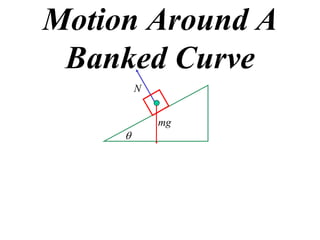
    Motion Around A Banked Curve
  • 2.
    Motion Around A Banked Curve 
  • 3.
    Motion Around A Banked Curve 
  • 4.
    Motion Around A Banked Curve N 
  • 5.
    Motion Around A Banked Curve N mg 
  • 6.
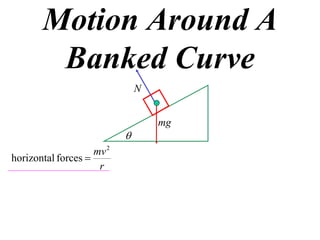
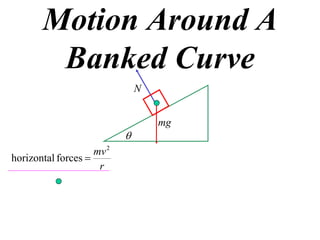
    Motion Around A Banked Curve N mg  mv 2 horizontal forces  r
  • 7.
    Motion Around A Banked Curve N mg  mv 2 horizontal forces  r
  • 8.
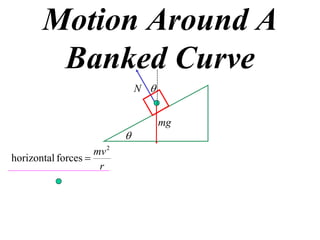
    Motion Around A Banked Curve N  mg  mv 2 horizontal forces  r
  • 9.
    Motion Around A Banked Curve N  mg  mv 2 horizontal forces  r N sin 
  • 10.
    Motion Around A Banked Curve N  mg  mv 2 horizontal forces  r N sin  2 mv N sin   r
  • 11.
    Motion Around A Banked Curve N  mg  mv 2 horizontal forces  vertical forces  0 r N sin  2 mv N sin   r
  • 12.
    Motion Around A Banked Curve N  mg  mv 2 horizontal forces  vertical forces  0 r N sin  2 mv N sin   r
  • 13.
    Motion Around A Banked Curve N  mg  mv 2 horizontal forces  vertical forces  0 r N sin  2 N cos mv N sin   mg r
  • 14.
    Motion Around A Banked Curve N  mg  mv 2 horizontal forces  vertical forces  0 r N sin  2 N cos N cos  mg  0 mv N cos  mg N sin   mg r
  • 15.
    mv 2 1 tan   r mg v2  rg
  • 16.
    mv 2 1 tan    r mg v2  rg e.g. (i) A railway line has been constructed around a circular curve of radius 400m. The distance between the rails is 1.5m and the outside rail is 0.08m above the inside rail. Find the most favourable speed (the speed that eliminates a sideways force on the wheels) for a train on this curve.
  • 17.
    mv 2 1 tan    r mg v2  rg e.g. (i) A railway line has been constructed around a circular curve of radius 400m. The distance between the rails is 1.5m and the outside rail is 0.08m above the inside rail. Find the most favourable speed (the speed that eliminates a sideways force on the wheels) for a train on this curve. 
  • 18.
    mv 2 1 tan    r mg v2  rg e.g. (i) A railway line has been constructed around a circular curve of radius 400m. The distance between the rails is 1.5m and the outside rail is 0.08m above the inside rail. Find the most favourable speed (the speed that eliminates a sideways force on the wheels) for a train on this curve. 1 .5m 
  • 19.
    mv 2 1 tan    r mg v2  rg e.g. (i) A railway line has been constructed around a circular curve of radius 400m. The distance between the rails is 1.5m and the outside rail is 0.08m above the inside rail. Find the most favourable speed (the speed that eliminates a sideways force on the wheels) for a train on this curve. 1 .5m 0.08m 
  • 20.
    mv 2 1 tan    r mg v2  rg e.g. (i) A railway line has been constructed around a circular curve of radius 400m. The distance between the rails is 1.5m and the outside rail is 0.08m above the inside rail. Find the most favourable speed (the speed that eliminates a sideways force on the wheels) for a train on this curve. 1 .5m 0.08m 
  • 21.
    mv 2 1 tan    r mg v2  rg e.g. (i) A railway line has been constructed around a circular curve of radius 400m. The distance between the rails is 1.5m and the outside rail is 0.08m above the inside rail. Find the most favourable speed (the speed that eliminates a sideways force on the wheels) for a train on this curve. N 1 .5m 0.08m 
  • 22.
    mv 2 1 tan    r mg v2  rg e.g. (i) A railway line has been constructed around a circular curve of radius 400m. The distance between the rails is 1.5m and the outside rail is 0.08m above the inside rail. Find the most favourable speed (the speed that eliminates a sideways force on the wheels) for a train on this curve. N 1 .5m mg 0.08m 
  • 23.
    mv 2 1 tan    r mg v2  rg e.g. (i) A railway line has been constructed around a circular curve of radius 400m. The distance between the rails is 1.5m and the outside rail is 0.08m above the inside rail. Find the most favourable speed (the speed that eliminates a sideways force on the wheels) for a train on this curve. N  1 .5m mg 0.08m 
  • 24.
  • 25.
  • 26.
    mv 2 horizontal forces r N sin 
  • 27.
    mv 2 horizontal forces r N sin  2 mv N sin   r
  • 28.
    mv 2 horizontal forces vertical forces  0 r N sin  2 mv N sin   r
  • 29.
    mv 2 horizontal forces vertical forces  0 r N sin  2 mv N sin   r
  • 30.
    mv 2 horizontal forces vertical forces  0 r N sin  2 N cos mv N sin   mg r
  • 31.
    mv 2 horizontal forces vertical forces  0 r N sin  2 N cos N cos  mg  0 mv N cos  mg N sin   mg r
  • 32.
    mv 2 horizontal forces vertical forces  0 r N sin  2 N cos N cos  mg  0 mv N cos  mg N sin   mg r mv 2 1 tan    r mg v2  rg
  • 33.
    mv 2 horizontal forces vertical forces  0 r N sin  2 N cos N cos  mg  0 mv N cos  mg N sin   mg r mv 2 1 tan    r mg v2  rg 0.08 But sin   1.5 4  75
  • 34.
    mv 2 horizontal forces vertical forces  0 r N sin  2 N cos N cos  mg  0 mv N cos  mg N sin   mg r mv 2 1 tan    r mg v2  rg 0.08 But sin   1.5 4  75 4  tan   5609
  • 35.
    mv 2 horizontal forces vertical forces  0 r N sin  2 N cos N cos  mg  0 mv N cos  mg N sin   mg r mv 2 1 v2 4 tan      r mg 4009.8 5609 v2  rg 0.08 But sin   1.5 4  75 4  tan   5609
  • 36.
    mv 2 horizontal forces vertical forces  0 r N sin  2 N cos N cos  mg  0 mv N cos  mg N sin   mg r mv 2 1 v2 4 tan      r mg 4009.8 5609  v2 4400 9.8 rg v2  5609 0.08 But sin   v  14.47 m/s 1.5 v  52km/h 4  75 4  tan   5609
  • 37.
    (ii) (1995) A particle of mass m travels at a constant speed v round a circular track of radius R, centre C. The track is banked inwards at an angle  , and the particle does not move up or down the bank. The reaction exerted by the track on the particle has a normal component N, and a component F due to friction, directed up or down the bank. The force F lies in the range  N to N , where  is a positive constant and N is the normal component; the sign of F is positive when F is directed up the bank. The acceleration due to gravity is2 g. The acceleration related to the circular motion is of magnitude v and is directed towards the centre of the track. R
  • 38.
    a) By resolvingforces horizontally and vertically, show that; v 2 N sin   F cos  Rg N cos  F sin 
  • 39.
    a) By resolvingforces horizontally and vertically, show that; v 2 N sin   F cos    Rg N cos  F sin 
  • 40.
    a) By resolvingforces horizontally and vertically, show that; v 2 N sin   F cos    Rg N cos  F sin  mv 2 horizontal forces  R
  • 41.
    a) By resolvingforces horizontally and vertically, show that; v 2 N sin   F cos    Rg N cos  F sin  mv 2 horizontal forces  R
  • 42.
    a) By resolvingforces horizontally and vertically, show that; v 2 N sin   F cos    Rg N cos  F sin  mv 2 horizontal forces  R N sin  F cos
  • 43.
    a) By resolvingforces horizontally and vertically, show that; v 2 N sin   F cos    Rg N cos  F sin  mv 2 horizontal forces  R N sin  F cos mv 2 N sin   F cos  R
  • 44.
    a) By resolvingforces horizontally and vertically, show that; v 2 N sin   F cos    Rg N cos  F sin  mv 2 horizontal forces  vertical forces  0 R N sin  F cos mv 2 N sin   F cos  R
  • 45.
    a) By resolvingforces horizontally and vertically, show that; v 2 N sin   F cos    Rg N cos  F sin  mv 2 horizontal forces  vertical forces  0 R N sin  F cos mv 2 N sin   F cos  R
  • 46.
    a) By resolvingforces horizontally and vertically, show that; v 2 N sin   F cos    Rg N cos  F sin  mv 2 horizontal forces  vertical forces  0 R N sin  F cos N cos F sin  mv 2 mg N sin   F cos  R
  • 47.
    a) By resolvingforces horizontally and vertically, show that; v 2 N sin   F cos    Rg N cos  F sin  mv 2 horizontal forces  vertical forces  0 R N sin  F cos N cos F sin  N cos  F sin   mg  0 mv 2 mg N cos  F sin   mg N sin   F cos  R
  • 48.
    a) By resolvingforces horizontally and vertically, show that; v 2 N sin   F cos    Rg N cos  F sin  mv 2 horizontal forces  vertical forces  0 R N sin  F cos N cos F sin  N cos  F sin   mg  0 mv 2 mg N cos  F sin   mg N sin   F cos  R v 2 mv 2 1   Rg R mg
  • 49.
    a) By resolvingforces horizontally and vertically, show that; v 2 N sin   F cos    Rg N cos  F sin  mv 2 horizontal forces  vertical forces  0 R N sin  F cos N cos F sin  N cos  F sin   mg  0 mv 2 mg N cos  F sin   mg N sin   F cos  R v 2 mv 2 1   Rg R mg v 2 N sin   F cos  Rg N cos  F sin 
  • 50.
    b) Show thatthe maximum speed vmaxat which the particle can travel without slipping up the track is given by; vmax tan    2  Rg 1   tan  You may suppose that  tan   1
  • 51.
    b) Show thatthe maximum speed vmaxat which the particle can travel without slipping up the track is given by; vmax tan    2  Rg 1   tan  You may suppose that  tan   1 As it is the friction that resists the particle moving up or down the slope, then if the particle is not slipping up, then friction must be at a maximum in the opposite direction, i.e. F   N
  • 52.
    b) Show thatthe maximum speed vmaxat which the particle can travel without slipping up the track is given by; vmax tan    2  Rg 1   tan  You may suppose that  tan   1 As it is the friction that resists the particle moving up or down the slope, then if the particle is not slipping up, then friction must be at a maximum in the opposite direction, i.e. F   N vmax N sin   N cos 2  Rg N cos  N sin 
  • 53.
    b) Show thatthe maximum speed vmaxat which the particle can travel without slipping up the track is given by; vmax tan    2  Rg 1   tan  You may suppose that  tan   1 As it is the friction that resists the particle moving up or down the slope, then if the particle is not slipping up, then friction must be at a maximum in the opposite direction, i.e. F   N vmax N sin   N cos 2  Rg N cos  N sin  sin  cos   cos cos cos sin   cos cos tan     1   tan 
  • 54.
    c) Show thatif   tan  , then the particle will not slide down the track, regardless of its speed.
  • 55.
    c) Show thatif   tan  , then the particle will not slide down the track, regardless of its speed. vmin is the minimum speed the particle can travel without sliding down the track. In this case friction must be a maximum up the slope i.e. F  N
  • 56.
    c) Show thatif   tan  , then the particle will not slide down the track, regardless of its speed. vmin is the minimum speed the particle can travel without sliding down the track. In this case friction must be a maximum up the slope i.e. F  N vmin tan    2  Rg 1   tan 
  • 57.
    c) Show thatif   tan  , then the particle will not slide down the track, regardless of its speed. vmin is the minimum speed the particle can travel without sliding down the track. In this case friction must be a maximum up the slope i.e. F  N vmin tan    2  Rg 1   tan  If   tan  ;
  • 58.
    c) Show thatif   tan  , then the particle will not slide down the track, regardless of its speed. vmin is the minimum speed the particle can travel without sliding down the track. In this case friction must be a maximum up the slope i.e. F  N vmin tan    2  Rg 1   tan  If   tan  ; 2 vmin  0 Rg
  • 59.
    c) Show thatif   tan  , then the particle will not slide down the track, regardless of its speed. vmin is the minimum speed the particle can travel without sliding down the track. In this case friction must be a maximum up the slope i.e. F  N vmin tan    2  Rg 1   tan  If   tan  ; 2 vmin  0 Rg vmin  0 2 vmin  0
  • 60.
    c) Show thatif   tan  , then the particle will not slide down the track, regardless of its speed. vmin is the minimum speed the particle can travel without sliding down the track. In this case friction must be a maximum up the slope i.e. F  N vmin tan    2  Rg 1   tan  If   tan  ; 2 vmin  0 Rg vmin  0 2 vmin  0 Thus if the minimum velocity the particle can travel without sliding down the track is 0, the particle will not slide down the track, regardless of its speed.
  • 61.
    (iii) (1996) A circular drum is rotating with uniform angular velocity round a horizontal axis. A particle P is rotating in a vertical circle, without slipping, on the inside of the drum. The radius of the drum is r metres and its angular velocity is  radians/second. Acceleration due to gravity is g metres/second 2, and the mass of P is m kilograms. The centre of the drum is O, and OP makes an angle of  to the horizontal. The drum exerts a normal force N on P, as well as frictional force F, acting tangentially to the drum, as shown in the diagram. By resolving forces perpendicular to and parallel to OP, find an expression for F in terms of the data. N
  • 63.
  • 64.
    forces  OP 0 
  • 65.
    forces  OP 0 
  • 66.
    forces  OP 0  F mg cos
  • 67.
    forces  OP 0  F mg cos mg cos  F  0
  • 68.
    forces  OP 0  F mg cos mg cos  F  0 F  mg cos
  • 69.
    forces  OP 0  F mg cos mg cos  F  0 F  mg cos forces || OP  mr 2
  • 70.
    forces  OP 0  F mg cos mg cos  F  0 F  mg cos forces || OP  mr 2
  • 71.
    forces  OP 0  F mg cos mg cos  F  0 F  mg cos forces || OP  mr 2 N mg sin 
  • 72.
    forces  OP 0  F mg cos mg cos  F  0 F  mg cos forces || OP  mr 2 N mg sin  N  mg sin   mr 2
  • 73.
    forces  OP 0  F mg cos mg cos  F  0 F  mg cos forces || OP  mr 2 N mg sin  N  mg sin   mr 2 N  mr 2  mg sin 
  • 74.
    forces  OP 0  F mg cos mg cos  F  0 F  mg cos forces || OP  mr 2 N mg sin  N  mg sin   mr 2 N  mr 2  mg sin  F mg cos  N mr 2  mg sin  F g cos  2 N r  g sin 
  • 75.
  • 76.
  • 77.
  • 78.
    Resolving Forces AlongThe Bank N 
  • 79.
    Resolving Forces AlongThe Bank N mg 
  • 80.
    Resolving Forces AlongThe Bank N F mg 
  • 81.
    Resolving Forces AlongThe Bank N N F F  mg mg 
  • 82.
    Resolving Forces AlongThe Bank N N F  F   mg mg 
  • 83.
    Resolving Forces AlongThe Bank N mv 2 N r F  F   mg mg 
  • 84.
    Resolving Forces AlongThe Bank mv 2 r N mv 2 N r F  F   mg mg 
  • 85.
    Resolving Forces AlongThe Bank mv 2 r N mv 2 N r F  F   mg mg 
  • 86.
    Resolving Forces AlongThe Bank mv 2 r N mv 2 N r F  F   mg mg  mv 2 forces along the bank  cos r
  • 87.
    Resolving Forces AlongThe Bank mv 2 r N mv 2 N r F  F   mg mg  mv 2 forces along the bank  cos r
  • 88.
    Resolving Forces AlongThe Bank mv 2 r N mv 2 N r F  F   mg mg  mv 2 forces along the bank  cos r mg sin  F
  • 89.
    Resolving Forces AlongThe Bank mv 2 r N mv 2 N r F  F   mg mg  mv 2 forces along the bank  cos r mg sin  F mv 2 F  mg sin   cos r
  • 90.
    Resolving Forces AlongThe Bank mv 2 r N mv 2 N r F  F   mg mg  mv 2 forces along the bank  cos r mg sin  F mv 2 F  mg sin   cos r mv 2 F cos  mg sin  r
  • 91.
    Resolving Forces AlongThe Bank mv 2 r N mv 2 N r F  F   mg mg  mv 2 mv 2 forces along the bank  cos forces  the bank  sin  r r mg sin  F mv 2 F  mg sin   cos r mv 2 F cos  mg sin  r
  • 92.
    Resolving Forces AlongThe Bank mv 2 r N mv 2 N r F  F   mg mg  mv 2 mv 2 forces along the bank  cos forces  the bank  sin  r r mg sin  F mv 2 F  mg sin   cos r mv 2 F cos  mg sin  r
  • 93.
    Resolving Forces AlongThe Bank mv 2 r N mv 2 N r F  F   mg mg  mv 2 mv 2 forces along the bank  cos forces  the bank  sin  r r mg sin  N F mv 2 mg cos F  mg sin   cos r mv 2 F cos  mg sin  r
  • 94.
    Resolving Forces AlongThe Bank mv 2 r N mv 2 N r F  F   mg mg  mv 2 mv 2 forces along the bank  cos forces  the bank  sin  r r mg sin  N F mv 2 mg cos F  mg sin   cos mv 2 r N  mg cos  sin  mv 2 r F cos  mg sin  r
  • 95.
    Resolving Forces AlongThe Bank mv 2 r N mv 2 N r F  F   mg mg  mv 2 mv 2 forces along the bank  cos forces  the bank  sin  r r mg sin  N F mv 2 mg cos F  mg sin   cos mv 2 r N  mg cos  sin  mv 2 r F cos  mg sin  2 mv r N sin   mg cos r
  • 96.