Copyright Sautter 2003
The next slide is a quick promo for my books
after which the presentation will begin
Thanks for your patience!
Walt S.
Wsautter@optonline.net
More stuff at: www.wsautter.com
Books available at:
www.wsautter.com
www.smashwords.com
www.amazon.com
www.bibliotastic.com
www.goodreads.com
Walt’s Books for Free!
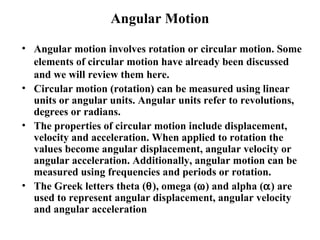
Angular Motion
• Angular motion involves rotation or circular motion. Some
elements of circular motion have already been discussed
and we will review them here.
• Circular motion (rotation) can be measured using linear
units or angular units. Angular units refer to revolutions,
degrees or radians.
• The properties of circular motion include displacement,
velocity and acceleration. When applied to rotation the
values become angular displacement, angular velocity or
angular acceleration. Additionally, angular motion can be
measured using frequencies and periods or rotation.
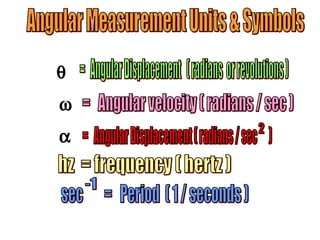
• The Greek letters theta (θ), omega (ω) and alpha (α) are
used to represent angular displacement, angular velocity
and angular acceleration
θ
ω
α
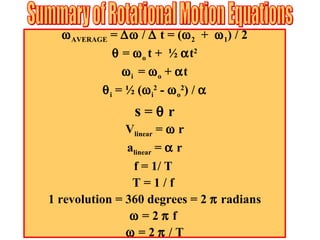
ωAVERAGE = ∆ω / ∆ t = (ω2 + ω1) / 2
θ = ωo t + ½ αt2
ωi = ωo + αt
θi = ½ (ωi
2
- ωo
2
) / α
s = θ r
Vlinear = ω r
alinear = α r
f = 1/ T
T = 1 / f
1 revolution = 360 degrees = 2 π radians
ω = 2 π f
ω = 2 π / T
Moment of Inertia
• All states of motion are subject to the laws of inertia, that is
tend to remain at the same rate and in the same directional
orientation.
• In the case of rotational motion, the angular velocity tends to
remain unchanged and the plane of rotation persists.
• As you will recall, outside forces can change inertial
conditions. In rotation, outside torques must be applied to
change an objects rotational inertia.
• Torque, as you remember, is a force applied perpendicularly
to the center of rotation.
• τ = F x r
Moment of Inertia
• The tendency of a body to resist changes in its linear
state of motion is measured by its mass.
• The tendency of a body to resist changes in its
rotational state of motion is measured by its moment of
inertia.
• Moment of inertia involves not just the mass of a
rotating object but also the distribution of the mass
within the object.
• τ = F x r, recall that F = ma, therefore:
• τ = ma x r, since a = α r, τ = m α r x r =(mr2
)α
• I = mr2
and τ = Iα
Moment of Inertia
• τ = Iα
• Note the similarity to F = ma for linear motion.
Instead of a applied force (F) and applied torque (τ) is
necessary to provide acceleration.
• Instead of mass (m), the moment of inertia (I)
determines the resulting acceleration.
• Instead of linear acceleration (a), angular acceleration
(α) results from the application of a torque.
• Although, the moment of inertia in its simplest form is
given as mass times radius squared (mr2
), in more
complex bodies the value of I must be found by
calculus methods (integration) or experimental
means.
The Laws of Motion for Rotating Bodies
(A summary)
• First Law – A body which is rotating tends to keep
rotating at the same rate and in the same plane unless
acted on by an outside torque.
• Second Law –
Torque = Moment of Inertia x angular acceleration
(τ = Iα)
• Third Law – for every torque there must be an equal
but opposite torque.
Moment of Inertia
• When the moment of inertia is found by experiment
a simplifying technique similar to the center of mass
concept is used.
• Remember, the center of mass of an object is a point
where all the mass of the body could be concentrated
to give the same inertial properties as the actual
mass distribution of the body.
• When describing rotational motion, radius of
gyration is used in place of the center of mass
concept.
• The radius of gyration of a body is the radius of a
thin ring of a mass equal to the mass of the body
which would give the same rotational characteristics
as the actual body.
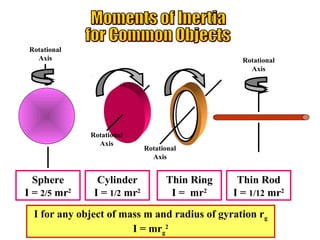
Sphere
I = 2/5 mr2
Cylinder
I = 1/2 mr2
Thin Ring
I = mr2
Thin Rod
I = 1/12 mr2
Rotational
Axis
Rotational
Axis
Rotational
Axis
Rotational
Axis
I for any object of mass m and radius of gyration rg
I = mrg
2
Equations for Rotational Motion
• All bodies in linear motion possess characteristics
such as momentum and kinetic energy. All
rotating body possess similar properties.
• Linear equations can be converted to rotational
analogs by substituting angular values into the
linear equations.
• Careful analysis of the units involved will show
that the rotational equations yield the appropriate
units for each quantity measured (joules for
energy, kg m/s for momentum, watts for power,
etc.)
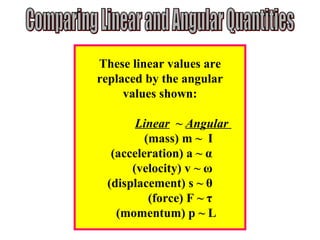
These linear values are
replaced by the angular
values shown:
Linear ~ Angular
(mass) m ~ I
(acceleration) a ~ α
(velocity) v ~ ω
(displacement) s ~ θ
(force) F ~ τ
(momentum) p ~ L
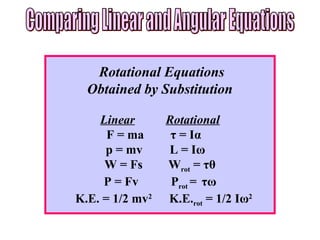
Rotational Equations
Obtained by Substitution
Linear Rotational
F = ma τ = Iα
p = mv L = Iω
W = Fs Wrot = τθ
P = Fv Prot = τω
K.E. = 1/2 mv2
K.E.rot = 1/2 Iω2
Rotational Dynamic Problems
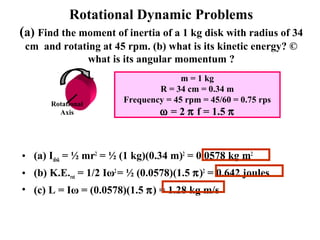
(a) Find the moment of inertia of a 1 kg disk with radius of 34
cm and rotating at 45 rpm. (b) what is its kinetic energy? ©
what is its angular momentum ?
• (a) Idisk = ½ mr2
= ½ (1 kg)(0.34 m)2
= 0.0578 kg m2
• (b) K.E.rot = 1/2 Iω2
= ½ (0.0578)(1.5 π)2
= 0.642 joules
• (c) L = Iω = (0.0578)(1.5 π) = 1.28 kg m/s
Rotational
Axis
m = 1 kg
R = 34 cm = 0.34 m
Frequency = 45 rpm = 45/60 = 0.75 rps
ω = 2 π f = 1.5 π
Rotational Dynamic Problems
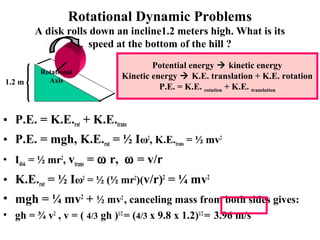
A disk rolls down an incline1.2 meters high. What is its
speed at the bottom of the hill ?
• P.E. = K.E.rot + K.E.trans
• P.E. = mgh, K.E.rot = ½ Iω2
, K.E.trans = ½ mv2
• Idisk = ½ mr2
, vtrans = ω r, ω = v/r
• K.E.rot = ½ Iω2
= ½ (½ mr2
)(v/r)2
= ¼ mv2
• mgh = ¼ mv2
+ ½ mv2
, canceling mass from both sides gives:
• gh = ¾ v2
, v = ( 4/3 gh )1/2
= (4/3 x 9.8 x 1.2)1/2
= 3.96 m/s
Potential energy  kinetic energy
Kinetic energy  K.E. translation + K.E. rotation
P.E. = K.E. rotation + K.E. translation
Rotational
Axis1.2 m
Rotational Dynamic Problems
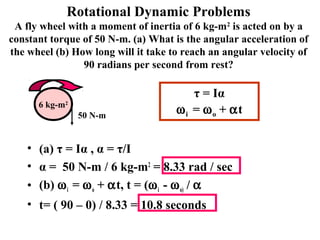
A fly wheel with a moment of inertia of 6 kg-m2
is acted on by a
constant torque of 50 N-m. (a) What is the angular acceleration of
the wheel (b) How long will it take to reach an angular velocity of
90 radians per second from rest?
• (a) τ = Iα , α = τ/I
• α = 50 N-m / 6 kg-m2
= 8.33 rad / sec
• (b) ωi = ωo + αt, t = (ωi - ωo) / α
• t= ( 90 – 0) / 8.33 = 10.8 seconds
6 kg-m2
50 N-m
τ = Iα
ωi = ωo + αt
Rotational Dynamic Problems
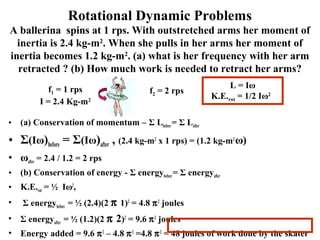
A ballerina spins at 1 rps. With outstretched arms her moment of
inertia is 2.4 kg-m2
. When she pulls in her arms her moment of
inertia becomes 1.2 kg-m2
. (a) what is her frequency with her arm
retracted ? (b) How much work is needed to retract her arms?
• (a) Conservation of momentum – Σ Lbefore= Σ Lafter
• Σ(Iω)before = Σ(Iω)after , (2.4 kg-m2
x 1 rps) = (1.2 kg-m2
ω)
• ωafter = 2.4 / 1.2 = 2 rps
• (b) Conservation of energy - Σ energybefore= Σ energyafter
• K.E.rot = ½ Iω2
,
• Σ energybefore = ½ (2.4)(2 π 1)2
= 4.8 π2
joules
• Σ energyafter = ½ (1.2)(2 π 2)2
= 9.6 π2
joules
• Energy added = 9.6 π2
– 4.8 π2
=4.8 π2
= 48 joules of work done by the skater
L = Iω
K.E.rot = 1/2 Iω2
f1 = 1 rps
I = 2.4 Kg-m2
f2 = 2 rps
Rotational Dynamic Problems
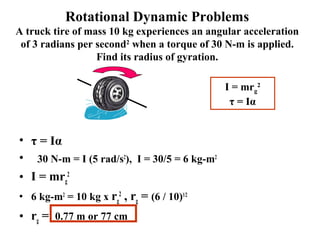
A truck tire of mass 10 kg experiences an angular acceleration
of 3 radians per second2
when a torque of 30 N-m is applied.
Find its radius of gyration.
• τ = Iα
• 30 N-m = I (5 rad/s2
), I = 30/5 = 6 kg-m2
• I = mrg
2
• 6 kg-m2
= 10 kg x rg
2
, rg = (6 / 10)1/2
• rg = 0.77 m or 77 cm
I = mrg
2
τ = Iα
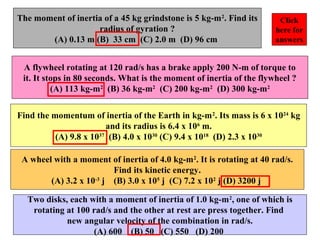
The moment of inertia of a 45 kg grindstone is 5 kg-m2
. Find its
radius of gyration ?
(A) 0.13 m (B) 33 cm (C) 2.0 m (D) 96 cm
A flywheel rotating at 120 rad/s has a brake apply 200 N-m of torque to
it. It stops in 80 seconds. What is the moment of inertia of the flywheel ?
(A) 113 kg-m2
(B) 36 kg-m2
(C) 200 kg-m2
(D) 300 kg-m2
Find the momentum of inertia of the Earth in kg-m2
. Its mass is 6 x 1024
kg
and its radius is 6.4 x 10⁶
m.
(A) 9.8 x 1037
(B) 4.0 x 1030
(C) 9.4 x 10¹⁸
(D) 2.3 x 1030
A wheel with a moment of inertia of 4.0 kg-m2
. It is rotating at 40 rad/s.
Find its kinetic energy.
(A) 3.2 x 10⁻³
j (B) 3.0 x 10⁵
j (C) 7.2 x 10²
j (D) 3200 j
Two disks, each with a moment of inertia of 1.0 kg-m2
, one of which is
rotating at 100 rad/s and the other at rest are press together. Find
new angular velocity of the combination in rad/s.
(A) 600 (B) 50 (C) 550 (D) 200
Click
here for
answers
Angularmotionrotationdynamics 100212165341-phpapp01 (1)

Angularmotionrotationdynamics 100212165341-phpapp01 (1)

  • 1.
  • 2.
    The next slideis a quick promo for my books after which the presentation will begin Thanks for your patience! Walt S. Wsautter@optonline.net More stuff at: www.wsautter.com
  • 3.
  • 4.
    Angular Motion • Angularmotion involves rotation or circular motion. Some elements of circular motion have already been discussed and we will review them here. • Circular motion (rotation) can be measured using linear units or angular units. Angular units refer to revolutions, degrees or radians. • The properties of circular motion include displacement, velocity and acceleration. When applied to rotation the values become angular displacement, angular velocity or angular acceleration. Additionally, angular motion can be measured using frequencies and periods or rotation. • The Greek letters theta (θ), omega (ω) and alpha (α) are used to represent angular displacement, angular velocity and angular acceleration
  • 5.
  • 6.
    ωAVERAGE = ∆ω/ ∆ t = (ω2 + ω1) / 2 θ = ωo t + ½ αt2 ωi = ωo + αt θi = ½ (ωi 2 - ωo 2 ) / α s = θ r Vlinear = ω r alinear = α r f = 1/ T T = 1 / f 1 revolution = 360 degrees = 2 π radians ω = 2 π f ω = 2 π / T
  • 7.
    Moment of Inertia •All states of motion are subject to the laws of inertia, that is tend to remain at the same rate and in the same directional orientation. • In the case of rotational motion, the angular velocity tends to remain unchanged and the plane of rotation persists. • As you will recall, outside forces can change inertial conditions. In rotation, outside torques must be applied to change an objects rotational inertia. • Torque, as you remember, is a force applied perpendicularly to the center of rotation. • τ = F x r
  • 8.
    Moment of Inertia •The tendency of a body to resist changes in its linear state of motion is measured by its mass. • The tendency of a body to resist changes in its rotational state of motion is measured by its moment of inertia. • Moment of inertia involves not just the mass of a rotating object but also the distribution of the mass within the object. • τ = F x r, recall that F = ma, therefore: • τ = ma x r, since a = α r, τ = m α r x r =(mr2 )α • I = mr2 and τ = Iα
  • 9.
    Moment of Inertia •τ = Iα • Note the similarity to F = ma for linear motion. Instead of a applied force (F) and applied torque (τ) is necessary to provide acceleration. • Instead of mass (m), the moment of inertia (I) determines the resulting acceleration. • Instead of linear acceleration (a), angular acceleration (α) results from the application of a torque. • Although, the moment of inertia in its simplest form is given as mass times radius squared (mr2 ), in more complex bodies the value of I must be found by calculus methods (integration) or experimental means.
  • 10.
    The Laws ofMotion for Rotating Bodies (A summary) • First Law – A body which is rotating tends to keep rotating at the same rate and in the same plane unless acted on by an outside torque. • Second Law – Torque = Moment of Inertia x angular acceleration (τ = Iα) • Third Law – for every torque there must be an equal but opposite torque.
  • 11.
    Moment of Inertia •When the moment of inertia is found by experiment a simplifying technique similar to the center of mass concept is used. • Remember, the center of mass of an object is a point where all the mass of the body could be concentrated to give the same inertial properties as the actual mass distribution of the body. • When describing rotational motion, radius of gyration is used in place of the center of mass concept. • The radius of gyration of a body is the radius of a thin ring of a mass equal to the mass of the body which would give the same rotational characteristics as the actual body.
  • 12.
    Sphere I = 2/5mr2 Cylinder I = 1/2 mr2 Thin Ring I = mr2 Thin Rod I = 1/12 mr2 Rotational Axis Rotational Axis Rotational Axis Rotational Axis I for any object of mass m and radius of gyration rg I = mrg 2
  • 13.
    Equations for RotationalMotion • All bodies in linear motion possess characteristics such as momentum and kinetic energy. All rotating body possess similar properties. • Linear equations can be converted to rotational analogs by substituting angular values into the linear equations. • Careful analysis of the units involved will show that the rotational equations yield the appropriate units for each quantity measured (joules for energy, kg m/s for momentum, watts for power, etc.)
  • 14.
    These linear valuesare replaced by the angular values shown: Linear ~ Angular (mass) m ~ I (acceleration) a ~ α (velocity) v ~ ω (displacement) s ~ θ (force) F ~ τ (momentum) p ~ L
  • 15.
    Rotational Equations Obtained bySubstitution Linear Rotational F = ma τ = Iα p = mv L = Iω W = Fs Wrot = τθ P = Fv Prot = τω K.E. = 1/2 mv2 K.E.rot = 1/2 Iω2
  • 17.
    Rotational Dynamic Problems (a)Find the moment of inertia of a 1 kg disk with radius of 34 cm and rotating at 45 rpm. (b) what is its kinetic energy? © what is its angular momentum ? • (a) Idisk = ½ mr2 = ½ (1 kg)(0.34 m)2 = 0.0578 kg m2 • (b) K.E.rot = 1/2 Iω2 = ½ (0.0578)(1.5 π)2 = 0.642 joules • (c) L = Iω = (0.0578)(1.5 π) = 1.28 kg m/s Rotational Axis m = 1 kg R = 34 cm = 0.34 m Frequency = 45 rpm = 45/60 = 0.75 rps ω = 2 π f = 1.5 π
  • 18.
    Rotational Dynamic Problems Adisk rolls down an incline1.2 meters high. What is its speed at the bottom of the hill ? • P.E. = K.E.rot + K.E.trans • P.E. = mgh, K.E.rot = ½ Iω2 , K.E.trans = ½ mv2 • Idisk = ½ mr2 , vtrans = ω r, ω = v/r • K.E.rot = ½ Iω2 = ½ (½ mr2 )(v/r)2 = ¼ mv2 • mgh = ¼ mv2 + ½ mv2 , canceling mass from both sides gives: • gh = ¾ v2 , v = ( 4/3 gh )1/2 = (4/3 x 9.8 x 1.2)1/2 = 3.96 m/s Potential energy  kinetic energy Kinetic energy  K.E. translation + K.E. rotation P.E. = K.E. rotation + K.E. translation Rotational Axis1.2 m
  • 19.
    Rotational Dynamic Problems Afly wheel with a moment of inertia of 6 kg-m2 is acted on by a constant torque of 50 N-m. (a) What is the angular acceleration of the wheel (b) How long will it take to reach an angular velocity of 90 radians per second from rest? • (a) τ = Iα , α = τ/I • α = 50 N-m / 6 kg-m2 = 8.33 rad / sec • (b) ωi = ωo + αt, t = (ωi - ωo) / α • t= ( 90 – 0) / 8.33 = 10.8 seconds 6 kg-m2 50 N-m τ = Iα ωi = ωo + αt
  • 20.
    Rotational Dynamic Problems Aballerina spins at 1 rps. With outstretched arms her moment of inertia is 2.4 kg-m2 . When she pulls in her arms her moment of inertia becomes 1.2 kg-m2 . (a) what is her frequency with her arm retracted ? (b) How much work is needed to retract her arms? • (a) Conservation of momentum – Σ Lbefore= Σ Lafter • Σ(Iω)before = Σ(Iω)after , (2.4 kg-m2 x 1 rps) = (1.2 kg-m2 ω) • ωafter = 2.4 / 1.2 = 2 rps • (b) Conservation of energy - Σ energybefore= Σ energyafter • K.E.rot = ½ Iω2 , • Σ energybefore = ½ (2.4)(2 π 1)2 = 4.8 π2 joules • Σ energyafter = ½ (1.2)(2 π 2)2 = 9.6 π2 joules • Energy added = 9.6 π2 – 4.8 π2 =4.8 π2 = 48 joules of work done by the skater L = Iω K.E.rot = 1/2 Iω2 f1 = 1 rps I = 2.4 Kg-m2 f2 = 2 rps
  • 21.
    Rotational Dynamic Problems Atruck tire of mass 10 kg experiences an angular acceleration of 3 radians per second2 when a torque of 30 N-m is applied. Find its radius of gyration. • τ = Iα • 30 N-m = I (5 rad/s2 ), I = 30/5 = 6 kg-m2 • I = mrg 2 • 6 kg-m2 = 10 kg x rg 2 , rg = (6 / 10)1/2 • rg = 0.77 m or 77 cm I = mrg 2 τ = Iα
  • 23.
    The moment ofinertia of a 45 kg grindstone is 5 kg-m2 . Find its radius of gyration ? (A) 0.13 m (B) 33 cm (C) 2.0 m (D) 96 cm A flywheel rotating at 120 rad/s has a brake apply 200 N-m of torque to it. It stops in 80 seconds. What is the moment of inertia of the flywheel ? (A) 113 kg-m2 (B) 36 kg-m2 (C) 200 kg-m2 (D) 300 kg-m2 Find the momentum of inertia of the Earth in kg-m2 . Its mass is 6 x 1024 kg and its radius is 6.4 x 10⁶ m. (A) 9.8 x 1037 (B) 4.0 x 1030 (C) 9.4 x 10¹⁸ (D) 2.3 x 1030 A wheel with a moment of inertia of 4.0 kg-m2 . It is rotating at 40 rad/s. Find its kinetic energy. (A) 3.2 x 10⁻³ j (B) 3.0 x 10⁵ j (C) 7.2 x 10² j (D) 3200 j Two disks, each with a moment of inertia of 1.0 kg-m2 , one of which is rotating at 100 rad/s and the other at rest are press together. Find new angular velocity of the combination in rad/s. (A) 600 (B) 50 (C) 550 (D) 200 Click here for answers