BRAINWARE
UNIVERSITY
Name- Anwesa Sardar
Student code- BWU/BRI/20/012
Semester- 3rd
Subject Name- Contrast and special radiography
procedures
Subject code- BMRIT 304
Topic name- X-ray tubes their types and advancements
CONTENTS
Introduction
Crookes tube and Coolidge Tube
Stationary anode X-ray tube and Rotating anode X-ray tube
Grid controlled X-ray tube and metal ceramic X-ray tube
INTRODUCTION
X-ray tube is a tube which is air evacuated and produce X- rays.
It mainly produce and attract electrons.
It’s basic principle is High voltage across anode and cathode, emitted electrons and interact
and produce X-rays.
Types: According to cathode: a) Cold cathode tubes(Crookes tube)
b)Hot cathode tubes (all other types)
According to anode: a) Stationary anode X-ray tube
b) Rotating anode X-ray tube
c)Grid controlled X-ray tube
d)Metal ceramic X-ray tube
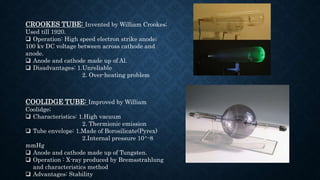
CROOKES TUBE: Invented by William Crookes;
Used till 1920.
 Operation: High speed electron strike anode;
100 kv DC voltage between across cathode and
anode.
 Anode and cathode made up of Al.
 Disadvantages: 1.Unreliable
2. Over-heating problem
COOLIDGE TUBE: Improved by William
Coolidge;
 Characteristics: 1.High vacuum
2. Thermionic emission
 Tube envelope: 1.Made of Borosilicate(Pyrex)
2.Internal pressure 10^-8
mmHg
 Anode and cathode made up of Tungsten.
 Operation : X-ray produced by Bremsstrahlung
and characteristics method
 Advantages: Stability
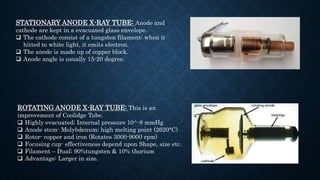
ROTATING ANODE X-RAY TUBE: This is an
improvement of Coolidge Tube.
 Highly evacuated; Internal pressure 10^-8 mmHg
 Anode stem- Molybdenum; high melting point (2620°C)
 Rotor- copper and iron (Rotates 3000-9000 rpm)
 Focusing cup- effectiveness depend upon Shape, size etc.
 Filament – Dual; 90%tungsten & 10% thorium
 Advantage: Larger in size.
STATIONARY ANODE X-RAY TUBE: Anode and
cathode are kept in a evacuated glass envelope.
 The cathode consist of a tungsten filament; when it
hitted to white light, it emits electron.
 The anode is made up of copper block.
 Anode angle is usually 15-20 degree.
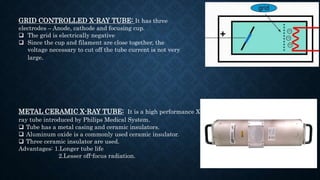
GRID CONTROLLED X-RAY TUBE: It has three
electrodes – Anode, cathode and focusing cup.
 The grid is electrically negative
 Since the cup and filament are close together, the
voltage necessary to cut off the tube current is not very
large.
METAL CERAMIC X-RAY TUBE: It is a high performance X
ray tube introduced by Philips Medical System.
 Tube has a metal casing and ceramic insulators.
 Aluminum oxide is a commonly used ceramic insulator.
 Three ceramic insulator are used.
Advantages: 1.Longer tube life
2.Lesser off-focus radiation.
X  ray tubes types and advancements

X ray tubes types and advancements

  • 1.
    BRAINWARE UNIVERSITY Name- Anwesa Sardar Studentcode- BWU/BRI/20/012 Semester- 3rd Subject Name- Contrast and special radiography procedures Subject code- BMRIT 304 Topic name- X-ray tubes their types and advancements
  • 2.
    CONTENTS Introduction Crookes tube andCoolidge Tube Stationary anode X-ray tube and Rotating anode X-ray tube Grid controlled X-ray tube and metal ceramic X-ray tube
  • 3.
    INTRODUCTION X-ray tube isa tube which is air evacuated and produce X- rays. It mainly produce and attract electrons. It’s basic principle is High voltage across anode and cathode, emitted electrons and interact and produce X-rays. Types: According to cathode: a) Cold cathode tubes(Crookes tube) b)Hot cathode tubes (all other types) According to anode: a) Stationary anode X-ray tube b) Rotating anode X-ray tube c)Grid controlled X-ray tube d)Metal ceramic X-ray tube
  • 4.
    CROOKES TUBE: Inventedby William Crookes; Used till 1920.  Operation: High speed electron strike anode; 100 kv DC voltage between across cathode and anode.  Anode and cathode made up of Al.  Disadvantages: 1.Unreliable 2. Over-heating problem COOLIDGE TUBE: Improved by William Coolidge;  Characteristics: 1.High vacuum 2. Thermionic emission  Tube envelope: 1.Made of Borosilicate(Pyrex) 2.Internal pressure 10^-8 mmHg  Anode and cathode made up of Tungsten.  Operation : X-ray produced by Bremsstrahlung and characteristics method  Advantages: Stability
  • 5.
    ROTATING ANODE X-RAYTUBE: This is an improvement of Coolidge Tube.  Highly evacuated; Internal pressure 10^-8 mmHg  Anode stem- Molybdenum; high melting point (2620°C)  Rotor- copper and iron (Rotates 3000-9000 rpm)  Focusing cup- effectiveness depend upon Shape, size etc.  Filament – Dual; 90%tungsten & 10% thorium  Advantage: Larger in size. STATIONARY ANODE X-RAY TUBE: Anode and cathode are kept in a evacuated glass envelope.  The cathode consist of a tungsten filament; when it hitted to white light, it emits electron.  The anode is made up of copper block.  Anode angle is usually 15-20 degree.
  • 6.
    GRID CONTROLLED X-RAYTUBE: It has three electrodes – Anode, cathode and focusing cup.  The grid is electrically negative  Since the cup and filament are close together, the voltage necessary to cut off the tube current is not very large. METAL CERAMIC X-RAY TUBE: It is a high performance X ray tube introduced by Philips Medical System.  Tube has a metal casing and ceramic insulators.  Aluminum oxide is a commonly used ceramic insulator.  Three ceramic insulator are used. Advantages: 1.Longer tube life 2.Lesser off-focus radiation.