X-RAY TUBES
BY
AUGUSTIN PCS
CONTENTS
• Introduction
• Types
• Construction of each tubes
• Features of each tube
• Line focus principle & anode heel effect
• Tube rating
• Tube failure
• Care of tube
• Conclusion
INTRODUCTION
• A tube is air evacuated device.
• In which the x-rays are produced.
• Characteristics-:
i) produce electrons
ii) attract electron
iii) physical protective casing
iv) radiation protection
• Purpose:
provide x-rays from near source.
INTRODUCTION
Requirement:
• Ability to control quality and quantity.
• X-ray emission from desired port
• movement
Basic principle:
• High voltage across anode and cathode
• electrons emitted
• accelerated toward anode
• Interact and produce x-ray.
TYPES
• According to the cathode
Two types
• Cold cathode tube(Crookes tube)
• Hot cathode tubes (all other types)
• According to the anode
Three types
• Stationary anode x-ray tube
• Rotating anode x-ray tube
( conventional radiography tubes, mammography tube, grid
control x-ray tube)
• Rotating envelope x-ray tube
Crookes Tube
Crookes Tube
• Crookes tube
• Historically , x-rays were discovered
radiating from experimental discharge tubes,
called Crookes tube.
• Invented by William Crookes and others.
• Commonly known as cold tubes.
• Used till 1920.
Crookes Tube
Consists :
• Tube Envelope
• Anode
• Cathode
• Anti Cathode
Tube Envelope
• Consists of a partially evacuated glass bulb .
• Material – sodium or cerium
• Air pressure of 10-6
to 5x10⁻⁸
.
Anode
• Material- Platinum
• (At no-78, mp-1768o
c)
Cathode
• Material- Aluminium
(At no -13, mp- 660o
c)
Anti cathode
• Material - Copper plate
CROOKES TUBE
Operation
• Field emission or cold emission.
• DC voltage (100kv) across cathode and anode.
• Gas atoms ionized , created positive ion.
• Positive ion attracted to cathode and create more
electron.
• High speed electron strike anode.
CROOKES TUBE
Disadvantage
• Unreliable
• Air absorbed by wall, reduces pressure.
• Overheating due to heavy use.
• Intensity and energy of x-ray cannot be
controlled independently.
CROOKES TUBE
COOLIDGE TUBE
OR
STATIONARY ANODE TUBE
COOLIDGE TUBE
• Crookes tubes improved by William Coolidge in
1913.
• Called Coolidge tube or hot cathode tube.
• Characteristic features-
i) high vacuum
ii) heated filament
Iii) thermionic emission
COOLIDGE TUBE
Construction
• Tube envelope
• Anode assembly
• Cathode assembly
COOLIDGE TUBE
Tube Envelope
• Spherical tempered glass tube with two cylindrical arms-
cathode and anode arm.
• Made of borosilicate ( Pyrex)
• Internal pressure 10-8
mmHg
• Hold both electrodes
Anode assembly
Consists
Target
• Material –tungsten embedded in
copper.
• Thickness- 2-3 mm, Size – 1.8 to 2.2 mm
• Shape – Circular, square or rectangular
• Anode angle – 6-20o
• Typical angle – 16.5o
• High atomic no. – W- 74
• High melting point – W- 3370o
c
• Evaporating point - 5600o
c
COOLIDGE TUBE
Cathode assembly
• Focusing cup
• Filament
COOLIDGE TUBE
Focusing cup
• Made of molybdenum
• Nickel coated (anticorrosive layer)
• Streamline the thermionic cloud.
Filament
• Made of tungsten
• High melting point-3370o
c
• High evaporation point- 5600o
c
• Highly ductile and malleable
COOLIDGE TUBE
COOLIDGE TUBE
Operation
• Cathode filament heated, emits electron.
• Emitted electron accelerated towards
positively charged anode.
• X-ray produced- bremsstrahlung and
characteristic .
COOLIDGE TUBE
Advantages
• Stability.
• Intensity and energy of x-ray can be
controlled independently.
ROTATING ANODE X-RAY TUBE
• The rotating anode tube is an
improvement of the Coolidge
tube.
Characteristic feature-
i) anode rotates
ii) tungsten – rhenium alloy
ROTATING ANODE X-RAY TUBE
Construction
• Glass envelope
• Anode assembly
• Cathode assembly
ROTATING ANODE X-RAY TUBE
Glass envelop
• Borosilicate glass
• Supports electrodes
• Shape - cylindrical
• Size - 30 – 50 cm length
20 cm broad
• Thinner window – size 5x5 cm
thickness 0.2mm
• Highly evacuated
• Internal pressure- 10-8
mmHg
• Ceramic metal (adv prevent off
focus radiation)
ROTATING ANODE X-RAY TUBE
Anode assembly
 Target track
• Material- 90% tungsten and 10%
rhenium(high thermal capacity, less
roughening)
 Anode disk
Base – molybdenum ( advanced
graphite alloy, light wt and heat
dissipation)
Anode angle- 7-17o
,typical angle – 12o
Rpm- 9000
Shape – beveled
• Anode stem
material – molybdenum
thin and long
restrict conduction of heat
• Rotor
material – copper and iron
high thermal capacity and
conductivity
rotation of anode
9000 rpm
Anode stem
ROTATING ANODE X-RAY TUBE
• Bearing
• Made of metal balls
• Lubrication – silver powder
• ( adv – liquid gallium
lubricated fluid dynamic
bearing)
• Stator induction Motor
• Material – electromagnet
• Supplied by AC power
ROTATING ANODE X-RAY TUBE
• Cathode AssemblyCathode Assembly
• Focusing cupFocusing cup
• Same as in Coolidge's tube.Same as in Coolidge's tube.
• Effectiveness of focusingEffectiveness of focusing
cup depends uponcup depends upon
• Shape , size , applied chargeShape , size , applied charge
and length of filamentand length of filament
ROTATING ANODE X-RAY TUBE
• FilamentFilament
• Dual filamentDual filament
• The size varies from 2.2mm toThe size varies from 2.2mm to
7mm in length in small filament7mm in length in small filament
• The size varies from 7mm toThe size varies from 7mm to
15mm in length in large15mm in length in large
filamentfilament
• 99 % tungsten and 1% thorium99 % tungsten and 1% thorium
• (prevent breakage, prevent(prevent breakage, prevent
evaporation)evaporation)
ROTATING ANODE X-RAY TUBE
ROTATING ANODE XRAY TUBE
ADVANTAGES
• Provide greater area for bombardment
• Better heat dissipation than stationary
anode tube
MAMOGRAPHY X-RAY TUBE
• X-ray tube dedicated for
mammography.
• Characteristic features
I) Low kv
Ii) Characteristic radiation
Iii) High spatial resolution
MAMOGRAPHY X-RAY TUBE
• CONSTRUCTION
• GLASS ENVELOPE
• ANODE ASSEMBLY
• CATHODE ASSEMBLY
Glass envelope
• Borosilicate glass/ ceramic metal
• Window- berrylium (z=4, mp=1287o
c)
Anode
• Material-
molybdenum – (z=42, mp=2623o
c)
rhodium - (z=45)
• Anode angle (0 or 16)/ tube tilt(24 or 06)
MAMOGRAPHY X-RAY TUBE
• Cathode assembly
consists
Focusing Cup - Mo
Filament
• W for MO track
• Rh for Rh track
(Added filter – Mo)
GRID CONTROLLED XRAY
TUBES
• Used in fluoroscopy units
• Purpose- reduced pt dose
• Interval between exposure.
• Focusing cup functions as a switch.
• Focusing cup act as a third electrode.
• Highly negatively charged -1.5 kV
ROTATING ENVELOPE TUBE
• Most advanced technology till date.
• Idea of rotating envelope – 1917
Characteristic features
• Electron beam is shaped and controlled by
magnetic field.
• Cooling surface of anode in direct contact
with cooling fluid
• And a rotating envelope
ROTATING ENVELOPE TUBE
It consists of four system
• Tube envelope system
• Electron emission system
• Magnetic deflection system
• Cooling system
ROTATING ENVELOPE TUBE
• Tube envelope system
i. Material – non magnetic stainless steel
ii. Directly Attached to anode disk
iii. Annular/Circular Window (Thickness – 0.2
mm)
iv. Max rotational speed – 150Hz
ROTATING ENVELOPE TUBE
• Anode assembly
• Consists
Target track- 90% tungsten & 10% Rhenium
Anode Disk – Tungsten , Zirconium,
molybdenum body(TZM Alloy)
BP- 4612, MP- 2600
ROTATING ENVELOPE TUBE
• Electron emission system
Cathode Assembly
Consists
Focusing cup
Flat Emitter
Shape of emitter – circular
Material – tungsten
Thickness -100µm
Diameter - 5µm
Meander like path – for
filament heating .
RET
• Magnetic deflection system
Three coils
R- coils - Deflect the beam radial
direction onto focal spot. (flying
focal spot in z- direction,)
Q-coils – focus the beam to
determine the size
Phi- coils – deflection of flying focal
spot in tangential direction
ROTATING ENVELOPE TUBE
• Microcontroller
controls individual coil
currents (real time )
Electronically adjusted focal
spot
Best image quality.
ROTATING ENVELOPE TUBE
• Cooling system (convective)
Anode disk comes in direct contact with
cooling oil.
Oil rotation is turbine flow
Flow of oil - during exposure is 25ltr/min
- during pump running 8 ltr/min
Oil – Mineral oil
• Advantages
• Better heat dissipation.
• Various size multiple focal spot
• Longer tube life.
• can be used in high kV and High mA
technique for prolonged duration ( ie. High
mAs)
ROTATING ENVELOPE TUBE
Line focus principle
• Introduced in 1918
• Relation between anode angle and focal
spot
• Three principles
i) Incr anode angle – incr effective focal spot
size ( decr intensity of x-ray beam, poor
image quality)
ii) decr anode angle – decr effective focal spot
size (incr intensity of x-ray beam, better
image quality)
iii)without change in anode angle increasing
the bombarding area incr actual focal
spot ,effective and provide better heat
dissipation.
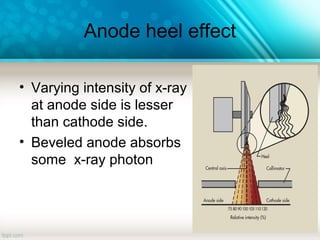
Anode heel effect
• Varying intensity of x-ray
at anode side is lesser
than cathode side.
• Beveled anode absorbs
some x-ray photon
TUBE RATING CHART
• Capacity of focal spot
supplied by
manufacture.
• Shows maximum
power delivered for a
given exposure time
without over loading.
Tube failure
• Anode pitting.
• Rapid heat increase at
anode.
• Filament vaporization.
CARE OF X-RAY TUBE
• Warm up the anode following manufactures
recommendation
• Minimize filament boost (prep) time.
• Use lower tube current (mA).
• Follow rating chart.
• Do not exceed anode thermal capacity or heat
dissipation rate of the target.
• Do not make high mA exposure on cold target.
• Do not rotate the tube housing rapidly from one
position to another
Conclusion
Mastery is not about perfection, but a
process ,a journey.
• So lets be sure there is going to be
more advanced technology and there will
be x-ray tubes with better heat dissipation
and lesser patient dose.
xray tubes

xray tubes

  • 1.
  • 2.
    CONTENTS • Introduction • Types •Construction of each tubes • Features of each tube • Line focus principle & anode heel effect • Tube rating • Tube failure • Care of tube • Conclusion
  • 3.
    INTRODUCTION • A tubeis air evacuated device. • In which the x-rays are produced. • Characteristics-: i) produce electrons ii) attract electron iii) physical protective casing iv) radiation protection • Purpose: provide x-rays from near source.
  • 4.
    INTRODUCTION Requirement: • Ability tocontrol quality and quantity. • X-ray emission from desired port • movement Basic principle: • High voltage across anode and cathode • electrons emitted • accelerated toward anode • Interact and produce x-ray.
  • 5.
    TYPES • According tothe cathode Two types • Cold cathode tube(Crookes tube) • Hot cathode tubes (all other types) • According to the anode Three types • Stationary anode x-ray tube • Rotating anode x-ray tube ( conventional radiography tubes, mammography tube, grid control x-ray tube) • Rotating envelope x-ray tube
  • 6.
  • 7.
    Crookes Tube • Crookestube • Historically , x-rays were discovered radiating from experimental discharge tubes, called Crookes tube. • Invented by William Crookes and others. • Commonly known as cold tubes. • Used till 1920.
  • 8.
    Crookes Tube Consists : •Tube Envelope • Anode • Cathode • Anti Cathode
  • 9.
    Tube Envelope • Consistsof a partially evacuated glass bulb . • Material – sodium or cerium • Air pressure of 10-6 to 5x10⁻⁸ . Anode • Material- Platinum • (At no-78, mp-1768o c) Cathode • Material- Aluminium (At no -13, mp- 660o c) Anti cathode • Material - Copper plate CROOKES TUBE
  • 10.
    Operation • Field emissionor cold emission. • DC voltage (100kv) across cathode and anode. • Gas atoms ionized , created positive ion. • Positive ion attracted to cathode and create more electron. • High speed electron strike anode. CROOKES TUBE
  • 11.
    Disadvantage • Unreliable • Airabsorbed by wall, reduces pressure. • Overheating due to heavy use. • Intensity and energy of x-ray cannot be controlled independently. CROOKES TUBE
  • 12.
  • 13.
    COOLIDGE TUBE • Crookestubes improved by William Coolidge in 1913. • Called Coolidge tube or hot cathode tube. • Characteristic features- i) high vacuum ii) heated filament Iii) thermionic emission
  • 14.
    COOLIDGE TUBE Construction • Tubeenvelope • Anode assembly • Cathode assembly
  • 15.
    COOLIDGE TUBE Tube Envelope •Spherical tempered glass tube with two cylindrical arms- cathode and anode arm. • Made of borosilicate ( Pyrex) • Internal pressure 10-8 mmHg • Hold both electrodes
  • 16.
    Anode assembly Consists Target • Material–tungsten embedded in copper. • Thickness- 2-3 mm, Size – 1.8 to 2.2 mm • Shape – Circular, square or rectangular • Anode angle – 6-20o • Typical angle – 16.5o • High atomic no. – W- 74 • High melting point – W- 3370o c • Evaporating point - 5600o c COOLIDGE TUBE
  • 17.
    Cathode assembly • Focusingcup • Filament COOLIDGE TUBE
  • 18.
    Focusing cup • Madeof molybdenum • Nickel coated (anticorrosive layer) • Streamline the thermionic cloud. Filament • Made of tungsten • High melting point-3370o c • High evaporation point- 5600o c • Highly ductile and malleable COOLIDGE TUBE
  • 19.
    COOLIDGE TUBE Operation • Cathodefilament heated, emits electron. • Emitted electron accelerated towards positively charged anode. • X-ray produced- bremsstrahlung and characteristic .
  • 20.
    COOLIDGE TUBE Advantages • Stability. •Intensity and energy of x-ray can be controlled independently.
  • 21.
  • 22.
    ROTATING ANODE X-RAYTUBE • The rotating anode tube is an improvement of the Coolidge tube. Characteristic feature- i) anode rotates ii) tungsten – rhenium alloy
  • 23.
    ROTATING ANODE X-RAYTUBE Construction • Glass envelope • Anode assembly • Cathode assembly
  • 24.
    ROTATING ANODE X-RAYTUBE Glass envelop • Borosilicate glass • Supports electrodes • Shape - cylindrical • Size - 30 – 50 cm length 20 cm broad • Thinner window – size 5x5 cm thickness 0.2mm • Highly evacuated • Internal pressure- 10-8 mmHg • Ceramic metal (adv prevent off focus radiation)
  • 25.
    ROTATING ANODE X-RAYTUBE Anode assembly  Target track • Material- 90% tungsten and 10% rhenium(high thermal capacity, less roughening)  Anode disk Base – molybdenum ( advanced graphite alloy, light wt and heat dissipation) Anode angle- 7-17o ,typical angle – 12o Rpm- 9000 Shape – beveled
  • 26.
    • Anode stem material– molybdenum thin and long restrict conduction of heat • Rotor material – copper and iron high thermal capacity and conductivity rotation of anode 9000 rpm Anode stem ROTATING ANODE X-RAY TUBE
  • 27.
    • Bearing • Madeof metal balls • Lubrication – silver powder • ( adv – liquid gallium lubricated fluid dynamic bearing) • Stator induction Motor • Material – electromagnet • Supplied by AC power ROTATING ANODE X-RAY TUBE
  • 28.
    • Cathode AssemblyCathodeAssembly • Focusing cupFocusing cup • Same as in Coolidge's tube.Same as in Coolidge's tube. • Effectiveness of focusingEffectiveness of focusing cup depends uponcup depends upon • Shape , size , applied chargeShape , size , applied charge and length of filamentand length of filament ROTATING ANODE X-RAY TUBE
  • 29.
    • FilamentFilament • DualfilamentDual filament • The size varies from 2.2mm toThe size varies from 2.2mm to 7mm in length in small filament7mm in length in small filament • The size varies from 7mm toThe size varies from 7mm to 15mm in length in large15mm in length in large filamentfilament • 99 % tungsten and 1% thorium99 % tungsten and 1% thorium • (prevent breakage, prevent(prevent breakage, prevent evaporation)evaporation) ROTATING ANODE X-RAY TUBE
  • 30.
    ROTATING ANODE XRAYTUBE ADVANTAGES • Provide greater area for bombardment • Better heat dissipation than stationary anode tube
  • 31.
    MAMOGRAPHY X-RAY TUBE •X-ray tube dedicated for mammography. • Characteristic features I) Low kv Ii) Characteristic radiation Iii) High spatial resolution
  • 32.
    MAMOGRAPHY X-RAY TUBE •CONSTRUCTION • GLASS ENVELOPE • ANODE ASSEMBLY • CATHODE ASSEMBLY
  • 33.
    Glass envelope • Borosilicateglass/ ceramic metal • Window- berrylium (z=4, mp=1287o c) Anode • Material- molybdenum – (z=42, mp=2623o c) rhodium - (z=45) • Anode angle (0 or 16)/ tube tilt(24 or 06) MAMOGRAPHY X-RAY TUBE
  • 34.
    MAMOGRAPHY X-RAY TUBE •Cathode assembly consists Focusing Cup - Mo Filament • W for MO track • Rh for Rh track (Added filter – Mo)
  • 35.
    GRID CONTROLLED XRAY TUBES •Used in fluoroscopy units • Purpose- reduced pt dose • Interval between exposure. • Focusing cup functions as a switch. • Focusing cup act as a third electrode. • Highly negatively charged -1.5 kV
  • 36.
  • 37.
    ROTATING ENVELOPE TUBE •Most advanced technology till date. • Idea of rotating envelope – 1917 Characteristic features • Electron beam is shaped and controlled by magnetic field. • Cooling surface of anode in direct contact with cooling fluid • And a rotating envelope
  • 38.
    ROTATING ENVELOPE TUBE Itconsists of four system • Tube envelope system • Electron emission system • Magnetic deflection system • Cooling system
  • 39.
    ROTATING ENVELOPE TUBE •Tube envelope system i. Material – non magnetic stainless steel ii. Directly Attached to anode disk iii. Annular/Circular Window (Thickness – 0.2 mm) iv. Max rotational speed – 150Hz
  • 40.
    ROTATING ENVELOPE TUBE •Anode assembly • Consists Target track- 90% tungsten & 10% Rhenium Anode Disk – Tungsten , Zirconium, molybdenum body(TZM Alloy) BP- 4612, MP- 2600
  • 41.
    ROTATING ENVELOPE TUBE •Electron emission system Cathode Assembly Consists Focusing cup Flat Emitter Shape of emitter – circular Material – tungsten Thickness -100µm Diameter - 5µm Meander like path – for filament heating .
  • 42.
    RET • Magnetic deflectionsystem Three coils R- coils - Deflect the beam radial direction onto focal spot. (flying focal spot in z- direction,) Q-coils – focus the beam to determine the size Phi- coils – deflection of flying focal spot in tangential direction
  • 44.
    ROTATING ENVELOPE TUBE •Microcontroller controls individual coil currents (real time ) Electronically adjusted focal spot Best image quality.
  • 45.
    ROTATING ENVELOPE TUBE •Cooling system (convective) Anode disk comes in direct contact with cooling oil. Oil rotation is turbine flow Flow of oil - during exposure is 25ltr/min - during pump running 8 ltr/min Oil – Mineral oil
  • 46.
    • Advantages • Betterheat dissipation. • Various size multiple focal spot • Longer tube life. • can be used in high kV and High mA technique for prolonged duration ( ie. High mAs) ROTATING ENVELOPE TUBE
  • 47.
    Line focus principle •Introduced in 1918 • Relation between anode angle and focal spot • Three principles i) Incr anode angle – incr effective focal spot size ( decr intensity of x-ray beam, poor image quality) ii) decr anode angle – decr effective focal spot size (incr intensity of x-ray beam, better image quality) iii)without change in anode angle increasing the bombarding area incr actual focal spot ,effective and provide better heat dissipation.
  • 48.
    Anode heel effect •Varying intensity of x-ray at anode side is lesser than cathode side. • Beveled anode absorbs some x-ray photon
  • 49.
    TUBE RATING CHART •Capacity of focal spot supplied by manufacture. • Shows maximum power delivered for a given exposure time without over loading.
  • 50.
    Tube failure • Anodepitting. • Rapid heat increase at anode. • Filament vaporization.
  • 51.
    CARE OF X-RAYTUBE • Warm up the anode following manufactures recommendation • Minimize filament boost (prep) time. • Use lower tube current (mA). • Follow rating chart. • Do not exceed anode thermal capacity or heat dissipation rate of the target. • Do not make high mA exposure on cold target. • Do not rotate the tube housing rapidly from one position to another
  • 52.
    Conclusion Mastery is notabout perfection, but a process ,a journey. • So lets be sure there is going to be more advanced technology and there will be x-ray tubes with better heat dissipation and lesser patient dose.