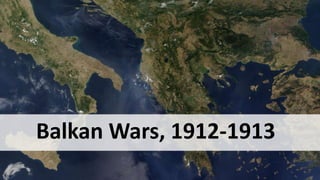
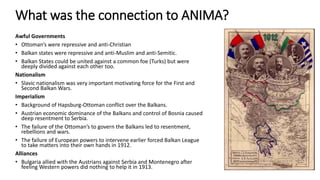
Balkan Wars, 1912-1913
What were the First and Second Balkan Wars?
• By the early 20th century, Ottoman Empire was considered “sick man
of Europe”.
• Bulgaria, Greece, Montenegro and Serbia had achieved independence
from the Ottoman Empire, but large elements of their ethnic
populations remained under Ottoman rule.
• In 1912, these countries formed the Balkan League to drive the
Ottomans from Europe.
• In 1913 the members of the league had a war over the division of the
conquered territory, especially Macedonia. Bulgaria lost.
• Britain and Germany brokered a peace treaty to end the conflict.
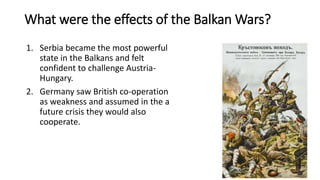
What were the effects of the Balkan Wars?
1. Serbia became the most powerful
state in the Balkans and felt
confident to challenge Austria-
Hungary.
2. Germany saw British co-operation
as weakness and assumed in the a
future crisis they would also
cooperate.
What was the connection to ANIMA?
Awful Governments
• Ottoman’s were repressive and anti-Christian
• Balkan states were repressive and anti-Muslim and anti-Semitic.
• Balkan States could be united against a common foe (Turks) but were
deeply divided against each other too.
Nationalism
• Slavic nationalism was very important motivating force for the First and
Second Balkan Wars.
Imperialism
• Background of Hapsburg-Ottoman conflict over the Balkans.
• Austrian economic dominance of the Balkans and control of Bosnia caused
deep resentment to Serbia.
• The failure of the Ottoman’s to govern the Balkans led to resentment,
rebellions and wars.
• The failure of European powers to intervene earlier forced Balkan League
to take matters into their own hands in 1912.
Alliances
• Bulgaria allied with the Austrians against Serbia and Montenegro after
feeling Western powers did nothing to help it in 1913.

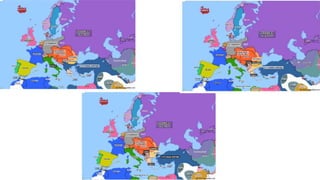
The Balkan wars

  • 1.
  • 2.
    What were theFirst and Second Balkan Wars? • By the early 20th century, Ottoman Empire was considered “sick man of Europe”. • Bulgaria, Greece, Montenegro and Serbia had achieved independence from the Ottoman Empire, but large elements of their ethnic populations remained under Ottoman rule. • In 1912, these countries formed the Balkan League to drive the Ottomans from Europe. • In 1913 the members of the league had a war over the division of the conquered territory, especially Macedonia. Bulgaria lost. • Britain and Germany brokered a peace treaty to end the conflict.
  • 4.
    What were theeffects of the Balkan Wars? 1. Serbia became the most powerful state in the Balkans and felt confident to challenge Austria- Hungary. 2. Germany saw British co-operation as weakness and assumed in the a future crisis they would also cooperate.
  • 5.
    What was theconnection to ANIMA? Awful Governments • Ottoman’s were repressive and anti-Christian • Balkan states were repressive and anti-Muslim and anti-Semitic. • Balkan States could be united against a common foe (Turks) but were deeply divided against each other too. Nationalism • Slavic nationalism was very important motivating force for the First and Second Balkan Wars. Imperialism • Background of Hapsburg-Ottoman conflict over the Balkans. • Austrian economic dominance of the Balkans and control of Bosnia caused deep resentment to Serbia. • The failure of the Ottoman’s to govern the Balkans led to resentment, rebellions and wars. • The failure of European powers to intervene earlier forced Balkan League to take matters into their own hands in 1912. Alliances • Bulgaria allied with the Austrians against Serbia and Montenegro after feeling Western powers did nothing to help it in 1913.