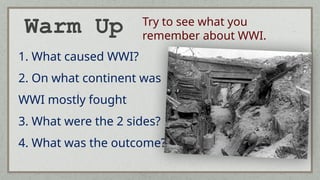
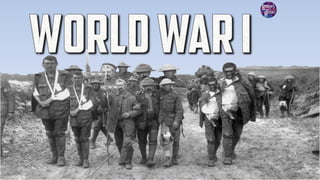
Warm Up Tryto see what you
remember about WWI.
1. What caused WWI?
2. On what continent was
WWI mostly fought
3. What were the 2 sides?
4. What was the outcome?
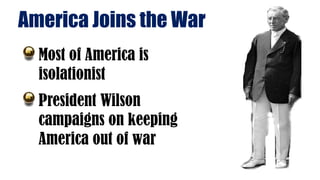
America Joins theWar
Most of America is
isolationist
President Wilson
campaigns on keeping
America out of war
22.
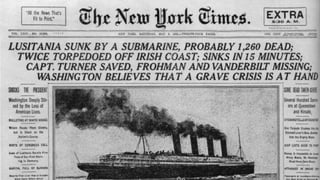
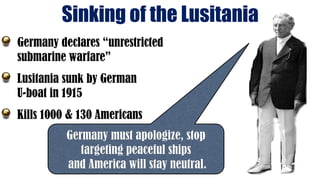
Sinking of theLusitania
Germany must apologize, stop
targeting peaceful ships
and America will stay neutral.
Germany declares “unrestricted
submarine warfare”
Lusitania sunk by German
U-boat in 1915
Kills 1000 & 130 Americans
23.
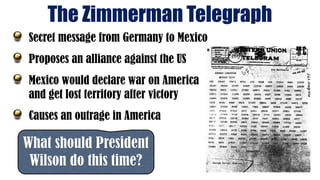
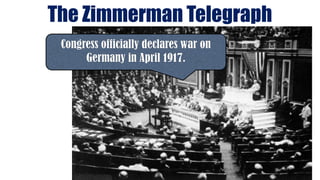
The Zimmerman Telegraph
Whatshould President
Wilson do this time?
Secret message from Germany to Mexico
Proposes an alliance against the US
Mexico would declare war on America
and get lost territory after victory
Causes an outrage in America
24.
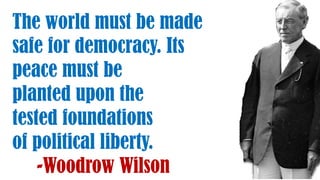
The world mustbe made
safe for democracy. Its
peace must be
planted upon the
tested foundations
of political liberty.
-Woodrow Wilson
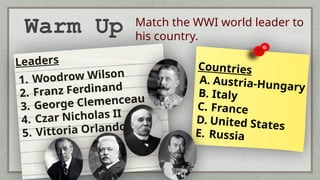
Countries
A. Austria-Hungary
B. Italy
C.France
D. United States
E. Russia
Warm Up Match the WWI world leader to
his country.
Leaders
1. Woodrow Wilson
2. Franz Ferdinand
3. George Clemenceau
4. Czar Nicholas II
5. Vittoria Orlando
27.
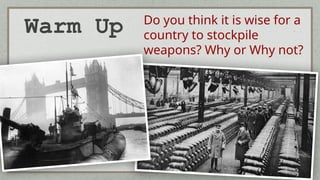
Warm Up Doyou think it is wise for a
country to stockpile
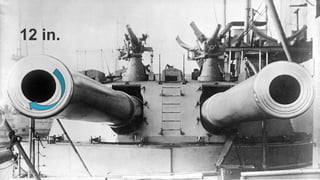
weapons? Why or Why not?
28.
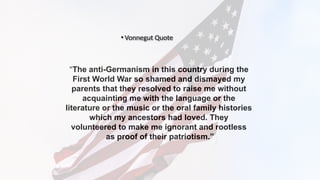
“The anti-Germanism inthis country during the
First World War so shamed and dismayed my
parents that they resolved to raise me without
acquainting me with the language or the
literature or the music or the oral family histories
which my ancestors had loved. They
volunteered to make me ignorant and rootless
as proof of their patriotism.”
• Vonnegut Quote
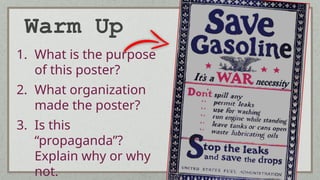
Warm Up
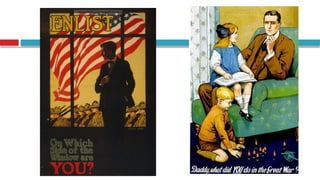
1. Whatis the purpose
of this poster?
2. What organization
made the poster?
3. Is this
“propaganda”?
Explain why or why
not.
37.
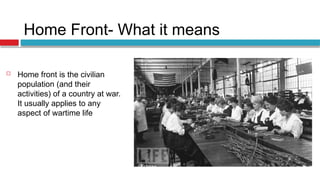
Home Front- Whatit means
Home front is the civilian
population (and their
activities) of a country at war.
It usually applies to any
aspect of wartime life
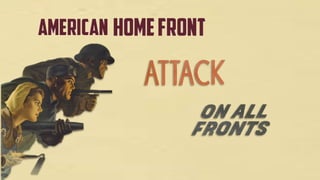
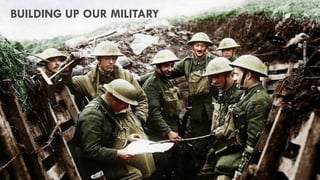
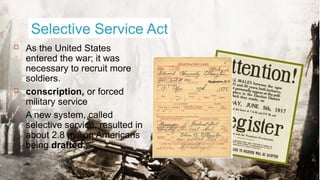
As theUnited States
entered the war; it was
necessary to recruit more
soldiers.
conscription, or forced
military service
A new system, called
selective service, resulted in
about 2.8 million Americans
being drafted.
Selective Service Act
40.
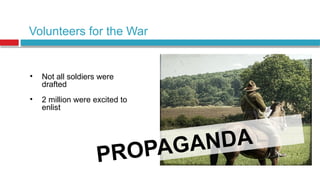
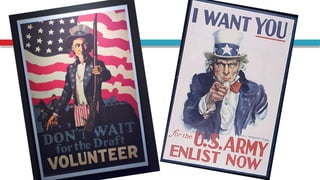
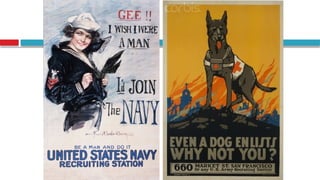
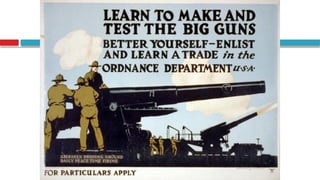
Volunteers for theWar
• Not all soldiers were
drafted
• 2 million were excited to
enlist
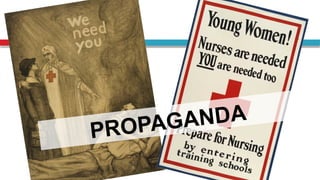
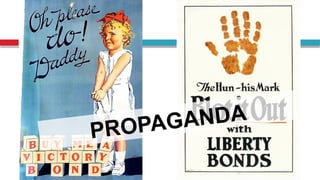
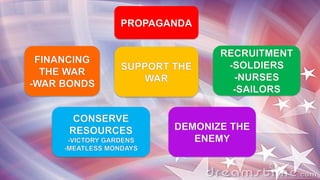
PROPAGANDA
42.
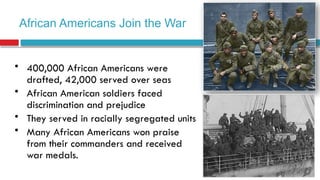
African Americans Jointhe War
• 400,000 African Americans were
drafted, 42,000 served over seas
• African American soldiers faced
discrimination and prejudice
• They served in racially segregated units
• Many African Americans won praise
from their commanders and received
war medals.
43.
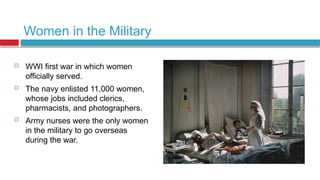
Women in theMilitary
WWI first war in which women
officially served.
The navy enlisted 11,000 women,
whose jobs included clerics,
pharmacists, and photographers.
Army nurses were the only women
in the military to go overseas
during the war.
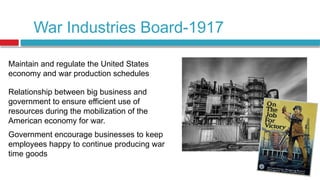
War Industries Board-1917
Maintainand regulate the United States
economy and war production schedules
Relationship between big business and
government to ensure efficient use of
resources during the mobilization of the
American economy for war.
Government encourage businesses to keep
employees happy to continue producing war
time goods
47.
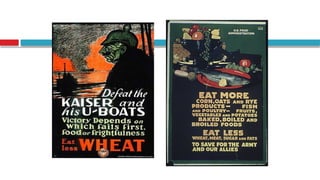
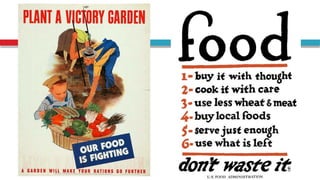
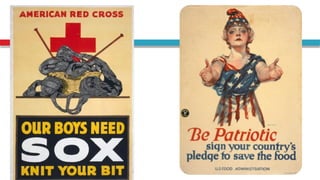
The FoodAdministration, under
Herbert Hoover--> responsible for
increasing food production while
reducing consumption.
victory gardens people raise
their own vegetables in order to
leave more food for the troops.
The Fuel Administration
encouraged people to conserve
coal and oil. Daylight savings time
was introduced to conserve
energy.
Victory Garden
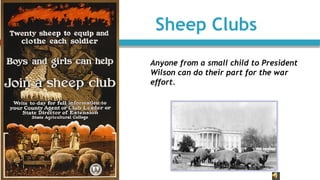
Sheep Clubs
Anyone froma small child to President
Wilson can do their part for the war
effort.
50.
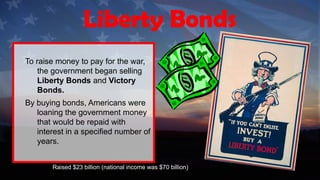
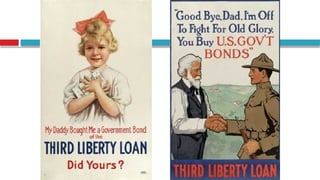
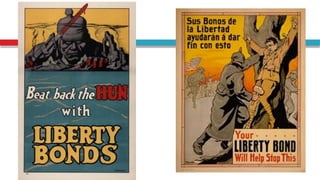
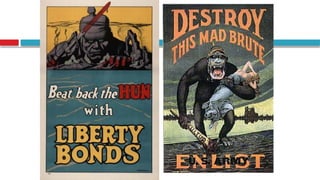
To raise moneyto pay for the war,
the government began selling
Liberty Bonds and Victory
Bonds.
By buying bonds, Americans were
loaning the government money
that would be repaid with
interest in a specified number of
years.
Raised $23 billion (national income was $70 billion)
Liberty Bonds
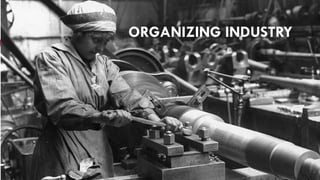
Women Working
• Thewar increased the
need for women in the
workforce.
• They took positions in
the shipping,
manufacturing, and
railroad industries.
• After the war, women
returned to their
previous jobs or left the
workforce.
WOMEN APPRECIATED!
• After WWI women will get
the right to vote with the
19th amendment due their
contributions during WWI
FINALLY
53.
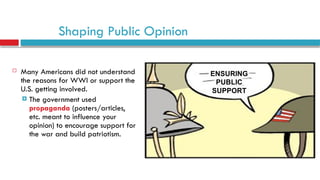
Shaping Public Opinion
Many Americans did not understand
the reasons for WWI or support the
U.S. getting involved.
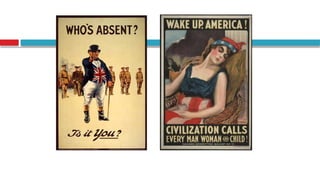
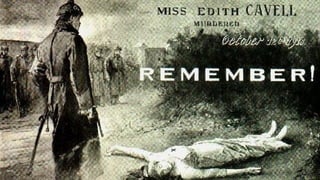
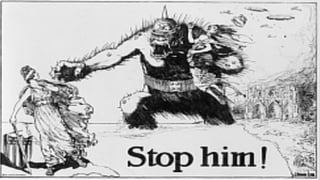
The government used
propaganda (posters/articles,
etc. meant to influence your
opinion) to encourage support for
the war and build patriotism.
54.
The Committeeon Public Information (CPI)
was a new government agency that attempted
to “sell” the idea of war to the American people.
it was the nation's first formal government
propaganda agency
Pamphlets and speeches helped deliver
patriotic messages.
Selling the War
55.
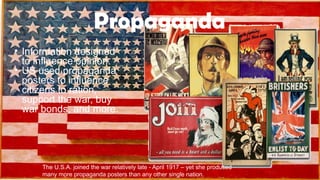
The U.S.A. joinedthe war relatively late - April 1917 – yet she produced
many more propaganda posters than any other single nation.
Propaganda
• Information designed
to influence opinion.
• US used propaganda
posters to influence
citizens to ration,
support the war, buy
war bonds, and more.
Discuss
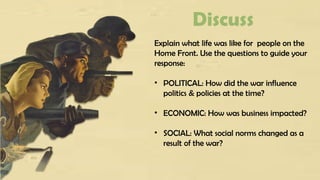
Explain what lifewas like for people on the
Home Front. Use the questions to guide your
response:
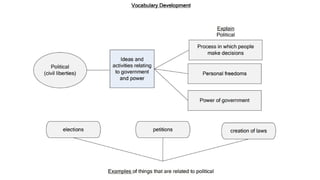
• POLITICAL: How did the war influence
politics & policies at the time?
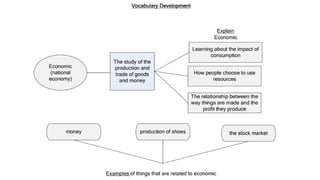
• ECONOMIC: How was business impacted?
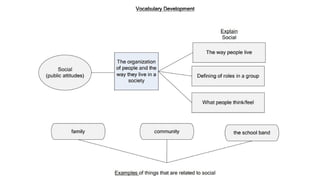
• SOCIAL: What social norms changed as a
result of the war?
75.
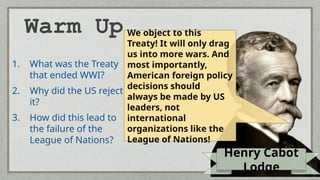
Warm Up
1. Whatwas the Treaty
that ended WWI?
2. Why did the US reject
it?
3. How did this lead to
the failure of the
League of Nations?
Henry Cabot
Lodge
We object to this
Treaty! It will only drag
us into more wars. And
most importantly,
American foreign policy
decisions should
always be made by US
leaders, not
international
organizations like the
League of Nations!
76.
Think abouta time
you have lost a
game.
What could the
winner do to make
you feel worse?
How do you feel
about the winner?
77.
When thewinners were rubbing it in
how did the other team react? Would
how you treat the loser effect how they
treat you the next time you play? What
happens if the winner is a bad sport?
78.
Unit Focus: CanPeace lead to war?
What are Wilson’s “14 Points”?
What goals did he hope to accomplish
with the 14 points?
What do you think will happen if
countries do not all agree on the
points?]
79.
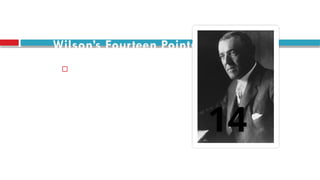
Wilson’s Fourteen Points
Woodrow Wilson
delivered his speech
in a joint meeting of
Congress on
January 8th
, 1918. 14
Wilson’s 14 Points
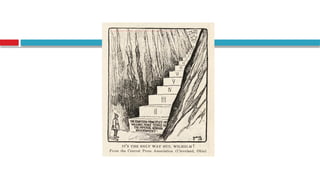
The fourteen points was
President Wilson’s plan to
establish peace in the world
after WWI and prevent future
wars from occurring.
Wilson wanted to be lenient to
Germany and the Central
powers; he argued that punishing
them too harshly would cause
future problems.
85.
“Only atranquil [calm] Europe can be a stable
Europe… [There] must be peace without victory…
Victory would mean peace forced on the loser, [the]
victors [winners] terms imposed [forced] on the
vanquished [defeated]. It would be accepted in
humiliation… and would leave a sting, a resentment
[hatred], a bitter memory upon which the terms of peace
would rest, not permanently, but… upon quicksand.”
~Woodrow Wilson, “Peace Without Victory”
Speech
86.
Wilson’s 14 Points
Wilson’s 14th
and most important
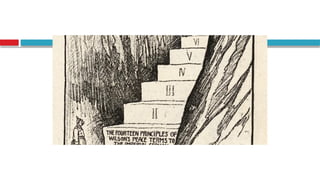
point was to establish a League
of Nations, a world
organization where countries
could gather and peacefully
work out their problems, which
would preserve peace and
prevent future wars.
87.
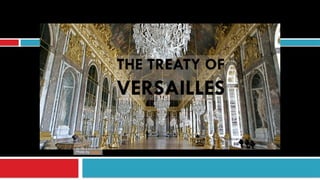
The Treaty ofVersailles
The Allies met in Versailles, France for a peace
conference to resolve the issues of WWI.
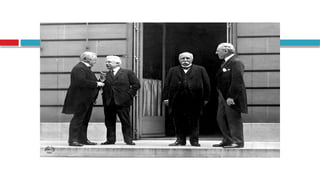
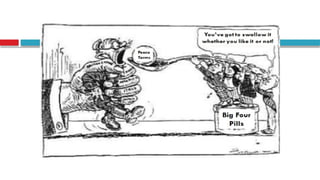
The main negotiators were the “Big Four” leaders of the
victorious Allied nations; U.S. president Woodrow
Wilson, British prime minister David Lloyd George,
French premier Georges Clemenceau, and Italian prime
minster Vittorio Orlando; Germany was not invited.
89.
The Treaty ofVersailles
The leaders of Britain and France criticized Wilson’s
plan for being too lenient toward Germany.
Because of the destruction Germany had caused their
countries, France and Britain wanted to punish Germany
and the Central Powers harshly for the war.
They also wanted to weaken Germany so that they
could never again start a war.
90.
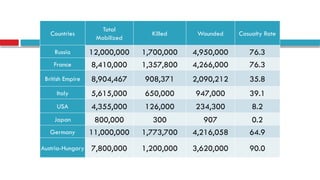
Countries
Total
Mobilized
Killed Wounded CasualtyRate
Russia 12,000,000 1,700,000 4,950,000 76.3
France 8,410,000 1,357,800 4,266,000 76.3
British Empire 8,904,467 908,371 2,090,212 35.8
Italy 5,615,000 650,000 947,000 39.1
USA 4,355,000 126,000 234,300 8.2
Japan 800,000 300 907 0.2
Germany 11,000,000 1,773,700 4,216,058 64.9
Austria-Hungary 7,800,000 1,200,000 3,620,000 90.0
92.
The Treaty ofVersailles
The terms of the Treaty of Versailles included:
Germany was ordered to pay $33 billion in war
reparations (payments for wrongdoing) to the Allies,
which was virtually impossible for them to do.
Germany was forced to give up its military, some land,
and admit guilt for WWI, which was humiliating to them.
A League of Nations was formed to prevent future wars.
94.
America Rejects theTreaty
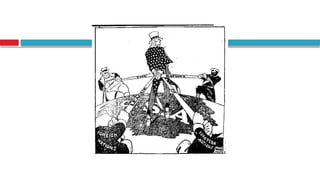
The U.S. Congress refused to ratify (approve) the
Treaty of Versailles.
They argued that joining the League of Nations would
“entangle America” in future wars.
After the U.S. experience in WWI, that was not a
chance they were willing to take and they wanted
nothing to do with Europe’s conflicts.
96.
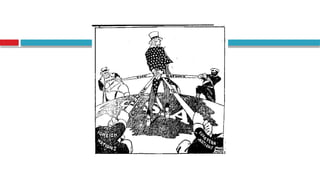
Legacy of theTreaty of Versailles
The Treaty of Versailles has a very negative legacy
and its failure helped to cause WWII.
The treaty was too harsh to the German people and they
wanted revenge on the other European nations for causing
them much suffering after WWI.
Hitler’s rise to power became possible because he offered
the Germans revenge and promised to bring Germany
back to greatness.
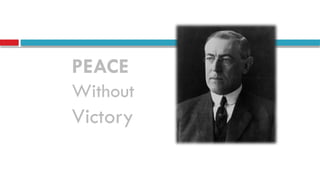
“Only atranquil [calm] Europe can be a stable Europe…
[There] must be peace without victory… Victory would
mean peace forced on the loser, [the] victors [winners]
terms imposed [forced] on the vanquished [defeated].
It would be accepted in humiliation… and would leave
a sting, a resentment [hatred], a bitter memory upon
which the terms of peace would rest, not permanently,
but… upon quicksand.”
~Woodrow Wilson, “Peace Without Victory”
Speech
January 22, 1917
100.
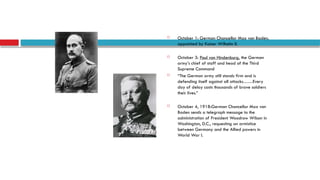
October 1:German Chancellor Max von Baden,
appointed by Kaiser Wilhelm II.
October 3: Paul von Hindenburg, the German
army’s chief of staff and head of the Third
Supreme Command
“The German army still stands firm and is
defending itself against all attacks……Every
day of delay costs thousands of brave soldiers
their lives.”
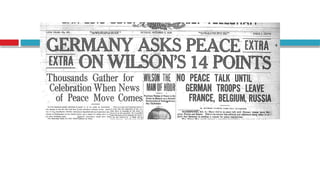
October 4, 1918:German Chancellor Max von
Baden sends a telegraph message to the
administration of President Woodrow Wilson in
Washington, D.C., requesting an armistice
between Germany and the Allied powers in
World War I.
101.
On November 7,Hindenburg contacted the Allied Supreme
Commander, Ferdinand Foch, to open armistice negotiations
102.
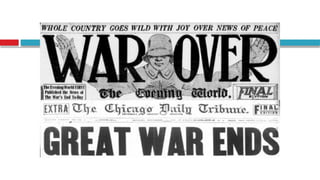
The War Ends
Sick of the war and losing hope, the people of
Berlin rose up in rebellion and forced the German
emperor to step down on November 9, 1918.
Germany then signed an armistice, or ceasefire, that
ended the war.
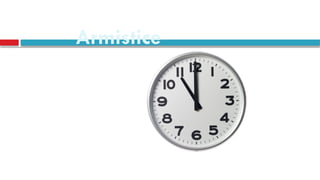
At the 11th
hour on the 11th
day of the 11th
month of
1918, the fighting stopped.
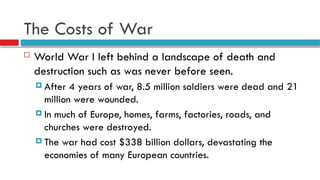
The Costs ofWar
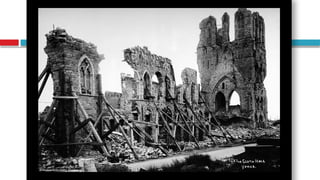
World War I left behind a landscape of death and
destruction such as was never before seen.
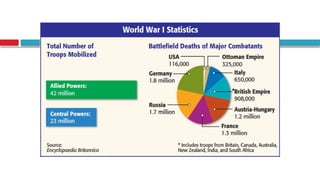
After 4 years of war, 8.5 million soldiers were dead and 21
million were wounded.
In much of Europe, homes, farms, factories, roads, and
churches were destroyed.
The war had cost $338 billion dollars, devastating the
economies of many European countries.
109.
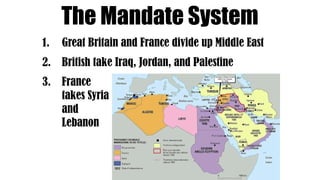
The Mandate System
1.Great Britain and France divide up Middle East
2. British take Iraq, Jordan, and Palestine
3. France
takes Syria
and
Lebanon
Editor's Notes
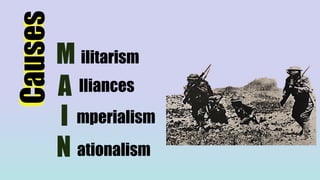
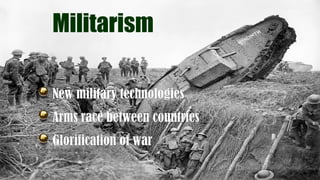
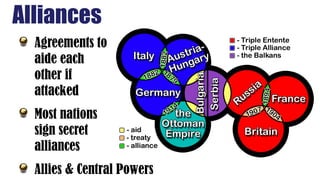
#1 1) Militarism, Alliances, Imperialism, Nationalism (and Ferdinand’s assassination) 2) Europe. 3) Allies & Central Powers. 4) The Allies won.
#26 1. US, 2) Austria-Hungary 3) France 4) Russia 5) Italy
#35 1) To conserve gasoline. 2) The US Fuel Administration 3) Open to student opinion.
#75 1) The Treaty of of Versailles 2) It was thought it might pull the US into other wars 3) The US never joined the League



![Unit Focus: Can Peace lead to war?
What are Wilson’s “14 Points”?
What goals did he hope to accomplish
with the 14 points?
What do you think will happen if
countries do not all agree on the
points?]](https://image.slidesharecdn.com/worldwaronefullunitwithreadingedited-250706200950-6d24059a/85/world-war-one-full-unit-with-reading-edited-pptx-78-320.jpg)
![ “Only a tranquil [calm] Europe can be a stable
Europe… [There] must be peace without victory…
Victory would mean peace forced on the loser, [the]
victors [winners] terms imposed [forced] on the
vanquished [defeated]. It would be accepted in
humiliation… and would leave a sting, a resentment
[hatred], a bitter memory upon which the terms of peace
would rest, not permanently, but… upon quicksand.”
~Woodrow Wilson, “Peace Without Victory”
Speech](https://image.slidesharecdn.com/worldwaronefullunitwithreadingedited-250706200950-6d24059a/85/world-war-one-full-unit-with-reading-edited-pptx-85-320.jpg)
![ “Only a tranquil [calm] Europe can be a stable Europe…
[There] must be peace without victory… Victory would
mean peace forced on the loser, [the] victors [winners]
terms imposed [forced] on the vanquished [defeated].
It would be accepted in humiliation… and would leave
a sting, a resentment [hatred], a bitter memory upon
which the terms of peace would rest, not permanently,
but… upon quicksand.”
~Woodrow Wilson, “Peace Without Victory”
Speech
January 22, 1917](https://image.slidesharecdn.com/worldwaronefullunitwithreadingedited-250706200950-6d24059a/85/world-war-one-full-unit-with-reading-edited-pptx-99-320.jpg)