Smart Environment understanding and meaning
Univ.-Prof. Mag. Dr. Rudolf Giffinger
Vienna University of Technology
Department of Spatial Planning
Centre of Regional Science

Workshop in Krakow

9th of January, 2014
,,SMART_KOM. Kraków in smart cities network”
cofinanced by the European Union within Malopolska Regional Operation
Programme for 2007-2013

Krakow, 9th of January, 2014
Objectives & tasks



Environment: why




Urbanisation – wealth – environmental quality

Understanding: what and how
 Strategic integrative SC-approach on urban development
 Understanding Smart City – an evidence based learning process
 Defining most relevant domains
 Elaborating strenghts and weaknesses

Krakow, 9th of January, 2014
WHY challenge of sustainable development
Environmental quality a precondition of urban socio-econommic development
Energy consumption a driving force of emissions


About 50 % of population in urban areas – energy consumption about 75 %



Increasing wealth – increase of traffic, urban sprawl and traffic

 Decoupling economic
growth and emissions:
CO2, particulate matter
 Increase of energy
efficiency in urban
development, / renewable
ressources in urban areas
 Re-structuring economic
activities: shift towards
green economy

Krakow, 9th of January, 2014
WHAT: ‚Smart City„: origins and basic expectations


… originated from the „information city‟



… believe in a wired, ICT-driven form of development





… using new ICTs innovatively ….. for example implementing a
network of sensors in the city

… stresses the role of innovation in ICT sectors

… evolved to the idea of an ICT-centered smart city


highly instrumented
– …. to optimize decision making in the short and long term
– … better to manage and to control city systems by collating everdetailed information about real time functioning



… mitigating and remedying current urban problems and make
urban development more sustainable

Krakow, 9th of January, 2014
Technical and economic understanding of Smart City
„Smart Cities combine diverse technologies to reduce their
environmental impact and offer citizens better lives.
This is not, however, simply a technical challenge….”
European Smart City stakeholder platform‟
http://www.eu-smartcities.eu/faqs# Smart_Cities; 25.2.2013


Technologies for distinct challenges existing but how to implement

„.. when investments in human and social capital and traditional (transport)
and modern (ICT) communication infrastructure fuel sustainable economic
growth and a high quality of life,with a wise management of natural
resources, through a participated governance.“
Caragliu, DelBoand, Nijkamp,2011



Factors influencing the emergence of innovations in urban context
– from triple helix to enhanced triple helix
– University, industry, goverment / learning, market, knowledge
Krakow, 9th of January, 2014
WHAT: Integrative understanding of Smart City
„A Smart City is a city well performing in
[relevant key fields of urban development],
built on the ‘smart’ combination of endowments
and activities of self-decisive, independent and
aware citizens.”




Giffinger, et al., 2007

Emphasizing good performance in urban
development through


improvement of services in different key fields



in collaboration with relevant actors: citizens,
customers, stakeholders



based on actors’ awareness/behaviour



supporting development in corresponding key
field

Krakow, 9th of January, 2014
The basic features of Europan Smart City approach


Important aspects of Smart City


.... a city well performing in a forward-looking way in specific key
fields of urban development, ….



….for which the path of development is decisive
– …efforts improving performance in distinct fields of development
– … not important to be the best

“…strengths and weaknesses of certain cities in comparison to other medium-sized
cities in Europe revealing the potentials for challenging other cities in an increasing
competitive situation…”



SC development based on learning processes


Integrative approach focusing on relevant key fields



Place based evidence: local conditions of urban development



Comprehensive: technology, structure, aware citizens (behaviour)

Krakow, 9th of January, 2014
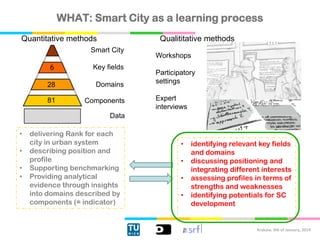
WHAT: Smart City as a learning process
Quantitative methods

Qualititative methods

Smart City
Key fields
28

Domains

81

Components

Workshops
Participatory
settings
Expert
interviews

Data
•

•
•
•

delivering Rank for each
city in urban system
describing position and
profile
Supporting benchmarking
Providing analytical
evidence through insights
into domains described by
components (= indicator)

•
•
•
•

identifying relevant key fields
and domains
discussing positioning and
integrating different interests
assessing profiles in terms of
strengths and weaknesses
identifying potentials for SC
development

Krakow, 9th of January, 2014
WHAT: most relevant key fields in SMART_KOM
FACTOR NAME domainsNAME LONG
FACTOR

FACTOR NAME

FACTOR
domainsNAME LONG

Eco_1

Innovative spirit

Mob_2

(Inter-)national accessibility

Eco_2

Entrepreneurship

Mob_3

Availability of ITInfrastructure

Eco_3

Economic image &
trademarks

Mob_4

Sustainability of the
transport system

Eco_4

Productivity

Env_1

Environmental conditions

Eco_5

Flexibility of labour market

Env_2

Pollution

Eco_6

International
embeddedness

Env_3

Ecological awareness

Peo_1

Level of qualification

Env_4

Sustainable resource
management

Peo_2

Lifelong learning

Liv_1

Cultural facilities

Peo_3

Ethnic plurality

Liv_2

Health conditions

Peo_4

Open-mindedness

Liv_3

Individual security

Gov_1

Participation public life

Liv_4

Housing quality

Gov_2

Public and social services

Liv_5

Education facilities

Gov_3

Transparent governance

Liv_6

Touristic attractivity

Mob_1

Local accessibility

Liv_7

Smart City:
6 key fields are pre-defined

Economic welfare

6 workshops on each key field
- Group of relevant
stakeholders/actors
- Identification of domains
- Common discussion of
meaning and importance

9

Krakow, 9th of January, 2014
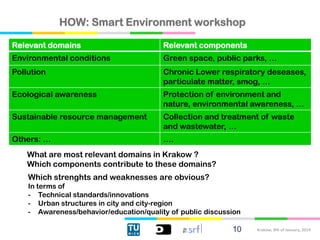
HOW: Smart Environment workshop
Relevant domains

Relevant components

Environmental conditions

Green space, public parks, …

Pollution

Chronic Lower respiratory deseases,
particulate matter, smog, …

Ecological awareness

Protection of environment and
nature, environmental awareness, …

Sustainable resource management

Collection and treatment of waste
and wastewater, …

Others: …

….

What are most relevant domains in Krakow ?
Which components contribute to these domains?
Which strenghts and weaknesses are obvious?
In terms of
- Technical standards/innovations
- Urban structures in city and city-region
- Awareness/behavior/education/quality of public discussion

10

Krakow, 9th of January, 2014
Good Luck
and
Many Thanks for Your Attention

Univ.Prof. Dr. Rudolf Giffinger

Department of Spatial Planning
Centre of Regional Science
Interdisciplinary Centre of European Spatial Development
Vienna University of Technology
www.srf.tuwien.ac.at

Krakow, 9th of January, 2014
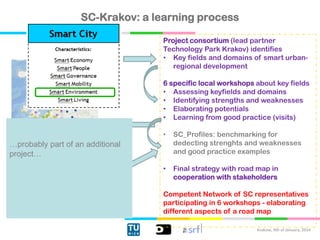
SC-Krakov: a learning process
Project consortium (lead partner
Technology Park Krakov) identifies
• Key fields and domains of smart urbanregional development
6 specific local workshops about key fields
• Assessing keyfields and domains
• Identifying strengths and weaknesses
• Elaborating potentials
• Learning from good practice (visits)
•

SC_Profiles: benchmarking for
dedecting strenghts and weaknesses
and good practice examples

•

Final strategy with road map in
cooperation with stakeholders

…probably part of an additional
project…

Competent Network of SC representatives
participating in 6 workshops - elaborating
different aspects of a road map
Krakow, 9th of January, 2014

Smart Environment - understanding and meaning

  • 1.
    Smart Environment understandingand meaning Univ.-Prof. Mag. Dr. Rudolf Giffinger Vienna University of Technology Department of Spatial Planning Centre of Regional Science Workshop in Krakow 9th of January, 2014 ,,SMART_KOM. Kraków in smart cities network” cofinanced by the European Union within Malopolska Regional Operation Programme for 2007-2013 Krakow, 9th of January, 2014
  • 2.
    Objectives & tasks  Environment:why   Urbanisation – wealth – environmental quality Understanding: what and how  Strategic integrative SC-approach on urban development  Understanding Smart City – an evidence based learning process  Defining most relevant domains  Elaborating strenghts and weaknesses Krakow, 9th of January, 2014
  • 3.
    WHY challenge ofsustainable development Environmental quality a precondition of urban socio-econommic development Energy consumption a driving force of emissions  About 50 % of population in urban areas – energy consumption about 75 %  Increasing wealth – increase of traffic, urban sprawl and traffic  Decoupling economic growth and emissions: CO2, particulate matter  Increase of energy efficiency in urban development, / renewable ressources in urban areas  Re-structuring economic activities: shift towards green economy Krakow, 9th of January, 2014
  • 4.
    WHAT: ‚Smart City„:origins and basic expectations  … originated from the „information city‟   … believe in a wired, ICT-driven form of development   … using new ICTs innovatively ….. for example implementing a network of sensors in the city … stresses the role of innovation in ICT sectors … evolved to the idea of an ICT-centered smart city  highly instrumented – …. to optimize decision making in the short and long term – … better to manage and to control city systems by collating everdetailed information about real time functioning  … mitigating and remedying current urban problems and make urban development more sustainable Krakow, 9th of January, 2014
  • 5.
    Technical and economicunderstanding of Smart City „Smart Cities combine diverse technologies to reduce their environmental impact and offer citizens better lives. This is not, however, simply a technical challenge….” European Smart City stakeholder platform‟ http://www.eu-smartcities.eu/faqs# Smart_Cities; 25.2.2013  Technologies for distinct challenges existing but how to implement „.. when investments in human and social capital and traditional (transport) and modern (ICT) communication infrastructure fuel sustainable economic growth and a high quality of life,with a wise management of natural resources, through a participated governance.“ Caragliu, DelBoand, Nijkamp,2011  Factors influencing the emergence of innovations in urban context – from triple helix to enhanced triple helix – University, industry, goverment / learning, market, knowledge Krakow, 9th of January, 2014
  • 6.
    WHAT: Integrative understandingof Smart City „A Smart City is a city well performing in [relevant key fields of urban development], built on the ‘smart’ combination of endowments and activities of self-decisive, independent and aware citizens.”   Giffinger, et al., 2007 Emphasizing good performance in urban development through  improvement of services in different key fields  in collaboration with relevant actors: citizens, customers, stakeholders  based on actors’ awareness/behaviour  supporting development in corresponding key field Krakow, 9th of January, 2014
  • 7.
    The basic featuresof Europan Smart City approach  Important aspects of Smart City  .... a city well performing in a forward-looking way in specific key fields of urban development, ….  ….for which the path of development is decisive – …efforts improving performance in distinct fields of development – … not important to be the best “…strengths and weaknesses of certain cities in comparison to other medium-sized cities in Europe revealing the potentials for challenging other cities in an increasing competitive situation…”  SC development based on learning processes  Integrative approach focusing on relevant key fields  Place based evidence: local conditions of urban development  Comprehensive: technology, structure, aware citizens (behaviour) Krakow, 9th of January, 2014
  • 8.
    WHAT: Smart Cityas a learning process Quantitative methods Qualititative methods Smart City Key fields 28 Domains 81 Components Workshops Participatory settings Expert interviews Data • • • • delivering Rank for each city in urban system describing position and profile Supporting benchmarking Providing analytical evidence through insights into domains described by components (= indicator) • • • • identifying relevant key fields and domains discussing positioning and integrating different interests assessing profiles in terms of strengths and weaknesses identifying potentials for SC development Krakow, 9th of January, 2014
  • 9.
    WHAT: most relevantkey fields in SMART_KOM FACTOR NAME domainsNAME LONG FACTOR FACTOR NAME FACTOR domainsNAME LONG Eco_1 Innovative spirit Mob_2 (Inter-)national accessibility Eco_2 Entrepreneurship Mob_3 Availability of ITInfrastructure Eco_3 Economic image & trademarks Mob_4 Sustainability of the transport system Eco_4 Productivity Env_1 Environmental conditions Eco_5 Flexibility of labour market Env_2 Pollution Eco_6 International embeddedness Env_3 Ecological awareness Peo_1 Level of qualification Env_4 Sustainable resource management Peo_2 Lifelong learning Liv_1 Cultural facilities Peo_3 Ethnic plurality Liv_2 Health conditions Peo_4 Open-mindedness Liv_3 Individual security Gov_1 Participation public life Liv_4 Housing quality Gov_2 Public and social services Liv_5 Education facilities Gov_3 Transparent governance Liv_6 Touristic attractivity Mob_1 Local accessibility Liv_7 Smart City: 6 key fields are pre-defined Economic welfare 6 workshops on each key field - Group of relevant stakeholders/actors - Identification of domains - Common discussion of meaning and importance 9 Krakow, 9th of January, 2014
  • 10.
    HOW: Smart Environmentworkshop Relevant domains Relevant components Environmental conditions Green space, public parks, … Pollution Chronic Lower respiratory deseases, particulate matter, smog, … Ecological awareness Protection of environment and nature, environmental awareness, … Sustainable resource management Collection and treatment of waste and wastewater, … Others: … …. What are most relevant domains in Krakow ? Which components contribute to these domains? Which strenghts and weaknesses are obvious? In terms of - Technical standards/innovations - Urban structures in city and city-region - Awareness/behavior/education/quality of public discussion 10 Krakow, 9th of January, 2014
  • 11.
    Good Luck and Many Thanksfor Your Attention Univ.Prof. Dr. Rudolf Giffinger Department of Spatial Planning Centre of Regional Science Interdisciplinary Centre of European Spatial Development Vienna University of Technology www.srf.tuwien.ac.at Krakow, 9th of January, 2014
  • 12.
    SC-Krakov: a learningprocess Project consortium (lead partner Technology Park Krakov) identifies • Key fields and domains of smart urbanregional development 6 specific local workshops about key fields • Assessing keyfields and domains • Identifying strengths and weaknesses • Elaborating potentials • Learning from good practice (visits) • SC_Profiles: benchmarking for dedecting strenghts and weaknesses and good practice examples • Final strategy with road map in cooperation with stakeholders …probably part of an additional project… Competent Network of SC representatives participating in 6 workshops - elaborating different aspects of a road map Krakow, 9th of January, 2014