

GUIDANCE
Origin of guidance service Definition of guidance Need for guidance Principles of guidance Different types of guidance School guidance services MAIN TOPICS FOR DISCUSSION
ORIGIN OF GUIDANCE SERVICE 1905- frank parsons  He worked directly with young people struggling to find work for living He helped to found the vocation bureau and wrote his classic  choosing a vocation Parsons was followed by a number of social reformers like Jessie b.Davis , Anne reed and Eli weaver
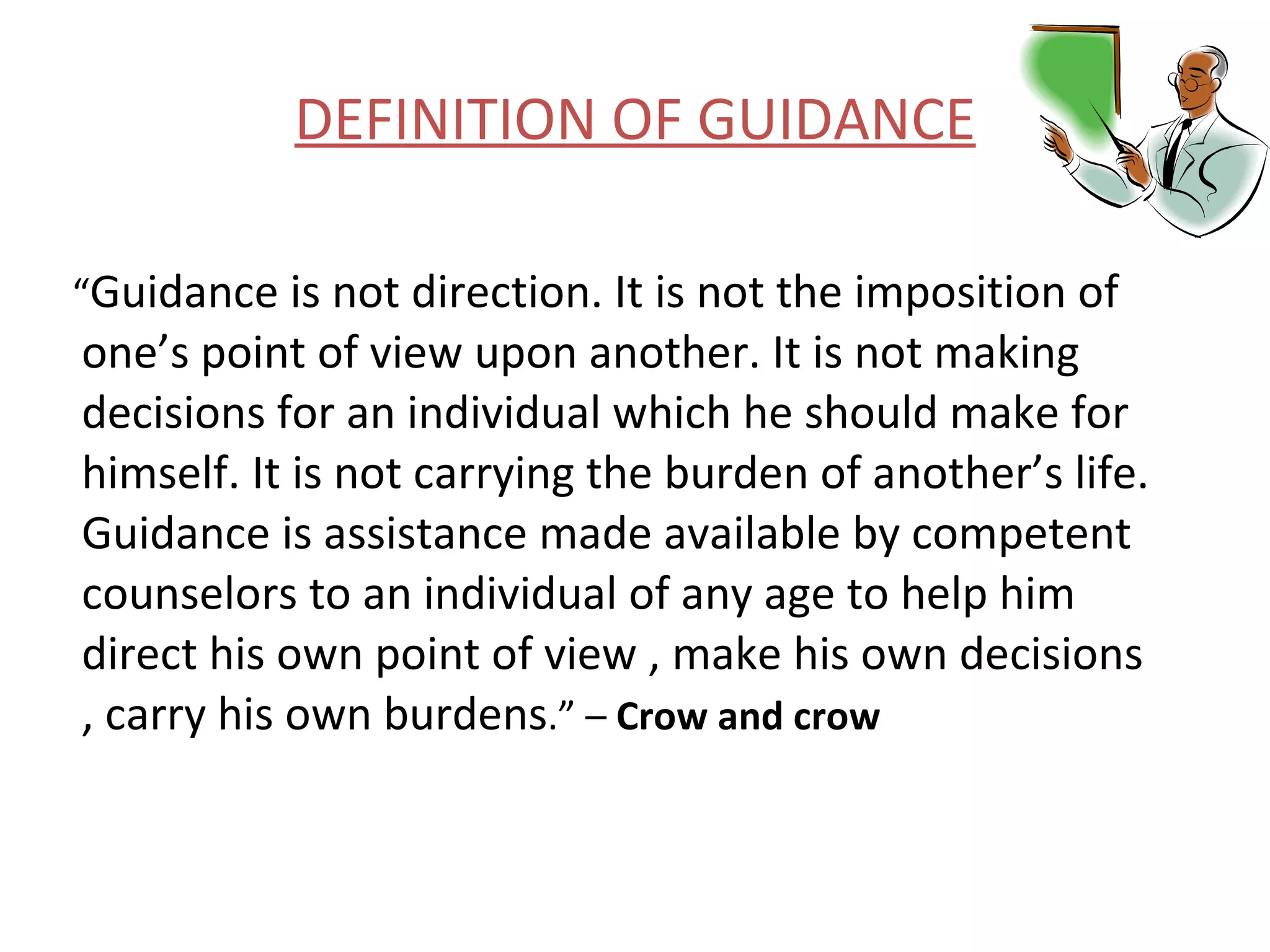
DEFINITION OF GUIDANCE “ Guidance is not direction. It is not the imposition of one’s point of view upon another. It is not making decisions for an individual which he should make for himself. It is not carrying the burden of another’s life. Guidance is assistance made available by competent counselors to an individual of any age to help him direct his own point of view , make his own decisions , carry his own burdens .” –  Crow and crow
NEED FOR GUIDANCE  The changing family Changing cities Conflicts in values, attitudes and morals Economic factors The changing role of work New pressure and demands on school Problems of young people
PRINCIPLES OF GUIDANCE According to Hollis and Hollis, there are eight principles on which any guidance programme should be based. The principles are , The dignity of the individual is supreme. Each individual is different from every other individual. The primary concern of guidance is the individual in his social setting.  
The attitudes and personnel perceptions of the individual are the bases on which he acts. The individual generally acts to enhance his perceived self. The individual has the innate ability to learn and can be helped to make choices that will lead to self direction consistent with social improvement. The individual needs a continuous guidance  process from early childhood through  adulthood.   Each individual may at times need the information and personalized assistance best given by competent professional personnel's.   
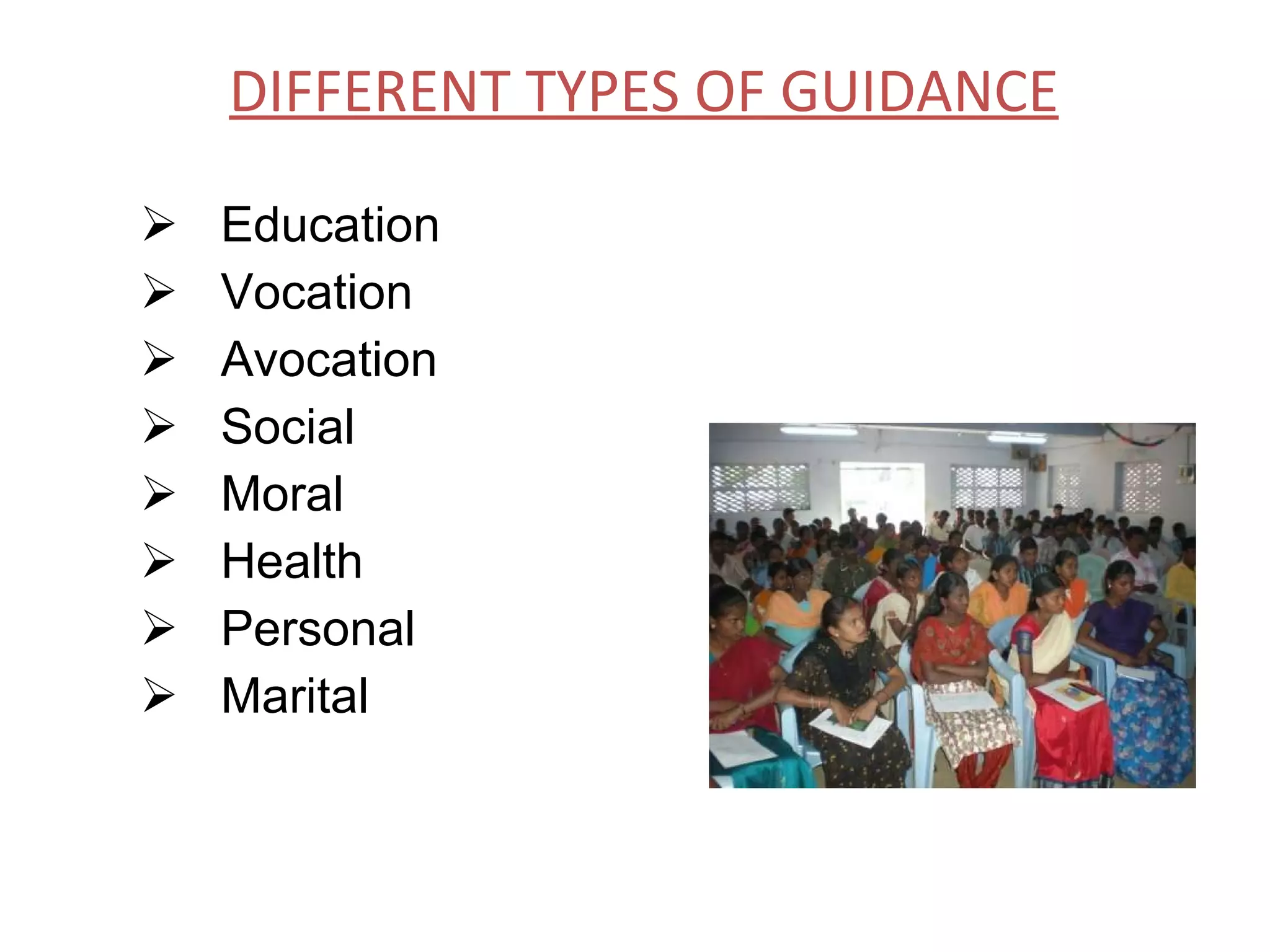
DIFFERENT TYPES OF GUIDANCE Education Vocation Avocation Social Moral Health Personal Marital
ORGANIZATION OF SCHOOL GUIDANCE SERVICES Typical elementary-school guidance program Typical secondary / higher secondary school guidance program 1.Maintenance of personal inventory 2. Collection and dissemination of occupational Information 3. Counseling 4. Placement 5. Follow-up study
TYPICAL ELEMENTARY-SCHOOL GUIDANCE PROGRAM Cooperation with other staff members in the development and maintenance of good habits of study. Cooperation with other staff members in the development and maintenance of good habits of school citizenship. Use of materials in the classroom to show not only how people live but how they make a living. Establishment of a healthful relationship between the parents and the school.
The introduction and use of an adequate cumulative record to be started when the pupil enters school and to continue until the pupil leaves school, with provisions of follow-up studies. The identification of the  pupils who have problem both in and outside school ,such as; Pupils who have specific weakness in mastering the basic skills. Pupils who have difficulty in fitting into a regular school programme because of mental ability, high or low. Pupils who have health conditions not conducive to good school and home adjustment;  Pupils who have problems of social and emotional adjustment. Pupils who have unusual talents or very intense interests.
Typical secondary / higher secondary school guidance program 1.MAINTENANCE OF PERSONAL INVENTORY Cumulative records should be kept and used for each pupil. Testing program should be developed to include intelligence, achievement, aptitude, and interest tests. Cumulative records, anecdotal records, teacher’s rating scales, and similar materials should be used. Cooperation with other staff members in the study of cases of poor attendance.
2. COLLECTION AND DISSEMINATION OF OCCUPATIONAL INFORMATION Source information concerning local occupational requirements and opportunities. Secure and present a general background of occupational information. Assist in correlating occupational information with regular school subjects. Use printed, illustrated and visual material in presenting occupational information. Plan visits to view various types of local and regional employment.
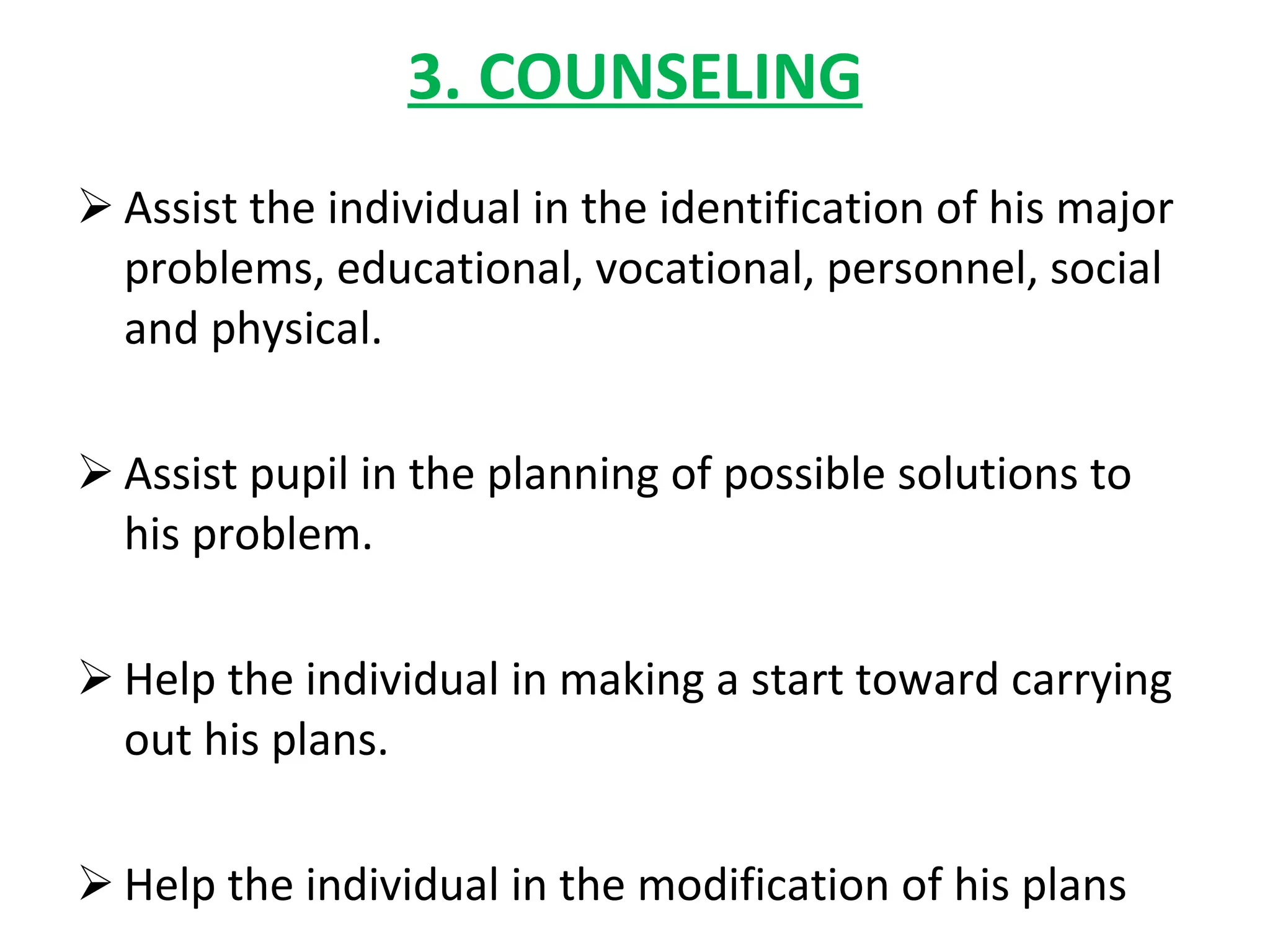
3. COUNSELING Assist the individual in the identification of his major problems, educational, vocational, personnel, social and physical. Assist pupil in the planning of possible solutions to his problem. Help the individual in making a start toward carrying out his plans. Help the individual in the modification of his plans
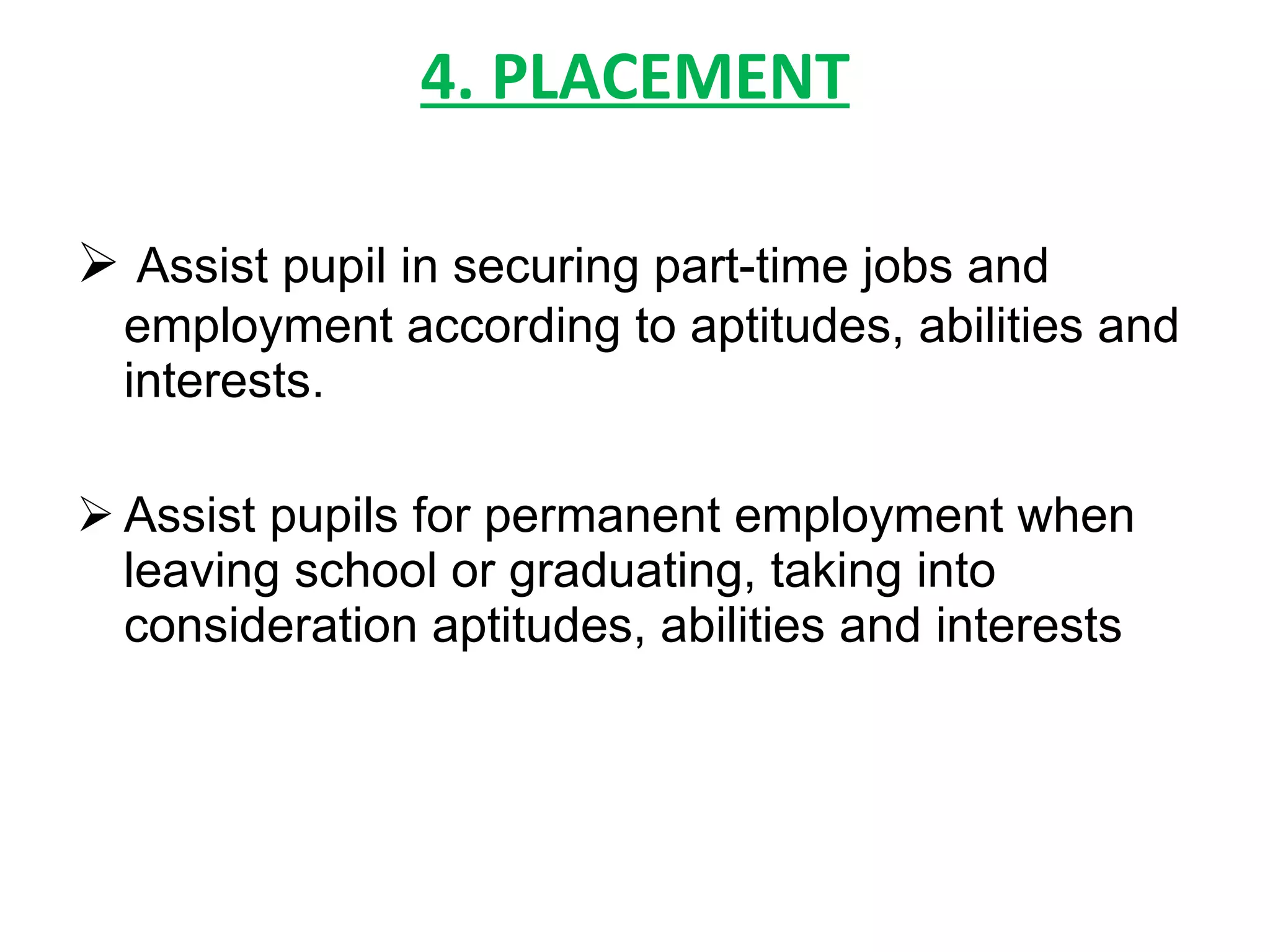
4. PLACEMENT Assist pupil in securing part-time jobs and employment according to aptitudes, abilities and interests. Assist pupils for permanent employment when leaving school or graduating, taking into consideration aptitudes, abilities and interests
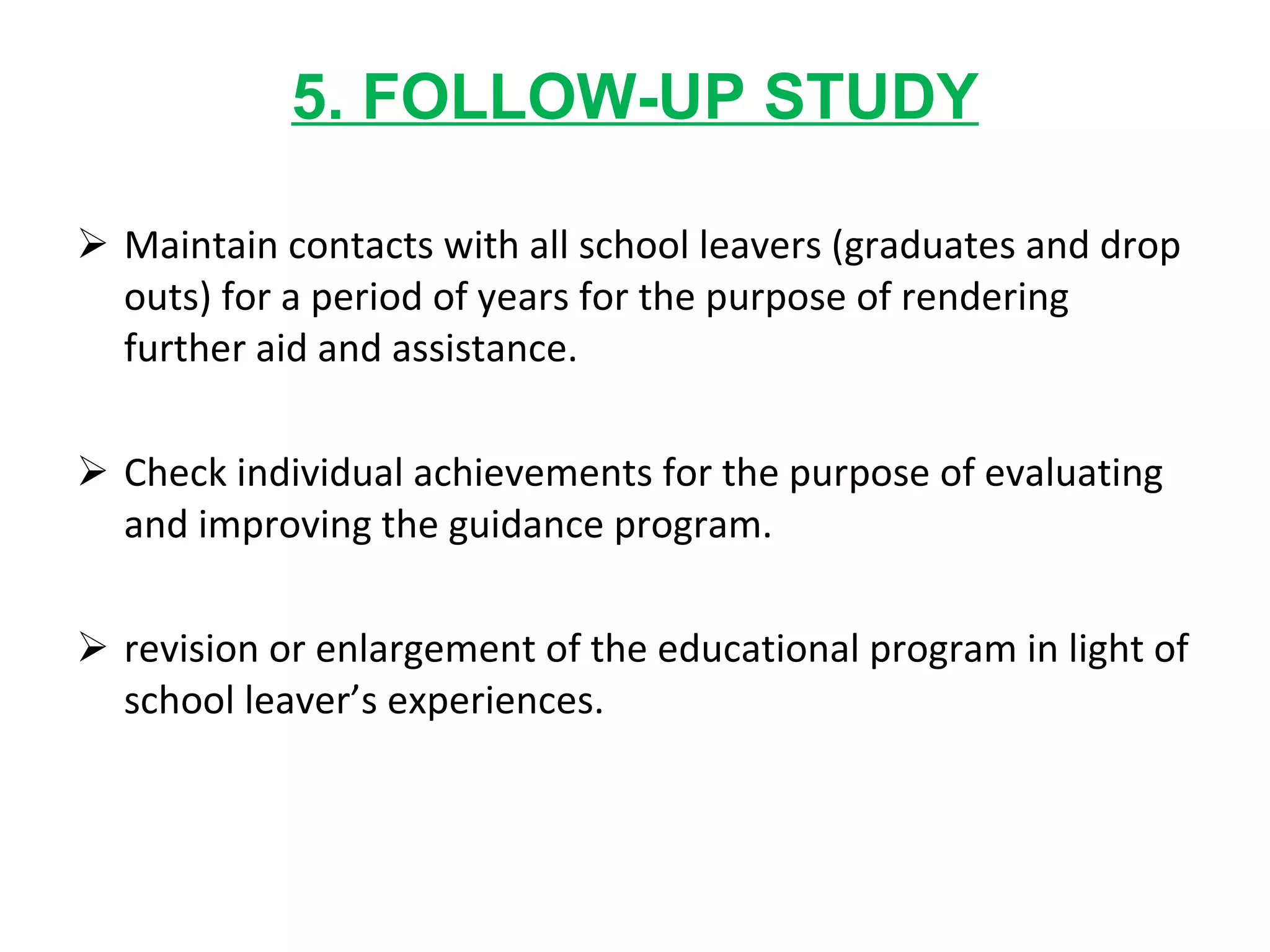
5. FOLLOW-UP STUDY Maintain contacts with all school leavers (graduates and drop outs) for a period of years for the purpose of rendering further aid and assistance. Check individual achievements for the purpose of evaluating and improving the guidance program. revision or enlargement of the educational program in light of school leaver’s experiences.
Thank You

Guidance

  • 1.
  • 2.
    Origin of guidanceservice Definition of guidance Need for guidance Principles of guidance Different types of guidance School guidance services MAIN TOPICS FOR DISCUSSION
  • 3.
    ORIGIN OF GUIDANCESERVICE 1905- frank parsons He worked directly with young people struggling to find work for living He helped to found the vocation bureau and wrote his classic choosing a vocation Parsons was followed by a number of social reformers like Jessie b.Davis , Anne reed and Eli weaver
  • 4.
    DEFINITION OF GUIDANCE“ Guidance is not direction. It is not the imposition of one’s point of view upon another. It is not making decisions for an individual which he should make for himself. It is not carrying the burden of another’s life. Guidance is assistance made available by competent counselors to an individual of any age to help him direct his own point of view , make his own decisions , carry his own burdens .” – Crow and crow
  • 5.
    NEED FOR GUIDANCE The changing family Changing cities Conflicts in values, attitudes and morals Economic factors The changing role of work New pressure and demands on school Problems of young people
  • 6.
    PRINCIPLES OF GUIDANCEAccording to Hollis and Hollis, there are eight principles on which any guidance programme should be based. The principles are , The dignity of the individual is supreme. Each individual is different from every other individual. The primary concern of guidance is the individual in his social setting.  
  • 7.
    The attitudes andpersonnel perceptions of the individual are the bases on which he acts. The individual generally acts to enhance his perceived self. The individual has the innate ability to learn and can be helped to make choices that will lead to self direction consistent with social improvement. The individual needs a continuous guidance process from early childhood through adulthood.   Each individual may at times need the information and personalized assistance best given by competent professional personnel's.  
  • 8.
    DIFFERENT TYPES OFGUIDANCE Education Vocation Avocation Social Moral Health Personal Marital
  • 9.
    ORGANIZATION OF SCHOOLGUIDANCE SERVICES Typical elementary-school guidance program Typical secondary / higher secondary school guidance program 1.Maintenance of personal inventory 2. Collection and dissemination of occupational Information 3. Counseling 4. Placement 5. Follow-up study
  • 10.
    TYPICAL ELEMENTARY-SCHOOL GUIDANCEPROGRAM Cooperation with other staff members in the development and maintenance of good habits of study. Cooperation with other staff members in the development and maintenance of good habits of school citizenship. Use of materials in the classroom to show not only how people live but how they make a living. Establishment of a healthful relationship between the parents and the school.
  • 11.
    The introduction anduse of an adequate cumulative record to be started when the pupil enters school and to continue until the pupil leaves school, with provisions of follow-up studies. The identification of the pupils who have problem both in and outside school ,such as; Pupils who have specific weakness in mastering the basic skills. Pupils who have difficulty in fitting into a regular school programme because of mental ability, high or low. Pupils who have health conditions not conducive to good school and home adjustment; Pupils who have problems of social and emotional adjustment. Pupils who have unusual talents or very intense interests.
  • 12.
    Typical secondary /higher secondary school guidance program 1.MAINTENANCE OF PERSONAL INVENTORY Cumulative records should be kept and used for each pupil. Testing program should be developed to include intelligence, achievement, aptitude, and interest tests. Cumulative records, anecdotal records, teacher’s rating scales, and similar materials should be used. Cooperation with other staff members in the study of cases of poor attendance.
  • 13.
    2. COLLECTION ANDDISSEMINATION OF OCCUPATIONAL INFORMATION Source information concerning local occupational requirements and opportunities. Secure and present a general background of occupational information. Assist in correlating occupational information with regular school subjects. Use printed, illustrated and visual material in presenting occupational information. Plan visits to view various types of local and regional employment.
  • 14.
    3. COUNSELING Assistthe individual in the identification of his major problems, educational, vocational, personnel, social and physical. Assist pupil in the planning of possible solutions to his problem. Help the individual in making a start toward carrying out his plans. Help the individual in the modification of his plans
  • 15.
    4. PLACEMENT Assistpupil in securing part-time jobs and employment according to aptitudes, abilities and interests. Assist pupils for permanent employment when leaving school or graduating, taking into consideration aptitudes, abilities and interests
  • 16.
    5. FOLLOW-UP STUDYMaintain contacts with all school leavers (graduates and drop outs) for a period of years for the purpose of rendering further aid and assistance. Check individual achievements for the purpose of evaluating and improving the guidance program. revision or enlargement of the educational program in light of school leaver’s experiences.
  • 17.