21st Century
Learning
What skillsdo you need for the 21st Century?
Are you Ready?
IN VIEW OF
THE PAST
HISTORYOF EDUCATIONOF THE PHILIPPINES
Who and
where are
we now?
Me in the
21st Century
T
e
c
h
n
o
l
o
g
y
Meinthe21st Century
Whenwe say 21st Century it is thehere
and now, themodern world.
Our generationwhich is evolved in
technology and highindustries.
People who live in an
“InstantWorld”
Education System of our country at
present sees the need of this
generation. Our current
President,Pres. Benigno
Aquino took the initiative to
implement the K-12
program which was
long time already
introduced.
In accordance with pertinent
provisions of the Constitution that:
the state:
“ Shall protect and
promote the right of all
citizens to quality
education at all levels…”
( Article XIV Section 1):
“Establish, maintain and support
a complete, adequate and
integrated system
of education relevant
to the needs of the
people and Society”
( Article XIV Section 2)
Exercise reasonable supervision and
regulation of all educational
institutions and as
reiterated in Republic
Act 7722 otherwise
known as the
“ Higher Education”
Act of 1994
The Commission on Higher
Education “ shall set
minimum standards
for Programs and
institutions of
higher learning
(Section 3)”
In furtherance of the ongoing
paradigm shift to learning
competency based
standards in Philippines
higher education
that underlies the
provisions of CHED Memorandum
Order
No. 2 series 2011:
In pursuit of the ongoing educational reforms that
include the enhanced basic education curriculum
through K to 12 which in its consideration of College
Readiness Standards (CEB Resolution No. 298-2011)
has integrated GE ( General Education) courses of
higher education programs
the senior high school core courses thus,
has created a window for the revision
of the current GE curriculum ( CHED Memorandum
NO. 59 series 1996).
The new GE curriculum aims to expose undergraduate
students to various
domains of knowledge and ways.
Visionof K12 &
Message from the Secretary of the Departmentof Education:
Bro. ArminLuistro
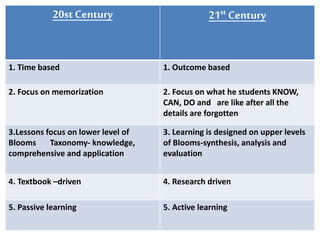
20st Century 21st Century
1. Time based 1. Outcome based
2. Focus on memorization 2. Focus on what he students KNOW,
CAN, DO and are like after all the
details are forgotten
3.Lessons focus on lower level of
Blooms Taxonomy- knowledge,
comprehensive and application
3. Learning is designed on upper levels
of Blooms-synthesis, analysis and
evaluation
4. Textbook –driven 4. Research driven
5. Passive learning 5. Active learning
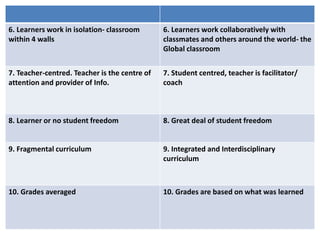
6. Learners work in isolation- classroom
within 4 walls
6. Learners work collaboratively with
classmates and others around the world- the
Global classroom
7. Teacher-centred. Teacher is the centre of
attention and provider of Info.
7. Student centred, teacher is facilitator/
coach
8. Learner or no student freedom 8. Great deal of student freedom
9. Fragmental curriculum 9. Integrated and Interdisciplinary
curriculum
10. Grades averaged 10. Grades are based on what was learned
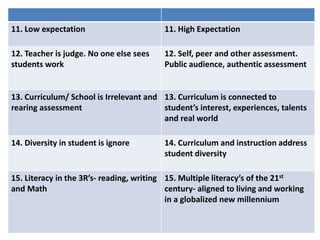
11. Low expectation 11. High Expectation
12. Teacher is judge. No one else sees
students work
12. Self, peer and other assessment.
Public audience, authentic assessment
13. Curriculum/ School is Irrelevant and
rearing assessment
13. Curriculum is connected to
student’s interest, experiences, talents
and real world
14. Diversity in student is ignore 14. Curriculum and instruction address
student diversity
15. Literacy in the 3R’s- reading, writing
and Math
15. Multiple literacy’s of the 21st
century- aligned to living and working
in a globalized new millennium
Teacher in theK-12 Program Basic Education
Program
Message from
Dr. ParalumanR.Giron
DepEd Technical Adviser
The 21st Century learning
proponents advocate an
expanded set of educational
goals as indicated by the
partnership for 21st century
skills
Vision ofK-12.Basic Education
Message from Dr. YolandaQuijano,Undersecretary
for programs and Projects DepEd
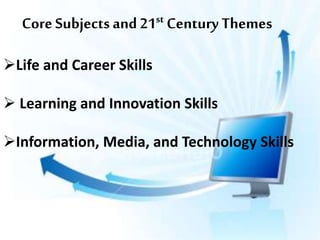
Core Subjects and 21st Century Themes
Life and Career Skills
 Learning and Innovation Skills
Information, Media, and Technology Skills
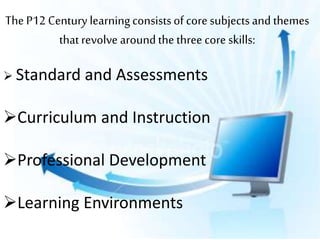
The P12 Century learningconsistsof core subjectsand themes

thatrevolve aroundthe three core skills:
 Standard and Assessments
Curriculum and Instruction
Professional Development
Learning Environments
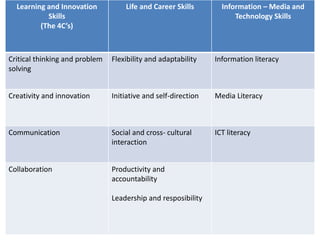
Learning and Innovation
Skills
(The 4C’s)
Life and Career Skills Information – Media and
Technology Skills
Critical thinking and problem
solving
Flexibility and adaptability Information literacy
Creativity and innovation Initiative and self-direction Media Literacy
Communication Social and cross- cultural
interaction
ICT literacy
Collaboration Productivity and
accountability
Leadership and resposibility
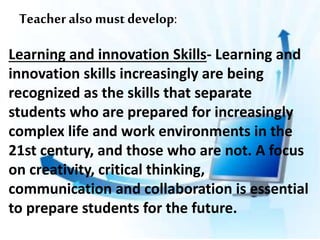
Teacher also must develop:
Learning and innovation Skills- Learning and
innovation skills increasingly are being
recognized as the skills that separate
students who are prepared for increasingly
complex life and work environments in the
21st century, and those who are not. A focus
on creativity, critical thinking,
communication and collaboration is essential
to prepare students for the future.
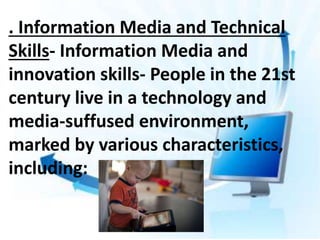
. Information Media and Technical
Skills- Information Media and
innovation skills- People in the 21st
century live in a technology and
media-suffused environment,
marked by various characteristics,
including:
1) access to an abundance of information,
2) rapid changes in technology tools, and
3) the ability to collaborate and make
individual contributions on an unprecedented
scale. To be effective in the 21st century,
citizens and workers must be able to exhibit a
range of functional and critical thinking skills
related to information, media and technology.
. Effective Communication Skills- Teaching is
generally considered as only fifty percent
knowledge and fifty percent interpersonal or
communication skills. For a teacher, it is not
just important to give a quality lecture but it is
more important for the presentation of a
lesson or lecture in class. Communication skills
for teachers are thus as important as their in-
depth knowledge of the particular subject
which they teach.
Teachers should be aware of the
importance of communication skills in
teaching. They must also realize that all
students have different levels of strengths
and weaknesses. It is only through
communication skills that a teacher can
introduce creative and effective solutions
to the problems of the students. Thus, a
teacher can enhance the learning process.
Life and Career Skills- 21st-Century Life &
Career Skills.
All students will demonstrate the
creative, critical thinking, collaboration,
and problem-solving skills needed to
function successfully as both global
citizens and workers in diverse ethnic and
organizational cultures.
In a
whole
view
of K12
Prepared by:
Sr. RodithEstillero
Kristine Seraphime
THANK YOU….
21st Century Learning

21st Century Learning

  • 1.
    21st Century Learning What skillsdoyou need for the 21st Century? Are you Ready?
  • 2.
  • 3.
  • 4.
  • 5.
  • 6.
  • 7.
    Meinthe21st Century Whenwe say21st Century it is thehere and now, themodern world. Our generationwhich is evolved in technology and highindustries. People who live in an “InstantWorld”
  • 9.
    Education System ofour country at present sees the need of this generation. Our current President,Pres. Benigno Aquino took the initiative to implement the K-12 program which was long time already introduced.
  • 10.
    In accordance withpertinent provisions of the Constitution that: the state: “ Shall protect and promote the right of all citizens to quality education at all levels…” ( Article XIV Section 1):
  • 11.
    “Establish, maintain andsupport a complete, adequate and integrated system of education relevant to the needs of the people and Society” ( Article XIV Section 2)
  • 12.
    Exercise reasonable supervisionand regulation of all educational institutions and as reiterated in Republic Act 7722 otherwise known as the “ Higher Education” Act of 1994
  • 13.
    The Commission onHigher Education “ shall set minimum standards for Programs and institutions of higher learning (Section 3)”
  • 14.
    In furtherance ofthe ongoing paradigm shift to learning competency based standards in Philippines higher education that underlies the provisions of CHED Memorandum Order No. 2 series 2011:
  • 15.
    In pursuit ofthe ongoing educational reforms that include the enhanced basic education curriculum through K to 12 which in its consideration of College Readiness Standards (CEB Resolution No. 298-2011) has integrated GE ( General Education) courses of higher education programs the senior high school core courses thus, has created a window for the revision of the current GE curriculum ( CHED Memorandum NO. 59 series 1996). The new GE curriculum aims to expose undergraduate students to various domains of knowledge and ways.
  • 16.
    Visionof K12 & Messagefrom the Secretary of the Departmentof Education: Bro. ArminLuistro
  • 17.
    20st Century 21stCentury 1. Time based 1. Outcome based 2. Focus on memorization 2. Focus on what he students KNOW, CAN, DO and are like after all the details are forgotten 3.Lessons focus on lower level of Blooms Taxonomy- knowledge, comprehensive and application 3. Learning is designed on upper levels of Blooms-synthesis, analysis and evaluation 4. Textbook –driven 4. Research driven 5. Passive learning 5. Active learning
  • 18.
    6. Learners workin isolation- classroom within 4 walls 6. Learners work collaboratively with classmates and others around the world- the Global classroom 7. Teacher-centred. Teacher is the centre of attention and provider of Info. 7. Student centred, teacher is facilitator/ coach 8. Learner or no student freedom 8. Great deal of student freedom 9. Fragmental curriculum 9. Integrated and Interdisciplinary curriculum 10. Grades averaged 10. Grades are based on what was learned
  • 19.
    11. Low expectation11. High Expectation 12. Teacher is judge. No one else sees students work 12. Self, peer and other assessment. Public audience, authentic assessment 13. Curriculum/ School is Irrelevant and rearing assessment 13. Curriculum is connected to student’s interest, experiences, talents and real world 14. Diversity in student is ignore 14. Curriculum and instruction address student diversity 15. Literacy in the 3R’s- reading, writing and Math 15. Multiple literacy’s of the 21st century- aligned to living and working in a globalized new millennium
  • 20.
    Teacher in theK-12Program Basic Education Program Message from Dr. ParalumanR.Giron DepEd Technical Adviser
  • 21.
    The 21st Centurylearning proponents advocate an expanded set of educational goals as indicated by the partnership for 21st century skills
  • 22.
    Vision ofK-12.Basic Education Messagefrom Dr. YolandaQuijano,Undersecretary for programs and Projects DepEd
  • 23.
    Core Subjects and21st Century Themes Life and Career Skills  Learning and Innovation Skills Information, Media, and Technology Skills
  • 24.
    The P12 Centurylearningconsistsof core subjectsand themes thatrevolve aroundthe three core skills:  Standard and Assessments Curriculum and Instruction Professional Development Learning Environments
  • 25.
    Learning and Innovation Skills (The4C’s) Life and Career Skills Information – Media and Technology Skills Critical thinking and problem solving Flexibility and adaptability Information literacy Creativity and innovation Initiative and self-direction Media Literacy Communication Social and cross- cultural interaction ICT literacy Collaboration Productivity and accountability Leadership and resposibility
  • 27.
    Teacher also mustdevelop: Learning and innovation Skills- Learning and innovation skills increasingly are being recognized as the skills that separate students who are prepared for increasingly complex life and work environments in the 21st century, and those who are not. A focus on creativity, critical thinking, communication and collaboration is essential to prepare students for the future.
  • 29.
    . Information Mediaand Technical Skills- Information Media and innovation skills- People in the 21st century live in a technology and media-suffused environment, marked by various characteristics, including:
  • 30.
    1) access toan abundance of information, 2) rapid changes in technology tools, and 3) the ability to collaborate and make individual contributions on an unprecedented scale. To be effective in the 21st century, citizens and workers must be able to exhibit a range of functional and critical thinking skills related to information, media and technology.
  • 31.
    . Effective CommunicationSkills- Teaching is generally considered as only fifty percent knowledge and fifty percent interpersonal or communication skills. For a teacher, it is not just important to give a quality lecture but it is more important for the presentation of a lesson or lecture in class. Communication skills for teachers are thus as important as their in- depth knowledge of the particular subject which they teach.
  • 32.
    Teachers should beaware of the importance of communication skills in teaching. They must also realize that all students have different levels of strengths and weaknesses. It is only through communication skills that a teacher can introduce creative and effective solutions to the problems of the students. Thus, a teacher can enhance the learning process.
  • 33.
    Life and CareerSkills- 21st-Century Life & Career Skills. All students will demonstrate the creative, critical thinking, collaboration, and problem-solving skills needed to function successfully as both global citizens and workers in diverse ethnic and organizational cultures.
  • 35.
  • 37.