Name: Regine Kyle B. Regida Professor: Prof. Elveña
Course and Year: BSE English 3 Subject: AL 2
Task:
Do the activities that follow.
Activity 2
Directions: Create your own lesson plan and create an authentic assessment about it.
Lesson Plan in English (Grade 10)
Prepared by: Regine Kyle Regida
I. Objectives
At the end of this lesson, the students must be able to:
1. Appreciate English literature;
2. Develop reading comprehension; and
3. Reflect on the message of the poem.
II. Subject Matter
Topic: The Leadership by Phillip Blytheville
References: English 10 Learner’s Material
Celebrating Diversity Through World Literature
Module 1: Overcoming Challenges
Hello Poetry (2017)
Materials: laptop, PowerPoint Presentation, and projector
Skills: reading comprehension
Values Integration: unity, cooperation, fellowship, and leadership
III. Procedure
Teacher’s Activity Students’ Activity
A. Preliminary Activities
1. Rearrangement of Classroom
2. Opening Prayer
3. Checking of Attendance
B. Motivation
“Will it be fine to start our day with a
little game?”
“Alright, let me start with a question.
Has anyone from the class
experienced being a leader?”
“What about being a follower?”
“Alright, I need eight (8) volunteers
for this activity. Four (4) of them
must have experienced being a
leader while the other four (4) must
have experienced being a follower.
Everyone will share their experience
as a leader and as a follower.”
“Alright! I guess everyone can relate
to their stories! The followers can
now sit down. Leaders, remain
standing in front.”
“Now, here’s the twist. After our
short discussion, we will be having a
“Yes, Ma’am!”
“Of course, Ma’am!”
“Yes, Ma’am!”
Leader 1: “Sometimes, it’s hard to
lead when it’s hard to make your
groupmates follow you.”
Leader 2: “It feels good when the
group accomplishes the task
assigned.”
Leader 3: “I feel frustrated when
teachers make me accountable for
the mistakes of the entire group.”
Leader 4: “It’s very nerve-cracking
because it feels like everyone’s
lives is on my hands.”
Follower 1: “I’m more than willing to
do whatever I can offer because it’s
hard to become a leader.”
Follower 2: “I don’t like it when the
leader is too bossy.”
Follower 3: “I think I’m too useless
to be a leader so I’d rather be a
follower.”
Follower 4: “It’s easier to follow
than to lead because it takes a lot
of responsibility and I don’t like it.”
“Okay. Thank you, Ma’am!”
Leader 1: “If my group wins,
everyone dance budots.”
group activity so I will divide you into
four (4) groups. Whoever gets the
highest rating will give a punishment
to the class. And that punishment
will be made by the leaders in front!
Now, think of any punishment you
want everyone to do if your group
wins. It can be silly, funny, or
anything that will not cause harm to
motivate everyone to do their best.”
“Those are very challenging
punishments! Nobody would want to
do them, would you? Remember
what your leaders has said! Now,
let’s divide you into four groups so
we can start the discussion.”
Leader 2: “If my group wins,
everyone must say uWu with
feelings and actions.”
Leader 3: “If my group wins, each
of you will do the Bad Romance
challenge.”
Leader 4: “If my group wins,
everyone must spell my name
using their butt.”
C. Presentation of the Lesson
(The teacher presents the
PowerPoint Presentation to the
class)
“Is the presentation visible to the
students at the back?”
“Alright. So, on the screen is the
poem entitled The Leadership by
Phillip Blytheville. In Grade 10, you
are bound to learn the beauty of the
world literature. And we’ll be starting
by indulging our minds in the
American literature. Would that be
okay with you, guys?”
“Okay, so, let us have a recall first
about the definition of a poem when
you were in Grade 8. Anyone from
the class?”
“Good memory! Can you still
remember the various rhyme
schemes?”
“Yes, Ma’am!”
“No problem, Ma’am!”
“Poem is a literary work composed
of lines and stanzas with rhymes
often conveys beautiful messages
in short phrases.”
“Ballad, sonnet, triplet, monorhyme,
coupled rhyme, and many more.”
“Glad you listened very well during
that day! I think we can now proceed
to the poem and start reading it with
comprehension!”
D. Discussion
“Can someone volunteer to read the
first stanza from the title?”
“Alright, thank you for reading the
first stanza. So, what can you say
about the message of it?”
“Good comprehension. What else?”
“Interesting, isn’t it? I agree with all
of your answers. We immediately
understood what the writer wants to
tell us because he used simple
words to communicate, right? Okay,
so, next stanza, please.”
“Any reactions or comments from
the second stanza?”
“I think that my students are too
smart to easily comprehend the
poem and that’s nice! Who else?”
“Your answers are so wonderful. I
think you’d become really good
citizens of our country if we keep in
mind that there are people who are
“The Leadership by Phillip
Blytheville
Streets covered with hatred, a
tainted neighborhood.
Leadership take it as a sign that
everything is good.”
“That leaders often turn their eyes
blind in the sufferings of their
followers.”
“That leaders ignore the cries of
their followers even if everything is
already full of hatred and
madness.”
“People mislead and forgotten,
left to carry a note.
Leadership’s only concern is will
you give them a vote.”
“Leaders start to forget their
promises once they’re seated on
their positions. They’re only good at
showing kindness when they need
our help to bring them to where
they are now.”
“Leaders loves numbers in terms of
money and vote but never in terms
of achievements and mass
support.”
“Not yet, Ma’am.”
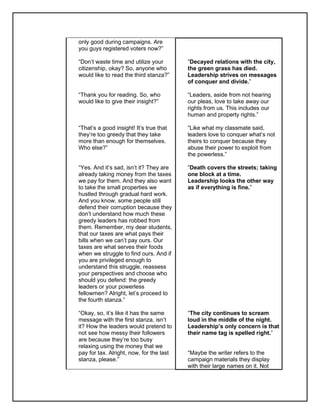
only good during campaigns. Are
you guys registered voters now?”
“Don’t waste time and utilize your
citizenship, okay? So, anyone who
would like to read the third stanza?”
“Thank you for reading. So, who
would like to give their insight?”
“That’s a good insight! It’s true that
they’re too greedy that they take
more than enough for themselves.
Who else?”
“Yes. And it’s sad, isn’t it? They are
already taking money from the taxes
we pay for them. And they also want
to take the small properties we
hustled through gradual hard work.
And you know, some people still
defend their corruption because they
don’t understand how much these
greedy leaders has robbed from
them. Remember, my dear students,
that our taxes are what pays their
bills when we can’t pay ours. Our
taxes are what serves their foods
when we struggle to find ours. And if
you are privileged enough to
understand this struggle, reassess
your perspectives and choose who
should you defend: the greedy
leaders or your powerless
fellowmen? Alright, let’s proceed to
the fourth stanza.”
“Okay, so, it’s like it has the same
message with the first stanza, isn’t
it? How the leaders would pretend to
not see how messy their followers
are because they’re too busy
relaxing using the money that we
pay for tax. Alright, now, for the last
stanza, please.”
“Decayed relations with the city,
the green grass has died.
Leadership strives on messages
of conquer and divide.”
“Leaders, aside from not hearing
our pleas, love to take away our
rights from us. This includes our
human and property rights.”
“Like what my classmate said,
leaders love to conquer what’s not
theirs to conquer because they
abuse their power to exploit from
the powerless.”
“Death covers the streets; taking
one block at a time.
Leadership looks the other way
as if everything is fine.”
“The city continues to scream
loud in the middle of the night.
Leadership’s only concern is that
their name tag is spelled right.”
“Maybe the writer refers to the
campaign materials they display
with their large names on it. Not
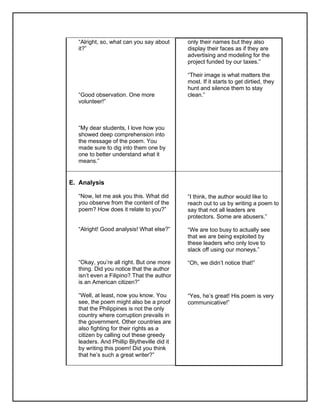
“Alright, so, what can you say about
it?”
“Good observation. One more
volunteer!”
“My dear students, I love how you
showed deep comprehension into
the message of the poem. You
made sure to dig into them one by
one to better understand what it
means.”
only their names but they also
display their faces as if they are
advertising and modeling for the
project funded by our taxes.”
“Their image is what matters the
most. If it starts to get dirtied, they
hunt and silence them to stay
clean.”
E. Analysis
“Now, let me ask you this. What did
you observe from the content of the
poem? How does it relate to you?”
“Alright! Good analysis! What else?”
“Okay, you’re all right. But one more
thing. Did you notice that the author
isn’t even a Filipino? That the author
is an American citizen?”
“Well, at least, now you know. You
see, the poem might also be a proof
that the Philippines is not the only
country where corruption prevails in
the government. Other countries are
also fighting for their rights as a
citizen by calling out these greedy
leaders. And Phillip Blytheville did it
by writing this poem! Did you think
that he’s such a great writer?”
“I think, the author would like to
reach out to us by writing a poem to
say that not all leaders are
protectors. Some are abusers.”
“We are too busy to actually see
that we are being exploited by
these leaders who only love to
slack off using our moneys.”
“Oh, we didn’t notice that!”
“Yes, he’s great! His poem is very
communicative!”
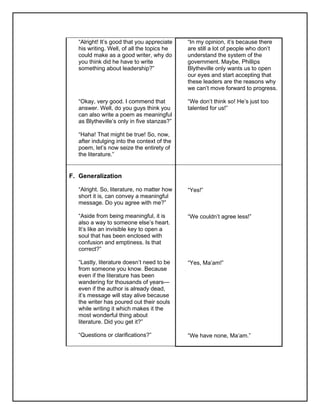
“Alright! It’s good that you appreciate
his writing. Well, of all the topics he
could make as a good writer, why do
you think did he have to write
something about leadership?”
“Okay, very good. I commend that
answer. Well, do you guys think you
can also write a poem as meaningful
as Blytheville’s only in five stanzas?”
“Haha! That might be true! So, now,
after indulging into the context of the
poem, let’s now seize the entirety of
the literature.”
“In my opinion, it’s because there
are still a lot of people who don’t
understand the system of the
government. Maybe, Phillips
Blytheville only wants us to open
our eyes and start accepting that
these leaders are the reasons why
we can’t move forward to progress.
“We don’t think so! He’s just too
talented for us!”
F. Generalization
“Alright. So, literature, no matter how
short it is, can convey a meaningful
message. Do you agree with me?”
“Aside from being meaningful, it is
also a way to someone else’s heart.
It’s like an invisible key to open a
soul that has been enclosed with
confusion and emptiness. Is that
correct?”
“Lastly, literature doesn’t need to be
from someone you know. Because
even if the literature has been
wandering for thousands of years—
even if the author is already dead,
it’s message will stay alive because
the writer has poured out their souls
while writing it which makes it the
most wonderful thing about
literature. Did you get it?”
“Questions or clarifications?”
“Yes!”
“We couldn’t agree less!”
“Yes, Ma’am!”
“We have none, Ma’am.”
G. Application
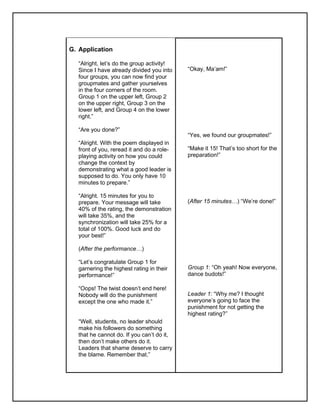
“Alright, let’s do the group activity!
Since I have already divided you into
four groups, you can now find your
groupmates and gather yourselves
in the four corners of the room.
Group 1 on the upper left, Group 2
on the upper right, Group 3 on the
lower left, and Group 4 on the lower
right.”
“Are you done?”
“Alright. With the poem displayed in
front of you, reread it and do a role-
playing activity on how you could
change the context by
demonstrating what a good leader is
supposed to do. You only have 10
minutes to prepare.”
“Alright. 15 minutes for you to
prepare. Your message will take
40% of the rating, the demonstration
will take 35%, and the
synchronization will take 25% for a
total of 100%. Good luck and do
your best!”
(After the performance…)
“Let’s congratulate Group 1 for
garnering the highest rating in their
performance!”
“Oops! The twist doesn’t end here!
Nobody will do the punishment
except the one who made it.”
“Well, students, no leader should
make his followers do something
that he cannot do. If you can’t do it,
then don’t make others do it.
Leaders that shame deserve to carry
the blame. Remember that.”
“Okay, Ma’am!”
“Yes, we found our groupmates!”
“Make it 15! That’s too short for the
preparation!”
(After 15 minutes…) “We’re done!”
Group 1: “Oh yeah! Now everyone,
dance budots!”
Leader 1: “Why me? I thought
everyone’s going to face the
punishment for not getting the
highest rating?”
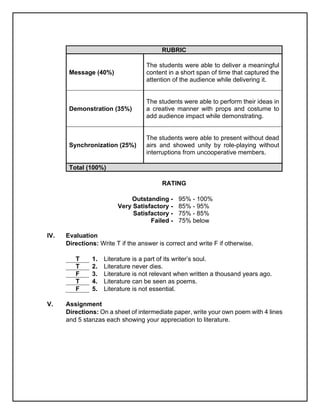
RUBRIC
Message (40%)
The students were able to deliver a meaningful
content in a short span of time that captured the
attention of the audience while delivering it.
Demonstration (35%)
The students were able to perform their ideas in
a creative manner with props and costume to
add audience impact while demonstrating.
Synchronization (25%)
The students were able to present without dead
airs and showed unity by role-playing without
interruptions from uncooperative members.
Total (100%)
RATING
Outstanding - 95% - 100%
Very Satisfactory - 85% - 95%
Satisfactory - 75% - 85%
Failed - 75% below
IV. Evaluation
Directions: Write T if the answer is correct and write F if otherwise.
T 1. Literature is a part of its writer’s soul.
T 2. Literature never dies.
F 3. Literature is not relevant when written a thousand years ago.
T 4. Literature can be seen as poems.
F 5. Literature is not essential.
V. Assignment
Directions: On a sheet of intermediate paper, write your own poem with 4 lines
and 5 stanzas each showing your appreciation to literature.

Detailed Lesson Plan with Authentic Assessment (Sample)

  • 1.
    Name: Regine KyleB. Regida Professor: Prof. Elveña Course and Year: BSE English 3 Subject: AL 2 Task: Do the activities that follow. Activity 2 Directions: Create your own lesson plan and create an authentic assessment about it. Lesson Plan in English (Grade 10) Prepared by: Regine Kyle Regida I. Objectives At the end of this lesson, the students must be able to: 1. Appreciate English literature; 2. Develop reading comprehension; and 3. Reflect on the message of the poem. II. Subject Matter Topic: The Leadership by Phillip Blytheville References: English 10 Learner’s Material Celebrating Diversity Through World Literature Module 1: Overcoming Challenges Hello Poetry (2017) Materials: laptop, PowerPoint Presentation, and projector Skills: reading comprehension Values Integration: unity, cooperation, fellowship, and leadership III. Procedure Teacher’s Activity Students’ Activity A. Preliminary Activities 1. Rearrangement of Classroom 2. Opening Prayer 3. Checking of Attendance
  • 2.
    B. Motivation “Will itbe fine to start our day with a little game?” “Alright, let me start with a question. Has anyone from the class experienced being a leader?” “What about being a follower?” “Alright, I need eight (8) volunteers for this activity. Four (4) of them must have experienced being a leader while the other four (4) must have experienced being a follower. Everyone will share their experience as a leader and as a follower.” “Alright! I guess everyone can relate to their stories! The followers can now sit down. Leaders, remain standing in front.” “Now, here’s the twist. After our short discussion, we will be having a “Yes, Ma’am!” “Of course, Ma’am!” “Yes, Ma’am!” Leader 1: “Sometimes, it’s hard to lead when it’s hard to make your groupmates follow you.” Leader 2: “It feels good when the group accomplishes the task assigned.” Leader 3: “I feel frustrated when teachers make me accountable for the mistakes of the entire group.” Leader 4: “It’s very nerve-cracking because it feels like everyone’s lives is on my hands.” Follower 1: “I’m more than willing to do whatever I can offer because it’s hard to become a leader.” Follower 2: “I don’t like it when the leader is too bossy.” Follower 3: “I think I’m too useless to be a leader so I’d rather be a follower.” Follower 4: “It’s easier to follow than to lead because it takes a lot of responsibility and I don’t like it.” “Okay. Thank you, Ma’am!” Leader 1: “If my group wins, everyone dance budots.”
  • 3.
    group activity soI will divide you into four (4) groups. Whoever gets the highest rating will give a punishment to the class. And that punishment will be made by the leaders in front! Now, think of any punishment you want everyone to do if your group wins. It can be silly, funny, or anything that will not cause harm to motivate everyone to do their best.” “Those are very challenging punishments! Nobody would want to do them, would you? Remember what your leaders has said! Now, let’s divide you into four groups so we can start the discussion.” Leader 2: “If my group wins, everyone must say uWu with feelings and actions.” Leader 3: “If my group wins, each of you will do the Bad Romance challenge.” Leader 4: “If my group wins, everyone must spell my name using their butt.” C. Presentation of the Lesson (The teacher presents the PowerPoint Presentation to the class) “Is the presentation visible to the students at the back?” “Alright. So, on the screen is the poem entitled The Leadership by Phillip Blytheville. In Grade 10, you are bound to learn the beauty of the world literature. And we’ll be starting by indulging our minds in the American literature. Would that be okay with you, guys?” “Okay, so, let us have a recall first about the definition of a poem when you were in Grade 8. Anyone from the class?” “Good memory! Can you still remember the various rhyme schemes?” “Yes, Ma’am!” “No problem, Ma’am!” “Poem is a literary work composed of lines and stanzas with rhymes often conveys beautiful messages in short phrases.” “Ballad, sonnet, triplet, monorhyme, coupled rhyme, and many more.”
  • 4.
    “Glad you listenedvery well during that day! I think we can now proceed to the poem and start reading it with comprehension!” D. Discussion “Can someone volunteer to read the first stanza from the title?” “Alright, thank you for reading the first stanza. So, what can you say about the message of it?” “Good comprehension. What else?” “Interesting, isn’t it? I agree with all of your answers. We immediately understood what the writer wants to tell us because he used simple words to communicate, right? Okay, so, next stanza, please.” “Any reactions or comments from the second stanza?” “I think that my students are too smart to easily comprehend the poem and that’s nice! Who else?” “Your answers are so wonderful. I think you’d become really good citizens of our country if we keep in mind that there are people who are “The Leadership by Phillip Blytheville Streets covered with hatred, a tainted neighborhood. Leadership take it as a sign that everything is good.” “That leaders often turn their eyes blind in the sufferings of their followers.” “That leaders ignore the cries of their followers even if everything is already full of hatred and madness.” “People mislead and forgotten, left to carry a note. Leadership’s only concern is will you give them a vote.” “Leaders start to forget their promises once they’re seated on their positions. They’re only good at showing kindness when they need our help to bring them to where they are now.” “Leaders loves numbers in terms of money and vote but never in terms of achievements and mass support.” “Not yet, Ma’am.”
  • 5.
    only good duringcampaigns. Are you guys registered voters now?” “Don’t waste time and utilize your citizenship, okay? So, anyone who would like to read the third stanza?” “Thank you for reading. So, who would like to give their insight?” “That’s a good insight! It’s true that they’re too greedy that they take more than enough for themselves. Who else?” “Yes. And it’s sad, isn’t it? They are already taking money from the taxes we pay for them. And they also want to take the small properties we hustled through gradual hard work. And you know, some people still defend their corruption because they don’t understand how much these greedy leaders has robbed from them. Remember, my dear students, that our taxes are what pays their bills when we can’t pay ours. Our taxes are what serves their foods when we struggle to find ours. And if you are privileged enough to understand this struggle, reassess your perspectives and choose who should you defend: the greedy leaders or your powerless fellowmen? Alright, let’s proceed to the fourth stanza.” “Okay, so, it’s like it has the same message with the first stanza, isn’t it? How the leaders would pretend to not see how messy their followers are because they’re too busy relaxing using the money that we pay for tax. Alright, now, for the last stanza, please.” “Decayed relations with the city, the green grass has died. Leadership strives on messages of conquer and divide.” “Leaders, aside from not hearing our pleas, love to take away our rights from us. This includes our human and property rights.” “Like what my classmate said, leaders love to conquer what’s not theirs to conquer because they abuse their power to exploit from the powerless.” “Death covers the streets; taking one block at a time. Leadership looks the other way as if everything is fine.” “The city continues to scream loud in the middle of the night. Leadership’s only concern is that their name tag is spelled right.” “Maybe the writer refers to the campaign materials they display with their large names on it. Not
  • 6.
    “Alright, so, whatcan you say about it?” “Good observation. One more volunteer!” “My dear students, I love how you showed deep comprehension into the message of the poem. You made sure to dig into them one by one to better understand what it means.” only their names but they also display their faces as if they are advertising and modeling for the project funded by our taxes.” “Their image is what matters the most. If it starts to get dirtied, they hunt and silence them to stay clean.” E. Analysis “Now, let me ask you this. What did you observe from the content of the poem? How does it relate to you?” “Alright! Good analysis! What else?” “Okay, you’re all right. But one more thing. Did you notice that the author isn’t even a Filipino? That the author is an American citizen?” “Well, at least, now you know. You see, the poem might also be a proof that the Philippines is not the only country where corruption prevails in the government. Other countries are also fighting for their rights as a citizen by calling out these greedy leaders. And Phillip Blytheville did it by writing this poem! Did you think that he’s such a great writer?” “I think, the author would like to reach out to us by writing a poem to say that not all leaders are protectors. Some are abusers.” “We are too busy to actually see that we are being exploited by these leaders who only love to slack off using our moneys.” “Oh, we didn’t notice that!” “Yes, he’s great! His poem is very communicative!”
  • 7.
    “Alright! It’s goodthat you appreciate his writing. Well, of all the topics he could make as a good writer, why do you think did he have to write something about leadership?” “Okay, very good. I commend that answer. Well, do you guys think you can also write a poem as meaningful as Blytheville’s only in five stanzas?” “Haha! That might be true! So, now, after indulging into the context of the poem, let’s now seize the entirety of the literature.” “In my opinion, it’s because there are still a lot of people who don’t understand the system of the government. Maybe, Phillips Blytheville only wants us to open our eyes and start accepting that these leaders are the reasons why we can’t move forward to progress. “We don’t think so! He’s just too talented for us!” F. Generalization “Alright. So, literature, no matter how short it is, can convey a meaningful message. Do you agree with me?” “Aside from being meaningful, it is also a way to someone else’s heart. It’s like an invisible key to open a soul that has been enclosed with confusion and emptiness. Is that correct?” “Lastly, literature doesn’t need to be from someone you know. Because even if the literature has been wandering for thousands of years— even if the author is already dead, it’s message will stay alive because the writer has poured out their souls while writing it which makes it the most wonderful thing about literature. Did you get it?” “Questions or clarifications?” “Yes!” “We couldn’t agree less!” “Yes, Ma’am!” “We have none, Ma’am.”
  • 8.
    G. Application “Alright, let’sdo the group activity! Since I have already divided you into four groups, you can now find your groupmates and gather yourselves in the four corners of the room. Group 1 on the upper left, Group 2 on the upper right, Group 3 on the lower left, and Group 4 on the lower right.” “Are you done?” “Alright. With the poem displayed in front of you, reread it and do a role- playing activity on how you could change the context by demonstrating what a good leader is supposed to do. You only have 10 minutes to prepare.” “Alright. 15 minutes for you to prepare. Your message will take 40% of the rating, the demonstration will take 35%, and the synchronization will take 25% for a total of 100%. Good luck and do your best!” (After the performance…) “Let’s congratulate Group 1 for garnering the highest rating in their performance!” “Oops! The twist doesn’t end here! Nobody will do the punishment except the one who made it.” “Well, students, no leader should make his followers do something that he cannot do. If you can’t do it, then don’t make others do it. Leaders that shame deserve to carry the blame. Remember that.” “Okay, Ma’am!” “Yes, we found our groupmates!” “Make it 15! That’s too short for the preparation!” (After 15 minutes…) “We’re done!” Group 1: “Oh yeah! Now everyone, dance budots!” Leader 1: “Why me? I thought everyone’s going to face the punishment for not getting the highest rating?”
  • 9.
    RUBRIC Message (40%) The studentswere able to deliver a meaningful content in a short span of time that captured the attention of the audience while delivering it. Demonstration (35%) The students were able to perform their ideas in a creative manner with props and costume to add audience impact while demonstrating. Synchronization (25%) The students were able to present without dead airs and showed unity by role-playing without interruptions from uncooperative members. Total (100%) RATING Outstanding - 95% - 100% Very Satisfactory - 85% - 95% Satisfactory - 75% - 85% Failed - 75% below IV. Evaluation Directions: Write T if the answer is correct and write F if otherwise. T 1. Literature is a part of its writer’s soul. T 2. Literature never dies. F 3. Literature is not relevant when written a thousand years ago. T 4. Literature can be seen as poems. F 5. Literature is not essential. V. Assignment Directions: On a sheet of intermediate paper, write your own poem with 4 lines and 5 stanzas each showing your appreciation to literature.