Mid Point Review
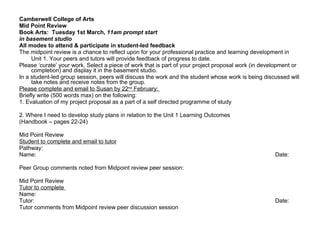
Camberwell College of Arts Mid Point Review  Book Arts:  Tuesday 1st March,  11am prompt start  in basement studio All modes to attend & participate in student-led feedback The midpoint review is a chance to reflect upon for your professional practice and learning development in Unit 1. Your peers and tutors will provide feedback of progress to date.  Please ‘curate’ your work. Select a piece of work that is part of your project proposal work (in development or completion) and display it in the basement studio. In a student-led group session, peers will discuss the work and the student whose work is being discussed will take notes and receive notes from the group. Please complete and email to Susan by 22 nd  February:  Briefly write (500 words max) on the following: 1. Evaluation of my project proposal as a part of a self directed programme of study    2. Where I need to develop study plans in relation to the Unit 1 Learning Outcomes (Handbook – pages 22-24)   Mid Point Review Student to complete and email to tutor Pathway: Name: Date:   Peer Group comments noted from Midpoint review peer session: Mid Point Review Tutor to complete  Name: Tutor:  Date: Tutor comments from Midpoint review peer discussion session
contextual practice
To find – wiki course doc archive mid point review briefing sheet
Practical support
BRIEF - Research Paper For this assignment you are asked to write a paper in essay form addressing a research question of your choice. The question should tackle an issue or theoretical concern that is central to your practice although your paper should not refer directly to your work. The research question should relate to the contemporary culture of art and design and may also encompass non-Western traditions. The aim of the paper is to contribute knowledge in your chosen field of research. Consider that your paper is to be published and/or presented at a conference.
BRIEF - Research Paper For this assignment you are asked to write a paper in essay form addressing a research question of your choice.  The question should tackle an issue or theoretical concern that is central to your practice  although your paper should not refer directly to your work. The research question should  relate to the contemporary culture of art and design and may also encompass non-Western traditions .  The aim of the paper is to  contribute knowledge in your chosen field of research . Consider that your paper is to be published and/or presented at a conference.
BRIEF - Research Paper The question should tackle an issue or theoretical concern that is central to your practice  although  relate to the contemporary culture of art and design and may also encompass non-Western traditions contribute knowledge in your chosen field of research . Consider that your paper is to be published and/or presented at a conference.
It is important that your paper demonstrates your ability to formulate a research question and research the issues you have identified. You should aim to write a coherent argument in which you critically contextualise the issue you are addressing, and arrive at a justified and independent conclusion. Your paper should be thoroughly proofread with typos, grammatical mistakes and spelling errors eradicated.
It is important that your paper demonstrates your ability to  formulate a research question  and research the issues you have identified. You should aim to write a coherent argument in which you  critically contextualise  the issue you are addressing, and arrive at a justified and independent conclusion. Your paper should be thoroughly proofread with typos, grammatical mistakes and spelling errors eradicated.
formulate a research  critically contextualise  the issue you are addressing, and arrive at a justified and independent conclusion. Your paper should be thoroughly proofread with typos, grammatical mistakes and spelling errors eradicated.
You should contextualise your research by using at least 10 citations (from research sources such as books, exhibitions, public lectures, journals, art magazines, web resources…). These citations must conform to the Harvard convention of citation.
Tutorial: You are required to attend a tutorial in the week beginning 7th March. The date and time have been posted on the VLE.  Please bring to the tutorial the following:  (1) abstract,  (2) research question  (3) case studies for discussion.
Your final paper should consist of the following academic structure:  Title page providing name, course and email address The research question A 300-word abstract, setting out the main points to be investigated, followed by 5 key words A detailed contents page A one-page bibliography constructed according to the Harvard convention of citation. The main body of the paper
The overall submission must be between 4,000 and 5,000 words in length and include at least 10 citations. Please post a digital copy of your submission on Blackboard and also deposit a hard copy at the Wilson Road reception and 2 copies to Susan.
Learning Outcomes:   Demonstrate a critical engagement with practice-based research. Articulate a clear understanding of the methodology and context of your creative practice in written form. These learning outcomes will be evidenced in the following way: Ability to formulate a specific research question. Ability to contextualise that question within a critical framework. Ability to form an independent conclusion. Professional presentation of the research paper adhering to the academic structure and the Harvard convention.
Marking: Your papers will be marked in three categories of achievement: Analysis Research Communication
The Research Question   The all-important research question is key to the essay. This will provide you with a starting point and help you develop the structure of the writing. It is sometimes difficult to know what is and what isn’t a research question. Here is an example:  It is NOT a review of your favourite artist’s work:  “An account of Bill Viola’s videos from the 1980s”  However, it might well be: In what ways did Bill Viola’s videos from the 1980s anticipate the embodied works of the new millennium?”
History & Theory   It is preferable to map out the theoretical and historical territory of your discussion before you start, signalling where you will develop the argument as you go.  So, taking our example No. 1 of Bill Viola, you might sketch in the history of video art starting with Nam June Paik, mentioning as you go how the body interacts with the technology and then launch into your discussion of Viola’s own work. At the same time as describing the work of the period - in my example, the 1980s - you would enumerate the major theories, of, in this case, the moving image, and then signal those contemporary theories that will inform your discussion of his chosen works. If the medium and individual works you are discussing have social or political as well as cultural significance, then weave these themes into your account. If you are drawing on other disciplines, for example, political theory, psychology, anthropology or science, then integrate these into your analysis of your case studies.
Breadth of Focus   Do not cast your net too wide. As a rule of thumb, restrict yourself to no more than 3 case studies – artists or works. The theoretical sources you consult to support your arguments should also be restricted to around 3 and be drawn from books, peer reviewed journals as well as online sources.
Things Not To Do   Do not copy and paste large chunks of other people’s writing. We want to know what you think of the subject you are researching, not just what other people have said.  Do not write at length about your own practice, although you may mention your own concerns, or a particular cultural background that informs your thinking in the context of your research for the paper.
Things To Do Do remember to use quotation marks when you are reproducing, word for word, other people’s writings. If you don’t, this constitutes plagiarism.  Do use spell check and pay heed to the green line warning that you are running into grammatical problems. Do read the paper out loud to yourself. You will hear when the text isn’t making sense. Do, if you can, get someone else to read your paper. You will soon find out if there are any problems of sense or grammar. Do copy edit the paper before submission.
Helpful Hints No one can read your mind, so do not assume we know what you are thinking. Put it down in writing. Remember to briefly describe each work you want the reader to consider. If you leave out essential information – like the fact that the work is a multiple or is deployed across several screens, then the reader will have trouble following the logic of your discussion.
Helpful Hints No one can read your mind , so do not assume we know what you are thinking. Put it down in writing. Remember to briefly describe each work you want the reader to consider. If you leave out essential information – like the fact that the work is a multiple or is deployed across several screens, then the reader will have trouble following the logic of your discussion.
Hints from Other Students   Finish your essay a good two weeks before the deadline to allow for revisions.  Save multiple copies of your essay file.  Number each new version in the file name.  Email the essay to yourself at the end of each working session.
Clarity Clarity is all-important. There are many pitfalls, one example being confusions about who the subject of the sentence might be:  “John saw Pete crossing the road. He was going to the cinema so he asked him to go with him.” Who asked whom to go to the cinema? Say things simply and if you find this difficult, speak the sentence out loud before writing or speak it as you write. You will soon hear any problems. Write short sentences. Avoid long sentences with many sub clauses.
Clarity Clarity is all-important . There are many pitfalls, one example being confusions about who the subject of the sentence might be:  “John saw Pete crossing the road. He was going to the cinema so he asked him to go with him.” Who asked whom to go to the cinema? Say things simply  and if you find this difficult, speak the sentence out loud before writing or speak it as you write. You will soon hear any problems. Write short sentences . Avoid long sentences with many sub clauses.
Structure The classic essay structure dictates that you announce what you are going to say, say it and then sum up your main findings. It is not a hard and fast rule, but it can help if you apply the basic formulation: Introduction  Argument  Conclusion
It can help if you make a visual representation of the essay, showing the different chapters or headings and assigning content to each section. Some people make flow charts on a computer, others write lists, or draw charts freehand.  You could make a list of key points you want to cover and then fit them into the overall design of the essay. Pay particular attention to how sections will be linked thematically to maintain a flow in the text. You might find it useful to create headings for each new thought and then group them into larger sections at the end. This provides a shorthand account of the whole essay that is easy to take in at a glance.
It can help if you  make a visual representation of the essay ,  showing the different chapters or headings and assigning content to each section. Some people make flow charts on a computer, others write lists, or draw charts freehand.  You could  make a list of key points  you want to cover and then fit them into the overall design of the essay. Pay particular attention to  how sections will be linked  thematically to maintain a flow in the text. You might find it useful to  create headings for each new thought  and then group them into larger sections at the end. This provides a shorthand account of the whole essay that is easy to take in at a glance.
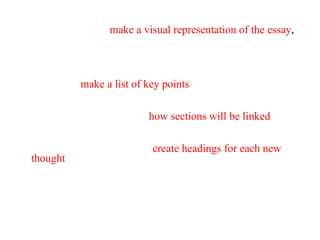
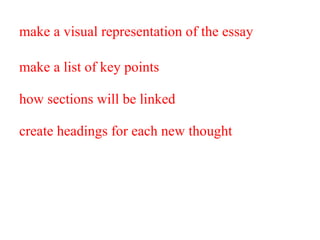
make a visual representation of the essay make a list of key points  you want to cover and then  how sections will be linked  thematically to maintain  create headings for each new thought  and then group them into larger sections at the end. This provides a shorthand account of the whole essay that is easy to take in at a glance.
Primary Research   If you are in a position to interview the artists, designers, theorists or curators you are writing about or quoting, this will be a bonus and the work you do could go forward into further research projects.
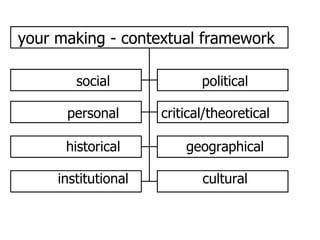
your making - contextual framework
social context Making and seeing an image always takes place in a social context. The way it is seen and how it is seen are culturally constructed. Audience for work - who is included/excluded/implicated on the ways an image is produced, circulated and consumed
political context Specific political issue broad political issue gender - race - ethnicity - sexual orientation - class - disability - religion
personal context Biography - narrative of the self particular issues - memories What motivates/ drives you? Your particular skills as an artist/ designer/writer/photographer What strategies do you use when the work is not going well? How do you relate to the forces that in part condition what you know and in which you make things?
critical/theoretical context Does your work relate to particular critical debates about contemporary art and design practices? Is your work informed by/engaging with/contesting particular theoretical frameworks/issues?
historical context Understand how/whether your practice relates to a tradition, with a history How knowledge relates to periods in time.
geographical context Local, regional, national, international, global. Where do you make your work? Do you make your work in relation to a particular place? studio home church city rural cyberspace
institutional context MA Course - school of art and design Your educational background/experience Your professional background/experience Your family background/experience
cultural context In it’s broadest sense - ‘a whole way of life’ - this relates to all the other categories. More specifically, what works of artists, designers, writers, filmmakers, photographers, musicians are important to you and your work - why?
mapping your practice Any other contexts worth considering? Importance Overlapping change - evolution of practice

Writing context 2011

  • 1.
  • 2.
    Camberwell College ofArts Mid Point Review Book Arts: Tuesday 1st March, 11am prompt start in basement studio All modes to attend & participate in student-led feedback The midpoint review is a chance to reflect upon for your professional practice and learning development in Unit 1. Your peers and tutors will provide feedback of progress to date. Please ‘curate’ your work. Select a piece of work that is part of your project proposal work (in development or completion) and display it in the basement studio. In a student-led group session, peers will discuss the work and the student whose work is being discussed will take notes and receive notes from the group. Please complete and email to Susan by 22 nd February: Briefly write (500 words max) on the following: 1. Evaluation of my project proposal as a part of a self directed programme of study   2. Where I need to develop study plans in relation to the Unit 1 Learning Outcomes (Handbook – pages 22-24)   Mid Point Review Student to complete and email to tutor Pathway: Name: Date:   Peer Group comments noted from Midpoint review peer session: Mid Point Review Tutor to complete Name: Tutor: Date: Tutor comments from Midpoint review peer discussion session
  • 3.
  • 4.
    To find –wiki course doc archive mid point review briefing sheet
  • 5.
  • 6.
    BRIEF - ResearchPaper For this assignment you are asked to write a paper in essay form addressing a research question of your choice. The question should tackle an issue or theoretical concern that is central to your practice although your paper should not refer directly to your work. The research question should relate to the contemporary culture of art and design and may also encompass non-Western traditions. The aim of the paper is to contribute knowledge in your chosen field of research. Consider that your paper is to be published and/or presented at a conference.
  • 7.
    BRIEF - ResearchPaper For this assignment you are asked to write a paper in essay form addressing a research question of your choice. The question should tackle an issue or theoretical concern that is central to your practice although your paper should not refer directly to your work. The research question should relate to the contemporary culture of art and design and may also encompass non-Western traditions . The aim of the paper is to contribute knowledge in your chosen field of research . Consider that your paper is to be published and/or presented at a conference.
  • 8.
    BRIEF - ResearchPaper The question should tackle an issue or theoretical concern that is central to your practice although relate to the contemporary culture of art and design and may also encompass non-Western traditions contribute knowledge in your chosen field of research . Consider that your paper is to be published and/or presented at a conference.
  • 9.
    It is importantthat your paper demonstrates your ability to formulate a research question and research the issues you have identified. You should aim to write a coherent argument in which you critically contextualise the issue you are addressing, and arrive at a justified and independent conclusion. Your paper should be thoroughly proofread with typos, grammatical mistakes and spelling errors eradicated.
  • 10.
    It is importantthat your paper demonstrates your ability to formulate a research question and research the issues you have identified. You should aim to write a coherent argument in which you critically contextualise the issue you are addressing, and arrive at a justified and independent conclusion. Your paper should be thoroughly proofread with typos, grammatical mistakes and spelling errors eradicated.
  • 11.
    formulate a research critically contextualise the issue you are addressing, and arrive at a justified and independent conclusion. Your paper should be thoroughly proofread with typos, grammatical mistakes and spelling errors eradicated.
  • 12.
    You should contextualiseyour research by using at least 10 citations (from research sources such as books, exhibitions, public lectures, journals, art magazines, web resources…). These citations must conform to the Harvard convention of citation.
  • 13.
    Tutorial: You arerequired to attend a tutorial in the week beginning 7th March. The date and time have been posted on the VLE. Please bring to the tutorial the following: (1) abstract, (2) research question (3) case studies for discussion.
  • 14.
    Your final papershould consist of the following academic structure: Title page providing name, course and email address The research question A 300-word abstract, setting out the main points to be investigated, followed by 5 key words A detailed contents page A one-page bibliography constructed according to the Harvard convention of citation. The main body of the paper
  • 15.
    The overall submissionmust be between 4,000 and 5,000 words in length and include at least 10 citations. Please post a digital copy of your submission on Blackboard and also deposit a hard copy at the Wilson Road reception and 2 copies to Susan.
  • 16.
    Learning Outcomes: Demonstrate a critical engagement with practice-based research. Articulate a clear understanding of the methodology and context of your creative practice in written form. These learning outcomes will be evidenced in the following way: Ability to formulate a specific research question. Ability to contextualise that question within a critical framework. Ability to form an independent conclusion. Professional presentation of the research paper adhering to the academic structure and the Harvard convention.
  • 17.
    Marking: Your paperswill be marked in three categories of achievement: Analysis Research Communication
  • 18.
    The Research Question The all-important research question is key to the essay. This will provide you with a starting point and help you develop the structure of the writing. It is sometimes difficult to know what is and what isn’t a research question. Here is an example: It is NOT a review of your favourite artist’s work: “An account of Bill Viola’s videos from the 1980s” However, it might well be: In what ways did Bill Viola’s videos from the 1980s anticipate the embodied works of the new millennium?”
  • 19.
    History & Theory It is preferable to map out the theoretical and historical territory of your discussion before you start, signalling where you will develop the argument as you go. So, taking our example No. 1 of Bill Viola, you might sketch in the history of video art starting with Nam June Paik, mentioning as you go how the body interacts with the technology and then launch into your discussion of Viola’s own work. At the same time as describing the work of the period - in my example, the 1980s - you would enumerate the major theories, of, in this case, the moving image, and then signal those contemporary theories that will inform your discussion of his chosen works. If the medium and individual works you are discussing have social or political as well as cultural significance, then weave these themes into your account. If you are drawing on other disciplines, for example, political theory, psychology, anthropology or science, then integrate these into your analysis of your case studies.
  • 20.
    Breadth of Focus Do not cast your net too wide. As a rule of thumb, restrict yourself to no more than 3 case studies – artists or works. The theoretical sources you consult to support your arguments should also be restricted to around 3 and be drawn from books, peer reviewed journals as well as online sources.
  • 21.
    Things Not ToDo Do not copy and paste large chunks of other people’s writing. We want to know what you think of the subject you are researching, not just what other people have said. Do not write at length about your own practice, although you may mention your own concerns, or a particular cultural background that informs your thinking in the context of your research for the paper.
  • 22.
    Things To DoDo remember to use quotation marks when you are reproducing, word for word, other people’s writings. If you don’t, this constitutes plagiarism. Do use spell check and pay heed to the green line warning that you are running into grammatical problems. Do read the paper out loud to yourself. You will hear when the text isn’t making sense. Do, if you can, get someone else to read your paper. You will soon find out if there are any problems of sense or grammar. Do copy edit the paper before submission.
  • 23.
    Helpful Hints Noone can read your mind, so do not assume we know what you are thinking. Put it down in writing. Remember to briefly describe each work you want the reader to consider. If you leave out essential information – like the fact that the work is a multiple or is deployed across several screens, then the reader will have trouble following the logic of your discussion.
  • 24.
    Helpful Hints Noone can read your mind , so do not assume we know what you are thinking. Put it down in writing. Remember to briefly describe each work you want the reader to consider. If you leave out essential information – like the fact that the work is a multiple or is deployed across several screens, then the reader will have trouble following the logic of your discussion.
  • 25.
    Hints from OtherStudents Finish your essay a good two weeks before the deadline to allow for revisions. Save multiple copies of your essay file. Number each new version in the file name. Email the essay to yourself at the end of each working session.
  • 26.
    Clarity Clarity isall-important. There are many pitfalls, one example being confusions about who the subject of the sentence might be: “John saw Pete crossing the road. He was going to the cinema so he asked him to go with him.” Who asked whom to go to the cinema? Say things simply and if you find this difficult, speak the sentence out loud before writing or speak it as you write. You will soon hear any problems. Write short sentences. Avoid long sentences with many sub clauses.
  • 27.
    Clarity Clarity isall-important . There are many pitfalls, one example being confusions about who the subject of the sentence might be: “John saw Pete crossing the road. He was going to the cinema so he asked him to go with him.” Who asked whom to go to the cinema? Say things simply and if you find this difficult, speak the sentence out loud before writing or speak it as you write. You will soon hear any problems. Write short sentences . Avoid long sentences with many sub clauses.
  • 28.
    Structure The classicessay structure dictates that you announce what you are going to say, say it and then sum up your main findings. It is not a hard and fast rule, but it can help if you apply the basic formulation: Introduction Argument Conclusion
  • 29.
    It can helpif you make a visual representation of the essay, showing the different chapters or headings and assigning content to each section. Some people make flow charts on a computer, others write lists, or draw charts freehand. You could make a list of key points you want to cover and then fit them into the overall design of the essay. Pay particular attention to how sections will be linked thematically to maintain a flow in the text. You might find it useful to create headings for each new thought and then group them into larger sections at the end. This provides a shorthand account of the whole essay that is easy to take in at a glance.
  • 30.
    It can helpif you make a visual representation of the essay , showing the different chapters or headings and assigning content to each section. Some people make flow charts on a computer, others write lists, or draw charts freehand. You could make a list of key points you want to cover and then fit them into the overall design of the essay. Pay particular attention to how sections will be linked thematically to maintain a flow in the text. You might find it useful to create headings for each new thought and then group them into larger sections at the end. This provides a shorthand account of the whole essay that is easy to take in at a glance.
  • 31.
    make a visualrepresentation of the essay make a list of key points you want to cover and then how sections will be linked thematically to maintain create headings for each new thought and then group them into larger sections at the end. This provides a shorthand account of the whole essay that is easy to take in at a glance.
  • 32.
    Primary Research If you are in a position to interview the artists, designers, theorists or curators you are writing about or quoting, this will be a bonus and the work you do could go forward into further research projects.
  • 33.
    your making -contextual framework
  • 34.
    social context Makingand seeing an image always takes place in a social context. The way it is seen and how it is seen are culturally constructed. Audience for work - who is included/excluded/implicated on the ways an image is produced, circulated and consumed
  • 35.
    political context Specificpolitical issue broad political issue gender - race - ethnicity - sexual orientation - class - disability - religion
  • 36.
    personal context Biography- narrative of the self particular issues - memories What motivates/ drives you? Your particular skills as an artist/ designer/writer/photographer What strategies do you use when the work is not going well? How do you relate to the forces that in part condition what you know and in which you make things?
  • 37.
    critical/theoretical context Doesyour work relate to particular critical debates about contemporary art and design practices? Is your work informed by/engaging with/contesting particular theoretical frameworks/issues?
  • 38.
    historical context Understandhow/whether your practice relates to a tradition, with a history How knowledge relates to periods in time.
  • 39.
    geographical context Local,regional, national, international, global. Where do you make your work? Do you make your work in relation to a particular place? studio home church city rural cyberspace
  • 40.
    institutional context MACourse - school of art and design Your educational background/experience Your professional background/experience Your family background/experience
  • 41.
    cultural context Init’s broadest sense - ‘a whole way of life’ - this relates to all the other categories. More specifically, what works of artists, designers, writers, filmmakers, photographers, musicians are important to you and your work - why?
  • 42.
    mapping your practiceAny other contexts worth considering? Importance Overlapping change - evolution of practice