Start

Dissertation
Proposal
Nathan Scrimshaw
In today’s workshop
                            In today’s
                            workshop

Having an idea
Developing an idea
Developing a question
Structuring your proposal
The write-up process
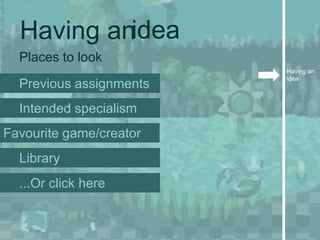
Having anidea
  Places to look
                         Having an
                         idea
  Previous assignments
  Intended specialism
Favourite game/creator
  Library
  ...Or click here
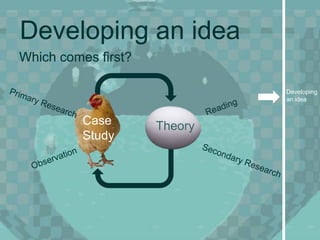
Developing an idea
Which comes first?

                              Developing
                              an idea


          Case       Theory
          Study
Developing an idea
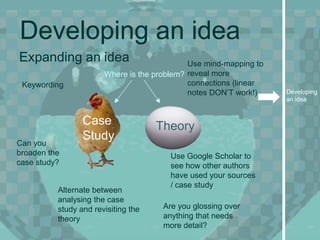
Expanding an idea                            Use mind-mapping to
                       Where is the problem? reveal more
 Keywording                                  connections (linear
                                             notes DON’T work!)    Developing
                                                                   an idea


                 Case                Theory
                 Study
Can you
broaden the                             Use Google Scholar to
case study?                             see how other authors
                                        have used your sources
                                        / case study
          Alternate between
          analysing the case
          study and revisiting the    Are you glossing over
          theory                      anything that needs
                                      more detail?
Developing an idea
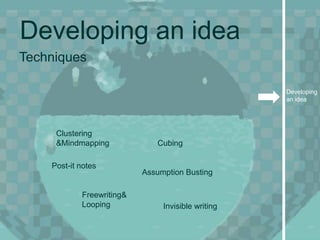
Techniques

                                                    Developing
                                                    an idea


     Clustering
     &Mindmapping             Cubing

    Post-it notes
                           Assumption Busting

            Freewriting&
            Looping             Invisible writing
Developing a
question
                         Click here for link
                         to Dartmouth


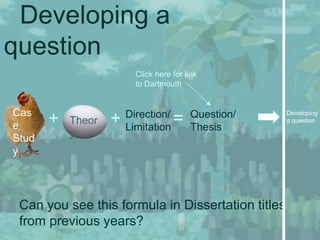
Cas                    Direction/         Question/   Developing

e      +   Theor   +   Limitation
                                    =     Thesis
                                                      a question


Stud       y
y


 Can you see this formula in Dissertation titles
 from previous years?
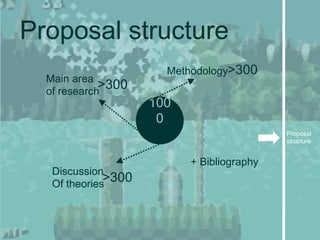
Proposal structure
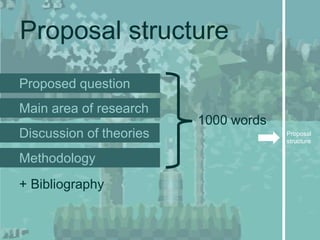
Proposed question
Main area of research
                         1000 words
Discussion of theories                Proposal
                                      structure


Methodology
+ Bibliography
Proposal structure
                       Methodology>300
  Main area
  of research
             >300
                     100
                      0
                                            Proposal
                                            structure


                           + Bibliography
   Discussion
   Of theories
              >300
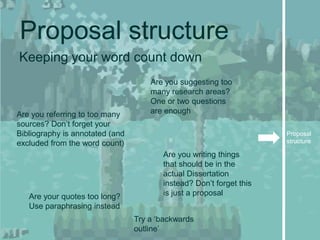
Proposal structure
Keeping your word count down
                                     Are you suggesting too
                                     many research areas?
                                     One or two questions
Are you referring to too many        are enough
sources? Don’t forget your
Bibliography is annotated (and                                       Proposal
excluded from the word count)                                        structure

                                        Are you writing things
                                        that should be in the
                                        actual Dissertation
                                        instead? Don’t forget this
   Are your quotes too long?            is just a proposal
   Use paraphrasing instead
                                 Try a ‘backwards
                                 outline’
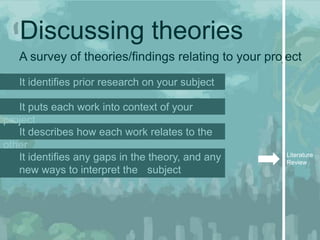
Discussing theories
   A survey of theories/findings relating to your project

   It identifies prior research on your subject

   It puts each work into context of your
project
   It describes how each work relates to the
other
                                                      Literature
   It identifies any gaps in the theory, and any      Review
   new ways to interpret the subject
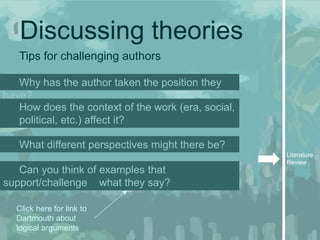
Discussing theories
   Tips for challenging authors

   Why has the author taken the position they
have?
   How does the context of the work (era, social,
   political, etc.) affect it?

   What different perspectives might there be?
                                                    Literature
                                                    Review
   Can you think of examples that
support/challenge what they say?

  Click here for link to
  Dartmouth about
  logical arguments
Methodology
How you intend to undertake your research

Explains your choice of case study

Explains your choice of theory

Details any parameters you need to set

Might indicate chapter-structure of dissertation
                                                   Methodolog
Might summarize content of each chapter            y
Bibliography
Not included in your word count

Can be annotated

Comprehensive – not edited highlights

Can include the stuff you plan to read as
well as the stuff you’ve already read
                                            Bibliography
Contact me
nscrimshaw@ucreative.ac.uk

  01252 89 1485

  @nathanscrimshaw


                                           Finish
          Don’t Leave Research To Chance

Cga dissertation proposal workshop

  • 1.
  • 2.
    In today’s workshop In today’s workshop Having an idea Developing an idea Developing a question Structuring your proposal The write-up process
  • 3.
    Having anidea Places to look Having an idea Previous assignments Intended specialism Favourite game/creator Library ...Or click here
  • 4.
    Developing an idea Whichcomes first? Developing an idea Case Theory Study
  • 5.
    Developing an idea Expandingan idea Use mind-mapping to Where is the problem? reveal more Keywording connections (linear notes DON’T work!) Developing an idea Case Theory Study Can you broaden the Use Google Scholar to case study? see how other authors have used your sources / case study Alternate between analysing the case study and revisiting the Are you glossing over theory anything that needs more detail?
  • 6.
    Developing an idea Techniques Developing an idea Clustering &Mindmapping Cubing Post-it notes Assumption Busting Freewriting& Looping Invisible writing
  • 7.
    Developing a question Click here for link to Dartmouth Cas Direction/ Question/ Developing e + Theor + Limitation = Thesis a question Stud y y Can you see this formula in Dissertation titles from previous years?
  • 8.
    Proposal structure Proposed question Mainarea of research 1000 words Discussion of theories Proposal structure Methodology + Bibliography
  • 9.
    Proposal structure Methodology>300 Main area of research >300 100 0 Proposal structure + Bibliography Discussion Of theories >300
  • 10.
    Proposal structure Keeping yourword count down Are you suggesting too many research areas? One or two questions Are you referring to too many are enough sources? Don’t forget your Bibliography is annotated (and Proposal excluded from the word count) structure Are you writing things that should be in the actual Dissertation instead? Don’t forget this Are your quotes too long? is just a proposal Use paraphrasing instead Try a ‘backwards outline’
  • 11.
    Discussing theories A survey of theories/findings relating to your project It identifies prior research on your subject It puts each work into context of your project It describes how each work relates to the other Literature It identifies any gaps in the theory, and any Review new ways to interpret the subject
  • 12.
    Discussing theories Tips for challenging authors Why has the author taken the position they have? How does the context of the work (era, social, political, etc.) affect it? What different perspectives might there be? Literature Review Can you think of examples that support/challenge what they say? Click here for link to Dartmouth about logical arguments
  • 13.
    Methodology How you intendto undertake your research Explains your choice of case study Explains your choice of theory Details any parameters you need to set Might indicate chapter-structure of dissertation Methodolog Might summarize content of each chapter y
  • 14.
    Bibliography Not included inyour word count Can be annotated Comprehensive – not edited highlights Can include the stuff you plan to read as well as the stuff you’ve already read Bibliography
  • 15.
    Contact me nscrimshaw@ucreative.ac.uk 01252 89 1485 @nathanscrimshaw Finish Don’t Leave Research To Chance

Editor's Notes

  • #2 These notes are adapted from a presentation given to Film Production students – the requirements for CGA and DFSA Dissertation Proposals are more flexible than may be indicated in this presentation – I will highlight any differences in the notes under each slide where appropriate!
  • #4 If you need inspiration try looking back at the previous assignments you’ve been set while on your course – look at the questions you chose not to answer, and look at your notes to see if there were any ideas that maybe you didn’t include in your final essay, or which you did use but felt you could expand on further.You don’t necessarily have to write about the specialism you hope to practise when you graduate – this might be your last chance to really explore any different specialisms that you’re also interested in.WARNING ABOUT USING YOUR FAVOURITEST DIRECTOR OR FILM OR GAME AS A TOPIC: Sometimes the affection we have for particular films/directors/games etc. can blind us to the fact that they might not make ideal case-studies. Firstly, you can’t just be gushing in a dissertation, you have to be critical too – do you really feel comfortable about doing that to something you have so much affection for? Secondly, you’re going to be analysing that film/director/game repeatedly for several months – you won’t just be watching for enjoyment, as you may have done previously – will doing this kill your enthusiasm for it/them? Thirdly, there are bound to be stages where your project gets difficult – this can happen in any project and it’s usually temporary, but be aware it can be much more demoralizing when you’re using subject matter that’s close to your heart. This is not to say that it won’t all be worth it in the end - in the long term you will get huge satisfaction from being able to understand your film/director in so much more depth... however the research stage of a dissertation may test your affections to the limit.Finally, don’t rule out the Library, and your Librarian, as a source of inspiration as they have resources for generating ideas as well as the heavy intellectual stuff.For more information about techniques and strategies for inventing ideas try clicking on the link for an in-depth guide provided by Dartmouth (if you’re reading a print version of this presentation Google: ‘Dartmouth Coming Up With Your Topic’ and click on the first result that comes up.
  • #5 There are two ingredients needed for your idea – a case study (e.g. a film or a director you plan to examine) and the theory/theories you plan to use with them. You can either use general arts theories (Feminism, identity, postmodernism, etc.) or specific ones that apply to your discipline (e.g. Classical Hollywood Narrative, Direct Cinema, etc.).You will probably find that the precise choice of case study and theories will evolve together and every refinement you make to one will affect the other.
  • #6 You may have been able to avoid serious ideas-development for previous assignments but your dissertation is simply too big and too complex for you to get away with that strategy now. A good way to promote creativity is to regularly alternate between viewing your case study and exploring the theory (don’t rely on your ability to recall one while investigating the other – if you read some of the book and then watch some of the film straight away you’ll make more intellectual connections). Even if you don’t quite see a connection between the two, regular repeat viewings and readings will soon reveal things you’ve never noticed before.Also, try using non-linear notes to help you establish more connections between the theory and the case study – if you don’t like mind-mapping try using post-it notes which you can constantly rearrange according to your deductions and observations.Finally, if you’re stuck on interpreting a theory (or case study), try using the citations functionality of Google Scholar to see how others have interpreted them (just don’t forget to cite these influences if you borrow from them!).
  • #7 Here are some alternative techniques for ideas development – for more information on how to do them just Google them. Then look for any websites from .edu or .ac domains in the results, as these will be websites for Colleges and Universities.
  • #8 YOU DON’T NEED A FULLY FORMED DISSERTATION QUESTION FOR YOUR PROPOSAL... But it’s worth explaining now so you’re prepared for it later on.Your dissertation title can either be in the form of a question or a statement. Either way it should summarize the central ‘quest’ of your research, and as such should mention your case study, the theories you will be applying to it, and what direction it will be taking (along with any parameters/limits to your research).You can probably tell instinctively when a dissertation title is good or bad but this formula can help explain how and why. It may also help identify where any weakness might be in your research area.Another good page from the Dartmouth website is linked on this slide, once again, if you can’t access the link Google ‘Dartmouth Developing Your Thesis’ and click on the first result that comes up.
  • #9 There’s no formal structure prescribed for your dissertation proposal, because the structure you choose will depend on the nature and subject of the topic you’ve chosen. However, you do need to include the following components: Some sort of description of your chosen research area (possibly including a tentative Dissertation Question), a discussion of the theories that are relevant to it, a methodology (i.e. how you will use the theories and the case study) and a bibliography. How formal you want to make your structure (and the order you want to cover these components in) is up to you – however, whatever the structure you must use Harvard-format referencing/citations and a Harvard-format Bibliography that’s located at the end of your proposal (and which is not included in your word count).
  • #10 These figures are NOT prescriptive – the reason I used an arbitrary length of 300 words for each section on this slide is that I want you to think about how short a 1000 word essay is, and how concise you’ll need to be if you’ve got to squeeze in a methodology, some explanation of your research area and some discussion of the theories that underpin it. You may be at a stage in your research where one of these areas is more developed than the others – in which case these sections may not be of equal length in your proposal.
  • #11 Once you've determined that you're meeting the requirements of the assignment, you'll want to get even more specific about what your essay says exactly. One way to do this is to create a "backwards outline." (It's "backwards" because it is written after rather than before the draft itself.) To do this, simply read your essay paragraph by paragraph. After each paragraph, determine the main idea of that section, and write the main idea in the margin of your draft. If you find more than one significant idea in a paragraph, write them both down. When you're finished, read over your marginal notes (or "outline") and look for connections - is there one central idea that each paragraph supports? If so, that's your main idea. If not, you'll probably want to look for an idea that most of the paragraphs support and consider dropping or rewriting paragraphs that don't support your focus.
  • #12 Your discussion of theories, sometimes called aLiterature Review, is a survey of the intellectual debate that relates to your topic. This serves two purposes: at one level it provides a rationale for your research (it supports your discussion of the research area, in helping to justify why you’re bothering with this topic at all). It does this by identifying if there are any gaps in current theory, if there are any disagreements between authors and if there are any faults or problems with particular theories (perhaps in relation to your case study). The idea is that hopefully your chosen research area and proposed question will set out to answer one or more of these anomalies.At another level it also serves to show your reader where your research sits in the wider intellectual debates surrounding your research. As a result your Literature Review needs to give your research some context as well as some justification.NOTE TO CGA and DFSA – you don’t need a distinct section called ‘Literature Review’ in your proposal – just make sure you include some of this intellectual stuff somewhere in there to help justify your choice of research area.
  • #13 If you’re struggling with challenging the ideas and theories put forward by the authors you’re investigating, try thinking of example films/games/genres/etc. that could reasonably be covered by those theories/ideas, but which don’t conform to them.You don’t need to just rely on the opinions of other authors to challenge a theory/idea – you can also use logic to disprove them. For a primer on using creating logical arguments Google ‘Dartmouth Logic Argument’ and click on the first result that comes up.
  • #14 Your Methodology covers How you intend to do your research. Once again, you don’t need a distinct section called ‘Methodology’ but you do need to cover as much of this stuff as you can. There might be practical reasons for your choice of case study or theory (e.g. not all the films by a particular director might be on general release, or maybe you can only use a specific part of a theory because it’s too broad for a BA dissertation). Or there might be a series of assumptions that you need to define and explain in the dissertation to enable you to answer the bigger question you’ve set yourself. Or there might not be much literature on the theory you’re using, meaning that you’ve got to approach the authors for an interview. Whatever it is, this is you’re opportunity to explain the practical stuff about how your dissertation is going to happen.
  • #15 What constitutes an ‘annotation’? It depends very much on why a source might be present in your bibliography or how you intend to use it. Just consider writing a sentence or two underneath each reference to give your reader a little context about it (e.g. why you’re using it, how you plan to use it, if/how it relates to other sources in your bibliography, whether it’s a key text for your dissertation or just a supporting theory, etc.). Your annotations don’t have to be deeply intellectual – you’re just giving your reader a little bit of insight into the research you’re doing.