Presented By
Relan Akash Sanjay
Under the Guidance of
Prof.S.S.Deore
DEPARTMENT OF COMPUTER ENGINEERING
S.S.V.P.S.’s B.S. DEORE COLLEGE OF ENGINEERING, DHULE.
2013-14
Worldkit System
o Introduction
o Ad-Hoc Network in Short..
o Structure
o Basic Methodology
o Features
o Advantages and Disadvantages
o Applications
o Future of Worldkit System
o Conclusion
o Bibliography
Outline
2Worldkit System10/7/2013
Introduction
Worldkit System 3
 A form of computing that offers ―a natural way of interacting
with system‖ rather than using the ―traditional user interface‖.
 The persistent goal of research areas such as augmented
reality , and mobile computing is creating interfaces in the
world, where and when we need them.
 It gives the user the potential to create interfaces that can
exist anywhere - even on our own bodies. This next generation
of interface represents a trend known as Digital Overlay.
10/7/2013
Introduction
Worldkit System 4
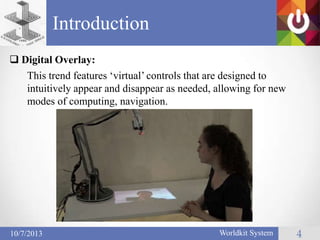
This trend features ‗virtual‘ controls that are designed to
intuitively appear and disappear as needed, allowing for new
modes of computing, navigation.
 Digital Overlay:
10/7/2013
Ad-Hoc Network
Worldkit System 510/7/2013
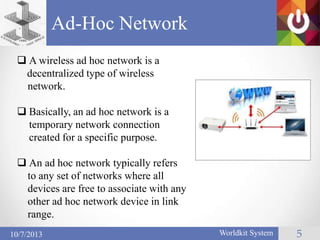
 A wireless ad hoc network is a
decentralized type of wireless
network.
 Basically, an ad hoc network is a
temporary network connection
created for a specific purpose.
 An ad hoc network typically refers
to any set of networks where all
devices are free to associate with any
other ad hoc network device in link
range.
Structure
Worldkit System 610/7/2013
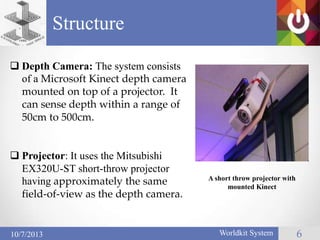
 Depth Camera: The system consists
of a Microsoft Kinect depth camera
mounted on top of a projector. It
can sense depth within a range of
50cm to 500cm.
 Projector: It uses the Mitsubishi
EX320U-ST short-throw projector
having approximately the same
field-of-view as the depth camera.
A short throw projector with
mounted Kinect
Structure
Worldkit System 710/7/2013
 CPU: It uses many of the same components found in
everyday desktop computers —
 a 2GHz Intel core i7 processor
 4 GB of RAM
 Wireless communication devices
 Interactor Surface : Applications built upon this system are
composed of one or more in-the world interactors, which can
be combined to create interactive applications.
Basic Methodology
Worldkit System 810/7/2013
 A core objective of the system is to make it simple for users
to define applications quickly and easily.
 The default interaction paradigm provided by the system
allows users to “paint” interactive elements onto the
environment with their hands.
 A single depth camera can view a large area and be used
to detect touch events on everyday surfaces and projector
to create a live model of the environment.
 After the interactor has been setup, and the elements are
instantiated the interface can be used immediately.
Features
Worldkit System 910/7/2013
 The Worldkit System has following features:
 Triggering Interfaces and Interface Design
 One-Time Projector / Depth Camera Calibration
 Basic Contact Sensing
Features
Worldkit System 1010/7/2013
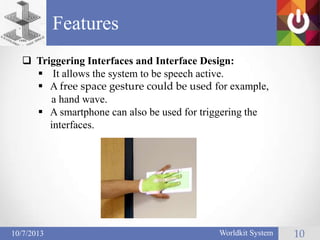
 Triggering Interfaces and Interface Design:
 It allows the system to be speech active.
 A free space gesture could be used for example,
a hand wave.
 A smartphone can also be used for triggering the
interfaces.
Features
Worldkit System 1110/7/2013
 One-Time Projector / Depth Camera Calibration:
o As long as depth camera remains rigidly fastened to the
projector calibration is to be done only once.
o Depth sensor is used for automatic detection of new
environments.
o For a permanent environment changes interfaces need to
be redefined by the user.
o The process being extremely light weight can be easily
done by novice users.
Features
Worldkit System 1210/7/2013
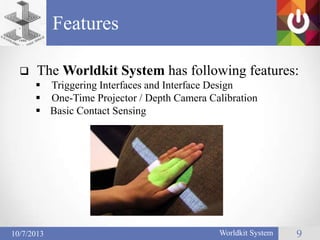
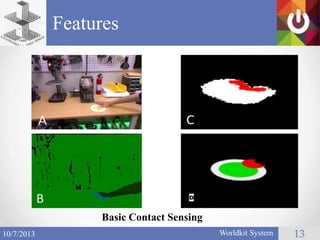
 Basic Contact Sensing:
The surface contact sensing is basically used for two
purposes:
 Creation of Interfaces.
 For detecting many interactor types such as touch,
presence or object contact inputs.
Features
Worldkit System 1310/7/2013
Basic Contact Sensing
Advantages
14Worldkit System10/7/2013
 Large surface area to perform different tasks simultaneously.
 Data manipulation – Selecting, moving, rotating and resizing
is easy.
 User-friendly – Quick and easy to learn and use.
 Economical –Just by using a depth camera and projector we
can paint any surface into a digital touchscreen.
 Reduces users efforts to perform certain tasks in short creates
an environment in which user is more comfortable to work.
Disadvantages
15Worldkit System10/7/2013
The worlkit system has following notable drawbacks: –
 Firstly, the resolution of sensing and graphics can
be lower than optimal.
 Users may occlude the projector and/or depth
camera during normal operation.
 Hand gesture recognition is sometimes not so accurate
as the resolution of the depth camera is less.
Applications
Worldkit System 1610/7/2013
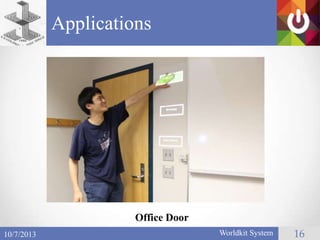
Office Door
Applications
Worldkit System 1710/7/2013
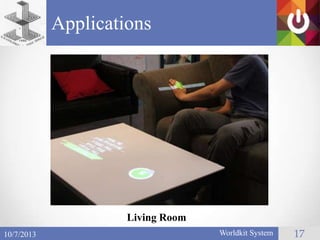
Living Room
Applications
Worldkit System 1810/7/2013
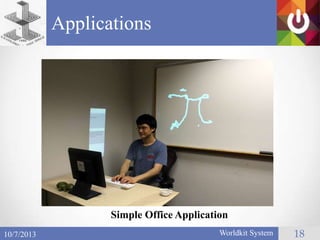
Simple Office Application
Applications
Worldkit System 1910/7/2013
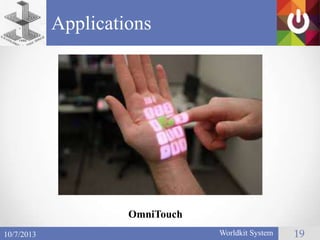
OmniTouch
Applications
Worldkit System 2010/7/2013
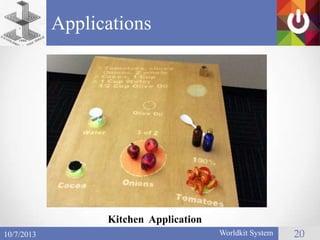
Kitchen Application
10/7/2013
Future of Worldkit System
Worldkit System 2110/7/2013
 Providing a substantial and complete library of interactors.
 Increasing the variety of applications that could be
supported.
 Emphasis are made on expansion from surface interaction
to free space interaction techniques.
 Advancement in hardware for improving the system
functionality.
 An additional future research area lies in expansion of these
techniques to other modalities.
10/7/2013
Future of Worldkit System
Worldkit System 2210/7/2013
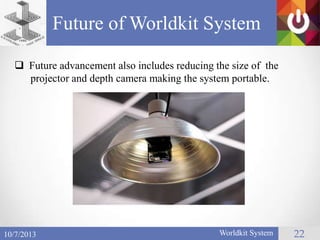
 Future advancement also includes reducing the size of the
projector and depth camera making the system portable.
Conclusion
Worldkit System 2310/7/2013
Worldkit System is next generation of computing.
It brings a change in the way users interact with
the system, turning any surface into touchscreens
when and where we need it. It allows any user to
naturally interact with computer by gestures and real world
objects. It simply helps the user to bring a part of the
physical world into the digital world.
Bibliography
Worldkit System 2410/7/2013
 Xiao, R., Harrison, C., and Hudson, S. E. WorldKit: Rapid and
Easy Creation of Ad-hoc Interactive Applications on Everyday
Surfaces. In Proceedings of the 31st Annual SIGCHI Conference
on Human Factors in Computing Systems (Paris, France, April 27
- May 2, 2013). CHI '13. ACM, New York, NY. pp879-888.
 Khoshelham, K. and Oude Elberink, S.J. (2012) Accuracy
and resolution of Kinect depth data for indoor mapping
applications. In: Sensors : journal on the science and
technology of sensors and biosensors (2012)2 pp. 1437-1454
 www.chrisharrison.net/index.php/Research/WorldKit
 http://iq.intel.com/iq/35346744/introduction-to-digitaloverlay
Worldkit System 2410/7/2013
Thank you…..

Worldkit System

  • 1.
    Presented By Relan AkashSanjay Under the Guidance of Prof.S.S.Deore DEPARTMENT OF COMPUTER ENGINEERING S.S.V.P.S.’s B.S. DEORE COLLEGE OF ENGINEERING, DHULE. 2013-14 Worldkit System
  • 2.
    o Introduction o Ad-HocNetwork in Short.. o Structure o Basic Methodology o Features o Advantages and Disadvantages o Applications o Future of Worldkit System o Conclusion o Bibliography Outline 2Worldkit System10/7/2013
  • 3.
    Introduction Worldkit System 3 A form of computing that offers ―a natural way of interacting with system‖ rather than using the ―traditional user interface‖.  The persistent goal of research areas such as augmented reality , and mobile computing is creating interfaces in the world, where and when we need them.  It gives the user the potential to create interfaces that can exist anywhere - even on our own bodies. This next generation of interface represents a trend known as Digital Overlay. 10/7/2013
  • 4.
    Introduction Worldkit System 4 Thistrend features ‗virtual‘ controls that are designed to intuitively appear and disappear as needed, allowing for new modes of computing, navigation.  Digital Overlay: 10/7/2013
  • 5.
    Ad-Hoc Network Worldkit System510/7/2013  A wireless ad hoc network is a decentralized type of wireless network.  Basically, an ad hoc network is a temporary network connection created for a specific purpose.  An ad hoc network typically refers to any set of networks where all devices are free to associate with any other ad hoc network device in link range.
  • 6.
    Structure Worldkit System 610/7/2013 Depth Camera: The system consists of a Microsoft Kinect depth camera mounted on top of a projector. It can sense depth within a range of 50cm to 500cm.  Projector: It uses the Mitsubishi EX320U-ST short-throw projector having approximately the same field-of-view as the depth camera. A short throw projector with mounted Kinect
  • 7.
    Structure Worldkit System 710/7/2013 CPU: It uses many of the same components found in everyday desktop computers —  a 2GHz Intel core i7 processor  4 GB of RAM  Wireless communication devices  Interactor Surface : Applications built upon this system are composed of one or more in-the world interactors, which can be combined to create interactive applications.
  • 8.
    Basic Methodology Worldkit System810/7/2013  A core objective of the system is to make it simple for users to define applications quickly and easily.  The default interaction paradigm provided by the system allows users to “paint” interactive elements onto the environment with their hands.  A single depth camera can view a large area and be used to detect touch events on everyday surfaces and projector to create a live model of the environment.  After the interactor has been setup, and the elements are instantiated the interface can be used immediately.
  • 9.
    Features Worldkit System 910/7/2013 The Worldkit System has following features:  Triggering Interfaces and Interface Design  One-Time Projector / Depth Camera Calibration  Basic Contact Sensing
  • 10.
    Features Worldkit System 1010/7/2013 Triggering Interfaces and Interface Design:  It allows the system to be speech active.  A free space gesture could be used for example, a hand wave.  A smartphone can also be used for triggering the interfaces.
  • 11.
    Features Worldkit System 1110/7/2013 One-Time Projector / Depth Camera Calibration: o As long as depth camera remains rigidly fastened to the projector calibration is to be done only once. o Depth sensor is used for automatic detection of new environments. o For a permanent environment changes interfaces need to be redefined by the user. o The process being extremely light weight can be easily done by novice users.
  • 12.
    Features Worldkit System 1210/7/2013 Basic Contact Sensing: The surface contact sensing is basically used for two purposes:  Creation of Interfaces.  For detecting many interactor types such as touch, presence or object contact inputs.
  • 13.
  • 14.
    Advantages 14Worldkit System10/7/2013  Largesurface area to perform different tasks simultaneously.  Data manipulation – Selecting, moving, rotating and resizing is easy.  User-friendly – Quick and easy to learn and use.  Economical –Just by using a depth camera and projector we can paint any surface into a digital touchscreen.  Reduces users efforts to perform certain tasks in short creates an environment in which user is more comfortable to work.
  • 15.
    Disadvantages 15Worldkit System10/7/2013 The worlkitsystem has following notable drawbacks: –  Firstly, the resolution of sensing and graphics can be lower than optimal.  Users may occlude the projector and/or depth camera during normal operation.  Hand gesture recognition is sometimes not so accurate as the resolution of the depth camera is less.
  • 16.
  • 17.
  • 18.
  • 19.
  • 20.
  • 21.
    10/7/2013 Future of WorldkitSystem Worldkit System 2110/7/2013  Providing a substantial and complete library of interactors.  Increasing the variety of applications that could be supported.  Emphasis are made on expansion from surface interaction to free space interaction techniques.  Advancement in hardware for improving the system functionality.  An additional future research area lies in expansion of these techniques to other modalities.
  • 22.
    10/7/2013 Future of WorldkitSystem Worldkit System 2210/7/2013  Future advancement also includes reducing the size of the projector and depth camera making the system portable.
  • 23.
    Conclusion Worldkit System 2310/7/2013 WorldkitSystem is next generation of computing. It brings a change in the way users interact with the system, turning any surface into touchscreens when and where we need it. It allows any user to naturally interact with computer by gestures and real world objects. It simply helps the user to bring a part of the physical world into the digital world.
  • 24.
    Bibliography Worldkit System 2410/7/2013 Xiao, R., Harrison, C., and Hudson, S. E. WorldKit: Rapid and Easy Creation of Ad-hoc Interactive Applications on Everyday Surfaces. In Proceedings of the 31st Annual SIGCHI Conference on Human Factors in Computing Systems (Paris, France, April 27 - May 2, 2013). CHI '13. ACM, New York, NY. pp879-888.  Khoshelham, K. and Oude Elberink, S.J. (2012) Accuracy and resolution of Kinect depth data for indoor mapping applications. In: Sensors : journal on the science and technology of sensors and biosensors (2012)2 pp. 1437-1454  www.chrisharrison.net/index.php/Research/WorldKit  http://iq.intel.com/iq/35346744/introduction-to-digitaloverlay
  • 25.