ArcIntTex Conference 2018
Creative Digital Anarky
Ann Marie Shillito,
Designer maker / jeweller
Founder and CEO of Anarkik3D Ltd
Honorary Research Fellow, Edinburgh College of Art
2
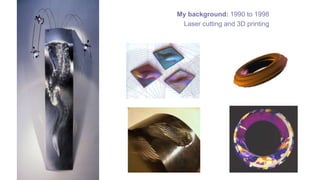
My background: 1990 to 1998
Laser cutting and 3D printing
3
To quote Peter Dormer:
“It is not craft as ‘handicraft’ that defines
contemporary craftsmanship:
it is craft as knowledge that empowers a
maker to take charge of technology.”
4
To participate in using industrial
technologies you need digital data.
5
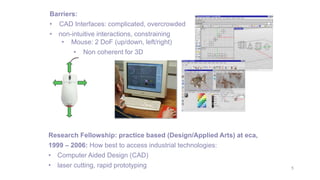
Barriers:
• CAD Interfaces: complicated, overcrowded
• non-intuitive interactions, constraining
• Mouse: 2 DoF (up/down, left/right)
• Non coherent for 3D
Research Fellowship: practice based (Design/Applied Arts) at eca,
1999 – 2006: How best to access industrial technologies:
• Computer Aided Design (CAD)
• laser cutting, rapid prototyping
6
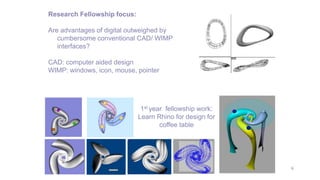
Research Fellowship focus:
Are advantages of digital outweighed by
cumbersome conventional CAD/ WIMP
interfaces?
CAD: computer aided design
WIMP: windows, icon, mouse, pointer
1st year fellowship work:
Learn Rhino for design for
coffee table
7
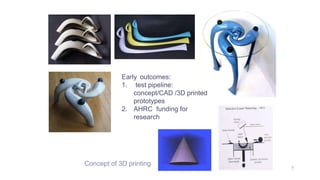
Early outcomes:
1. test pipeline:
concept/CAD /3D printed
prototypes
2. AHRC funding for
research
Concept of 3D printing
8
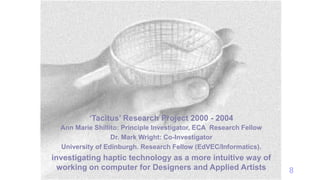
‘Tacitus’ Research Project 2000 - 2004
Ann Marie Shillito: Principle Investigator, ECA Research Fellow
Dr. Mark Wright: Co-Investigator
University of Edinburgh. Research Fellow (EdVEC/Informatics).
investigating haptic technology as a more intuitive way of
working on computer for Designers and Applied Artists
9
Aims of Tacitus Project :
• To explore the potential advantages of being able to work, think
and respond to physical and visual stimuli, in a virtual, fully three-
dimensional, non-gravity context, with particular reference to the
education of designers and artists and the development of 3
dimensional work.
• To discover the degrees of haptic (touch) and other multi-sensory
feed back required within digital systems to assist designers and
artists to work more intuitively.
• To develop viable software applications and virtual ‘handtools’ to
enhance the creative practice of applied artists
www2.eca.ac.uk/tacitus
10
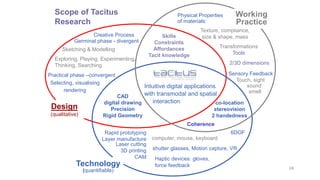
Skills
Constraints
Affordances
Tacit knowledge
co-location
stereovision
2 handedness
CAD
digital drawing
Precision
Rigid Geometry
Sensory Feedback
Touch, sight
sound
smell
Creative Process
Germinal phase - divergent
Exploring, Playing, Experimenting,
Thinking, Searching
Practical phase –convergent
Sketching & Modelling
Haptic devices: gloves,
force feedback
Rapid prototyping
Layer manufacture
Laser cutting
3D printing
CAM
Intuitive digital applications
with transmodal and spatial
interaction
Technology
(quantifiable)
Design
(qualitative)
Transformations
Tools
Texture, compliance,
size & shape, mass
Physical Properties
of materials:
Working
Practice
shutter glasses, Motion capture, VR
Selecting, visualising
rendering
2/3D dimensions
Coherence
6DOF
computer, mouse, keyboard
Scope of Tacitus
Research
11
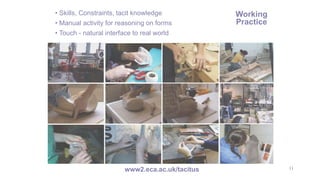
• Skills, Constraints, tacit knowledge
• Manual activity for reasoning on forms
• Touch - natural interface to real world
Working
Practice
www2.eca.ac.uk/tacitus
12
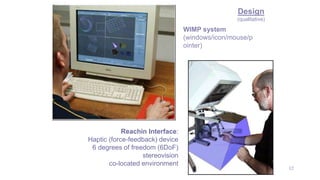
Reachin Interface:
Haptic (force-feedback) device
6 degrees of freedom (6DoF)
stereovision
co-located environment
Design
(qualitative)
WIMP system
(windows/icon/mouse/p
ointer)
13
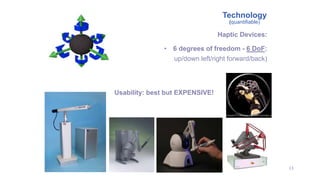
Haptic Devices:
• 6 degrees of freedom - 6 DoF:
up/down left/right forward/back)
Usability: best but EXPENSIVE!
Technology
(quantifiable)
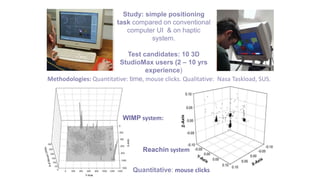
WIMP system:
Methodologies: Quantitative: time, mouse clicks. Qualitative: Nasa Taskload, SUS.
Study: simple positioning
task compared on conventional
computer UI & on haptic
system.
Test candidates: 10 3D
StudioMax users (2 – 10 yrs
experience)
Reachin system
Quantitative: mouse clicks
15
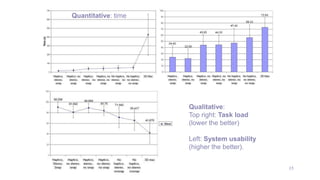
Quantitative: time
Qualitative:
Top right: Task load
(lower the better)
Left: System usability
(higher the better).
16
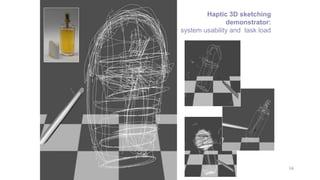
Haptic 3D sketching
demonstrator:
system usability and task load
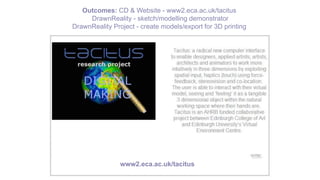
Outcomes: CD & Website - www2.eca.ac.uk/tacitus
DrawnReality - sketch/modelling demonstrator
DrawnReality Project - create models/export for 3D printing
www2.eca.ac.uk/tacitus
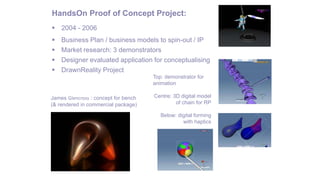
HandsOn Proof of Concept Project:
 2004 - 2006
 Business Plan / business models to spin-out / IP
 Market research: 3 demonstrators
 Designer evaluated application for conceptualising
 DrawnReality Project
Top: demonstrator for
animation
Centre: 3D digital model
of chain for RP
Below: digital forming
with haptics
James Glencross : concept for bench
(& rendered in commercial package)
19
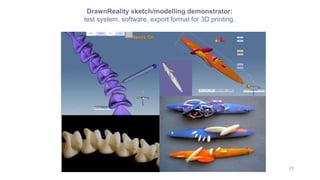
DrawnReality sketch/modelling demonstrator:
test system, software, export format for 3D printing.
20
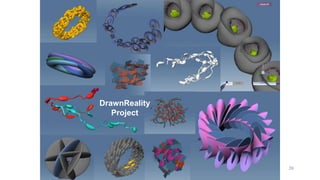
DrawnReality
Project
21
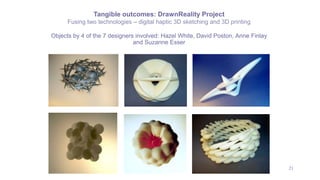
Objects by 4 of the 7 designers involved: Hazel White, David Poston, Anne Finlay
and Suzanne Esser
Tangible outcomes: DrawnReality Project
Fusing two technologies – digital haptic 3D sketching and 3D printing
22
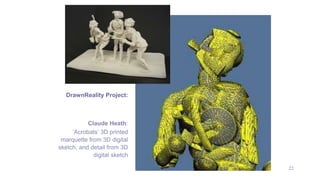
Claude Heath:
‘Acrobats’ 3D printed
marquette from 3D digital
sketch, and detail from 3D
digital sketch
DrawnReality Project:
Commercialisation of Research:
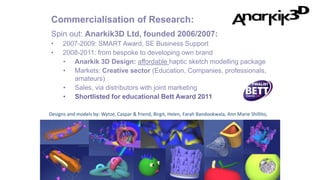
Spin out: Anarkik3D Ltd, founded 2006/2007:
• 2007-2009: SMART Award, SE Business Support
• 2008-2011: from bespoke to developing own brand
• Anarkik 3D Design: affordable haptic sketch modelling package
• Markets: Creative sector (Education, Companies, professionals,
amateurs)
• Sales, via distributors with joint marketing
• Shortlisted for educational Bett Award 2011
Designs and models by: Wytze, Caspar & friend, Birgit, Helen, Farah Bandookwala, Ann Marie Shillito,
24
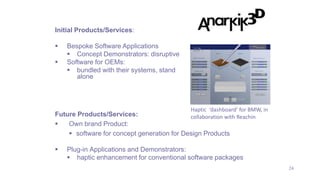
Future Products/Services:
 Own brand Product:
 software for concept generation for Design Products
 Plug-in Applications and Demonstrators:
 haptic enhancement for conventional software packages
Initial Products/Services:
 Bespoke Software Applications
 Concept Demonstrators: disruptive
 Software for OEMs:
 bundled with their systems, stand
alone
Haptic ‘dashboard’ for BMW, in
collaboration with Reachin
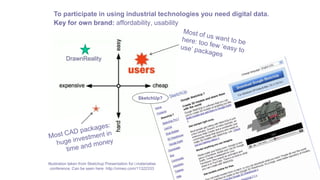
Illustration taken from Sketchup Presentation for i.materialise
conference. Can be seen here http://vimeo.com/11322333
To participate in using industrial technologies you need digital data.
Key for own brand: affordability, usability
SketchUp?
DrawnReality
26
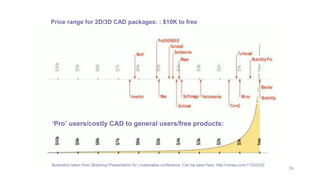
Illustration taken from Sketchup Presentation for i.materialise conference. Can be seen here http://vimeo.com/11322333
Price range for 2D/3D CAD packages: : $10K to free
‘Pro’ users/costly CAD to general users/free products:
27
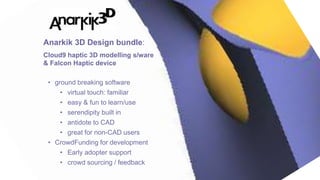
• ground breaking software
• virtual touch: familiar
• easy & fun to learn/use
• serendipity built in
• antidote to CAD
• great for non-CAD users
• CrowdFunding for development
• Early adopter support
• crowd sourcing / feedback
Anarkik 3D Design bundle:
Cloud9 haptic 3D modelling s/ware
& Falcon Haptic device
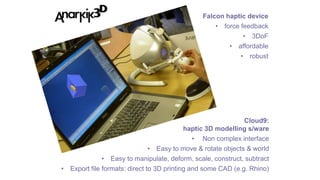
Falcon haptic device
• force feedback
• 3DoF
• affordable
• robust
Cloud9:
haptic 3D modelling s/ware
• Non complex interface
• Easy to move & rotate objects & world
• Easy to manipulate, deform, scale, construct, subtract
• Export file formats: direct to 3D printing and some CAD (e.g. Rhino)
29
Sketchup
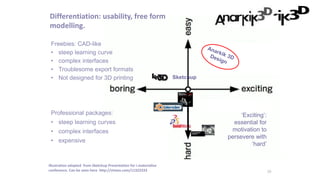
Differentiation: usability, free form
modelling.
Freebies: CAD-like
• steep learning curve
• complex interfaces
• Troublesome export formats
• Not designed for 3D printing
Professional packages:
• steep learning curves
• complex interfaces
• expensive
Illustration adapted from Sketchup Presentation for i.materialise
conference. Can be seen here http://vimeo.com/11322333
‘Exciting’:
essential for
motivation to
persevere with
‘hard’
30
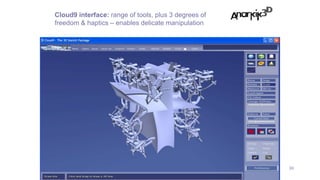
Cloud9 interface: range of tools, plus 3 degrees of
freedom & haptics – enables delicate manipulation
31
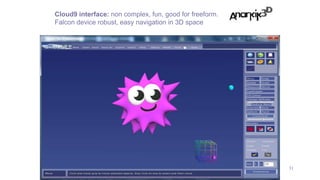
Cloud9 interface: non complex, fun, good for freeform.
Falcon device robust, easy navigation in 3D space
32
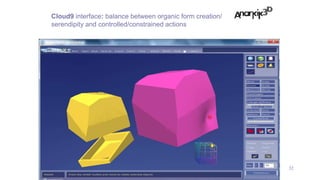
Cloud9 interface: balance between organic form creation/
serendipity and controlled/constrained actions
33
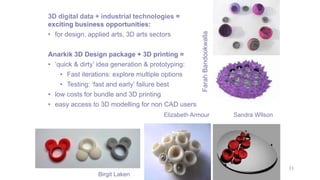
3D digital data + industrial technologies =
exciting business opportunities:
• for design, applied arts, 3D arts sectors
Anarkik 3D Design package + 3D printing =
• ‘quick & dirty’ idea generation & prototyping:
• Fast iterations: explore multiple options
• Testing: ‘fast and early’ failure best
• low costs for bundle and 3D printing
• easy access to 3D modelling for non CAD users
Farah
Bandookwalla
Birgit Laken
Elizabeth Armour Sandra WIlson
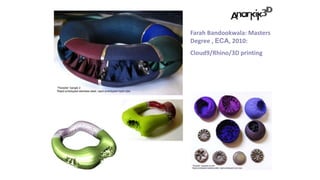
Farah Bandookwala: Masters
Degree , ECA, 2010:
Cloud9/Rhino/3D printing
35
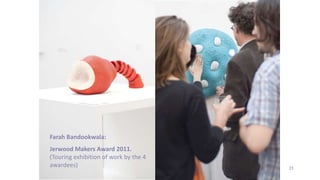
Farah Bandookwala:
Jerwood Makers Award 2011.
(Touring exhibition of work by the 4
awardees)
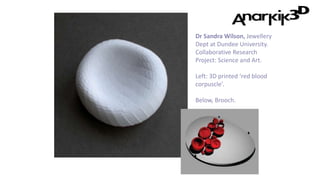
Dr Sandra Wilson, Jewellery
Dept at Dundee University.
Collaborative Research
Project: Science and Art.
Left: 3D printed ‘red blood
corpuscle’.
Below, Brooch.
37
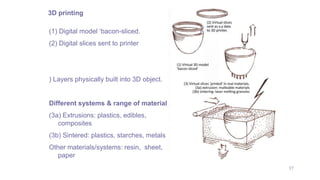
3D printing
(1) Digital model ‘bacon-sliced.
(2) Digital slices sent to printer
) Layers physically built into 3D object.
Different systems & range of materials.
(3a) Extrusions: plastics, edibles,
composites
(3b) Sintered: plastics, starches, metals
Other materials/systems: resin, sheet,
paper
38
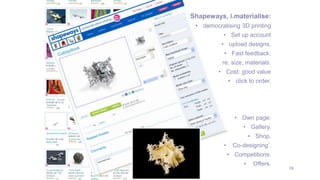
Shapeways, i.materialise:
• democratising 3D printing
• Set up account
• upload designs.
• Fast feedback:
re. size, materials.
• Cost: good value
• click to order.
• Own page.
• Gallery.
• Shop.
• ‘Co-designing’.
• Competitions.
• Offers.
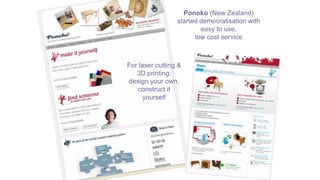
For laser cutting &
3D printing:
design your own,
construct it
yourself
Ponoko (New Zealand)
started democratisation with
easy to use,
low cost service
40
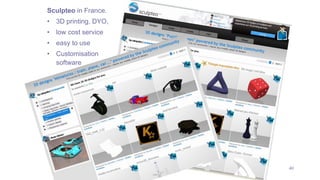
Sculpteo in France.
• 3D printing, DYO,
• low cost service
• easy to use
• Customisation
software
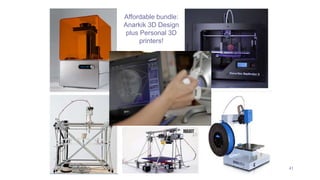
Affordable bundle:
Anarkik 3D Design
plus Personal 3D
printers!
41
42
Thank you.
Hands-on demo of Anarkik 3D Design
in Inspace after symposium.
PS.
My book
‘Digital Crafts: Industrial Technologies for
Applied Artists and Designer Makers’
to be published Sept. 2013

AMS & Anarkik3D Ltd.pptx

  • 1.
    ArcIntTex Conference 2018 CreativeDigital Anarky Ann Marie Shillito, Designer maker / jeweller Founder and CEO of Anarkik3D Ltd Honorary Research Fellow, Edinburgh College of Art
  • 2.
    2 My background: 1990to 1998 Laser cutting and 3D printing
  • 3.
    3 To quote PeterDormer: “It is not craft as ‘handicraft’ that defines contemporary craftsmanship: it is craft as knowledge that empowers a maker to take charge of technology.”
  • 4.
    4 To participate inusing industrial technologies you need digital data.
  • 5.
    5 Barriers: • CAD Interfaces:complicated, overcrowded • non-intuitive interactions, constraining • Mouse: 2 DoF (up/down, left/right) • Non coherent for 3D Research Fellowship: practice based (Design/Applied Arts) at eca, 1999 – 2006: How best to access industrial technologies: • Computer Aided Design (CAD) • laser cutting, rapid prototyping
  • 6.
    6 Research Fellowship focus: Areadvantages of digital outweighed by cumbersome conventional CAD/ WIMP interfaces? CAD: computer aided design WIMP: windows, icon, mouse, pointer 1st year fellowship work: Learn Rhino for design for coffee table
  • 7.
    7 Early outcomes: 1. testpipeline: concept/CAD /3D printed prototypes 2. AHRC funding for research Concept of 3D printing
  • 8.
    8 ‘Tacitus’ Research Project2000 - 2004 Ann Marie Shillito: Principle Investigator, ECA Research Fellow Dr. Mark Wright: Co-Investigator University of Edinburgh. Research Fellow (EdVEC/Informatics). investigating haptic technology as a more intuitive way of working on computer for Designers and Applied Artists
  • 9.
    9 Aims of TacitusProject : • To explore the potential advantages of being able to work, think and respond to physical and visual stimuli, in a virtual, fully three- dimensional, non-gravity context, with particular reference to the education of designers and artists and the development of 3 dimensional work. • To discover the degrees of haptic (touch) and other multi-sensory feed back required within digital systems to assist designers and artists to work more intuitively. • To develop viable software applications and virtual ‘handtools’ to enhance the creative practice of applied artists www2.eca.ac.uk/tacitus
  • 10.
    10 Skills Constraints Affordances Tacit knowledge co-location stereovision 2 handedness CAD digitaldrawing Precision Rigid Geometry Sensory Feedback Touch, sight sound smell Creative Process Germinal phase - divergent Exploring, Playing, Experimenting, Thinking, Searching Practical phase –convergent Sketching & Modelling Haptic devices: gloves, force feedback Rapid prototyping Layer manufacture Laser cutting 3D printing CAM Intuitive digital applications with transmodal and spatial interaction Technology (quantifiable) Design (qualitative) Transformations Tools Texture, compliance, size & shape, mass Physical Properties of materials: Working Practice shutter glasses, Motion capture, VR Selecting, visualising rendering 2/3D dimensions Coherence 6DOF computer, mouse, keyboard Scope of Tacitus Research
  • 11.
    11 • Skills, Constraints,tacit knowledge • Manual activity for reasoning on forms • Touch - natural interface to real world Working Practice www2.eca.ac.uk/tacitus
  • 12.
    12 Reachin Interface: Haptic (force-feedback)device 6 degrees of freedom (6DoF) stereovision co-located environment Design (qualitative) WIMP system (windows/icon/mouse/p ointer)
  • 13.
    13 Haptic Devices: • 6degrees of freedom - 6 DoF: up/down left/right forward/back) Usability: best but EXPENSIVE! Technology (quantifiable)
  • 14.
    WIMP system: Methodologies: Quantitative:time, mouse clicks. Qualitative: Nasa Taskload, SUS. Study: simple positioning task compared on conventional computer UI & on haptic system. Test candidates: 10 3D StudioMax users (2 – 10 yrs experience) Reachin system Quantitative: mouse clicks
  • 15.
    15 Quantitative: time Qualitative: Top right:Task load (lower the better) Left: System usability (higher the better).
  • 16.
  • 17.
    Outcomes: CD &Website - www2.eca.ac.uk/tacitus DrawnReality - sketch/modelling demonstrator DrawnReality Project - create models/export for 3D printing www2.eca.ac.uk/tacitus
  • 18.
    HandsOn Proof ofConcept Project:  2004 - 2006  Business Plan / business models to spin-out / IP  Market research: 3 demonstrators  Designer evaluated application for conceptualising  DrawnReality Project Top: demonstrator for animation Centre: 3D digital model of chain for RP Below: digital forming with haptics James Glencross : concept for bench (& rendered in commercial package)
  • 19.
    19 DrawnReality sketch/modelling demonstrator: testsystem, software, export format for 3D printing.
  • 20.
  • 21.
    21 Objects by 4of the 7 designers involved: Hazel White, David Poston, Anne Finlay and Suzanne Esser Tangible outcomes: DrawnReality Project Fusing two technologies – digital haptic 3D sketching and 3D printing
  • 22.
    22 Claude Heath: ‘Acrobats’ 3Dprinted marquette from 3D digital sketch, and detail from 3D digital sketch DrawnReality Project:
  • 23.
    Commercialisation of Research: Spinout: Anarkik3D Ltd, founded 2006/2007: • 2007-2009: SMART Award, SE Business Support • 2008-2011: from bespoke to developing own brand • Anarkik 3D Design: affordable haptic sketch modelling package • Markets: Creative sector (Education, Companies, professionals, amateurs) • Sales, via distributors with joint marketing • Shortlisted for educational Bett Award 2011 Designs and models by: Wytze, Caspar & friend, Birgit, Helen, Farah Bandookwala, Ann Marie Shillito,
  • 24.
    24 Future Products/Services:  Ownbrand Product:  software for concept generation for Design Products  Plug-in Applications and Demonstrators:  haptic enhancement for conventional software packages Initial Products/Services:  Bespoke Software Applications  Concept Demonstrators: disruptive  Software for OEMs:  bundled with their systems, stand alone Haptic ‘dashboard’ for BMW, in collaboration with Reachin
  • 25.
    Illustration taken fromSketchup Presentation for i.materialise conference. Can be seen here http://vimeo.com/11322333 To participate in using industrial technologies you need digital data. Key for own brand: affordability, usability SketchUp? DrawnReality
  • 26.
    26 Illustration taken fromSketchup Presentation for i.materialise conference. Can be seen here http://vimeo.com/11322333 Price range for 2D/3D CAD packages: : $10K to free ‘Pro’ users/costly CAD to general users/free products:
  • 27.
    27 • ground breakingsoftware • virtual touch: familiar • easy & fun to learn/use • serendipity built in • antidote to CAD • great for non-CAD users • CrowdFunding for development • Early adopter support • crowd sourcing / feedback Anarkik 3D Design bundle: Cloud9 haptic 3D modelling s/ware & Falcon Haptic device
  • 28.
    Falcon haptic device •force feedback • 3DoF • affordable • robust Cloud9: haptic 3D modelling s/ware • Non complex interface • Easy to move & rotate objects & world • Easy to manipulate, deform, scale, construct, subtract • Export file formats: direct to 3D printing and some CAD (e.g. Rhino)
  • 29.
    29 Sketchup Differentiation: usability, freeform modelling. Freebies: CAD-like • steep learning curve • complex interfaces • Troublesome export formats • Not designed for 3D printing Professional packages: • steep learning curves • complex interfaces • expensive Illustration adapted from Sketchup Presentation for i.materialise conference. Can be seen here http://vimeo.com/11322333 ‘Exciting’: essential for motivation to persevere with ‘hard’
  • 30.
    30 Cloud9 interface: rangeof tools, plus 3 degrees of freedom & haptics – enables delicate manipulation
  • 31.
    31 Cloud9 interface: noncomplex, fun, good for freeform. Falcon device robust, easy navigation in 3D space
  • 32.
    32 Cloud9 interface: balancebetween organic form creation/ serendipity and controlled/constrained actions
  • 33.
    33 3D digital data+ industrial technologies = exciting business opportunities: • for design, applied arts, 3D arts sectors Anarkik 3D Design package + 3D printing = • ‘quick & dirty’ idea generation & prototyping: • Fast iterations: explore multiple options • Testing: ‘fast and early’ failure best • low costs for bundle and 3D printing • easy access to 3D modelling for non CAD users Farah Bandookwalla Birgit Laken Elizabeth Armour Sandra WIlson
  • 34.
    Farah Bandookwala: Masters Degree, ECA, 2010: Cloud9/Rhino/3D printing
  • 35.
    35 Farah Bandookwala: Jerwood MakersAward 2011. (Touring exhibition of work by the 4 awardees)
  • 36.
    Dr Sandra Wilson,Jewellery Dept at Dundee University. Collaborative Research Project: Science and Art. Left: 3D printed ‘red blood corpuscle’. Below, Brooch.
  • 37.
    37 3D printing (1) Digitalmodel ‘bacon-sliced. (2) Digital slices sent to printer ) Layers physically built into 3D object. Different systems & range of materials. (3a) Extrusions: plastics, edibles, composites (3b) Sintered: plastics, starches, metals Other materials/systems: resin, sheet, paper
  • 38.
    38 Shapeways, i.materialise: • democratising3D printing • Set up account • upload designs. • Fast feedback: re. size, materials. • Cost: good value • click to order. • Own page. • Gallery. • Shop. • ‘Co-designing’. • Competitions. • Offers.
  • 39.
    For laser cutting& 3D printing: design your own, construct it yourself Ponoko (New Zealand) started democratisation with easy to use, low cost service
  • 40.
    40 Sculpteo in France. •3D printing, DYO, • low cost service • easy to use • Customisation software
  • 41.
    Affordable bundle: Anarkik 3DDesign plus Personal 3D printers! 41
  • 42.
    42 Thank you. Hands-on demoof Anarkik 3D Design in Inspace after symposium. PS. My book ‘Digital Crafts: Industrial Technologies for Applied Artists and Designer Makers’ to be published Sept. 2013