THE ROLE AND IMPACT OF THE
WORLD TRADE ORGANIZATION
THE CONCEPT OF TRADE
Trade is defined as a single act of exchanging something for
something else. With a goal of obtaining an advantage.
dependent on calculation, evaluate decisions by becoming aware of
its value (cost vs benefit) as trading parties can be deceived having
different value systems or knowledge
Forms of Trade
Direct
Unstructured
Indirect
THE CONCEPT OF TRADE
Trade itself, or the act of trading becomes the economic and social tool and
takes place as a part of diplomacy and politics. So the items being
exchanged becomes the token.
As trade becomes complex, legal systems evolved.
Trade agreement was created to bind trade itself to the law.
GENERAL AGREEMENT ON TARIFFS AND
TRADE (GATT)
signed by 23 nations in Geneva on 30 October 1947
took effect on 1 January 1948
A legal agreement between many countries, whose overall
purpose was to promote international trade by reducing
or eliminating trade barriers such as tariffs or quotas.
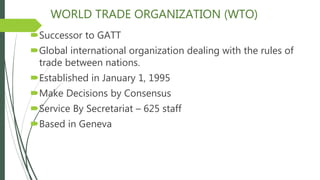
WORLD TRADE ORGANIZATION (WTO)
Successor to GATT
Global international organization dealing with the rules of
trade between nations.
Established in January 1, 1995
Make Decisions by Consensus
Service By Secretariat – 625 staff
Based in Geneva
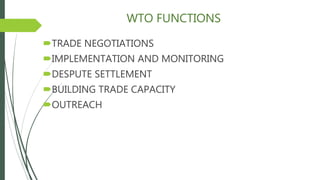
WTO FUNCTIONS
TRADE NEGOTIATIONS
IMPLEMENTATION AND MONITORING
DESPUTE SETTLEMENT
BUILDING TRADE CAPACITY
OUTREACH
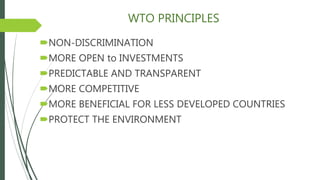
WTO PRINCIPLES
NON-DISCRIMINATION
MORE OPEN to INVESTMENTS
PREDICTABLE AND TRANSPARENT
MORE COMPETITIVE
MORE BENEFICIAL FOR LESS DEVELOPED COUNTRIES
PROTECT THE ENVIRONMENT
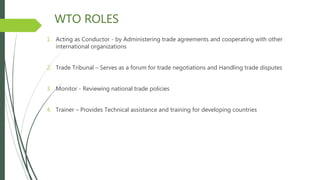
WTO ROLES
1. Acting as Conductor - by Administering trade agreements and cooperating with other
international organizations
2. Trade Tribunal – Serves as a forum for trade negotiations and Handling trade disputes
3. Monitor - Reviewing national trade policies
4. Trainer – Provides Technical assistance and training for developing countries
IMPACTS OF WTO
 The WTO as a global organization has helped the developing nations to participate in world
economic arena.
 It is a forum to all types of developing countries to compete the quality of their goods and
services with those of others. Therefore, the overall quality of goods and services increases which
in turn improve the quality of life in a nation.
 Apart from strengthening economic relationship among countries, it has helped the trade and
development go hand in hand.
 it has helped in providing market for the manufacturing goods which has enhanced the exports
at a higher pace.
 It has also played significant role in providing technical assistance, knowledge of quality goods,
access to newer technologies to the developing nations.
 Because of multi-lateral rules and disciplines ,it is expected that fair trade conditions will be
created for developing nations, also the dispute settlement system will help to check the
disputes arising out of it.
IMPACTS OF WTO
 The WTO is dominated by leading industrialized countries and by the corporation of these
countries. The developing countries have a less say In this organization.
 The developing countries have fewer human and technical resources and therefore often enter
negotiations less prepared than their developed counterparts.
 The tariff peaks and escalations hamper developing countries' exports and their attempts in
export diversification.
 Through the various agreements signed under the WTO ,the developing nations have actually
foreclosed a wide range of development options.
 The domestic economy supporters often face neglect because of global competitive better
goods.
 The agendas of the WTO are often designed in the favor of the developed nations, sidelining
the interests of developing and the least developed countries.
 The rules which have uniformly applied on WTO members have brought about inequalities
because of the varied economic conditions of the countries.
 The developing countries have discovered that finding resources in the dispute settlement
system is costly and requires a legal expertise which they may not have.
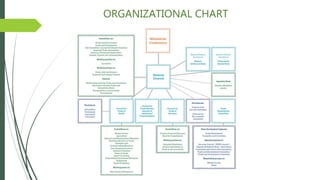
ORGANIZATIONAL CHART
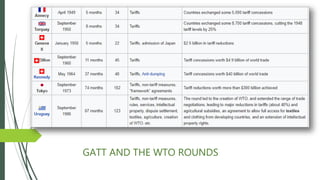
GATT AND THE WTO ROUNDS
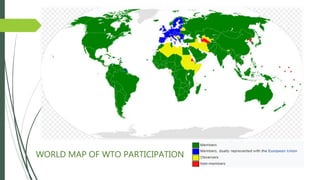
WORLD MAP OF WTO PARTICIPATION
References
https://en.wikibooks.org
https://www.dti.gov.ph
https://www.wto.org
https://en.wikipedia.org
https://www.quora.com/
http://fordschool.umich.edu

World Trade Organization

  • 1.
    THE ROLE ANDIMPACT OF THE WORLD TRADE ORGANIZATION
  • 2.
    THE CONCEPT OFTRADE Trade is defined as a single act of exchanging something for something else. With a goal of obtaining an advantage. dependent on calculation, evaluate decisions by becoming aware of its value (cost vs benefit) as trading parties can be deceived having different value systems or knowledge Forms of Trade Direct Unstructured Indirect
  • 3.
    THE CONCEPT OFTRADE Trade itself, or the act of trading becomes the economic and social tool and takes place as a part of diplomacy and politics. So the items being exchanged becomes the token. As trade becomes complex, legal systems evolved. Trade agreement was created to bind trade itself to the law.
  • 4.
    GENERAL AGREEMENT ONTARIFFS AND TRADE (GATT) signed by 23 nations in Geneva on 30 October 1947 took effect on 1 January 1948 A legal agreement between many countries, whose overall purpose was to promote international trade by reducing or eliminating trade barriers such as tariffs or quotas.
  • 5.
    WORLD TRADE ORGANIZATION(WTO) Successor to GATT Global international organization dealing with the rules of trade between nations. Established in January 1, 1995 Make Decisions by Consensus Service By Secretariat – 625 staff Based in Geneva
  • 6.
    WTO FUNCTIONS TRADE NEGOTIATIONS IMPLEMENTATIONAND MONITORING DESPUTE SETTLEMENT BUILDING TRADE CAPACITY OUTREACH
  • 7.
    WTO PRINCIPLES NON-DISCRIMINATION MORE OPENto INVESTMENTS PREDICTABLE AND TRANSPARENT MORE COMPETITIVE MORE BENEFICIAL FOR LESS DEVELOPED COUNTRIES PROTECT THE ENVIRONMENT
  • 8.
    WTO ROLES 1. Actingas Conductor - by Administering trade agreements and cooperating with other international organizations 2. Trade Tribunal – Serves as a forum for trade negotiations and Handling trade disputes 3. Monitor - Reviewing national trade policies 4. Trainer – Provides Technical assistance and training for developing countries
  • 9.
    IMPACTS OF WTO The WTO as a global organization has helped the developing nations to participate in world economic arena.  It is a forum to all types of developing countries to compete the quality of their goods and services with those of others. Therefore, the overall quality of goods and services increases which in turn improve the quality of life in a nation.  Apart from strengthening economic relationship among countries, it has helped the trade and development go hand in hand.  it has helped in providing market for the manufacturing goods which has enhanced the exports at a higher pace.  It has also played significant role in providing technical assistance, knowledge of quality goods, access to newer technologies to the developing nations.  Because of multi-lateral rules and disciplines ,it is expected that fair trade conditions will be created for developing nations, also the dispute settlement system will help to check the disputes arising out of it.
  • 10.
    IMPACTS OF WTO The WTO is dominated by leading industrialized countries and by the corporation of these countries. The developing countries have a less say In this organization.  The developing countries have fewer human and technical resources and therefore often enter negotiations less prepared than their developed counterparts.  The tariff peaks and escalations hamper developing countries' exports and their attempts in export diversification.  Through the various agreements signed under the WTO ,the developing nations have actually foreclosed a wide range of development options.  The domestic economy supporters often face neglect because of global competitive better goods.  The agendas of the WTO are often designed in the favor of the developed nations, sidelining the interests of developing and the least developed countries.  The rules which have uniformly applied on WTO members have brought about inequalities because of the varied economic conditions of the countries.  The developing countries have discovered that finding resources in the dispute settlement system is costly and requires a legal expertise which they may not have.
  • 11.
  • 12.
    GATT AND THEWTO ROUNDS
  • 13.
    WORLD MAP OFWTO PARTICIPATION
  • 14.