
(WORLDTRADE ORGANISATION) Presented By:-
Vartika Dalela
Yozana Singhal
 WTO was formed on 1st
jan,1995.
 It took over GATT (General agreement on
tariffs & trade). In 8th
round of GATT,
popularly known as Uruguay Round,
member nations of GATT decided to set
up a new organization, ‘World Trade
Organization’ in place of GATT.
II
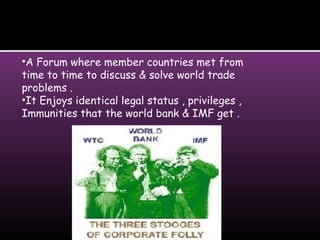
•A Forum where member countries met from
time to time to discuss & solve world trade
problems .
•It Enjoys identical legal status , privileges ,
Immunities that the world bank & IMF get .
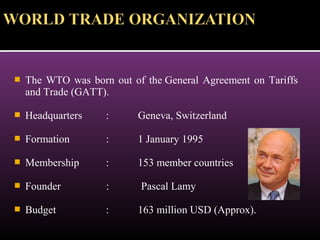
 The WTO was born out of the General Agreement on Tariffs
and Trade (GATT).
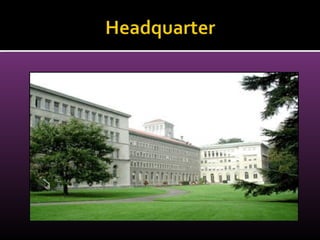
 Headquarters : Geneva, Switzerland
 Formation : 1 January 1995
 Membership : 153 member countries
 Founder : Pascal Lamy
 Budget : 163 million USD (Approx).
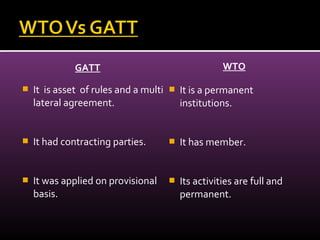
GATT
 It is asset of rules and a multi
lateral agreement.
 It had contracting parties.
 It was applied on provisional
basis.
WTO
 It is a permanent
institutions.
 It has member.
 Its activities are full and
permanent.
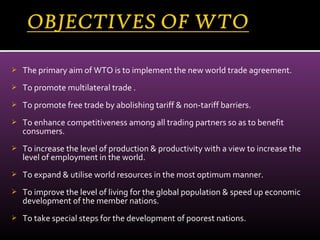
 The primary aim of WTO is to implement the new world trade agreement.
 To promote multilateral trade .
 To promote free trade by abolishing tariff & non-tariff barriers.
 To enhance competitiveness among all trading partners so as to benefit
consumers.
 To increase the level of production & productivity with a view to increase the
level of employment in the world.
 To expand & utilise world resources in the most optimum manner.
 To improve the level of living for the global population & speed up economic
development of the member nations.
 To take special steps for the development of poorest nations.
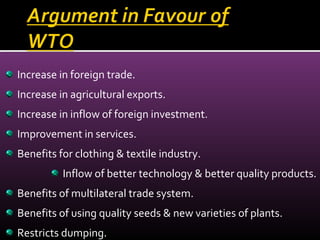
Increase in foreign trade.
Increase in agricultural exports.
Increase in inflow of foreign investment.
Improvement in services.
Benefits for clothing & textile industry.
Inflow of better technology & better quality products.
Benefits of multilateral trade system.
Benefits of using quality seeds & new varieties of plants.
Restricts dumping.
 Introduction.
After over 7 years of negotiations the multilateral
trade negotiations were concluded on December
1993 and were formally ratified in April 1994 at
Marrakesh, Morocco.
 The WTO Agreement on Agriculture was one of
the main agreements which were negotiated
 The WTO Agreement on Agriculture contains
provisions in 2 broad areas of agriculture.
1. Domestic support.
2. Export subsidies
 It measures that have a minimum
impact on the trade also known as
green box policies . It includes general
government services like : As in the
areas of research , disease control ,
infrastructure and food security . Also
includes direct payments to
producers in form of income support
etc .
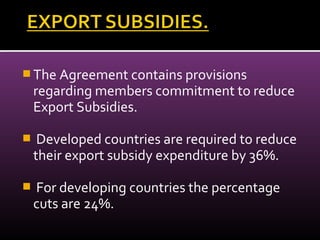
 The Agreement contains provisions
regarding members commitment to reduce
Export Subsidies.
 Developed countries are required to reduce
their export subsidy expenditure by 36%.
 For developing countries the percentage
cuts are 24%.
 India, as a developing economy, has been benefitted
being a founding member of the World trade
Organization.
 The country at large has seen many
significant changes which have taken place after the
formation of WTO.
you

Wto ppt

  • 1.
    (WORLDTRADE ORGANISATION) PresentedBy:- Vartika Dalela Yozana Singhal
  • 2.
     WTO wasformed on 1st jan,1995.  It took over GATT (General agreement on tariffs & trade). In 8th round of GATT, popularly known as Uruguay Round, member nations of GATT decided to set up a new organization, ‘World Trade Organization’ in place of GATT. II
  • 3.
    •A Forum wheremember countries met from time to time to discuss & solve world trade problems . •It Enjoys identical legal status , privileges , Immunities that the world bank & IMF get .
  • 4.
     The WTOwas born out of the General Agreement on Tariffs and Trade (GATT).  Headquarters : Geneva, Switzerland  Formation : 1 January 1995  Membership : 153 member countries  Founder : Pascal Lamy  Budget : 163 million USD (Approx).
  • 6.
    GATT  It isasset of rules and a multi lateral agreement.  It had contracting parties.  It was applied on provisional basis. WTO  It is a permanent institutions.  It has member.  Its activities are full and permanent.
  • 7.
     The primaryaim of WTO is to implement the new world trade agreement.  To promote multilateral trade .  To promote free trade by abolishing tariff & non-tariff barriers.  To enhance competitiveness among all trading partners so as to benefit consumers.  To increase the level of production & productivity with a view to increase the level of employment in the world.  To expand & utilise world resources in the most optimum manner.  To improve the level of living for the global population & speed up economic development of the member nations.  To take special steps for the development of poorest nations.
  • 8.
    Increase in foreigntrade. Increase in agricultural exports. Increase in inflow of foreign investment. Improvement in services. Benefits for clothing & textile industry. Inflow of better technology & better quality products. Benefits of multilateral trade system. Benefits of using quality seeds & new varieties of plants. Restricts dumping.
  • 9.
     Introduction. After over7 years of negotiations the multilateral trade negotiations were concluded on December 1993 and were formally ratified in April 1994 at Marrakesh, Morocco.  The WTO Agreement on Agriculture was one of the main agreements which were negotiated
  • 10.
     The WTOAgreement on Agriculture contains provisions in 2 broad areas of agriculture. 1. Domestic support. 2. Export subsidies
  • 11.
     It measuresthat have a minimum impact on the trade also known as green box policies . It includes general government services like : As in the areas of research , disease control , infrastructure and food security . Also includes direct payments to producers in form of income support etc .
  • 12.
     The Agreementcontains provisions regarding members commitment to reduce Export Subsidies.  Developed countries are required to reduce their export subsidy expenditure by 36%.  For developing countries the percentage cuts are 24%.
  • 13.
     India, asa developing economy, has been benefitted being a founding member of the World trade Organization.  The country at large has seen many significant changes which have taken place after the formation of WTO.
  • 14.