Do you know?
The WTO has handled over
500 trade disputes in the last
two decades.
Let's start
Presented By:
PIYUSH GANGWAR
BATCH PGDM(2018-2020)
Road Map:
The World Trade
Organization
(WTO) is the only
international
organization dealing
with the
global rules of trade
between
nations. Its main
function is to
Ensure that trade
flows as smoothly,
predictably and freely
as possible.
In the presentation
 About WTO
 Fact file of WTO
 Why WTO?
 Objectives & Functions of WTO
 Principles of WTO
 Role of WTO
 Structure of WTO
 Trim & Trips of WTO
 Relevance of WTO
 Agreements of WTO
About WTO
The World Trade Organization (WTO) is an
intergovernmental organization which regulates
international trade. The World trade Organization
officially commenced on 1 January 1995 under the
Marrakesh Agreement, signed by 123 nations on 15
april 1994, replacing the General Agreement on
Tariff and Trade(GATT), which commenced in
1948.
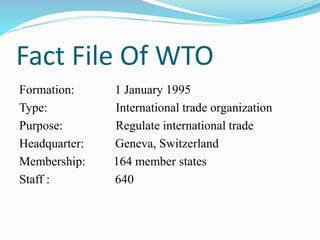
Fact File Of WTO
Formation: 1 January 1995
Type: International trade organization
Purpose: Regulate international trade
Headquarter: Geneva, Switzerland
Membership: 164 member states
Staff : 640
Why WTO?
 To arrange the implementation, administration and
operations of trade agreements.
 Settlement of disputes.
 Trade relations in issues deal with under the agreements.
 To create more together relationship with all nations in
respect of global economic.
Objectives of WTO
 The primary aim of WTO is to implement the
world trade agreement.
 To accept the concept of sustainable
development.
 To enlarge production and trade of goods.
 Increase living standards of people.
Functions of WTO
 To ensure optimum utilization of
world resources.
 To assist international organisation
such as IMF & IBRD.
 Monitoring national trade policies.
 Handling trade disputes.
Role of WTO
 The main goal of WTO is to help the trading industry
to become smooth, fair, free and predictable. It was
organized to become the administrator of multilateral
trade and business agreements between its member
nations. It also tries to resolve trade disputes between
member nations.
 Tariff and other regulations should be applied to
imported or exported goods with out discrimination
among countries.
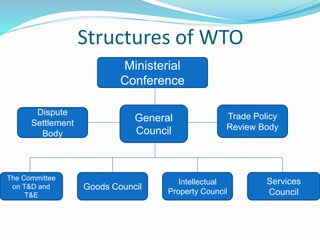
Structures of WTO
Ministerial
Conference
General
Council
Trade Policy
Review Body
Dispute
Settlement
Body
The Committee
on T&D and
T&E
Goods Council
Intellectual
Property Council
Services
Council
Relevance of WTO
 The system allows disputes to be handled
constructively.
 Trade raises incomes.
 The system helps promote peace.
 Trade stimulates economic growth and that can
be good news for employment.
Agreements of WTO
 The agreement on agriculture (AOG)
 Agreement on Trade-Rlated Aspects of
Intellectual Property Rights (TRIPS)
 Agreement on Technical Barriers to Trade
(TBT)
 Agreement on Trade Related Investment
Measures (TRIM)

Wto ppt 18 12-12

  • 1.
    Do you know? TheWTO has handled over 500 trade disputes in the last two decades.
  • 2.
  • 3.
  • 4.
    Road Map: The WorldTrade Organization (WTO) is the only international organization dealing with the global rules of trade between nations. Its main function is to Ensure that trade flows as smoothly, predictably and freely as possible.
  • 5.
    In the presentation About WTO  Fact file of WTO  Why WTO?  Objectives & Functions of WTO  Principles of WTO  Role of WTO  Structure of WTO  Trim & Trips of WTO  Relevance of WTO  Agreements of WTO
  • 6.
    About WTO The WorldTrade Organization (WTO) is an intergovernmental organization which regulates international trade. The World trade Organization officially commenced on 1 January 1995 under the Marrakesh Agreement, signed by 123 nations on 15 april 1994, replacing the General Agreement on Tariff and Trade(GATT), which commenced in 1948.
  • 7.
    Fact File OfWTO Formation: 1 January 1995 Type: International trade organization Purpose: Regulate international trade Headquarter: Geneva, Switzerland Membership: 164 member states Staff : 640
  • 8.
    Why WTO?  Toarrange the implementation, administration and operations of trade agreements.  Settlement of disputes.  Trade relations in issues deal with under the agreements.  To create more together relationship with all nations in respect of global economic.
  • 9.
    Objectives of WTO The primary aim of WTO is to implement the world trade agreement.  To accept the concept of sustainable development.  To enlarge production and trade of goods.  Increase living standards of people.
  • 10.
    Functions of WTO To ensure optimum utilization of world resources.  To assist international organisation such as IMF & IBRD.  Monitoring national trade policies.  Handling trade disputes.
  • 11.
    Role of WTO The main goal of WTO is to help the trading industry to become smooth, fair, free and predictable. It was organized to become the administrator of multilateral trade and business agreements between its member nations. It also tries to resolve trade disputes between member nations.  Tariff and other regulations should be applied to imported or exported goods with out discrimination among countries.
  • 12.
    Structures of WTO Ministerial Conference General Council TradePolicy Review Body Dispute Settlement Body The Committee on T&D and T&E Goods Council Intellectual Property Council Services Council
  • 13.
    Relevance of WTO The system allows disputes to be handled constructively.  Trade raises incomes.  The system helps promote peace.  Trade stimulates economic growth and that can be good news for employment.
  • 14.
    Agreements of WTO The agreement on agriculture (AOG)  Agreement on Trade-Rlated Aspects of Intellectual Property Rights (TRIPS)  Agreement on Technical Barriers to Trade (TBT)  Agreement on Trade Related Investment Measures (TRIM)