World’s Population 
and Food Supply 
AGST 3000 
Agriculture, Society 
and the Natural World
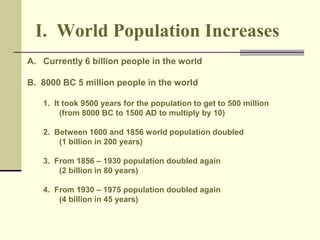
I. World Population Increases 
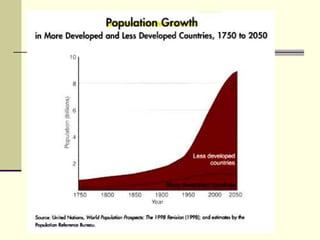
A. Currently 6 billion people in the world 
B. 8000 BC 5 million people in the world 
1. It took 9500 years for the population to get to 500 million 
(from 8000 BC to 1500 AD to multiply by 10) 
2. Between 1600 and 1856 world population doubled 
(1 billion in 200 years) 
3. From 1856 – 1930 population doubled again 
(2 billion in 80 years) 
4. From 1930 – 1975 population doubled again 
(4 billion in 45 years)
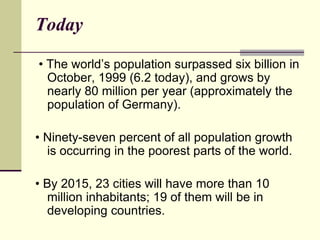
Today 
• The world’s population surpassed six billion in 
October, 1999 (6.2 today), and grows by 
nearly 80 million per year (approximately the 
population of Germany). 
• Ninety-seven percent of all population growth 
is occurring in the poorest parts of the world. 
• By 2015, 23 cities will have more than 10 
million inhabitants; 19 of them will be in 
developing countries.
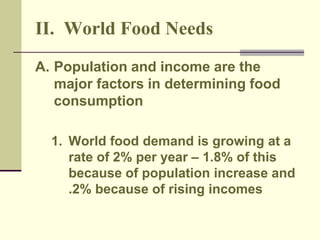
II. World Food Needs 
A. Population and income are the 
major factors in determining food 
consumption 
1. World food demand is growing at a 
rate of 2% per year – 1.8% of this 
because of population increase and 
.2% because of rising incomes
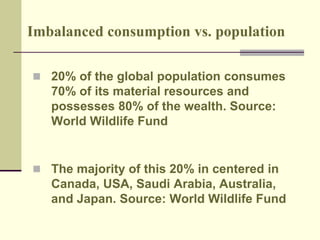
Imbalanced consumption vs. population 
 20% of the global population consumes 
70% of its material resources and 
possesses 80% of the wealth. Source: 
World Wildlife Fund 
 The majority of this 20% in centered in 
Canada, USA, Saudi Arabia, Australia, 
and Japan. Source: World Wildlife Fund
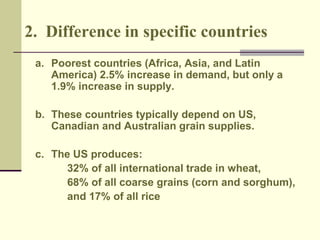
2. Difference in specific countries 
a. Poorest countries (Africa, Asia, and Latin 
America) 2.5% increase in demand, but only a 
1.9% increase in supply. 
b. These countries typically depend on US, 
Canadian and Australian grain supplies. 
c. The US produces: 
32% of all international trade in wheat, 
68% of all coarse grains (corn and sorghum), 
and 17% of all rice
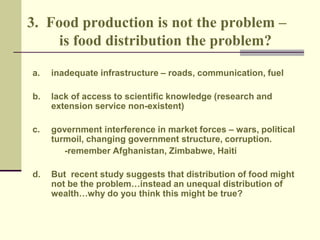
3. Food production is not the problem – 
is food distribution the problem? 
a. inadequate infrastructure – roads, communication, fuel 
b. lack of access to scientific knowledge (research and 
extension service non-existent) 
c. government interference in market forces – wars, political 
turmoil, changing government structure, corruption. 
-remember Afghanistan, Zimbabwe, Haiti 
d. But recent study suggests that distribution of food might 
not be the problem…instead an unequal distribution of 
wealth…why do you think this might be true?
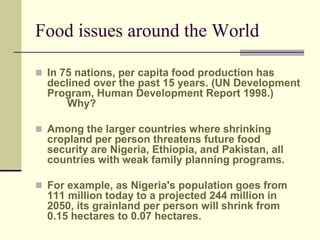
Food issues around the World 
 In 75 nations, per capita food production has 
declined over the past 15 years. (UN Development 
Program, Human Development Report 1998.) 
Why? 
 Among the larger countries where shrinking 
cropland per person threatens future food 
security are Nigeria, Ethiopia, and Pakistan, all 
countries with weak family planning programs. 
 For example, as Nigeria's population goes from 
111 million today to a projected 244 million in 
2050, its grainland per person will shrink from 
0.15 hectares to 0.07 hectares.
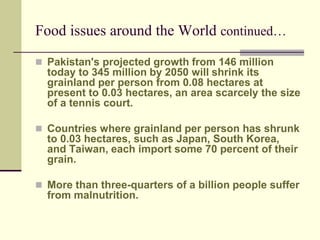
Food issues around the World continued… 
 Pakistan's projected growth from 146 million 
today to 345 million by 2050 will shrink its 
grainland per person from 0.08 hectares at 
present to 0.03 hectares, an area scarcely the size 
of a tennis court. 
 Countries where grainland per person has shrunk 
to 0.03 hectares, such as Japan, South Korea, 
and Taiwan, each import some 70 percent of their 
grain. 
 More than three-quarters of a billion people suffer 
from malnutrition.
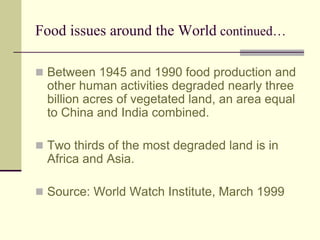
Food issues around the World continued… 
 Between 1945 and 1990 food production and 
other human activities degraded nearly three 
billion acres of vegetated land, an area equal 
to China and India combined. 
 Two thirds of the most degraded land is in 
Africa and Asia. 
 Source: World Watch Institute, March 1999
Increasing the World’s Food 
Supply..How? 
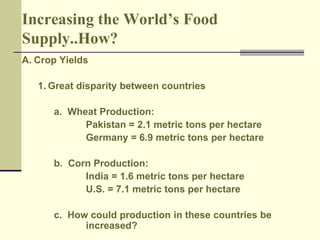
A. Crop Yields 
1. Great disparity between countries 
a. Wheat Production: 
Pakistan = 2.1 metric tons per hectare 
Germany = 6.9 metric tons per hectare 
b. Corn Production: 
India = 1.6 metric tons per hectare 
U.S. = 7.1 metric tons per hectare 
c. How could production in these countries be 
increased?
1. “Green Revolution” 1970’s 
The introduction of high 
yielding varieties of wheat 
and rice in Asia doubled or 
tripled yields… but with 
environmental and social 
consequences 
Increasing the World’s Food Supply..How?
2. Genetic Manipulation: GMO’s 
(Genetically Modified Organisms) 
a. Increased yields 
b. Decrease the need for pesticides 
c. Neutracueticals 
d. “Frankenfoods” 
e. Environmental consequences 
f. Websites 
http://students.washington.edu/ebv7777/gmo.html 
http://www.effectiveoptions.com/GMO/biotechnology.htm 
http://ohioline.osu.edu/gmo/articles.html 
Increasing the World’s Food Supply..How?
3. Land Area 
1. Land surface = 25% of the earth, the rest 
is water, polar icecaps 
2. Africa and South America have the 
largest areas of potentially arable land. 
a. Africa currently farms 20% of its 
potentially arable land. 
b. South America farms 10% 
Increasing the World’s Food Supply..How?
Land Area …continued 
3. The U.S., Canada, Australia and New Zealand have 
about 1 billion more acres that could be farmed. 
a. Land will only be farmed if it becomes 
economical to do so 
b. Water availability plays a large role in 
determining farm land’s productive capacity 
c. Ecosystem degradation and environmental 
concerns 
4. World population increased by 30% from 1975 – 
1990, but land area used to support that population 
increased only 3.6%
4. Food from the Sea 
1. Aquatic products are a very important 
food source in Japan, Norway, Spain, 
Iceland, Portugal and Southeast Asia 
2. However, fish make up only 1% of the 
world’s caloric intake and only 6% of all 
protein 
3. Long-term plans for “Farming the Sea” 
will do little to solve world hunger 
problems 
Increasing the World’s Food Supply..How?
History….Malthusian dilemma 
1. Reverend Thomas R. Malthus, writing in 
1798 gained fame for what he called the 
“principle of population” 
a. His concept was that food supplies could 
only increase arithmetically but 
populations would increase geometrically 
b. Economic principle based on the “Law of 
Diminishing Returns” – increasing labor 
to a fixed amount of land
Malthusian dilemma … continued 
c. 200 years later – both population and food 
supplies have increased geometrically – Why? 
Increasing land area for food production – after his 
prediction (1798)…North America’s potential for 
food production was not known 
 1920’s increase in mechanization 
 1960’s application of scientific principles to 
agriculture (plant breeding, irrigation, plant 
protection)
Looking into the Future 
A. As economic growth occurs, populations transition 
from agricultural (high fertility, large families, high 
mortality) to industrial (the world’s richest countries 
have stable or shrinking populations) 
1. Fact – World birth rates are decreasing but the 
population is increasing because people are living 
longer 
B. Crucial question “How will food issues be dealt with 
in the future?” Political leverage, Economic Control? 
C. Developing uncultivated land i.e. Rainforests, tends 
to lead to environmental degradation and loss of 
species variability 
D. Raising crop and livestock yields - technology
In Class Writing Assignment 
 What factors would support the notion that man is doomed 
on planet earth? 
 What factors might change or what changes might occur 
that would circumvent the above question? 
 What should the people of developed nations do to help 
stem starvation in under-developed areas of the world? 
 Why is simply providing technology to under-developed 
areas of the world not the right answer? 
 Where do you see the greatest potential in solving the issue 
of food shortages with a growing population on earth?

World Population and Food Supply

  • 1.
    World’s Population andFood Supply AGST 3000 Agriculture, Society and the Natural World
  • 2.
    I. World PopulationIncreases A. Currently 6 billion people in the world B. 8000 BC 5 million people in the world 1. It took 9500 years for the population to get to 500 million (from 8000 BC to 1500 AD to multiply by 10) 2. Between 1600 and 1856 world population doubled (1 billion in 200 years) 3. From 1856 – 1930 population doubled again (2 billion in 80 years) 4. From 1930 – 1975 population doubled again (4 billion in 45 years)
  • 3.
    Today • Theworld’s population surpassed six billion in October, 1999 (6.2 today), and grows by nearly 80 million per year (approximately the population of Germany). • Ninety-seven percent of all population growth is occurring in the poorest parts of the world. • By 2015, 23 cities will have more than 10 million inhabitants; 19 of them will be in developing countries.
  • 5.
    II. World FoodNeeds A. Population and income are the major factors in determining food consumption 1. World food demand is growing at a rate of 2% per year – 1.8% of this because of population increase and .2% because of rising incomes
  • 6.
    Imbalanced consumption vs.population  20% of the global population consumes 70% of its material resources and possesses 80% of the wealth. Source: World Wildlife Fund  The majority of this 20% in centered in Canada, USA, Saudi Arabia, Australia, and Japan. Source: World Wildlife Fund
  • 7.
    2. Difference inspecific countries a. Poorest countries (Africa, Asia, and Latin America) 2.5% increase in demand, but only a 1.9% increase in supply. b. These countries typically depend on US, Canadian and Australian grain supplies. c. The US produces: 32% of all international trade in wheat, 68% of all coarse grains (corn and sorghum), and 17% of all rice
  • 8.
    3. Food productionis not the problem – is food distribution the problem? a. inadequate infrastructure – roads, communication, fuel b. lack of access to scientific knowledge (research and extension service non-existent) c. government interference in market forces – wars, political turmoil, changing government structure, corruption. -remember Afghanistan, Zimbabwe, Haiti d. But recent study suggests that distribution of food might not be the problem…instead an unequal distribution of wealth…why do you think this might be true?
  • 9.
    Food issues aroundthe World  In 75 nations, per capita food production has declined over the past 15 years. (UN Development Program, Human Development Report 1998.) Why?  Among the larger countries where shrinking cropland per person threatens future food security are Nigeria, Ethiopia, and Pakistan, all countries with weak family planning programs.  For example, as Nigeria's population goes from 111 million today to a projected 244 million in 2050, its grainland per person will shrink from 0.15 hectares to 0.07 hectares.
  • 10.
    Food issues aroundthe World continued…  Pakistan's projected growth from 146 million today to 345 million by 2050 will shrink its grainland per person from 0.08 hectares at present to 0.03 hectares, an area scarcely the size of a tennis court.  Countries where grainland per person has shrunk to 0.03 hectares, such as Japan, South Korea, and Taiwan, each import some 70 percent of their grain.  More than three-quarters of a billion people suffer from malnutrition.
  • 11.
    Food issues aroundthe World continued…  Between 1945 and 1990 food production and other human activities degraded nearly three billion acres of vegetated land, an area equal to China and India combined.  Two thirds of the most degraded land is in Africa and Asia.  Source: World Watch Institute, March 1999
  • 12.
    Increasing the World’sFood Supply..How? A. Crop Yields 1. Great disparity between countries a. Wheat Production: Pakistan = 2.1 metric tons per hectare Germany = 6.9 metric tons per hectare b. Corn Production: India = 1.6 metric tons per hectare U.S. = 7.1 metric tons per hectare c. How could production in these countries be increased?
  • 13.
    1. “Green Revolution”1970’s The introduction of high yielding varieties of wheat and rice in Asia doubled or tripled yields… but with environmental and social consequences Increasing the World’s Food Supply..How?
  • 14.
    2. Genetic Manipulation:GMO’s (Genetically Modified Organisms) a. Increased yields b. Decrease the need for pesticides c. Neutracueticals d. “Frankenfoods” e. Environmental consequences f. Websites http://students.washington.edu/ebv7777/gmo.html http://www.effectiveoptions.com/GMO/biotechnology.htm http://ohioline.osu.edu/gmo/articles.html Increasing the World’s Food Supply..How?
  • 15.
    3. Land Area 1. Land surface = 25% of the earth, the rest is water, polar icecaps 2. Africa and South America have the largest areas of potentially arable land. a. Africa currently farms 20% of its potentially arable land. b. South America farms 10% Increasing the World’s Food Supply..How?
  • 16.
    Land Area …continued 3. The U.S., Canada, Australia and New Zealand have about 1 billion more acres that could be farmed. a. Land will only be farmed if it becomes economical to do so b. Water availability plays a large role in determining farm land’s productive capacity c. Ecosystem degradation and environmental concerns 4. World population increased by 30% from 1975 – 1990, but land area used to support that population increased only 3.6%
  • 17.
    4. Food fromthe Sea 1. Aquatic products are a very important food source in Japan, Norway, Spain, Iceland, Portugal and Southeast Asia 2. However, fish make up only 1% of the world’s caloric intake and only 6% of all protein 3. Long-term plans for “Farming the Sea” will do little to solve world hunger problems Increasing the World’s Food Supply..How?
  • 18.
    History….Malthusian dilemma 1.Reverend Thomas R. Malthus, writing in 1798 gained fame for what he called the “principle of population” a. His concept was that food supplies could only increase arithmetically but populations would increase geometrically b. Economic principle based on the “Law of Diminishing Returns” – increasing labor to a fixed amount of land
  • 19.
    Malthusian dilemma …continued c. 200 years later – both population and food supplies have increased geometrically – Why? Increasing land area for food production – after his prediction (1798)…North America’s potential for food production was not known  1920’s increase in mechanization  1960’s application of scientific principles to agriculture (plant breeding, irrigation, plant protection)
  • 20.
    Looking into theFuture A. As economic growth occurs, populations transition from agricultural (high fertility, large families, high mortality) to industrial (the world’s richest countries have stable or shrinking populations) 1. Fact – World birth rates are decreasing but the population is increasing because people are living longer B. Crucial question “How will food issues be dealt with in the future?” Political leverage, Economic Control? C. Developing uncultivated land i.e. Rainforests, tends to lead to environmental degradation and loss of species variability D. Raising crop and livestock yields - technology
  • 21.
    In Class WritingAssignment  What factors would support the notion that man is doomed on planet earth?  What factors might change or what changes might occur that would circumvent the above question?  What should the people of developed nations do to help stem starvation in under-developed areas of the world?  Why is simply providing technology to under-developed areas of the world not the right answer?  Where do you see the greatest potential in solving the issue of food shortages with a growing population on earth?