World Hunger and Food
Security
Lecture Series in Quantitative
Sustainability
by

Toni Menninger
http://www.slideshare.net/amenning/
World Hunger and Food Security
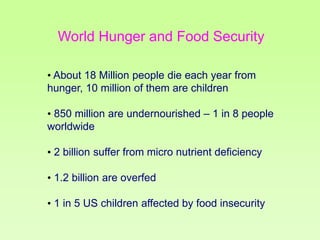
• About 18 Million people die each year from
hunger, 10 million of them are children
• 850 million are undernourished – 1 in 8 people
worldwide
• 2 billion suffer from micro nutrient deficiency
• 1.2 billion are overfed
• 1 in 5 US children affected by food insecurity
World Hunger and Food Security
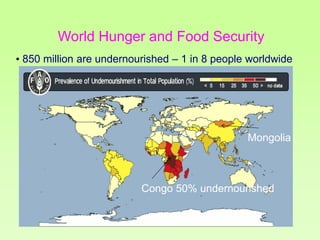
• 850 million are undernourished – 1 in 8 people worldwide

Mongolia

Congo 50% undernourished
World Hunger and Food Security
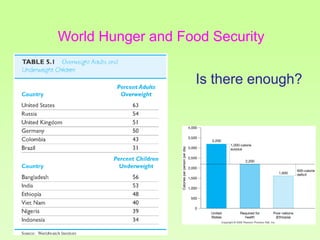
Is there enough?
World Hunger and Food Security
• The average person requires 2200 to 2400 dietary
calories (kcal) per day.
• Per capita food consumption in 2003: 2800 kcal,
up from 2250 in 1961 (FAO).
• Since the “Green Revolution”, food production has
increased faster than world population.

• Theoretically, even today there is enough food for 8
billion people.
• Hunger is not caused by a global food shortage. It
is caused by economic inequality – the poorest
people can't afford an adequate diet.
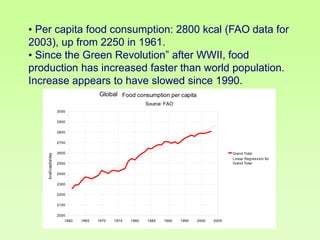
• Per capita food consumption: 2800 kcal (FAO data for
2003), up from 2250 in 1961.
• Since the Green Revolution” after WWII, food
production has increased faster than world population.
Increase appears to have slowed since 1990.
Global Food consumption per capita
Source: FAO
3000
2900
2800

kcal/capita/day

2700
2600

Grand Total
Linear Regression for
Grand Total

2500
2400
2300
2200
2100
2000
1960

1965

1970

1975

1980

1985

1990

1995

2000

2005
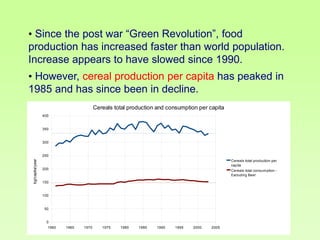
• Since the post war “Green Revolution”, food
production has increased faster than world population.
Increase appears to have slowed since 1990.
• However, cereal production per capita has peaked in
1985 and has since been in decline.
Cereals total production and consumption per capita
400

350

300

kg/capita/year

250
Cereals total production per
capita
Cereals total consum ption Excluding Beer

200

150

100

50

0
1960

1965

1970

1975

1980

1985

1990

1995

2000

2005
World's largest grain producers, 2010 (FAOSTAT)
0

China
United States of America
India
Indonesia
Brazil
France
Russian Federation
Bangladesh
Argentina
Canada
Viet Nam
Germany
Ukraine
Thailand
Mexico
Myanmar
Pakistan
Australia
Turkey
Poland
Iran (Islamic Republic of)
Philippines
United Kingdom
Nigeria
Egypt
Spain
Italy
Romania
Ethiopia
South Africa
Hungary
Kazakhstan
Japan

100,000,000

200,000,000

300,000,000

400,000,000

500,000,000

600,000,000
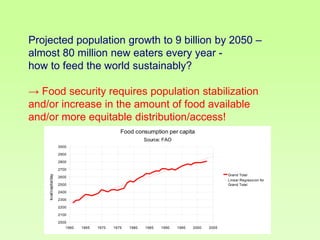
Projected population growth to 9 billion by 2050 –
almost 80 million new eaters every year how to feed the world sustainably?
→ Food security requires population stabilization
and/or increase in the amount of food available
and/or more equitable distribution/access!
Food consumption per capita
Source: FAO
3000
2900
2800

kcal/capita/day

2700
Grand Total
Linear Regression for
Grand Total

2600
2500
2400
2300
2200
2100
2000
1960

1965

1970

1975

1980

1985

1990

1995

2000

2005
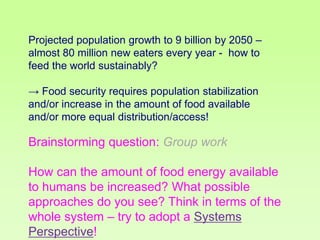
Projected population growth to 9 billion by 2050 –
almost 80 million new eaters every year - how to
feed the world sustainably?
→ Food security requires population stabilization
and/or increase in the amount of food available
and/or more equal distribution/access!

Brainstorming question: Group work

How can the amount of food energy available
to humans be increased? What possible
approaches do you see? Think in terms of the
whole system – try to adopt a Systems
Perspective!
Factors determining food supply
• Area under cultivation
• Land productivity (yield per acre)
• Availability for human consumption

• Post-harvest losses and waste
Factors determining food supply
Area under cultivation
→ Protect arable land from erosion, degradation,
desertification, urban development
→ Climate Change: some marginal areas may become
available for cultivation but some prime crop areas are
threatened
→ Expanding agricultural area in many countries not
possible or only at high environmental cost
→ Tropical rainforest soils not suitable for intensive
agriculture

→ Some marginal areas can be made productive if
carefully managed – avoid overgrazing
→ Increasing importance of Urban Gardening
Factors determining food supply
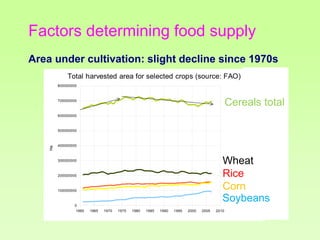
Area under cultivation: slight decline since 1970s
Total harvested area for selected crops (source: FAO)
800000000

Cereals total

700000000

600000000

Ha

500000000

Maize
Rice
Soybeans
Wheat
Cereals,Total

400000000

Wheat
Rice
Corn
Soybeans

300000000

200000000

100000000

0
1960

1965

1970

1975

1980

1985

1990

1995

2000

2005

2010
Factors determining food supply
Productivity (yield per acre)
Thanks to the Green Revolution, global food production
since 1960 has more than kept up with population growth. How
was this achieved, and at what price?

→ Green Revolution yield gains through:
•

Synthetic fertilizer

•

Chemical pesticides

•

Irrigation

•

High performance crop varieties (hybrid,
genetic engineering)

• Capital and energy intensive, dependence of
farmers from agribusiness; is it sustainable?
Factors determining food supply
Productivity (yield per acre):
→ Green Revolution yield gains through:
• Synthetic fertilizer
• Pesticides
• Irrigation
• High performance crop varieties (hybrid, genetic engineering)
• Capital and energy intensive, dependence of farmers from
agribusiness; is it sustainable?

→ Yield gains through alternative approaches?
• Permaculture, locally adapted varieties, diversification
instead of monoculture
• Higher labor input required
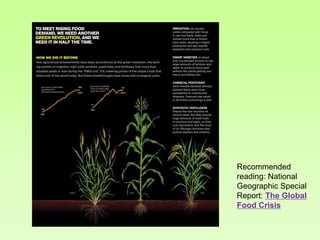
Recommended
reading: National
Geographic Special
Report: The Global
Food Crisis
Productivity (yield per acre)

Green Revolution yield gains
through:
• Synthetic fertilizer
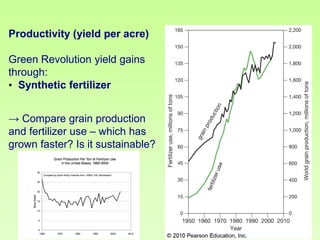
→ Compare grain production
and fertilizer use – which has
grown faster? Is it sustainable?
Productivity (yield per acre)

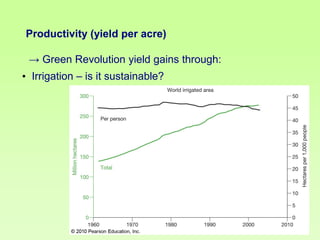
→ Green Revolution yield gains through:
• Irrigation – is it sustainable?
Productivity (yield per acre)

→ Green Revolution yield gains
through:
• Irrigation
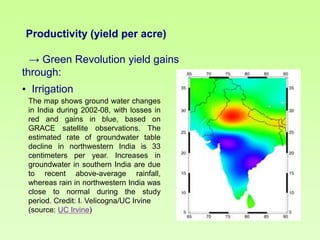
The map shows ground water changes
in India during 2002-08, with losses in
red and gains in blue, based on
GRACE satellite observations. The
estimated rate of groundwater table
decline in northwestern India is 33
centimeters per year. Increases in
groundwater in southern India are due
to recent above-average rainfall,
whereas rain in northwestern India was
close to normal during the study
period. Credit: I. Velicogna/UC Irvine
(source: UC Irvine)
Productivity (yield per acre)

→ Green Revolution yield gains through:
• Irrigation
http://www.scientificamerican.com/article.cf
m?id=is-india-running-out-of-water
http://www.nasa.gov/topics/earth/features/i
ndia_water.html
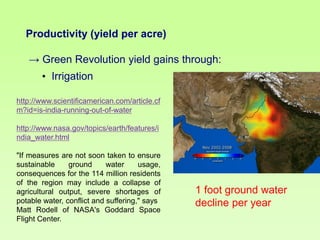
"If measures are not soon taken to ensure
sustainable
ground
water
usage,
consequences for the 114 million residents
of the region may include a collapse of
agricultural output, severe shortages of
potable water, conflict and suffering," says
Matt Rodell of NASA's Goddard Space
Flight Center.

1 foot ground water
decline per year
Productivity (yield per acre)

→ Green Revolution yield gains through:
• High performance crop varieties (hybrid, genetic
engineering)

• Decline in the variety of food crops because a handful of
high performance varieties dominate the seed market
• Tendency to monoculture and industrial farming
• Commercial varieties often not adapted to local
conditions in developing countries (especially Africa) and
to the needs of small subsistence farmers

• Hybrid and patented GM varieties are expensive and
farmers are prevented from reseeding their own seed
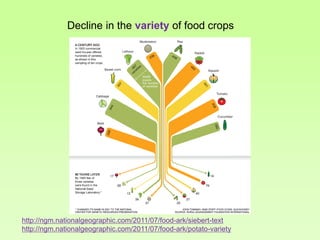
Decline in the variety of food crops

http://ngm.nationalgeographic.com/2011/07/food-ark/siebert-text
http://ngm.nationalgeographic.com/2011/07/food-ark/potato-variety
Productivity (yield per acre)

→ Green Revolution yield gains through:
• High performance crop varieties (hybrid, genetic
engineering)
→ Yield gains through alternative approaches?
• Permaculture, locally adapted varieties, diversification
instead of monoculture
• Higher labor input required
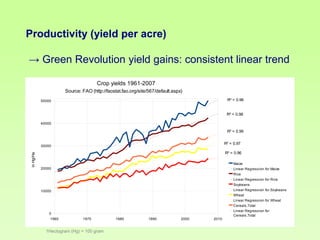
Productivity (yield per acre)

→ Green Revolution yield gains: consistent linear trend
Crop yields 1961-2007
Source: FAO (http://faostat.fao.org/site/567/default.aspx)
R² = 0.96

50000

R² = 0.98
40000

R² = 0.99
R² = 0.97

in Hg/Ha

30000

R² = 0.96
Maize
Linear Regression for Maize
Rice
Linear Regression for Rice
Soybeans
Linear Regression for Soybeans
Wheat
Linear Regression for Wheat
Cereals,Total
Linear Regression for
Cereals,Total

20000

10000

0
1960

1970

1Hectogram (Hg) = 100 gram

1980

1990

2000

2010
Productivity (yield per acre)

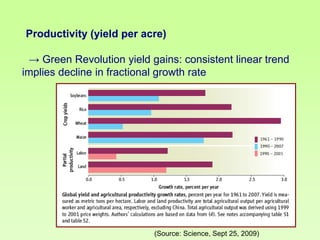
→ Green Revolution yield gains: consistent linear trend
implies decline in fractional growth rate

(Source: Science, Sept 25, 2009)
Factors determining food supply
Availability for human consumption
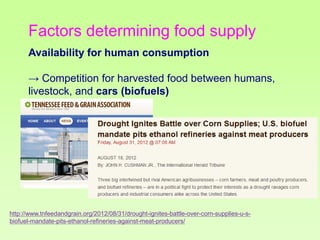
→ Competition for harvested food between humans,
livestock, cars (biofuels), and pests (rats)
→ Also, some agricultural production not edible:

coffee, tea, tobacco, cotton, flowers ...(cash crop)
→ In many poor countries, a large share of
agricultural production consists in cash crops for
export. These countries lose the ability to grow
their own food and become dependent on
commodity prices on the world market. Their
agriculture is often dominated by large corporate
plantations and lacks diversity.
Factors determining food supply
Availability for human consumption
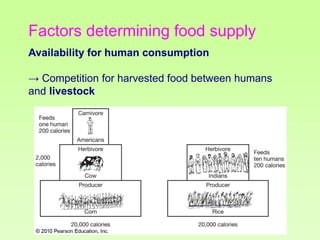
→ Competition for harvested food between humans
and livestock
Factors determining food supply
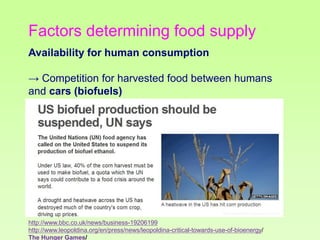
Availability for human consumption
→ Competition for harvested food between humans
and cars (biofuels)

http://www.bbc.co.uk/news/business-19206199
http://www.leopoldina.org/en/press/news/leopoldina-critical-towards-use-of-bioenergy/
The Hunger Games/
Factors determining food supply
Availability for human consumption
→ Competition for harvested food between humans,
livestock, and cars (biofuels)

http://www.tnfeedandgrain.org/2012/08/31/drought-ignites-battle-over-corn-supplies-u-sbiofuel-mandate-pits-ethanol-refineries-against-meat-producers/
Factors determining food supply
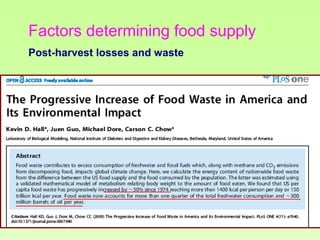
Post-harvest losses and waste
Factors determining food supply
Post-harvest losses (waste)
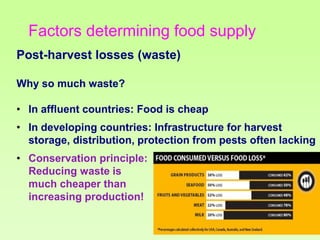
Why so much waste?

• In affluent countries: Food is cheap
• In developing countries: Infrastructure for harvest
storage, distribution, protection from pests often lacking

• Conservation principle:
Reducing waste is
much cheaper than
increasing production!
Factors determining food supply
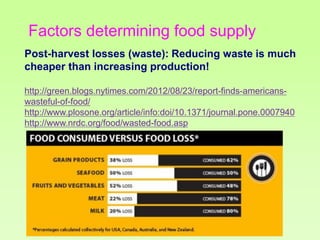
Post-harvest losses (waste): Reducing waste is much
cheaper than increasing production!
http://green.blogs.nytimes.com/2012/08/23/report-finds-americanswasteful-of-food/
http://www.plosone.org/article/info:doi/10.1371/journal.pone.0007940
http://www.nrdc.org/food/wasted-food.asp
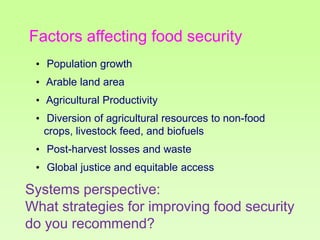
Factors affecting food security
• Population growth
• Arable land area
• Agricultural Productivity
• Diversion of agricultural resources to non-food
crops, livestock feed, and biofuels

• Post-harvest losses and waste
• Global justice and equitable access

Systems perspective:
What strategies for improving food security
do you recommend?

World Hunger and Food Security

  • 1.
    World Hunger andFood Security Lecture Series in Quantitative Sustainability by Toni Menninger http://www.slideshare.net/amenning/
  • 2.
    World Hunger andFood Security • About 18 Million people die each year from hunger, 10 million of them are children • 850 million are undernourished – 1 in 8 people worldwide • 2 billion suffer from micro nutrient deficiency • 1.2 billion are overfed • 1 in 5 US children affected by food insecurity
  • 3.
    World Hunger andFood Security • 850 million are undernourished – 1 in 8 people worldwide Mongolia Congo 50% undernourished
  • 4.
    World Hunger andFood Security Is there enough?
  • 5.
    World Hunger andFood Security • The average person requires 2200 to 2400 dietary calories (kcal) per day. • Per capita food consumption in 2003: 2800 kcal, up from 2250 in 1961 (FAO). • Since the “Green Revolution”, food production has increased faster than world population. • Theoretically, even today there is enough food for 8 billion people. • Hunger is not caused by a global food shortage. It is caused by economic inequality – the poorest people can't afford an adequate diet.
  • 6.
    • Per capitafood consumption: 2800 kcal (FAO data for 2003), up from 2250 in 1961. • Since the Green Revolution” after WWII, food production has increased faster than world population. Increase appears to have slowed since 1990. Global Food consumption per capita Source: FAO 3000 2900 2800 kcal/capita/day 2700 2600 Grand Total Linear Regression for Grand Total 2500 2400 2300 2200 2100 2000 1960 1965 1970 1975 1980 1985 1990 1995 2000 2005
  • 7.
    • Since thepost war “Green Revolution”, food production has increased faster than world population. Increase appears to have slowed since 1990. • However, cereal production per capita has peaked in 1985 and has since been in decline. Cereals total production and consumption per capita 400 350 300 kg/capita/year 250 Cereals total production per capita Cereals total consum ption Excluding Beer 200 150 100 50 0 1960 1965 1970 1975 1980 1985 1990 1995 2000 2005
  • 8.
    World's largest grainproducers, 2010 (FAOSTAT) 0 China United States of America India Indonesia Brazil France Russian Federation Bangladesh Argentina Canada Viet Nam Germany Ukraine Thailand Mexico Myanmar Pakistan Australia Turkey Poland Iran (Islamic Republic of) Philippines United Kingdom Nigeria Egypt Spain Italy Romania Ethiopia South Africa Hungary Kazakhstan Japan 100,000,000 200,000,000 300,000,000 400,000,000 500,000,000 600,000,000
  • 9.
    Projected population growthto 9 billion by 2050 – almost 80 million new eaters every year how to feed the world sustainably? → Food security requires population stabilization and/or increase in the amount of food available and/or more equitable distribution/access! Food consumption per capita Source: FAO 3000 2900 2800 kcal/capita/day 2700 Grand Total Linear Regression for Grand Total 2600 2500 2400 2300 2200 2100 2000 1960 1965 1970 1975 1980 1985 1990 1995 2000 2005
  • 10.
    Projected population growthto 9 billion by 2050 – almost 80 million new eaters every year - how to feed the world sustainably? → Food security requires population stabilization and/or increase in the amount of food available and/or more equal distribution/access! Brainstorming question: Group work How can the amount of food energy available to humans be increased? What possible approaches do you see? Think in terms of the whole system – try to adopt a Systems Perspective!
  • 11.
    Factors determining foodsupply • Area under cultivation • Land productivity (yield per acre) • Availability for human consumption • Post-harvest losses and waste
  • 12.
    Factors determining foodsupply Area under cultivation → Protect arable land from erosion, degradation, desertification, urban development → Climate Change: some marginal areas may become available for cultivation but some prime crop areas are threatened → Expanding agricultural area in many countries not possible or only at high environmental cost → Tropical rainforest soils not suitable for intensive agriculture → Some marginal areas can be made productive if carefully managed – avoid overgrazing → Increasing importance of Urban Gardening
  • 13.
    Factors determining foodsupply Area under cultivation: slight decline since 1970s Total harvested area for selected crops (source: FAO) 800000000 Cereals total 700000000 600000000 Ha 500000000 Maize Rice Soybeans Wheat Cereals,Total 400000000 Wheat Rice Corn Soybeans 300000000 200000000 100000000 0 1960 1965 1970 1975 1980 1985 1990 1995 2000 2005 2010
  • 14.
    Factors determining foodsupply Productivity (yield per acre) Thanks to the Green Revolution, global food production since 1960 has more than kept up with population growth. How was this achieved, and at what price? → Green Revolution yield gains through: • Synthetic fertilizer • Chemical pesticides • Irrigation • High performance crop varieties (hybrid, genetic engineering) • Capital and energy intensive, dependence of farmers from agribusiness; is it sustainable?
  • 15.
    Factors determining foodsupply Productivity (yield per acre): → Green Revolution yield gains through: • Synthetic fertilizer • Pesticides • Irrigation • High performance crop varieties (hybrid, genetic engineering) • Capital and energy intensive, dependence of farmers from agribusiness; is it sustainable? → Yield gains through alternative approaches? • Permaculture, locally adapted varieties, diversification instead of monoculture • Higher labor input required
  • 16.
  • 17.
    Productivity (yield peracre) Green Revolution yield gains through: • Synthetic fertilizer → Compare grain production and fertilizer use – which has grown faster? Is it sustainable?
  • 18.
    Productivity (yield peracre) → Green Revolution yield gains through: • Irrigation – is it sustainable?
  • 19.
    Productivity (yield peracre) → Green Revolution yield gains through: • Irrigation The map shows ground water changes in India during 2002-08, with losses in red and gains in blue, based on GRACE satellite observations. The estimated rate of groundwater table decline in northwestern India is 33 centimeters per year. Increases in groundwater in southern India are due to recent above-average rainfall, whereas rain in northwestern India was close to normal during the study period. Credit: I. Velicogna/UC Irvine (source: UC Irvine)
  • 20.
    Productivity (yield peracre) → Green Revolution yield gains through: • Irrigation http://www.scientificamerican.com/article.cf m?id=is-india-running-out-of-water http://www.nasa.gov/topics/earth/features/i ndia_water.html "If measures are not soon taken to ensure sustainable ground water usage, consequences for the 114 million residents of the region may include a collapse of agricultural output, severe shortages of potable water, conflict and suffering," says Matt Rodell of NASA's Goddard Space Flight Center. 1 foot ground water decline per year
  • 21.
    Productivity (yield peracre) → Green Revolution yield gains through: • High performance crop varieties (hybrid, genetic engineering) • Decline in the variety of food crops because a handful of high performance varieties dominate the seed market • Tendency to monoculture and industrial farming • Commercial varieties often not adapted to local conditions in developing countries (especially Africa) and to the needs of small subsistence farmers • Hybrid and patented GM varieties are expensive and farmers are prevented from reseeding their own seed
  • 22.
    Decline in thevariety of food crops http://ngm.nationalgeographic.com/2011/07/food-ark/siebert-text http://ngm.nationalgeographic.com/2011/07/food-ark/potato-variety
  • 23.
    Productivity (yield peracre) → Green Revolution yield gains through: • High performance crop varieties (hybrid, genetic engineering) → Yield gains through alternative approaches? • Permaculture, locally adapted varieties, diversification instead of monoculture • Higher labor input required
  • 24.
    Productivity (yield peracre) → Green Revolution yield gains: consistent linear trend Crop yields 1961-2007 Source: FAO (http://faostat.fao.org/site/567/default.aspx) R² = 0.96 50000 R² = 0.98 40000 R² = 0.99 R² = 0.97 in Hg/Ha 30000 R² = 0.96 Maize Linear Regression for Maize Rice Linear Regression for Rice Soybeans Linear Regression for Soybeans Wheat Linear Regression for Wheat Cereals,Total Linear Regression for Cereals,Total 20000 10000 0 1960 1970 1Hectogram (Hg) = 100 gram 1980 1990 2000 2010
  • 25.
    Productivity (yield peracre) → Green Revolution yield gains: consistent linear trend implies decline in fractional growth rate (Source: Science, Sept 25, 2009)
  • 26.
    Factors determining foodsupply Availability for human consumption → Competition for harvested food between humans, livestock, cars (biofuels), and pests (rats) → Also, some agricultural production not edible: coffee, tea, tobacco, cotton, flowers ...(cash crop) → In many poor countries, a large share of agricultural production consists in cash crops for export. These countries lose the ability to grow their own food and become dependent on commodity prices on the world market. Their agriculture is often dominated by large corporate plantations and lacks diversity.
  • 27.
    Factors determining foodsupply Availability for human consumption → Competition for harvested food between humans and livestock
  • 28.
    Factors determining foodsupply Availability for human consumption → Competition for harvested food between humans and cars (biofuels) http://www.bbc.co.uk/news/business-19206199 http://www.leopoldina.org/en/press/news/leopoldina-critical-towards-use-of-bioenergy/ The Hunger Games/
  • 29.
    Factors determining foodsupply Availability for human consumption → Competition for harvested food between humans, livestock, and cars (biofuels) http://www.tnfeedandgrain.org/2012/08/31/drought-ignites-battle-over-corn-supplies-u-sbiofuel-mandate-pits-ethanol-refineries-against-meat-producers/
  • 30.
    Factors determining foodsupply Post-harvest losses and waste
  • 31.
    Factors determining foodsupply Post-harvest losses (waste) Why so much waste? • In affluent countries: Food is cheap • In developing countries: Infrastructure for harvest storage, distribution, protection from pests often lacking • Conservation principle: Reducing waste is much cheaper than increasing production!
  • 32.
    Factors determining foodsupply Post-harvest losses (waste): Reducing waste is much cheaper than increasing production! http://green.blogs.nytimes.com/2012/08/23/report-finds-americanswasteful-of-food/ http://www.plosone.org/article/info:doi/10.1371/journal.pone.0007940 http://www.nrdc.org/food/wasted-food.asp
  • 33.
    Factors affecting foodsecurity • Population growth • Arable land area • Agricultural Productivity • Diversion of agricultural resources to non-food crops, livestock feed, and biofuels • Post-harvest losses and waste • Global justice and equitable access Systems perspective: What strategies for improving food security do you recommend?