FULL PLANET, EMPTY PLATES
Carrelli Lydia,
Cassio Paola,
Yongchang He,
Ottanà Giulia,
Rytsola Valentina,
Serrini Livia
The New Geopolitics of Food Scarcity
By Lester R. Brown
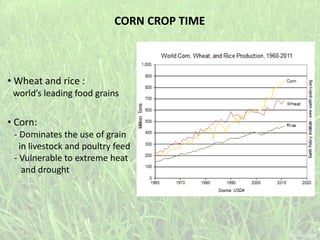
CORN CROP TIME
• Wheat and rice :
world’s leading food grains
• Corn:
- Dominates the use of grain
in livestock and poultry feed
- Vulnerable to extreme heat
and drought
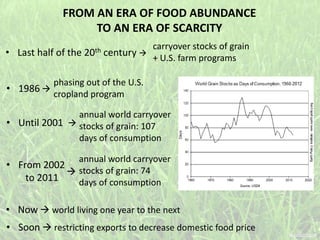
FROM AN ERA OF FOOD ABUNDANCE
TO AN ERA OF SCARCITY
• 1986 
• Until 2001 
• From 2002
to 2011

annual world carryover
stocks of grain: 74
days of consumption
annual world carryover
stocks of grain: 107
days of consumption
phasing out of the U.S.
cropland program
• Now  world living one year to the next
• Last half of the 20th century 
carryover stocks of grain
+ U.S. farm programs
• Soon  restricting exports to decrease domestic food price
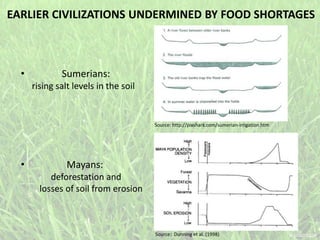
EARLIER CIVILIZATIONS UNDERMINED BY FOOD SHORTAGES
• Sumerians:
rising salt levels in the soil
• Mayans:
deforestation and
losses of soil from erosion
Source: http://pixshark.com/sumerian-irrigation.htm
Source: Dunning et al. (1998)
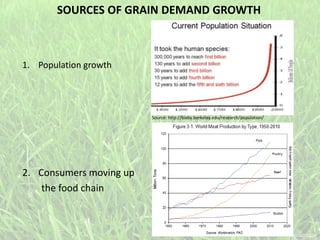
SOURCES OF GRAIN DEMAND GROWTH
1. Population growth
Source: http://bixby.berkeley.edu/research/population/
2. Consumers moving up
the food chain
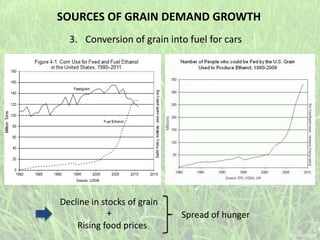
3. Conversion of grain into fuel for cars
SOURCES OF GRAIN DEMAND GROWTH
Decline in stocks of grain
Rising food prices
+ Spread of hunger
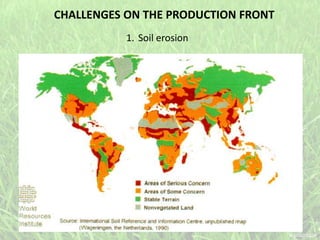
CHALLENGES ON THE PRODUCTION FRONT
1. Soil erosion
CHALLENGES ON THE PRODUCTION FRONT
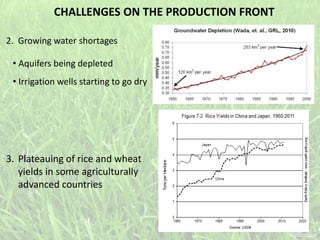
2. Growing water shortages
• Aquifers being depleted
• Irrigation wells starting to go dry
3. Plateauing of rice and wheat
yields in some agriculturally
advanced countries
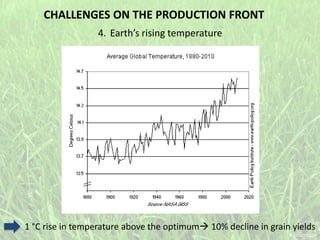
4. Earth’s rising temperature
CHALLENGES ON THE PRODUCTION FRONT
1 °C rise in temperature above the optimum 10% decline in grain yields
POPULATION GROWTH
• Consequences of the explosive population growth
(forests, fisheries, grasslands, aquifers, soils)
• Forests: overcutting
- growing demand for firewood, lumber, paper
- forests are shrinking
- Mauritania
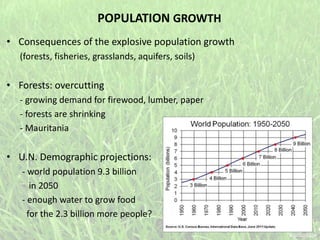
• U.N. Demographic projections:
- world population 9.3 billion
in 2050
- enough water to grow food
for the 2.3 billion more people?
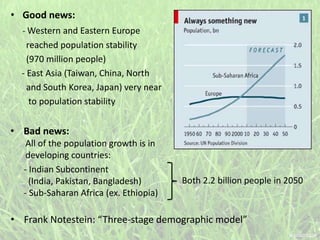
• Good news:
- Western and Eastern Europe
reached population stability
(970 million people)
- East Asia (Taiwan, China, North
and South Korea, Japan) very near
to population stability
- Indian Subcontinent
(India, Pakistan, Bangladesh)
- Sub-Saharan Africa (ex. Ethiopia)
• Bad news:
All of the population growth is in
developing countries:
Both 2.2 billion people in 2050
• Frank Notestein: “Three-stage demographic model”
SOLUTIONS:
• Smaller families
• Access to reproductive health care and family planning
services for every woman
• Two children per couple
• Stabilized world population
• Every country moving into “stage-three”
MOVING UP THE FOOD CHAIN
• Food habits depend on geographic location protein change
USA, Brazil, Argentina:
land-rich with grassland
Beef and mutton
Germany and China:
densely populated with lack of space
Pork
• During the years, meat consumption is changed:
- 1950: beef and pork dominated
- 1997: poultry overtook beef
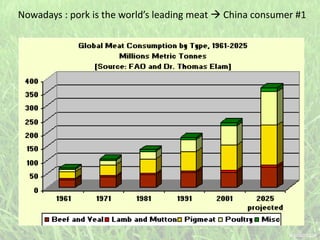
Nowadays : pork is the world’s leading meat  China consumer #1
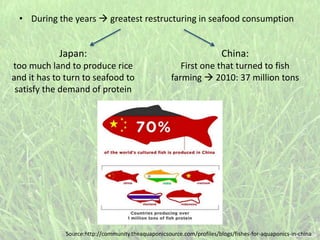
• During the years  greatest restructuring in seafood consumption
Japan:
too much land to produce rice
and it has to turn to seafood to
satisfy the demand of protein
China:
First one that turned to fish
farming  2010: 37 million tons
Source:http://community.theaquaponicsource.com/profiles/blogs/fishes-for-aquaponics-in-china
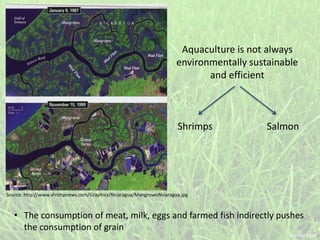
• The consumption of meat, milk, eggs and farmed fish indirectly pushes
the consumption of grain
SalmonShrimps
Aquaculture is not always
environmentally sustainable
and efficient
Source: http://www.shrimpnews.com/Graphics/Nicaragua/MangrovesNicaragua.jpg
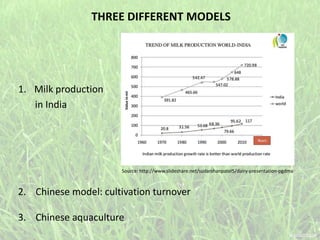
1. Milk production
in India
THREE DIFFERENT MODELS
2. Chinese model: cultivation turnover
3. Chinese aquaculture
Source: http://www.slideshare.net/sudarshanpatel5/dairy-presentation-pgdma
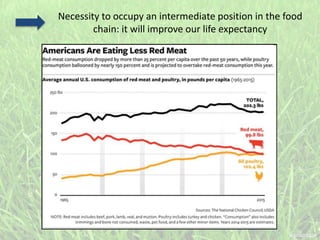
Necessity to occupy an intermediate position in the food
chain: it will improve our life expectancy
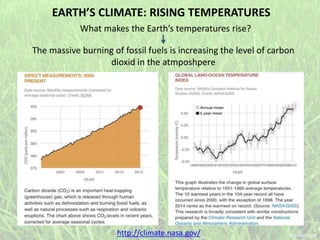
EARTH’S CLIMATE: RISING TEMPERATURES
What makes the Earth’s temperatures rise?
The massive burning of fossil fuels is increasing the level of carbon
dioxid in the atmposhpere
http://climate.nasa.gov/
WHICH ARE THE CONSEQUENCES?
1. Agriculture: high temperatures interfere with pollination and
reduce photosynthesis of basic food crops
- corn pollination
- rice pollination
2. Increasing drought
3. Spreading of wildfires
4. Heat waves
1988 U.S.A.
2003 U.E.
2010 Russia
5. Melting mountain glaciers
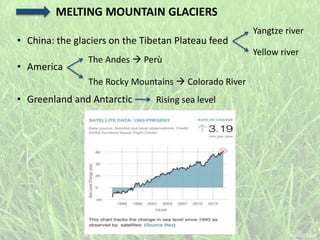
MELTING MOUNTAIN GLACIERS
• China: the glaciers on the Tibetan Plateau feed
Yangtze river
Yellow river
• America
The Andes  Perù
The Rocky Mountains  Colorado River
• Greenland and Antarctic Rising sea level
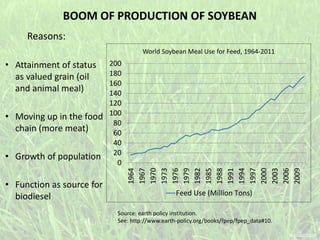
BOOM OF PRODUCTION OF SOYBEAN
Reasons:
• Attainment of status
as valued grain (oil
and animal meal)
• Moving up in the food
chain (more meat)
• Growth of population
• Function as source for
biodiesel
0
20
40
60
80
100
120
140
160
180
200
1964
1967
1970
1973
1976
1979
1982
1985
1988
1991
1994
1997
2000
2003
2006
2009
World Soybean Meal Use for Feed, 1964-2011
Feed Use (Million Tons)
Source: earth policy institution.
See: http://www.earth-policy.org/books/fpep/fpep_data#10.
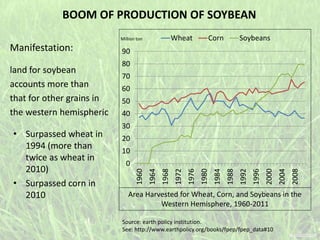
BOOM OF PRODUCTION OF SOYBEAN
Manifestation:
land for soybean
accounts more than
that for other grains in
the western hemispheric
• Surpassed wheat in
1994 (more than
twice as wheat in
2010)
• Surpassed corn in
2010
0
10
20
30
40
50
60
70
80
90
1960
1964
1968
1972
1976
1980
1984
1988
1992
1996
2000
2004
2008
Million ton Wheat Corn Soybeans
Area Harvested for Wheat, Corn, and Soybeans in the
Western Hemisphere, 1960-2011
Source: earth policy institution.
See: http://www.earthpolicy.org/books/fpep/fpep_data#10
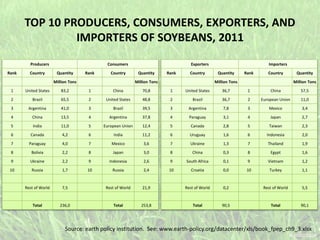
TOP 10 PRODUCERS, CONSUMERS, EXPORTERS, AND
IMPORTERS OF SOYBEANS, 2011
Producers Consumers
Rank Country Quantity Rank Country Quantity
Million Tons Million Tons
1 United States 83,2 1 China 70,8
2 Brazil 65,5 2 United States 48,8
3 Argentina 41,0 3 Brazil 39,5
4 China 13,5 4 Argentina 37,8
5 India 11,0 5 European Union 12,4
6 Canada 4,2 6 India 11,2
7 Paraguay 4,0 7 Mexico 3,6
8 Bolivia 2,2 8 Japan 3,0
9 Ukraine 2,2 9 Indonesia 2,6
10 Russia 1,7 10 Russia 2,4
Rest of World 7,5 Rest of World 21,9
Total 236,0 Total 253,8
Exporters Importers
Rank Country Quantity Rank Country Quantity
Million Tons Million Tons
1 United States 36,7 1 China 57,5
2 Brazil 36,7 2 European Union 11,0
3 Argentina 7,8 3 Mexico 3,4
4 Paraguay 3,1 4 Japan 2,7
5 Canada 2,8 5 Taiwan 2,3
6 Uruguay 1,6 6 Indonesia 2,0
7 Ukraine 1,3 7 Thailand 1,9
8 China 0,3 8 Egypt 1,6
9 South Africa 0,1 9 Vietnam 1,2
10 Croatia 0,0 10 Turkey 1,1
Rest of World 0,2 Rest of World 5,5
Total 90,5 Total 90,1
Source: earth policy institution. See: www.earth-policy.org/datacenter/xls/book_fpep_ch9_3.xlsx
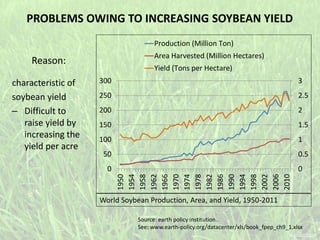
PROBLEMS OWING TO INCREASING SOYBEAN YIELD
Reason:
characteristic of
soybean yield
– Difficult to
raise yield by
increasing the
yield per acre
0
0.5
1
1.5
2
2.5
3
0
50
100
150
200
250
300
1950
1954
1958
1962
1966
1970
1974
1978
1982
1986
1990
1994
1998
2002
2006
2010
Production (Million Ton)
Area Harvested (Million Hectares)
Yield (Tons per Hectare)
World Soybean Production, Area, and Yield, 1950-2011
Source: earth policy institution.
See: www.earth-policy.org/datacenter/xls/book_fpep_ch9_1.xlsx
PROBLEMS OWING TO INCREASING SOYBEAN YIELD
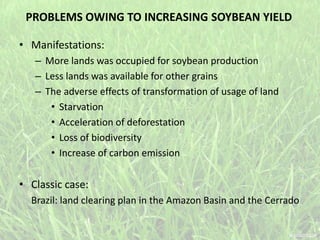
• Manifestations:
– More lands was occupied for soybean production
– Less lands was available for other grains
– The adverse effects of transformation of usage of land
• Starvation
• Acceleration of deforestation
• Loss of biodiversity
• Increase of carbon emission
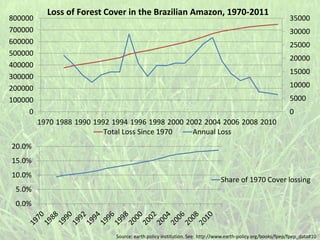
• Classic case:
Brazil: land clearing plan in the Amazon Basin and the Cerrado
0
5000
10000
15000
20000
25000
30000
35000
0
100000
200000
300000
400000
500000
600000
700000
800000
1970 1988 1990 1992 1994 1996 1998 2000 2002 2004 2006 2008 2010
Loss of Forest Cover in the Brazilian Amazon, 1970-2011
Total Loss Since 1970 Annual Loss
0.0%
5.0%
10.0%
15.0%
20.0%
Share of 1970 Cover lossing
Source: earth policy institution. See: http://www.earth-policy.org/books/fpep/fpep_data#10
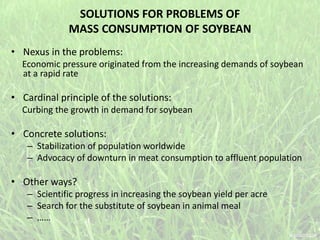
SOLUTIONS FOR PROBLEMS OF
MASS CONSUMPTION OF SOYBEAN
• Nexus in the problems:
Economic pressure originated from the increasing demands of soybean
at a rapid rate
• Cardinal principle of the solutions:
Curbing the growth in demand for soybean
• Concrete solutions:
– Stabilization of population worldwide
– Advocacy of downturn in meat consumption to affluent population
• Other ways?
– Scientific progress in increasing the soybean yield per acre
– Search for the substitute of soybean in animal meal
– ……
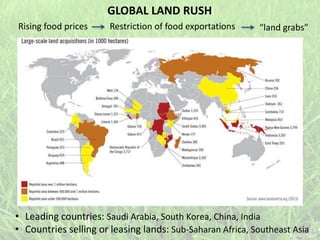
GLOBAL LAND RUSH
Rising food prices Restriction of food exportations “land grabs”
• Leading countries: Saudi Arabia, South Korea, China, India
• Countries selling or leasing lands: Sub-Saharan Africa, Southeast Asia
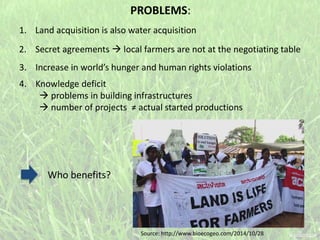
1. Land acquisition is also water acquisition
Who benefits?
PROBLEMS:
2. Secret agreements  local farmers are not at the negotiating table
3. Increase in world’s hunger and human rights violations
4. Knowledge deficit
 problems in building infrastructures
 number of projects ≠ actual started productions
Source: http://www.bioecogeo.com/2014/10/28
• The World Bank working with the U.N. Food and Agriculture
Organization: set of principles governing land acquisitions
Developing countries need international support for local
village-level farmers
and NOT big corporations bringing large-scale, heavily
mechanized, capital- intensive agriculture

• Global power struggle for control of the earth’s land and
water resources
DEMAND SIDE
1. Stabilize world population
2. Eradicate poverty
3. Reduce excessive meat consumption
4. Reverse biofuels policies that encourage the use of food, land or
water that could be used to feed people
SUPPLY SIDE
1. Stabilize climate
2. Raise water productivity
3. Controlling soil erosion
‘’The challenge now is to move our civilization onto a sustainable path before climate
change spirals out of control and food shortages overwhelm our political system’’
PRESSING NEEDS

"Full Planet, Empty Plates: The New Geopolitics of Food Scarcity"

  • 1.
    FULL PLANET, EMPTYPLATES Carrelli Lydia, Cassio Paola, Yongchang He, Ottanà Giulia, Rytsola Valentina, Serrini Livia The New Geopolitics of Food Scarcity By Lester R. Brown
  • 2.
    CORN CROP TIME •Wheat and rice : world’s leading food grains • Corn: - Dominates the use of grain in livestock and poultry feed - Vulnerable to extreme heat and drought
  • 3.
    FROM AN ERAOF FOOD ABUNDANCE TO AN ERA OF SCARCITY • 1986  • Until 2001  • From 2002 to 2011  annual world carryover stocks of grain: 74 days of consumption annual world carryover stocks of grain: 107 days of consumption phasing out of the U.S. cropland program • Now  world living one year to the next • Last half of the 20th century  carryover stocks of grain + U.S. farm programs • Soon  restricting exports to decrease domestic food price
  • 4.
    EARLIER CIVILIZATIONS UNDERMINEDBY FOOD SHORTAGES • Sumerians: rising salt levels in the soil • Mayans: deforestation and losses of soil from erosion Source: http://pixshark.com/sumerian-irrigation.htm Source: Dunning et al. (1998)
  • 5.
    SOURCES OF GRAINDEMAND GROWTH 1. Population growth Source: http://bixby.berkeley.edu/research/population/ 2. Consumers moving up the food chain
  • 6.
    3. Conversion ofgrain into fuel for cars SOURCES OF GRAIN DEMAND GROWTH Decline in stocks of grain Rising food prices + Spread of hunger
  • 7.
    CHALLENGES ON THEPRODUCTION FRONT 1. Soil erosion
  • 8.
    CHALLENGES ON THEPRODUCTION FRONT 2. Growing water shortages • Aquifers being depleted • Irrigation wells starting to go dry 3. Plateauing of rice and wheat yields in some agriculturally advanced countries
  • 9.
    4. Earth’s risingtemperature CHALLENGES ON THE PRODUCTION FRONT 1 °C rise in temperature above the optimum 10% decline in grain yields
  • 10.
    POPULATION GROWTH • Consequencesof the explosive population growth (forests, fisheries, grasslands, aquifers, soils) • Forests: overcutting - growing demand for firewood, lumber, paper - forests are shrinking - Mauritania • U.N. Demographic projections: - world population 9.3 billion in 2050 - enough water to grow food for the 2.3 billion more people?
  • 11.
    • Good news: -Western and Eastern Europe reached population stability (970 million people) - East Asia (Taiwan, China, North and South Korea, Japan) very near to population stability - Indian Subcontinent (India, Pakistan, Bangladesh) - Sub-Saharan Africa (ex. Ethiopia) • Bad news: All of the population growth is in developing countries: Both 2.2 billion people in 2050 • Frank Notestein: “Three-stage demographic model”
  • 12.
    SOLUTIONS: • Smaller families •Access to reproductive health care and family planning services for every woman • Two children per couple • Stabilized world population • Every country moving into “stage-three”
  • 13.
    MOVING UP THEFOOD CHAIN • Food habits depend on geographic location protein change USA, Brazil, Argentina: land-rich with grassland Beef and mutton Germany and China: densely populated with lack of space Pork • During the years, meat consumption is changed: - 1950: beef and pork dominated - 1997: poultry overtook beef
  • 14.
    Nowadays : porkis the world’s leading meat  China consumer #1
  • 15.
    • During theyears  greatest restructuring in seafood consumption Japan: too much land to produce rice and it has to turn to seafood to satisfy the demand of protein China: First one that turned to fish farming  2010: 37 million tons Source:http://community.theaquaponicsource.com/profiles/blogs/fishes-for-aquaponics-in-china
  • 16.
    • The consumptionof meat, milk, eggs and farmed fish indirectly pushes the consumption of grain SalmonShrimps Aquaculture is not always environmentally sustainable and efficient Source: http://www.shrimpnews.com/Graphics/Nicaragua/MangrovesNicaragua.jpg
  • 17.
    1. Milk production inIndia THREE DIFFERENT MODELS 2. Chinese model: cultivation turnover 3. Chinese aquaculture Source: http://www.slideshare.net/sudarshanpatel5/dairy-presentation-pgdma
  • 18.
    Necessity to occupyan intermediate position in the food chain: it will improve our life expectancy
  • 19.
    EARTH’S CLIMATE: RISINGTEMPERATURES What makes the Earth’s temperatures rise? The massive burning of fossil fuels is increasing the level of carbon dioxid in the atmposhpere http://climate.nasa.gov/
  • 20.
    WHICH ARE THECONSEQUENCES? 1. Agriculture: high temperatures interfere with pollination and reduce photosynthesis of basic food crops - corn pollination - rice pollination 2. Increasing drought 3. Spreading of wildfires 4. Heat waves 1988 U.S.A. 2003 U.E. 2010 Russia 5. Melting mountain glaciers
  • 21.
    MELTING MOUNTAIN GLACIERS •China: the glaciers on the Tibetan Plateau feed Yangtze river Yellow river • America The Andes  Perù The Rocky Mountains  Colorado River • Greenland and Antarctic Rising sea level
  • 22.
    BOOM OF PRODUCTIONOF SOYBEAN Reasons: • Attainment of status as valued grain (oil and animal meal) • Moving up in the food chain (more meat) • Growth of population • Function as source for biodiesel 0 20 40 60 80 100 120 140 160 180 200 1964 1967 1970 1973 1976 1979 1982 1985 1988 1991 1994 1997 2000 2003 2006 2009 World Soybean Meal Use for Feed, 1964-2011 Feed Use (Million Tons) Source: earth policy institution. See: http://www.earth-policy.org/books/fpep/fpep_data#10.
  • 23.
    BOOM OF PRODUCTIONOF SOYBEAN Manifestation: land for soybean accounts more than that for other grains in the western hemispheric • Surpassed wheat in 1994 (more than twice as wheat in 2010) • Surpassed corn in 2010 0 10 20 30 40 50 60 70 80 90 1960 1964 1968 1972 1976 1980 1984 1988 1992 1996 2000 2004 2008 Million ton Wheat Corn Soybeans Area Harvested for Wheat, Corn, and Soybeans in the Western Hemisphere, 1960-2011 Source: earth policy institution. See: http://www.earthpolicy.org/books/fpep/fpep_data#10
  • 24.
    TOP 10 PRODUCERS,CONSUMERS, EXPORTERS, AND IMPORTERS OF SOYBEANS, 2011 Producers Consumers Rank Country Quantity Rank Country Quantity Million Tons Million Tons 1 United States 83,2 1 China 70,8 2 Brazil 65,5 2 United States 48,8 3 Argentina 41,0 3 Brazil 39,5 4 China 13,5 4 Argentina 37,8 5 India 11,0 5 European Union 12,4 6 Canada 4,2 6 India 11,2 7 Paraguay 4,0 7 Mexico 3,6 8 Bolivia 2,2 8 Japan 3,0 9 Ukraine 2,2 9 Indonesia 2,6 10 Russia 1,7 10 Russia 2,4 Rest of World 7,5 Rest of World 21,9 Total 236,0 Total 253,8 Exporters Importers Rank Country Quantity Rank Country Quantity Million Tons Million Tons 1 United States 36,7 1 China 57,5 2 Brazil 36,7 2 European Union 11,0 3 Argentina 7,8 3 Mexico 3,4 4 Paraguay 3,1 4 Japan 2,7 5 Canada 2,8 5 Taiwan 2,3 6 Uruguay 1,6 6 Indonesia 2,0 7 Ukraine 1,3 7 Thailand 1,9 8 China 0,3 8 Egypt 1,6 9 South Africa 0,1 9 Vietnam 1,2 10 Croatia 0,0 10 Turkey 1,1 Rest of World 0,2 Rest of World 5,5 Total 90,5 Total 90,1 Source: earth policy institution. See: www.earth-policy.org/datacenter/xls/book_fpep_ch9_3.xlsx
  • 25.
    PROBLEMS OWING TOINCREASING SOYBEAN YIELD Reason: characteristic of soybean yield – Difficult to raise yield by increasing the yield per acre 0 0.5 1 1.5 2 2.5 3 0 50 100 150 200 250 300 1950 1954 1958 1962 1966 1970 1974 1978 1982 1986 1990 1994 1998 2002 2006 2010 Production (Million Ton) Area Harvested (Million Hectares) Yield (Tons per Hectare) World Soybean Production, Area, and Yield, 1950-2011 Source: earth policy institution. See: www.earth-policy.org/datacenter/xls/book_fpep_ch9_1.xlsx
  • 26.
    PROBLEMS OWING TOINCREASING SOYBEAN YIELD • Manifestations: – More lands was occupied for soybean production – Less lands was available for other grains – The adverse effects of transformation of usage of land • Starvation • Acceleration of deforestation • Loss of biodiversity • Increase of carbon emission • Classic case: Brazil: land clearing plan in the Amazon Basin and the Cerrado
  • 27.
    0 5000 10000 15000 20000 25000 30000 35000 0 100000 200000 300000 400000 500000 600000 700000 800000 1970 1988 19901992 1994 1996 1998 2000 2002 2004 2006 2008 2010 Loss of Forest Cover in the Brazilian Amazon, 1970-2011 Total Loss Since 1970 Annual Loss 0.0% 5.0% 10.0% 15.0% 20.0% Share of 1970 Cover lossing Source: earth policy institution. See: http://www.earth-policy.org/books/fpep/fpep_data#10
  • 28.
    SOLUTIONS FOR PROBLEMSOF MASS CONSUMPTION OF SOYBEAN • Nexus in the problems: Economic pressure originated from the increasing demands of soybean at a rapid rate • Cardinal principle of the solutions: Curbing the growth in demand for soybean • Concrete solutions: – Stabilization of population worldwide – Advocacy of downturn in meat consumption to affluent population • Other ways? – Scientific progress in increasing the soybean yield per acre – Search for the substitute of soybean in animal meal – ……
  • 29.
    GLOBAL LAND RUSH Risingfood prices Restriction of food exportations “land grabs” • Leading countries: Saudi Arabia, South Korea, China, India • Countries selling or leasing lands: Sub-Saharan Africa, Southeast Asia
  • 30.
    1. Land acquisitionis also water acquisition Who benefits? PROBLEMS: 2. Secret agreements  local farmers are not at the negotiating table 3. Increase in world’s hunger and human rights violations 4. Knowledge deficit  problems in building infrastructures  number of projects ≠ actual started productions Source: http://www.bioecogeo.com/2014/10/28
  • 31.
    • The WorldBank working with the U.N. Food and Agriculture Organization: set of principles governing land acquisitions Developing countries need international support for local village-level farmers and NOT big corporations bringing large-scale, heavily mechanized, capital- intensive agriculture  • Global power struggle for control of the earth’s land and water resources
  • 32.
    DEMAND SIDE 1. Stabilizeworld population 2. Eradicate poverty 3. Reduce excessive meat consumption 4. Reverse biofuels policies that encourage the use of food, land or water that could be used to feed people SUPPLY SIDE 1. Stabilize climate 2. Raise water productivity 3. Controlling soil erosion ‘’The challenge now is to move our civilization onto a sustainable path before climate change spirals out of control and food shortages overwhelm our political system’’ PRESSING NEEDS