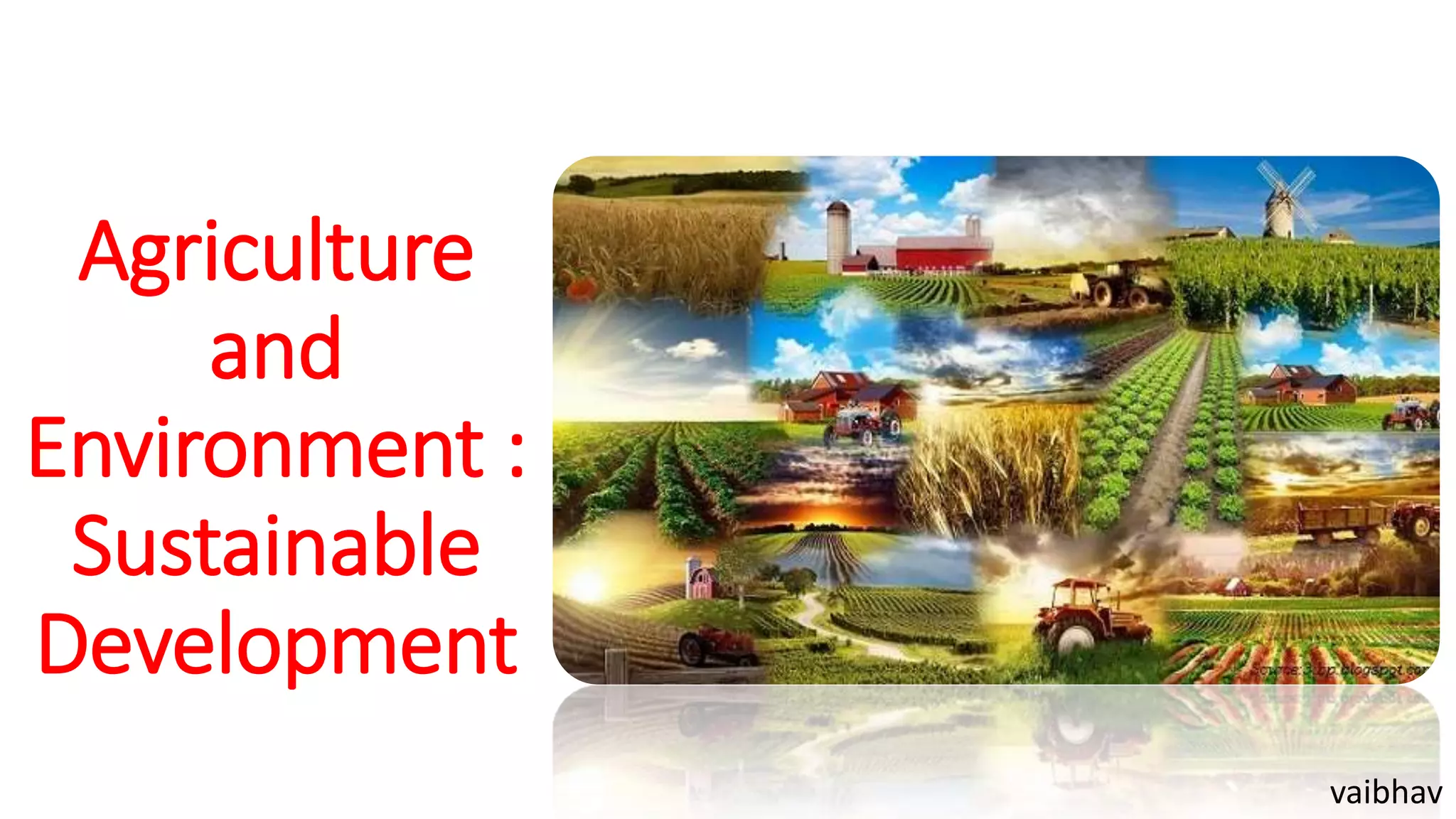
Agriculture
and
Environment :
Sustainable
Development
vaibhav
Agriculture & Environment
•Often, when speaking of the agricultural impact on the
environment, one restricts any consideration to
processes of pollution of surface and ground waters
from chemicals added to the soil during agricultural
practices.
•No doubt, such processes exist and may have even a
prominent importance. They are caused either by
water infiltration in soil, with the consequent
possibility of nutrient and pesticide leaching.
Environmental Impacts of Agriculture
•When farming operations are sustainably
managed, they can help preserve and
restore critical habitats, protect watersheds,
and improve soil health and water quality.
•But when practiced without care, farming
presents the greatest threat to species and
ecosystems.
Multiple Impacts Negative environmental impacts
from unsustainable farming practices include:
• Land conversion & habitat loss
• Wasteful water consumption
• Soil erosion and degradation
• Pollution
• Climate change
• Genetic erosion
Land conversion & habitat loss
•Natural habitats converted to monocultures: Rising
demand for food and other agricultural products has
seen large-scale clearing of natural habitats to make
room for intensive monocultures.
•Freshwater is also affected: Waste water of Fields also
effect to the fresh water of river ,oceans Etc.
•Land lost to desertification: On top of habitat loss due
to clearing, unsustainable agricultural practices are
seeing 12 million hectares of land lost each year to
desertification.
Wasteful Water Consumption
•Agriculture, the greatest user of water: Globally, the
agricultural sector consumes about 70% of the
planet's accessible freshwater more than twice that of
industry (23%), and dwarfing municipal use (8%).
•Wasteful and unsustainable: The main causes of
wasteful water use are: 1. leaky irrigation systems 2.
wasteful field application methods 3. cultivation of
thirsty crops not suited to the environment.
Soil Erosion and Degradation
•Flooding increased: Erosion caused by
deforestation can also lead to increased flooding.
•Arable land destroyed: It is estimated that since
1960, one-third of the world’s arable land has
been lost through erosion and other degradation.
•Waterways clogged & polluted: Soil carried off in
rain or irrigation water can lead to sedimentation
of rivers, lakes and coastal areas.
Pollution
• Toxic pesticides: Pesticides often don't just kill the target pest. Pesticides can
also kill soil microorganisms.
• Excess nutrients: Fertilizers are not directly toxic. However, their presence in
freshwater and marine areas alters the nutrient system.
Climate change
• Climate change Agricultural practices are responsible for around 14% of global
greenhouse gas emissions Sources include:
• Fertilizers
• Livestock
• Wetland rice cultivation
• Burning of savanna
• Agricultural residues, and plugging
Genetic Erosion
Lost genetic diversity:
The widespread use of genetically uniform modern crop
varieties has caused agricultural crops to lose about 75%
of their genetic diversity in the last century.
This lost genetic diversity reduces the potential for
modern crops to adapt to, or be breed for, changing
conditions and so directly threatens long-term food
security.
Sustainable agriculture
Sustainable agriculture is the pratice of
farming using principles of ecology ,the
study of relationship between organisms
and their environment. this form of
agriculture enables us to produce
healthful food without compromising
future generations ability to do the
same.
Benefits of sustainable agriculture
•1) environmental preservation sustainable farming
produce crops and raise animals without relying on toxic
chemical, pesticides, synthetic fertilizers, genetically
modified seeds, or practices that degrade soil, water or
other natural resources.
• 2) Protection of public health since sustainable crop farms avoid
hazardous pesticides, they are able to grow fruits and vegetables
that are safer for consumers, workers and surrounding
communities. likewise sustainable livestock farmers an ranchers
raise animals without dangerous practices like non-therapeutic
antibiotic or arsenic based growth.
•3) Sustaining vibrant communities A critical
component of sustainable agriculture is its ability
to remain economically viable providing farmers,
farm workers, food processors an others
employed in the food system with a liveable wage
an safe fair working condition.
•4) Upholding animal welfare sustainable farmers
and ranchers treat animals with care an respect,
implementing livestock husbandry practise that
protect animals health and well being
Techniques of Sustainable Farming
• INTEGRATED PEST MANAGMENT(IPM) IPM is a broad based approach that
integrates sustainable practice for economic control of pests. It is a careful
consideration of all available pest control techniques and subsequent
integration of appropriate measures that discourages the development of pest
population and keep pesticides to levels that reduce or minimise the risk to
humans health and environment.
• CROP ROTATION Sustainable practice of growing series of different types of
crops in same area in sequential seasons . crop rotation gives various nutrients
to soil, it also mitigates the build up of pathogens and pests that often occurs
when one species is continuously cropped and also improve soil structure and
fertility.
• BIOTECHNOLOGY Use of living systems or organisms to develop or make
useful produts. Biotechnology can provide appropriate new tools for use in
solution of specific problems in sustainable agriculture.
•USE OF ORGANIC FERTILIZERS Organic waste are
derived from animal matter or veg matter. The
use of organic fertilizes in sustainable gardens
and farms are quickly gaining popularity.
•CONSERVATION TILLAGE conservations tillage is
any method of soil ultivation that leaves the
previous years crop residue on fields before and
after planting the next crop.

Agriculture and environment

  • 1.
  • 2.
    Agriculture & Environment •Often,when speaking of the agricultural impact on the environment, one restricts any consideration to processes of pollution of surface and ground waters from chemicals added to the soil during agricultural practices. •No doubt, such processes exist and may have even a prominent importance. They are caused either by water infiltration in soil, with the consequent possibility of nutrient and pesticide leaching.
  • 3.
    Environmental Impacts ofAgriculture •When farming operations are sustainably managed, they can help preserve and restore critical habitats, protect watersheds, and improve soil health and water quality. •But when practiced without care, farming presents the greatest threat to species and ecosystems.
  • 4.
    Multiple Impacts Negativeenvironmental impacts from unsustainable farming practices include: • Land conversion & habitat loss • Wasteful water consumption • Soil erosion and degradation • Pollution • Climate change • Genetic erosion
  • 5.
    Land conversion &habitat loss •Natural habitats converted to monocultures: Rising demand for food and other agricultural products has seen large-scale clearing of natural habitats to make room for intensive monocultures. •Freshwater is also affected: Waste water of Fields also effect to the fresh water of river ,oceans Etc. •Land lost to desertification: On top of habitat loss due to clearing, unsustainable agricultural practices are seeing 12 million hectares of land lost each year to desertification.
  • 6.
    Wasteful Water Consumption •Agriculture,the greatest user of water: Globally, the agricultural sector consumes about 70% of the planet's accessible freshwater more than twice that of industry (23%), and dwarfing municipal use (8%). •Wasteful and unsustainable: The main causes of wasteful water use are: 1. leaky irrigation systems 2. wasteful field application methods 3. cultivation of thirsty crops not suited to the environment.
  • 7.
    Soil Erosion andDegradation •Flooding increased: Erosion caused by deforestation can also lead to increased flooding. •Arable land destroyed: It is estimated that since 1960, one-third of the world’s arable land has been lost through erosion and other degradation. •Waterways clogged & polluted: Soil carried off in rain or irrigation water can lead to sedimentation of rivers, lakes and coastal areas.
  • 8.
    Pollution • Toxic pesticides:Pesticides often don't just kill the target pest. Pesticides can also kill soil microorganisms. • Excess nutrients: Fertilizers are not directly toxic. However, their presence in freshwater and marine areas alters the nutrient system. Climate change • Climate change Agricultural practices are responsible for around 14% of global greenhouse gas emissions Sources include: • Fertilizers • Livestock • Wetland rice cultivation • Burning of savanna • Agricultural residues, and plugging
  • 9.
    Genetic Erosion Lost geneticdiversity: The widespread use of genetically uniform modern crop varieties has caused agricultural crops to lose about 75% of their genetic diversity in the last century. This lost genetic diversity reduces the potential for modern crops to adapt to, or be breed for, changing conditions and so directly threatens long-term food security.
  • 10.
    Sustainable agriculture Sustainable agricultureis the pratice of farming using principles of ecology ,the study of relationship between organisms and their environment. this form of agriculture enables us to produce healthful food without compromising future generations ability to do the same.
  • 11.
    Benefits of sustainableagriculture •1) environmental preservation sustainable farming produce crops and raise animals without relying on toxic chemical, pesticides, synthetic fertilizers, genetically modified seeds, or practices that degrade soil, water or other natural resources. • 2) Protection of public health since sustainable crop farms avoid hazardous pesticides, they are able to grow fruits and vegetables that are safer for consumers, workers and surrounding communities. likewise sustainable livestock farmers an ranchers raise animals without dangerous practices like non-therapeutic antibiotic or arsenic based growth.
  • 12.
    •3) Sustaining vibrantcommunities A critical component of sustainable agriculture is its ability to remain economically viable providing farmers, farm workers, food processors an others employed in the food system with a liveable wage an safe fair working condition. •4) Upholding animal welfare sustainable farmers and ranchers treat animals with care an respect, implementing livestock husbandry practise that protect animals health and well being
  • 13.
    Techniques of SustainableFarming • INTEGRATED PEST MANAGMENT(IPM) IPM is a broad based approach that integrates sustainable practice for economic control of pests. It is a careful consideration of all available pest control techniques and subsequent integration of appropriate measures that discourages the development of pest population and keep pesticides to levels that reduce or minimise the risk to humans health and environment. • CROP ROTATION Sustainable practice of growing series of different types of crops in same area in sequential seasons . crop rotation gives various nutrients to soil, it also mitigates the build up of pathogens and pests that often occurs when one species is continuously cropped and also improve soil structure and fertility. • BIOTECHNOLOGY Use of living systems or organisms to develop or make useful produts. Biotechnology can provide appropriate new tools for use in solution of specific problems in sustainable agriculture.
  • 14.
    •USE OF ORGANICFERTILIZERS Organic waste are derived from animal matter or veg matter. The use of organic fertilizes in sustainable gardens and farms are quickly gaining popularity. •CONSERVATION TILLAGE conservations tillage is any method of soil ultivation that leaves the previous years crop residue on fields before and after planting the next crop.