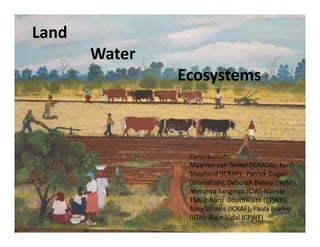
Land
       Water 
                Ecosystems


                 Contributions:
                 Maarten van Ginkel (ICARDA); Keith 
                 Shepherd (ICRAF);  Patrick Dugan 
                 (WorldFish); Deborah Bossio (IWMI); 
                 Nteranya Sanginga,(CIAT‐Nairobi 
                 TSBF); Boru
                 TSBF); Boru Douthwaite (CPWF);
                                           (CPWF); 
                 Tony Simons (ICRAF); Paula Bramel
                 (IITA); Alain Vidal (CPWF) 
Drivers of Land & Water 
Drivers of Land & Water Use
Drivers of Land & Water Use
     Other Water Pressures
Urbanization ‐ Cities are projected to use 150% 
   more water in 2025, encroach on ag land
   more water in 2025, encroach on ag
Agriculture – I
A i l           Increased water use and land 
                        d                dl d
   expansion behind production increases
Population & Diet food grain production 
Population & Diet – food grain production
   projected to increase by 100% by 2050
Energy – Hydropower and biofuels compete for
          Hydropower and biofuels compete for 
          Hydropower and 
   water and land
Climate Change  Shifting patterns of water 
Climate Change – Shifting patterns of water
   availability –
   availability – potential yields decline in Africa
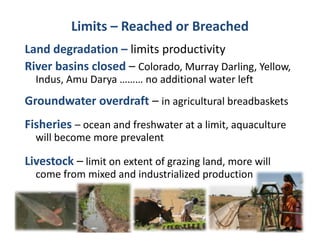
Limits – Reached or Breached
Land degradation – li it
L dd       d ti     limits productivity
                              d ti it
River basins closed – Colorado, Murray Darling, Yellow, 
  Indus, Amu Darya ……… no additional water left
  I d A      D             dditi   l t l ft
Groundwater overdraft – in agricultural breadbaskets
Fisheries – ocean and freshwater at a limit, aquaculture 
  will become more prevalent
  will become more prevalent

Livestock – limit on extent of grazing land, more will 
  come from mixed and industrialized production
       f        d d d          l d      d
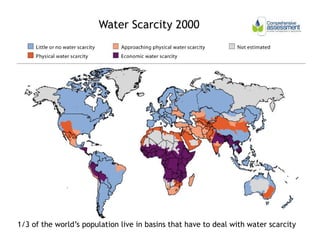
Water Scarcity 2000


1/3 of the world’s population live in basins that have to deal with water scarcity
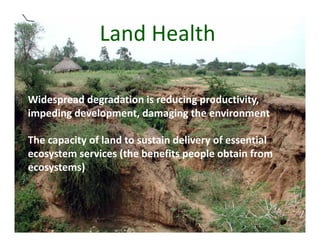
Land Health

Widespread degradation is reducing productivity, 
impeding development, damaging the environment

The capacity of land to sustain delivery of essential 
The capacity of land to sustain delivery of essential
ecosystem services (the benefits people obtain from 
ecosystems)
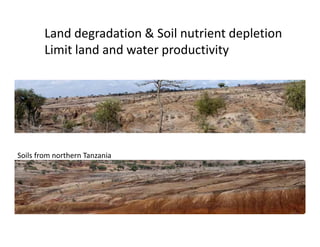
Land degradation & Soil nutrient depletion
        Limit land and water productivity
        Li i l d d              d i i


Soils from northern Tanzania
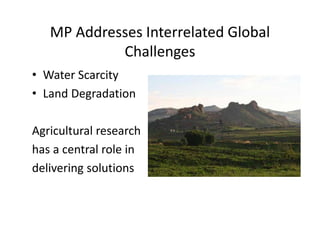
MP Addresses Interrelated Global 
            Challenges
              h ll
• Water Scarcity
  Water Scarcity
• Land Degradation 

Agricultural research
has a central role in 
delivering solutions
delivering solutions
Global initiatives and accompanying investments
are urgently needed for nine billion to be
adequately nourished by 2050:
 Soil and Water: Restore and enhance soil fertility with organic
 compost and manure fertilizers; nitrogen fixing crop rotations; and
 reduced tillage practices; rainwater retention, groundwater
 recharge rates and water utilization through agro-ecological
    h        t     d    t    tili ti th      h         l i l
 farming practices and improved land rights for farmers.
 Biodiversity and ecosystem services: Promote the
            y         y
 diversification and integration of crops and livestock under a Multi-
 Functional Agricultural System.
 Energy and people: Invest public funds in participatory
 agro-ecological research and extension to build scientific and
 traditional knowledge.
IPCC 2008
                     IPCC 2008
• "the relationship between climate change and 
  freshwater resources is of primary concern and 
                               p     y
  interest"; so far, "water resource issues have not been 
  adequately addressed in climate change analyses and 
          p y                    ;   ,         g
  climate policy formulations"; and, according to many  y
  experts, "water and its availability and quality will be 
  the main pressures, and issues, on societies and the 
                                    g
  environment under climate change". 

• CC Adaptation is about water
From GCARD 2010 White Paper
                           p
“… regions could either become self –sufficient and 
    meet their nutrition, health and food needs, or 
                         ,                      ,
    become a potential hot spot for poverty because of: 
()
(i) shortage of irrigated land, 
            g        g          ,
(ii) shortage of water, 
( )
(iii) adverse effects of agro‐chemicals used on their land 
                           g
      and the proportionate increased need of water each 
      year and contaminating of subsoil water, ……”
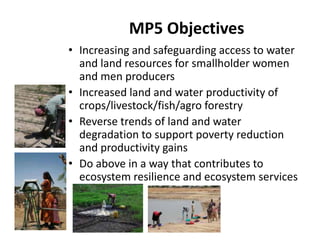
MP5 Objectives
• Increasing and safeguarding access to water 
  and land resources for smallholder women 
  and men producers
  and men producers
• Increased land and water productivity of 
  crops/livestock/fish/agro forestry
  crops/livestock/fish/agro forestry
• Reverse trends of land and water 
  degradation to support poverty reduction 
     g              pp p         y
  and productivity gains
• Do above in a way that contributes to 
  ecosystem resilience and ecosystem services
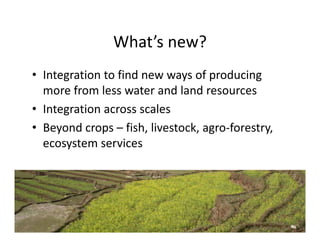
What s new?
                What’s new?
• Integration to find new ways of producing
  Integration to find new ways of producing 
  more from less water and land resources
• Integration across scales
  Integration across scales
• Beyond crops – fish, livestock, agro‐forestry, 
  ecosystem services
                  i
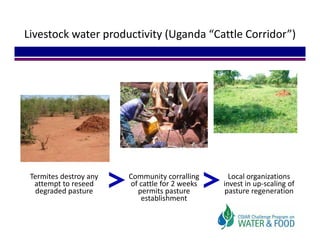
Livestock water productivity (Uganda “Cattle Corridor”)


 Termites destroy any    Community corralling       Local organizations 
  attempt to reseed      of cattle for 2 weeks    invest in up‐scaling of 
  degraded pasture         permits pasture        pasture regeneration 
                            establishment
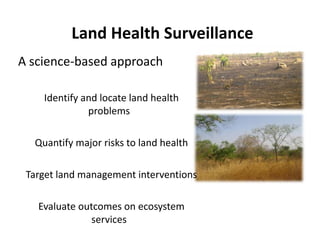
Land Health Surveillance
A science‐based approach 

    •Identify and locate land health 
               problems
                  bl

  •Quantify major risks to land health
         f           k     l dh l h
                   •
•Target land management interventions

  •Evaluate outcomes on ecosystem 
                services
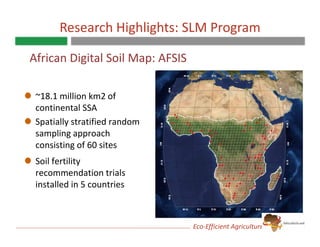
Research Highlights: SLM Program

African Digital Soil Map: AFSIS

 ~18.1 million km2 of 
 continental SSA 
 continental SSA
 Spatially stratified random 
 sampling approach 
 consisting of 60 sites 
 Soil fertility 
 recommendation trials 
               d ti t i l
 installed in 5 countries


                                  Eco‐Efficient Agriculture for the Poor
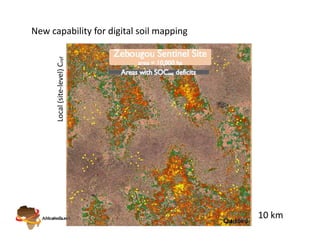
New capability for digital soil mapping

         al (site‐leve ref
      Loca           el) C


                                          10 km
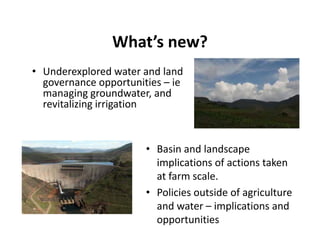
What s new?
                What’s new?
• Underexplored water and land 
            p
  governance opportunities – ie
  managing groundwater, and 
  revitalizing irrigation
             g g


                      • Basin and landscape 
                        implications of actions taken 
                        at farm scale.
                      • Policies outside of agriculture 
                        and water – implications and 
                        opportunities 
MP Components
            MP Components
1.1. Delivering greater water productivity
1.2. Enhancing and safeguarding water access for 
       h           d f      d                 f
  the poor
2.1. Improving Land Health, water quality and 
  ecosystem services
2.2. Improved Soil management
3. Water and Land management for ecosystem 
3 Water and Land management for ecosystem
  services
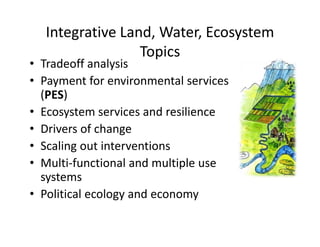
Integrative Land, Water, Ecosystem 
                 Topics
• Tradeoff analysis
• P
  Payment for environmental services 
             f      i        l    i
  (PES)
• E
  Ecosystem services and resilience
                  i      d ili
• Drivers of change
• Scaling out interventions
• Multi‐functional and multiple use 
  systems
• Political ecology and economy
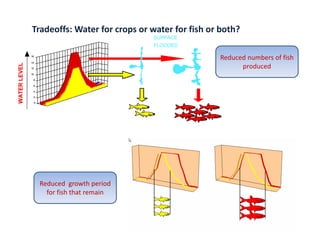
Tradeoffs: Water for crops or water for fish or both?
                                                 SURFACE
                                                 FLOODED

              16
                                                             Reduced numbers of fish 
              14
       EVEL


              12                                                   produced
              10
WATER LE


               8

               6

               4

               2

                   0


                       Reduced  growth period 
                         for fish that remain


                                                                                 20
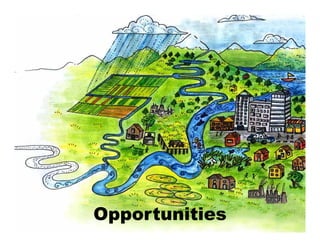
Opportunities
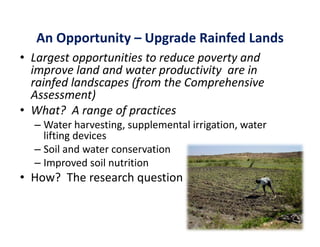
An Opportunity – Upgrade Rainfed Lands
• Largest opportunities to reduce poverty and 
  improve land and water productivity  are in 
  rainfed landscapes (from the Comprehensive 
  Assessment)
• Wh t? A
  What?  A range of practices
                   f     ti
  – Water harvesting, supplemental irrigation, water 
    lifting devices
    lifting devices
  – Soil and water conservation
  – Improved soil nutrition 
• How?  The research question
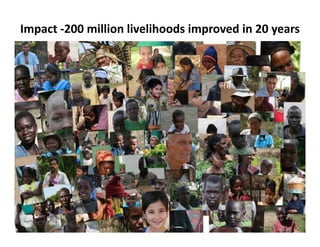
Impact ‐200 million livelihoods improved in 20 years
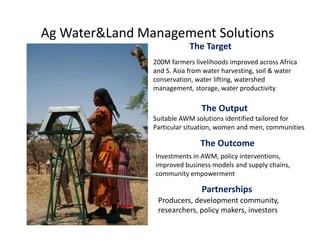
Ag Water&Land Management Solutions
                            The Target
                            The Target
                200M farmers livelihoods improved across Africa 
                and S. Asia from water harvesting, soil & water 
                conservation, water lifting, watershed 
                management, storage, water productivity

                               The Output
                               The Output
                Suitable AWM solutions identified tailored for
                Particular situation, women and men, communities

                               The Outcome
                Investments in AWM, policy interventions, 
                improved business models and supply chains, 
                community empowerment

                               Partnerships
                 Producers, development community, 
                 Producers development community
                 researchers, policy makers, investors
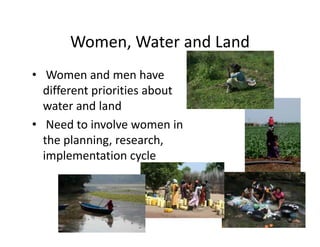
Women, Water and Land
       Women, Water and Land
• Women and men have
   Women and men have 
  different priorities about 
  water and land
  water and land
• Need to involve women in 
  the planning, research, 
  the planning research
  implementation cycle
Partnerships
• Must cross several scales: local, national, regional, 
  global ‐ changes at one system level are the key 
  global changes at one system level are the key
  that unlocks the other levels

• Boundary spanning role goes well beyond 
  agriculture – broader water, climate change, 
  energy, trade and environment sectors
• New capacity needed, new way of thinking and 
       g,                                p
  doing, a new cadre of land and water specialists

Land Water Ecosystems

  • 1.
    Land Water  Ecosystems Contributions: Maarten van Ginkel (ICARDA); Keith  Shepherd (ICRAF);  Patrick Dugan  (WorldFish); Deborah Bossio (IWMI);  Nteranya Sanginga,(CIAT‐Nairobi  TSBF); Boru TSBF); Boru Douthwaite (CPWF); (CPWF);  Tony Simons (ICRAF); Paula Bramel (IITA); Alain Vidal (CPWF) 
  • 2.
    Drivers of Land & Water  Drivers of Land & Water Use Drivers of Land& Water Use Other Water Pressures Urbanization ‐ Cities are projected to use 150%  more water in 2025, encroach on ag land more water in 2025, encroach on ag Agriculture – I A i l Increased water use and land  d dl d expansion behind production increases Population & Diet food grain production  Population & Diet – food grain production projected to increase by 100% by 2050 Energy – Hydropower and biofuels compete for Hydropower and biofuels compete for  Hydropower and  water and land Climate Change  Shifting patterns of water  Climate Change – Shifting patterns of water availability – availability – potential yields decline in Africa
  • 3.
    Limits – Reached or Breached Land degradation – liit L dd d ti limits productivity d ti it River basins closed – Colorado, Murray Darling, Yellow,  Indus, Amu Darya ……… no additional water left I d A D dditi l t l ft Groundwater overdraft – in agricultural breadbaskets Fisheries – ocean and freshwater at a limit, aquaculture  will become more prevalent will become more prevalent Livestock – limit on extent of grazing land, more will  come from mixed and industrialized production f d d d l d d
  • 4.
    Water Scarcity 2000 1/3of the world’s population live in basins that have to deal with water scarcity
  • 5.
  • 6.
    Land degradation & Soil nutrient depletion Limit land and water productivity Li i l d d d i i Soils from northern Tanzania
  • 7.
    MP Addresses Interrelated Global  Challenges h ll • Water Scarcity Water Scarcity • Land Degradation  Agricultural research has a central role in  delivering solutions delivering solutions
  • 8.
    Global initiatives andaccompanying investments are urgently needed for nine billion to be adequately nourished by 2050: Soil and Water: Restore and enhance soil fertility with organic compost and manure fertilizers; nitrogen fixing crop rotations; and reduced tillage practices; rainwater retention, groundwater recharge rates and water utilization through agro-ecological h t d t tili ti th h l i l farming practices and improved land rights for farmers. Biodiversity and ecosystem services: Promote the y y diversification and integration of crops and livestock under a Multi- Functional Agricultural System. Energy and people: Invest public funds in participatory agro-ecological research and extension to build scientific and traditional knowledge.
  • 9.
    IPCC 2008 IPCC 2008 • "the relationship between climate change and  freshwater resources is of primary concern and  p y interest"; so far, "water resource issues have not been  adequately addressed in climate change analyses and  p y ; , g climate policy formulations"; and, according to many  y experts, "water and its availability and quality will be  the main pressures, and issues, on societies and the  g environment under climate change".  • CC Adaptation is about water
  • 10.
    From GCARD 2010 White Paper p “… regions could either become self –sufficient and  meet their nutrition, health and food needs, or  , , become a potential hot spot for poverty because of:  () (i) shortage of irrigated land,  g g , (ii) shortage of water,  ( ) (iii) adverse effects of agro‐chemicals used on their land  g and the proportionate increased need of water each  year and contaminating of subsoil water, ……”
  • 11.
    MP5 Objectives • Increasing and safeguarding access to water  and land resources for smallholder women  and men producers and men producers • Increased land and water productivity of  crops/livestock/fish/agro forestry crops/livestock/fish/agro forestry • Reverse trends of land and water  degradation to support poverty reduction  g pp p y and productivity gains • Do above in a way that contributes to  ecosystem resilience and ecosystem services
  • 12.
    What s new? What’s new? • Integration to find new ways of producing Integration to find new ways of producing  more from less water and land resources • Integration across scales Integration across scales • Beyond crops – fish, livestock, agro‐forestry,  ecosystem services i
  • 13.
    Livestock water productivity (Uganda “Cattle Corridor”) Termites destroy any  Community corralling  Local organizations  attempt to reseed   of cattle for 2 weeks  invest in up‐scaling of  degraded pasture   permits pasture  pasture regeneration  establishment
  • 14.
    Land Health Surveillance A science‐based approach  •Identify and locate land health  problems bl •Quantify major risks to land health f k l dh l h • •Target land management interventions •Evaluate outcomes on ecosystem  services
  • 15.
    Research Highlights: SLM Program African Digital Soil Map: AFSIS ~18.1 million km2 of  continental SSA  continental SSA Spatially stratified random  sampling approach  consisting of 60 sites  Soil fertility  recommendation trials  d ti t i l installed in 5 countries Eco‐Efficient Agriculture for the Poor
  • 16.
    New capability for digital soil mapping al (site‐leve ref Loca el) C 10 km
  • 17.
    What s new? What’s new? • Underexplored water and land  p governance opportunities – ie managing groundwater, and  revitalizing irrigation g g • Basin and landscape  implications of actions taken  at farm scale. • Policies outside of agriculture  and water – implications and  opportunities 
  • 18.
    MP Components MP Components 1.1. Delivering greater water productivity 1.2. Enhancing and safeguarding water access for  h d f d f the poor 2.1. Improving Land Health, water quality and  ecosystem services 2.2. Improved Soil management 3. Water and Land management for ecosystem  3 Water and Land management for ecosystem services
  • 19.
    Integrative Land, Water, Ecosystem  Topics • Tradeoff analysis • P Payment for environmental services  f i l i (PES) • E Ecosystem services and resilience i d ili • Drivers of change • Scaling out interventions • Multi‐functional and multiple use  systems • Political ecology and economy
  • 20.
    Tradeoffs: Water for crops or water for fish or both? SURFACE FLOODED 16 Reduced numbers of fish  14 EVEL 12 produced 10 WATER LE 8 6 4 2 0 Reduced  growth period  for fish that remain 20
  • 21.
  • 22.
    An Opportunity – Upgrade Rainfed Lands •Largest opportunities to reduce poverty and  improve land and water productivity  are in  rainfed landscapes (from the Comprehensive  Assessment) • Wh t? A What?  A range of practices f ti – Water harvesting, supplemental irrigation, water  lifting devices lifting devices – Soil and water conservation – Improved soil nutrition  • How?  The research question
  • 23.
  • 24.
    Ag Water&Land Management Solutions The Target The Target 200M farmers livelihoods improved across Africa  and S. Asia from water harvesting, soil & water  conservation, water lifting, watershed  management, storage, water productivity The Output The Output Suitable AWM solutions identified tailored for Particular situation, women and men, communities The Outcome Investments in AWM, policy interventions,  improved business models and supply chains,  community empowerment Partnerships Producers, development community,  Producers development community researchers, policy makers, investors
  • 25.
    Women, Water and Land Women, Water and Land • Women and men have Women and men have  different priorities about  water and land water and land • Need to involve women in  the planning, research,  the planning research implementation cycle
  • 26.
    Partnerships • Must cross several scales: local, national, regional,  global ‐ changes at one system level are the key  global changes at one system level are the key that unlocks the other levels • Boundary spanning role goes well beyond  agriculture – broader water, climate change,  energy, trade and environment sectors • New capacity needed, new way of thinking and  g, p doing, a new cadre of land and water specialists