Agriculture and Food
     Production
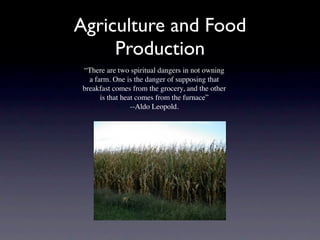
 “There are two spiritual dangers in not owning
   a farm. One is the danger of supposing that
 breakfast comes from the grocery, and the other
       is that heat comes from the furnace”
                  --Aldo Leopold.
Food Security and Nutrition
    •
 global food production has stayed in front of
       population growth

    •
 poverty prevents people from buying or growing
       enough food

    •
 India is self-sufficient in food, but 1/5 of the
       population is malnourished

    •
 developing countries produce too little food

    •
 developing countries lack $ to import adequate food

    •
 wars and political corruption also deny people access
       to food

    •
 poor distribution systems hinder access to food
       (transportation, refrigeration, etc.)
Challenges to Agriculture
•
 feed 8.9 billion people by 2050

•
 avoid loss of biodiversity

•
 work within finite water supplies

•
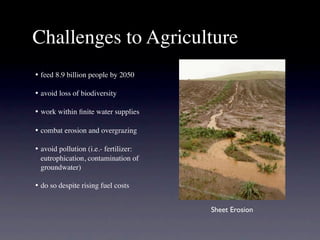
 combat erosion and overgrazing

•
 avoid pollution (i.e.- fertilizer:
   eutrophication, contamination of
   groundwater)

•
 do so despite rising fuel costs


                                        Sheet Erosion
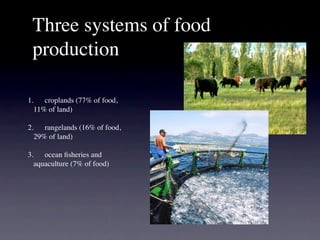
Three systems of food
 production

1.
 croplands (77% of food,
  11% of land)

2.
 rangelands (16% of food,
  29% of land)

3.
 ocean fisheries and
  aquaculture (7% of food)
Food Production
1. 30,000 edible plants in the world

2. 15 plant & 8 animal species feed 90% people

3. Wheat, rice, corn, potato are the majority, all
  are annuals

4. Only 1/3 of the global population can afford
  meat
US Agriculture

•
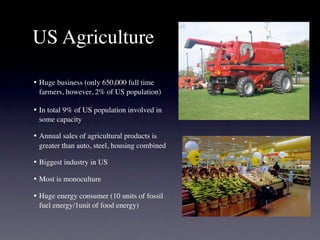
 Huge business (only 650,000 full time
   farmers, however, 2% of US population)

•
 In total 9% of US population involved in
   some capacity

•
 Annual sales of agricultural products is
   greater than auto, steel, housing combined

•
 Biggest industry in US

•
 Most is monoculture

•
 Huge energy consumer (10 units of fossil
   fuel energy/1unit of food energy)
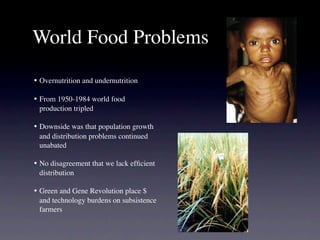
World Food Problems
•
 Overnutrition and undernutrition

•
 From 1950-1984 world food
   production tripled

•
 Downside was that population growth
   and distribution problems continued
   unabated

•
 No disagreement that we lack efficient
   distribution

•
 Green and Gene Revolution place $
   and technology burdens on subsistence
   farmers
Ecological effects of
agriculture
•
 Agriculture has greater impact on
   air, soil, water, biodiversity than
   any human activity

•
 Water, fertilizers, monoculture,
   pesticides

•
 Increasing the amount of land
   under
   cultivation is not sound
   ecologically

•
 Desert areas need too much water;
   grassland and rainforest are
   valuable ecologically
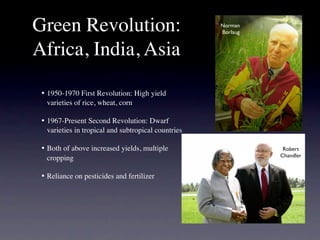
Green Revolution:                                     Norman
                                                      Borlaug


Africa, India, Asia

 •
 1950-1970 First Revolution: High yield
    varieties of rice, wheat, corn

 •
 1967-Present Second Revolution: Dwarf
    varieties in tropical and subtropical countries

 •
 Both of above increased yields, multiple                     Robert
                                                                Chandler
    cropping

 •
 Reliance on pesticides and fertilizer
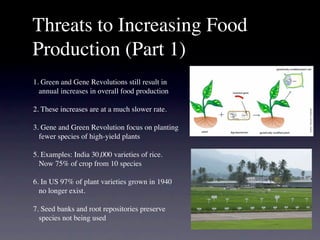
Threats to Increasing Food
Production (Part 1)
1. Green and Gene Revolutions still result in
  annual increases in overall food production

2. These increases are at a much slower rate.

3. Gene and Green Revolution focus on planting
  fewer species of high-yield plants

5. Examples: India 30,000 varieties of rice.
  Now 75% of crop from 10 species

6. In US 97% of plant varieties grown in 1940
  no longer exist.

7. Seed banks and root repositories preserve
  species not being used
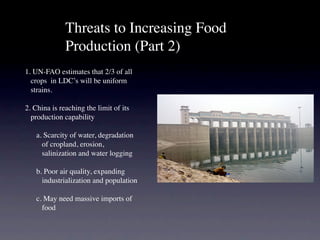
Threats to Increasing Food
              Production (Part 2)
1. UN-FAO estimates that 2/3 of all
  crops in LDC’s will be uniform
  strains.

2. China is reaching the limit of its
  production capability

   a. Scarcity of water, degradation
     of cropland, erosion,
     salinization and water logging

   b. Poor air quality, expanding
     industrialization and population

   c. May need massive imports of
     food

Agriculture & Food Production

  • 1.
    Agriculture and Food Production “There are two spiritual dangers in not owning a farm. One is the danger of supposing that breakfast comes from the grocery, and the other is that heat comes from the furnace” --Aldo Leopold.
  • 2.
    Food Security andNutrition • global food production has stayed in front of population growth • poverty prevents people from buying or growing enough food • India is self-sufficient in food, but 1/5 of the population is malnourished • developing countries produce too little food • developing countries lack $ to import adequate food • wars and political corruption also deny people access to food • poor distribution systems hinder access to food (transportation, refrigeration, etc.)
  • 3.
    Challenges to Agriculture • feed 8.9 billion people by 2050 • avoid loss of biodiversity • work within finite water supplies • combat erosion and overgrazing • avoid pollution (i.e.- fertilizer: eutrophication, contamination of groundwater) • do so despite rising fuel costs Sheet Erosion
  • 4.
    Three systems offood production 1. croplands (77% of food, 11% of land) 2. rangelands (16% of food, 29% of land) 3. ocean fisheries and aquaculture (7% of food)
  • 5.
    Food Production 1. 30,000edible plants in the world 2. 15 plant & 8 animal species feed 90% people 3. Wheat, rice, corn, potato are the majority, all are annuals 4. Only 1/3 of the global population can afford meat
  • 6.
    US Agriculture • Hugebusiness (only 650,000 full time farmers, however, 2% of US population) • In total 9% of US population involved in some capacity • Annual sales of agricultural products is greater than auto, steel, housing combined • Biggest industry in US • Most is monoculture • Huge energy consumer (10 units of fossil fuel energy/1unit of food energy)
  • 7.
    World Food Problems • Overnutrition and undernutrition • From 1950-1984 world food production tripled • Downside was that population growth and distribution problems continued unabated • No disagreement that we lack efficient distribution • Green and Gene Revolution place $ and technology burdens on subsistence farmers
  • 8.
    Ecological effects of agriculture • Agriculture has greater impact on air, soil, water, biodiversity than any human activity • Water, fertilizers, monoculture, pesticides • Increasing the amount of land under cultivation is not sound ecologically • Desert areas need too much water; grassland and rainforest are valuable ecologically
  • 9.
    Green Revolution: Norman Borlaug Africa, India, Asia • 1950-1970 First Revolution: High yield varieties of rice, wheat, corn • 1967-Present Second Revolution: Dwarf varieties in tropical and subtropical countries • Both of above increased yields, multiple Robert Chandler cropping • Reliance on pesticides and fertilizer
  • 10.
    Threats to IncreasingFood Production (Part 1) 1. Green and Gene Revolutions still result in annual increases in overall food production 2. These increases are at a much slower rate. 3. Gene and Green Revolution focus on planting fewer species of high-yield plants 5. Examples: India 30,000 varieties of rice. Now 75% of crop from 10 species 6. In US 97% of plant varieties grown in 1940 no longer exist. 7. Seed banks and root repositories preserve species not being used
  • 11.
    Threats to IncreasingFood Production (Part 2) 1. UN-FAO estimates that 2/3 of all crops in LDC’s will be uniform strains. 2. China is reaching the limit of its production capability a. Scarcity of water, degradation of cropland, erosion, salinization and water logging b. Poor air quality, expanding industrialization and population c. May need massive imports of food

Editor's Notes