STREAMING VARIANT 
CALLING? 
C. Titus Brown 
Michigan State University 
Sep 2014, NCI EDRN / Bethesda, MD
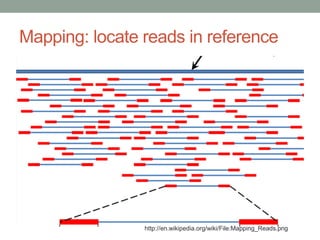
Mapping: locate reads in reference 
http://en.wikipedia.org/wiki/File:Mapping_Reads.png
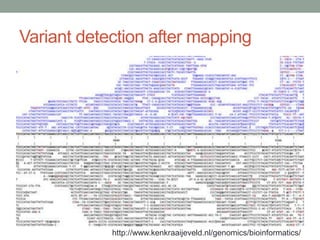
Variant detection after mapping 
http://www.kenkraaijeveld.nl/genomics/bioinformatics/
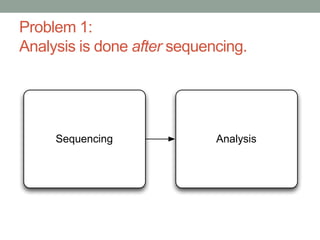
Problem 1: 
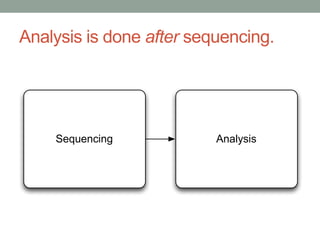
Analysis is done after sequencing. 
Sequencing Analysis
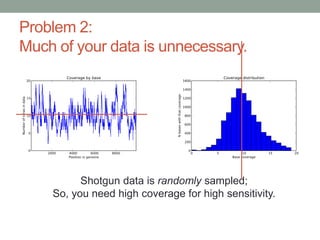
Problem 2: 
Much of your data is unnecessary. 
Shotgun data is randomly sampled; 
So, you need high coverage for high sensitivity.
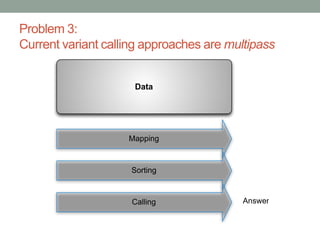
Problem 3: 
Current variant calling approaches are multipass 
Data 
Mapping 
Sorting 
Calling Answer
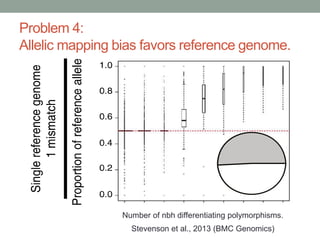
Problem 4: 
Allelic mapping bias favors reference genome. 
Number of nbh differentiating polymorphisms. 
Stevenson et al., 2013 (BMC Genomics)
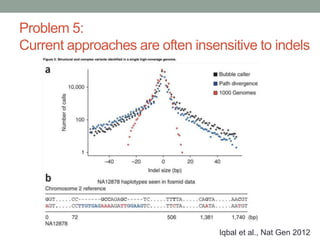
Problem 5: 
Current approaches are often insensitive to indels 
Iqbal et al., Nat Gen 2012
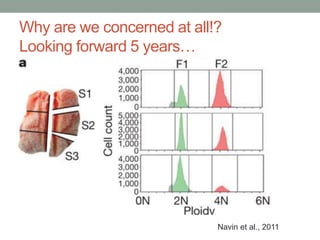
Why are we concerned at all!? 
Looking forward 5 years… 
Navin et al., 2011
Some basic math: 
• 1000 single cells from a tumor… 
• …sequenced to 40x haploid coverage with Illumina… 
• …yields 120 Gbp each cell… 
• …or 120 Tbp of data. 
• HiSeq X10 can do the sequencing in ~3 weeks. 
• The variant calling will require 2,000 CPU weeks… 
• …so, given ~2,000 computers, can do this all in one 
month.
Similar math applies: 
• Pathogen detection in blood; 
• Environmental sequencing; 
• Sequencing rare DNA from circulating blood. 
• Two issues: 
•Volume of data & compute 
infrastructure; 
• Latency for clinical applications.
Can we improve this situation? 
• Tie directly into machine as it generates sequence 
(Illumina, PacBio, and Nanopore can all do streaming, in theory) 
• Analyze data as it comes off; for some (many?) 
applications, can stop run early if signal detected. 
• Avoid using a reference genome for primary variant 
calling. 
• Easier indel detection, less allelic mapping bias 
• Can use reference for interpretation. 
Does such a magical approach exist!?
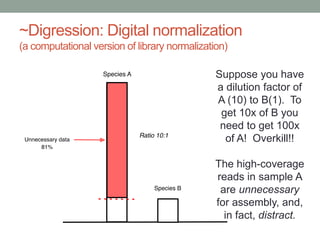
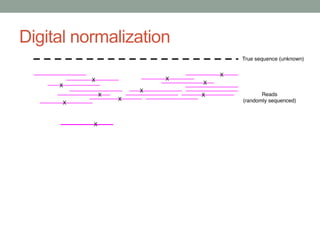
~Digression: Digital normalization 
(a computational version of library normalization) 
Suppose you have 
a dilution factor of 
A (10) to B(1). To 
get 10x of B you 
need to get 100x 
of A! Overkill!! 
The high-coverage 
reads in sample A 
are unnecessary 
for assembly, and, 
in fact, distract.
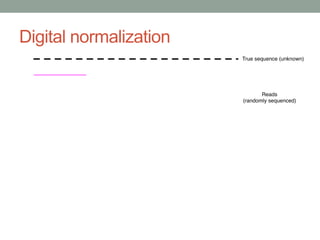
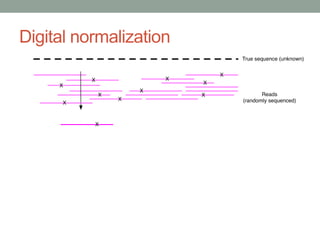
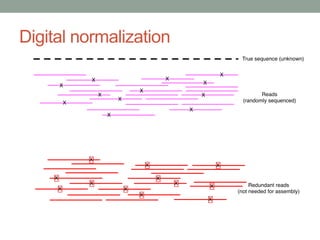
Digital normalization
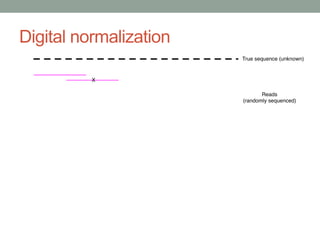
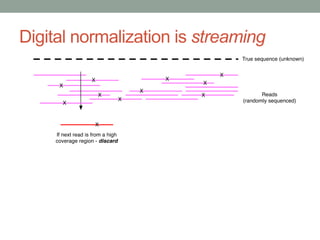
Digital normalization is streaming
Digital normalization
Some key points -- 
• Digital normalization is streaming. 
• Digital normalizing is computationally efficient (lower 
memory than other approaches; parallelizable/multicore; 
single-pass) 
• Currently, primarily used for prefiltering for assembly, but 
relies on underlying abstraction (De Bruijn graph) that is 
also used in variant calling.
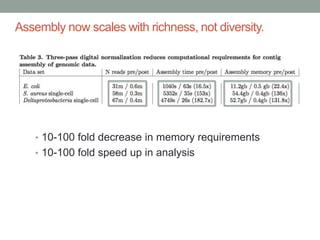
Assembly now scales with richness, not diversity. 
• 10-100 fold decrease in memory requirements 
• 10-100 fold speed up in analysis
Diginorm is widely useful: 
1. Assembly of the H. contortus parasitic nematode 
genome, a “high polymorphism/variable coverage” 
problem. 
(Schwarz et al., 2013; pmid 23985341) 
2. Reference-free assembly of the lamprey (P. marinus) 
transcriptome, a “big assembly” problem. (in prep) 
3. Osedax symbiont metagenome, a “contaminated 
metagenome” problem (Goffredi et al, 2013; pmid 
24225886)
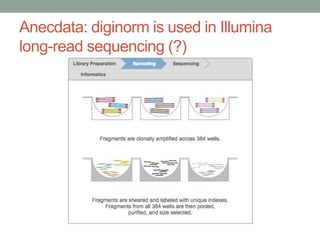
Anecdata: diginorm is used in Illumina 
long-read sequencing (?)
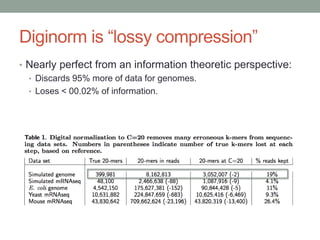
Diginorm is “lossy compression” 
• Nearly perfect from an information theoretic perspective: 
• Discards 95% more of data for genomes. 
• Loses < 00.02% of information.
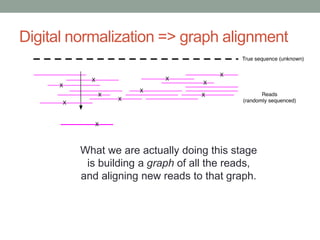
Digital normalization => graph alignment 
What we are actually doing this stage 
is building a graph of all the reads, 
and aligning new reads to that graph.
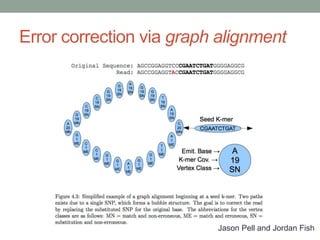
Error correction via graph alignment 
Jason Pell and Jordan Fish
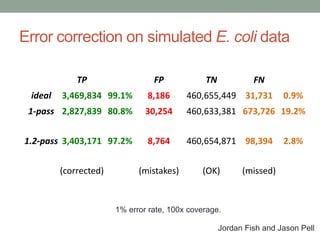
Error correction on simulated E. coli data 
TP FP TN FN 
ideal 3,469,834 99.1% 8,186 460,655,449 31,731 0.9% 
1-pass 2,827,839 80.8% 30,254 460,633,381 673,726 19.2% 
1.2-pass 3,403,171 97.2% 8,764 460,654,871 98,394 2.8% 
(corrected) (mistakes) (OK) (missed) 
1% error rate, 100x coverage. 
Jordan Fish and Jason Pell
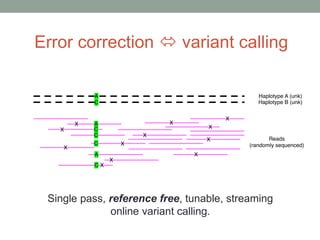
Error correction  variant calling 
Single pass, reference free, tunable, streaming 
online variant calling.
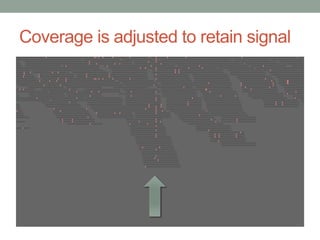
Coverage is adjusted to retain signal
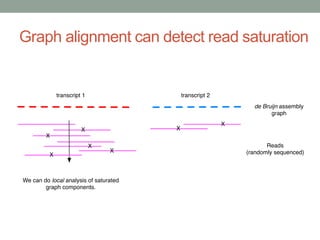
Graph alignment can detect read saturation
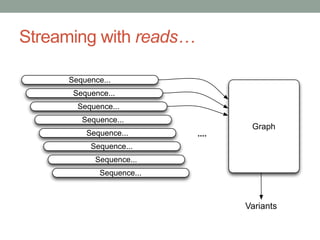
Streaming with reads… 
Sequence... 
Graph 
Sequence... 
Sequence... 
Sequence... 
Sequence... 
Sequence... 
Sequence... 
Sequence... 
.... 
Variants
Analysis is done after sequencing. 
Sequencing Analysis
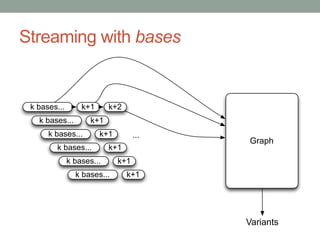
Streaming with bases 
k bases... 
Graph 
k+1 
k bases... k+1 
k+2 
k bases... k+1 
k bases... k+1 
k bases... k+1 
... 
k bases... k+1 
Variants
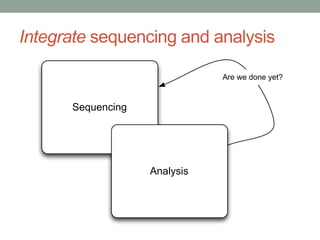
Integrate sequencing and analysis 
Sequencing 
Analysis 
Are we done yet?
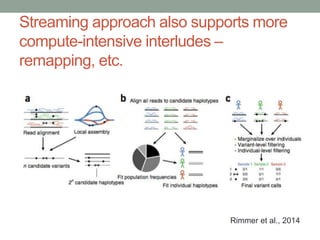
Streaming approach also supports more 
compute-intensive interludes – 
remapping, etc. 
Rimmer et al., 2014
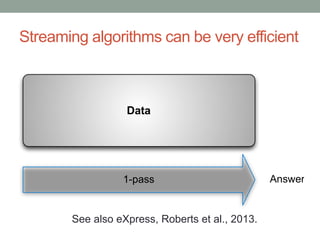
Streaming algorithms can be very efficient 
Data 
1-pass 
Answer 
See also eXpress, Roberts et al., 2013.
So: reference-free variant calling 
• Streaming & online algorithm; single pass. 
• For real-time diagnostics, can be applied as bases are emitted from 
sequencer. 
• Reference free: independent of reference bias. 
• Coverage of variants is adaptively adjusted to retain all 
signal. 
• Parameters are easily tuned, although theory needs to be 
developed. 
• High sensitivity (e.g. C=50 in 100x coverage) => poor compression 
• Low sensitivity (C=20) => good compression. 
• Can “subtract” reference => novel structural variants. 
• (See: Cortex, Zam Iqbal.)
Two other features -- 
• More single-computer scalable approach than current: low 
disk access, high parallelizability. 
• Openness – our software is free to use, reuse, remix; no 
intellectual property restrictions. (Hence “We hear Illumina 
is using it…”)
Prospectus for streaming variant detection 
• Underlying concept is sound and offers many advantages over 
current approaches; 
• We have proofs of concept implemented; 
• We know that underlying approach works well in amplification 
situations, as well; 
• Tuning and math/theory needed! 
• …grad students keep on getting poached by Amazon and 
Google. (This is becoming a serious problem.)
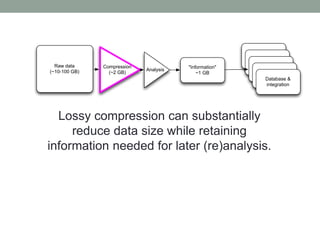
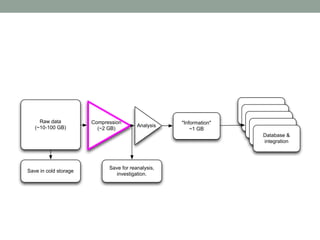
Raw data 
(~10-100 GB) Analysis 
"Information" 
~1 GB 
"Information" 
"Information" 
"Information" 
"Information" 
Database & 
integration 
Compression 
(~2 GB) 
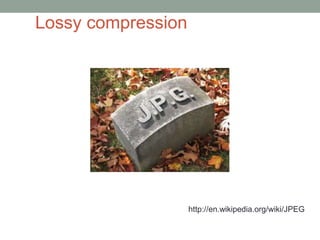
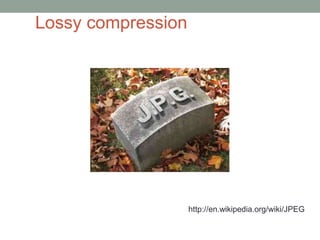
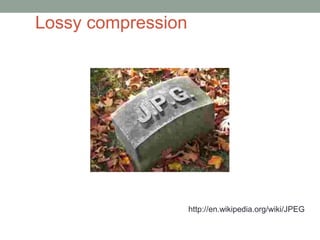
Lossy compression can substantially 
reduce data size while retaining 
information needed for later (re)analysis.
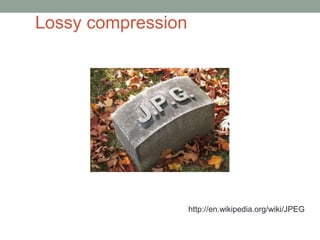
http://en.wikipedia.org/wiki/JPEG 
Lossy compression
http://en.wikipedia.org/wiki/JPEG 
Lossy compression
http://en.wikipedia.org/wiki/JPEG 
Lossy compression
http://en.wikipedia.org/wiki/JPEG 
Lossy compression
http://en.wikipedia.org/wiki/JPEG 
Lossy compression
Raw data 
(~10-100 GB) Analysis 
"Information" 
~1 GB 
"Information" 
"Information" 
"Information" 
"Information" 
Database & 
integration 
Compression 
(~2 GB) 
Save in cold storage 
Save for reanalysis, 
investigation.
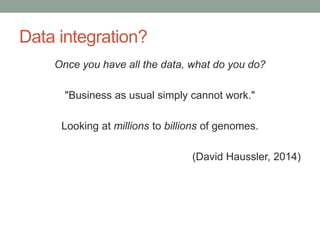
Data integration? 
Once you have all the data, what do you do? 
"Business as usual simply cannot work." 
Looking at millions to billions of genomes. 
(David Haussler, 2014)
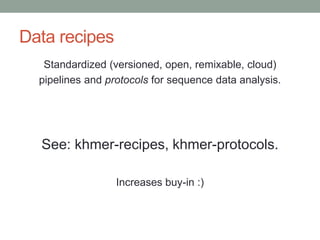
Data recipes 
Standardized (versioned, open, remixable, cloud) 
pipelines and protocols for sequence data analysis. 
See: khmer-recipes, khmer-protocols. 
Increases buy-in :)
Training! 
Lots of training planned at Davis – 
open workshops. 
ivory.idyll.org/blog/2014-davis-and-training.html 
Increases buy-in x 2!
Acknowledgements 
Lab members involved Collaborators 
• Adina Howe (w/Tiedje) 
• Jason Pell 
• Qingpeng Zhang 
• Tim Brom 
• Jordan Fish 
• Michael Crusoe 
• Jim Tiedje, MSU 
• Billie Swalla, UW 
• Janet Jansson, LBNL 
• Susannah Tringe, JGI 
• Eran Andrechek, MSU 
Funding 
USDA NIFA; NSF IOS; 
NIH NHGRI; NSF 
BEACON.

2014 nci-edrn

  • 1.
    STREAMING VARIANT CALLING? C. Titus Brown Michigan State University Sep 2014, NCI EDRN / Bethesda, MD
  • 2.
    Mapping: locate readsin reference http://en.wikipedia.org/wiki/File:Mapping_Reads.png
  • 3.
    Variant detection aftermapping http://www.kenkraaijeveld.nl/genomics/bioinformatics/
  • 4.
    Problem 1: Analysisis done after sequencing. Sequencing Analysis
  • 5.
    Problem 2: Muchof your data is unnecessary. Shotgun data is randomly sampled; So, you need high coverage for high sensitivity.
  • 6.
    Problem 3: Currentvariant calling approaches are multipass Data Mapping Sorting Calling Answer
  • 7.
    Problem 4: Allelicmapping bias favors reference genome. Number of nbh differentiating polymorphisms. Stevenson et al., 2013 (BMC Genomics)
  • 8.
    Problem 5: Currentapproaches are often insensitive to indels Iqbal et al., Nat Gen 2012
  • 9.
    Why are weconcerned at all!? Looking forward 5 years… Navin et al., 2011
  • 10.
    Some basic math: • 1000 single cells from a tumor… • …sequenced to 40x haploid coverage with Illumina… • …yields 120 Gbp each cell… • …or 120 Tbp of data. • HiSeq X10 can do the sequencing in ~3 weeks. • The variant calling will require 2,000 CPU weeks… • …so, given ~2,000 computers, can do this all in one month.
  • 11.
    Similar math applies: • Pathogen detection in blood; • Environmental sequencing; • Sequencing rare DNA from circulating blood. • Two issues: •Volume of data & compute infrastructure; • Latency for clinical applications.
  • 12.
    Can we improvethis situation? • Tie directly into machine as it generates sequence (Illumina, PacBio, and Nanopore can all do streaming, in theory) • Analyze data as it comes off; for some (many?) applications, can stop run early if signal detected. • Avoid using a reference genome for primary variant calling. • Easier indel detection, less allelic mapping bias • Can use reference for interpretation. Does such a magical approach exist!?
  • 13.
    ~Digression: Digital normalization (a computational version of library normalization) Suppose you have a dilution factor of A (10) to B(1). To get 10x of B you need to get 100x of A! Overkill!! The high-coverage reads in sample A are unnecessary for assembly, and, in fact, distract.
  • 14.
  • 15.
  • 16.
  • 17.
  • 18.
  • 19.
  • 20.
    Some key points-- • Digital normalization is streaming. • Digital normalizing is computationally efficient (lower memory than other approaches; parallelizable/multicore; single-pass) • Currently, primarily used for prefiltering for assembly, but relies on underlying abstraction (De Bruijn graph) that is also used in variant calling.
  • 21.
    Assembly now scaleswith richness, not diversity. • 10-100 fold decrease in memory requirements • 10-100 fold speed up in analysis
  • 22.
    Diginorm is widelyuseful: 1. Assembly of the H. contortus parasitic nematode genome, a “high polymorphism/variable coverage” problem. (Schwarz et al., 2013; pmid 23985341) 2. Reference-free assembly of the lamprey (P. marinus) transcriptome, a “big assembly” problem. (in prep) 3. Osedax symbiont metagenome, a “contaminated metagenome” problem (Goffredi et al, 2013; pmid 24225886)
  • 23.
    Anecdata: diginorm isused in Illumina long-read sequencing (?)
  • 24.
    Diginorm is “lossycompression” • Nearly perfect from an information theoretic perspective: • Discards 95% more of data for genomes. • Loses < 00.02% of information.
  • 25.
    Digital normalization =>graph alignment What we are actually doing this stage is building a graph of all the reads, and aligning new reads to that graph.
  • 26.
    Error correction viagraph alignment Jason Pell and Jordan Fish
  • 27.
    Error correction onsimulated E. coli data TP FP TN FN ideal 3,469,834 99.1% 8,186 460,655,449 31,731 0.9% 1-pass 2,827,839 80.8% 30,254 460,633,381 673,726 19.2% 1.2-pass 3,403,171 97.2% 8,764 460,654,871 98,394 2.8% (corrected) (mistakes) (OK) (missed) 1% error rate, 100x coverage. Jordan Fish and Jason Pell
  • 28.
    Error correction variant calling Single pass, reference free, tunable, streaming online variant calling.
  • 29.
    Coverage is adjustedto retain signal
  • 30.
    Graph alignment candetect read saturation
  • 31.
    Streaming with reads… Sequence... Graph Sequence... Sequence... Sequence... Sequence... Sequence... Sequence... Sequence... .... Variants
  • 32.
    Analysis is doneafter sequencing. Sequencing Analysis
  • 33.
    Streaming with bases k bases... Graph k+1 k bases... k+1 k+2 k bases... k+1 k bases... k+1 k bases... k+1 ... k bases... k+1 Variants
  • 34.
    Integrate sequencing andanalysis Sequencing Analysis Are we done yet?
  • 35.
    Streaming approach alsosupports more compute-intensive interludes – remapping, etc. Rimmer et al., 2014
  • 36.
    Streaming algorithms canbe very efficient Data 1-pass Answer See also eXpress, Roberts et al., 2013.
  • 37.
    So: reference-free variantcalling • Streaming & online algorithm; single pass. • For real-time diagnostics, can be applied as bases are emitted from sequencer. • Reference free: independent of reference bias. • Coverage of variants is adaptively adjusted to retain all signal. • Parameters are easily tuned, although theory needs to be developed. • High sensitivity (e.g. C=50 in 100x coverage) => poor compression • Low sensitivity (C=20) => good compression. • Can “subtract” reference => novel structural variants. • (See: Cortex, Zam Iqbal.)
  • 38.
    Two other features-- • More single-computer scalable approach than current: low disk access, high parallelizability. • Openness – our software is free to use, reuse, remix; no intellectual property restrictions. (Hence “We hear Illumina is using it…”)
  • 39.
    Prospectus for streamingvariant detection • Underlying concept is sound and offers many advantages over current approaches; • We have proofs of concept implemented; • We know that underlying approach works well in amplification situations, as well; • Tuning and math/theory needed! • …grad students keep on getting poached by Amazon and Google. (This is becoming a serious problem.)
  • 40.
    Raw data (~10-100GB) Analysis "Information" ~1 GB "Information" "Information" "Information" "Information" Database & integration Compression (~2 GB) Lossy compression can substantially reduce data size while retaining information needed for later (re)analysis.
  • 41.
  • 42.
  • 43.
  • 44.
  • 45.
  • 46.
    Raw data (~10-100GB) Analysis "Information" ~1 GB "Information" "Information" "Information" "Information" Database & integration Compression (~2 GB) Save in cold storage Save for reanalysis, investigation.
  • 47.
    Data integration? Onceyou have all the data, what do you do? "Business as usual simply cannot work." Looking at millions to billions of genomes. (David Haussler, 2014)
  • 48.
    Data recipes Standardized(versioned, open, remixable, cloud) pipelines and protocols for sequence data analysis. See: khmer-recipes, khmer-protocols. Increases buy-in :)
  • 49.
    Training! Lots oftraining planned at Davis – open workshops. ivory.idyll.org/blog/2014-davis-and-training.html Increases buy-in x 2!
  • 50.
    Acknowledgements Lab membersinvolved Collaborators • Adina Howe (w/Tiedje) • Jason Pell • Qingpeng Zhang • Tim Brom • Jordan Fish • Michael Crusoe • Jim Tiedje, MSU • Billie Swalla, UW • Janet Jansson, LBNL • Susannah Tringe, JGI • Eran Andrechek, MSU Funding USDA NIFA; NSF IOS; NIH NHGRI; NSF BEACON.

Editor's Notes

  • #22 Goal is to do first stage data reduction/analysis in less time than it takes to generate the data. Compression => OLC assembly.
  • #28 Update from Jordan