By: Shashank Varun
ASE Structure Design Pvt Ltd

• Communication Skills
• Nonverbal communication
• Oral communication
• Written communication
• Interpersonal Applications
• Business Applications
Overview

 Influence of Mental Maps
 Redundant
 Visual
 Auditory
 Kinesthetic
 Energetic
What Is
Communication?

 Nonverbal: 150,000 years
 Oral: 55,000 years
 Written: 6,000 years
 Early writing: 4000 BC
 Egyptian hieroglyphics: 3000 BC
 Phoenician alphabet: 1500 to 2000 BC
 Book printing in China: 600 BC
 Book printing in Europe: 1400 AD
History of
Communication

 Conscious and Intentional
 Nonverbal
 Verbal
 Unconscious and Unintentional
 Nonverbal
 Verbal
What Is
Communication?

 Conscious Processing = 7±2/Second
 Unconscious Processing = 200,000,000/Sec.
 Short-term Memory
 Long-term Memory
 Habits
 Physical
 Mental
Unconscious Processing

 Learned Behavior
 Established Over Time
 Practice
 Self-talk
 Change
Habits

 Physiology and Appearance: 55 percent
 Paralanguage: 38 percent
 Language: 7 percent
Communicating
Meaning

 Visual
 Auditory
 Kinesthetic
 Touch
 Taste
 Smell
 Emotional responses (feelings)
Sensory Modalities

 Vocabulary
 I see what you mean.
 It looks good to me.
 Let’s stay focused on the problem.
 She has a bright future.
 He’s always in a fog.
 Physiology and Appearance
 Paralanguage
Visuals

 Vocabulary
 I hear what you are saying.
 It sounds good to me.
 Does the name Pavlov ring a bell?
 That’s music to my ears.
 He’s always blowing his own horn.
 Physiology and Appearance
 Paralanguage
Auditories

 Vocabulary
 I can grasp the concept, and it feels right to me.
 It smells fishy to me.
 It left me with a bad taste in my mouth.
 She’s still rough around the edges.
 He’s a smooth operator.
 Physiology and Appearance
 Paralanguage
Kinesthetics (Kinos)

Eye Accessing Cues
Vr
Ar
Ai
Vc
Ac
K
 Finding Commonalities
 Values
 Vocabulary and paralanguage
 Physiology and appearance
 Matching and Mirroring
 Cross-over Matching
Rapport
People who are like each other,
like each other.

 Nonverbal (what you see and do)
 Physiology
 Appearance
 Congruence
 Verbal (what you hear and say)
 Sense-based predicates
 Values, beliefs, and criteria
 Voice tone and rate of speech
Developing Rapport

 Sensory Acuity
 Agree and Disagree
 Posture and Movement
 Associated or dissociated
 Bodily response
Reading Nonverbal Messages

 Matching and Mirroring
 Observing others
 Practicing
 Calibration
 Like/dislike
 Yes/no
Exercises: Rapport
18
• Pace
• Match (nonverbally and verbally)
• Meet expectations
• Lead
• Set direction
• Maintain interest
• Maintain rapport
• Blend Outcomes
• Understand objectives and desires
• Create win-win solutions
• Motivate
• Clarify who does what next
• Future-pace possibilities
• Presuppose positive results
• E-mail message - No nonverbal expression to
supplement what we are “saying”.
• Normal communication takes into account tone of voice,
gestures, and proximity
• Since this is absent – be very careful with email
21
What impression does yours leave???
22
• Organize contacts by first and last name
• Makes you much more efficient and professional
23
• Brief and to the point
• Preferably one page
• Readers should not have to scroll
24
• Never use ALL CAPS
• Watch for typos
• Use normal capitalization and punctuation
• Use correct grammar & spelling
• Avoid long sentences
25
• Return emails in the same day that you would return a
phone call
26
• Write a salutation or greetings for each new subject email
27
• Always use a subject line
• Make the subject line meaningful
• Example: “April 22 production team meeting agenda”
instead of “meeting”
28
• Always use a signature or name at the end
• Includes alternate means of contacting you
29
• Use active words instead of passive
30
• Emails = public documents
• Only include those statements in email that you can
openly defend
31
• Attachments: Title needs to make sense
• Large attachments??
32
• Never “flame” someone.
• Flaming = virtual term for venting emotion online or
sending inflammatory emails.
33
• Never send an email about sensitive
subjects.
• Examples:
• Disciplinary action
• Conflicts about grades or personal information
• Concerns about fellow classmates/co-workers
• complaints
34
• Be very careful
35
• Do not over use the forward button
36
37
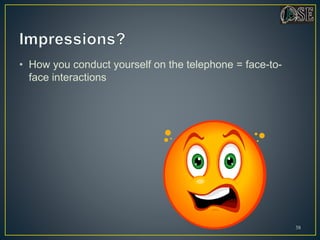
• How you conduct yourself on the telephone = face-to-
face interactions
38
HELLO
39
• Identify yourself, office or organization in as few words as
possible
40
• Cheerful and considerate attitude toward each
telephone caller.
• Smile when you answer or talk on the phone
• ***It will show on the other end.
41
• Give your name when the telephone is answered, before
asking for the person you are requesting
42
• Enunciate your words very carefully
43
• Keep business conversations to the point
44
• Do not keep someone on hold more than 30 seconds.
45
• Always leave your phone number if you ask someone to
call you back
• Even if you think they have it
46
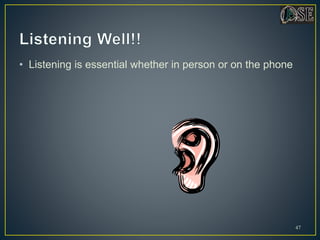
• Listening is essential whether in person or on the phone
47
• Make sure your voice mail or answering machine work
properly
48
• Always return your calls on the same day
49
• Think about the time when making a phone call.
• Not acceptable to call someone before 7-8 a.m. and
after 8:30-9 p.m..
• Avoid meal times
50
• Never hang-up when you realize you have a wrong
number
• Apologize and then hang up
51
• When calling someone, let the telephone ring a
reasonable length of time
52
• Calling a business at or very near closing time =
inconsiderate
53
• When taking a message
• Indicate the time & date of the call
• Caller
• Information
• Phone number
• Person taking the message
• Ask for correct spelling if necessary
54
• Never – eat, drink or chew gum on the phone
55
• Leave a message when appropriate – especially with
caller-ID, people will see you called so they should not
have to wonder what you needed.
56
57
• Maintain at least a 10 foot zone from anyone while
talking.
58
• Elevators
• Libraries
• Museums
• Restaurants
• Cemeteries
• Theaters
• Dentist or doctor waiting rooms
• Places of worship
• Auditoriums
• Other enclosed public spaces (hospital emergency
rooms or buses)
59
• Don’t have emotional conversations in public – ever.
60
• Watch your language & tone of voice
• Others are watching and getting impressions of you
61
• Don’t use loud and annoying ring tones
62
• Never “multi-task” by making calls while shopping,
banking, waiting in line or conducting other personal
business.
63
• Never take a personal call during a business meeting.
64
• Do not send text messages to someone else unless
you have their permission to do so as they may incur a
charge.
65
• Never utilize a cell phone in something like a State
FFA Convention session
• This would also include text messaging
66
• If you must answer a cell phone in a public setting,
answer and tell the person to hold a minute while you
remove yourself from the room.
67
• Always keep your phone on manner mode when in a
public event such as a convention or meeting.
68
• Do not utilize a cell phone while driving or operating
other equipment.
69
• Do not grow too attached to your cell phone
70

Body Language Video

  • 1.
    By: Shashank Varun ASEStructure Design Pvt Ltd
  • 2.
     • Communication Skills •Nonverbal communication • Oral communication • Written communication • Interpersonal Applications • Business Applications Overview
  • 3.
      Influence ofMental Maps  Redundant  Visual  Auditory  Kinesthetic  Energetic What Is Communication?
  • 4.
      Nonverbal: 150,000years  Oral: 55,000 years  Written: 6,000 years  Early writing: 4000 BC  Egyptian hieroglyphics: 3000 BC  Phoenician alphabet: 1500 to 2000 BC  Book printing in China: 600 BC  Book printing in Europe: 1400 AD History of Communication
  • 5.
      Conscious andIntentional  Nonverbal  Verbal  Unconscious and Unintentional  Nonverbal  Verbal What Is Communication?
  • 6.
      Conscious Processing= 7±2/Second  Unconscious Processing = 200,000,000/Sec.  Short-term Memory  Long-term Memory  Habits  Physical  Mental Unconscious Processing
  • 7.
      Learned Behavior Established Over Time  Practice  Self-talk  Change Habits
  • 8.
      Physiology andAppearance: 55 percent  Paralanguage: 38 percent  Language: 7 percent Communicating Meaning
  • 9.
      Visual  Auditory Kinesthetic  Touch  Taste  Smell  Emotional responses (feelings) Sensory Modalities
  • 10.
      Vocabulary  Isee what you mean.  It looks good to me.  Let’s stay focused on the problem.  She has a bright future.  He’s always in a fog.  Physiology and Appearance  Paralanguage Visuals
  • 11.
      Vocabulary  Ihear what you are saying.  It sounds good to me.  Does the name Pavlov ring a bell?  That’s music to my ears.  He’s always blowing his own horn.  Physiology and Appearance  Paralanguage Auditories
  • 12.
      Vocabulary  Ican grasp the concept, and it feels right to me.  It smells fishy to me.  It left me with a bad taste in my mouth.  She’s still rough around the edges.  He’s a smooth operator.  Physiology and Appearance  Paralanguage Kinesthetics (Kinos)
  • 13.
  • 14.
     Finding Commonalities Values  Vocabulary and paralanguage  Physiology and appearance  Matching and Mirroring  Cross-over Matching Rapport People who are like each other, like each other.
  • 15.
      Nonverbal (whatyou see and do)  Physiology  Appearance  Congruence  Verbal (what you hear and say)  Sense-based predicates  Values, beliefs, and criteria  Voice tone and rate of speech Developing Rapport
  • 16.
      Sensory Acuity Agree and Disagree  Posture and Movement  Associated or dissociated  Bodily response Reading Nonverbal Messages
  • 17.
      Matching andMirroring  Observing others  Practicing  Calibration  Like/dislike  Yes/no Exercises: Rapport
  • 18.
  • 19.
    • Pace • Match(nonverbally and verbally) • Meet expectations • Lead • Set direction • Maintain interest • Maintain rapport
  • 20.
    • Blend Outcomes •Understand objectives and desires • Create win-win solutions • Motivate • Clarify who does what next • Future-pace possibilities • Presuppose positive results
  • 21.
    • E-mail message- No nonverbal expression to supplement what we are “saying”. • Normal communication takes into account tone of voice, gestures, and proximity • Since this is absent – be very careful with email 21
  • 22.
    What impression doesyours leave??? 22
  • 23.
    • Organize contactsby first and last name • Makes you much more efficient and professional 23
  • 24.
    • Brief andto the point • Preferably one page • Readers should not have to scroll 24
  • 25.
    • Never useALL CAPS • Watch for typos • Use normal capitalization and punctuation • Use correct grammar & spelling • Avoid long sentences 25
  • 26.
    • Return emailsin the same day that you would return a phone call 26
  • 27.
    • Write asalutation or greetings for each new subject email 27
  • 28.
    • Always usea subject line • Make the subject line meaningful • Example: “April 22 production team meeting agenda” instead of “meeting” 28
  • 29.
    • Always usea signature or name at the end • Includes alternate means of contacting you 29
  • 30.
    • Use activewords instead of passive 30
  • 31.
    • Emails =public documents • Only include those statements in email that you can openly defend 31
  • 32.
    • Attachments: Titleneeds to make sense • Large attachments?? 32
  • 33.
    • Never “flame”someone. • Flaming = virtual term for venting emotion online or sending inflammatory emails. 33
  • 34.
    • Never sendan email about sensitive subjects. • Examples: • Disciplinary action • Conflicts about grades or personal information • Concerns about fellow classmates/co-workers • complaints 34
  • 35.
    • Be verycareful 35
  • 36.
    • Do notover use the forward button 36
  • 37.
  • 38.
    • How youconduct yourself on the telephone = face-to- face interactions 38
  • 39.
  • 40.
    • Identify yourself,office or organization in as few words as possible 40
  • 41.
    • Cheerful andconsiderate attitude toward each telephone caller. • Smile when you answer or talk on the phone • ***It will show on the other end. 41
  • 42.
    • Give yourname when the telephone is answered, before asking for the person you are requesting 42
  • 43.
    • Enunciate yourwords very carefully 43
  • 44.
    • Keep businessconversations to the point 44
  • 45.
    • Do notkeep someone on hold more than 30 seconds. 45
  • 46.
    • Always leaveyour phone number if you ask someone to call you back • Even if you think they have it 46
  • 47.
    • Listening isessential whether in person or on the phone 47
  • 48.
    • Make sureyour voice mail or answering machine work properly 48
  • 49.
    • Always returnyour calls on the same day 49
  • 50.
    • Think aboutthe time when making a phone call. • Not acceptable to call someone before 7-8 a.m. and after 8:30-9 p.m.. • Avoid meal times 50
  • 51.
    • Never hang-upwhen you realize you have a wrong number • Apologize and then hang up 51
  • 52.
    • When callingsomeone, let the telephone ring a reasonable length of time 52
  • 53.
    • Calling abusiness at or very near closing time = inconsiderate 53
  • 54.
    • When takinga message • Indicate the time & date of the call • Caller • Information • Phone number • Person taking the message • Ask for correct spelling if necessary 54
  • 55.
    • Never –eat, drink or chew gum on the phone 55
  • 56.
    • Leave amessage when appropriate – especially with caller-ID, people will see you called so they should not have to wonder what you needed. 56
  • 57.
  • 58.
    • Maintain atleast a 10 foot zone from anyone while talking. 58
  • 59.
    • Elevators • Libraries •Museums • Restaurants • Cemeteries • Theaters • Dentist or doctor waiting rooms • Places of worship • Auditoriums • Other enclosed public spaces (hospital emergency rooms or buses) 59
  • 60.
    • Don’t haveemotional conversations in public – ever. 60
  • 61.
    • Watch yourlanguage & tone of voice • Others are watching and getting impressions of you 61
  • 62.
    • Don’t useloud and annoying ring tones 62
  • 63.
    • Never “multi-task”by making calls while shopping, banking, waiting in line or conducting other personal business. 63
  • 64.
    • Never takea personal call during a business meeting. 64
  • 65.
    • Do notsend text messages to someone else unless you have their permission to do so as they may incur a charge. 65
  • 66.
    • Never utilizea cell phone in something like a State FFA Convention session • This would also include text messaging 66
  • 67.
    • If youmust answer a cell phone in a public setting, answer and tell the person to hold a minute while you remove yourself from the room. 67
  • 68.
    • Always keepyour phone on manner mode when in a public event such as a convention or meeting. 68
  • 69.
    • Do notutilize a cell phone while driving or operating other equipment. 69
  • 70.
    • Do notgrow too attached to your cell phone 70