Lateral Kindness
CAAN June 23rd, 2021
Presentation by Greg Riehl RN BScN MA
Land Acknowledgment
• I would like to begin by acknowledging that we are on the traditional lands,
referred to as Treaty 4 Territory and that the city of Regina is located on
Treaty 4 territory, the original lands of the Cree, Ojibwe(OJIB-WĒ),
Saulteaux (SO-TO), Dakota, Nakota, Lakota, and on the homeland of the
Métis Nation. We respect and honour the Treaties that were made on all
territories, we acknowledge the harms and mistakes of the past, and we are
committed to move forward in partnership with Indigenous Nations in the
spirit of reconciliation and collaboration.
• https://saskschoolboards.ca/wp-content/uploads/Treaty-4-Territory.pdf
Conflict of Interest:
I have no actual or potential conflict of interest in relation to this presentation.
My ultimate goal is to have good relations, with the people, with the water, with
the land, and all the creatures above the land, all the creatures below the land.
(all seven directions)
Disclosure(s)
Learning Objectives/Outcomes
• To describe what lateral kindness means
• To explore unconditional positive regard.
• To explore bullying, lateral violence, and the role of the victim
• To share memorable experiences that support the Platinum Rule
• I will describe the bronze silver gold platinum rules
• To see your co-workers and others as they want to be seen
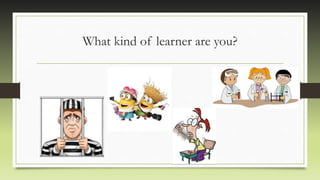
What kind of learner are you?
Stories
• I will use some of my experiences working in health, in the north, in
community, as an nurse, often an outsider, working in different situations,
working along side some of you...
• You are a part of the story.
Once Upon a time…
• Sami was late for work, again, ….
• Kelly left work early, but nothing is going to happen……
• She didn't get all her work done, again ……
• Why is their screen always black on our Zoom calls?
• I sent an anonymous thank you card to my co-worker…..
• I brought doughnuts for a staff meeting…..
• I stayed late and helped get the report in that was due at 1600h…
• He was out drinking with the boss again…..
• They got their vacation approved and I didn’t……
• It’s Friday….. And guess what? Sally is sick……. Again!!!!
• Greg took the company vehicle home over the weekend, again…
Who are the people I work with and for?
"There's a lot of healing to be done“
How many people have never had a bad day? Have never done something, that
caused you to reflect? How did you want to be treated in that moment, or do
you even know? This is not going to be a discussion about how to fix bullies in
your workplace, or your environment, but rather, it will be about how you want
to be treated, IR-regardless of XYZ. Once we understand how we want to be
treated, then we can understand how others, as well, want to be treated.
Unconditional Positive Regard. This will be something to strive towards,
together, as a group.
Acts of Kindness
Take a minute right now, to do something kind
Take time, right now, to do something kind.
“Reach out and help others. If you have the power to make someone
happy, do it. Be a vessel, be the change, be the difference, or be the
inspiration. Shine your light as an example. The world needs more of
that.”
― Germany Kent
Can you, could you, do this everyday? Throughout the day?
We Don’t See Things As They Are, We See
Them As We Are
“It has been well said that we do not see things as they are, but as
we are ourselves. Every (hu)man looks through the eyes of his
prejudices, of his preconceived notions. Hence, it is the most difficult
thing in the world to broaden a man so that he will realize truth as
other (hu)men see it.”
Connections
“Humans are hardwired to connect. It’s an essential part of our well-being, and,
as the research shows, having strong social connections is deeply important for
our physical and mental health.” Melanie Mannarino
The need for quality connections is absolutely critical for both mental and
physical health.
Bullying increases with the more hierarchy in an organizational structure, there are more
opportunities for disconnections.
Lateral Kindness thrives with connections…
What is Bullying?
• There are many ways that people bully each other, even if they don't realize it
at the time. Some of these include:
• Punching, shoving and other acts that hurt people physically
• Spreading bad rumours about people
• Keeping certain people out of a group - isolation
• Teasing people in a mean way
• Getting certain people to "gang up" on others
https://www.bullyingcanada.ca/what-is-bullying
Who gets targeted?
Anyone who is different from the group norm on any major characteristic
• Experience
• Education
• Race/ethnicity
• Gender
Targeted person’s gender
• 79% Female
• 21% Male
Dealing with Lateral Violence
Dealing with lateral violence is dealing with poorly expressed
anger. Poorly expressed anger can be due to failure to recognize
anger and take constructive action when possible or failure to find
healthy ways to blow off some of the anger-related stress or
failure to discuss the precipitating cause of the anger.
Expressing internalized anger is associated with less stress and
depression, more optimism, and a stronger sense of self-efficacy.
(Thomas, 2003, 108).
What are the characteristics of a Bully/Victim?
In the eyes of a bully, those who display kindness and compassion
are weak, but in truth, it’s the bully trying to hide their weakness by
making others feel weak.
Narcissistic Bully
They are grandiose and have dreams of breath taking achievement. They feel
they deserve power and position. They can fly into a rage when reality
confronts them. This person is very destructive and manipulative, they don’t set
out in a callous way to annihilate any person – it is purely an expression of their
superiority.
Accidental Bully
This person is task orientated and just wants to get things done, tends to panic
when things are not getting done, and goes into a rage about it. This person is
basically decent, they don’t really think about the impact of what’s happening or
what they have done.
They are responding to stress and it is believed that they can be coached out of
this behavior.
Serial Bully
Has a sociopathic and psychopathic personality. This type of bully is intentional, systematic and organized and is often
relentless. They usually get things done in terms of self-interest.
They employ subtle techniques that are difficult to detect or prove. Coaching is often ineffective.
They exhibit the following:
• Grandiose, but charming
• Authoritative, aggressive and dominating
• Fearless and shameless
• Devoid of empathy or remorse
• Manipulative and deceptive
• Impulsive, chaotic or stimulus seeking
• Master of imitation or mimicry
4 Most common types of Bullying Behaviours
1 Social Bullying
2 Verbal Bullying
3 Physical Bullying
4 Cyber Bullying
1 Social Bullying
• Social Bullying - mobbing, scapegoating, excluding others from a group,
humiliating others with public gestures or graffiti intended to put others
down.
https://www.bullyingcanada.ca/what-is-bullying
2 Verbal Bullying
• Verbal bullying - name-calling, sarcasm, teasing, spreading rumours,
threatening, making negative references to one's culture, ethnicity, race,
religion, gender, or sexual orientation, unwanted sexual comments.
https://www.bullyingcanada.ca/what-is-bullying
3 Physical Bullying
• Physical Bullying - hitting, poking, pinching, chasing, shoving, coercing,
destroying or stealing belongings, unwanted sexual touching.
https://www.bullyingcanada.ca/what-is-bullying
4 Cyber Bullying
• Cyber Bullying - using the internet or text messaging to intimidate, put-down,
spread rumours or make fun of someone.
https://www.bullyingcanada.ca/what-is-bullying
In Conflict who are you: Victim, Villain, Hero ?
In conflict, each person feels hit first.
The size of the villain determines the
size of the hero.
“Without goliath, David is just some
punk, throwing rocks.”
Billy Crystal, My Giant
What are the characteristics of a victim/target?
• A victim, according to Webster’s dictionary, is a person who has been
attacked, injured, robbed, killed, cheated, or fooled by someone else, or
harmed by an unpleasant event.
• Everyone gets attacked, injured, cheated, fooled, and harmed during their life
— if not physically, then emotionally. And everyone gets harmed by
unpleasant events. We’re all victims, in moments, to life’s challenges and
difficulties — life’s lifeness.
Are there benefits of being a victim?
1. The bully is out to get me, it is not my fault, avoid, avoid…
2. Can become a comfort zone, don’t take risks, feels safe
3. I'm right the bully is wrong, I get sympathy and support
4. Becomes an identity, if lost, who will you be?
5. It's not my fault, I'm not responsible, blame outlet
How to break out of being a victim?
1. I have it the worst, but do you? Challenge yourself
2. Be grateful, especially humble, especially if you are a nurse!
3. It's not all about you, think about the other person (the bully)
4. Meditate, chill, find balance, what stories are you creating?
5. Get up and get out, exercise, volunteer, move from …..to ….
6. Forgive, accept, understand, learn
How to break out of being a victim?
7. Take ownership and responsibility for your own needs and wants.
8. Practice saying “No.”
9. Stop blaming.
10. Become aware of the root of your sense of powerlessness.
11. Be kind to yourself.
12. Turn your focus to helping others.
13. Practice gratitude.
14. Practice forgiveness.
Zero Tolerance Policies
• Should we be adopting and promoting Zero Tolerance Policies?
High Conflict Personalities
• Lots of all of nothing thinking
• Intense or unmanaged emotions
• Extreme behaviour or threats
• A preoccupation with blaming others – Targets of Blame
• From Bill Eddy’s book 5 Types of People who can Ruin Your Life
How to Deal with High Conflict Personalities
• Connect with empathy, attention, and respect
• Analyze alternatives or options
• Respond to misinformation or hostility
• Set limits on high-conflict behaviours
• From Bill Eddy’s book
Tone Policing is not Kind . . .
• The definition of Tone Policing, according to Dictionary.com is “a conversational tactic that
dismisses the ideas being communicated when they are perceived to be delivered in an angry,
frustrated, sad, fearful or otherwise emotionally charged manner.”
Examples of tone policing?
1. “Calm down.”
2. “You don’t need to get so angry.”
3. “Tone matters.”
One of my friends said to me - Residential school children deaths and mass graves – but there
was TB, Flu, lots of reasons why children may have died, this was not an easy time to be alive.
Me - yah, but they could have had a proper “chrisitian” burial, with names, and dates – but, …..
Time for a break - Scavenger hunt
1.Favorite thing that holds liquid
2.Your mask
3.Book you are reading right now
4.Knapsack or purse or carry all bag
Please be safe, and see you shortly
Recognizing my Privilege.
• Firstly, to be an effective ally I need to recognize the privileges I may (unknowingly)
be benefitting from.
• As a true ally I am aware of my privilege and I am willing to speak up about it
without taking attention away from those who are marginalized.
• As a true ally this can only be decided by those who I am working with, that is, it is
not up to me at all.
• Really, I am aligning myself with others, it is an action, and an act of doing
something, and not something to be turned on or off when it is convenient.
Lateral Silence
• It is part of the culture.
• Everybody knows about it
• Everybody does it
• No body talks about it
How do you show that you CARE?
• CARE
• Compassion
• Acceptance
• Respect
• Empathy
• When you read this, are you thinking of how you show that you CARE for
others, or yourself?
Compassion
• Compassion is not the same as empathy or altruism, though the concepts
are related.
• Compassion is when those feelings and thoughts include the desire to help.
Compassionate Empathy
• Compassionate empathy is the most active form of empathy. It involves not
only having concern for another person, and sharing their emotional pain,
but also taking practical steps to reduce it.
• For example, imagine that one of your team members is upset and angry
because they delivered an important presentation badly. Acknowledging their
hurt is valuable, and affirming their reaction by showing signs of those
feelings yourself even more so. But best of all is putting aside some time for
them, and offering practical support or guidance on getting through the
situation and preparing for next time.
Acceptance vs Tolerance
• Acceptance is defined as “favorable reception; approval; favor”.
• Tolerance is defined as “a fair, objective, and permissive attitude toward those
whose opinions, practices, race, religion, nationality, etc., differ from one’s
own; freedom from bigotry”.
RESPECT
1. Listen and be present
2. Be thoughtful of others’ feelings
3. Acknowledge others and say thank you
4. Address mistakes with kindness
5. Make decisions based on what’s right, not who you like
6. Respect physical boundaries
7. Live and let live
Empathy
• To use empathy effectively, you need to put aside your own viewpoint and
see things from the other person's perspective. Then, you can recognize
behavior that appears at first sight to be over emotional, stubborn, or
unreasonable as simply a reaction based on a person's prior knowledge and
experiences.
• Empathy refers more generally to our ability to take the perspective of and
feel the emotions of another person.
Tolerance
• Here are some ways to practice tolerance:
• Practice respect and kindness to others
• Words matter - Be sensitive to the language you choose
• Avoid stereotypes and respect individuality
• Be careful about potentially hurtful jokes
• Be inclusive - celebrate diversity
• Focus on commonalities rather than differences Stand up for others if they are being
treated unfairly or unkindly
He said, She said, They Said
• Different genders and cultures communicate differently
• Indirect communication
• Direct communication
• Asynchronous communication – text, email, voicemail
• Cyber Lateral Violence
• CAPS LOCK
We punish people for not being able to communicate properly as opposed to helping them learn new skills..
Kind Questions
• Tell me more about that…
• Tell me what happened next…
Lateral Kindness at work
• Listen closely when people introduce themselves.
• Have a conversation where you mostly listen.
• Eye contact, and smile at others as you walk down the hallway (or online)
• Ask a colleague about their life outside work.
• Each day, make a connection with someone you normally don’t spend much time
with.
• Go for lunch!
• Connect with yourself.
Lateral Kindness every day
• Ask yourself, if what I am saying or doing is helpful?
• If you can be kind to your patients, please be kind to each other
• Respectful and responsible relationships, there are no apps for that.
• Please be kind to each other
• Be Grateful
• Be Great!
We all see
the world
differently.
Can we work to create spaces for - Equality, Equity, Reality, Justice
Kindness - making safe and welcomed space
Safe
• LISTEN and SILENT have the
same letters
• Presence
• Connectedness with others
• Being safe vs Feeling safe
Welcomed
• Secure
• Inclusion
• We must act together or towards
others or with others
• Feeling “belonged”
Vulnerable and Marginalized (People do not do this to themselves)
Vulnerable
• Adj. - susceptible to physical or emotional
attack or harm
• (of a person) in need of special care,
support, or protection because of age,
disability, or risk of abuse or neglect
• ISOLATION in all its forms
• Trauma
Marginalized
• Adj. - (of a person, group, or concept)
treated as insignificant or peripheral
• Who are these people in your
community? Homeless, elders, disabled,
BIPOC, IVDU, PLWHIV, …
• Fight, Flight, Freeze, Fawn, Flop…
“Every decision you've ever made has led you to this exact moment.”
Case study questions
• Sally is late to work again….
• What should you do?
• Timmy posted on Social Media that they were drunk and partying on the
weekend, and they called in sick to work?
• What should you do?
Indigenous students in school division where
girl was shamed for ribbon skirt make inroads
Unconditional Positive Regard
• When we accept others as they are, we give them permission to accept
themselves.
• To cultivate an attitude of unconditional positive regard for the people in your
team, keep these reminders/ personal mantras at hand:
• I am here to help, understand, and provide guidelines, not criticize.
• Your worth does not need to be earned.
• I accept you, even though I may not approve of all the actions or choices you make.
• I give you permission to make mistakes and I believe in our collective ability to learn from them.
UPR In The Workplace
• So what does it mean for the workplace? A job that most Americans have at some point in their lives is retail, so we will use
this. Most people leave their jobs not because they do not enjoy the work, but because of poor management. So how would
unconditional positive regard look among your management team in the workplace? Here are some examples:
• Giving praise where praise is due
• Offering support and positive feedback when you’re struggling
• Not blaming things not being done on your inability to do so
• Caring about things going on that may affect work (car breaking down, marital problems, personal or family sickness)
• Having an open door policy
• Hearing the ideas and concerns of its workers.
• Does where you work have Unconditional Positive Regard for you and your co-workers? Most job's turnover rate would
dramatically decline if these practices were used in the workplace, whether it is retail, service, manufacturing, or creative
work .
Kindness is -
• Not staying silence on critique, and complaining against x, y, z, 1, 2, 3
• Kindness can mean sitting with someone (bully), sharing a meal, and
discussing their (harmful) thoughts, and actions.
• Seeing the plight of people facing injustice, and using the truth to
speak to power.
• When we are kind to one another and help others, it is often at great
personal cost.
Case study on kindness
• Being kind to yourself is very important
• Have you ever bought yourself a pair of shoes, boots, moccasins, slippers, …
• How did this make you feel?
• Have you ever bought someone else a pair of shoes, boots, moccasins,
slippers, …
• How did this make you feel?
Altruism
• Altruism is when we act to promote someone else’s welfare, even at a risk or
cost to ourselves
The Case Against Altruism
First, let's consider the case against altruism. Acting with kindness offers the following "selfish"
benefits:
1) Doing something kind reduces the tension created by our experience of empathy and
inaction.
2) A kind act allows us to avoid social sanction or personal guilt for failing to help.
3) Kindness confers social and personal rewards.
We earn the approval of others and feel good about ourselves for doing the "right" thing. A
theory or "reciprocal altruism" suggests that kind acts are most often directed toward
individuals who are likely to repay us in the future
People are People: we're not born unkind.
Kindness is innate.
• The word 'kind' originates from the Germanic derivative 'kin', which means 'the natural order’.
• Clear is kind
• Unclear is unkind.
• Question how, not why, a person behaves or acts who they do . . .
This will make your life easier…
• Do you believe others around you are doing their “best”?
“Are People Doing The Best They Can?”
• So, if you don’t believe it, who does that person look like?
• But, what if I told you, that person is and always is, doing the very best they can….
• Brené Brown 50/50 https://www.youtube.com/watch?v=w5TkA7d7eTw
• Believing that people are doing the best they can, whether they are or they are not, will make
a big difference in your (and their) lives. This is your choice to make.
• We overthink, we worry, we wish people would be different…. So our lives would be easier.
I don’t see colour
Anyone who is able to see
can discern and recognize
one skin color from the
next. To say you don’t see
color is a misnomer.
The goal is actually to see
and recognize skin color
but to control and regulate
your innate impulse to
make decisions based on
such characteristics. Being
able to first recognize this
is critical. We all see color.
Diversity, and who decides
• Skin colour has an impact on how people are treated, hair colour and style, heights, weights, speech, accents, able
bodied, disabled, young, old, blind, deaf, rich, poor, smelly, fat, …
More states are trying to protect black employees who want to wear natural hairstyles at work
• I don’t see colour, is not helpful. Racism is not hidden.
• You see colour, and you have lived, learned, and grown in this environment.
• what does your clinic or space look and feel like?
• Racism sexism
• Single mom, 2 kids, 2 different dads. Who do you see?
• Do you see colour?
How are we the same?
What things do you have in common with ………?
Culture of Inclusion
Culture - Everybody does it, everybody knows about it, no one talks about it…
K. Bartholomew
Safe place
• Where is the safe place in your organization?
How do we make spaces safe?
• Indigenous art
• Safe Space (poster, signs, stickers)
• Feb black history month
• June Indigenous peoples' day month
RICHARD RIEL DUBOIS
CLIFF DUBOIS
When you have the choice to be
right, or kind…
Always choose to be kind.
Tone Policing
• Black woman colleague: “I am really tired of going to these women leadership events
and it only being about or for white women! Someone needs to call this out—it is
ridiculous. And it really makes our diversity efforts seem so one-sided.”
• White woman colleague: “You know, I think you could probably get more buy-in if
your approach wasn’t as divisive. You don’t want people thinking you’re upset or being
difficult or saying their efforts don’t work. Like, you know I’m all for diversity but your
statement kind of made me feel excluded, or if as a white woman, I’m doing something
wrong.” > tone-policing
Tone Policing
• The definition of tone policing, according to Dictionary.com is “a conversational tactic
that dismisses the ideas being communicated when they are perceived to be delivered in an
angry, frustrated, sad, fearful or otherwise emotionally charged manner.”
What are some examples of tone policing?
1. “Calm down.”
2. “You don’t need to get so angry.”
3. “Tone matters.”
Bronze rule
• Do unto others as they have done unto you
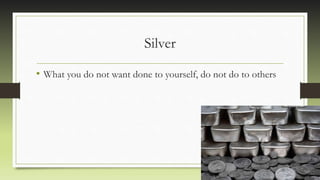
Silver
• What you do not want done to yourself, do not do to others
Gold
• Do unto others as you would have them do unto you.
Platinum
• Do unto others as they want done unto them
THE PLATINUM RULE. TREAT OTHERS HOW THEY WANT TO BE
TREATED
"Have" to or "Get" to be kind
I don’t “have” to . . . I “get” to . . .
The key point is that both versions of reality are true. I have to do certain
things, and I also get to do them.
There’s always a reason why a person becomes who they are.
The most important decision we can make about every
experience in our life is the meaning we assign to those
experiences.
Do we survive in order to connect, or do we connect
in order to survive?
An environment that is safe for people; where there is no assault, challenge or denial of their
identity, of who they are and what they need. It is about shared respect, shared meaning, shared
knowledge and experience, of learning, living and working together with dignity and truly
listening.
(Health Q. F., 2012)
Cultural Safety
Ask “What matters to you?” rather
than “What’s the matter with you?”
Western thinking is individualistic, and based on problem solving.
Other cultures are not so linear.
Risk and Rewards
• We often face a risk acting, and we also face a risk when we do not act.
I am a visitor on this land
May the sun bring you new energy by day,
May the moon softly restore you by night,
May the rain wash away your worries,
May the breeze blow new strength into your being.
May you walk gently through the world and know it’s beauty all the day of your life.
Apache Blessing
& DonT be arfaid to
kame mit sakes
Ask questions, listen,
and then ask more
questions.
Do you have any questions?
Contact information
Greg Riehl RN BScN MA
gregriehl@sasktel.net
greg.riehl@usask.ca

Lateral kindness

  • 1.
    Lateral Kindness CAAN June23rd, 2021 Presentation by Greg Riehl RN BScN MA
  • 2.
    Land Acknowledgment • Iwould like to begin by acknowledging that we are on the traditional lands, referred to as Treaty 4 Territory and that the city of Regina is located on Treaty 4 territory, the original lands of the Cree, Ojibwe(OJIB-WĒ), Saulteaux (SO-TO), Dakota, Nakota, Lakota, and on the homeland of the Métis Nation. We respect and honour the Treaties that were made on all territories, we acknowledge the harms and mistakes of the past, and we are committed to move forward in partnership with Indigenous Nations in the spirit of reconciliation and collaboration. • https://saskschoolboards.ca/wp-content/uploads/Treaty-4-Territory.pdf
  • 3.
    Conflict of Interest: Ihave no actual or potential conflict of interest in relation to this presentation. My ultimate goal is to have good relations, with the people, with the water, with the land, and all the creatures above the land, all the creatures below the land. (all seven directions) Disclosure(s)
  • 4.
    Learning Objectives/Outcomes • Todescribe what lateral kindness means • To explore unconditional positive regard. • To explore bullying, lateral violence, and the role of the victim • To share memorable experiences that support the Platinum Rule • I will describe the bronze silver gold platinum rules • To see your co-workers and others as they want to be seen
  • 5.
    What kind oflearner are you?
  • 6.
    Stories • I willuse some of my experiences working in health, in the north, in community, as an nurse, often an outsider, working in different situations, working along side some of you... • You are a part of the story.
  • 7.
    Once Upon atime… • Sami was late for work, again, …. • Kelly left work early, but nothing is going to happen…… • She didn't get all her work done, again …… • Why is their screen always black on our Zoom calls? • I sent an anonymous thank you card to my co-worker….. • I brought doughnuts for a staff meeting….. • I stayed late and helped get the report in that was due at 1600h… • He was out drinking with the boss again….. • They got their vacation approved and I didn’t…… • It’s Friday….. And guess what? Sally is sick……. Again!!!! • Greg took the company vehicle home over the weekend, again…
  • 8.
    Who are thepeople I work with and for? "There's a lot of healing to be done“ How many people have never had a bad day? Have never done something, that caused you to reflect? How did you want to be treated in that moment, or do you even know? This is not going to be a discussion about how to fix bullies in your workplace, or your environment, but rather, it will be about how you want to be treated, IR-regardless of XYZ. Once we understand how we want to be treated, then we can understand how others, as well, want to be treated. Unconditional Positive Regard. This will be something to strive towards, together, as a group.
  • 9.
    Acts of Kindness Takea minute right now, to do something kind
  • 10.
    Take time, rightnow, to do something kind. “Reach out and help others. If you have the power to make someone happy, do it. Be a vessel, be the change, be the difference, or be the inspiration. Shine your light as an example. The world needs more of that.” ― Germany Kent Can you, could you, do this everyday? Throughout the day?
  • 12.
    We Don’t SeeThings As They Are, We See Them As We Are “It has been well said that we do not see things as they are, but as we are ourselves. Every (hu)man looks through the eyes of his prejudices, of his preconceived notions. Hence, it is the most difficult thing in the world to broaden a man so that he will realize truth as other (hu)men see it.”
  • 13.
    Connections “Humans are hardwiredto connect. It’s an essential part of our well-being, and, as the research shows, having strong social connections is deeply important for our physical and mental health.” Melanie Mannarino The need for quality connections is absolutely critical for both mental and physical health. Bullying increases with the more hierarchy in an organizational structure, there are more opportunities for disconnections. Lateral Kindness thrives with connections…
  • 14.
    What is Bullying? •There are many ways that people bully each other, even if they don't realize it at the time. Some of these include: • Punching, shoving and other acts that hurt people physically • Spreading bad rumours about people • Keeping certain people out of a group - isolation • Teasing people in a mean way • Getting certain people to "gang up" on others https://www.bullyingcanada.ca/what-is-bullying
  • 15.
    Who gets targeted? Anyonewho is different from the group norm on any major characteristic • Experience • Education • Race/ethnicity • Gender Targeted person’s gender • 79% Female • 21% Male
  • 16.
    Dealing with LateralViolence Dealing with lateral violence is dealing with poorly expressed anger. Poorly expressed anger can be due to failure to recognize anger and take constructive action when possible or failure to find healthy ways to blow off some of the anger-related stress or failure to discuss the precipitating cause of the anger. Expressing internalized anger is associated with less stress and depression, more optimism, and a stronger sense of self-efficacy. (Thomas, 2003, 108).
  • 17.
    What are thecharacteristics of a Bully/Victim? In the eyes of a bully, those who display kindness and compassion are weak, but in truth, it’s the bully trying to hide their weakness by making others feel weak.
  • 18.
    Narcissistic Bully They aregrandiose and have dreams of breath taking achievement. They feel they deserve power and position. They can fly into a rage when reality confronts them. This person is very destructive and manipulative, they don’t set out in a callous way to annihilate any person – it is purely an expression of their superiority.
  • 19.
    Accidental Bully This personis task orientated and just wants to get things done, tends to panic when things are not getting done, and goes into a rage about it. This person is basically decent, they don’t really think about the impact of what’s happening or what they have done. They are responding to stress and it is believed that they can be coached out of this behavior.
  • 20.
    Serial Bully Has asociopathic and psychopathic personality. This type of bully is intentional, systematic and organized and is often relentless. They usually get things done in terms of self-interest. They employ subtle techniques that are difficult to detect or prove. Coaching is often ineffective. They exhibit the following: • Grandiose, but charming • Authoritative, aggressive and dominating • Fearless and shameless • Devoid of empathy or remorse • Manipulative and deceptive • Impulsive, chaotic or stimulus seeking • Master of imitation or mimicry
  • 21.
    4 Most commontypes of Bullying Behaviours 1 Social Bullying 2 Verbal Bullying 3 Physical Bullying 4 Cyber Bullying
  • 22.
    1 Social Bullying •Social Bullying - mobbing, scapegoating, excluding others from a group, humiliating others with public gestures or graffiti intended to put others down. https://www.bullyingcanada.ca/what-is-bullying
  • 23.
    2 Verbal Bullying •Verbal bullying - name-calling, sarcasm, teasing, spreading rumours, threatening, making negative references to one's culture, ethnicity, race, religion, gender, or sexual orientation, unwanted sexual comments. https://www.bullyingcanada.ca/what-is-bullying
  • 24.
    3 Physical Bullying •Physical Bullying - hitting, poking, pinching, chasing, shoving, coercing, destroying or stealing belongings, unwanted sexual touching. https://www.bullyingcanada.ca/what-is-bullying
  • 25.
    4 Cyber Bullying •Cyber Bullying - using the internet or text messaging to intimidate, put-down, spread rumours or make fun of someone. https://www.bullyingcanada.ca/what-is-bullying
  • 26.
    In Conflict whoare you: Victim, Villain, Hero ? In conflict, each person feels hit first. The size of the villain determines the size of the hero. “Without goliath, David is just some punk, throwing rocks.” Billy Crystal, My Giant
  • 27.
    What are thecharacteristics of a victim/target? • A victim, according to Webster’s dictionary, is a person who has been attacked, injured, robbed, killed, cheated, or fooled by someone else, or harmed by an unpleasant event. • Everyone gets attacked, injured, cheated, fooled, and harmed during their life — if not physically, then emotionally. And everyone gets harmed by unpleasant events. We’re all victims, in moments, to life’s challenges and difficulties — life’s lifeness.
  • 28.
    Are there benefitsof being a victim? 1. The bully is out to get me, it is not my fault, avoid, avoid… 2. Can become a comfort zone, don’t take risks, feels safe 3. I'm right the bully is wrong, I get sympathy and support 4. Becomes an identity, if lost, who will you be? 5. It's not my fault, I'm not responsible, blame outlet
  • 29.
    How to breakout of being a victim? 1. I have it the worst, but do you? Challenge yourself 2. Be grateful, especially humble, especially if you are a nurse! 3. It's not all about you, think about the other person (the bully) 4. Meditate, chill, find balance, what stories are you creating? 5. Get up and get out, exercise, volunteer, move from …..to …. 6. Forgive, accept, understand, learn
  • 30.
    How to breakout of being a victim? 7. Take ownership and responsibility for your own needs and wants. 8. Practice saying “No.” 9. Stop blaming. 10. Become aware of the root of your sense of powerlessness. 11. Be kind to yourself. 12. Turn your focus to helping others. 13. Practice gratitude. 14. Practice forgiveness.
  • 31.
    Zero Tolerance Policies •Should we be adopting and promoting Zero Tolerance Policies?
  • 32.
    High Conflict Personalities •Lots of all of nothing thinking • Intense or unmanaged emotions • Extreme behaviour or threats • A preoccupation with blaming others – Targets of Blame • From Bill Eddy’s book 5 Types of People who can Ruin Your Life
  • 33.
    How to Dealwith High Conflict Personalities • Connect with empathy, attention, and respect • Analyze alternatives or options • Respond to misinformation or hostility • Set limits on high-conflict behaviours • From Bill Eddy’s book
  • 34.
    Tone Policing isnot Kind . . . • The definition of Tone Policing, according to Dictionary.com is “a conversational tactic that dismisses the ideas being communicated when they are perceived to be delivered in an angry, frustrated, sad, fearful or otherwise emotionally charged manner.” Examples of tone policing? 1. “Calm down.” 2. “You don’t need to get so angry.” 3. “Tone matters.” One of my friends said to me - Residential school children deaths and mass graves – but there was TB, Flu, lots of reasons why children may have died, this was not an easy time to be alive. Me - yah, but they could have had a proper “chrisitian” burial, with names, and dates – but, …..
  • 35.
    Time for abreak - Scavenger hunt 1.Favorite thing that holds liquid 2.Your mask 3.Book you are reading right now 4.Knapsack or purse or carry all bag Please be safe, and see you shortly
  • 36.
    Recognizing my Privilege. •Firstly, to be an effective ally I need to recognize the privileges I may (unknowingly) be benefitting from. • As a true ally I am aware of my privilege and I am willing to speak up about it without taking attention away from those who are marginalized. • As a true ally this can only be decided by those who I am working with, that is, it is not up to me at all. • Really, I am aligning myself with others, it is an action, and an act of doing something, and not something to be turned on or off when it is convenient.
  • 37.
    Lateral Silence • Itis part of the culture. • Everybody knows about it • Everybody does it • No body talks about it
  • 38.
    How do youshow that you CARE? • CARE • Compassion • Acceptance • Respect • Empathy • When you read this, are you thinking of how you show that you CARE for others, or yourself?
  • 39.
    Compassion • Compassion isnot the same as empathy or altruism, though the concepts are related. • Compassion is when those feelings and thoughts include the desire to help.
  • 40.
    Compassionate Empathy • Compassionateempathy is the most active form of empathy. It involves not only having concern for another person, and sharing their emotional pain, but also taking practical steps to reduce it. • For example, imagine that one of your team members is upset and angry because they delivered an important presentation badly. Acknowledging their hurt is valuable, and affirming their reaction by showing signs of those feelings yourself even more so. But best of all is putting aside some time for them, and offering practical support or guidance on getting through the situation and preparing for next time.
  • 41.
    Acceptance vs Tolerance •Acceptance is defined as “favorable reception; approval; favor”. • Tolerance is defined as “a fair, objective, and permissive attitude toward those whose opinions, practices, race, religion, nationality, etc., differ from one’s own; freedom from bigotry”.
  • 42.
    RESPECT 1. Listen andbe present 2. Be thoughtful of others’ feelings 3. Acknowledge others and say thank you 4. Address mistakes with kindness 5. Make decisions based on what’s right, not who you like 6. Respect physical boundaries 7. Live and let live
  • 43.
    Empathy • To useempathy effectively, you need to put aside your own viewpoint and see things from the other person's perspective. Then, you can recognize behavior that appears at first sight to be over emotional, stubborn, or unreasonable as simply a reaction based on a person's prior knowledge and experiences. • Empathy refers more generally to our ability to take the perspective of and feel the emotions of another person.
  • 44.
    Tolerance • Here aresome ways to practice tolerance: • Practice respect and kindness to others • Words matter - Be sensitive to the language you choose • Avoid stereotypes and respect individuality • Be careful about potentially hurtful jokes • Be inclusive - celebrate diversity • Focus on commonalities rather than differences Stand up for others if they are being treated unfairly or unkindly
  • 45.
    He said, Shesaid, They Said • Different genders and cultures communicate differently • Indirect communication • Direct communication • Asynchronous communication – text, email, voicemail • Cyber Lateral Violence • CAPS LOCK We punish people for not being able to communicate properly as opposed to helping them learn new skills..
  • 46.
    Kind Questions • Tellme more about that… • Tell me what happened next…
  • 47.
    Lateral Kindness atwork • Listen closely when people introduce themselves. • Have a conversation where you mostly listen. • Eye contact, and smile at others as you walk down the hallway (or online) • Ask a colleague about their life outside work. • Each day, make a connection with someone you normally don’t spend much time with. • Go for lunch! • Connect with yourself.
  • 48.
    Lateral Kindness everyday • Ask yourself, if what I am saying or doing is helpful? • If you can be kind to your patients, please be kind to each other • Respectful and responsible relationships, there are no apps for that. • Please be kind to each other • Be Grateful • Be Great!
  • 49.
    We all see theworld differently.
  • 50.
    Can we workto create spaces for - Equality, Equity, Reality, Justice
  • 53.
    Kindness - makingsafe and welcomed space Safe • LISTEN and SILENT have the same letters • Presence • Connectedness with others • Being safe vs Feeling safe Welcomed • Secure • Inclusion • We must act together or towards others or with others • Feeling “belonged”
  • 54.
    Vulnerable and Marginalized(People do not do this to themselves) Vulnerable • Adj. - susceptible to physical or emotional attack or harm • (of a person) in need of special care, support, or protection because of age, disability, or risk of abuse or neglect • ISOLATION in all its forms • Trauma Marginalized • Adj. - (of a person, group, or concept) treated as insignificant or peripheral • Who are these people in your community? Homeless, elders, disabled, BIPOC, IVDU, PLWHIV, … • Fight, Flight, Freeze, Fawn, Flop… “Every decision you've ever made has led you to this exact moment.”
  • 55.
    Case study questions •Sally is late to work again…. • What should you do? • Timmy posted on Social Media that they were drunk and partying on the weekend, and they called in sick to work? • What should you do?
  • 56.
    Indigenous students inschool division where girl was shamed for ribbon skirt make inroads
  • 57.
    Unconditional Positive Regard •When we accept others as they are, we give them permission to accept themselves. • To cultivate an attitude of unconditional positive regard for the people in your team, keep these reminders/ personal mantras at hand: • I am here to help, understand, and provide guidelines, not criticize. • Your worth does not need to be earned. • I accept you, even though I may not approve of all the actions or choices you make. • I give you permission to make mistakes and I believe in our collective ability to learn from them.
  • 58.
    UPR In TheWorkplace • So what does it mean for the workplace? A job that most Americans have at some point in their lives is retail, so we will use this. Most people leave their jobs not because they do not enjoy the work, but because of poor management. So how would unconditional positive regard look among your management team in the workplace? Here are some examples: • Giving praise where praise is due • Offering support and positive feedback when you’re struggling • Not blaming things not being done on your inability to do so • Caring about things going on that may affect work (car breaking down, marital problems, personal or family sickness) • Having an open door policy • Hearing the ideas and concerns of its workers. • Does where you work have Unconditional Positive Regard for you and your co-workers? Most job's turnover rate would dramatically decline if these practices were used in the workplace, whether it is retail, service, manufacturing, or creative work .
  • 59.
    Kindness is - •Not staying silence on critique, and complaining against x, y, z, 1, 2, 3 • Kindness can mean sitting with someone (bully), sharing a meal, and discussing their (harmful) thoughts, and actions. • Seeing the plight of people facing injustice, and using the truth to speak to power. • When we are kind to one another and help others, it is often at great personal cost.
  • 60.
    Case study onkindness • Being kind to yourself is very important • Have you ever bought yourself a pair of shoes, boots, moccasins, slippers, … • How did this make you feel? • Have you ever bought someone else a pair of shoes, boots, moccasins, slippers, … • How did this make you feel?
  • 61.
    Altruism • Altruism iswhen we act to promote someone else’s welfare, even at a risk or cost to ourselves
  • 62.
    The Case AgainstAltruism First, let's consider the case against altruism. Acting with kindness offers the following "selfish" benefits: 1) Doing something kind reduces the tension created by our experience of empathy and inaction. 2) A kind act allows us to avoid social sanction or personal guilt for failing to help. 3) Kindness confers social and personal rewards. We earn the approval of others and feel good about ourselves for doing the "right" thing. A theory or "reciprocal altruism" suggests that kind acts are most often directed toward individuals who are likely to repay us in the future
  • 63.
    People are People:we're not born unkind. Kindness is innate. • The word 'kind' originates from the Germanic derivative 'kin', which means 'the natural order’. • Clear is kind • Unclear is unkind. • Question how, not why, a person behaves or acts who they do . . .
  • 64.
    This will makeyour life easier… • Do you believe others around you are doing their “best”? “Are People Doing The Best They Can?” • So, if you don’t believe it, who does that person look like? • But, what if I told you, that person is and always is, doing the very best they can…. • Brené Brown 50/50 https://www.youtube.com/watch?v=w5TkA7d7eTw • Believing that people are doing the best they can, whether they are or they are not, will make a big difference in your (and their) lives. This is your choice to make. • We overthink, we worry, we wish people would be different…. So our lives would be easier.
  • 65.
    I don’t seecolour Anyone who is able to see can discern and recognize one skin color from the next. To say you don’t see color is a misnomer. The goal is actually to see and recognize skin color but to control and regulate your innate impulse to make decisions based on such characteristics. Being able to first recognize this is critical. We all see color.
  • 66.
    Diversity, and whodecides • Skin colour has an impact on how people are treated, hair colour and style, heights, weights, speech, accents, able bodied, disabled, young, old, blind, deaf, rich, poor, smelly, fat, … More states are trying to protect black employees who want to wear natural hairstyles at work • I don’t see colour, is not helpful. Racism is not hidden. • You see colour, and you have lived, learned, and grown in this environment. • what does your clinic or space look and feel like? • Racism sexism • Single mom, 2 kids, 2 different dads. Who do you see? • Do you see colour?
  • 67.
    How are wethe same? What things do you have in common with ………?
  • 68.
    Culture of Inclusion Culture- Everybody does it, everybody knows about it, no one talks about it… K. Bartholomew
  • 69.
    Safe place • Whereis the safe place in your organization?
  • 70.
    How do wemake spaces safe? • Indigenous art • Safe Space (poster, signs, stickers) • Feb black history month • June Indigenous peoples' day month RICHARD RIEL DUBOIS CLIFF DUBOIS
  • 71.
    When you havethe choice to be right, or kind… Always choose to be kind.
  • 72.
    Tone Policing • Blackwoman colleague: “I am really tired of going to these women leadership events and it only being about or for white women! Someone needs to call this out—it is ridiculous. And it really makes our diversity efforts seem so one-sided.” • White woman colleague: “You know, I think you could probably get more buy-in if your approach wasn’t as divisive. You don’t want people thinking you’re upset or being difficult or saying their efforts don’t work. Like, you know I’m all for diversity but your statement kind of made me feel excluded, or if as a white woman, I’m doing something wrong.” > tone-policing
  • 73.
    Tone Policing • Thedefinition of tone policing, according to Dictionary.com is “a conversational tactic that dismisses the ideas being communicated when they are perceived to be delivered in an angry, frustrated, sad, fearful or otherwise emotionally charged manner.” What are some examples of tone policing? 1. “Calm down.” 2. “You don’t need to get so angry.” 3. “Tone matters.”
  • 75.
    Bronze rule • Dounto others as they have done unto you
  • 76.
    Silver • What youdo not want done to yourself, do not do to others
  • 77.
    Gold • Do untoothers as you would have them do unto you.
  • 78.
    Platinum • Do untoothers as they want done unto them THE PLATINUM RULE. TREAT OTHERS HOW THEY WANT TO BE TREATED
  • 80.
    "Have" to or"Get" to be kind I don’t “have” to . . . I “get” to . . . The key point is that both versions of reality are true. I have to do certain things, and I also get to do them.
  • 81.
    There’s always areason why a person becomes who they are. The most important decision we can make about every experience in our life is the meaning we assign to those experiences. Do we survive in order to connect, or do we connect in order to survive?
  • 82.
    An environment thatis safe for people; where there is no assault, challenge or denial of their identity, of who they are and what they need. It is about shared respect, shared meaning, shared knowledge and experience, of learning, living and working together with dignity and truly listening. (Health Q. F., 2012) Cultural Safety
  • 83.
    Ask “What mattersto you?” rather than “What’s the matter with you?” Western thinking is individualistic, and based on problem solving. Other cultures are not so linear.
  • 84.
    Risk and Rewards •We often face a risk acting, and we also face a risk when we do not act.
  • 85.
    I am avisitor on this land May the sun bring you new energy by day, May the moon softly restore you by night, May the rain wash away your worries, May the breeze blow new strength into your being. May you walk gently through the world and know it’s beauty all the day of your life. Apache Blessing
  • 86.
    & DonT bearfaid to kame mit sakes Ask questions, listen, and then ask more questions.
  • 87.
    Do you haveany questions?
  • 88.
    Contact information Greg RiehlRN BScN MA gregriehl@sasktel.net greg.riehl@usask.ca

Editor's Notes

  • #3 https://en.wikipedia.org/wiki/Treaty_4 https://www.webcitation.org/query?url=http%3A%2F%2Fwww.ainc-inac.gc.ca%2Fai%2Fscr%2Fsk%2Ffni%2Fpubs%2Ffnl-eng.pdf&date=2009-12-02 Treaty 4 is a treaty established between Queen Victoria and the Cree and Saulteaux First Nation band governments. The area covered by Treaty 4 represents most of current day southern Saskatchewan, plus small portions of what are today western Manitoba and southeastern Alberta. “When working on or within the traditional territory of a First Nation there is protocol to follow. It can be customary between one First Nation and another to acknowledge the host First Nation Peoples and their traditional territory at the outset of any meeting…it follows then, that if you want to [work] with a First Nation, one of the best ways is to show respect to the Nation by following traditional territory protocol.” Joseph, “First Nation Protocol on Traditional Territory.”
  • #5 https://medium.com/behavior-design/the-surprising-benefits-of-unconditional-positive-regard-973cb9d9baa7
  • #6  1) Prisoner: this participant is there because they have been “told” to attend. They don’t want to be there and don’t see why they need to be there. They don’t want to contribute and they will lower the energy levels in the room. 2) Vacationer: the person who’s attending because it’s an excuse for a “day off ” from their normal job. They will get involved, but are not really interested in learning anything – more about having fun and avoiding the work they left behind on their desk. 3) Keener: this participant is there to genuinely learn as much as they can from the session. This type of learner is attentive during the session, gets actively involved in group work and brings high levels of energy into the room. 4) Expert: you clearly know more than I do, http://www.clomedia.com/2008/06/17/engaging-the-prisoner-the-vacationer-the-expert-and-the-explorer/
  • #9 https://practicalpie.com/unconditional-positive-regard/
  • #11 https://www.randomactsofkindness.org/world-kindness-day
  • #12 Someone is always watching you,
  • #13 http://quoteinvestigator.com/2014/03/09/as-we-are/ 1891, The Province of Expression: A Search for Principles Underlying Adequate Methods of Developing Dramatic and Oratoric Delivery by S. S. Curry (Samuel Silas Curry) (Dean, School of Expression: Instructor of Elocution, Harvard College), Quote Page 392, Published by School of Expression, Boston, Massachusetts. (Google Books Full View) link ↩
  • #14 What about ‘Sticks and Stones may break my bones, but names will never hurt me?” https://thriveglobal.com/stories/career-work-relationships-connections-colleagues-success-tech-happiness/ https://www.psychologytoday.com/ca/blog/the-science-kindness/201901/the-secret-sauce-kindness-connection
  • #16 Women were more often the perpetrator – 65% Men target men and women equally Women target other women 70% of the time Hierarchy makes us different
  • #18 What about ‘Sticks and Stones may break my bones, but names will never hurt me?” http://www.lillooetnews.net/opinion/vocal-local/it-s-never-too-late-to-discuss-bullying-1.23192805
  • #19 https://www.psychology.org.au/publications/inpsych/workplace_bullying/
  • #20 https://www.psychology.org.au/publications/inpsych/workplace_bullying/
  • #21 https://www.psychology.org.au/publications/inpsych/workplace_bullying/
  • #27 roles focus on problems, feed on each other, generate anxiety and perpetuate the toxic interplay between the people within the drama. Sometimes you switch back and forth between these roles so fast you can't keep it all straight. Drama Triangle Gary Harper
  • #28 https://www.psychologytoday.com/ca/blog/inviting-monkey-tea/201801/are-you-ready-stop-feeling-victim
  • #30 https://createbalanceandfindinghappiness.wordpress.com/2014/12/16/the-benefits-of-being-a-victim/
  • #31 https://createbalanceandfindinghappiness.wordpress.com/2014/12/16/the-benefits-of-being-a-victim/ https://www.psychologytoday.com/ca/blog/inviting-monkey-tea/201801/are-you-ready-stop-feeling-victim
  • #32 http://www.tolerance.org/magazine/number-45-fall-2013/there-are-no-bullies How can we help? The painful effects of bullying lead many educators to focus on justice and safety for students who are targeted and to feel contempt for those responsible for the pain—an approach that often results in harsh disciplinary measures, such as suspensions and expulsions from school. These zero-tolerance measures may appear responsive, but Juvonen and most experts who study school discipline warn against policies that make school a threatening, uncertain place. Juvonen notes that in addition to not addressing the root causes of bullying, such harsh tactics fuel the perception that youth have no choice but to fight for themselves. The most effective bullying interventions don’t focus on only one category of kids, but rather acknowledge that all students benefit when schools empower youth and teach them about healthy relationships. By adopting such policies and giving the power to stop bullying to teachers, faculty, parents, governments, law makers, what does this do to the bully? To the victim? This might give more power to the bully . . . Ontario statutory definition states: “bullying” means repeated and aggressive behaviour by a pupil where, (a) the behaviour is intended by the pupil to cause, or the pupil ought to know that the behaviour would be likely to cause, harm, fear or distress to another individual, including psychological harm or harm to the individual’s reputation, and (b) the behaviour occurs in a context where there is a real or perceived power imbalance between the pupil and the individual based on factors such as size, strength, age, intelligence, peer group power, economic status, social status, religion, ethnic origin, sexual orientation, family circumstances, gender, race, disability or the receipt of special education73
  • #35 http://www.theinclusionsolution.me/unpacking-the-conversations-that-matter-if-you-werent-so-angry-people-would-listen-and-the-problem-with-tone-policing/ https://ca.news.yahoo.com/might-guilty-tone-policing-spot-160000440.html
  • #38 Kathleen Bartholomew quote
  • #42 https://ruminating.org/news/creating-an-inclusive-society-tolerance-vs-acceptance/
  • #43 https://www.girlscouts.org/en/raising-girls/leadership/life-skills/how-to-be-respectful.html
  • #44 https://www.mindtools.com/pages/article/EmpathyatWork.htm
  • #45 https://www.theeap.com/wp-content/uploads/2016/02/TotalCare-EAP-March-Employee-Newsletter.pdf
  • #46 https://www.achievesolutions.net/achievesolutions/en/Content.do?contentId=10241 The #1 Mistake in Modern Communication no emotional communication ever No emotional communication via email, text or voicemail (AKA asynchronous media). Ever.
  • #47 https://www.mindtools.com/pages/article/newTMC_88.htm
  • #48 https://thriveglobal.com/stories/career-work-relationships-connections-colleagues-success-tech-happiness/
  • #50  Same picture everyone has a different interpretation The Golden Rule “do unto other as you would have them do unto you” or treat others how we would like to be treated, is a value many people learn growing up. Nursing education reinforces this adage and supports nurses to treat clients with similar conditions in similar ways. But, the Golden Rule does not support holistic care of addressing physical, mental, spiritual, or emotional needs of the client who may be culturally, ethnically, or spiritually different from the person or group providing care. For social justice to support inclusivity there needs to be a shift to the Platinum Rule, “do unto other as they want do unto them” or treat others how they want to be treated. The challenge implementing the Platinum Rule is evident in practice and occurs when providers work with clients who are culturally, ethnically, or socially different from themselves or with clients who actively engaging in risky behaviours or unhealthy choices. The Golden Rule supports healthcare provider morals and personal values; the Platinum Rule supports clients’ values and realizes that all humans have certain rights, even the right to make “bad” choices. In nursing, we should not treat everyone the same; we are all different. Patients, families, groups, and communities possess the knowledge to be active consumers and partners in health programming. Acceptance of all clients, with a focus on genuine empathy, regardless of lifestyles, behaviours, and choices, is required to deliver optimal client-first health care. This presentation is about the Platinum Rule and you.  
  • #54 https://www.vocabulary.com/dictionary/marginalize
  • #55 Adjectives describe or modify—that is, they limit or restrict the meaning of—nouns and pronouns. Marginalized A society that labels certain people as outside the norm — weird, scary, hateful, or useless — marginalizes those people, edging them out. Native or aboriginal groups often end up in this position, and so do people who are poor, disabled, elderly, or who in other ways are seen as not quite fitting in. The Latin root is margo, "edge, brink, or border." Since the late 1920's marginalize has referred not to a literal edge, but to a powerless position just outside society. https://www.vocabulary.com/dictionary/marginalize
  • #57 https://www.cbc.ca/news/canada/saskatchewan/indigenous-students-ribbon-skirt-school-1.6069359
  • #58 http://www.rodmatthews.com.au/blog/human-universals-keep-us-connected-1
  • #59 https://practicalpie.com/unconditional-positive-regard/ https://www.psqh.com/analysis/leveraging-unconditional-positive-regard-to-minimize-violence-in-the-healthcare-workplace/ https://onlinelibrary.wiley.com/doi/full/10.1002/ijop.12761 https://www.youtube.com/watch?v=-1KCzrTg9ic
  • #60 https://shanacarroll.medium.com/a-case-study-on-kindness-8e6a7d310c41 http://www.honeyfoundation.org/research-info/
  • #63 https://www.authentichappiness.sas.upenn.edu/newsletters/authentichappinesscoaching/kindness It can be physically and psychologically uncomfortable to see someone in need of support (e.g., a homeless person shivering during winter, a friend who lost a parent, a child being verbally abused by a parent). Helping relieves this tension. You may remember the very last Seinfeld show. Jerry, George, Elaine and Kramer were prosecuted and jailed in Massachusetts for failing to help someone being robbed, thus violating a Good Samaritan law. Such laws actually do exist in a few states (although fines are more likely than jail time). A much more common sanction for failing to help when needed is the disapproval of our friends, coworkers, family members, and romantic partners. Selfish, Insensitive, Heartless, Mean--These are labels we wish to avoid. (Trivers, 1971). If you offer to collect the mail of your neighbors when they are on vacation, then they will likely do the same for you. Evolutionary psychologist Geoffrey Miller noted that a truly anonymous act of kindness is the exception. For example, most "anonymous" donations are no secret to the giver's immediate family. Miller does not deny that most people have pure intentions when they donate money or time; but he does question why feelings of empathy and a proclivity to help evolved in the first place. He suggests that they evolved because acting with kindness and generosity confers social rewards.
  • #65 https://www.youtube.com/watch?v=DitC14Z_FYQ
  • #66 https://www.forbes.com/sites/janicegassam/2019/02/15/why-the-i-dont-see-color-mantra-is-hurting-diversity-and-inclusion-efforts/?sh=5653e7f72c8d
  • #67 https://www.washingtonpost.com/business/2019/09/19/more-states-are-trying-protect-black-employees-who-want-wear-natural-hairstyles-work/
  • #68 1. 10 things in common Split everyone into pairs and hand each pair a piece of paper. Each pair is responsible for finding 10 things they have in common with one another. Remember to tell everyone easy cop-outs aren’t allowed, like “we both have hands”. Once they find 10 things they have in common, they share their discoveries with the group. The point of this icebreaker is to help direct conversations and to find some similarities between you and your partner. You can repeat this a few times to have people chat with someone new.
  • #71 https://nativecanadianarts.com/ Indigenous awareness vs white privilege awareness https://hbr.org/2014/08/fixing-a-work-relationship-gone-sour https://www.inc.com/amy-morin/2-psychological-tricks-that-will-help-you-stop-feeling-sorry-for-yourself.html https://www.huffpost.com/entry/5-ways-commiserating-keep_b_3558837 https://breaktheframe.com/leadership-commiserating/
  • #73 http://www.theinclusionsolution.me/unpacking-the-conversations-that-matter-if-you-werent-so-angry-people-would-listen-and-the-problem-with-tone-policing/
  • #74 http://www.theinclusionsolution.me/unpacking-the-conversations-that-matter-if-you-werent-so-angry-people-would-listen-and-the-problem-with-tone-policing/ https://ca.news.yahoo.com/might-guilty-tone-policing-spot-160000440.html
  • #75 We all know the Golden Rule “do unto others…” but in health care, this does not work all the time for all people receiving or providing care. The Platinum Rule supports acceptance of all and avoids value and moral judgments to support care. Learn about the Platinum Rule and you.
  • #76 Unfortunately this is often how nursing is, we had to endure certain hardships as new nurses, and many feel the need to see one, do one, and teach one in the same manner, putting new graduate nurses through the same hardships they endured.
  • #77 Confucius or One should not treat others in ways that one would not like to be treated
  • #79 This is really what we are trying to do with all people. Basically treat other people how they want to be treated. The Platinum Rule meets people where they are at, it is a balanced approach that gives power to the client. Just like all areas of the medicine wheel need to be balanced for (w)holistic health for the client, where the client is the person, family, group, or community. Indigenous teachings support addressing all areas of the person to achieve balance.
  • #82 https://www.psychologytoday.com/us/blog/in-it-together/201809/the-neuroscience-feeling-safe-and-connected
  • #83 http://pub209healthcultureandsociety.wikispaces.com/%27A+Tree+Without+Roots%27+-+The+Importance+of+Cultural+Safety+in+the+Healthcare+System Picture is from Yellowknife