UNIT 3
CONTROL OF PARTICULATE
CONTAMINANTS
• UNIT III CONTROL OF PARTICULATE
CONTAMINANTS
Factors affecting Selection of Control Equipment
– Gas Particle Interaction – Working principle,
Design and performance equations of Gravity
Separators, Centrifugal separators Fabric
filters, Particulate Scrubbers, Electrostatic
Precipitators – Operational Considerations.
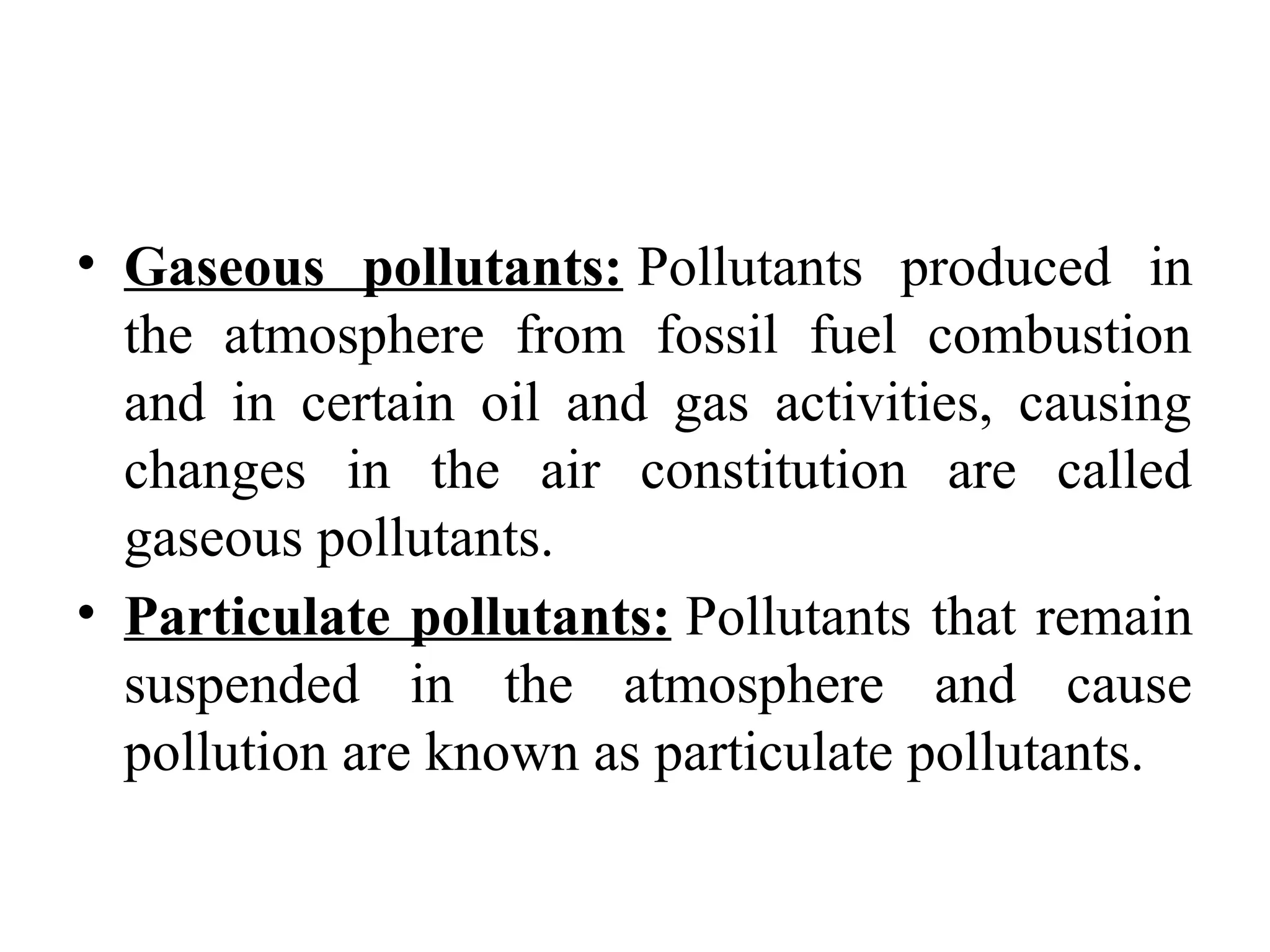
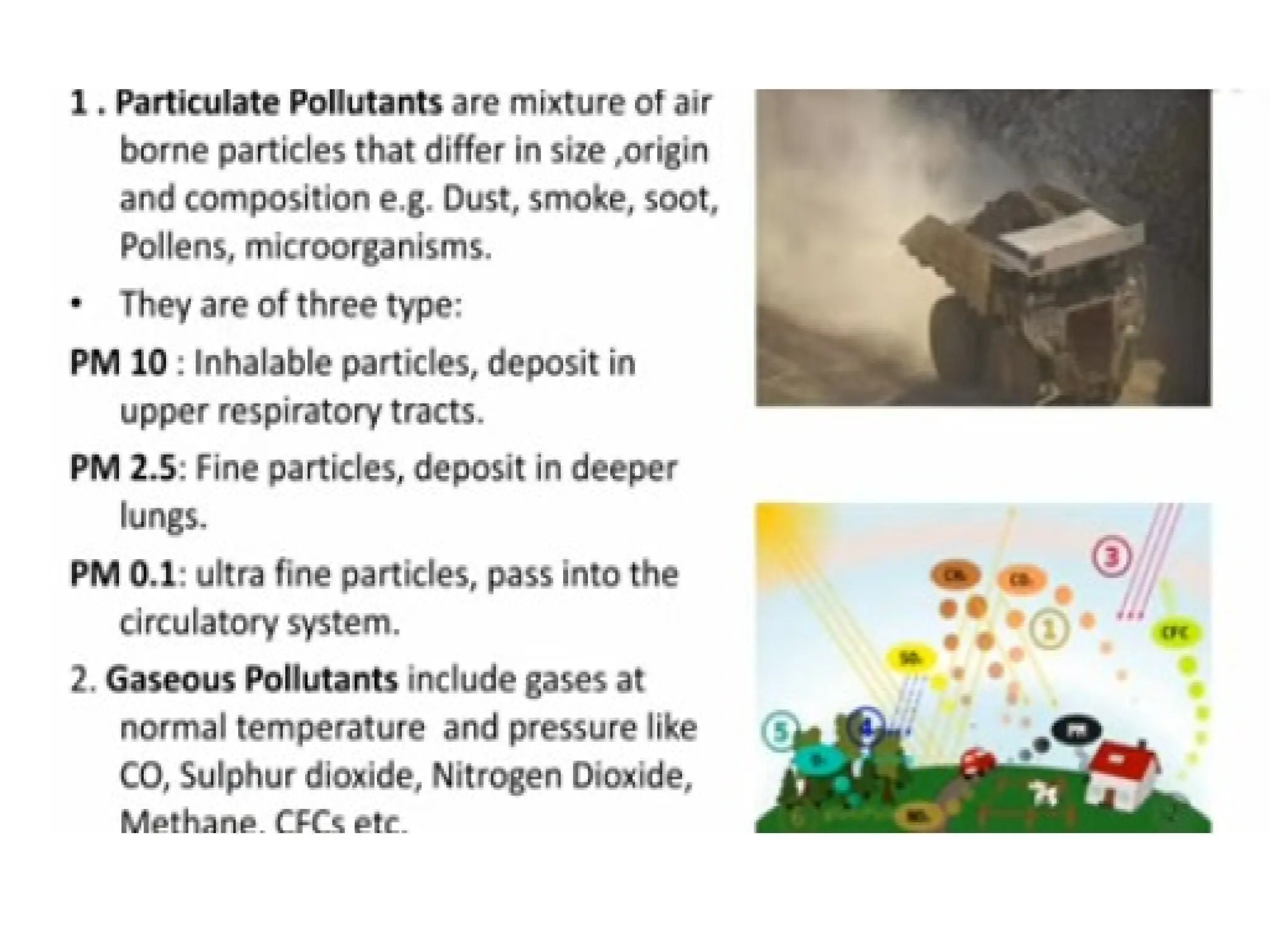
• Gaseous pollutants: Pollutants produced in
the atmosphere from fossil fuel combustion
and in certain oil and gas activities, causing
changes in the air constitution are called
gaseous pollutants.
• Particulate pollutants: Pollutants that remain
suspended in the atmosphere and cause
pollution are known as particulate pollutants.
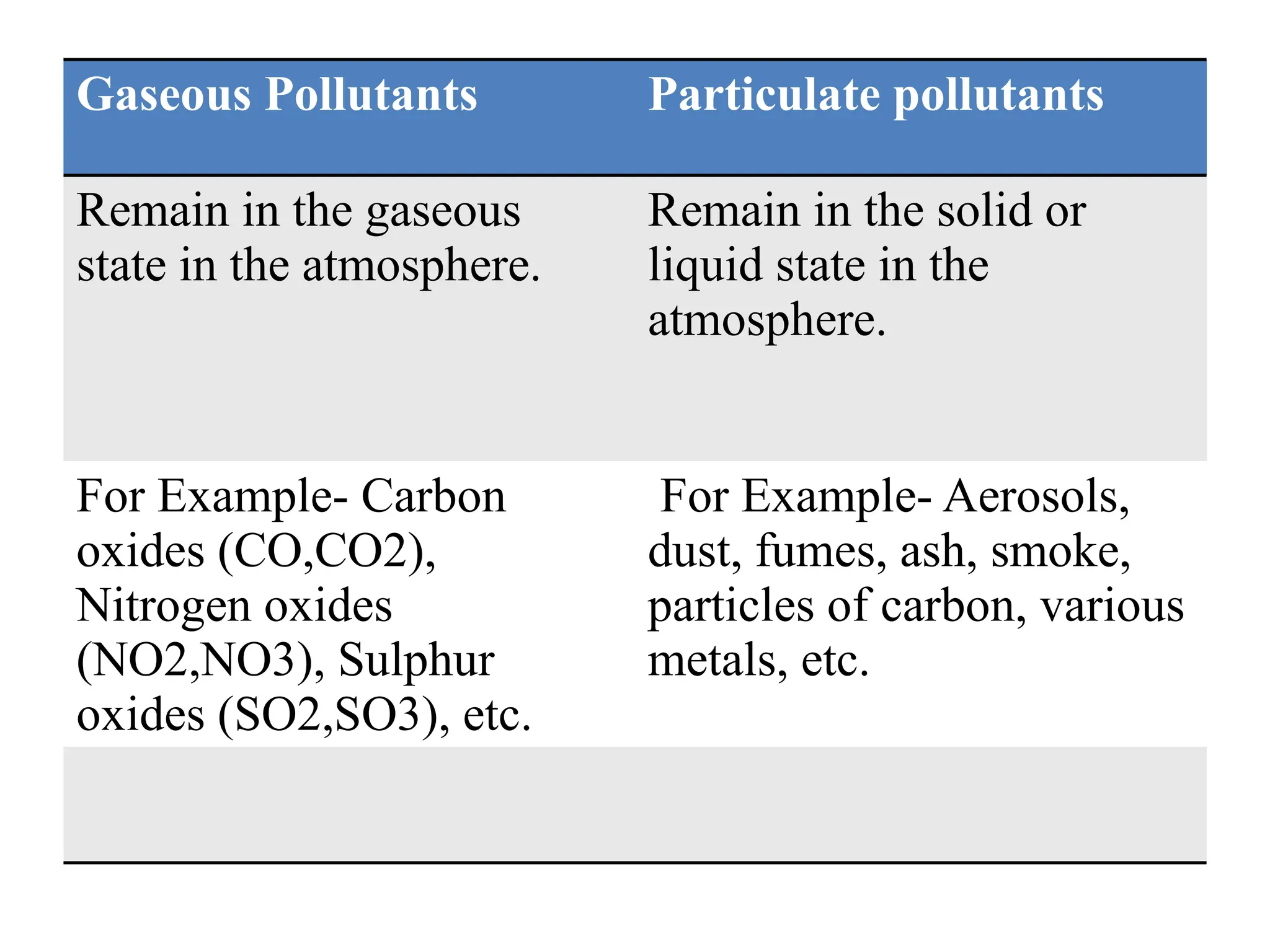
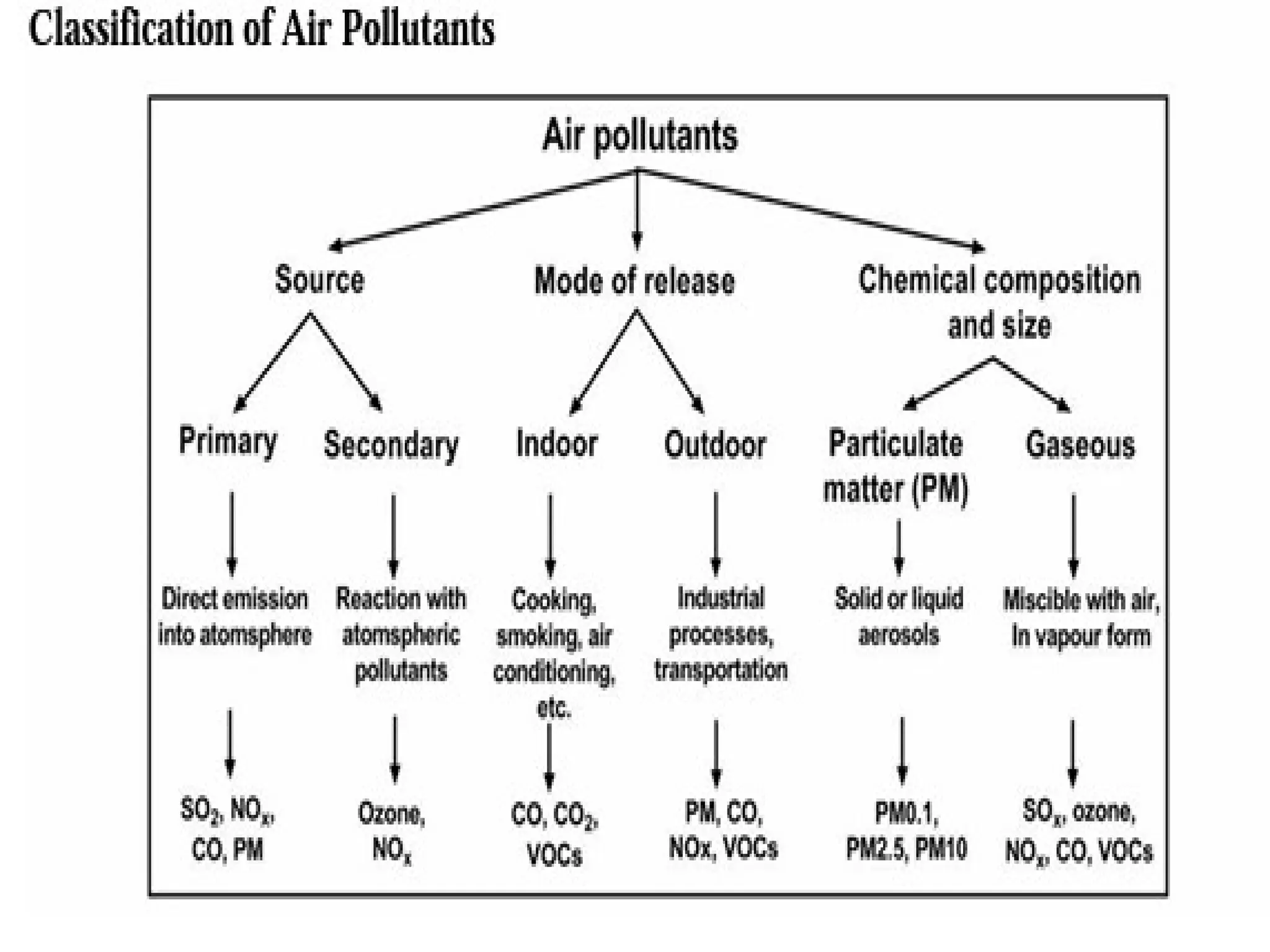
Gaseous Pollutants Particulate pollutants
Remain in the gaseous
state in the atmosphere.
Remain in the solid or
liquid state in the
atmosphere.
For Example- Carbon
oxides (CO,CO2),
Nitrogen oxides
(NO2,NO3), Sulphur
oxides (SO2,SO3), etc.
For Example- Aerosols,
dust, fumes, ash, smoke,
particles of carbon, various
metals, etc.
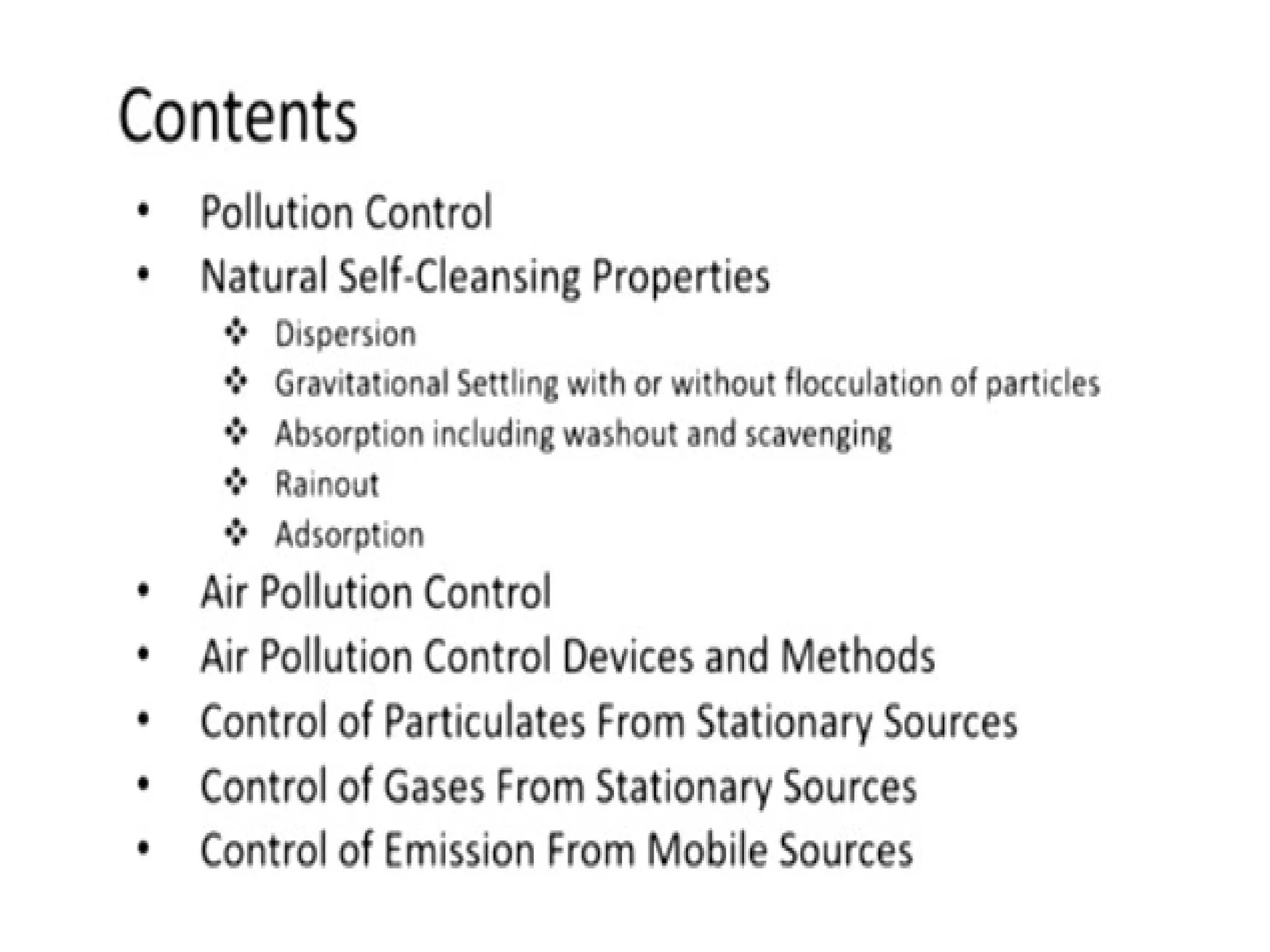
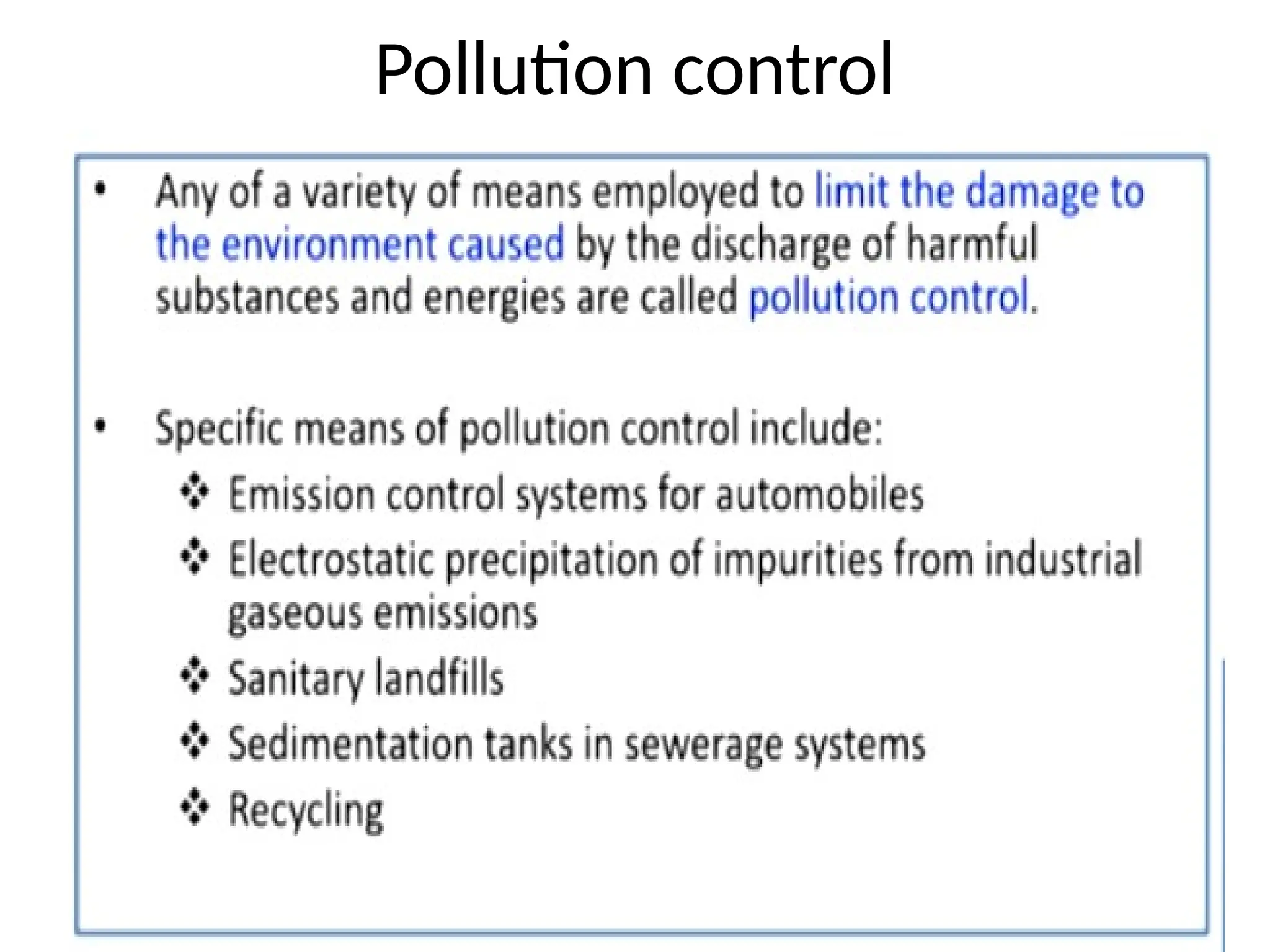
Pollution control
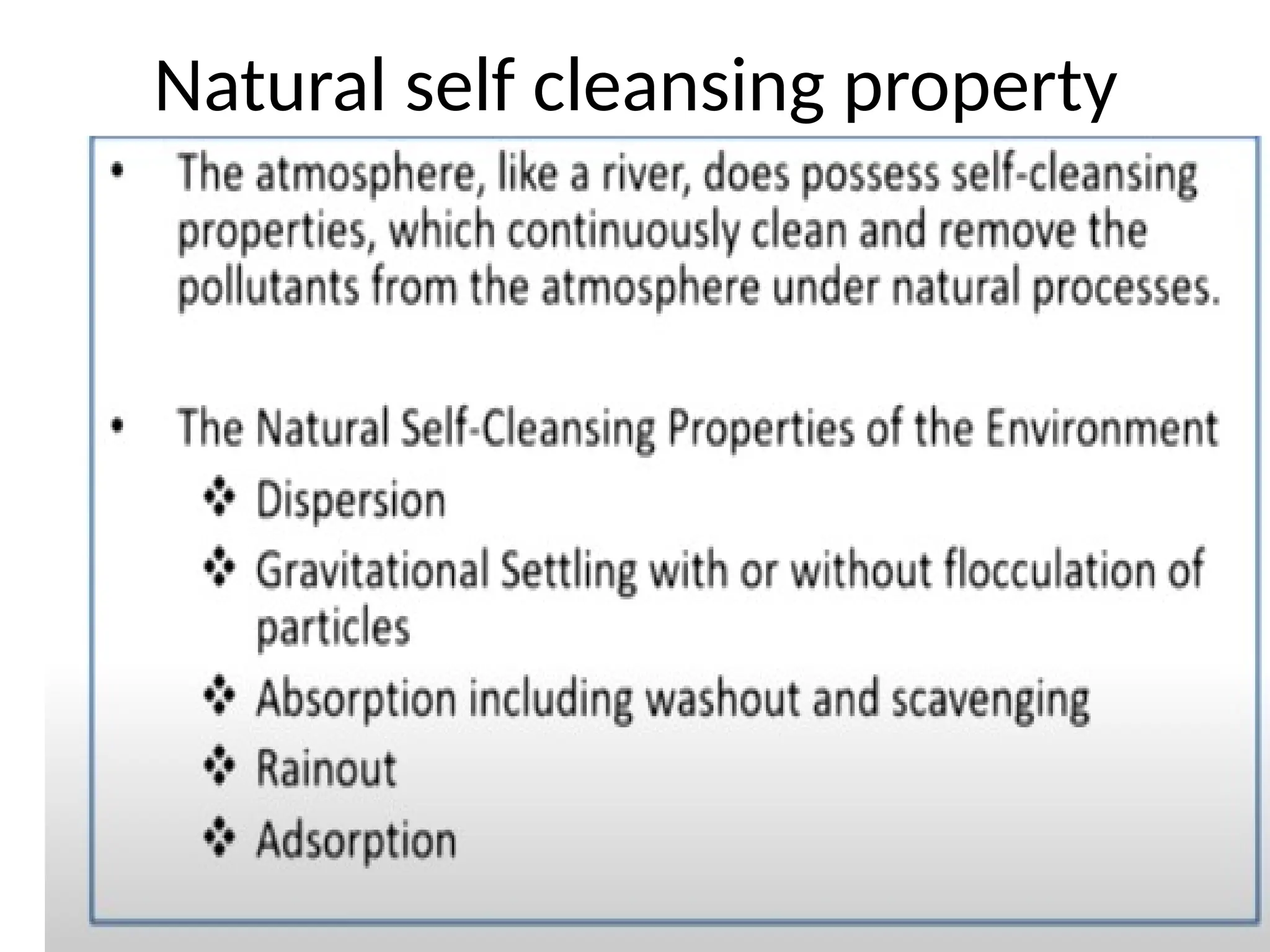
Natural self cleansing property
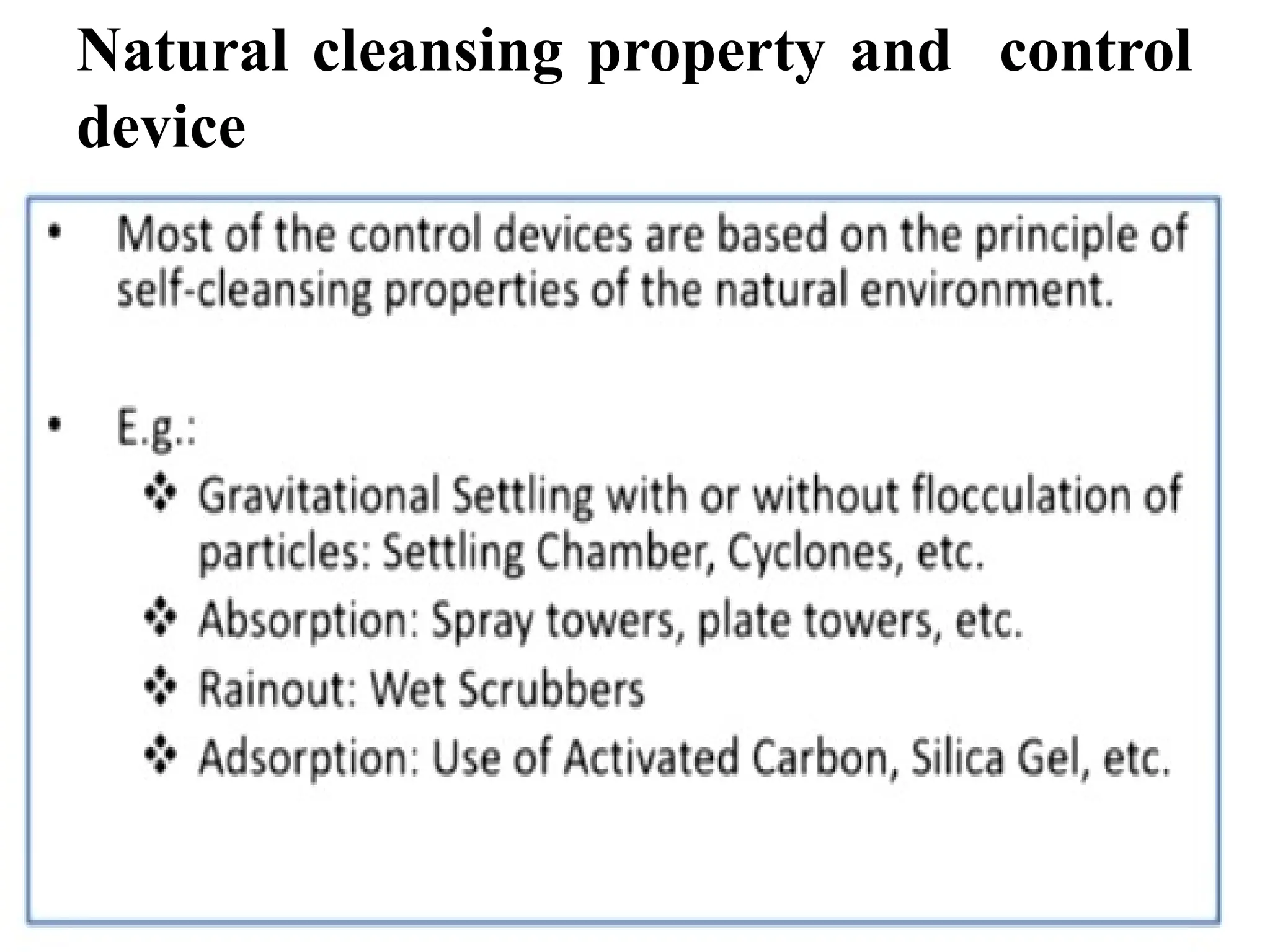
Natural cleansing property and control
device
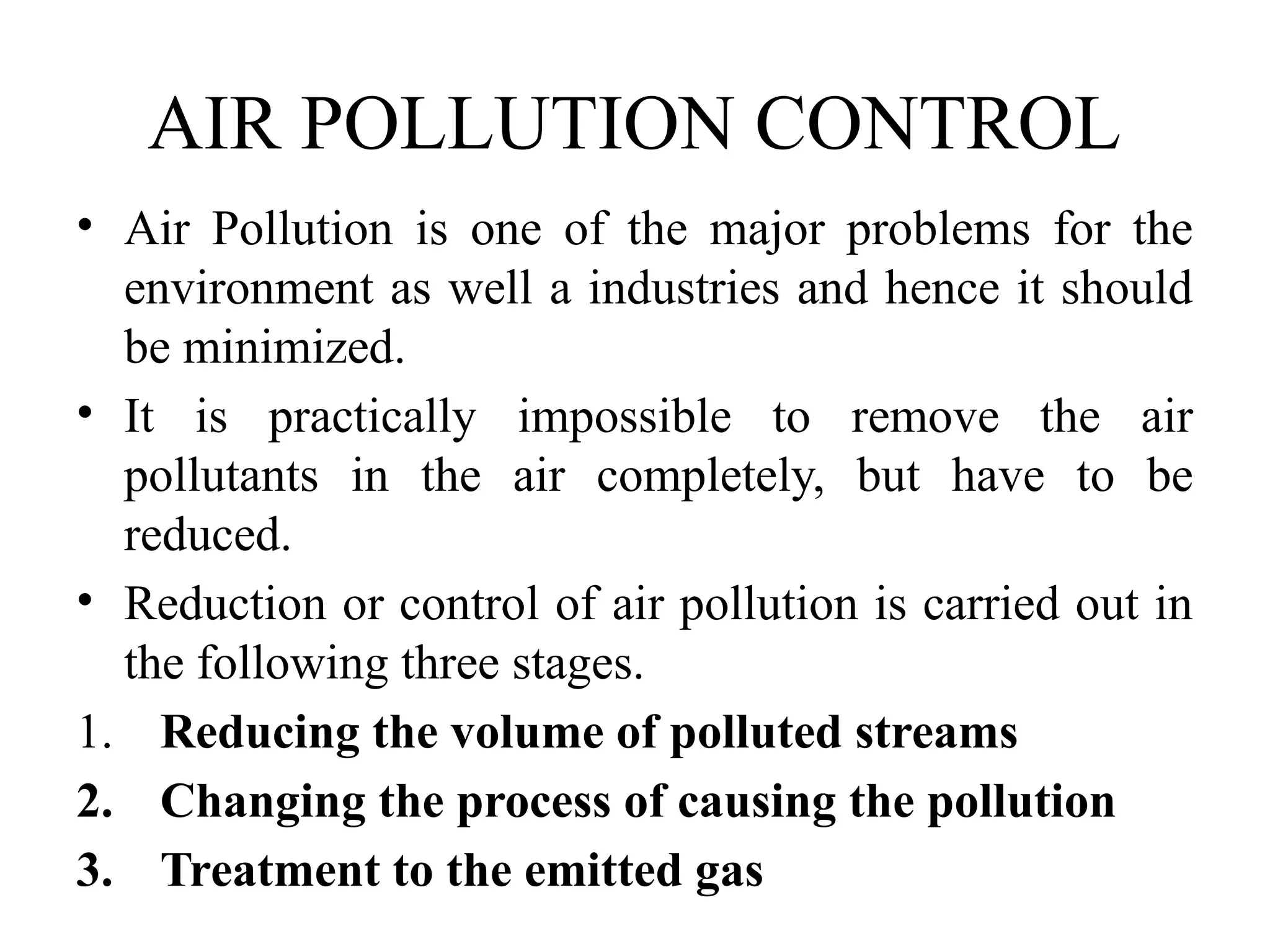
AIR POLLUTION CONTROL
• Air Pollution is one of the major problems for the
environment as well a industries and hence it should
be minimized.
• It is practically impossible to remove the air
pollutants in the air completely, but have to be
reduced.
• Reduction or control of air pollution is carried out in
the following three stages.
1. Reducing the volume of polluted streams
2. Changing the process of causing the pollution
3. Treatment to the emitted gas
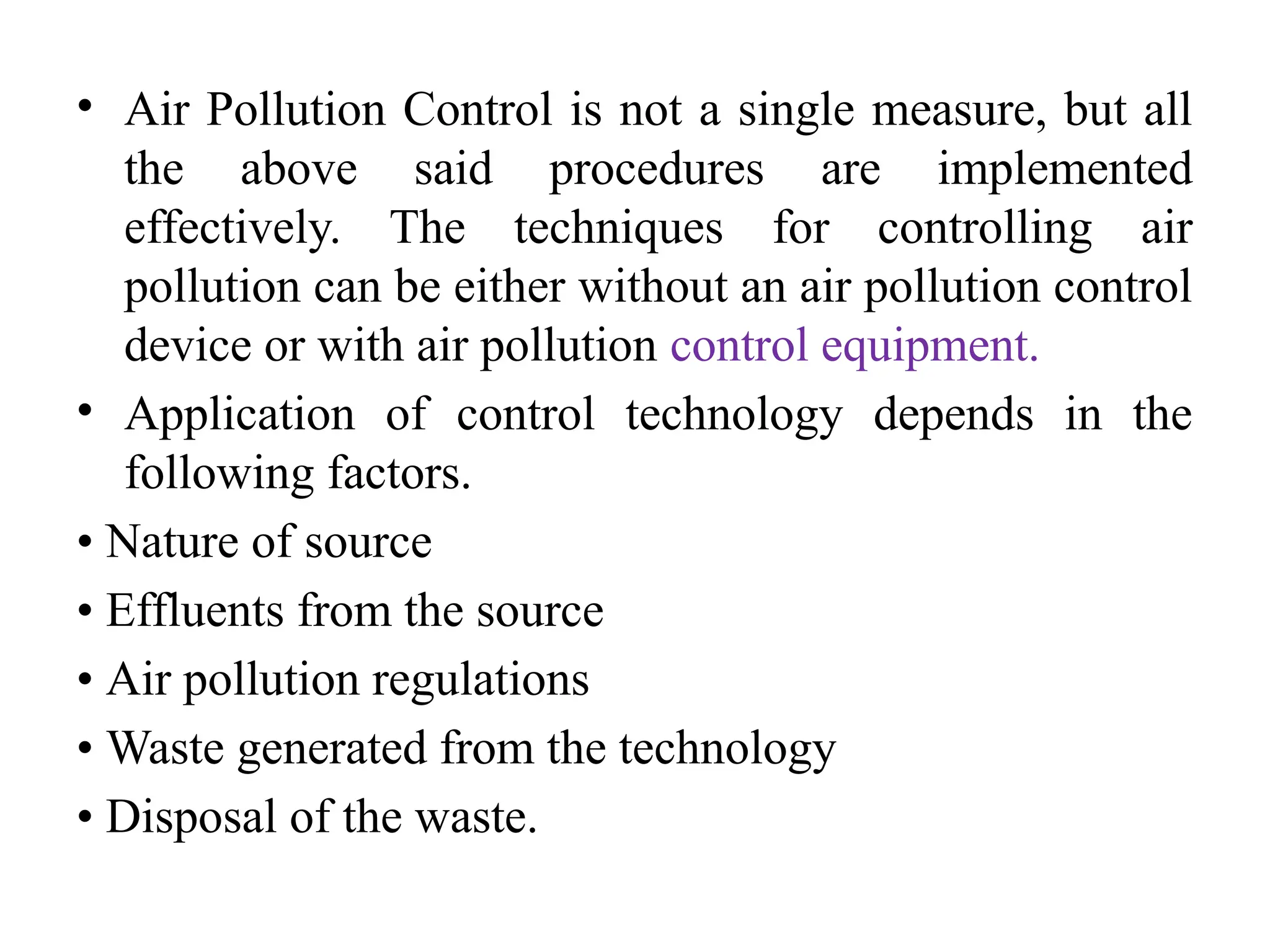
• Air Pollution Control is not a single measure, but all
the above said procedures are implemented
effectively. The techniques for controlling air
pollution can be either without an air pollution control
device or with air pollution control equipment.
• Application of control technology depends in the
following factors.
• Nature of source
• Effluents from the source
• Air pollution regulations
• Waste generated from the technology
• Disposal of the waste.
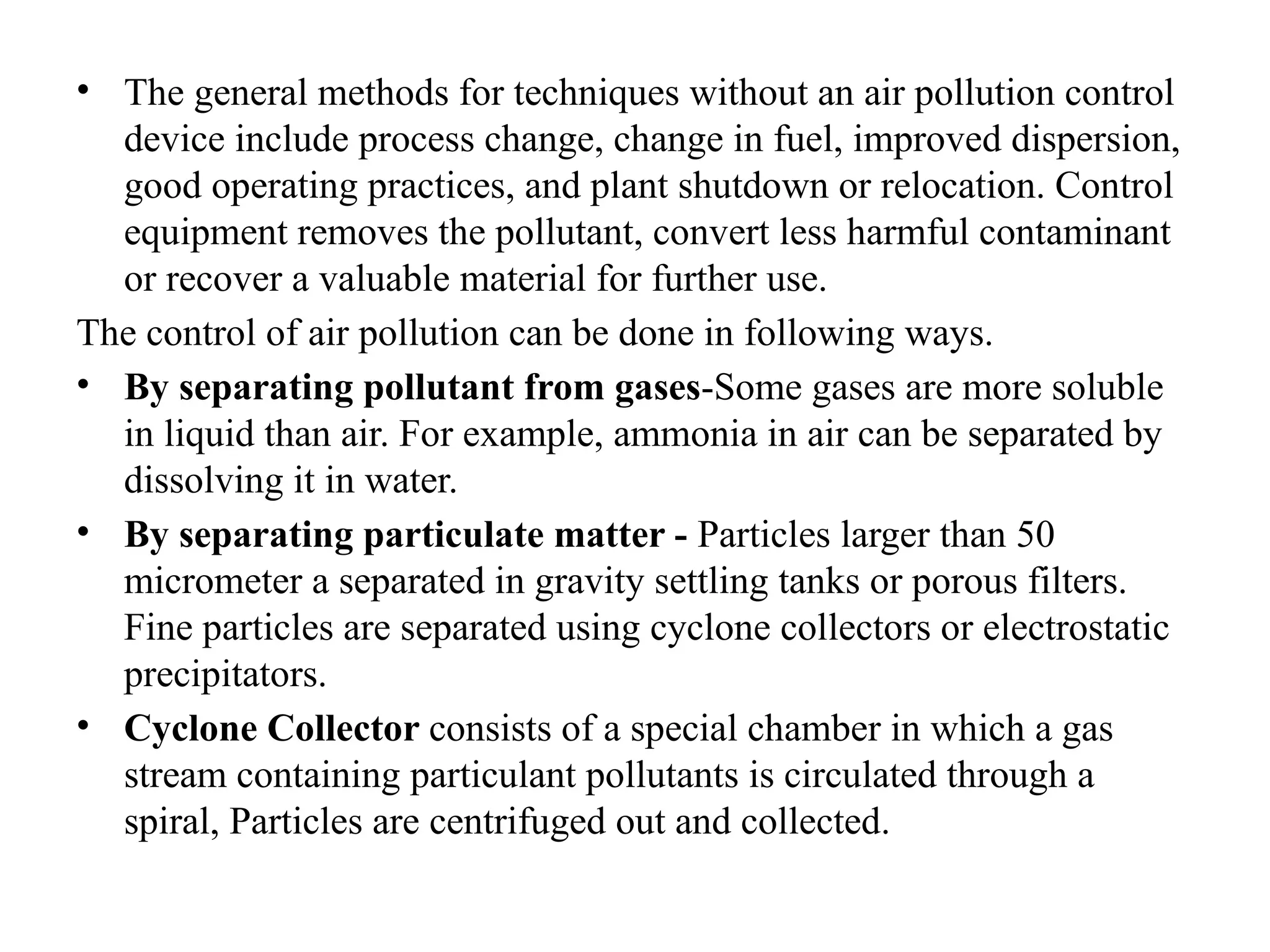
• The general methods for techniques without an air pollution control
device include process change, change in fuel, improved dispersion,
good operating practices, and plant shutdown or relocation. Control
equipment removes the pollutant, convert less harmful contaminant
or recover a valuable material for further use.
The control of air pollution can be done in following ways.
• By separating pollutant from gases-Some gases are more soluble
in liquid than air. For example, ammonia in air can be separated by
dissolving it in water.
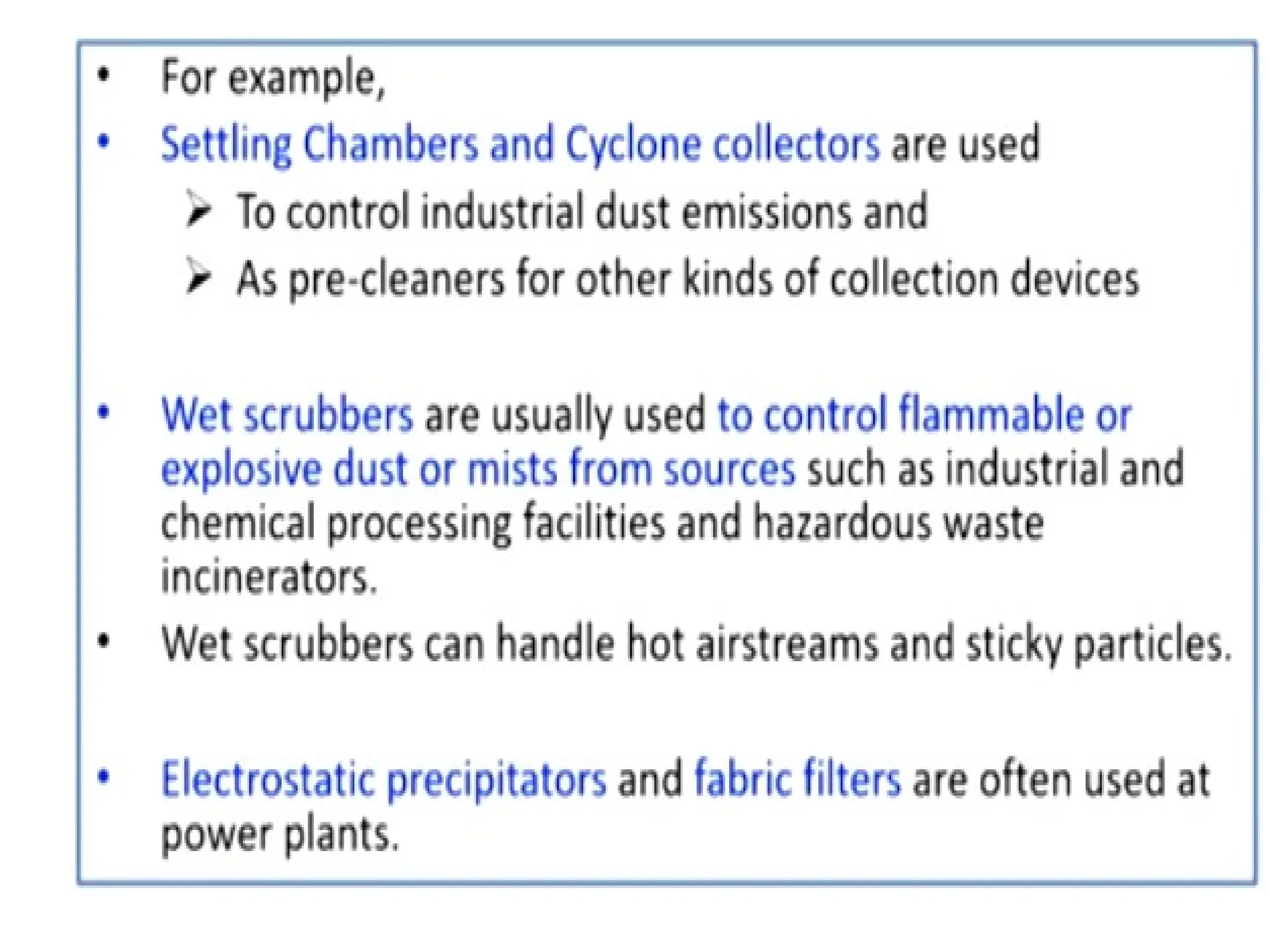
• By separating particulate matter - Particles larger than 50
micrometer a separated in gravity settling tanks or porous filters.
Fine particles are separated using cyclone collectors or electrostatic
precipitators.
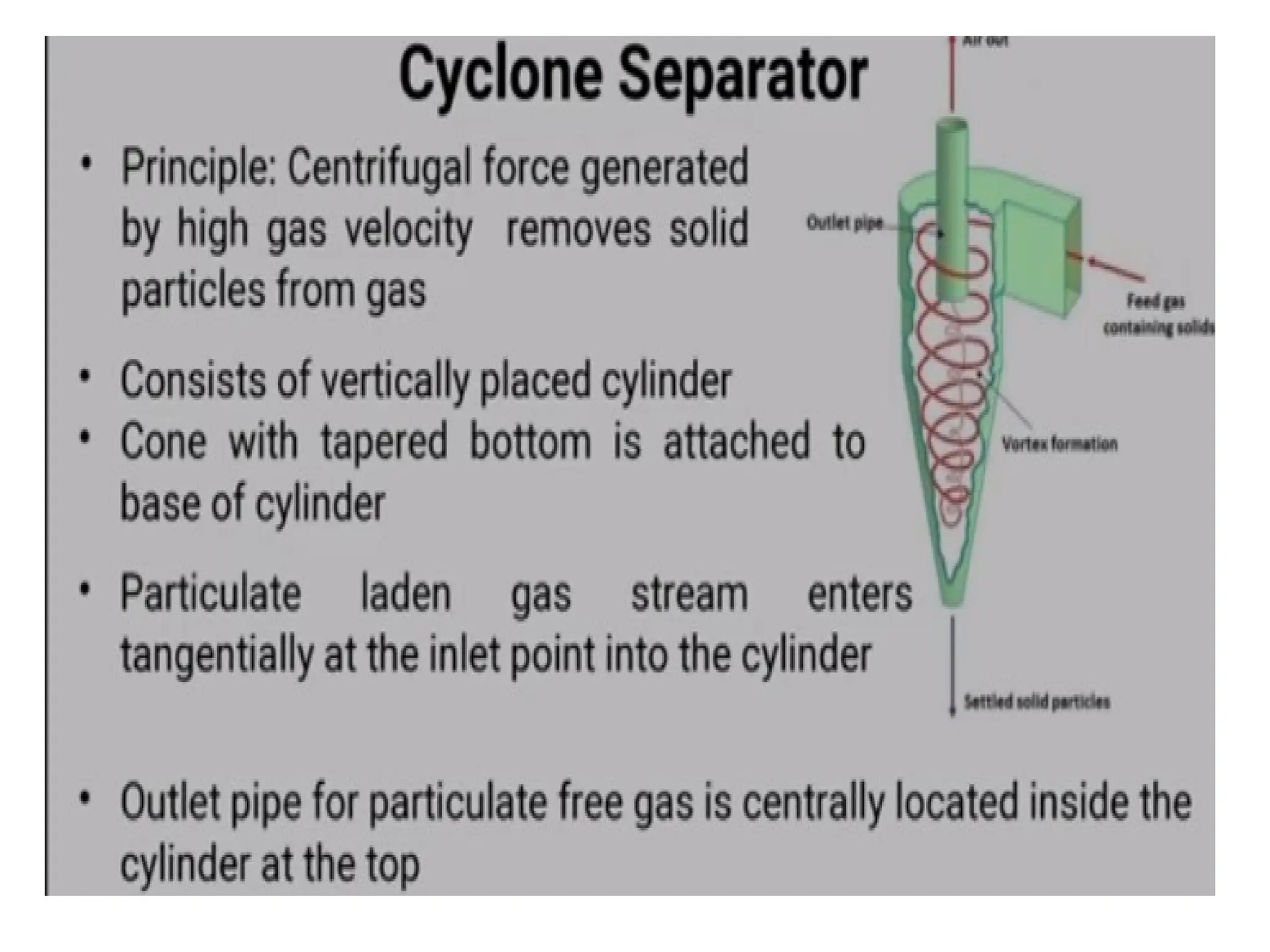
• Cyclone Collector consists of a special chamber in which a gas
stream containing particulant pollutants is circulated through a
spiral, Particles are centrifuged out and collected.
Objective of Air Pollution Control
The important objectives of the air pollution
control are as follows.
1. Controlling of effects of air pollution on public
2. Describe natural processes that help control air
pollution
3. Protection of animals, Plants, etc...
4. Protection of properties against pollutants attack
5. Providing the acceptable environment etc..
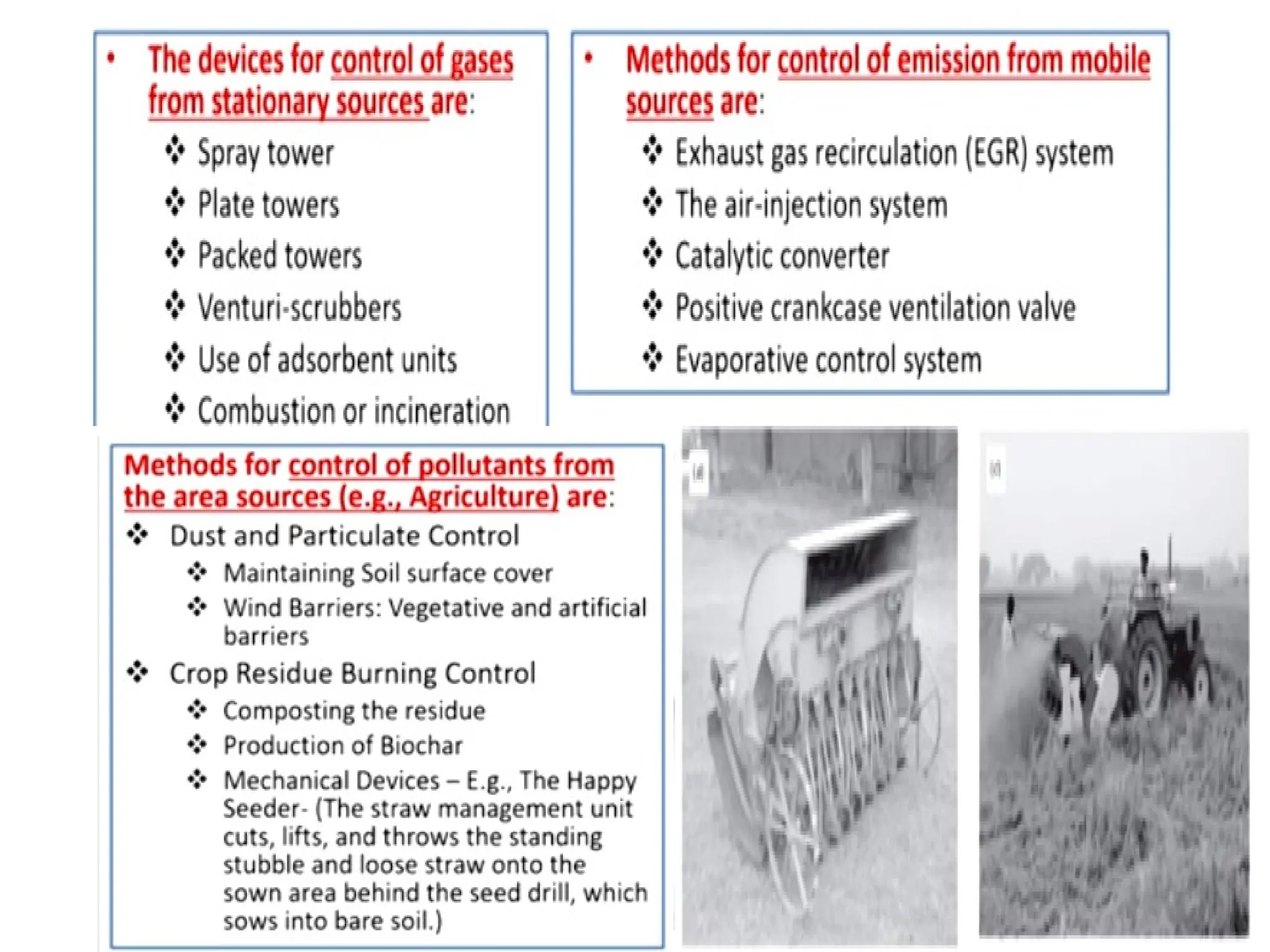
Air pollution control devices and
methods
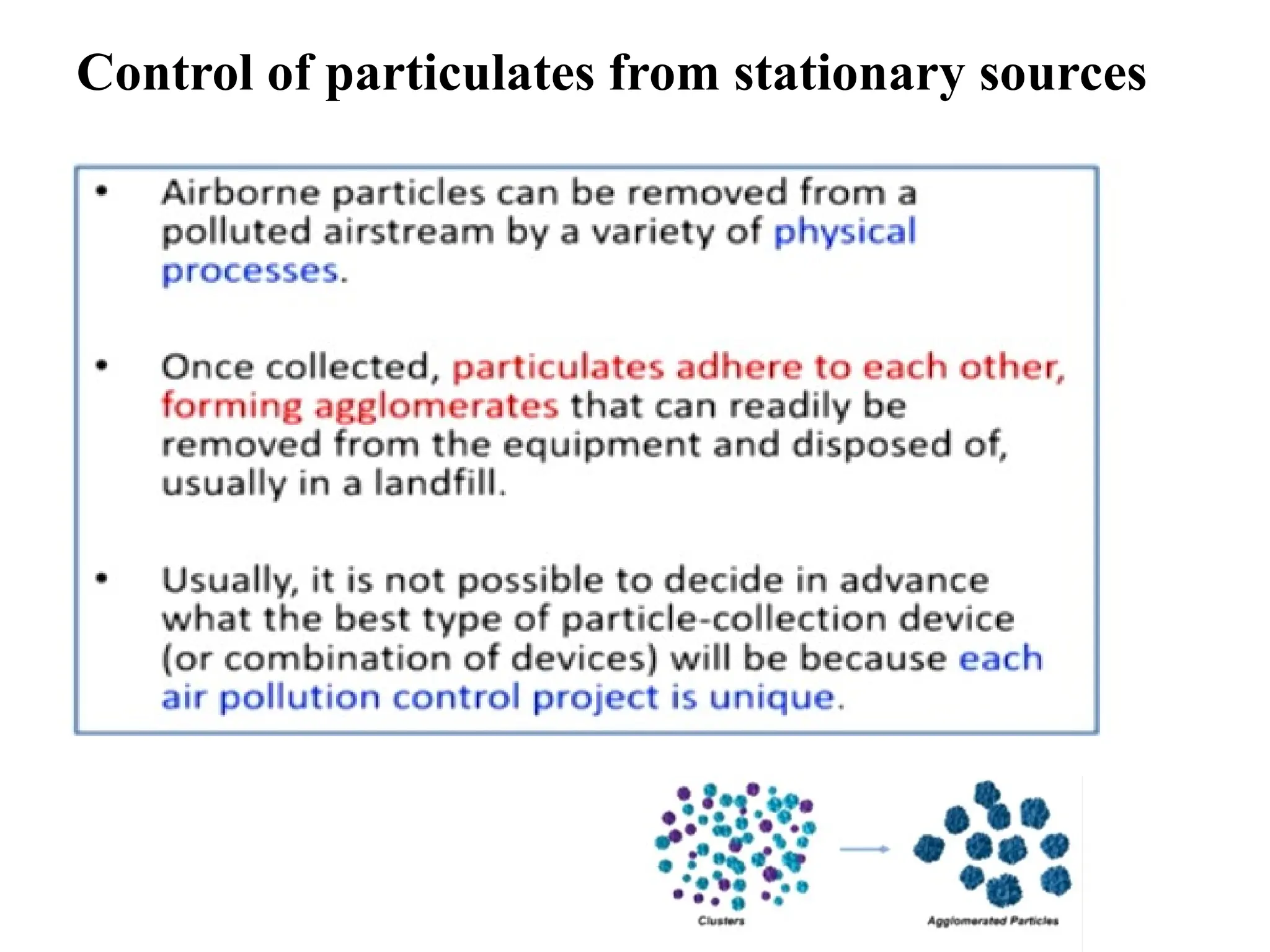
Control of particulates from stationary sources
FACTORS AFFECTING
SELECTION OF CONTROL
EQUIPMENTS
• Particulate matter pollution or particulate pollution is
one of the deadliest of air pollution in India and on a
global level
• The primary reason for the toy particulate pollution,
type of air pollution, it because of human activities
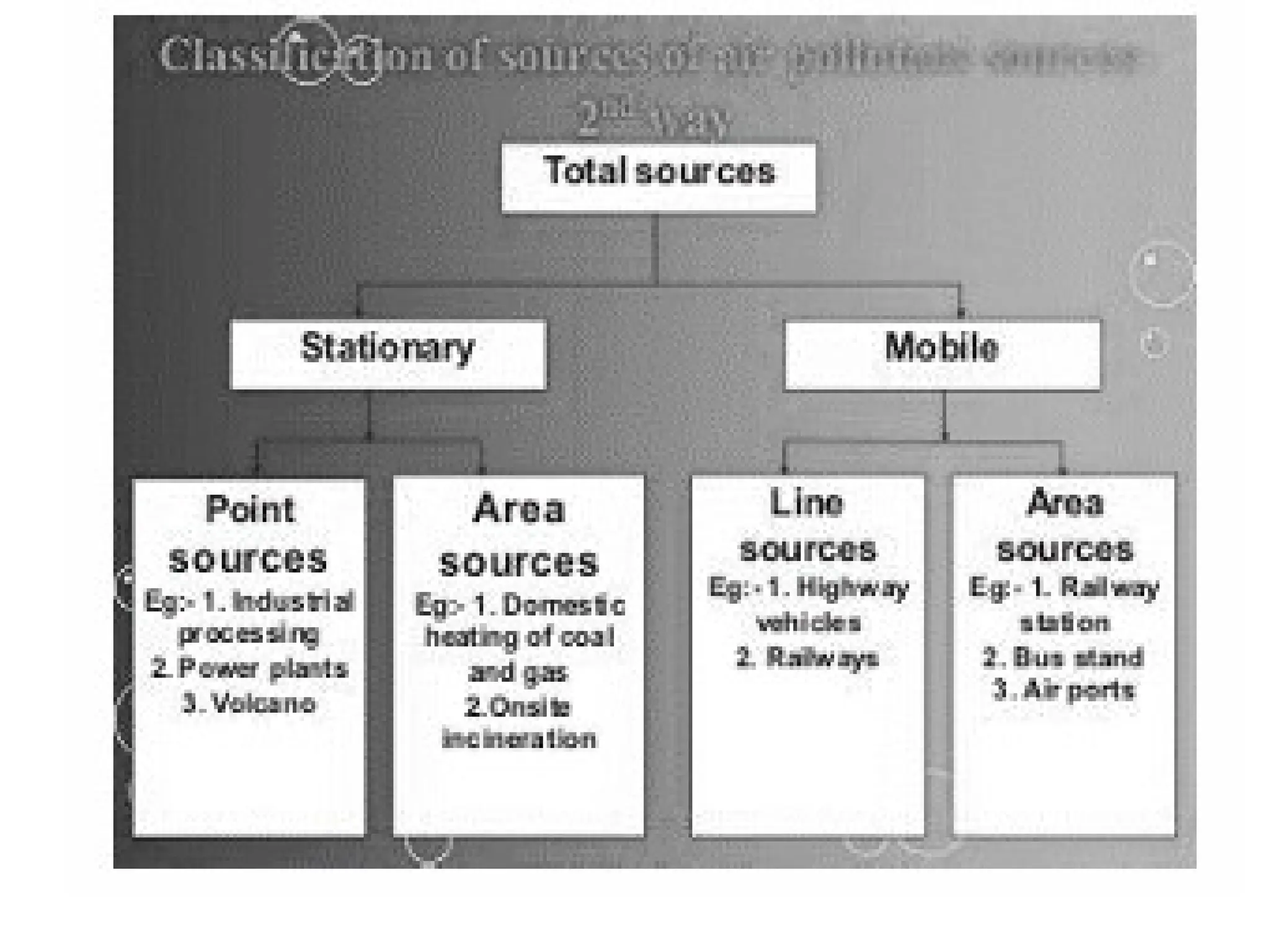
Major so of particulate matter emission are factories,
power stations, incinerators, industries, automobiles,
and diesel generators
• All of this is anthropogenic sources
There are a number of factors to be considered
prior to selecting a particular air pollution
control equipment.
In generally, they can group into three categories
1. Environmental,
2. Engineering, and
3. Economic
Environmental
 Equipment location, availability space, ambient
conditions, availability adequate utilities and ancillary
system facilities.
 Maximum allowable emissions (air pollution
regulation).
 Contribution of air pollution control system to
wastewater and solid waste.
 Contribution of air pollution control system to plant
noise levels.
Engineering
• Design and performance characteristics of the particular
control system and weight), pressure drop, reliability
and dependability, temperature limitation, maintenance
requirement.
• Gas stream characteristics (volume, flow rate,
temperature, pressure, humidity, composition,
viscosity, density, reactivity, corrosiveness, and
toxicity)
• Contaminant characteristics (physical and chemical
properties, concentration, particulate shape and size
distribution in the case of particulates)
Economic
• Capital cost (equipment, installation, engineering, etc.)
• Operating cost utilities, maintenance, etc.).
• Expected equipment lifetime and salvage value
Characteristics of PM that impact the effectives of specific air pollution
control devices include:
• Particle size and size distribution,
• Pile shape
• Particle density,
• Stickiness;
• Corrosivity;
• Condensation temperature
• Reactivity and;
• Toxicity
• Unlike most other pollutants, particulate
matter (PM) can be characterized time-
variations of the mass concentrations of a
single compound factors influencing PM
transport and its environmental and health
effects the following:
• 1. Size and Morphology
• Environmental effects and lifetimes of particles vary with size this,
PM is classified by aerodynamic diameter "PM10" is the mass of
particulate matter with diameters smaller than 10 µm, and "PM2.5”
or “fine PM” designates the fraction with aerodynamic diameters
smaller than 2.5µm: the “coarse” fraction is PM10 to PM2.5, Most
attention has been focused on the fine fraction because it affects
health, visibility, and radiative forcing With lies on the order of
days to weeks, fine particulate matter can undergo long port,
producing global and regional in addition to local impacts While les
larger than 10 µm are also found in the atmosphere, rapid removal
ply limits their lifetime to the order of hours, and as they are too
large to parable, their health impacts are considered of minor
importance Particles are often to be spherical, whereas this is only
the case for liquid particles. Although not generally characterized,
even in measurement campaigns, particle shape and phase can
influence radiative properties and health impacts.
• 2. Chemical Composition The varying chemical and physical
nature of PA complicates the assessment of its impacts. Its
composition depends on the citing sources or particle
precursors and also on atmospheric conditions Some PM
components Including nitrate species, organic species, and
water-re semi volatile and repartition between the gas and
particle phase depending on environmental factors such as
temperature, relative humidity, or the composition of the PM
• Primary and Secondary Sources
• PM is emitted from both natural and
anthropogenic sources, and its components are
both primary (directly emitted) and secondary
(formed in the atmosphere). Direct natural
emissions come from des, sea spray, and
resuspension of organic matter such as leaf
litter. The first of these produces primarily
PM2.5, while the latter two are mainly PM10
Gas particle Interaction
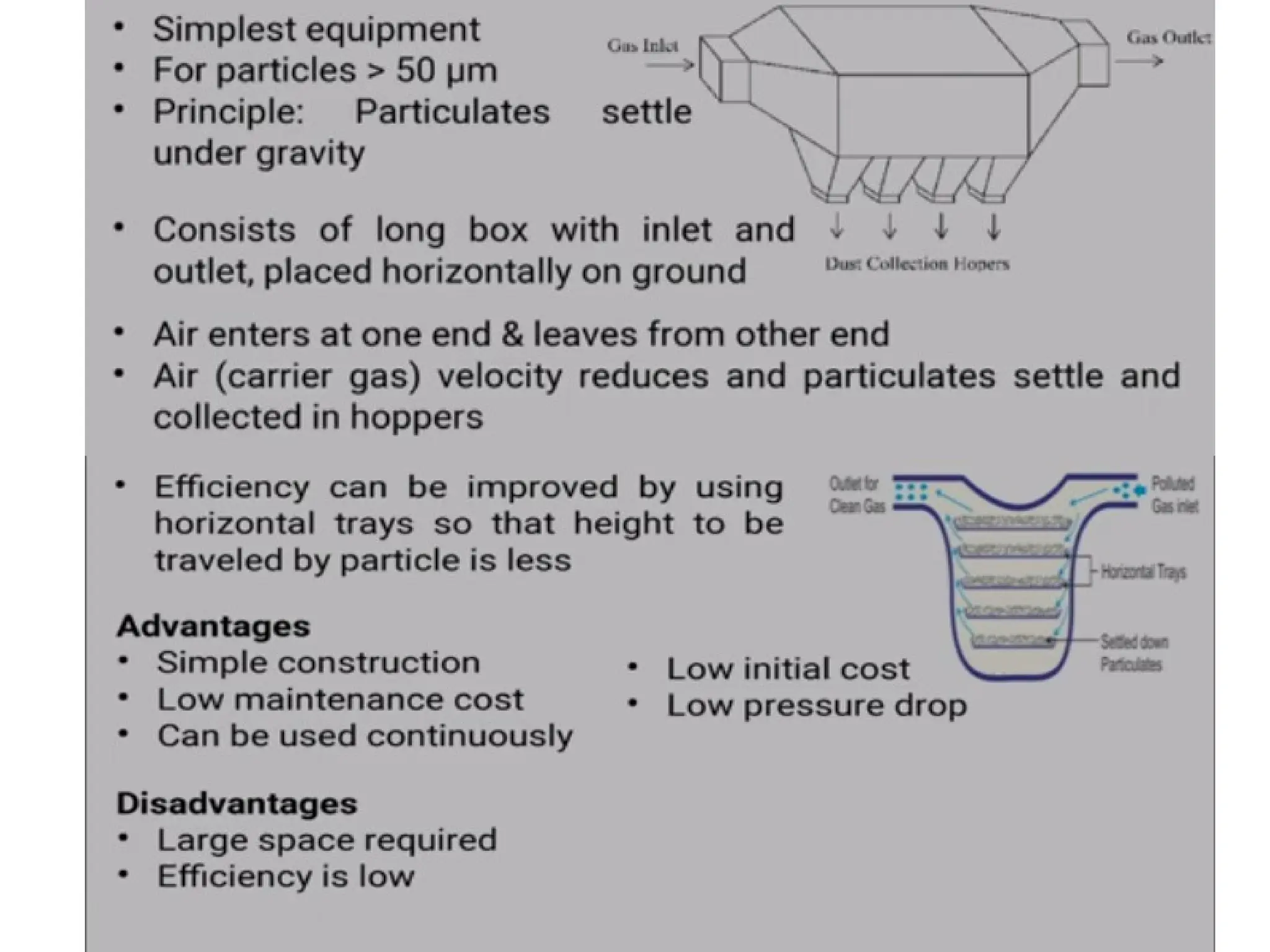
Working principle of Gravity separators
All gravity separators utilize the same principles to effect a
separation. Once base principles are understood, it is usually a
simple step to adjust a gravity separator produce the optimum
separation. The term Gravity Separator.. is a contraction of the
proper name.. Specific Gravity Separator which means, a separator
of particles suffering in their specific gravities.
About 250 B.C., Archimedes discovered the law of specific gravity
which is: All dies floating in or submerged in a liquid are buoyed up
by a force exactly equal to weight of the liquid they displace. The
specific gravity of a particle is the ratio of is density to some
standard substance, the standard usually employed being water with
a unit of 1. Particles having a specific gravity of less than 1 will
float on water shall particles with a specific gravity greater than I
will sink. Gravity separators use air as a standard rather than water.
Since air is lighter than water, the relative difference between
particles of differing weights is widened.
For this reason, the gravity separator is a very sensitive machine and
when operated recently can produce a very precise separation.
Working principle
• Inertial impaction
• Interception
• Diffusion
• Electrostatic attraction
• filtration
AIR POLLUTION AND CONTROL ENGINEERING UNIT 3

AIR POLLUTION AND CONTROL ENGINEERING UNIT 3

  • 1.
    UNIT 3 CONTROL OFPARTICULATE CONTAMINANTS
  • 2.
    • UNIT IIICONTROL OF PARTICULATE CONTAMINANTS Factors affecting Selection of Control Equipment – Gas Particle Interaction – Working principle, Design and performance equations of Gravity Separators, Centrifugal separators Fabric filters, Particulate Scrubbers, Electrostatic Precipitators – Operational Considerations.
  • 3.
    • Gaseous pollutants:Pollutants produced in the atmosphere from fossil fuel combustion and in certain oil and gas activities, causing changes in the air constitution are called gaseous pollutants. • Particulate pollutants: Pollutants that remain suspended in the atmosphere and cause pollution are known as particulate pollutants.
  • 4.
    Gaseous Pollutants Particulatepollutants Remain in the gaseous state in the atmosphere. Remain in the solid or liquid state in the atmosphere. For Example- Carbon oxides (CO,CO2), Nitrogen oxides (NO2,NO3), Sulphur oxides (SO2,SO3), etc. For Example- Aerosols, dust, fumes, ash, smoke, particles of carbon, various metals, etc.
  • 9.
  • 11.
  • 12.
    Natural cleansing propertyand control device
  • 15.
    AIR POLLUTION CONTROL •Air Pollution is one of the major problems for the environment as well a industries and hence it should be minimized. • It is practically impossible to remove the air pollutants in the air completely, but have to be reduced. • Reduction or control of air pollution is carried out in the following three stages. 1. Reducing the volume of polluted streams 2. Changing the process of causing the pollution 3. Treatment to the emitted gas
  • 16.
    • Air PollutionControl is not a single measure, but all the above said procedures are implemented effectively. The techniques for controlling air pollution can be either without an air pollution control device or with air pollution control equipment. • Application of control technology depends in the following factors. • Nature of source • Effluents from the source • Air pollution regulations • Waste generated from the technology • Disposal of the waste.
  • 17.
    • The generalmethods for techniques without an air pollution control device include process change, change in fuel, improved dispersion, good operating practices, and plant shutdown or relocation. Control equipment removes the pollutant, convert less harmful contaminant or recover a valuable material for further use. The control of air pollution can be done in following ways. • By separating pollutant from gases-Some gases are more soluble in liquid than air. For example, ammonia in air can be separated by dissolving it in water. • By separating particulate matter - Particles larger than 50 micrometer a separated in gravity settling tanks or porous filters. Fine particles are separated using cyclone collectors or electrostatic precipitators. • Cyclone Collector consists of a special chamber in which a gas stream containing particulant pollutants is circulated through a spiral, Particles are centrifuged out and collected.
  • 18.
    Objective of AirPollution Control The important objectives of the air pollution control are as follows. 1. Controlling of effects of air pollution on public 2. Describe natural processes that help control air pollution 3. Protection of animals, Plants, etc... 4. Protection of properties against pollutants attack 5. Providing the acceptable environment etc..
  • 19.
    Air pollution controldevices and methods
  • 21.
    Control of particulatesfrom stationary sources
  • 24.
    FACTORS AFFECTING SELECTION OFCONTROL EQUIPMENTS • Particulate matter pollution or particulate pollution is one of the deadliest of air pollution in India and on a global level • The primary reason for the toy particulate pollution, type of air pollution, it because of human activities Major so of particulate matter emission are factories, power stations, incinerators, industries, automobiles, and diesel generators • All of this is anthropogenic sources
  • 25.
    There are anumber of factors to be considered prior to selecting a particular air pollution control equipment. In generally, they can group into three categories 1. Environmental, 2. Engineering, and 3. Economic
  • 26.
    Environmental  Equipment location,availability space, ambient conditions, availability adequate utilities and ancillary system facilities.  Maximum allowable emissions (air pollution regulation).  Contribution of air pollution control system to wastewater and solid waste.  Contribution of air pollution control system to plant noise levels.
  • 27.
    Engineering • Design andperformance characteristics of the particular control system and weight), pressure drop, reliability and dependability, temperature limitation, maintenance requirement. • Gas stream characteristics (volume, flow rate, temperature, pressure, humidity, composition, viscosity, density, reactivity, corrosiveness, and toxicity) • Contaminant characteristics (physical and chemical properties, concentration, particulate shape and size distribution in the case of particulates)
  • 28.
    Economic • Capital cost(equipment, installation, engineering, etc.) • Operating cost utilities, maintenance, etc.). • Expected equipment lifetime and salvage value Characteristics of PM that impact the effectives of specific air pollution control devices include: • Particle size and size distribution, • Pile shape • Particle density, • Stickiness; • Corrosivity; • Condensation temperature • Reactivity and; • Toxicity
  • 29.
    • Unlike mostother pollutants, particulate matter (PM) can be characterized time- variations of the mass concentrations of a single compound factors influencing PM transport and its environmental and health effects the following:
  • 30.
    • 1. Sizeand Morphology • Environmental effects and lifetimes of particles vary with size this, PM is classified by aerodynamic diameter "PM10" is the mass of particulate matter with diameters smaller than 10 µm, and "PM2.5” or “fine PM” designates the fraction with aerodynamic diameters smaller than 2.5µm: the “coarse” fraction is PM10 to PM2.5, Most attention has been focused on the fine fraction because it affects health, visibility, and radiative forcing With lies on the order of days to weeks, fine particulate matter can undergo long port, producing global and regional in addition to local impacts While les larger than 10 µm are also found in the atmosphere, rapid removal ply limits their lifetime to the order of hours, and as they are too large to parable, their health impacts are considered of minor importance Particles are often to be spherical, whereas this is only the case for liquid particles. Although not generally characterized, even in measurement campaigns, particle shape and phase can influence radiative properties and health impacts.
  • 31.
    • 2. ChemicalComposition The varying chemical and physical nature of PA complicates the assessment of its impacts. Its composition depends on the citing sources or particle precursors and also on atmospheric conditions Some PM components Including nitrate species, organic species, and water-re semi volatile and repartition between the gas and particle phase depending on environmental factors such as temperature, relative humidity, or the composition of the PM
  • 32.
    • Primary andSecondary Sources • PM is emitted from both natural and anthropogenic sources, and its components are both primary (directly emitted) and secondary (formed in the atmosphere). Direct natural emissions come from des, sea spray, and resuspension of organic matter such as leaf litter. The first of these produces primarily PM2.5, while the latter two are mainly PM10
  • 33.
  • 36.
    Working principle ofGravity separators
  • 38.
    All gravity separatorsutilize the same principles to effect a separation. Once base principles are understood, it is usually a simple step to adjust a gravity separator produce the optimum separation. The term Gravity Separator.. is a contraction of the proper name.. Specific Gravity Separator which means, a separator of particles suffering in their specific gravities. About 250 B.C., Archimedes discovered the law of specific gravity which is: All dies floating in or submerged in a liquid are buoyed up by a force exactly equal to weight of the liquid they displace. The specific gravity of a particle is the ratio of is density to some standard substance, the standard usually employed being water with a unit of 1. Particles having a specific gravity of less than 1 will float on water shall particles with a specific gravity greater than I will sink. Gravity separators use air as a standard rather than water. Since air is lighter than water, the relative difference between particles of differing weights is widened. For this reason, the gravity separator is a very sensitive machine and when operated recently can produce a very precise separation.
  • 50.
    Working principle • Inertialimpaction • Interception • Diffusion • Electrostatic attraction • filtration