Motivational Interviewing
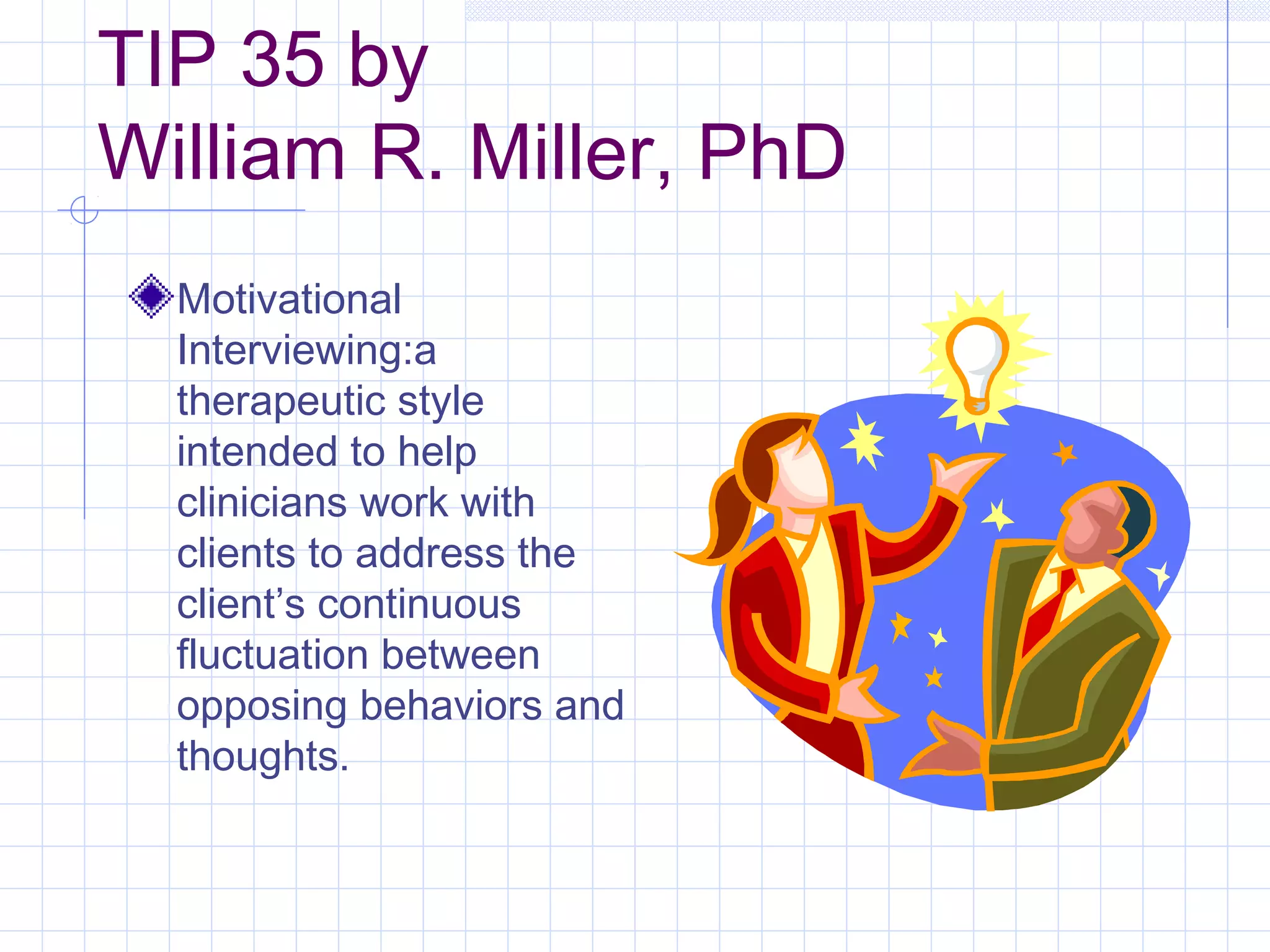
TIP 35 by
William R. Miller, PhD
Motivational
Interviewing:a
therapeutic style
intended to help
clinicians work with
clients to address the
client’s continuous
fluctuation between
opposing behaviors and
thoughts.
Effectiveness of
Motivational Interviewing
A recent review of 11 clinical trials of
motivational interviewing concluded that
this is a "useful clinical intervention...
[and] appears to be an effective,
efficient, and adaptive therapeutic style
worthy of further development,
application, and research" (Noonan and
Moyers, 1997, p. 8).
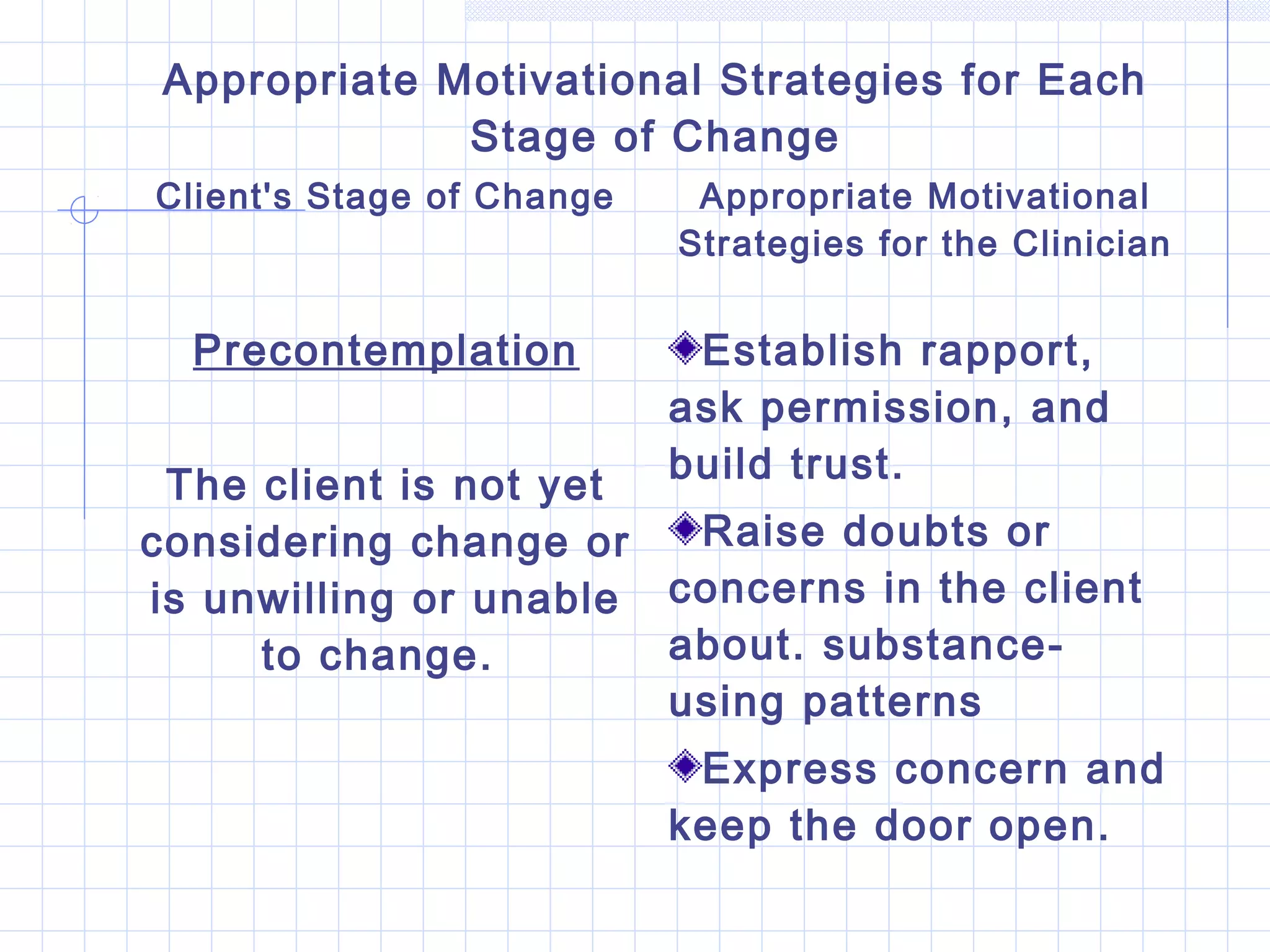
Appropriate Motivational Strategies for Each
Stage of Change
Client's Stage of Change Appropriate Motivational
Strategies for the Clinician
Precontemplation
The client is not yet
considering change or
is unwilling or unable
to change.
Establish rapport,
ask permission, and
build trust.
Raise doubts or
concerns in the client
about. substance-
using patterns
Express concern and
keep the door open.
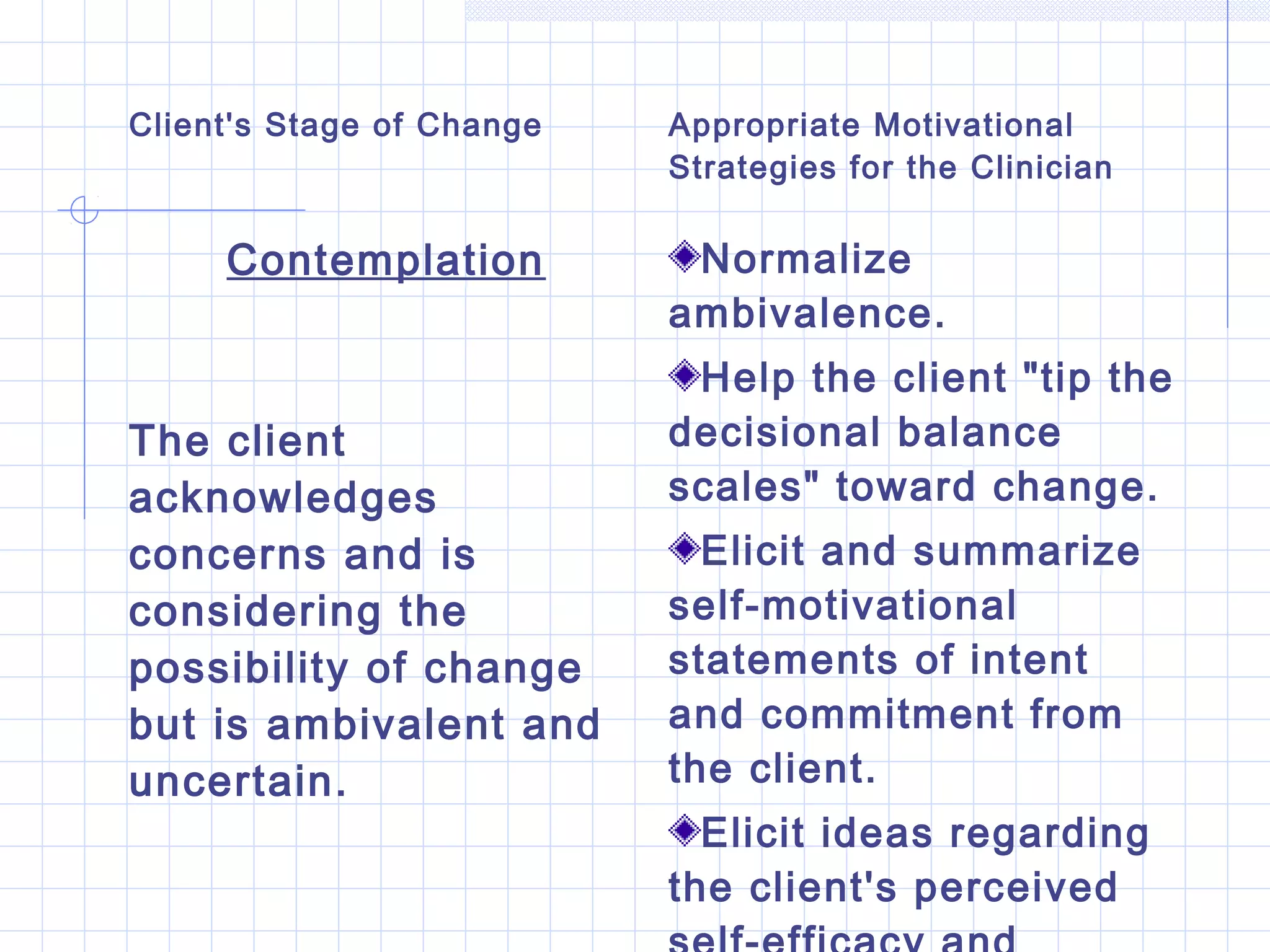
Client's Stage of Change Appropriate Motivational
Strategies for the Clinician
Contemplation
The client
acknowledges
concerns and is
considering the
possibility of change
but is ambivalent and
uncertain.
Normalize
ambivalence.
Help the client "tip the
decisional balance
scales" toward change.
Elicit and summarize
self-motivational
statements of intent
and commitment from
the client.
Elicit ideas regarding
the client's perceived
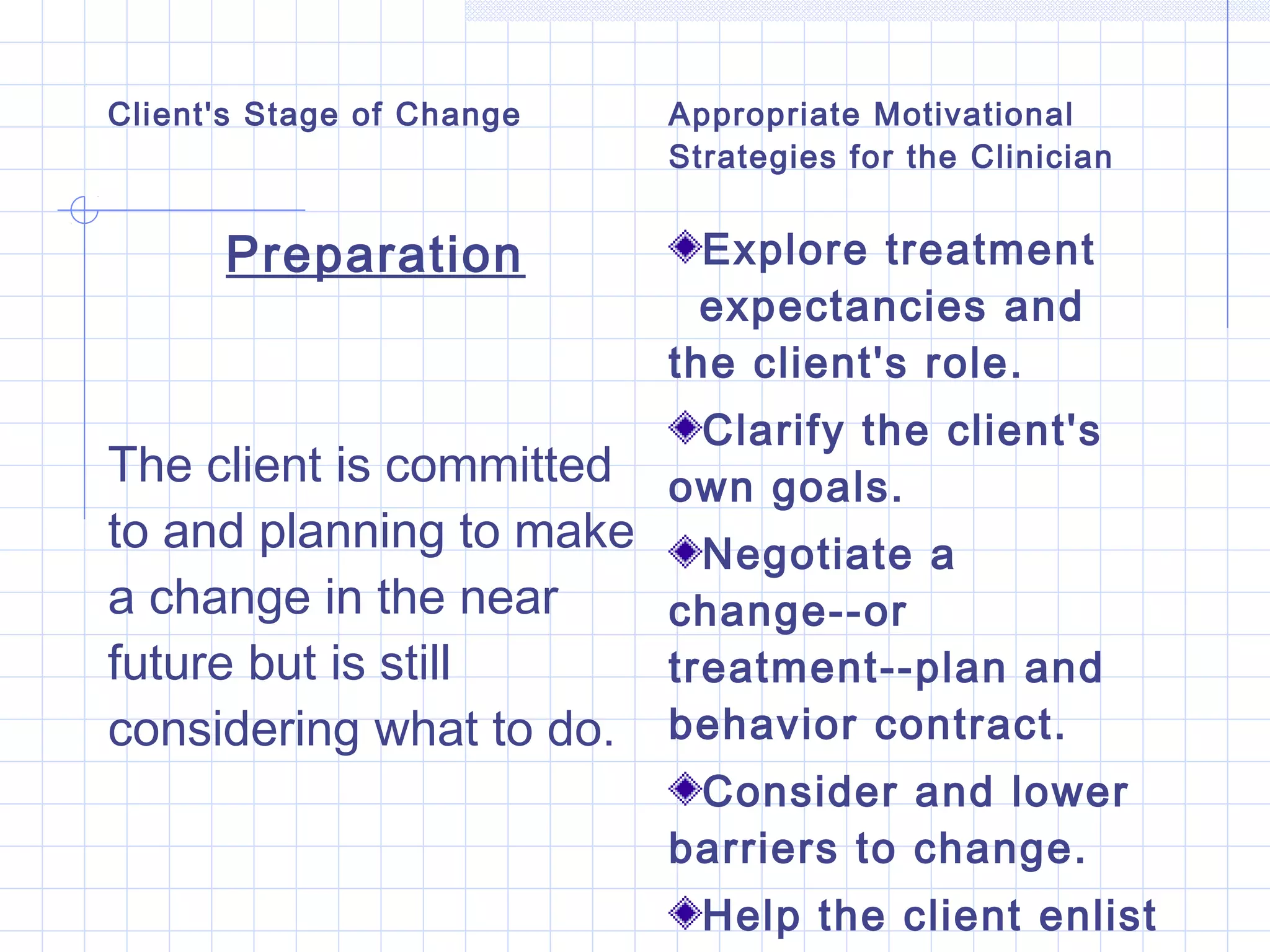
Client's Stage of Change Appropriate Motivational
Strategies for the Clinician
Preparation
The client is committed
to and planning to make
a change in the near
future but is still
considering what to do.
Explore treatment
expectancies and
the client's role.
Clarify the client's
own goals.
Negotiate a
change--or
treatment--plan and
behavior contract.
Consider and lower
barriers to change.
Help the client enlist
Client's Stage of Change Appropriate Motivational
Strategies for the Clinician
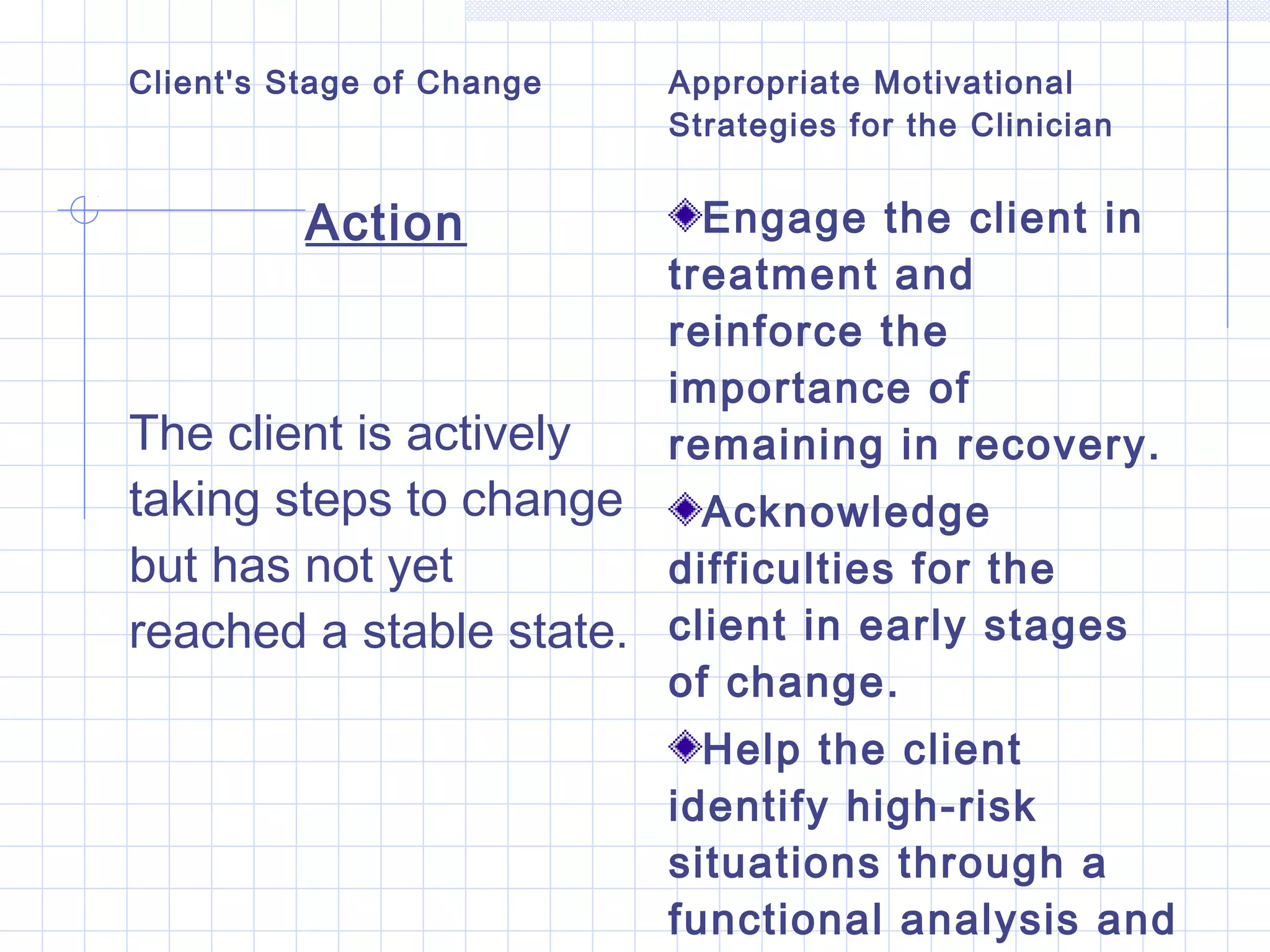
Action
The client is actively
taking steps to change
but has not yet
reached a stable state.
Engage the client in
treatment and
reinforce the
importance of
remaining in recovery.
Acknowledge
difficulties for the
client in early stages
of change.
Help the client
identify high-risk
situations through a
functional analysis and
Client's Stage of Change Appropriate Motivational
Strategies for the Clinician
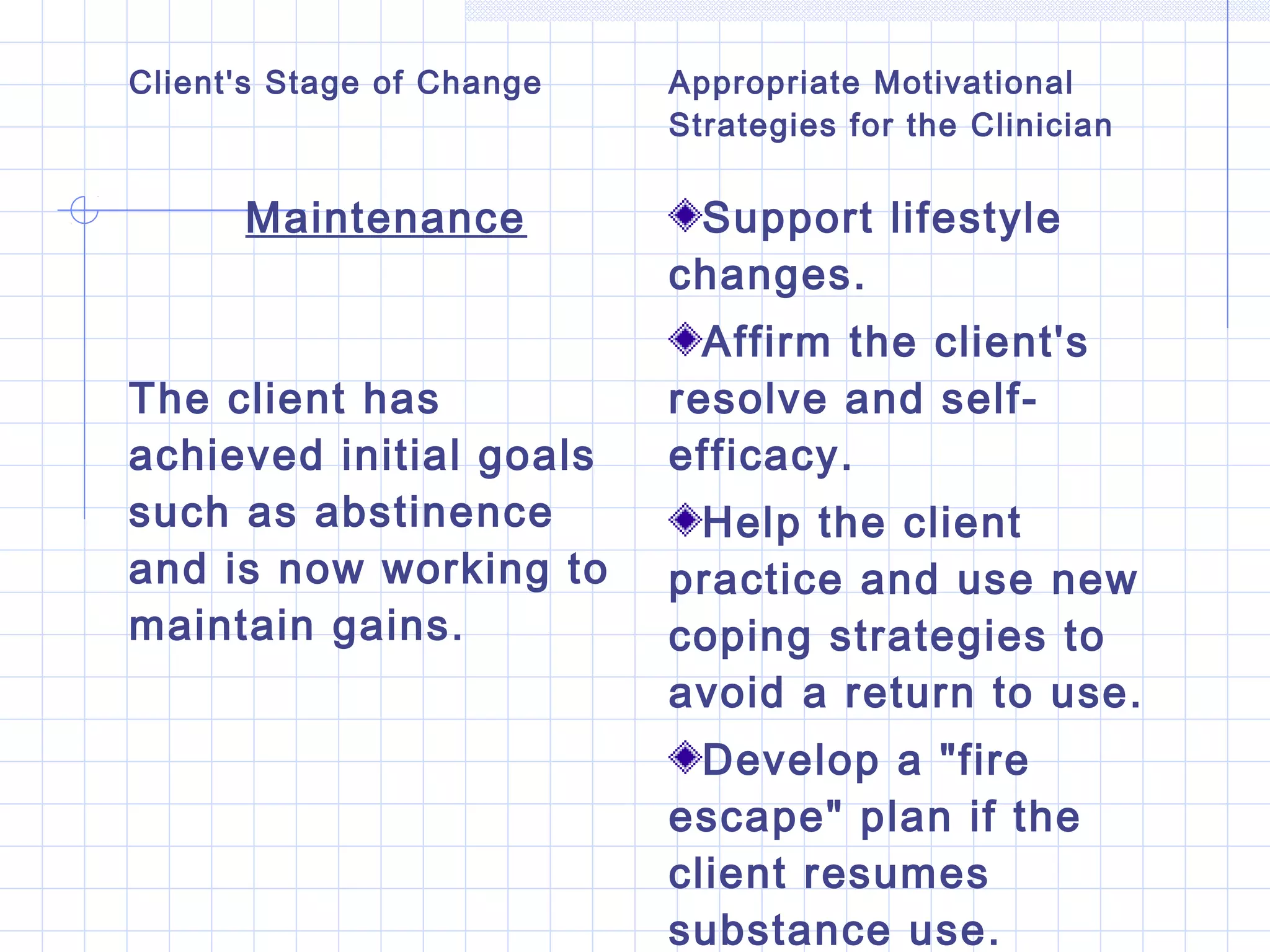
Maintenance
The client has
achieved initial goals
such as abstinence
and is now working to
maintain gains.
Support lifestyle
changes.
Affirm the client's
resolve and self-
efficacy.
Help the client
practice and use new
coping strategies to
avoid a return to use.
Develop a "fire
escape" plan if the
client resumes
substance use.
Client's Stage of Change Appropriate Motivational
Strategies for the Clinician
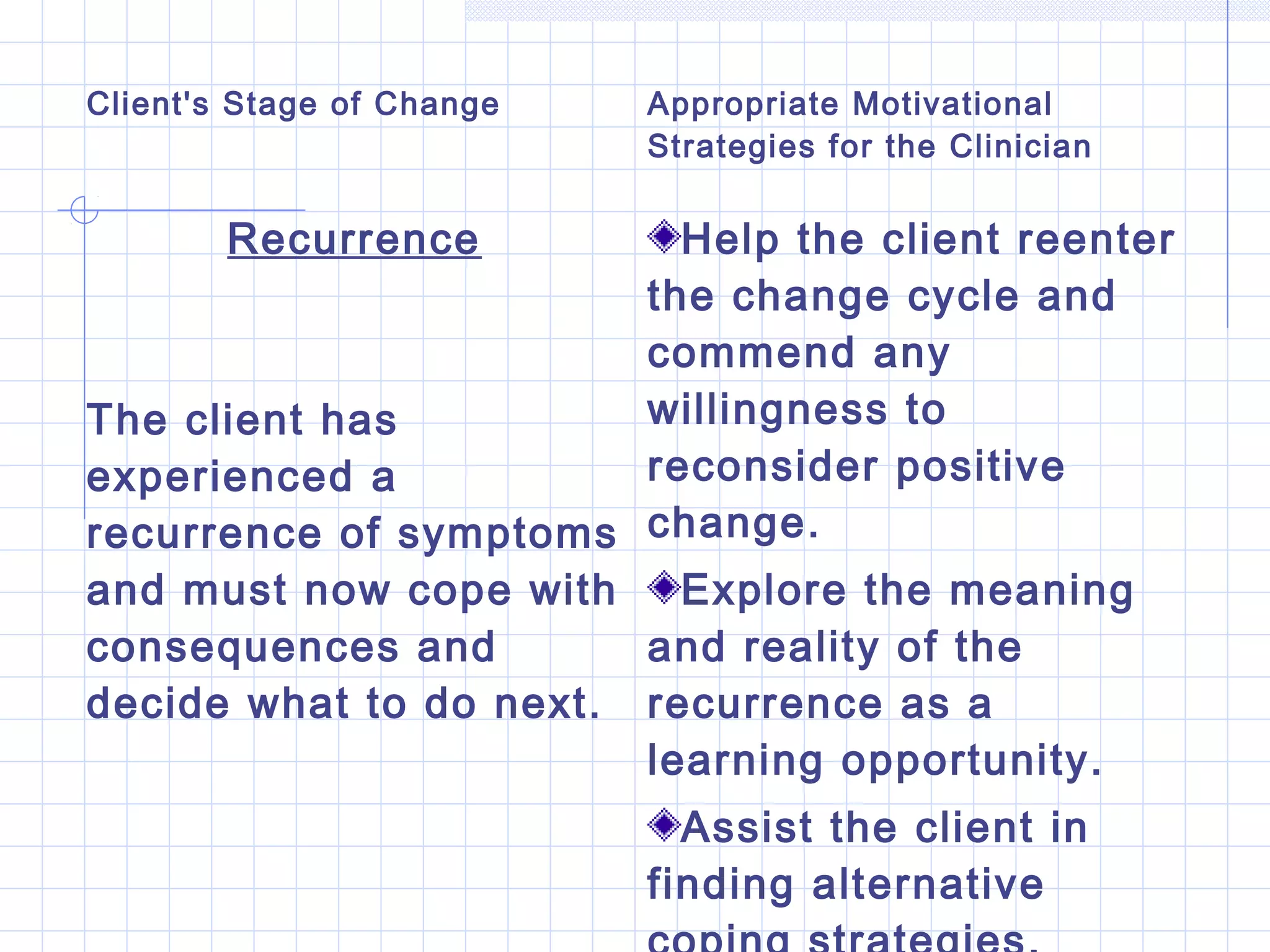
Recurrence
The client has
experienced a
recurrence of symptoms
and must now cope with
consequences and
decide what to do next.
Help the client reenter
the change cycle and
commend any
willingness to
reconsider positive
change.
Explore the meaning
and reality of the
recurrence as a
learning opportunity.
Assist the client in
finding alternative
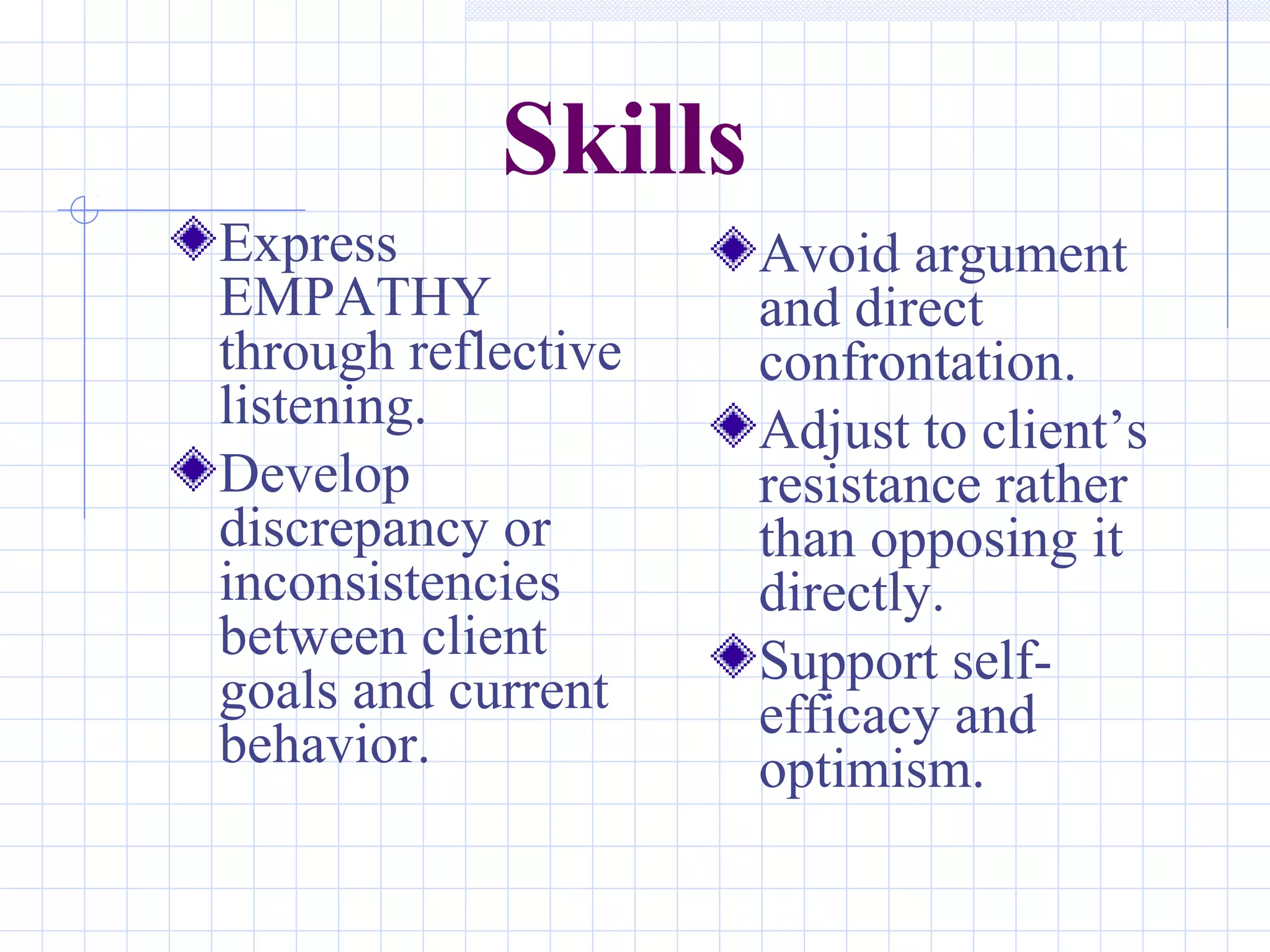
Skills
Express
EMPATHY
through reflective
listening.
Develop
discrepancy or
inconsistencies
between client
goals and current
behavior.
Avoid argument
and direct
confrontation.
Adjust to client’s
resistance rather
than opposing it
directly.
Support self-
efficacy and
optimism.
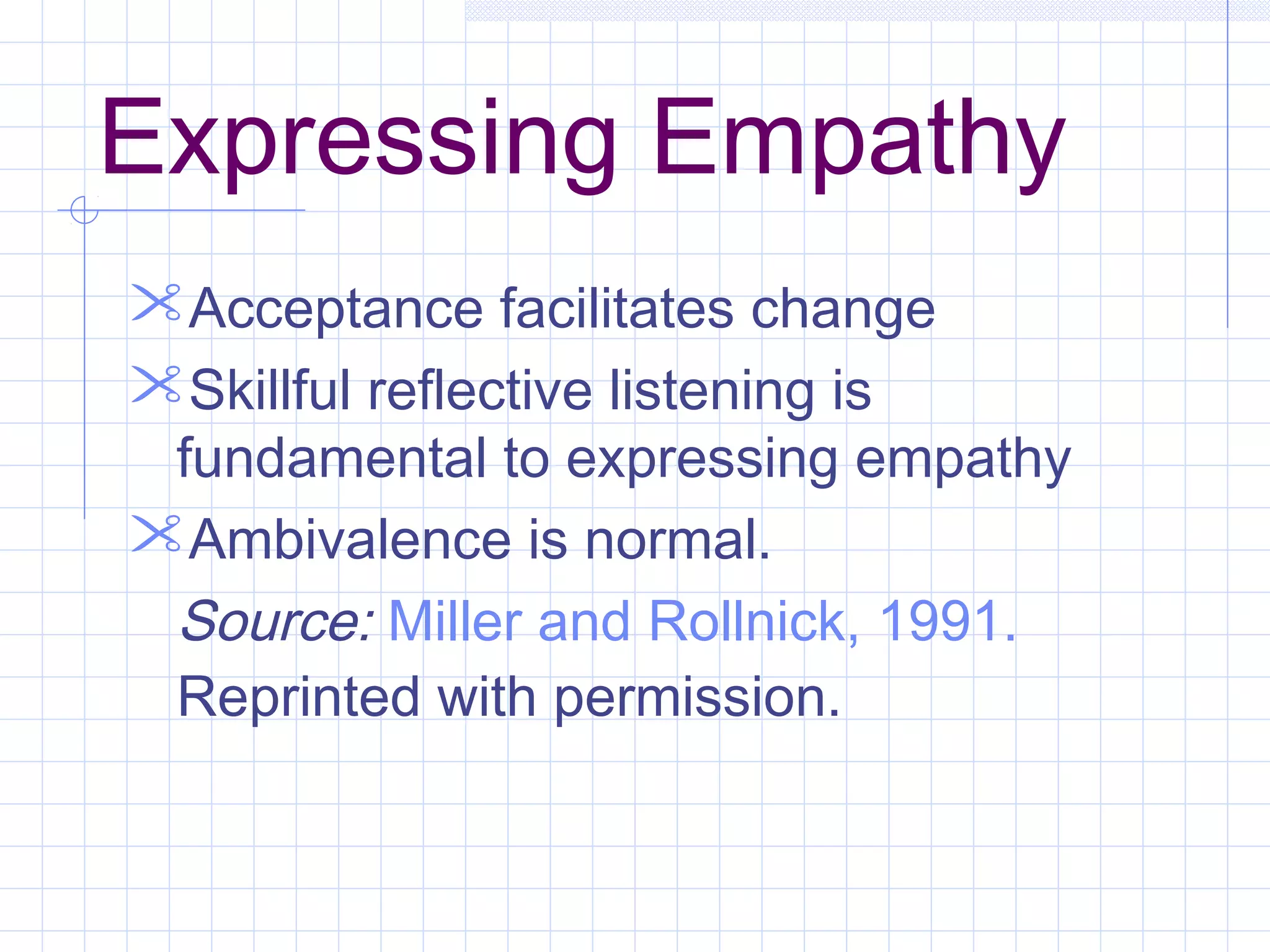
Expressing Empathy
Acceptance facilitates change
Skillful reflective listening is
fundamental to expressing empathy
Ambivalence is normal.
Source: Miller and Rollnick, 1991.
Reprinted with permission.
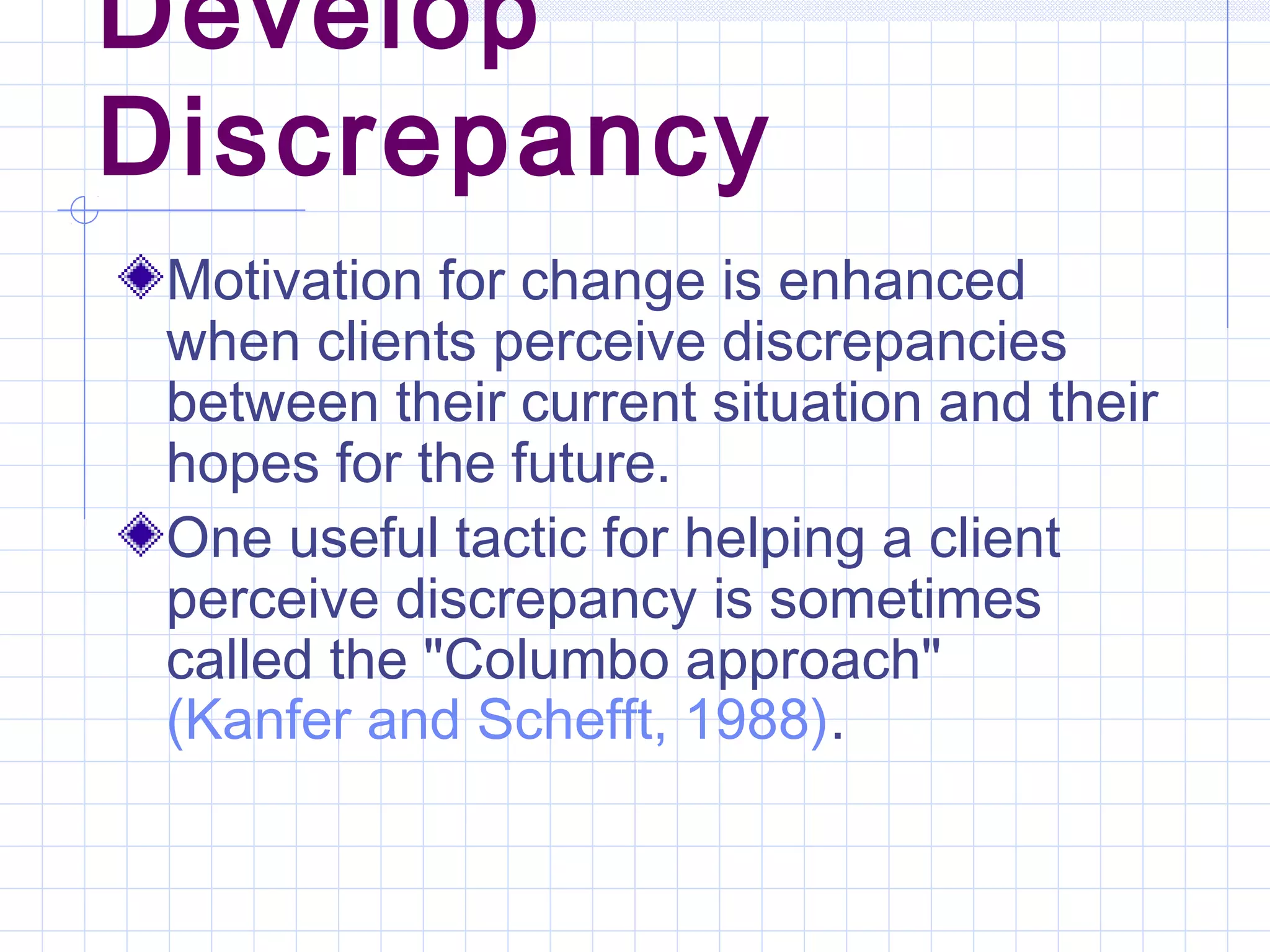
Develop
Discrepancy
Motivation for change is enhanced
when clients perceive discrepancies
between their current situation and their
hopes for the future.
One useful tactic for helping a client
perceive discrepancy is sometimes
called the "Columbo approach"
(Kanfer and Schefft, 1988).
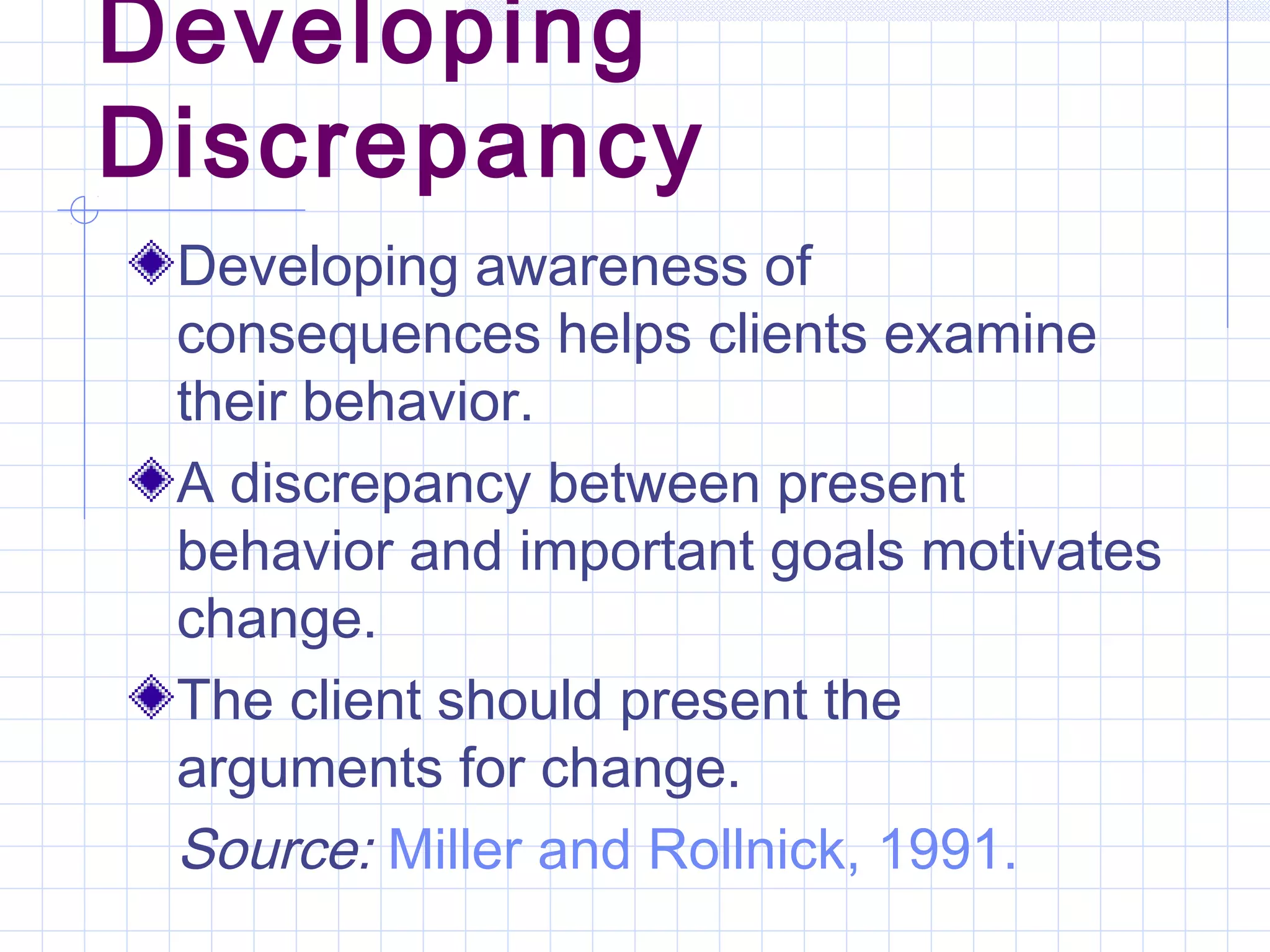
Developing
Discrepancy
Developing awareness of
consequences helps clients examine
their behavior.
A discrepancy between present
behavior and important goals motivates
change.
The client should present the
arguments for change.
Source: Miller and Rollnick, 1991.
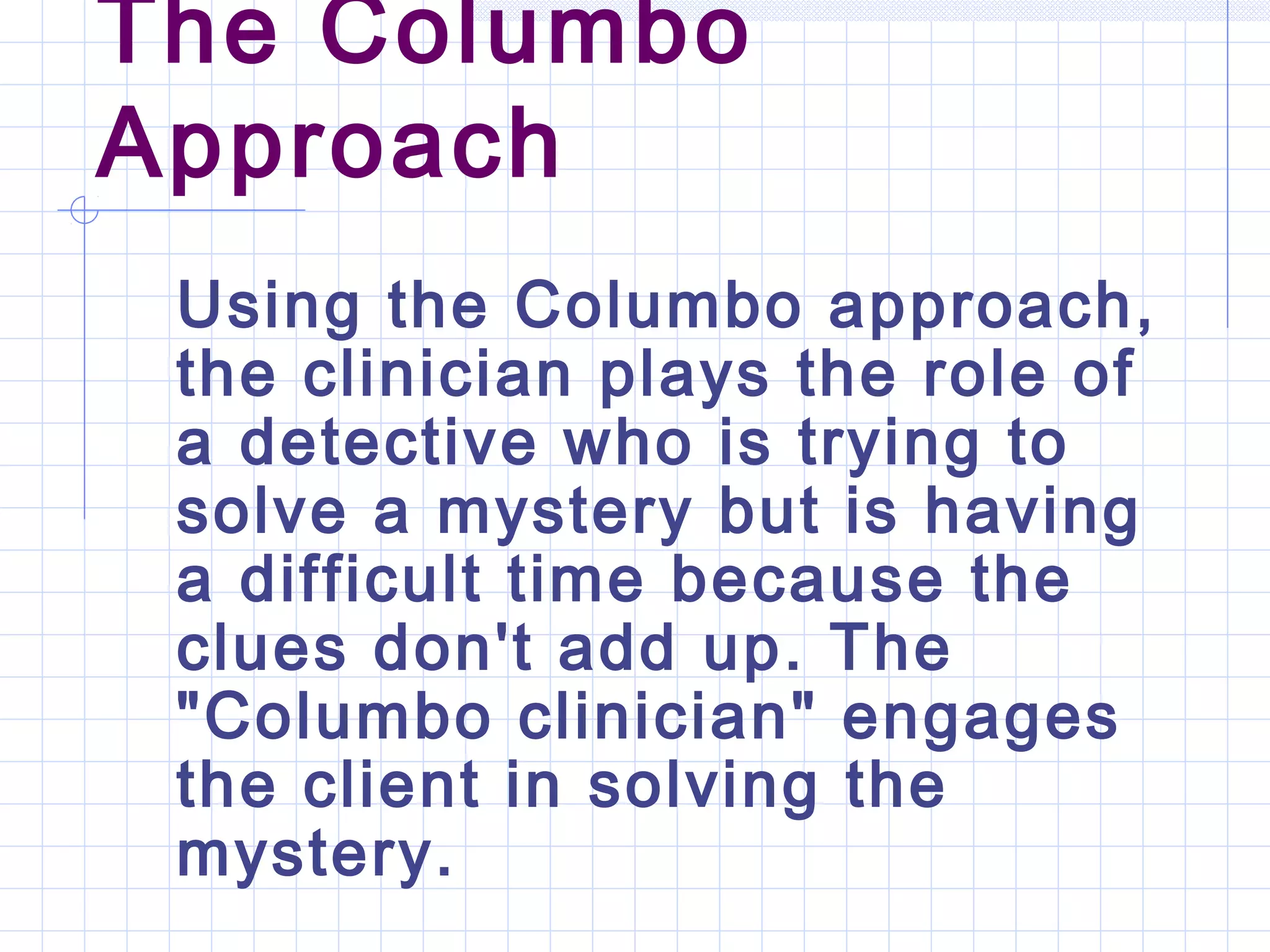
The Columbo
Approach
Using the Columbo approach,
the clinician plays the role of
a detective who is trying to
solve a mystery but is having
a difficult time because the
clues don't add up. The
"Columbo clinician" engages
the client in solving the
mystery.
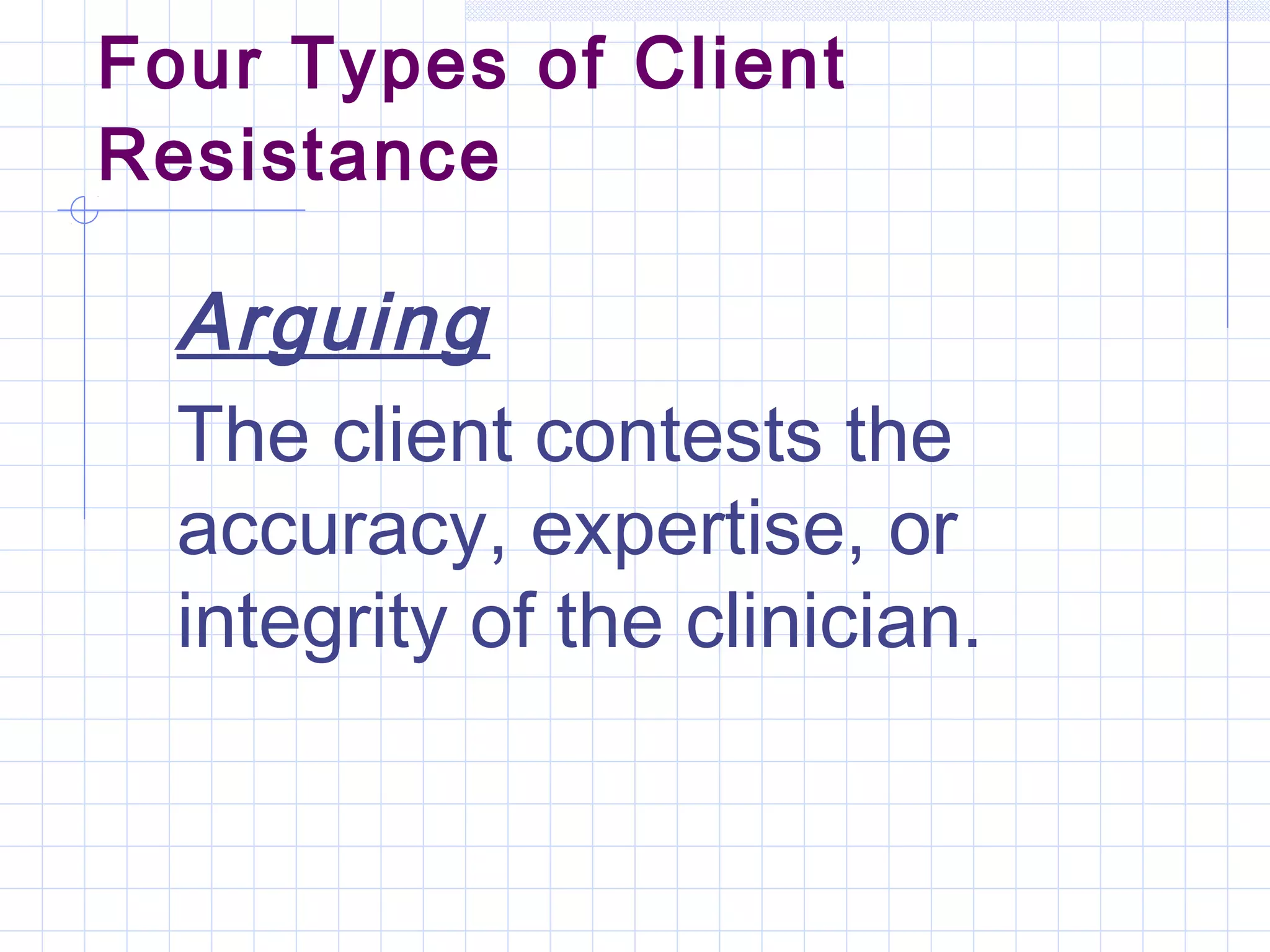
Four Types of Client
Resistance
Arguing
The client contests the
accuracy, expertise, or
integrity of the clinician.
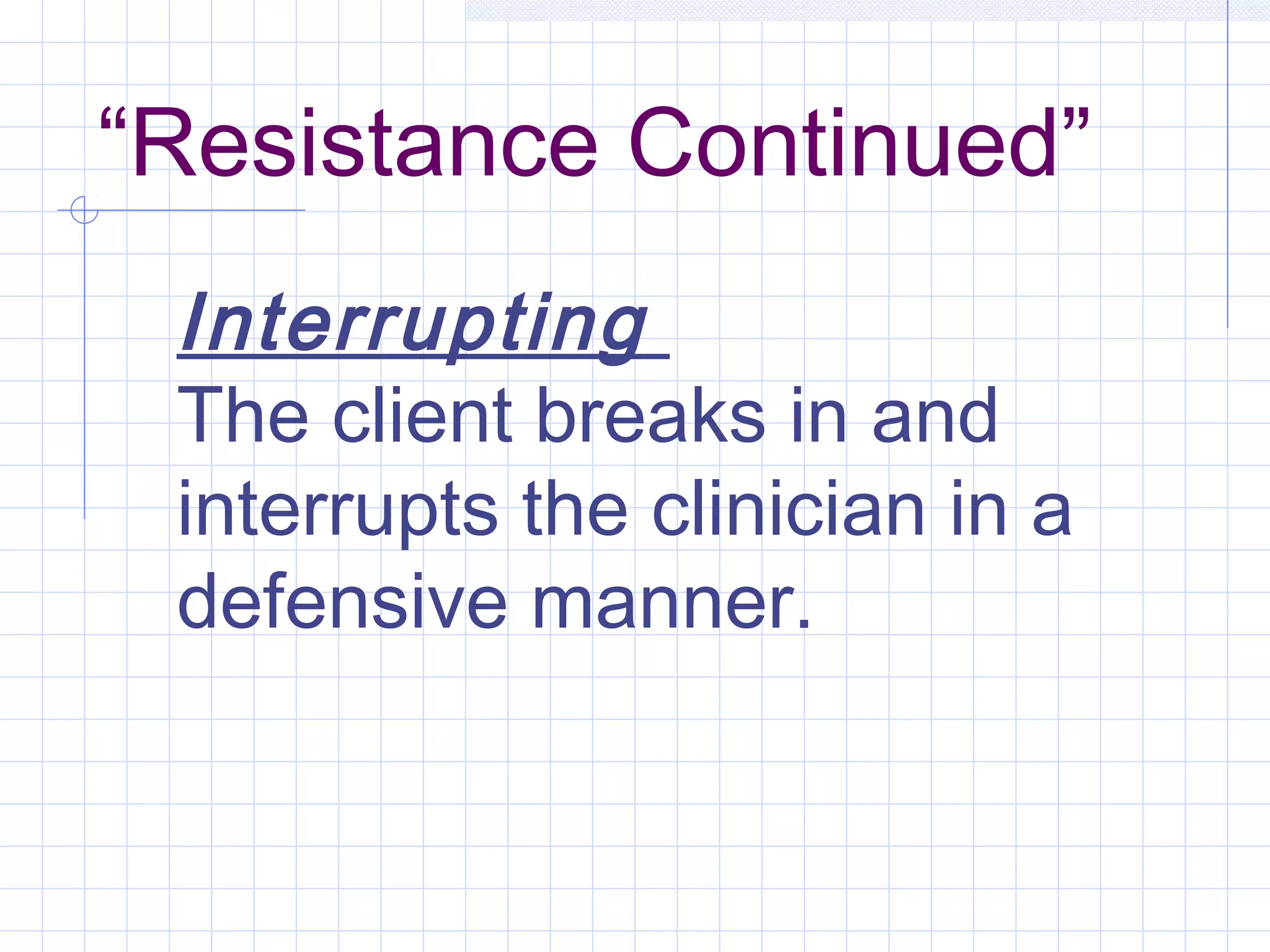
“Resistance Continued”
Interrupting
The client breaks in and
interrupts the clinician in a
defensive manner.
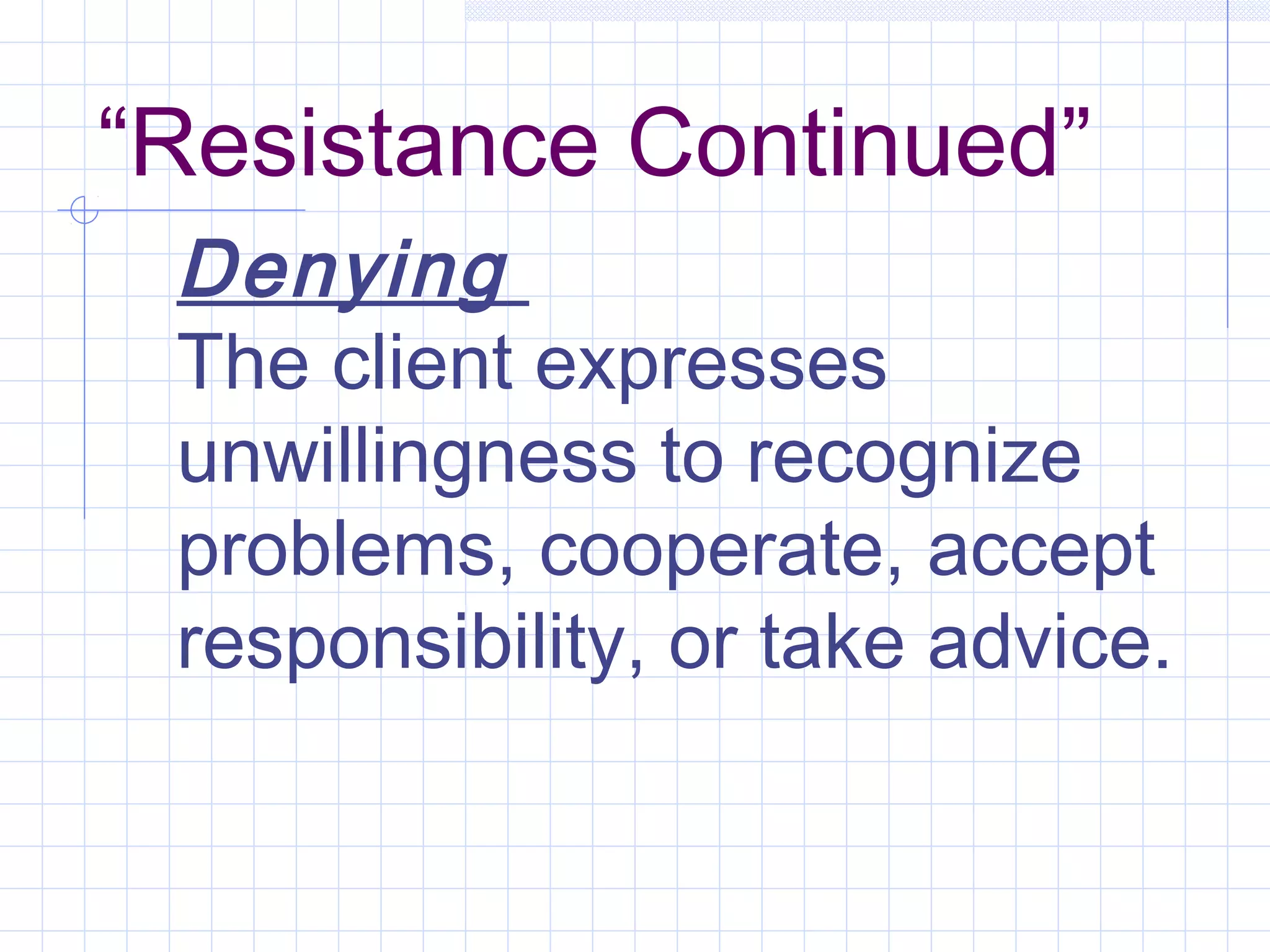
“Resistance Continued”
Denying
The client expresses
unwillingness to recognize
problems, cooperate, accept
responsibility, or take advice.
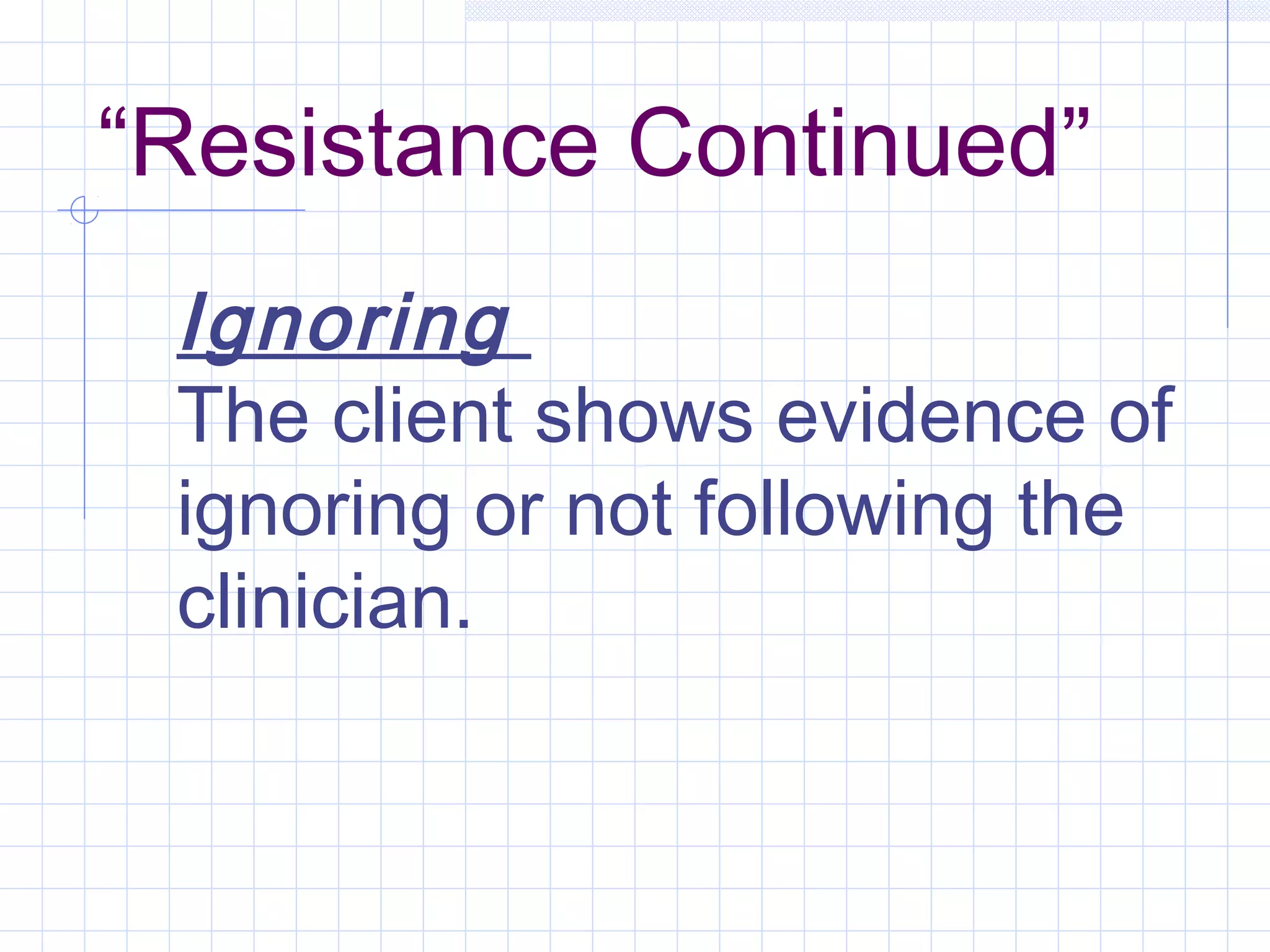
“Resistance Continued”
Ignoring
The client shows evidence of
ignoring or not following the
clinician.
Simple Reflection
The simplest approach to
responding to resistance is with
nonresistance, by repeating the
client's statement in a neutral form.
This acknowledges and validates
what the client has said and can
elicit an opposite response.
Amplified
Reflection
Another strategy is to reflect the
client's statement in an
exaggerated form--to state it in a
more extreme way but without
sarcasm. This can move the client
toward positive change rather than
resistance.
Double-sided Reflection
A third strategy entails
acknowledging what the client has
said but then also stating contrary
things she has said in the past.
This requires the use of information
that the client has offered
previously, although perhaps not in
the same session.
Shifting Focus
You can defuse resistance by
helping the client shift focus away
from obstacles and barriers. This
method offers an opportunity to
affirm your client's personal choice
regarding the conduct of his own
life.
Agreement With a Twist
A subtle strategy is to agree
with the client, but with a
slight twist or change of
direction that propels the
discussion forward.
Reframing
A good strategy to use when a
client denies personal problems is
reframing--offering a new and
positive interpretation of negative
information provided by the client.
Reframing "acknowledges the
validity of the client's raw
observations, but offers a new
meaning...for them"
(Miller and Rollnick, 1991, p. 107).
Rolling With Resistance
Momentum can be used to good
advantage.
Perceptions can be shifted.
New perspectives are invited but not
imposed.
The client is a valuable resource in
finding solutions to problems.
Source: Miller and Rollnick, 1991.
Reprinted with permission.
Siding With the Negative
One more strategy for adapting to
client resistance is to "side with the
negative"--to take up the negative
voice in the discussion. If your
client is ambivalent, your taking the
negative side of the argument
evokes a "Yes, but..." from the
client, who then expresses the
other (positive) side.
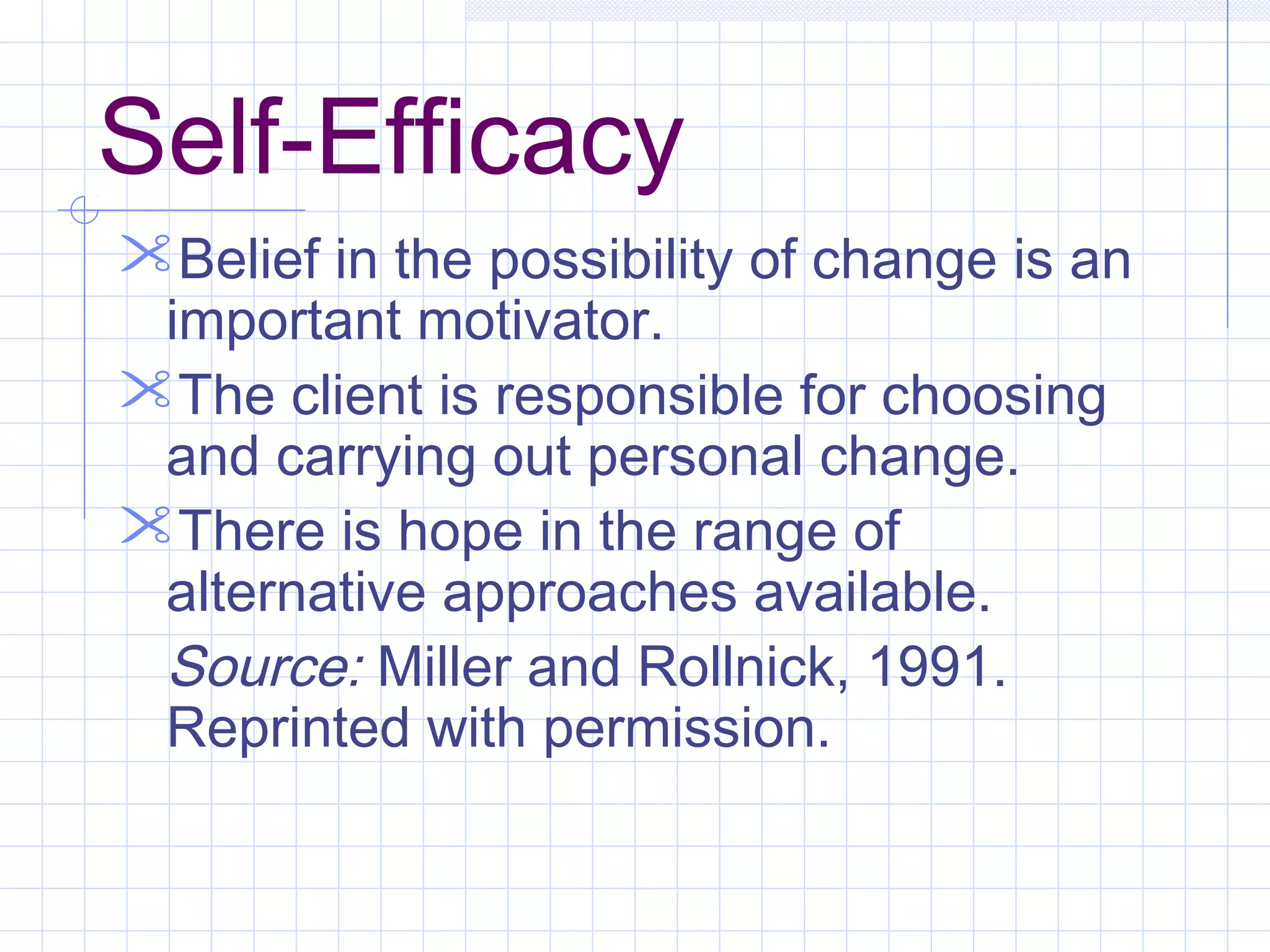
Self-Efficacy
Belief in the possibility of change is an
important motivator.
The client is responsible for choosing
and carrying out personal change.
There is hope in the range of
alternative approaches available.
Source: Miller and Rollnick, 1991.
Reprinted with permission.
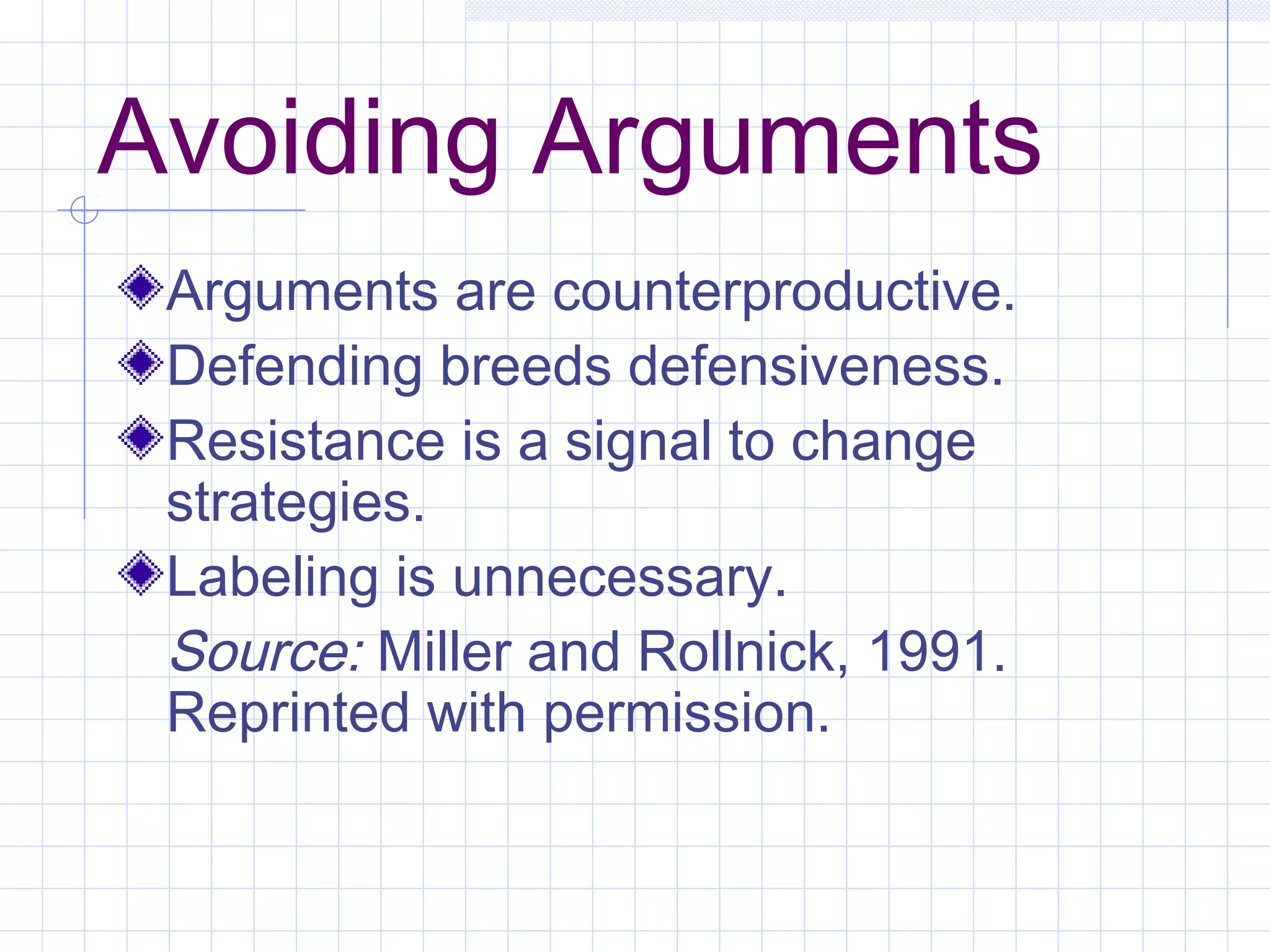
Avoiding Arguments
Arguments are counterproductive.
Defending breeds defensiveness.
Resistance is a signal to change
strategies.
Labeling is unnecessary.
Source: Miller and Rollnick, 1991.
Reprinted with permission.
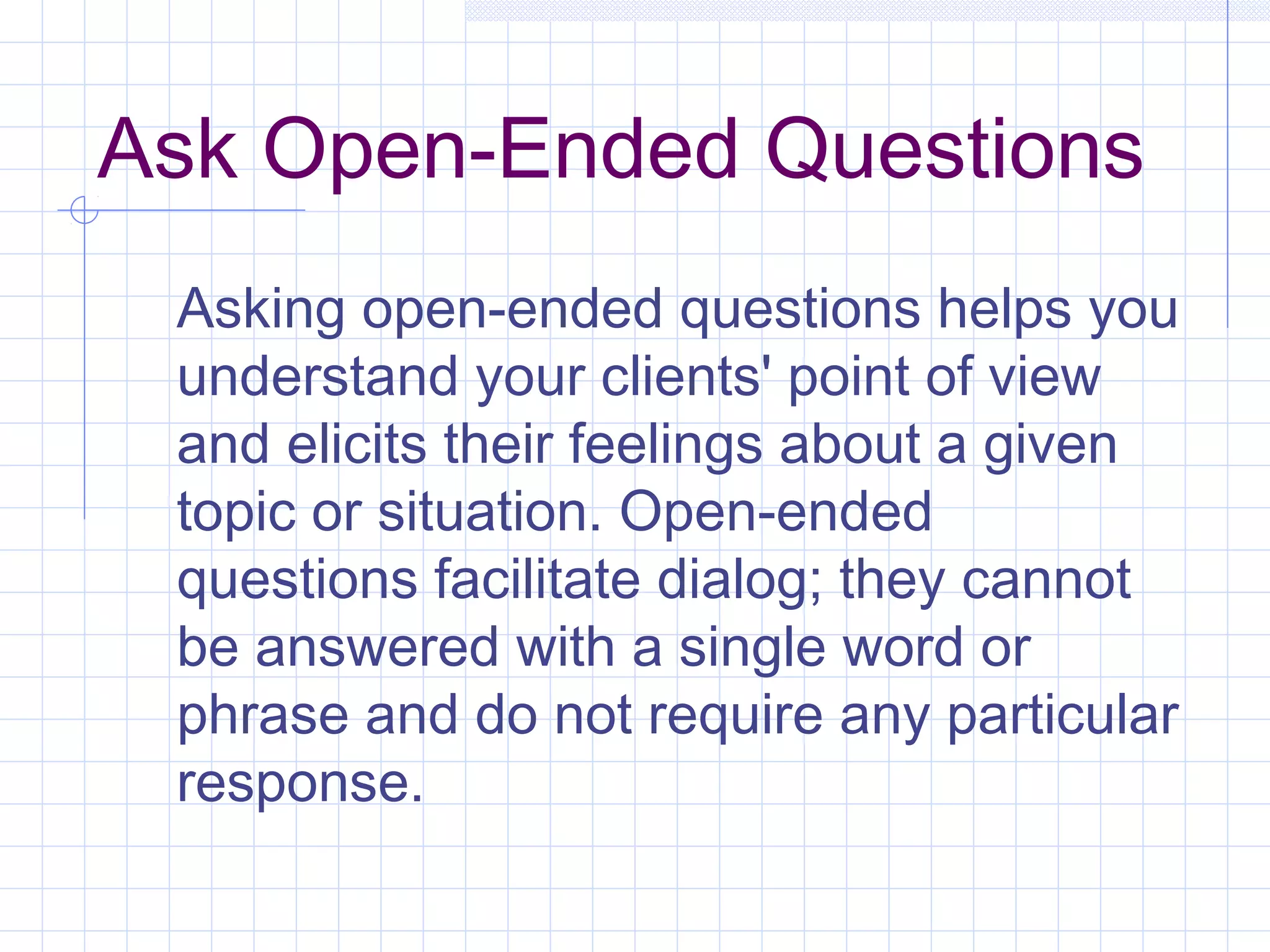
Ask Open-Ended Questions
Asking open-ended questions helps you
understand your clients' point of view
and elicits their feelings about a given
topic or situation. Open-ended
questions facilitate dialog; they cannot
be answered with a single word or
phrase and do not require any particular
response.
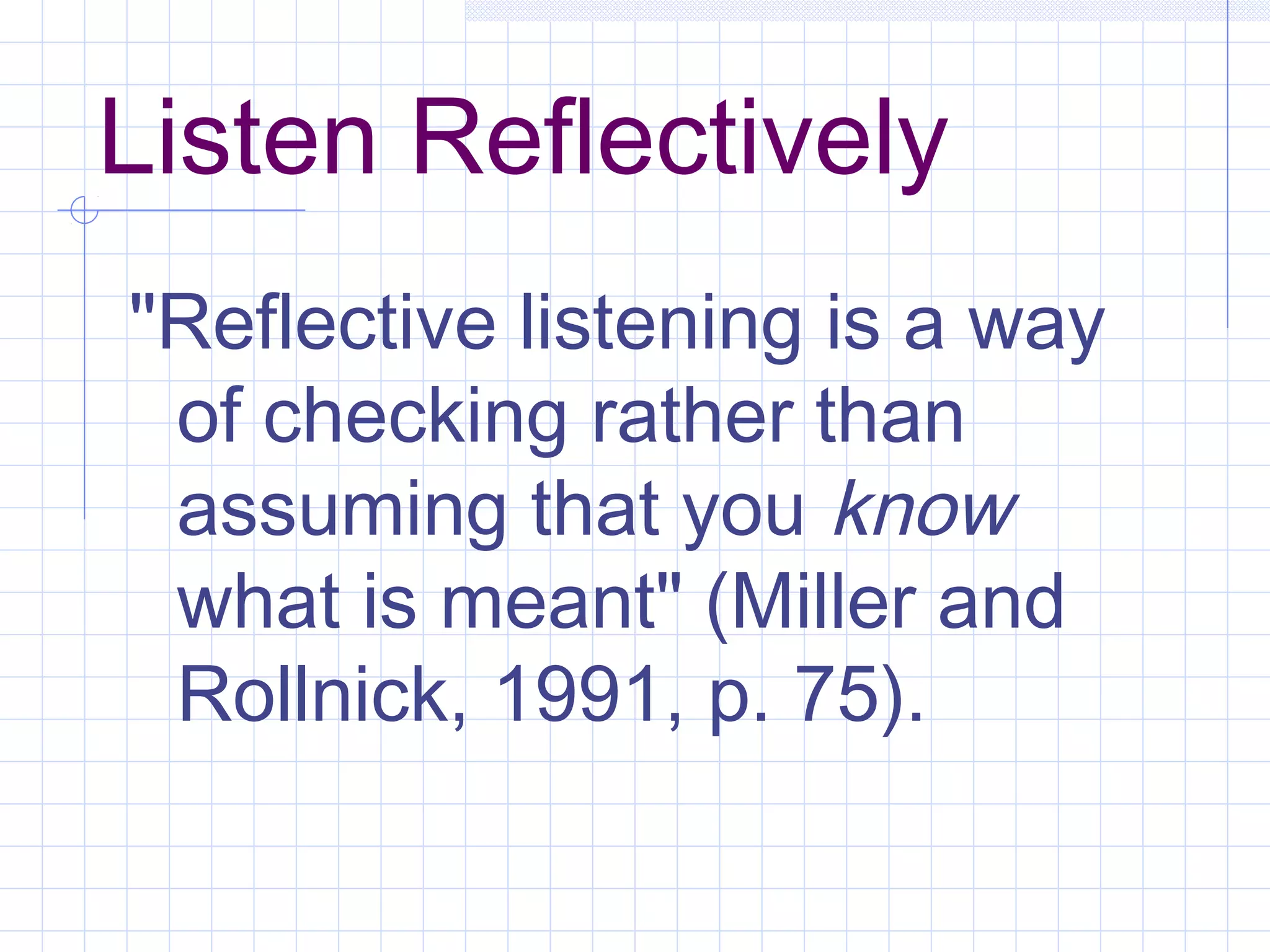
Listen Reflectively
"Reflective listening is a way
of checking rather than
assuming that you know
what is meant" (Miller and
Rollnick, 1991, p. 75).
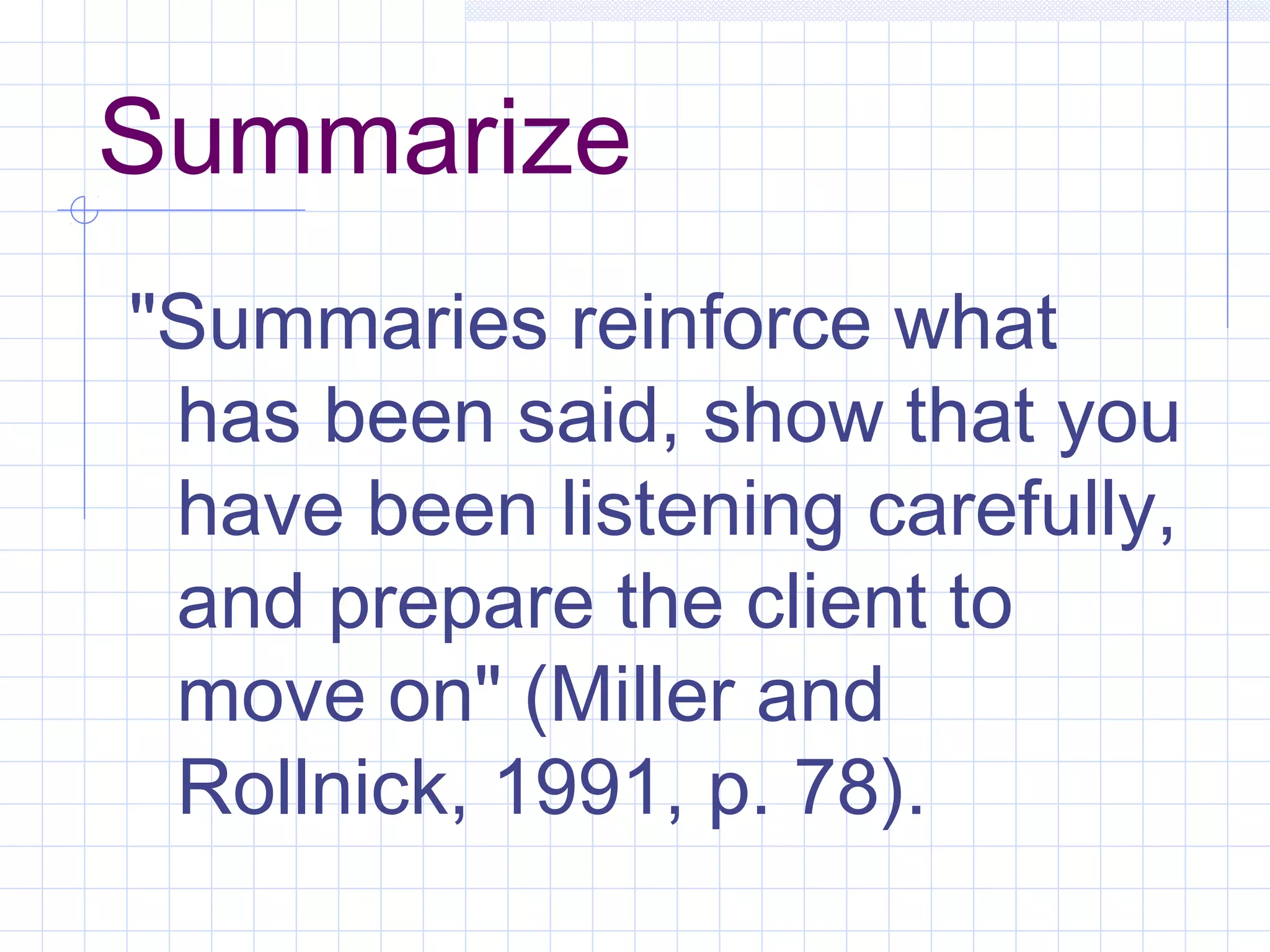
Summarize
"Summaries reinforce what
has been said, show that you
have been listening carefully,
and prepare the client to
move on" (Miller and
Rollnick, 1991, p. 78).
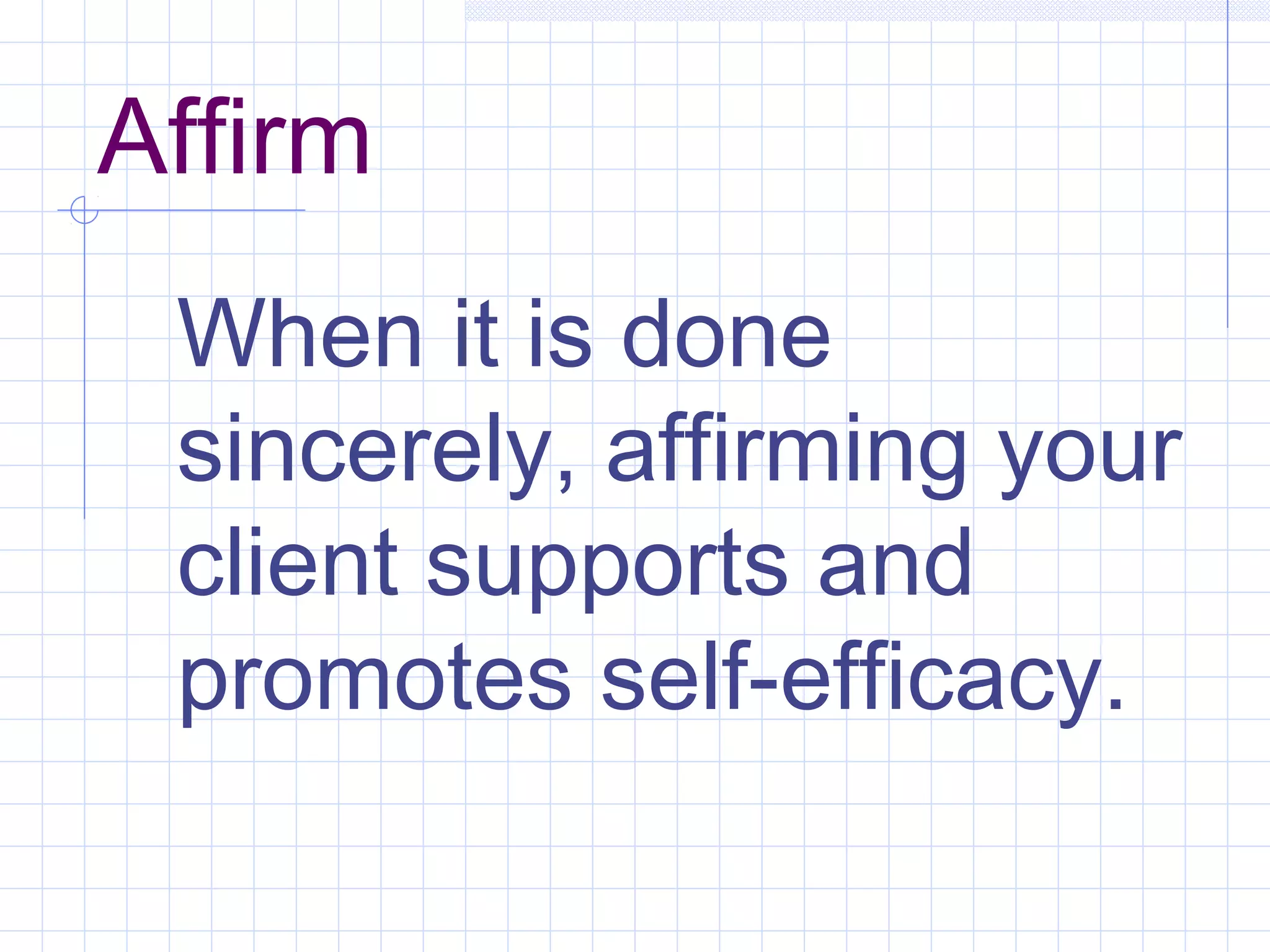
Affirm
When it is done
sincerely, affirming your
client supports and
promotes self-efficacy.
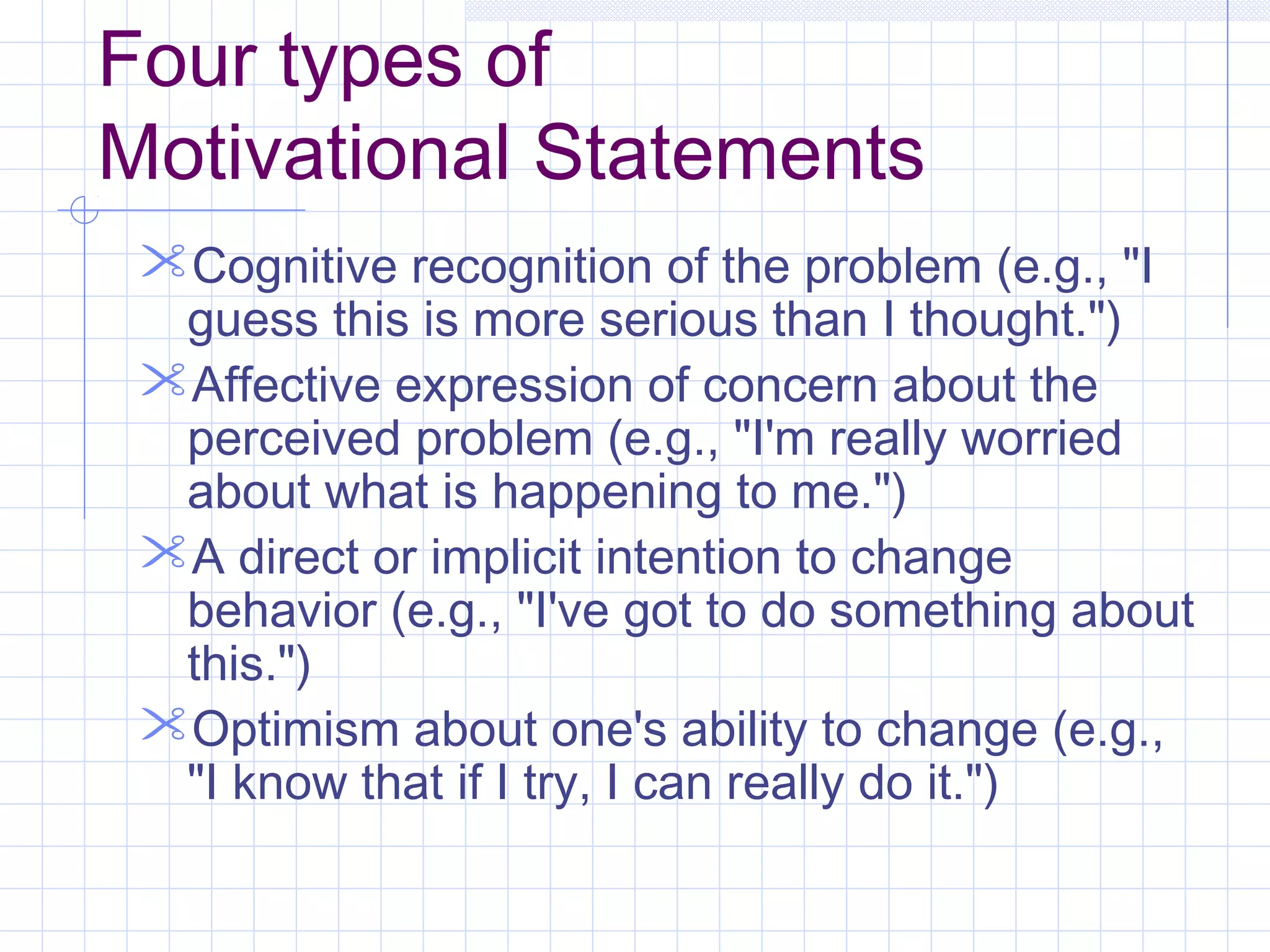
Four types of
Motivational Statements
Cognitive recognition of the problem (e.g., "I
guess this is more serious than I thought.")
Affective expression of concern about the
perceived problem (e.g., "I'm really worried
about what is happening to me.")
A direct or implicit intention to change
behavior (e.g., "I've got to do something about
this.")
Optimism about one's ability to change (e.g.,
"I know that if I try, I can really do it.")
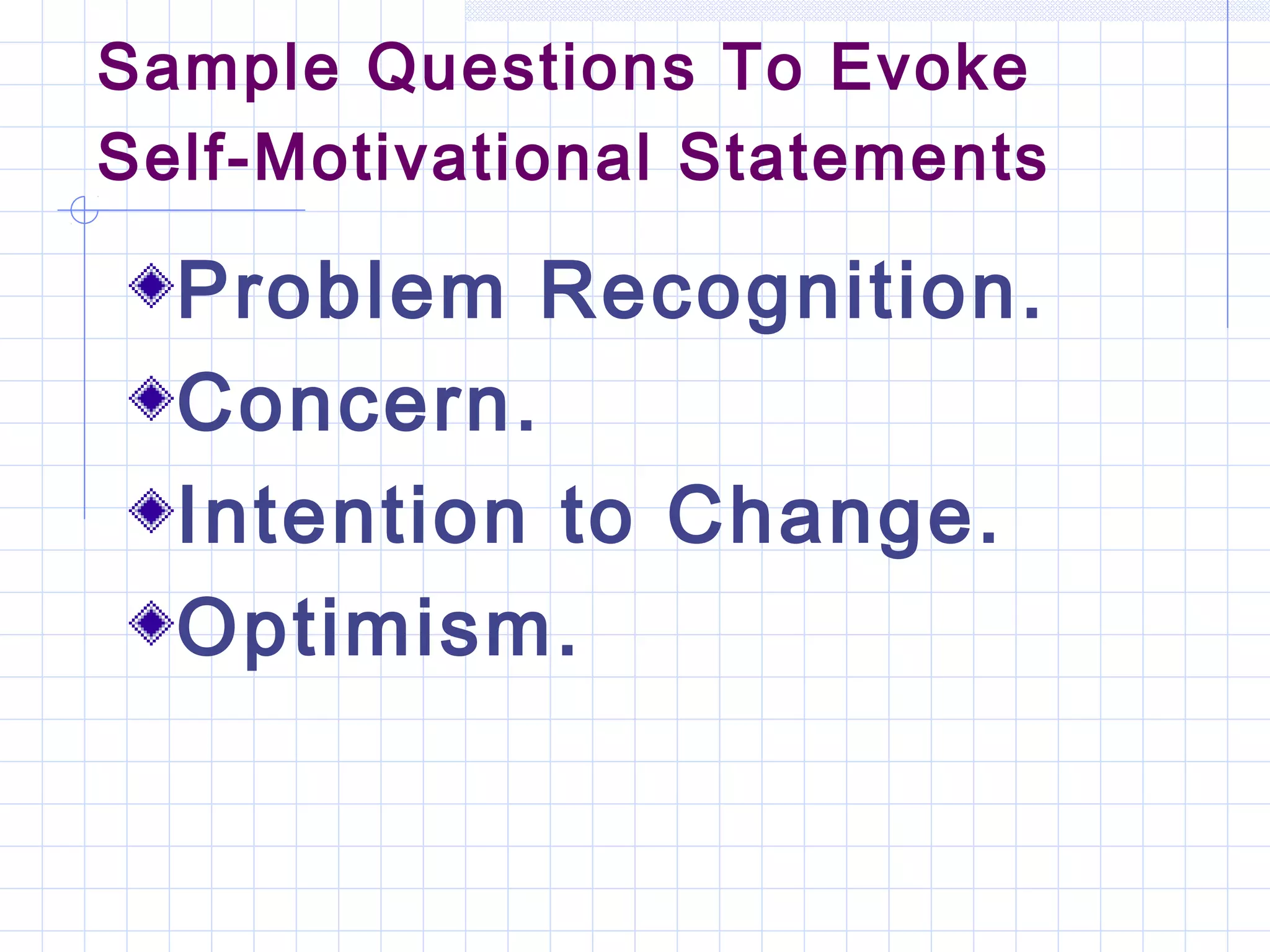
Sample Questions To Evoke
Self-Motivational Statements
Problem Recognition.
Concern.
Intention to Change.
Optimism.
Training and Technical Assistance
Should you have any questions about the
presentation, please call:
Melva Moore, MSSW
Program Specialist II
1-800-832-9623 or 1-512-349-6693
Valerie Shown, LMSW – ACP
Program Specialist II
1-800-832-9623 or 1-512-349-6681

Motivational interviewing

  • 1.
  • 2.
    TIP 35 by WilliamR. Miller, PhD Motivational Interviewing:a therapeutic style intended to help clinicians work with clients to address the client’s continuous fluctuation between opposing behaviors and thoughts.
  • 3.
    Effectiveness of Motivational Interviewing Arecent review of 11 clinical trials of motivational interviewing concluded that this is a "useful clinical intervention... [and] appears to be an effective, efficient, and adaptive therapeutic style worthy of further development, application, and research" (Noonan and Moyers, 1997, p. 8).
  • 4.
    Appropriate Motivational Strategiesfor Each Stage of Change Client's Stage of Change Appropriate Motivational Strategies for the Clinician Precontemplation The client is not yet considering change or is unwilling or unable to change. Establish rapport, ask permission, and build trust. Raise doubts or concerns in the client about. substance- using patterns Express concern and keep the door open.
  • 5.
    Client's Stage ofChange Appropriate Motivational Strategies for the Clinician Contemplation The client acknowledges concerns and is considering the possibility of change but is ambivalent and uncertain. Normalize ambivalence. Help the client "tip the decisional balance scales" toward change. Elicit and summarize self-motivational statements of intent and commitment from the client. Elicit ideas regarding the client's perceived
  • 6.
    Client's Stage ofChange Appropriate Motivational Strategies for the Clinician Preparation The client is committed to and planning to make a change in the near future but is still considering what to do. Explore treatment expectancies and the client's role. Clarify the client's own goals. Negotiate a change--or treatment--plan and behavior contract. Consider and lower barriers to change. Help the client enlist
  • 7.
    Client's Stage ofChange Appropriate Motivational Strategies for the Clinician Action The client is actively taking steps to change but has not yet reached a stable state. Engage the client in treatment and reinforce the importance of remaining in recovery. Acknowledge difficulties for the client in early stages of change. Help the client identify high-risk situations through a functional analysis and
  • 8.
    Client's Stage ofChange Appropriate Motivational Strategies for the Clinician Maintenance The client has achieved initial goals such as abstinence and is now working to maintain gains. Support lifestyle changes. Affirm the client's resolve and self- efficacy. Help the client practice and use new coping strategies to avoid a return to use. Develop a "fire escape" plan if the client resumes substance use.
  • 9.
    Client's Stage ofChange Appropriate Motivational Strategies for the Clinician Recurrence The client has experienced a recurrence of symptoms and must now cope with consequences and decide what to do next. Help the client reenter the change cycle and commend any willingness to reconsider positive change. Explore the meaning and reality of the recurrence as a learning opportunity. Assist the client in finding alternative
  • 10.
    Skills Express EMPATHY through reflective listening. Develop discrepancy or inconsistencies betweenclient goals and current behavior. Avoid argument and direct confrontation. Adjust to client’s resistance rather than opposing it directly. Support self- efficacy and optimism.
  • 11.
    Expressing Empathy Acceptance facilitateschange Skillful reflective listening is fundamental to expressing empathy Ambivalence is normal. Source: Miller and Rollnick, 1991. Reprinted with permission.
  • 12.
    Develop Discrepancy Motivation for changeis enhanced when clients perceive discrepancies between their current situation and their hopes for the future. One useful tactic for helping a client perceive discrepancy is sometimes called the "Columbo approach" (Kanfer and Schefft, 1988).
  • 13.
    Developing Discrepancy Developing awareness of consequenceshelps clients examine their behavior. A discrepancy between present behavior and important goals motivates change. The client should present the arguments for change. Source: Miller and Rollnick, 1991.
  • 14.
    The Columbo Approach Using theColumbo approach, the clinician plays the role of a detective who is trying to solve a mystery but is having a difficult time because the clues don't add up. The "Columbo clinician" engages the client in solving the mystery.
  • 15.
    Four Types ofClient Resistance Arguing The client contests the accuracy, expertise, or integrity of the clinician.
  • 16.
    “Resistance Continued” Interrupting The clientbreaks in and interrupts the clinician in a defensive manner.
  • 17.
    “Resistance Continued” Denying The clientexpresses unwillingness to recognize problems, cooperate, accept responsibility, or take advice.
  • 18.
    “Resistance Continued” Ignoring The clientshows evidence of ignoring or not following the clinician.
  • 19.
    Simple Reflection The simplestapproach to responding to resistance is with nonresistance, by repeating the client's statement in a neutral form. This acknowledges and validates what the client has said and can elicit an opposite response.
  • 20.
    Amplified Reflection Another strategy isto reflect the client's statement in an exaggerated form--to state it in a more extreme way but without sarcasm. This can move the client toward positive change rather than resistance.
  • 21.
    Double-sided Reflection A thirdstrategy entails acknowledging what the client has said but then also stating contrary things she has said in the past. This requires the use of information that the client has offered previously, although perhaps not in the same session.
  • 22.
    Shifting Focus You candefuse resistance by helping the client shift focus away from obstacles and barriers. This method offers an opportunity to affirm your client's personal choice regarding the conduct of his own life.
  • 23.
    Agreement With aTwist A subtle strategy is to agree with the client, but with a slight twist or change of direction that propels the discussion forward.
  • 24.
    Reframing A good strategyto use when a client denies personal problems is reframing--offering a new and positive interpretation of negative information provided by the client. Reframing "acknowledges the validity of the client's raw observations, but offers a new meaning...for them" (Miller and Rollnick, 1991, p. 107).
  • 25.
    Rolling With Resistance Momentumcan be used to good advantage. Perceptions can be shifted. New perspectives are invited but not imposed. The client is a valuable resource in finding solutions to problems. Source: Miller and Rollnick, 1991. Reprinted with permission.
  • 26.
    Siding With theNegative One more strategy for adapting to client resistance is to "side with the negative"--to take up the negative voice in the discussion. If your client is ambivalent, your taking the negative side of the argument evokes a "Yes, but..." from the client, who then expresses the other (positive) side.
  • 27.
    Self-Efficacy Belief in thepossibility of change is an important motivator. The client is responsible for choosing and carrying out personal change. There is hope in the range of alternative approaches available. Source: Miller and Rollnick, 1991. Reprinted with permission.
  • 28.
    Avoiding Arguments Arguments arecounterproductive. Defending breeds defensiveness. Resistance is a signal to change strategies. Labeling is unnecessary. Source: Miller and Rollnick, 1991. Reprinted with permission.
  • 29.
    Ask Open-Ended Questions Askingopen-ended questions helps you understand your clients' point of view and elicits their feelings about a given topic or situation. Open-ended questions facilitate dialog; they cannot be answered with a single word or phrase and do not require any particular response.
  • 30.
    Listen Reflectively "Reflective listeningis a way of checking rather than assuming that you know what is meant" (Miller and Rollnick, 1991, p. 75).
  • 31.
    Summarize "Summaries reinforce what hasbeen said, show that you have been listening carefully, and prepare the client to move on" (Miller and Rollnick, 1991, p. 78).
  • 32.
    Affirm When it isdone sincerely, affirming your client supports and promotes self-efficacy.
  • 33.
    Four types of MotivationalStatements Cognitive recognition of the problem (e.g., "I guess this is more serious than I thought.") Affective expression of concern about the perceived problem (e.g., "I'm really worried about what is happening to me.") A direct or implicit intention to change behavior (e.g., "I've got to do something about this.") Optimism about one's ability to change (e.g., "I know that if I try, I can really do it.")
  • 34.
    Sample Questions ToEvoke Self-Motivational Statements Problem Recognition. Concern. Intention to Change. Optimism.
  • 35.
    Training and TechnicalAssistance Should you have any questions about the presentation, please call: Melva Moore, MSSW Program Specialist II 1-800-832-9623 or 1-512-349-6693 Valerie Shown, LMSW – ACP Program Specialist II 1-800-832-9623 or 1-512-349-6681