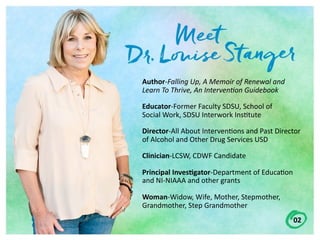
Author-Falling	Up,	A	Memoir	of	Renewal	and		
Learn	To	Thrive,	An	Interven;on	Guidebook	
Educator-Former	Faculty	SDSU,	School	of		
Social	Work,	SDSU	Interwork	Ins;tute	
Director-All	About	Interven;ons	and	Past	Director		
of	Alcohol	and	Other	Drug	Services	USD	
Clinician-LCSW,	CDWF	Candidate	
Principal	Inves7gator-Department	of	Educa;on		
and	NI-NIAAA	and	other	grants	
Woman-Widow,	Wife,	Mother,	Stepmother,	
Grandmother,	Step	Grandmother
02
Thank	you	to	
Sonia	Levine	and	Brené	Brown	
for	all	you	do	for	our	industry.	
This	presenta;on	is	inspired	
directly	by	your	work.	
SoniaLevine.com	
BreneBrown.com
03
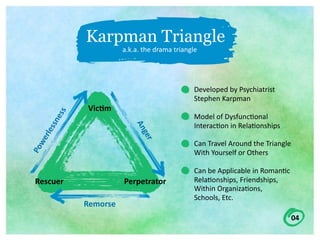
Developed	by	Psychiatrist		
Stephen	Karpman	
Model	of	Dysfunc;onal		
Interac;on	in	Rela;onships	
Can	Travel	Around	the	Triangle		
With	Yourself	or	Others	
Can	be	Applicable	in	Roman;c		
Rela;onships,	Friendships,		
Within	Organiza;ons,		
Schools,	Etc.
04
Karpman Triangle
a.k.a.	the	drama	triangle
Remorse
Powerlessness
Anger
Rescuer
Vic7m
Perpetrator
05
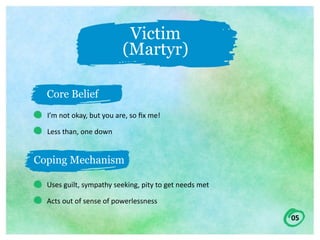
Victim
(Martyr)
I’m	not	okay,	but	you	are,	so	fix	me!	
Less	than,	one	down
Uses	guilt,	sympathy	seeking,	pity	to	get	needs	met	
Acts	out	of	sense	of	powerlessness	
Core Belief
Coping Mechanism
06
07
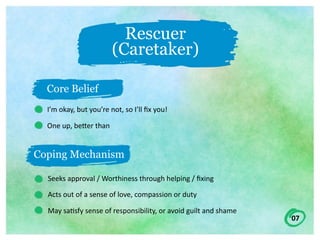
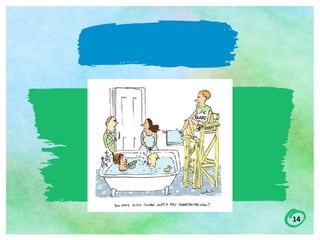
Rescuer
(Caretaker)
I’m	okay,	but	you’re	not,	so	I’ll	fix	you!	
One	up,	beTer	than
Seeks	approval	/	Worthiness	through	helping	/	fixing	
Acts	out	of	a	sense	of	love,	compassion	or	duty	
May	sa;sfy	sense	of	responsibility,	or	avoid	guilt	and	shame	
Core Belief
Coping Mechanism
08
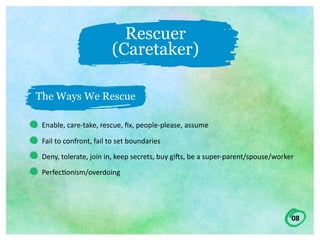
Rescuer
(Caretaker)
Enable,	care-take,	rescue,	fix,	people-please,	assume	
Fail	to	confront,	fail	to	set	boundaries	
Deny,	tolerate,	join	in,	keep	secrets,	buy	giWs,	be	a	super-parent/spouse/worker	
Perfec;onism/overdoing	
The Ways We Rescue
09
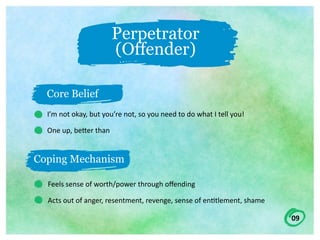
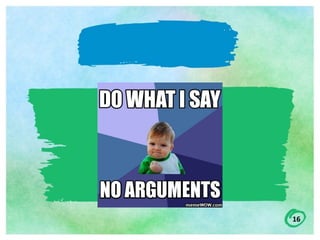
Perpetrator
(Offender)
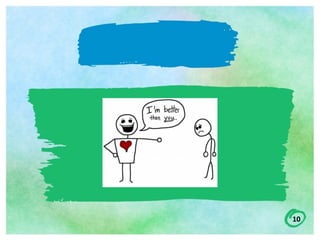
I’m	not	okay,	but	you’re	not,	so	you	need	to	do	what	I	tell	you!	
One	up,	beTer	than
Feels	sense	of	worth/power	through	offending	
Acts	out	of	anger,	resentment,	revenge,	sense	of	en;tlement,	shame	
Core Belief
Coping Mechanism
10
11
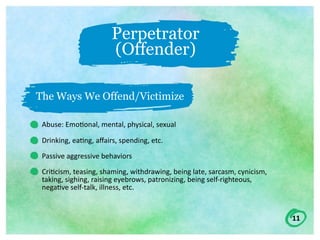
Perpetrator
(Offender)
Abuse:	Emo;onal,	mental,	physical,	sexual	
		
Drinking,	ea;ng,	affairs,	spending,	etc.	
Passive	aggressive	behaviors	
Cri;cism,	teasing,	shaming,	withdrawing,	being	late,	sarcasm,	cynicism,		
taking,	sighing,	raising	eyebrows,	patronizing,	being	self-righteous,		
nega;ve	self-talk,	illness,	etc.	
The Ways We Offend/Victimize
12
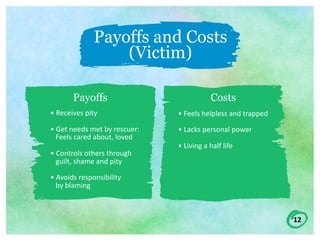
Payoffs and Costs
(Victim)
•	Receives	pity	
•	Get	needs	met	by	rescuer:		
			Feels	cared	about,	loved	
•	Controls	others	through		
			guilt,	shame	and	pity	
•	Avoids	responsibility		
			by	blaming	
Payoffs Costs
•	Feels	helpless	and	trapped	
•	Lacks	personal	power	
•	Living	a	half	life
13
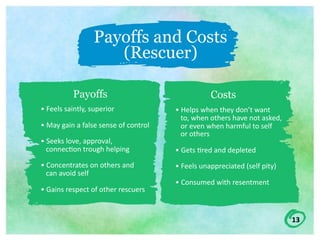
Payoffs and Costs
(Rescuer)
•	Feels	saintly,	superior	
•	May	gain	a	false	sense	of	control	
•	Seeks	love,	approval,		
			connec;on	trough	helping	
•	Concentrates	on	others	and	
			can	avoid	self	
•	Gains	respect	of	other	rescuers	
Payoffs Costs
•	Helps	when	they	don’t	want		
			to,	when	others	have	not	asked,		
			or	even	when	harmful	to	self		
			or	others	
•	Gets	;red	and	depleted	
•	Feels	unappreciated	(self	pity)	
•	Consumed	with	resentment
14
15
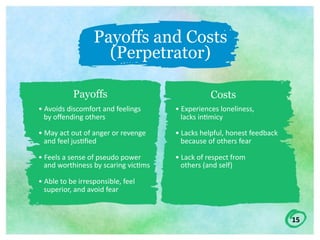
Payoffs and Costs
(Perpetrator)
•	Avoids	discomfort	and	feelings		
			by	offending	others	
•	May	act	out	of	anger	or	revenge		
			and	feel	jus;fied	
•	Feels	a	sense	of	pseudo	power		
			and	worthiness	by	scaring	vic;ms	
•	Able	to	be	irresponsible,	feel		
			superior,	and	avoid	fear	
Payoffs Costs
•	Experiences	loneliness,		
			lacks	in;micy	
•	Lacks	helpful,	honest	feedback		
			because	of	others	fear	
•	Lack	of	respect	from		
			others	(and	self)
16
17
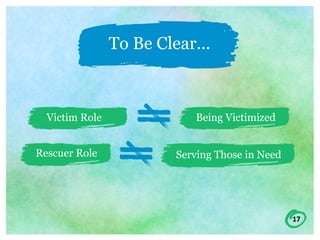
To Be Clear...
Victim Role Being Victimized
Rescuer Role Serving Those in Need
18
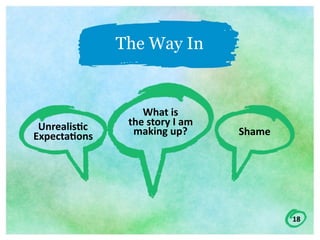
The Way In
Unrealis7c	
Expecta7ons
What	is		
the	story	I	am	
making	up? Shame
19
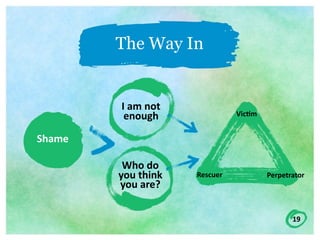
The Way In
Shame
I	am	not	
enough Vic7m
Who	do	
you	think	
you	are?
PerpetratorRescuer
20
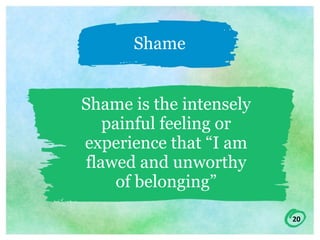
Shame
Shame is the intensely
painful feeling or
experience that “I am
flawed and unworthy
of belonging”
21
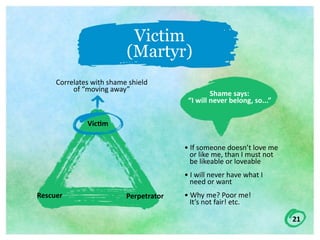
Victim
(Martyr)
Shame	says:	
“I	will	never	belong,	so...”
Correlates	with	shame	shield	
of	“moving	away”
Vic7m
PerpetratorRescuer
•	If	someone	doesn’t	love	me		
			or	like	me,	than	I	must	not		
			be	likeable	or	loveable	
•	I	will	never	have	what	I		
			need	or	want	
•	Why	me?	Poor	me!		
			It’s	not	fair!	etc.
22
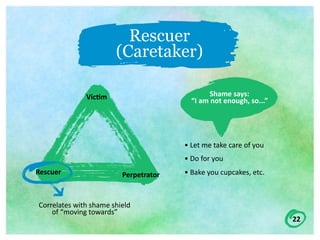
Rescuer
(Caretaker)
Shame	says:	
“I	am	not	enough,	so...”	
Correlates	with	shame	shield	
of	“moving	towards”
Vic7m
PerpetratorRescuer
•	Let	me	take	care	of	you	
•	Do	for	you	
•	Bake	you	cupcakes,	etc.
23
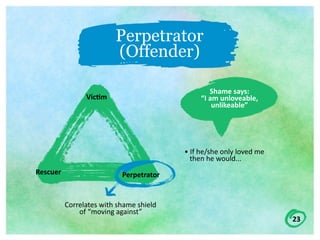
Perpetrator
(Offender)
Shame	says:	
“I	am	unloveable,	
unlikeable”	
Correlates	with	shame	shield	
of	“moving	against”
Vic7m
PerpetratorRescuer
•	If	he/she	only	loved	me		
			then	he	would...
24
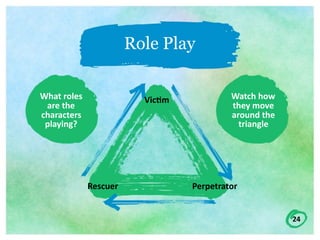
Role Play
What	roles	
are	the	
characters	
playing?
Vic7m Watch	how	
they	move	
around	the	
triangle
Rescuer Perpetrator
25
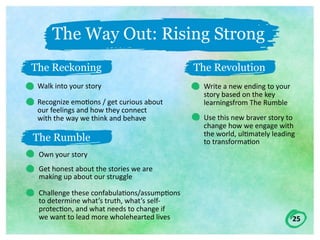
The Way Out: Rising Strong
Walk	into	your	story	
Recognize	emo;ons	/	get	curious	about		
our	feelings	and	how	they	connect		
with	the	way	we	think	and	behave	
Own	your	story	
Get	honest	about	the	stories	we	are		
making	up	about	our	struggle	
Challenge	these	confabula;ons/assump;ons		
to	determine	what’s	truth,	what’s	self-	
protec;on,	and	what	needs	to	change	if		
we	want	to	lead	more	wholehearted	lives	
The Reckoning
The Rumble
Write	a	new	ending	to	your	
story	based	on	the	key		
learningsfrom	The	Rumble	
Use	this	new	braver	story	to		
change	how	we	engage	with	
the	world,	ul;mately	leading		
to	transforma;on	
The Revolution
26
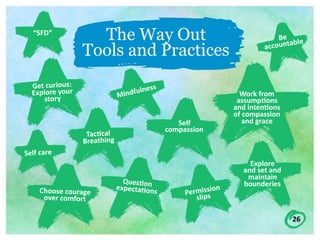
Work	from		
assump7ons	
and	inten7ons	
of	compassion	
and	grace
Be	
accountable	
Explore	
and	set	and	
maintain	
bounderies
Permission	
slips	
Self	
compassion
Mindfulness	
Ques7on	expecta7ons
The Way Out
Tools and Practices
Tac7cal	
Breathing	
Choose	courage	
over	comfort
Self	care	
Get	curious:	
Explore	your	
story	
“SFD”
27
Resources
www.karpmandramatriangle.com	
www.poweroWed.com	
www.self-compassion.org	
www.mindfulselfcompassion.org	
www.centerformsc.org	
Rising	Strong	by	Dr.	Brené	Brown	
Daring	Greatly	by	Dr.	Brené	Brown	
GiHs	of	Imperfec;on	by	Dr.	Brené	Brown
28

Exploring the Karpman Triangle