THERMOCOUPLES
ALL ABOUTTEMPERATURE
• Follow us on facebook
• https://youtu.be/kwoPcOJj4fY
• Follow us on youtube
• https://www.youtube.com/channel/UCBCKLWgJ2h
ffro0sEVx1cWA
• A scalar quantity that determines the direction of heat flow
between two bodies
• A statistical measurement
. Temperature measurement relies on the transfer of heat
energy from the process material to the measuring device
• Temperature is an important parameter in many control
systems
• These include non electrical as well as electrical methods
• A thermometer is the most common non electrical sensor
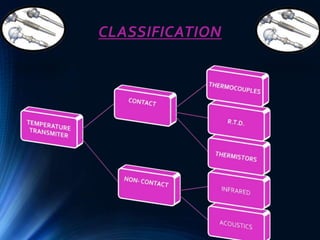
CLASSIFICATION
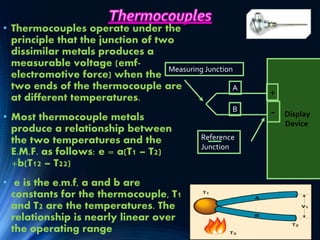
• Thermocouples operate under the
principle that the junction of two
dissimilar metals produces a
measurable voltage (emf-
electromotive force) when the
two ends of the thermocouple are
at different temperatures.
• Most thermocouple metals
produce a relationship between
the two temperatures and the
E.M.F. as follows: e = a(T1 – T2)
+b(T12 – T22)
• e is the e.m.f, a and b are
constants for the thermocouple, T1
and T2 are the temperatures. The
relationship is nearly linear over
the operating range
Display
Device
+
-
A
B
Reference
Junction
Measuring Junction
GOVERNING EFFECTS
The three main principles that
governs the operation of
thermocouple are
 SEEBECK EFFECT
 PELTIER EFFECT
 THOMSON EFFECT
SEEBECK EFECT
The Seebeck effect states that when
two different or unlike metals are joined
together at two junctions, an
electromotive force (emf) is generated
at the two junctions.The amount of emf
generated is different for different
combinations of the metals.
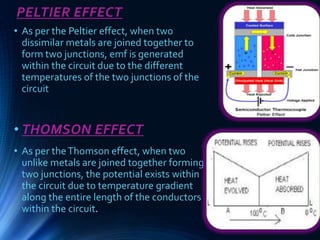
PELTIER EFFECT
• As per the Peltier effect, when two
dissimilar metals are joined together to
form two junctions, emf is generated
within the circuit due to the different
temperatures of the two junctions of the
circuit
• THOMSON EFFECT
• As per theThomson effect, when two
unlike metals are joined together forming
two junctions, the potential exists within
the circuit due to temperature gradient
along the entire length of the conductors
within the circuit.
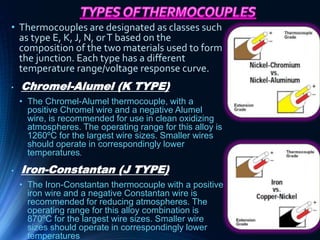
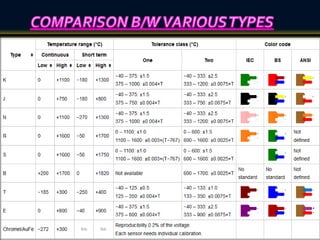
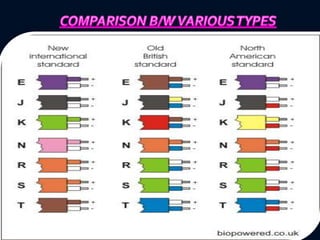
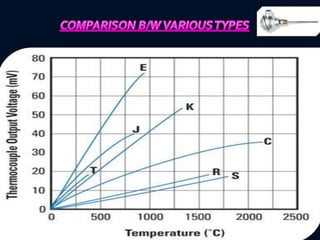
• Thermocouples are designated as classes such
as type E, K, J, N, orT based on the
composition of the two materials used to form
the junction. Each type has a different
temperature range/voltage response curve.
• Chromel-Alumel (K TYPE)
• The Chromel-Alumel thermocouple, with a
positive Chromel wire and a negative Alumel
wire, is recommended for use in clean oxidizing
atmospheres. The operating range for this alloy is
1260ºC for the largest wire sizes. Smaller wires
should operate in correspondingly lower
temperatures.
• Iron-Constantan (J TYPE)
• The Iron-Constantan thermocouple with a positive
iron wire and a negative Constantan wire is
recommended for reducing atmospheres. The
operating range for this alloy combination is
870ºC for the largest wire sizes. Smaller wire
sizes should operate in correspondingly lower
temperatures
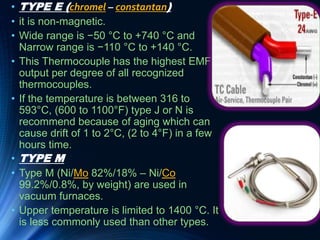
• TYPE E (chromel – constantan)
• it is non-magnetic.
• Wide range is −50 °C to +740 °C and
Narrow range is −110 °C to +140 °C.
• This Thermocouple has the highest EMF
output per degree of all recognized
thermocouples.
• If the temperature is between 316 to
593°C, (600 to 1100°F) type J or N is
recommend because of aging which can
cause drift of 1 to 2°C, (2 to 4°F) in a few
hours time.
• TYPE M
• Type M (Ni/Mo 82%/18% – Ni/Co
99.2%/0.8%, by weight) are used in
vacuum furnaces.
• Upper temperature is limited to 1400 °C. It
is less commonly used than other types.
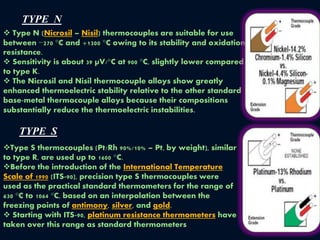
TYPE N
 Type N (Nicrosil – Nisil) thermocouples are suitable for use
between −270 °C and +1300 °C owing to its stability and oxidation
resistance.
 Sensitivity is about 39 µV/°C at 900 °C, slightly lower compared
to type K.
 The Nicrosil and Nisil thermocouple alloys show greatly
enhanced thermoelectric stability relative to the other standard
base-metal thermocouple alloys because their compositions
substantially reduce the thermoelectric instabilities.
TYPE S
Type S thermocouples (Pt/Rh 90%/10% – Pt, by weight), similar
to type R, are used up to 1600 °C.
Before the introduction of the International Temperature
Scale of 1990 (ITS-90), precision type S thermocouples were
used as the practical standard thermometers for the range of
630 °C to 1064 °C, based on an interpolation between the
freezing points of antimony, silver, and gold.
 Starting with ITS-90, platinum resistance thermometers have
taken over this range as standard thermometers
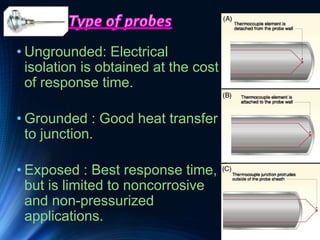
• Ungrounded: Electrical
isolation is obtained at the cost
of response time.
• Grounded : Good heat transfer
to junction.
• Exposed : Best response time,
but is limited to noncorrosive
and non-pressurized
applications.
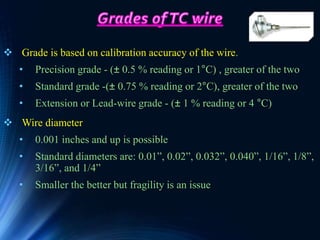
 Grade is based on calibration accuracy of the wire.
• Precision grade - (± 0.5 % reading or 1°C) , greater of the two
• Standard grade -(± 0.75 % reading or 2°C), greater of the two
• Extension or Lead-wire grade - (± 1 % reading or 4 °C)
 Wire diameter
• 0.001 inches and up is possible
• Standard diameters are: 0.01”, 0.02”, 0.032”, 0.040”, 1/16”, 1/8”,
3/16”, and 1/4”
• Smaller the better but fragility is an issue
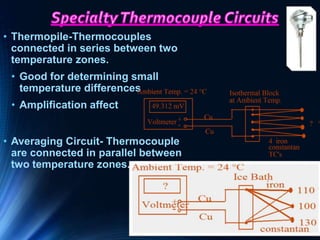
• Thermopile-Thermocouples
connected in series between two
temperature zones.
• Good for determining small
temperature differences
• Amplification affect
• Averaging Circuit- Thermocouple
are connected in parallel between
two temperature zones.
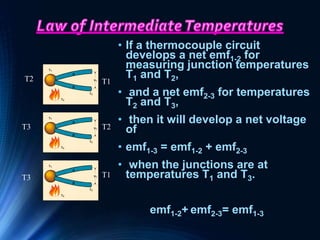
• If a thermocouple circuit
develops a net emf1-2 for
measuring junction temperatures
T1 and T2,
• and a net emf2-3 for temperatures
T2 and T3,
• then it will develop a net voltage
of
• emf1-3 = emf1-2 + emf2-3
• when the junctions are at
temperatures T1 and T3.
emf1-2+ emf2-3= emf1-3
T2
T3 T1
T3 T2
T1
Plastic injection molding
machinery
Food processing equipment
Deicing
Semiconductor processing
Heat treating
Medical equipment
Industrial heat treating
Packaging equipment
• Failed = inaccuracy
- When wires are heated/cooled changes take place on
molecular level
Physically: molecular structure changes
Chemically: wires react with oxygen or other substances, changing
chemical composition
- Result: millivolt signal “drifts”
Time
EMF
(mV)
Tolerance Band
- Recalibration: adjust controller to compensate for errors
• 3 General constructions
Insulated Wire
Ceramic-beaded
Metal-sheathed
• Bare wires wrapped with insulation
• Insulations
• Fibrous, woven material made of fiber-
glass, mica, or ceramic fiber
• Plastics (Teflon)
• Polyimides (Kapton)
• Purpose
• Electrically isolate wires
• Protects wires from contamination
• Easier wire installation
• Junction and wires are assembled in small diameter
metal tubes
• Insulation
• Fiberglass
• MgO
• Purpose
• Protects against contamination
• Defends against chemical attack
• Provides mechanical stability
Simple, Rugged
High temperature
operation
Low cost
No resistance lead wire
problems
Point temperature
sensing
Fastest response to
temperature changes
Least stable, least
repeatable
Low sensitivity to small
temperature changes
Extension wire must be
of the same
thermocouple type
Wire may pick up
radiated electrical noise
if not shielded
Lowest accuracy
Advantages Disadvantages

All about temperature transmiter.

  • 1.
  • 2.
    • Follow uson facebook • https://youtu.be/kwoPcOJj4fY • Follow us on youtube • https://www.youtube.com/channel/UCBCKLWgJ2h ffro0sEVx1cWA
  • 3.
    • A scalarquantity that determines the direction of heat flow between two bodies • A statistical measurement . Temperature measurement relies on the transfer of heat energy from the process material to the measuring device • Temperature is an important parameter in many control systems • These include non electrical as well as electrical methods • A thermometer is the most common non electrical sensor
  • 4.
  • 5.
    • Thermocouples operateunder the principle that the junction of two dissimilar metals produces a measurable voltage (emf- electromotive force) when the two ends of the thermocouple are at different temperatures. • Most thermocouple metals produce a relationship between the two temperatures and the E.M.F. as follows: e = a(T1 – T2) +b(T12 – T22) • e is the e.m.f, a and b are constants for the thermocouple, T1 and T2 are the temperatures. The relationship is nearly linear over the operating range Display Device + - A B Reference Junction Measuring Junction
  • 6.
    GOVERNING EFFECTS The threemain principles that governs the operation of thermocouple are  SEEBECK EFFECT  PELTIER EFFECT  THOMSON EFFECT SEEBECK EFECT The Seebeck effect states that when two different or unlike metals are joined together at two junctions, an electromotive force (emf) is generated at the two junctions.The amount of emf generated is different for different combinations of the metals.
  • 7.
    PELTIER EFFECT • Asper the Peltier effect, when two dissimilar metals are joined together to form two junctions, emf is generated within the circuit due to the different temperatures of the two junctions of the circuit • THOMSON EFFECT • As per theThomson effect, when two unlike metals are joined together forming two junctions, the potential exists within the circuit due to temperature gradient along the entire length of the conductors within the circuit.
  • 8.
    • Thermocouples aredesignated as classes such as type E, K, J, N, orT based on the composition of the two materials used to form the junction. Each type has a different temperature range/voltage response curve. • Chromel-Alumel (K TYPE) • The Chromel-Alumel thermocouple, with a positive Chromel wire and a negative Alumel wire, is recommended for use in clean oxidizing atmospheres. The operating range for this alloy is 1260ºC for the largest wire sizes. Smaller wires should operate in correspondingly lower temperatures. • Iron-Constantan (J TYPE) • The Iron-Constantan thermocouple with a positive iron wire and a negative Constantan wire is recommended for reducing atmospheres. The operating range for this alloy combination is 870ºC for the largest wire sizes. Smaller wire sizes should operate in correspondingly lower temperatures
  • 9.
    • TYPE E(chromel – constantan) • it is non-magnetic. • Wide range is −50 °C to +740 °C and Narrow range is −110 °C to +140 °C. • This Thermocouple has the highest EMF output per degree of all recognized thermocouples. • If the temperature is between 316 to 593°C, (600 to 1100°F) type J or N is recommend because of aging which can cause drift of 1 to 2°C, (2 to 4°F) in a few hours time. • TYPE M • Type M (Ni/Mo 82%/18% – Ni/Co 99.2%/0.8%, by weight) are used in vacuum furnaces. • Upper temperature is limited to 1400 °C. It is less commonly used than other types.
  • 10.
    TYPE N  TypeN (Nicrosil – Nisil) thermocouples are suitable for use between −270 °C and +1300 °C owing to its stability and oxidation resistance.  Sensitivity is about 39 µV/°C at 900 °C, slightly lower compared to type K.  The Nicrosil and Nisil thermocouple alloys show greatly enhanced thermoelectric stability relative to the other standard base-metal thermocouple alloys because their compositions substantially reduce the thermoelectric instabilities. TYPE S Type S thermocouples (Pt/Rh 90%/10% – Pt, by weight), similar to type R, are used up to 1600 °C. Before the introduction of the International Temperature Scale of 1990 (ITS-90), precision type S thermocouples were used as the practical standard thermometers for the range of 630 °C to 1064 °C, based on an interpolation between the freezing points of antimony, silver, and gold.  Starting with ITS-90, platinum resistance thermometers have taken over this range as standard thermometers
  • 14.
    • Ungrounded: Electrical isolationis obtained at the cost of response time. • Grounded : Good heat transfer to junction. • Exposed : Best response time, but is limited to noncorrosive and non-pressurized applications.
  • 15.
     Grade isbased on calibration accuracy of the wire. • Precision grade - (± 0.5 % reading or 1°C) , greater of the two • Standard grade -(± 0.75 % reading or 2°C), greater of the two • Extension or Lead-wire grade - (± 1 % reading or 4 °C)  Wire diameter • 0.001 inches and up is possible • Standard diameters are: 0.01”, 0.02”, 0.032”, 0.040”, 1/16”, 1/8”, 3/16”, and 1/4” • Smaller the better but fragility is an issue
  • 16.
    • Thermopile-Thermocouples connected inseries between two temperature zones. • Good for determining small temperature differences • Amplification affect • Averaging Circuit- Thermocouple are connected in parallel between two temperature zones.
  • 18.
    • If athermocouple circuit develops a net emf1-2 for measuring junction temperatures T1 and T2, • and a net emf2-3 for temperatures T2 and T3, • then it will develop a net voltage of • emf1-3 = emf1-2 + emf2-3 • when the junctions are at temperatures T1 and T3. emf1-2+ emf2-3= emf1-3 T2 T3 T1 T3 T2 T1
  • 19.
    Plastic injection molding machinery Foodprocessing equipment Deicing Semiconductor processing Heat treating Medical equipment Industrial heat treating Packaging equipment
  • 20.
    • Failed =inaccuracy - When wires are heated/cooled changes take place on molecular level Physically: molecular structure changes Chemically: wires react with oxygen or other substances, changing chemical composition - Result: millivolt signal “drifts” Time EMF (mV) Tolerance Band - Recalibration: adjust controller to compensate for errors
  • 21.
    • 3 Generalconstructions Insulated Wire Ceramic-beaded Metal-sheathed
  • 22.
    • Bare wireswrapped with insulation • Insulations • Fibrous, woven material made of fiber- glass, mica, or ceramic fiber • Plastics (Teflon) • Polyimides (Kapton) • Purpose • Electrically isolate wires • Protects wires from contamination • Easier wire installation
  • 23.
    • Junction andwires are assembled in small diameter metal tubes • Insulation • Fiberglass • MgO • Purpose • Protects against contamination • Defends against chemical attack • Provides mechanical stability
  • 24.
    Simple, Rugged High temperature operation Lowcost No resistance lead wire problems Point temperature sensing Fastest response to temperature changes Least stable, least repeatable Low sensitivity to small temperature changes Extension wire must be of the same thermocouple type Wire may pick up radiated electrical noise if not shielded Lowest accuracy Advantages Disadvantages