MOUSAM CHOUDHURY
Amity Institute of Nanotechnology
Amity University, Noida .
SCANNING
ELECTRON
MICROSCOPY
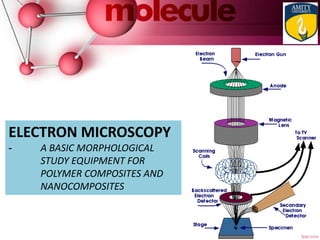
ELECTRON MICROSCOPY
- A BASIC MORPHOLOGICAL
STUDY EQUIPMENT FOR
POLYMER COMPOSITES AND
NANOCOMPOSITES
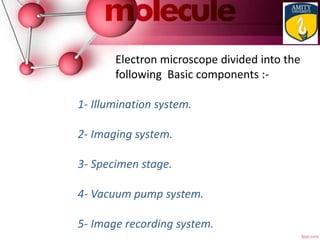
Electron microscope divided into the
following Basic components :-
1- Illumination system.
2- Imaging system.
3- Specimen stage.
4- Vacuum pump system.
5- Image recording system.
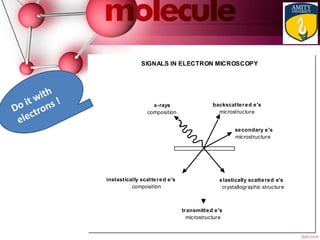
x-rays
composition
backscattered e's
microstructure
secondary e's
microstructure
elastically scattered e's
crystallographic structure
inelastically scattered e's
composition
transmitted e's
microstructure
SIGNALS IN ELECTRON MICROSCOPY
TYPES OF ELECTRON
MICROSCOPY FOR POLYMER
COMPOSITES
• SCANNING ELECTRON MICROSCOPE (SEM)
• TRANSMISSION ELECTRON MICROSCOPE (TEM)
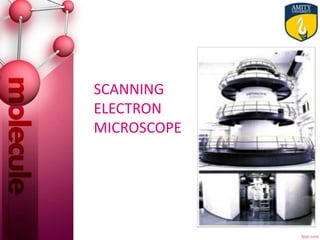
SCANNING
ELECTRON
MICROSCOPE
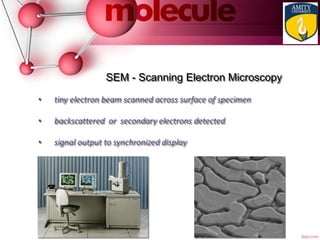
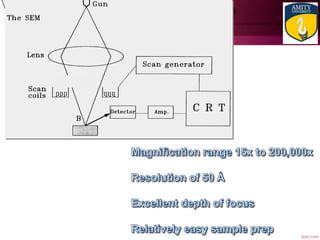
SEM - Scanning Electron Microscopy
• tiny electron beam scanned across surface of specimen
• backscattered or secondary electrons detected
• signal output to synchronized display
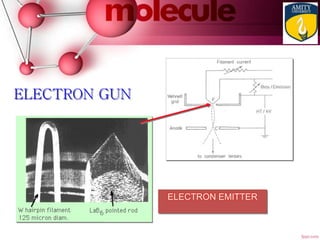
ELECTRON GUN
ELECTRON EMITTER
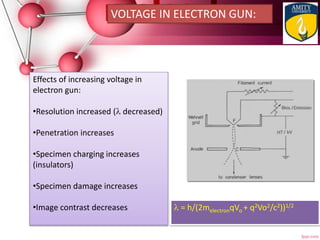
Effects of increasing voltage in
electron gun:
•Resolution increased ( decreased)
•Penetration increases
•Specimen charging increases
(insulators)
•Specimen damage increases
•Image contrast decreases  = h/(2melectronqVo + q2Vo2/c2))1/2
VOLTAGE IN ELECTRON GUN:
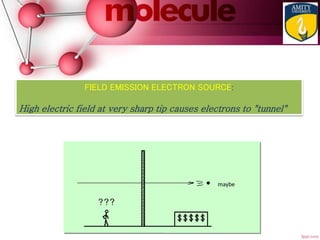
FIELD EMISSION ELECTRON SOURCE:
High electric field at very sharp tip causes electrons to "tunnel"
maybe
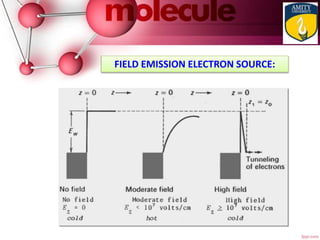
FIELD EMISSION ELECTRON SOURCE:
ELECTRIC FIELD
High electric field at very sharp tip causes electrons to "tunnel"
cool tip ——> smaller E in beam
improved coherence
many electrons from small tip ——> finer
probe size, higher current densities (100X >)
problems - high vacuum
Electrons focused by Lorentz force from electromagnetic field
F = qv x B
effectively same as optical lenses
Lenses are ring-shaped
• coils generate magnetic field
• electrons pass thru hollow center
• lens focal length is continuously variable
• apertures control, limit beam
LENSES
Conducting -
• little or no preparation
• attach to mounting stub for
insertion into SEM instrument
• may need to provide
Conductive path with Ag paint
Non-conducting (E.g., Polymers and Plastics)-
usually coat with conductive very thin layer (Au, C, Cr)
SPECIMEN
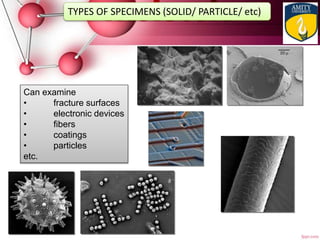
Can examine
• fracture surfaces
• electronic devices
• fibers
• coatings
• particles
etc.
TYPES OF SPECIMENS (SOLID/ PARTICLE/ etc)
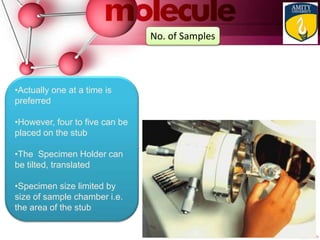
•Actually one at a time is
preferred
•However, four to five can be
placed on the stub
•The Specimen Holder can
be tilted, translated
•Specimen size limited by
size of sample chamber i.e.
the area of the stub
No. of Samples
THAT IS HOW AN IMAGE IS FORMED AND CALLED A MICROGRAPH
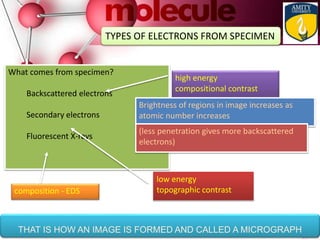
TYPES OF ELECTRONS FROM SPECIMEN
What comes from specimen?
Backscattered electrons
Secondary electrons
Fluorescent X-rays
high energy
compositional contrast
low energy
topographic contrastcomposition - EDS
Brightness of regions in image increases as
atomic number increases
(less penetration gives more backscattered
electrons)
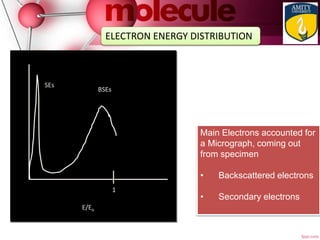
BSEs
SEs
E/Eo
1
Main Electrons accounted for
a Micrograph, coming out
from specimen
• Backscattered electrons
• Secondary electrons
ELECTRON ENERGY DISTRIBUTION
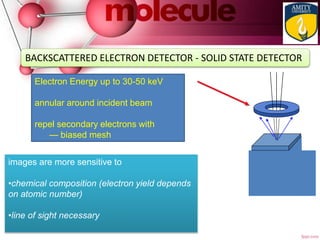
Electron Energy up to 30-50 keV
annular around incident beam
repel secondary electrons with
— biased mesh
images are more sensitive to
•chemical composition (electron yield depends
on atomic number)
•line of sight necessary
BACKSCATTERED ELECTRON DETECTOR - SOLID STATE DETECTOR
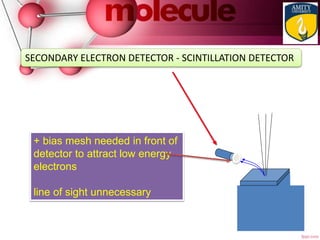
SECONDARY ELECTRON DETECTOR - SCINTILLATION DETECTOR
+ bias mesh needed in front of
detector to attract low energy
electrons
line of sight unnecessary
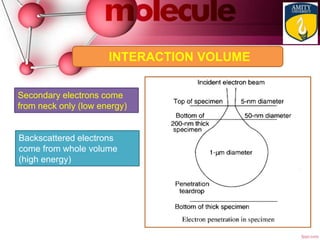
INTERACTION VOLUME
Backscattered electrons
come from whole volume
(high energy)
Secondary electrons come
from neck only (low energy)
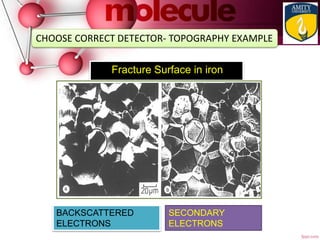
Fracture Surface in iron
SECONDARY
ELECTRONS
BACKSCATTERED
ELECTRONS
CHOOSE CORRECT DETECTOR- TOPOGRAPHY EXAMPLE
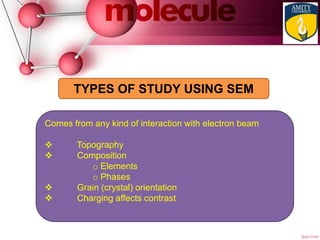
Comes from any kind of interaction with electron beam
 Topography
 Composition
o Elements
o Phases
 Grain (crystal) orientation
 Charging affects contrast
TYPES OF STUDY USING SEM
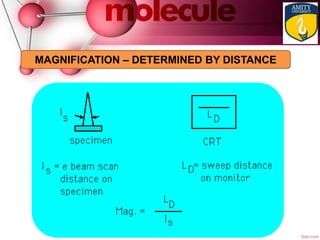
MAGNIFICATION – DETERMINED BY DISTANCE
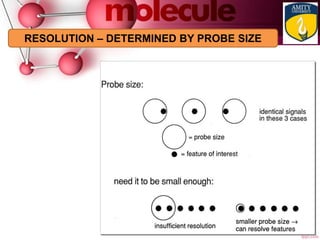
RESOLUTION – DETERMINED BY PROBE SIZE
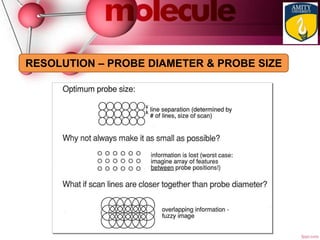
RESOLUTION – PROBE DIAMETER & PROBE SIZE
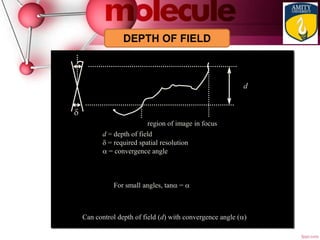
d = depth of field
 = required spatial resolution
a = convergence angle

d
region of image in focus
tana 
0.5
0.5d


d
For small angles, tana = a
d 

a
Can control depth of field (d) with convergence angle (a)
DEPTH OF FIELD
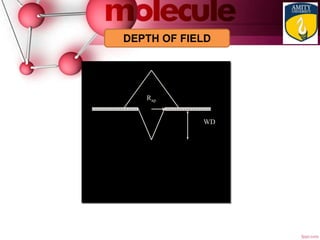
DEPTH OF FIELD
WD
Rap
tana 
Rap
WD
Thank you

WORKING OF SEM: SCANNING ELECTRON MICROSCOPE

  • 1.
    MOUSAM CHOUDHURY Amity Instituteof Nanotechnology Amity University, Noida . SCANNING ELECTRON MICROSCOPY
  • 2.
    ELECTRON MICROSCOPY - ABASIC MORPHOLOGICAL STUDY EQUIPMENT FOR POLYMER COMPOSITES AND NANOCOMPOSITES
  • 3.
    Electron microscope dividedinto the following Basic components :- 1- Illumination system. 2- Imaging system. 3- Specimen stage. 4- Vacuum pump system. 5- Image recording system.
  • 4.
    x-rays composition backscattered e's microstructure secondary e's microstructure elasticallyscattered e's crystallographic structure inelastically scattered e's composition transmitted e's microstructure SIGNALS IN ELECTRON MICROSCOPY
  • 5.
    TYPES OF ELECTRON MICROSCOPYFOR POLYMER COMPOSITES • SCANNING ELECTRON MICROSCOPE (SEM) • TRANSMISSION ELECTRON MICROSCOPE (TEM)
  • 6.
  • 7.
    SEM - ScanningElectron Microscopy • tiny electron beam scanned across surface of specimen • backscattered or secondary electrons detected • signal output to synchronized display
  • 9.
  • 10.
    Effects of increasingvoltage in electron gun: •Resolution increased ( decreased) •Penetration increases •Specimen charging increases (insulators) •Specimen damage increases •Image contrast decreases  = h/(2melectronqVo + q2Vo2/c2))1/2 VOLTAGE IN ELECTRON GUN:
  • 11.
    FIELD EMISSION ELECTRONSOURCE: High electric field at very sharp tip causes electrons to "tunnel" maybe
  • 12.
  • 13.
    ELECTRIC FIELD High electricfield at very sharp tip causes electrons to "tunnel" cool tip ——> smaller E in beam improved coherence many electrons from small tip ——> finer probe size, higher current densities (100X >) problems - high vacuum
  • 14.
    Electrons focused byLorentz force from electromagnetic field F = qv x B effectively same as optical lenses Lenses are ring-shaped • coils generate magnetic field • electrons pass thru hollow center • lens focal length is continuously variable • apertures control, limit beam LENSES
  • 15.
    Conducting - • littleor no preparation • attach to mounting stub for insertion into SEM instrument • may need to provide Conductive path with Ag paint Non-conducting (E.g., Polymers and Plastics)- usually coat with conductive very thin layer (Au, C, Cr) SPECIMEN
  • 16.
    Can examine • fracturesurfaces • electronic devices • fibers • coatings • particles etc. TYPES OF SPECIMENS (SOLID/ PARTICLE/ etc)
  • 17.
    •Actually one ata time is preferred •However, four to five can be placed on the stub •The Specimen Holder can be tilted, translated •Specimen size limited by size of sample chamber i.e. the area of the stub No. of Samples
  • 18.
    THAT IS HOWAN IMAGE IS FORMED AND CALLED A MICROGRAPH TYPES OF ELECTRONS FROM SPECIMEN What comes from specimen? Backscattered electrons Secondary electrons Fluorescent X-rays high energy compositional contrast low energy topographic contrastcomposition - EDS Brightness of regions in image increases as atomic number increases (less penetration gives more backscattered electrons)
  • 19.
    BSEs SEs E/Eo 1 Main Electrons accountedfor a Micrograph, coming out from specimen • Backscattered electrons • Secondary electrons ELECTRON ENERGY DISTRIBUTION
  • 20.
    Electron Energy upto 30-50 keV annular around incident beam repel secondary electrons with — biased mesh images are more sensitive to •chemical composition (electron yield depends on atomic number) •line of sight necessary BACKSCATTERED ELECTRON DETECTOR - SOLID STATE DETECTOR
  • 21.
    SECONDARY ELECTRON DETECTOR- SCINTILLATION DETECTOR + bias mesh needed in front of detector to attract low energy electrons line of sight unnecessary
  • 22.
    INTERACTION VOLUME Backscattered electrons comefrom whole volume (high energy) Secondary electrons come from neck only (low energy)
  • 23.
    Fracture Surface iniron SECONDARY ELECTRONS BACKSCATTERED ELECTRONS CHOOSE CORRECT DETECTOR- TOPOGRAPHY EXAMPLE
  • 24.
    Comes from anykind of interaction with electron beam  Topography  Composition o Elements o Phases  Grain (crystal) orientation  Charging affects contrast TYPES OF STUDY USING SEM
  • 25.
  • 26.
  • 27.
    RESOLUTION – PROBEDIAMETER & PROBE SIZE
  • 28.
    d = depthof field  = required spatial resolution a = convergence angle  d region of image in focus tana  0.5 0.5d   d For small angles, tana = a d   a Can control depth of field (d) with convergence angle (a) DEPTH OF FIELD
  • 29.
  • 30.