
 Working capital typically means the
  firm’s holding of current or short-term
  assets such as cash, receivables,
  inventory and marketable securities.
 These items are also referred to as
  circulating capital
 Corporate     executives   devote     a
  considerable amount of attention to the
  management of working capital.
   There are two possible interpretations
    of working capital concept:
    1. Balance sheet concept
    2. Operating cycle concept
    Balance sheet concept
    There are two interpretations of
    working capital under the balance
    sheet concept.
      a.    Excess of current assets over
           current liabilities
      b. gross or total current assets.
   Excess of current assets over current
    liabilities are called the net working capital
    or net current assets.
   Working capital is really what a part of long
    term finance is locked in and used for
    supporting current activities.
   The balance sheet definition of working
    capital is meaningful only as an indication
    of the firm’s current solvency in repaying its
    creditors.
   When firms speak of shortage of working
    capital they in fact possibly imply scarcity of
    cash resources.
   In fund flow analysis an increase in working
    capital,      as    conventionally    defined,
    represents employment or application of
   Operating cycle concept
   A company’s operating cycle              typically
    consists of three primary activities:
    › Purchasing resources,
    › Producing the product and
    › Distributing (selling) the product.
      These activities create funds flows that are both
      unsynchronized and uncertain.
      Unsynchronized because cash disbursements (for
      example, payments for resource purchases) usually
      take place before cash receipts (for example
      collection of receivables).
    They are uncertain because future sales and costs,
      which generate the respective receipts and
      disbursements, cannot be forecasted with
      complete accuracy.
“ circulating capital means current assets
  of a company that are changed in the
  ordinary course of business from one
  form to another, as for example, from
  cash to inventories, inventories to
  receivables, receivable to cash”


  ……Genestenbreg
 The firm has to maintain cash balance to
  pay the bills as they come due.
 In addition, the company must invest in
  inventories to fill customer orders
  promptly.
 And finally, the company invests in
  accounts receivable to extend credit to
  customers.
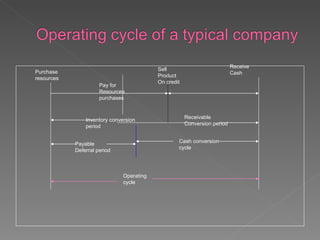
 Operating cycle is equal to the length of
  inventory and receivable conversion
  periods.
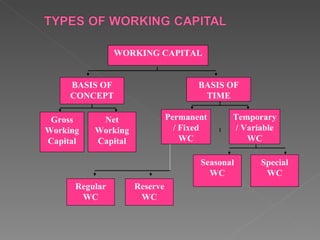
WORKING CAPITAL


     BASIS OF                        BASIS OF
     CONCEPT                          TIME

 Gross     Net                Permanent     Temporary
Working   Working               / Fixed     / Variable
Capital   Capital                 WC           WC

                                     Seasonal     Special
                                       WC          WC
      Regular       Reserve
       WC            WC
Receive
                                           Sell
Purchase                                                                   Cash
                                           Product
resources
                                           On credit
                      Pay for
                      Resources
                      purchases


                                                       Receivable
                Inventory conversion
                                                       Conversion period
                period

                                                   Cash conversion
            Payable
                                                   cycle
            Deferral period


                               Operating
                               cycle
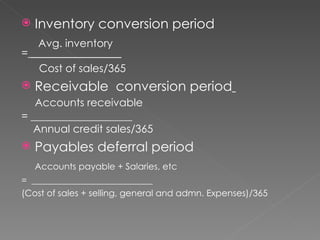
   Inventory conversion period
   Avg. inventory
= _________________
    Cost of sales/365
   Receivable conversion period
   Accounts receivable
= ___________________
  Annual credit sales/365
   Payables deferral period
    Accounts payable + Salaries, etc
= ___________________________
(Cost of sales + selling, general and admn. Expenses)/365
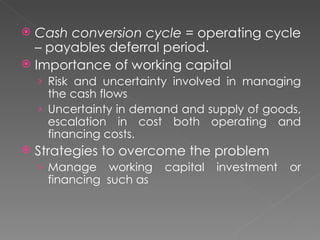
 Cash conversion cycle = operating cycle
  – payables deferral period.
 Importance of working capital
    › Risk and uncertainty involved in managing
      the cash flows
    › Uncertainty in demand and supply of goods,
      escalation in cost both operating and
      financing costs.
   Strategies to overcome the problem
    › Manage   working   capital   investment   or
     financing such as
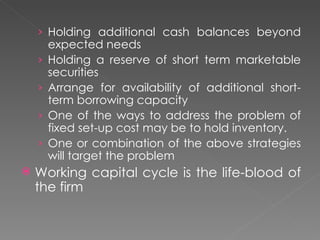
› Holding additional cash balances beyond
        expected needs
    ›   Holding a reserve of short term marketable
        securities
    ›   Arrange for availability of additional short-
        term borrowing capacity
    ›   One of the ways to address the problem of
        fixed set-up cost may be to hold inventory.
    ›   One or combination of the above strategies
        will target the problem
   Working capital cycle is the life-blood of
    the firm
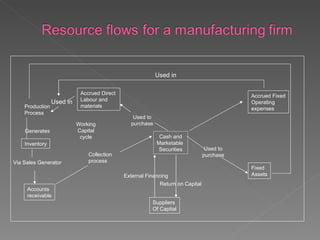
Used in

                            Accrued Direct                                                 Accrued Fixed
                 Used in    Labour and                                                     Operating
    Production              materials                                                      expenses
    Process
                                                 Used to
                           Working              purchase
    Generates              Capital
                            cycle                           Cash and
    Inventory                                              Marketable
                                                            Securities           Used to
                               Collection                                       purchase
Via Sales Generator            process
                                                                                           Fixed
                                             External Financing                            Assets
                                                            Return on Capital
     Accounts
     receivable
                                                        Suppliers
                                                        Of Capital
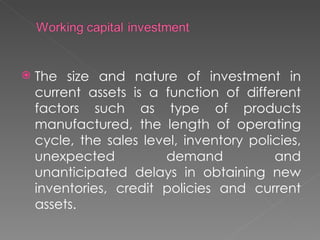
   The size and nature of investment in
    current assets is a function of different
    factors such as type of products
    manufactured, the length of operating
    cycle, the sales level, inventory policies,
    unexpected          demand            and
    unanticipated delays in obtaining new
    inventories, credit policies and current
    assets.
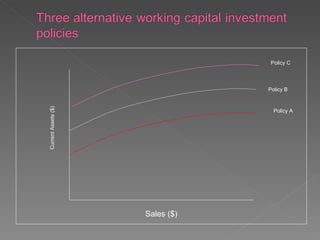
Policy C


                                 Policy B
Current Assets ($)


                                   Policy A


                     Sales ($)
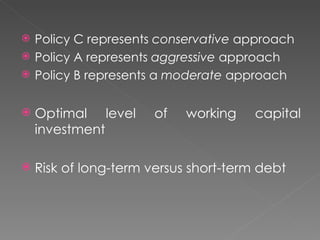
   Policy C represents conservative approach
   Policy A represents aggressive approach
   Policy B represents a moderate approach

   Optimal level      of   working    capital
    investment

   Risk of long-term versus short-term debt
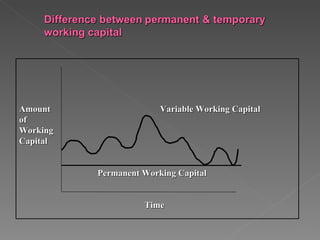
Amount                  Variable Working Capital
of
Working
Capital


          Permanent Working Capital


                    Time
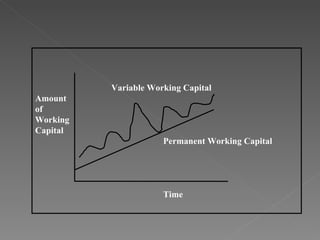
Variable Working Capital
Amount
of
Working
Capital
                      Permanent Working Capital


                      Time
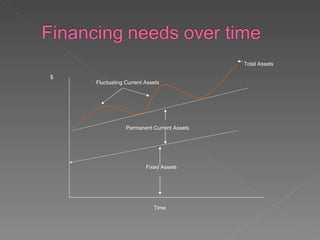
Total Assets

$
    Fluctuating Current Assets


                Permanent Current Assets


                        Fixed Assets


                           Time
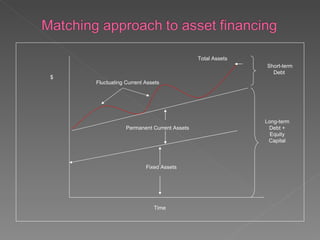
Total Assets
                                                          Short-term
                                                            Debt
$
    Fluctuating Current Assets


                                                          Long-term
                Permanent Current Assets                   Debt +
                                                            Equity
                                                           Capital


                        Fixed Assets


                           Time
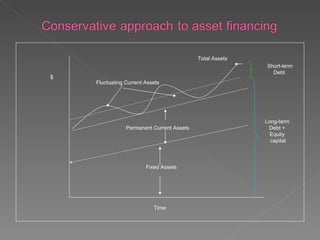
Total Assets
                                                          Short-term
                                                            Debt
$
    Fluctuating Current Assets


                                                          Long-term
                Permanent Current Assets                   Debt +
                                                            Equity
                                                            capital


                        Fixed Assets


                           Time
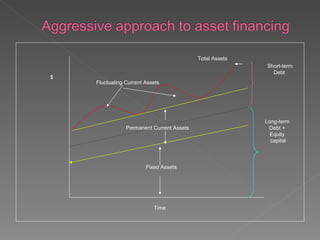
Total Assets
                                                          Short-term
                                                            Debt
$
    Fluctuating Current Assets


                                                          Long-term
                Permanent Current Assets                   Debt +
                                                            Equity
                                                            capital


                        Fixed Assets


                           Time
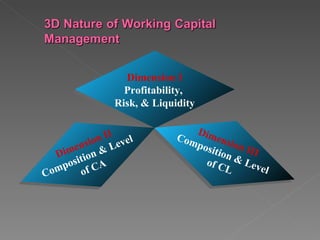
Dimension I
                Profitability,
              Risk, & Liquidity

                              D
        i
              I
          on I evel        Com imens
     ens & L                  pos      ion
  Dim tion                        ition III
    osi CA                      of C & Lev
Comp of                               L     el
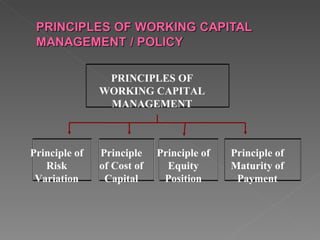
PRINCIPLES OF
               WORKING CAPITAL
                MANAGEMENT


Principle of   Principle    Principle of   Principle of
   Risk        of Cost of     Equity       Maturity of
 Variation      Capital      Position       Payment
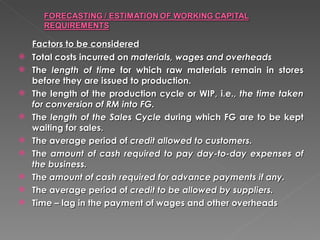
Factors to be considered
   Total costs incurred on materials, wages and overheads
   The length of time for which raw materials remain in stores
    before they are issued to production.
   The length of the production cycle or WIP, i.e., the time taken
    for conversion of RM into FG.
   The length of the Sales Cycle during which FG are to be kept
    waiting for sales.
   The average period of credit allowed to customers.
   The amount of cash required to pay day-to-day expenses of
    the business.
   The amount of cash required for advance payments if any.
   The average period of credit to be allowed by suppliers.
   Time – lag in the payment of wages and other overheads
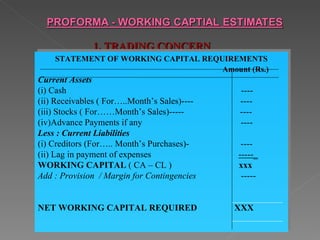
1. TRADING CONCERN
    STATEMENT OF WORKING CAPITAL REQUIREMENTS
                                     Amount (Rs.)
Current Assets
(i) Cash                                      ----
(ii) Receivables ( For…..Month’s Sales)----   ----
(iii) Stocks ( For……Month’s Sales)-----       ----
(iv)Advance Payments if any                   ----
Less : Current Liabilities
(i) Creditors (For….. Month’s Purchases)-      ----
(ii) Lag in payment of expenses               -----_
WORKING CAPITAL ( CA – CL )                   xxx
Add : Provision / Margin for Contingencies     -----


NET WORKING CAPITAL REQUIRED                  XXX
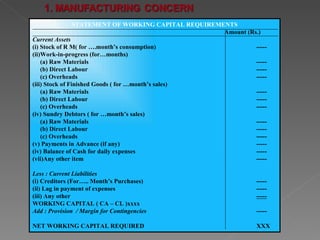
STATEMENT OF WORKING CAPITAL REQUIREMENTS
                                                    Amount (Rs.)
Current Assets
(i) Stock of R M( for ….month’s consumption)                  -----
(ii)Work-in-progress (for…months)
    (a) Raw Materials                                         -----
    (b) Direct Labour                                         -----
    (c) Overheads                                             -----
(iii) Stock of Finished Goods ( for …month’s sales)
    (a) Raw Materials                                         -----
    (b) Direct Labour                                         -----
    (c) Overheads                                             -----
(iv) Sundry Debtors ( for …month’s sales)
    (a) Raw Materials                                         -----
    (b) Direct Labour                                         -----
    (c) Overheads                                             -----
(v) Payments in Advance (if any)                              -----
(iv) Balance of Cash for daily expenses                       -----
(vii)Any other item                                           -----

Less : Current Liabilities
(i) Creditors (For….. Month’s Purchases)                      -----
(ii) Lag in payment of expenses                               -----
(iii) Any other                                               -----
WORKING CAPITAL ( CA – CL )xxxx
Add : Provision / Margin for Contingencies                    -----

NET WORKING CAPITAL REQUIRED                                  XXX
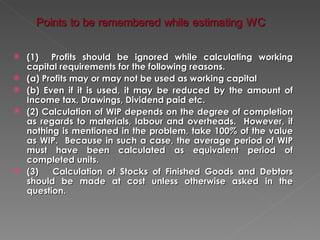
   (1) Profits should be ignored while calculating working
    capital requirements for the following reasons.
   (a) Profits may or may not be used as working capital
   (b) Even if it is used, it may be reduced by the amount of
    Income tax, Drawings, Dividend paid etc.
   (2) Calculation of WIP depends on the degree of completion
    as regards to materials, labour and overheads. However, if
    nothing is mentioned in the problem, take 100% of the value
    as WIP. Because in such a case, the average period of WIP
    must have been calculated as equivalent period of
    completed units.
   (3)    Calculation of Stocks of Finished Goods and Debtors
    should be made at cost unless otherwise asked in the
    question.
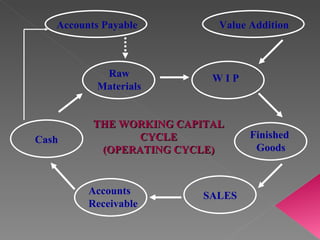
Accounts Payable         Value Addition


            Raw            WIP
           Materials


          THE WORKING CAPITAL
Cash             CYCLE            Finished
           (OPERATING CYCLE)       Goods


         Accounts        SALES
         Receivable
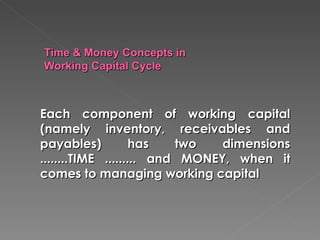
Each component of working capital
(namely inventory, receivables and
payables)           has   two   dimensions
........TIME ......... and MONEY, when it
comes to managing working capital
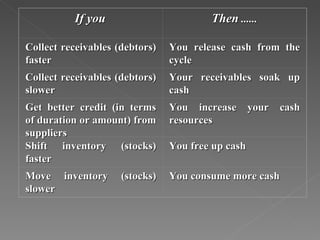
If you                        Then ......

Collect receivables (debtors)   You release cash from the
faster                          cycle
Collect receivables (debtors)   Your receivables soak up
slower                          cash
Get better credit (in terms     You increase your cash
of duration or amount) from     resources
suppliers
Shift inventory (stocks)        You free up cash
faster
Move inventory       (stocks)   You consume more cash
slower
Caiibfmwctlmoduled contd2m

Caiibfmwctlmoduled contd2m

  • 2.
     Working capitaltypically means the firm’s holding of current or short-term assets such as cash, receivables, inventory and marketable securities.  These items are also referred to as circulating capital  Corporate executives devote a considerable amount of attention to the management of working capital.
  • 4.
    There are two possible interpretations of working capital concept: 1. Balance sheet concept 2. Operating cycle concept Balance sheet concept There are two interpretations of working capital under the balance sheet concept. a. Excess of current assets over current liabilities b. gross or total current assets.
  • 5.
    Excess of current assets over current liabilities are called the net working capital or net current assets.  Working capital is really what a part of long term finance is locked in and used for supporting current activities.  The balance sheet definition of working capital is meaningful only as an indication of the firm’s current solvency in repaying its creditors.  When firms speak of shortage of working capital they in fact possibly imply scarcity of cash resources.  In fund flow analysis an increase in working capital, as conventionally defined, represents employment or application of
  • 6.
    Operating cycle concept  A company’s operating cycle typically consists of three primary activities: › Purchasing resources, › Producing the product and › Distributing (selling) the product. These activities create funds flows that are both unsynchronized and uncertain. Unsynchronized because cash disbursements (for example, payments for resource purchases) usually take place before cash receipts (for example collection of receivables). They are uncertain because future sales and costs, which generate the respective receipts and disbursements, cannot be forecasted with complete accuracy.
  • 7.
    “ circulating capitalmeans current assets of a company that are changed in the ordinary course of business from one form to another, as for example, from cash to inventories, inventories to receivables, receivable to cash” ……Genestenbreg
  • 8.
     The firmhas to maintain cash balance to pay the bills as they come due.  In addition, the company must invest in inventories to fill customer orders promptly.  And finally, the company invests in accounts receivable to extend credit to customers.  Operating cycle is equal to the length of inventory and receivable conversion periods.
  • 9.
    WORKING CAPITAL BASIS OF BASIS OF CONCEPT TIME Gross Net Permanent Temporary Working Working / Fixed / Variable Capital Capital WC WC Seasonal Special WC WC Regular Reserve WC WC
  • 10.
    Receive Sell Purchase Cash Product resources On credit Pay for Resources purchases Receivable Inventory conversion Conversion period period Cash conversion Payable cycle Deferral period Operating cycle
  • 11.
    Inventory conversion period Avg. inventory = _________________ Cost of sales/365  Receivable conversion period Accounts receivable = ___________________ Annual credit sales/365  Payables deferral period Accounts payable + Salaries, etc = ___________________________ (Cost of sales + selling, general and admn. Expenses)/365
  • 12.
     Cash conversioncycle = operating cycle – payables deferral period.  Importance of working capital › Risk and uncertainty involved in managing the cash flows › Uncertainty in demand and supply of goods, escalation in cost both operating and financing costs.  Strategies to overcome the problem › Manage working capital investment or financing such as
  • 13.
    › Holding additionalcash balances beyond expected needs › Holding a reserve of short term marketable securities › Arrange for availability of additional short- term borrowing capacity › One of the ways to address the problem of fixed set-up cost may be to hold inventory. › One or combination of the above strategies will target the problem  Working capital cycle is the life-blood of the firm
  • 14.
    Used in Accrued Direct Accrued Fixed Used in Labour and Operating Production materials expenses Process Used to Working purchase Generates Capital cycle Cash and Inventory Marketable Securities Used to Collection purchase Via Sales Generator process Fixed External Financing Assets Return on Capital Accounts receivable Suppliers Of Capital
  • 15.
    The size and nature of investment in current assets is a function of different factors such as type of products manufactured, the length of operating cycle, the sales level, inventory policies, unexpected demand and unanticipated delays in obtaining new inventories, credit policies and current assets.
  • 16.
    Policy C Policy B Current Assets ($) Policy A Sales ($)
  • 17.
    Policy C represents conservative approach  Policy A represents aggressive approach  Policy B represents a moderate approach  Optimal level of working capital investment  Risk of long-term versus short-term debt
  • 18.
    Amount Variable Working Capital of Working Capital Permanent Working Capital Time
  • 19.
  • 20.
    Total Assets $ Fluctuating Current Assets Permanent Current Assets Fixed Assets Time
  • 21.
    Total Assets Short-term Debt $ Fluctuating Current Assets Long-term Permanent Current Assets Debt + Equity Capital Fixed Assets Time
  • 22.
    Total Assets Short-term Debt $ Fluctuating Current Assets Long-term Permanent Current Assets Debt + Equity capital Fixed Assets Time
  • 23.
    Total Assets Short-term Debt $ Fluctuating Current Assets Long-term Permanent Current Assets Debt + Equity capital Fixed Assets Time
  • 30.
    Dimension I Profitability, Risk, & Liquidity D i I on I evel Com imens ens & L pos ion Dim tion ition III osi CA of C & Lev Comp of L el
  • 31.
    PRINCIPLES OF WORKING CAPITAL MANAGEMENT Principle of Principle Principle of Principle of Risk of Cost of Equity Maturity of Variation Capital Position Payment
  • 32.
    Factors to beconsidered  Total costs incurred on materials, wages and overheads  The length of time for which raw materials remain in stores before they are issued to production.  The length of the production cycle or WIP, i.e., the time taken for conversion of RM into FG.  The length of the Sales Cycle during which FG are to be kept waiting for sales.  The average period of credit allowed to customers.  The amount of cash required to pay day-to-day expenses of the business.  The amount of cash required for advance payments if any.  The average period of credit to be allowed by suppliers.  Time – lag in the payment of wages and other overheads
  • 33.
    1. TRADING CONCERN STATEMENT OF WORKING CAPITAL REQUIREMENTS Amount (Rs.) Current Assets (i) Cash ---- (ii) Receivables ( For…..Month’s Sales)---- ---- (iii) Stocks ( For……Month’s Sales)----- ---- (iv)Advance Payments if any ---- Less : Current Liabilities (i) Creditors (For….. Month’s Purchases)- ---- (ii) Lag in payment of expenses -----_ WORKING CAPITAL ( CA – CL ) xxx Add : Provision / Margin for Contingencies ----- NET WORKING CAPITAL REQUIRED XXX
  • 34.
    STATEMENT OF WORKINGCAPITAL REQUIREMENTS Amount (Rs.) Current Assets (i) Stock of R M( for ….month’s consumption) ----- (ii)Work-in-progress (for…months) (a) Raw Materials ----- (b) Direct Labour ----- (c) Overheads ----- (iii) Stock of Finished Goods ( for …month’s sales) (a) Raw Materials ----- (b) Direct Labour ----- (c) Overheads ----- (iv) Sundry Debtors ( for …month’s sales) (a) Raw Materials ----- (b) Direct Labour ----- (c) Overheads ----- (v) Payments in Advance (if any) ----- (iv) Balance of Cash for daily expenses ----- (vii)Any other item ----- Less : Current Liabilities (i) Creditors (For….. Month’s Purchases) ----- (ii) Lag in payment of expenses ----- (iii) Any other ----- WORKING CAPITAL ( CA – CL )xxxx Add : Provision / Margin for Contingencies ----- NET WORKING CAPITAL REQUIRED XXX
  • 35.
    (1) Profits should be ignored while calculating working capital requirements for the following reasons.  (a) Profits may or may not be used as working capital  (b) Even if it is used, it may be reduced by the amount of Income tax, Drawings, Dividend paid etc.  (2) Calculation of WIP depends on the degree of completion as regards to materials, labour and overheads. However, if nothing is mentioned in the problem, take 100% of the value as WIP. Because in such a case, the average period of WIP must have been calculated as equivalent period of completed units.  (3) Calculation of Stocks of Finished Goods and Debtors should be made at cost unless otherwise asked in the question.
  • 36.
    Accounts Payable Value Addition Raw WIP Materials THE WORKING CAPITAL Cash CYCLE Finished (OPERATING CYCLE) Goods Accounts SALES Receivable
  • 37.
    Each component ofworking capital (namely inventory, receivables and payables) has two dimensions ........TIME ......... and MONEY, when it comes to managing working capital
  • 39.
    If you Then ...... Collect receivables (debtors) You release cash from the faster cycle Collect receivables (debtors) Your receivables soak up slower cash Get better credit (in terms You increase your cash of duration or amount) from resources suppliers Shift inventory (stocks) You free up cash faster Move inventory (stocks) You consume more cash slower