Kerry Leedom Larson
Pork Management Conference
May 7, 2009
Outline
 Introduction to OSHA
 Family farms and OSHA
 Recordkeeping Standard
 Occupational Safety & Health Standards
 OSHA Inspections
 OSHA Resources
What is OSHA?
 Occupational Safety and Health Administration
(OSH Act 1970)
 OSHA mission
 Set and enforce standards;
 Provide training, outreach, and education;
 Establish partnerships;
 Encourage continual improvement in work place safety and
health.
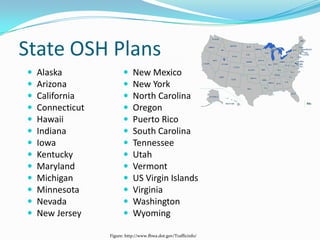
State OSH Plans
 Alaska
 Arizona
 California
 Connecticut
 Hawaii
 Indiana
 Iowa
 Kentucky
 Maryland
 Michigan
 Minnesota
 Nevada
 New Jersey
 New Mexico
 New York
 North Carolina
 Oregon
 Puerto Rico
 South Carolina
 Tennessee
 Utah
 Vermont
 US Virgin Islands
 Virginia
 Washington
 Wyoming
Figure: http://www.fhwa.dot.gov/Trafficinfo/
What are “standards”?
 “Standards” are basically OSHA rules and regulations
 There are specific standard s for:
 Inspection, citation, and penalty procedures
 Recordkeeping and reporting of illnesses and injuries
 Specific occupational safety and health rules
 Standard naming
 Example: 29 CFR 1910.155
 Code of Federal Regulations
 General and specific standard name (some are universal,
some differ by industry)
How are farms regulated?
 Family farms are not regulated by OSHA
 Farms with one to ten non-family employees are not
inspected by OSHA, but are covered by the General Duty
Clause (GDC)
 Farms with more than ten non-family employees must
keep OSHA records, must abide by all applicable OSHA
standards, and may be inspected by OSHA
How is a family farm defined?
 1975.4(b)(2)
 Any person engaged in an agricultural activity employing
one or more employees comes within the definition of an
employer under the Act, and therefore, is covered by its
provisions. However, members of the immediate family of
the farm employer are not regarded as employees for the
purposes of this definition.
Important note: fatalities
 FARMS with non-family employees must report a fatality
or hospitalization of three or more employees within 8
hours
 1-800-321-OSHA (6742)
 You must speak with a person, and be prepared to give
the following information:
 Establishment name, location of incident, time of incident,
number of fatalities or hospitalizations, names of injured
employees, contact person information, and a brief description
of the incident
OSHA Recordkeeping
 In general, any farm with more than ten non-family
employees must keep OSHA records
 Form 300
 Log of work related injuries and illnesses
 Form 301
 Injury and illness incident report
 Form 300A
 Summary of work related injuries and illnesses
What is “work-related”?
 1904.5(a)
 “…if an event or exposure in the work environment
caused or contributed to the condition or significantly
aggravated a preexisting condition.
 Work relatedness is presumed for injuries and illnesses
resulting from events or exposures occurring in the
workplace, unless an exception specifically applies.”
Is it work related if…?
 1904.5(b)(2)
 Injuries or illness in the work environment that are
NOT work-related if . . .
OSHA Form 300
 You must record information about each work-related
death, injury, or illness on your farm that involves:
 Loss of consciousness, restricted work activity, job transfer,
days away from work, or medical treatment beyond first aid
 Any work-related injuries or illnesses that are diagnosed by
a physician or licensed health care professional
 Any work-related cases involving cancer, chronic irreversible
disease, fractured or cracked bones, and punctured
eardrums
13
OSHA Form 300
OSHA Form 301
 You must record information about each work-related
injury or illness within 7 days of the occurrence
15
OSHA Form 301
OSHA Form 300A
 You must record:
 The total number of work-related deaths, injuries, or
illnesses (even if you the number is zero) that occurred in
the previous year
 The number of days away from work or job
restriction/transfer that occurred in the previous year
 The types of illness and injury that occurred in the previous
year
 The annual average number of employees and the total
hours worked by all employees in the previous year
17
OSHA Form 300A
Recordkeeping
 In general, records are for your own use
 Form 300A (annual summary) must be posed at the end
of the year for employees to view from at least February
1 to April 30 of the following year
 Bureau of Labor Statistics (BLS) may request data
 If you receive a survey form, you must comply
 OSHA may request survey information
 If you receive a survey form, you must comply
Sources for recordkeeping help
 OSHA forms with instructions
 http://www.osha.gov/recordkeeping/new-osha300form1-1-
04.pdf
 Training presentations (power points)
 http://www.osha.gov/recordkeeping/RKpresentations.html
 Classroom training with OSHA
 Course 7845
http://www.osha.gov/fso/ote/training/edcenters/index.html
 OSHA recordkeeping handbook
 More than you ever wanted to know!
 http://www.osha.gov/recordkeeping/handbook/index.html
Safety & Health Standards
 Different standards for different industries
 Three important categories for pork producers
 (General Duty Clause)
 Agriculture Standard
 General Industry Standard
General Duty Clause
 Also known as Section 5(a)(1)
 Requires employers to “furnish to each of his employees
employment and a place of employment which are free
from recognized hazards that are causing or are likely to
cause death or serious physical harm to his employees.“
General Duty Clause
 Interpretation:
 OSHA can require you to find ways to eliminate ANY type of
serious hazard as long as that hazard represents a current
or future risk to your workers
 Most frequent citation for pork producers!
Agriculture standard (29 CFR 1928)
 Specific regulations that apply only to agriculture
 http://www.osha.gov/SLTC/agriculturaloperations/index.html
 Key parts of the standard for pork producers:
 1928.57 : Guarding of farm equipment
 (1928.51 – 1928.53: Roll over protective structures)
 1928 also includes parts of the General Industry Standard
General Industry (29 CFR 1910)
 Parts of 1910 always apply to agricultural operations
 1910.1200: Hazard Communication, others
 All of 1910 may apply to your operation, if you perform work
outside of the “agricultural operation” definition
 So, what is an agricultural operation?
 “…preparation of ground, sowing, watering of plants, feeding of
plants, weeding, spraying, harvesting, and the raising of livestock,
but also all activity necessary for these operations, such as the
repair or maintenance of equipment used in these operations,
and all activity necessary to gaining economic value from the
agricultural products themselves.”
General Industry
 So hog farms only perform agricultural operations, right?
 Well, a gray area exists here . . .
 Farms with feed mills or trucking components are most
definitely regulated by General Industry
 But, other farm activities could be considered “general
industry” as well depending on the inspector
 To be safe, follow the entire General Industry standard
I have to follow the entire 1910?!
 The General Industry standard (1910) is very large and
comprehensive, and OSHA doesn’t expect small farms to
have the same safety program as a large company
 The best way to avoid OSHA penalties is to use common
sense, and eliminate obvious hazards
 Remember, even if a hazard is not covered by 1928 or by
1910, the General Duty Clause always applies!
What happens if I’m inspected?
 Usually no advance notice
 Inspections may be due to an accident investigation, an
employee complaint, or they may be planned
 OSHA inspector will present his or her credentials
 You may refuse an OSHA inspection, but . . .
 Inspectors can return with a warrant for entry
 It is in your best interest to be interested, courteous, and
helpful during the inspection!
The inspection process
 Opening conference
 General review of paperwork and records
 May review your safety plan and general commitment to
safety and health
 Must keep OSHA (300, 301, 300A) records for 5 years
following the end of the calendar year
 Must keep employee health records for 30 years following
retirement if any type of health/safety incident occurred
The inspection process
 Walk-around inspection
 If investigating a complaint, the inspector may only look at
one specific area
 If doing a general inspection, the entire farm may be
examined
 In general, inspectors will look for specific hazards
 Inspectors may take pictures and write down information
 Inspectors may talk to employees
 You should accompany the inspector, and take notes as well
The inspection process
 Closing conference
 Inspector will review findings, and focus on critical issues
 You may discuss measures to correct the hazards
 You may discuss potential fines to be levied
 The bigger the hazard, the bigger the fine
 Inspectors will consider
 Your level of safety awareness
 If your farm has good overall safety conditions
 Previous citations
After the inspection
 It may take up to 6 months to receive specific citations
and fine amounts by certified letter
 You have 15 days after the receipt of letter to contest any
citations and/or fines
 Show that you have abated hazards
 Document your safety improvements
 In many cases, fines are reduced or eliminated
The reality . . .
 OSHA never inspects most swine farms
 You may be subject to state or federal inspections, but in
reality OSHA is chronically understaffed
 Likelihood of a “planned” OSHA inspection is small
 But, remember that an employee complaint can initiate an
OSHA inspection
 OSHA inspectors can also “drop in” if they suspect a
problem at a farm
 The bottom line: use common sense, eliminate obvious
hazards, and develop a safety plan!
OSHA Resources
 Cooperative programs
 Safety and Health Achievement Recognition Program
(SHARP)
 OSHA Strategic Partnership Program (OSPP)
 Voluntary Protection Program (VPP)
 Compliance assistance
 Publications, training resources
 Compliance assistance specialists
Other safety resources
 www.osha.gov
 Pork Checkoff
 Pork Production Safety System
 Worker safety website:
 http://www.pork.org/workersafety/
 Worker safety list serve
 Worker safety roundtable
Contact information
 Kerry Leedom Larson
 kleedom-larson@pork.org
 319-470-9279

Worker Safety / OSHA

  • 1.
    Kerry Leedom Larson PorkManagement Conference May 7, 2009
  • 2.
    Outline  Introduction toOSHA  Family farms and OSHA  Recordkeeping Standard  Occupational Safety & Health Standards  OSHA Inspections  OSHA Resources
  • 3.
    What is OSHA? Occupational Safety and Health Administration (OSH Act 1970)  OSHA mission  Set and enforce standards;  Provide training, outreach, and education;  Establish partnerships;  Encourage continual improvement in work place safety and health.
  • 4.
    State OSH Plans Alaska  Arizona  California  Connecticut  Hawaii  Indiana  Iowa  Kentucky  Maryland  Michigan  Minnesota  Nevada  New Jersey  New Mexico  New York  North Carolina  Oregon  Puerto Rico  South Carolina  Tennessee  Utah  Vermont  US Virgin Islands  Virginia  Washington  Wyoming Figure: http://www.fhwa.dot.gov/Trafficinfo/
  • 5.
    What are “standards”? “Standards” are basically OSHA rules and regulations  There are specific standard s for:  Inspection, citation, and penalty procedures  Recordkeeping and reporting of illnesses and injuries  Specific occupational safety and health rules  Standard naming  Example: 29 CFR 1910.155  Code of Federal Regulations  General and specific standard name (some are universal, some differ by industry)
  • 6.
    How are farmsregulated?  Family farms are not regulated by OSHA  Farms with one to ten non-family employees are not inspected by OSHA, but are covered by the General Duty Clause (GDC)  Farms with more than ten non-family employees must keep OSHA records, must abide by all applicable OSHA standards, and may be inspected by OSHA
  • 7.
    How is afamily farm defined?  1975.4(b)(2)  Any person engaged in an agricultural activity employing one or more employees comes within the definition of an employer under the Act, and therefore, is covered by its provisions. However, members of the immediate family of the farm employer are not regarded as employees for the purposes of this definition.
  • 8.
    Important note: fatalities FARMS with non-family employees must report a fatality or hospitalization of three or more employees within 8 hours  1-800-321-OSHA (6742)  You must speak with a person, and be prepared to give the following information:  Establishment name, location of incident, time of incident, number of fatalities or hospitalizations, names of injured employees, contact person information, and a brief description of the incident
  • 9.
    OSHA Recordkeeping  Ingeneral, any farm with more than ten non-family employees must keep OSHA records  Form 300  Log of work related injuries and illnesses  Form 301  Injury and illness incident report  Form 300A  Summary of work related injuries and illnesses
  • 10.
    What is “work-related”? 1904.5(a)  “…if an event or exposure in the work environment caused or contributed to the condition or significantly aggravated a preexisting condition.  Work relatedness is presumed for injuries and illnesses resulting from events or exposures occurring in the workplace, unless an exception specifically applies.”
  • 11.
    Is it workrelated if…?  1904.5(b)(2)  Injuries or illness in the work environment that are NOT work-related if . . .
  • 12.
    OSHA Form 300 You must record information about each work-related death, injury, or illness on your farm that involves:  Loss of consciousness, restricted work activity, job transfer, days away from work, or medical treatment beyond first aid  Any work-related injuries or illnesses that are diagnosed by a physician or licensed health care professional  Any work-related cases involving cancer, chronic irreversible disease, fractured or cracked bones, and punctured eardrums
  • 13.
  • 14.
    OSHA Form 301 You must record information about each work-related injury or illness within 7 days of the occurrence
  • 15.
  • 16.
    OSHA Form 300A You must record:  The total number of work-related deaths, injuries, or illnesses (even if you the number is zero) that occurred in the previous year  The number of days away from work or job restriction/transfer that occurred in the previous year  The types of illness and injury that occurred in the previous year  The annual average number of employees and the total hours worked by all employees in the previous year
  • 17.
  • 18.
    Recordkeeping  In general,records are for your own use  Form 300A (annual summary) must be posed at the end of the year for employees to view from at least February 1 to April 30 of the following year  Bureau of Labor Statistics (BLS) may request data  If you receive a survey form, you must comply  OSHA may request survey information  If you receive a survey form, you must comply
  • 19.
    Sources for recordkeepinghelp  OSHA forms with instructions  http://www.osha.gov/recordkeeping/new-osha300form1-1- 04.pdf  Training presentations (power points)  http://www.osha.gov/recordkeeping/RKpresentations.html  Classroom training with OSHA  Course 7845 http://www.osha.gov/fso/ote/training/edcenters/index.html  OSHA recordkeeping handbook  More than you ever wanted to know!  http://www.osha.gov/recordkeeping/handbook/index.html
  • 20.
    Safety & HealthStandards  Different standards for different industries  Three important categories for pork producers  (General Duty Clause)  Agriculture Standard  General Industry Standard
  • 21.
    General Duty Clause Also known as Section 5(a)(1)  Requires employers to “furnish to each of his employees employment and a place of employment which are free from recognized hazards that are causing or are likely to cause death or serious physical harm to his employees.“
  • 22.
    General Duty Clause Interpretation:  OSHA can require you to find ways to eliminate ANY type of serious hazard as long as that hazard represents a current or future risk to your workers  Most frequent citation for pork producers!
  • 23.
    Agriculture standard (29CFR 1928)  Specific regulations that apply only to agriculture  http://www.osha.gov/SLTC/agriculturaloperations/index.html  Key parts of the standard for pork producers:  1928.57 : Guarding of farm equipment  (1928.51 – 1928.53: Roll over protective structures)  1928 also includes parts of the General Industry Standard
  • 24.
    General Industry (29CFR 1910)  Parts of 1910 always apply to agricultural operations  1910.1200: Hazard Communication, others  All of 1910 may apply to your operation, if you perform work outside of the “agricultural operation” definition  So, what is an agricultural operation?  “…preparation of ground, sowing, watering of plants, feeding of plants, weeding, spraying, harvesting, and the raising of livestock, but also all activity necessary for these operations, such as the repair or maintenance of equipment used in these operations, and all activity necessary to gaining economic value from the agricultural products themselves.”
  • 25.
    General Industry  Sohog farms only perform agricultural operations, right?  Well, a gray area exists here . . .  Farms with feed mills or trucking components are most definitely regulated by General Industry  But, other farm activities could be considered “general industry” as well depending on the inspector  To be safe, follow the entire General Industry standard
  • 26.
    I have tofollow the entire 1910?!  The General Industry standard (1910) is very large and comprehensive, and OSHA doesn’t expect small farms to have the same safety program as a large company  The best way to avoid OSHA penalties is to use common sense, and eliminate obvious hazards  Remember, even if a hazard is not covered by 1928 or by 1910, the General Duty Clause always applies!
  • 27.
    What happens ifI’m inspected?  Usually no advance notice  Inspections may be due to an accident investigation, an employee complaint, or they may be planned  OSHA inspector will present his or her credentials  You may refuse an OSHA inspection, but . . .  Inspectors can return with a warrant for entry  It is in your best interest to be interested, courteous, and helpful during the inspection!
  • 28.
    The inspection process Opening conference  General review of paperwork and records  May review your safety plan and general commitment to safety and health  Must keep OSHA (300, 301, 300A) records for 5 years following the end of the calendar year  Must keep employee health records for 30 years following retirement if any type of health/safety incident occurred
  • 29.
    The inspection process Walk-around inspection  If investigating a complaint, the inspector may only look at one specific area  If doing a general inspection, the entire farm may be examined  In general, inspectors will look for specific hazards  Inspectors may take pictures and write down information  Inspectors may talk to employees  You should accompany the inspector, and take notes as well
  • 30.
    The inspection process Closing conference  Inspector will review findings, and focus on critical issues  You may discuss measures to correct the hazards  You may discuss potential fines to be levied  The bigger the hazard, the bigger the fine  Inspectors will consider  Your level of safety awareness  If your farm has good overall safety conditions  Previous citations
  • 31.
    After the inspection It may take up to 6 months to receive specific citations and fine amounts by certified letter  You have 15 days after the receipt of letter to contest any citations and/or fines  Show that you have abated hazards  Document your safety improvements  In many cases, fines are reduced or eliminated
  • 32.
    The reality .. .  OSHA never inspects most swine farms  You may be subject to state or federal inspections, but in reality OSHA is chronically understaffed  Likelihood of a “planned” OSHA inspection is small  But, remember that an employee complaint can initiate an OSHA inspection  OSHA inspectors can also “drop in” if they suspect a problem at a farm  The bottom line: use common sense, eliminate obvious hazards, and develop a safety plan!
  • 33.
    OSHA Resources  Cooperativeprograms  Safety and Health Achievement Recognition Program (SHARP)  OSHA Strategic Partnership Program (OSPP)  Voluntary Protection Program (VPP)  Compliance assistance  Publications, training resources  Compliance assistance specialists
  • 34.
    Other safety resources www.osha.gov  Pork Checkoff  Pork Production Safety System  Worker safety website:  http://www.pork.org/workersafety/  Worker safety list serve  Worker safety roundtable
  • 35.
    Contact information  KerryLeedom Larson  kleedom-larson@pork.org  319-470-9279