U.S. Global Position
Dermot Hayes
Iowa State University
Wednesday, June 16, 2010
10:30 am - 11:15 am
Overview
 Trade patterns
 Competitiveness of the US industry
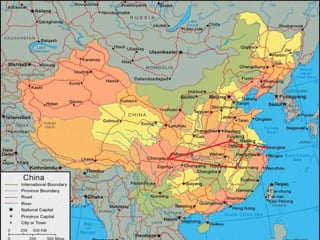
 China
-1000
-500
0
500
1000
1500
2000
2500
1960
1962
1964
1966
1968
1970
1972
1974
1976
1978
1980
1982
1984
1986
1988
1990
1992
1994
1996
1998
2000
2002
2004
2006
2008
ThousandMetricTons(CWE)
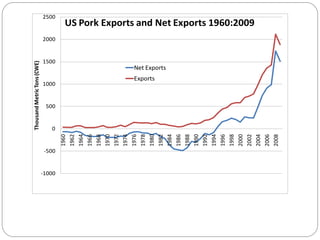
US Pork Exports and Net Exports 1960:2009
Net Exports
Exports
-10
-5
0
5
10
15
20
1960
1962
1964
1966
1968
1970
1972
1974
1976
1978
1980
1982
1984
1986
1988
1990
1992
1994
1996
1998
2000
2002
2004
2006
2008
Percent
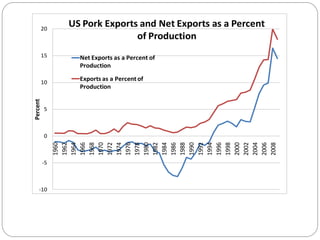
US Pork Exports and Net Exports as a Percent
of Production
Net Exports as a Percent of
Production
Exports as a Percent of
Production
0
500
1000
1500
2000
2500ThousandMetricTons(CWE)
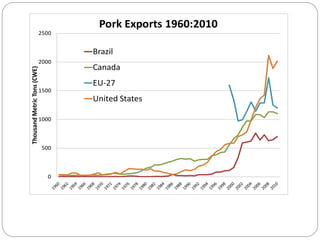
Pork Exports 1960:2010
Brazil
Canada
EU-27
United States
0
10
20
30
40
50
60
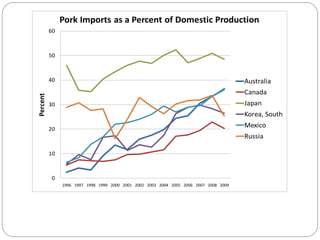
1996 1997 1998 1999 2000 2001 2002 2003 2004 2005 2006 2007 2008 2009
Percent
Pork Imports as a Percent of Domestic Production
Australia
Canada
Japan
Korea, South
Mexico
Russia
0
0.2
0.4
0.6
0.8
1
1.2
1.4
1.6
1.8
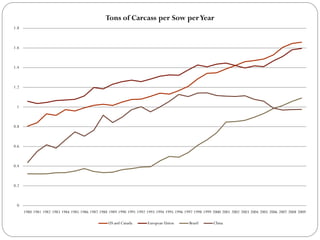
1980 1981 1982 1983 1984 1985 1986 1987 1988 1989 1990 1991 1992 1993 1994 1995 1996 1997 1998 1999 2000 2001 2002 2003 2004 2005 2006 2007 2008 2009
Tons of Carcass per Sow perYear
US and Canada European Union Brazil China
600
800
1,000
1,200
1,400
1,600
1,800
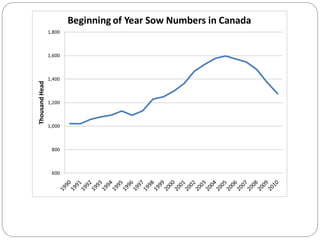
ThousandHead
Beginning of Year Sow Numbers in Canada
Rate and scale of development
 Markets forces, entrepreneurship and centralized
government have combined to generate faster growth than
Japan or South Korea at the same stage of development
 The scale is at least ten times greater than any other land
scarce country
 Vast movement of labor out of agriculture, the loss of
workers will be noticed as the impact of the one child policy
becomes more obvious
 Unproductive land being planted to trees
 High quality land moving into development
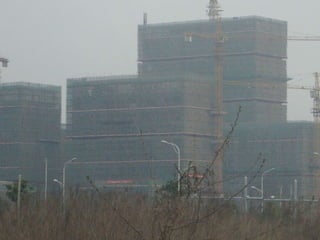
Miles of new construction outside
every city
Agricultural Resources
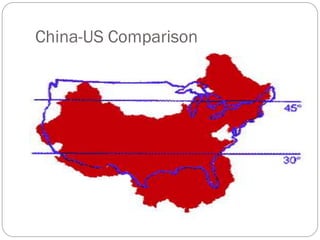
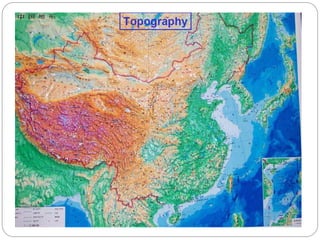
 China has gone below the politically sensitive 120 million hectares
(296 million acres), has at most 275 million acres, a lot of which is
poor quality land that cannot be mechanized and should not be
farmed
 The US has about 360 million acres in crops and about 400 million
acres of pasture, total agricultural area of almost a billion acres
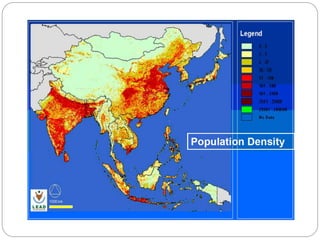
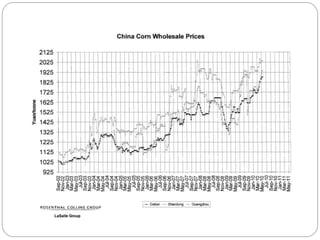
 Yet China feeds almost five times the population, the key to this
success is the creative Chinese diet, and the use of labor to
substitute for crop land and animal feed
 China has given up on the most land intensive products (beef and
soybeans) and has begun to import corn
China-US Comparison
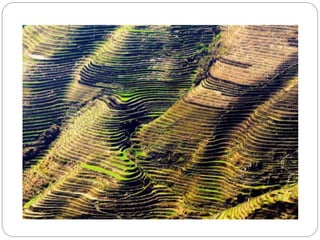
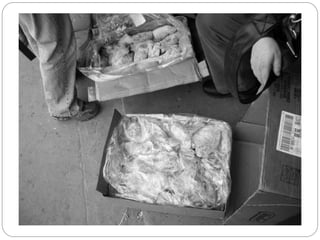
How do you mechanize this?
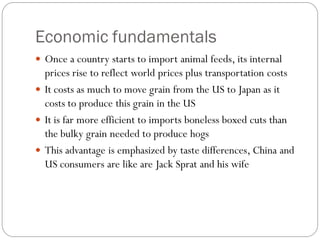
Economic fundamentals
 Once a country starts to import animal feeds, its internal
prices rise to reflect world prices plus transportation costs
 It costs as much to move grain from the US to Japan as it
costs to produce this grain in the US
 It is far more efficient to imports boneless boxed cuts than
the bulky grain needed to produce hogs
 This advantage is emphasized by taste differences, China and
US consumers are like are Jack Sprat and his wife
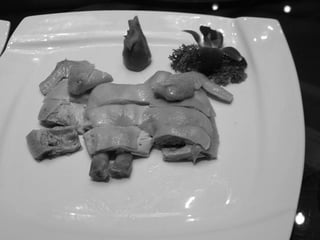
Chicken heads are a delicacy
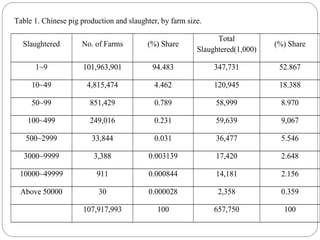
Table 1. Chinese pig production and slaughter, by farm size.
Slaughtered No. of Farms (%) Share
Total
Slaughtered(1,000)
(%) Share
1~9 101,963,901 94.483 347,731 52.867
10~49 4,815,474 4.462 120,945 18.388
50~99 851,429 0.789 58,999 8.970
100~499 249,016 0.231 59,639 9,067
500~2999 33,844 0.031 36,477 5.546
3000~9999 3,388 0.003139 17,420 2.648
10000~49999 911 0.000844 14,181 2.156
Above 50000 30 0.000028 2,358 0.359
107,917,993 100 657,750 100
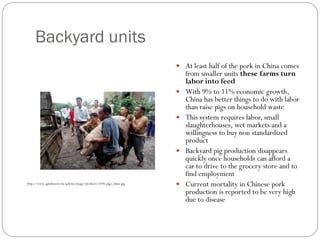
Backyard units
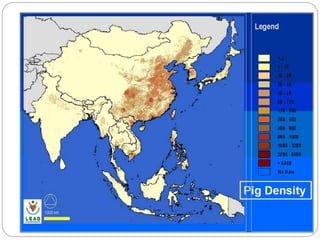
 At least half of the pork in China comes
from smaller units these farms turn
labor into feed
 With 9% to 11% economic growth,
China has better things to do with labor
than raise pigs on household waste
 This system requires labor, small
slaughterhouses, wet markets and a
willingness to buy non standardized
product
 Backyard pig production disappears
quickly once households can afford a
car to drive to the grocery store and to
find employment
 Current mortality in Chinese pork
production is reported to be very high
due to disease
http://www.agrarhaszon.hu/galeria/image/products/1039_pigs_china.jpg
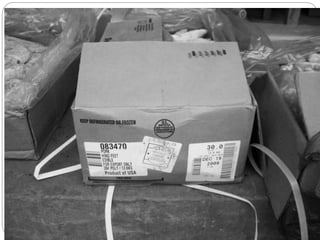
A common sight outside restaurants
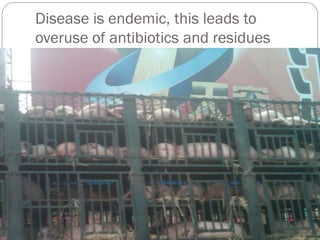
Disease is endemic, this leads to
overuse of antibiotics and residues
Competitive position of the pork
industry as of early April, 2010
 Corn prices are at $7.00 to $7.40 per bushel, this market is
protected and prices are set
 Soybean meal is already at import parity
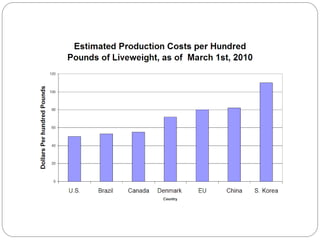
 Current production costs; US $48/100lbs, China $75 to $80
a minimum cost difference of 56%
 Feed only in China is $52 to $56,
 It costs $0.20 per pound to ship pork from US plants to
China, this increases the carcass price by 25% to 30%, if this
was the only barrier US pork would flood in
 Add in the discriminatory vat and import duty and the
difference becomes 58%
Competitiveness
 At current production costs pork carcasses will not move,
however there is a quality difference and the differential taste
issue
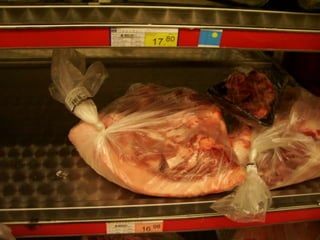
 All the animal extremes (ear, tongue, snout, mask, feet and hock
white organs and bung should move if only economics were at
play
 Chinese consumers do not place as much value on the loin and
therefore they have a relative preference for the shoulder
 Skin on shoulder has an additional 13% competitive advantage
and is price competitive
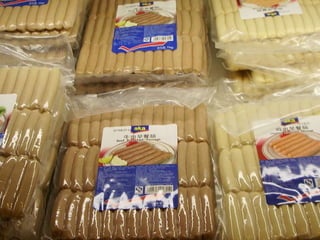
 However the Ractopamine issue keeps cuts and processed
products out of legal channels
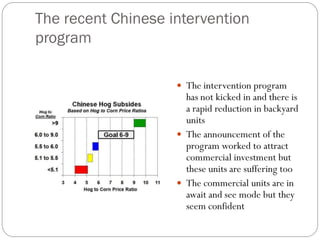
The recent Chinese intervention
program
 The intervention program
has not kicked in and there is
a rapid reduction in backyard
units
 The announcement of the
program worked to attract
commercial investment but
these units are suffering too
 The commercial units are in
await and see mode but they
seem confident
What happens next?
 In the short run, opportunities will be based on the grey market,
this adds about 250 RMB per ton for repack and 3,250 RMB for
the “agent fee” this is $0.24 per pound
 Pork exporters and canners will buy legal US product to avoid
residue issues, possibly 20,000 to 50,000 tons
 There will be a scarcity in 12 to 18 months, more and more of
the carcass will move to China, probably shoulders and some hams
 When the US and Chinese hog cycles are at opposite points, then
we will see more six piece carcasses some in through official
channels
What happens next?
 A currency appreciation or a solution to the
Ractopamine issue, or a removal of the differential vat or
import duty would generate large movements of
shoulders and inexpensive processed meats
 When the currency strengthens soybean meal prices in
China will fall, but corn prices will not.Total production
costs will go up by 8% for each 10% in appreciation
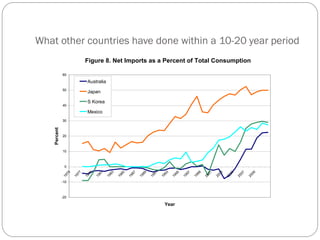
What other countries have done within a 10-20 year period
Figure 8. Net Imports as a Percent of Total Consumption
-20
-10
0
10
20
30
40
50
60
1975
1977
1979
1981
1983
1985
1987
1989
1991
1993
1995
1997
1999
2001
2003
2005
2007
2009
Year
Percent
Australia
Japan
S Korea
Mexico
Long run
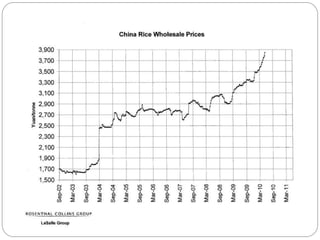
 China will face food price inflation and high food prices
unless it imports
 It is in Chinas best interests to open its food market for
competition, the government will understand this eventually
 Imported quantities will be enormous, take your best
market and multiply by 10
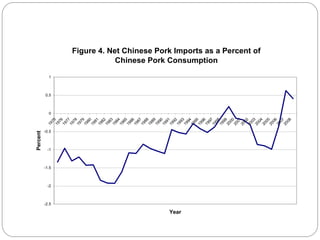
Figure 4. Net Chinese Pork Imports as a Percent of
Chinese Pork Consumption
-2.5
-2
-1.5
-1
-0.5
0
0.5
1
1975
1976
1977
1978
1979
1980
1981
1982
1983
1984
1985
1986
1987
1988
1989
1990
1991
1992
1993
1994
1995
1996
1997
1998
1999
2000
2001
2002
2003
2004
2005
2006
2007
2008
Year
Percent

U.S. Global Position (imports/exports)

  • 1.
    U.S. Global Position DermotHayes Iowa State University Wednesday, June 16, 2010 10:30 am - 11:15 am
  • 2.
    Overview  Trade patterns Competitiveness of the US industry  China
  • 3.
  • 4.
    -10 -5 0 5 10 15 20 1960 1962 1964 1966 1968 1970 1972 1974 1976 1978 1980 1982 1984 1986 1988 1990 1992 1994 1996 1998 2000 2002 2004 2006 2008 Percent US Pork Exportsand Net Exports as a Percent of Production Net Exports as a Percent of Production Exports as a Percent of Production
  • 5.
  • 6.
    0 10 20 30 40 50 60 1996 1997 19981999 2000 2001 2002 2003 2004 2005 2006 2007 2008 2009 Percent Pork Imports as a Percent of Domestic Production Australia Canada Japan Korea, South Mexico Russia
  • 8.
    0 0.2 0.4 0.6 0.8 1 1.2 1.4 1.6 1.8 1980 1981 19821983 1984 1985 1986 1987 1988 1989 1990 1991 1992 1993 1994 1995 1996 1997 1998 1999 2000 2001 2002 2003 2004 2005 2006 2007 2008 2009 Tons of Carcass per Sow perYear US and Canada European Union Brazil China
  • 9.
  • 11.
    Rate and scaleof development  Markets forces, entrepreneurship and centralized government have combined to generate faster growth than Japan or South Korea at the same stage of development  The scale is at least ten times greater than any other land scarce country  Vast movement of labor out of agriculture, the loss of workers will be noticed as the impact of the one child policy becomes more obvious  Unproductive land being planted to trees  High quality land moving into development
  • 12.
    Miles of newconstruction outside every city
  • 15.
    Agricultural Resources  Chinahas gone below the politically sensitive 120 million hectares (296 million acres), has at most 275 million acres, a lot of which is poor quality land that cannot be mechanized and should not be farmed  The US has about 360 million acres in crops and about 400 million acres of pasture, total agricultural area of almost a billion acres  Yet China feeds almost five times the population, the key to this success is the creative Chinese diet, and the use of labor to substitute for crop land and animal feed  China has given up on the most land intensive products (beef and soybeans) and has begun to import corn
  • 16.
  • 21.
    How do youmechanize this?
  • 25.
    Economic fundamentals  Oncea country starts to import animal feeds, its internal prices rise to reflect world prices plus transportation costs  It costs as much to move grain from the US to Japan as it costs to produce this grain in the US  It is far more efficient to imports boneless boxed cuts than the bulky grain needed to produce hogs  This advantage is emphasized by taste differences, China and US consumers are like are Jack Sprat and his wife
  • 29.
  • 30.
    Table 1. Chinesepig production and slaughter, by farm size. Slaughtered No. of Farms (%) Share Total Slaughtered(1,000) (%) Share 1~9 101,963,901 94.483 347,731 52.867 10~49 4,815,474 4.462 120,945 18.388 50~99 851,429 0.789 58,999 8.970 100~499 249,016 0.231 59,639 9,067 500~2999 33,844 0.031 36,477 5.546 3000~9999 3,388 0.003139 17,420 2.648 10000~49999 911 0.000844 14,181 2.156 Above 50000 30 0.000028 2,358 0.359 107,917,993 100 657,750 100
  • 31.
    Backyard units  Atleast half of the pork in China comes from smaller units these farms turn labor into feed  With 9% to 11% economic growth, China has better things to do with labor than raise pigs on household waste  This system requires labor, small slaughterhouses, wet markets and a willingness to buy non standardized product  Backyard pig production disappears quickly once households can afford a car to drive to the grocery store and to find employment  Current mortality in Chinese pork production is reported to be very high due to disease http://www.agrarhaszon.hu/galeria/image/products/1039_pigs_china.jpg
  • 32.
    A common sightoutside restaurants
  • 33.
    Disease is endemic,this leads to overuse of antibiotics and residues
  • 36.
    Competitive position ofthe pork industry as of early April, 2010  Corn prices are at $7.00 to $7.40 per bushel, this market is protected and prices are set  Soybean meal is already at import parity  Current production costs; US $48/100lbs, China $75 to $80 a minimum cost difference of 56%  Feed only in China is $52 to $56,  It costs $0.20 per pound to ship pork from US plants to China, this increases the carcass price by 25% to 30%, if this was the only barrier US pork would flood in  Add in the discriminatory vat and import duty and the difference becomes 58%
  • 37.
    Competitiveness  At currentproduction costs pork carcasses will not move, however there is a quality difference and the differential taste issue  All the animal extremes (ear, tongue, snout, mask, feet and hock white organs and bung should move if only economics were at play  Chinese consumers do not place as much value on the loin and therefore they have a relative preference for the shoulder  Skin on shoulder has an additional 13% competitive advantage and is price competitive  However the Ractopamine issue keeps cuts and processed products out of legal channels
  • 40.
    The recent Chineseintervention program  The intervention program has not kicked in and there is a rapid reduction in backyard units  The announcement of the program worked to attract commercial investment but these units are suffering too  The commercial units are in await and see mode but they seem confident
  • 41.
    What happens next? In the short run, opportunities will be based on the grey market, this adds about 250 RMB per ton for repack and 3,250 RMB for the “agent fee” this is $0.24 per pound  Pork exporters and canners will buy legal US product to avoid residue issues, possibly 20,000 to 50,000 tons  There will be a scarcity in 12 to 18 months, more and more of the carcass will move to China, probably shoulders and some hams  When the US and Chinese hog cycles are at opposite points, then we will see more six piece carcasses some in through official channels
  • 42.
    What happens next? A currency appreciation or a solution to the Ractopamine issue, or a removal of the differential vat or import duty would generate large movements of shoulders and inexpensive processed meats  When the currency strengthens soybean meal prices in China will fall, but corn prices will not.Total production costs will go up by 8% for each 10% in appreciation
  • 43.
    What other countrieshave done within a 10-20 year period Figure 8. Net Imports as a Percent of Total Consumption -20 -10 0 10 20 30 40 50 60 1975 1977 1979 1981 1983 1985 1987 1989 1991 1993 1995 1997 1999 2001 2003 2005 2007 2009 Year Percent Australia Japan S Korea Mexico
  • 44.
    Long run  Chinawill face food price inflation and high food prices unless it imports  It is in Chinas best interests to open its food market for competition, the government will understand this eventually  Imported quantities will be enormous, take your best market and multiply by 10
  • 45.
    Figure 4. NetChinese Pork Imports as a Percent of Chinese Pork Consumption -2.5 -2 -1.5 -1 -0.5 0 0.5 1 1975 1976 1977 1978 1979 1980 1981 1982 1983 1984 1985 1986 1987 1988 1989 1990 1991 1992 1993 1994 1995 1996 1997 1998 1999 2000 2001 2002 2003 2004 2005 2006 2007 2008 Year Percent