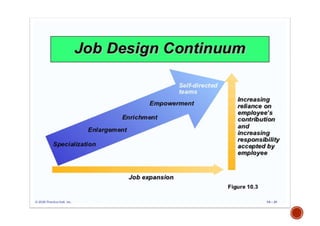
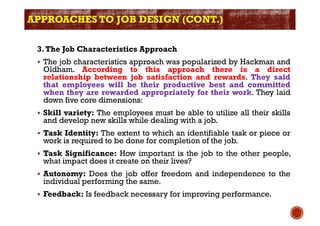
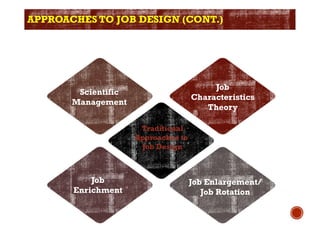
Job design involves determining the tasks, responsibilities, and relationships associated with a job. It is done after job analysis and aims to organize job duties based on qualifications and skills required. Job design provides information on required qualifications and rewards. It is important because properly designed jobs can motivate efficient managers, while poorly designed jobs can cause problems. Approaches to job design include the human approach focusing on employee needs, the engineering/scientific management approach standardizing tasks, and the job characteristics approach linking satisfaction to skills variety, task identity, significance, autonomy, and feedback. Contemporary issues involve flexible schedules, telecommuting, job sharing, and addressing techno-stress and ensuring skills match job requirements.


![Job Enlargement –increases the number of activities in a job to
overcome the boredom of overspecialized work
Job enlargement means increasing the scope of a job through
extending the range of its job duties and responsibilities
generally within the same level and periphery.
Job enlargement involves combining various activities at the same
level in the organization and adding them to the existing job. It
is also called the horizontal expansion of job activities.[1]
Job Rotation – workers are exposed to a variety of specialized
jobs over time
Cross-Training – workers are trained in different specialized
tasks or activities
JOB ENLARGEMENT / ROTATION
JOB ENLARGEMENT / ROTATION](https://image.slidesharecdn.com/jobdesign-231111060036-9a363bce/85/Job-Design-pdf-8-320.jpg)