Work Holding
On The Milling Machine
On the milling machine there are many
different styles of work holding, from milling
vises to specially designed fixtures that are
made for one operation.
Because there are so many different styles of
work holding, this Learning Object will only
show a few of the basic styles of work holding
and work stops
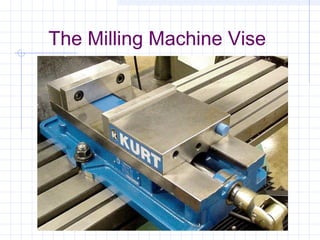
The Milling Machine Vise
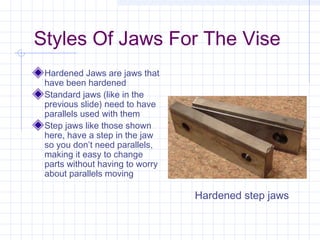
Styles Of Jaws For The Vise
Hardened Jaws are jaws that
have been hardened
Standard jaws (like in the
previous slide) need to have
parallels used with them
Step jaws like those shown
here, have a step in the jaw
so you don’t need parallels,
making it easy to change
parts without having to worry
about parallels moving
Hardened step jaws
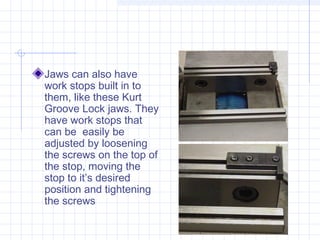
Jaws can also have
work stops built in to
them, like these Kurt
Groove Lock jaws. They
have work stops that
can be easily be
adjusted by loosening
the screws on the top of
the stop, moving the
stop to it’s desired
position and tightening
the screws
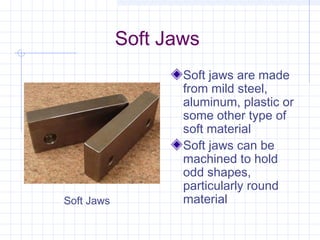
Soft Jaws
Soft jaws are made
from mild steel,
aluminum, plastic or
some other type of
soft material
Soft jaws can be
machined to hold
odd shapes,
particularly round
materialSoft Jaws
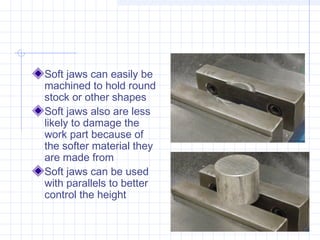
Soft jaws can easily be
machined to hold round
stock or other shapes
Soft jaws also are less
likely to damage the
work part because of
the softer material they
are made from
Soft jaws can be used
with parallels to better
control the height
Parallels
When using standard
hardened jaws it is
important to use
parallels
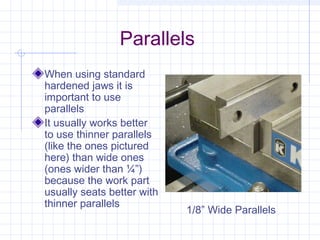
It usually works better
to use thinner parallels
(like the ones pictured
here) than wide ones
(ones wider than ¼”)
because the work part
usually seats better with
thinner parallels
1/8” Wide Parallels
Parallels
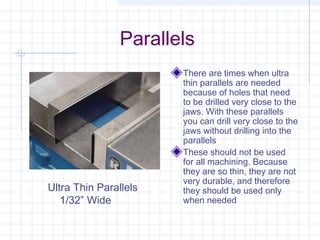
There are times when ultra
thin parallels are needed
because of holes that need
to be drilled very close to the
jaws. With these parallels
you can drill very close to the
jaws without drilling into the
parallels
These should not be used
for all machining. Because
they are so thin, they are not
very durable, and therefore
they should be used only
when needed
Ultra Thin Parallels
1/32” Wide
Parallels
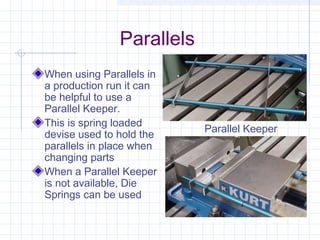
When using Parallels in
a production run it can
be helpful to use a
Parallel Keeper.
This is spring loaded
devise used to hold the
parallels in place when
changing parts
When a Parallel Keeper
is not available, Die
Springs can be used
Parallel Keeper
Work Stops
Whether you are doing one
part or hundreds of parts it
can be very helpful to use
work stops.
When making many parts it
helps keep the parts
consistent
When making one or just a
few parts it helps to keep
your ZERO consistent,
therefore saving time so you
don’t have to keep edge
finding every time you rotate
your part
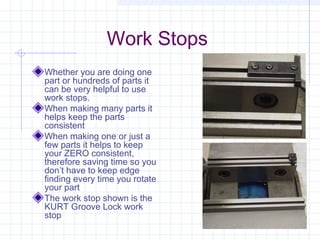
The work stop shown is the
KURT Groove Lock work
stop
Work Stops
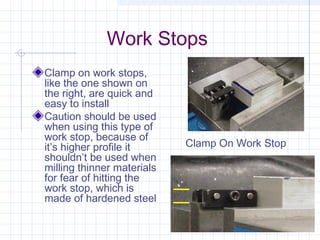
Clamp on work stops,
like the one shown on
the right, are quick and
easy to install
Caution should be used
when using this type of
work stop, because of
it’s higher profile it
shouldn’t be used when
milling thinner materials
for fear of hitting the
work stop, which is
made of hardened steel
Clamp On Work Stop
Work Stops
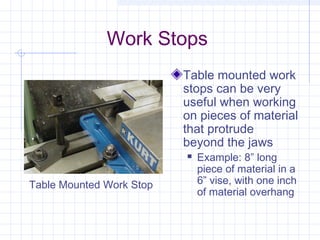
Table mounted work
stops can be very
useful when working
on pieces of material
that protrude
beyond the jaws
 Example: 8” long
piece of material in a
6” vise, with one inch
of material overhang
Table Mounted Work Stop
Work Stops
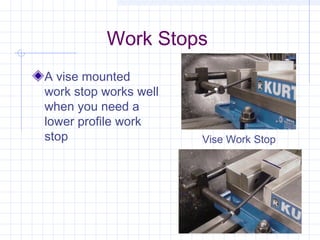
A vise mounted
work stop works well
when you need a
lower profile work
stop Vise Work Stop
Miscellaneous Work Holding
5-C Collet Holder
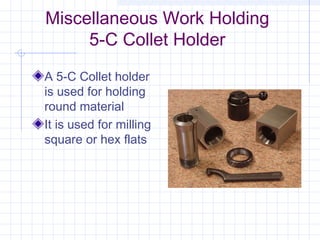
A 5-C Collet holder
is used for holding
round material
It is used for milling
square or hex flats
Miscellaneous Work Holding
5-C Collet Holder
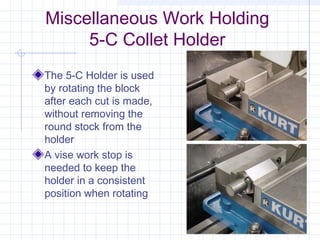
The 5-C Holder is used
by rotating the block
after each cut is made,
without removing the
round stock from the
holder
A vise work stop is
needed to keep the
holder in a consistent
position when rotating
Miscellaneous Work Holding
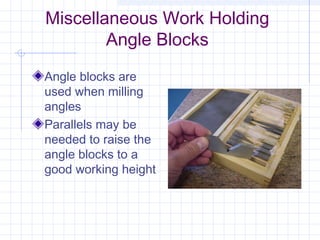
Angle Blocks
Angle blocks are
used when milling
angles
Parallels may be
needed to raise the
angle blocks to a
good working height
Miscellaneous Work Holding
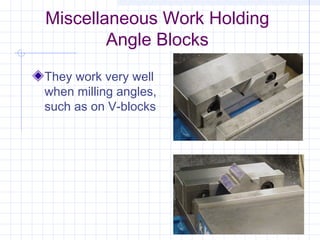
Angle Blocks
They work very well
when milling angles,
such as on V-blocks
Miscellaneous Work Holding
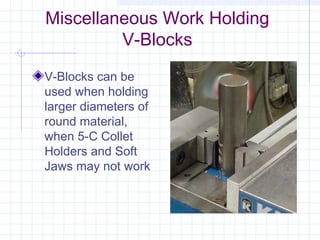
V-Blocks
V-Blocks can be
used when holding
larger diameters of
round material,
when 5-C Collet
Holders and Soft
Jaws may not work
The End

Work holding

  • 1.
    Work Holding On TheMilling Machine
  • 2.
    On the millingmachine there are many different styles of work holding, from milling vises to specially designed fixtures that are made for one operation. Because there are so many different styles of work holding, this Learning Object will only show a few of the basic styles of work holding and work stops
  • 3.
  • 4.
    Styles Of JawsFor The Vise Hardened Jaws are jaws that have been hardened Standard jaws (like in the previous slide) need to have parallels used with them Step jaws like those shown here, have a step in the jaw so you don’t need parallels, making it easy to change parts without having to worry about parallels moving Hardened step jaws
  • 5.
    Jaws can alsohave work stops built in to them, like these Kurt Groove Lock jaws. They have work stops that can be easily be adjusted by loosening the screws on the top of the stop, moving the stop to it’s desired position and tightening the screws
  • 6.
    Soft Jaws Soft jawsare made from mild steel, aluminum, plastic or some other type of soft material Soft jaws can be machined to hold odd shapes, particularly round materialSoft Jaws
  • 7.
    Soft jaws caneasily be machined to hold round stock or other shapes Soft jaws also are less likely to damage the work part because of the softer material they are made from Soft jaws can be used with parallels to better control the height
  • 8.
    Parallels When using standard hardenedjaws it is important to use parallels It usually works better to use thinner parallels (like the ones pictured here) than wide ones (ones wider than ¼”) because the work part usually seats better with thinner parallels 1/8” Wide Parallels
  • 9.
    Parallels There are timeswhen ultra thin parallels are needed because of holes that need to be drilled very close to the jaws. With these parallels you can drill very close to the jaws without drilling into the parallels These should not be used for all machining. Because they are so thin, they are not very durable, and therefore they should be used only when needed Ultra Thin Parallels 1/32” Wide
  • 10.
    Parallels When using Parallelsin a production run it can be helpful to use a Parallel Keeper. This is spring loaded devise used to hold the parallels in place when changing parts When a Parallel Keeper is not available, Die Springs can be used Parallel Keeper
  • 11.
    Work Stops Whether youare doing one part or hundreds of parts it can be very helpful to use work stops. When making many parts it helps keep the parts consistent When making one or just a few parts it helps to keep your ZERO consistent, therefore saving time so you don’t have to keep edge finding every time you rotate your part The work stop shown is the KURT Groove Lock work stop
  • 12.
    Work Stops Clamp onwork stops, like the one shown on the right, are quick and easy to install Caution should be used when using this type of work stop, because of it’s higher profile it shouldn’t be used when milling thinner materials for fear of hitting the work stop, which is made of hardened steel Clamp On Work Stop
  • 13.
    Work Stops Table mountedwork stops can be very useful when working on pieces of material that protrude beyond the jaws  Example: 8” long piece of material in a 6” vise, with one inch of material overhang Table Mounted Work Stop
  • 14.
    Work Stops A visemounted work stop works well when you need a lower profile work stop Vise Work Stop
  • 15.
    Miscellaneous Work Holding 5-CCollet Holder A 5-C Collet holder is used for holding round material It is used for milling square or hex flats
  • 16.
    Miscellaneous Work Holding 5-CCollet Holder The 5-C Holder is used by rotating the block after each cut is made, without removing the round stock from the holder A vise work stop is needed to keep the holder in a consistent position when rotating
  • 17.
    Miscellaneous Work Holding AngleBlocks Angle blocks are used when milling angles Parallels may be needed to raise the angle blocks to a good working height
  • 18.
    Miscellaneous Work Holding AngleBlocks They work very well when milling angles, such as on V-blocks
  • 19.
    Miscellaneous Work Holding V-Blocks V-Blockscan be used when holding larger diameters of round material, when 5-C Collet Holders and Soft Jaws may not work
  • 20.