3/1/2018
1
HOLDING TOOLS
For you to do your work with minimal disturbance you need to grip the
work using holding tools
Lesson objectives
By the end of this lesson you should be able to
 Name at least four types of holding tools
 State specific functions of different holding tools
 Produce sketches of the holding tools
 Describe the operation mechanism of the different holding
tools
3/1/2018
2
Below is a list of some holding tools
 Engineer’s vice
 Machine vice
 Leg vice
 Hand vice
 Tool makers clamp
 Vee-block
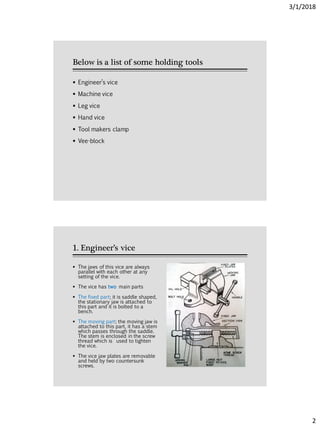
1. Engineer’s vice
 The jaws of this vice are always
parallel with each other at any
setting of the vice.
 The vice has two main parts
 The fixed part; it is saddle shaped,
the stationary jaw is attached to
this part and it is bolted to a
bench.
 The moving part; the moving jaw is
attached to this part, it has a stem
which passes through the saddle.
The stem is enclosed in the screw
thread which is used to tighten
the vice.
 The vice jaw plates are removable
and held by two countersunk
screws.
3/1/2018
3
Precautions when using engineer’s vice
 Always keep the vice clean
 Do not hammer on the back of a vice stem
 Lubricate the screw regularly
 Do not use a hammer to tighten the jaws
 It must not be cut or marked with hacksaw, file or chisel
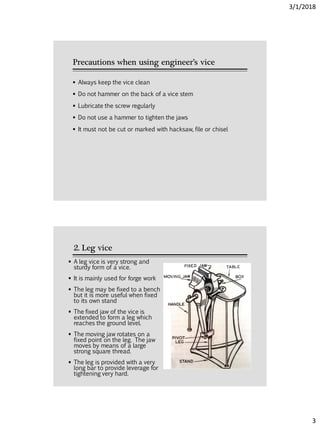
2. Leg vice
 A leg vice is very strong and
sturdy form of a vice.
 It is mainly used for forge work
 The leg may be fixed to a bench
but it is more useful when fixed
to its own stand
 The fixed jaw of the vice is
extended to form a leg which
reaches the ground level.
 The moving jaw rotates on a
fixed point on the leg. The jaw
moves by means of a large
strong square thread.
 The leg is provided with a very
long bar to provide leverage for
tightening very hard.
3/1/2018
4
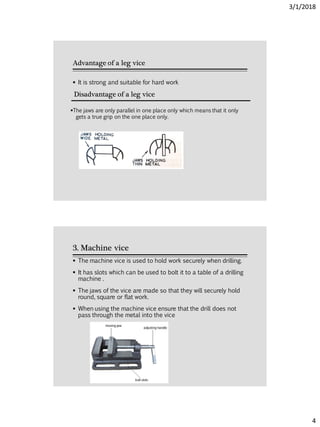
Advantage of a leg vice
 It is strong and suitable for hard work
Disadvantage of a leg vice
The jaws are only parallel in one place only which means that it only
gets a true grip on the one place only.
3. Machine vice
 The machine vice is used to hold work securely when drilling.
 It has slots which can be used to bolt it to a table of a drilling
machine .
 The jaws of the vice are made so that they will securely hold
round, square or flat work.
 When using the machine vice ensure that the drill does not
pass through the metal into the vice
3/1/2018
5
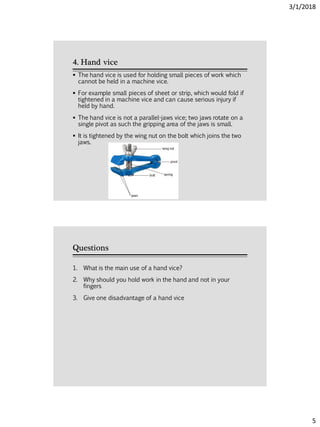
4. Hand vice
 The hand vice is used for holding small pieces of work which
cannot be held in a machine vice.
 For example small pieces of sheet or strip, which would fold if
tightened in a machine vice and can cause serious injury if
held by hand.
 The hand vice is not a parallel-jaws vice; two jaws rotate on a
single pivot as such the gripping area of the jaws is small.
 It is tightened by the wing nut on the bolt which joins the two
jaws.
Questions
1. What is the main use of a hand vice?
2. Why should you hold work in the hand and not in your
fingers
3. Give one disadvantage of a hand vice
3/1/2018
6
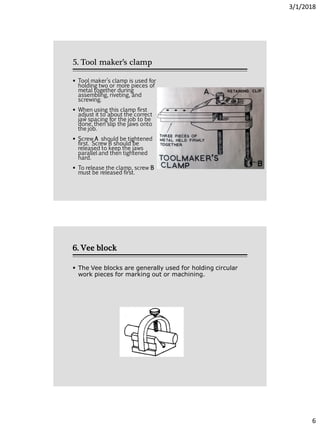
5. Tool maker’s clamp
 Tool maker’s clamp is used for
holding two or more pieces of
metal together during
assembling, riveting, and
screwing.
 When using this clamp first
adjust it to about the correct
jaw spacing for the job to be
done, then slip the jaws onto
the job.
 Screw A should be tightened
first. Screw B should be
released to keep the jaws
parallel and then tightened
hard.
 To release the clamp, screw B
must be released first.
6. Vee block
 The Vee blocks are generally used for holding circular
work pieces for marking out or machining.

metal holding tools

  • 1.
    3/1/2018 1 HOLDING TOOLS For youto do your work with minimal disturbance you need to grip the work using holding tools Lesson objectives By the end of this lesson you should be able to  Name at least four types of holding tools  State specific functions of different holding tools  Produce sketches of the holding tools  Describe the operation mechanism of the different holding tools
  • 2.
    3/1/2018 2 Below is alist of some holding tools  Engineer’s vice  Machine vice  Leg vice  Hand vice  Tool makers clamp  Vee-block 1. Engineer’s vice  The jaws of this vice are always parallel with each other at any setting of the vice.  The vice has two main parts  The fixed part; it is saddle shaped, the stationary jaw is attached to this part and it is bolted to a bench.  The moving part; the moving jaw is attached to this part, it has a stem which passes through the saddle. The stem is enclosed in the screw thread which is used to tighten the vice.  The vice jaw plates are removable and held by two countersunk screws.
  • 3.
    3/1/2018 3 Precautions when usingengineer’s vice  Always keep the vice clean  Do not hammer on the back of a vice stem  Lubricate the screw regularly  Do not use a hammer to tighten the jaws  It must not be cut or marked with hacksaw, file or chisel 2. Leg vice  A leg vice is very strong and sturdy form of a vice.  It is mainly used for forge work  The leg may be fixed to a bench but it is more useful when fixed to its own stand  The fixed jaw of the vice is extended to form a leg which reaches the ground level.  The moving jaw rotates on a fixed point on the leg. The jaw moves by means of a large strong square thread.  The leg is provided with a very long bar to provide leverage for tightening very hard.
  • 4.
    3/1/2018 4 Advantage of aleg vice  It is strong and suitable for hard work Disadvantage of a leg vice The jaws are only parallel in one place only which means that it only gets a true grip on the one place only. 3. Machine vice  The machine vice is used to hold work securely when drilling.  It has slots which can be used to bolt it to a table of a drilling machine .  The jaws of the vice are made so that they will securely hold round, square or flat work.  When using the machine vice ensure that the drill does not pass through the metal into the vice
  • 5.
    3/1/2018 5 4. Hand vice The hand vice is used for holding small pieces of work which cannot be held in a machine vice.  For example small pieces of sheet or strip, which would fold if tightened in a machine vice and can cause serious injury if held by hand.  The hand vice is not a parallel-jaws vice; two jaws rotate on a single pivot as such the gripping area of the jaws is small.  It is tightened by the wing nut on the bolt which joins the two jaws. Questions 1. What is the main use of a hand vice? 2. Why should you hold work in the hand and not in your fingers 3. Give one disadvantage of a hand vice
  • 6.
    3/1/2018 6 5. Tool maker’sclamp  Tool maker’s clamp is used for holding two or more pieces of metal together during assembling, riveting, and screwing.  When using this clamp first adjust it to about the correct jaw spacing for the job to be done, then slip the jaws onto the job.  Screw A should be tightened first. Screw B should be released to keep the jaws parallel and then tightened hard.  To release the clamp, screw B must be released first. 6. Vee block  The Vee blocks are generally used for holding circular work pieces for marking out or machining.