Course: Dimensions of Agricultural
Extension
Dr. Arpita Sharma
Assistant Professor,
GBPUA&T, Pantnagar
 Launched on 2 Oct, 1975.
 Largest Early childhood development
programme.
 Aim: to provide pre-school education, reduce
childhood mortality and morbidity and
enhance capacity to mothers to look after
the nutritional needs of children and family
through nutritional education.
 Six services:
 Immunization: Pregnant women+infants-6
diseases.
 Health Check up-Regular
 Supplementary nutrition: 300 days
 Referral service: special health facility by
PHC.
 Non Formal pre-school education: 3-6yr.
 Nutrition and Health Education: Capacity
building activity for women to enable them
to look after the nutritional needs of
children and family.
 1 lakh population-1 AWC.
 Sep 1982 a sub plan of IRDP.
 Poor rural women were provided income
generating activities and assistance was
provided in form of goods and services.
 Policy of making 10-15 SHGs: Income
generating activities.
 DWACRA has been merged with SYSG April
1,1999.
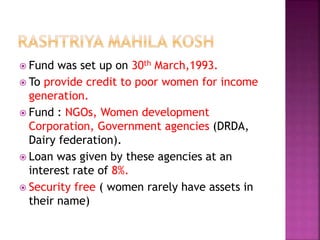
 Fund was set up on 30th March,1993.
 To provide credit to poor women for income
generation.
 Fund : NGOs, Women development
Corporation, Government agencies (DRDA,
Dairy federation).
 Loan was given by these agencies at an
interest rate of 8%.
 Security free ( women rarely have assets in
their name)
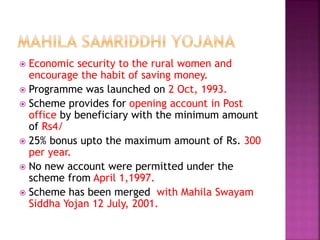
 Economic security to the rural women and
encourage the habit of saving money.
 Programme was launched on 2 Oct, 1993.
 Scheme provides for opening account in Post
office by beneficiary with the minimum amount
of Rs4/
 25% bonus upto the maximum amount of Rs. 300
per year.
 No new account were permitted under the
scheme from April 1,1997.
 Scheme has been merged with Mahila Swayam
Siddha Yojan 12 July, 2001.

Women Development Programme

  • 1.
    Course: Dimensions ofAgricultural Extension Dr. Arpita Sharma Assistant Professor, GBPUA&T, Pantnagar
  • 2.
     Launched on2 Oct, 1975.  Largest Early childhood development programme.  Aim: to provide pre-school education, reduce childhood mortality and morbidity and enhance capacity to mothers to look after the nutritional needs of children and family through nutritional education.  Six services:
  • 3.
     Immunization: Pregnantwomen+infants-6 diseases.  Health Check up-Regular  Supplementary nutrition: 300 days  Referral service: special health facility by PHC.  Non Formal pre-school education: 3-6yr.  Nutrition and Health Education: Capacity building activity for women to enable them to look after the nutritional needs of children and family.  1 lakh population-1 AWC.
  • 4.
     Sep 1982a sub plan of IRDP.  Poor rural women were provided income generating activities and assistance was provided in form of goods and services.  Policy of making 10-15 SHGs: Income generating activities.  DWACRA has been merged with SYSG April 1,1999.
  • 5.
     Fund wasset up on 30th March,1993.  To provide credit to poor women for income generation.  Fund : NGOs, Women development Corporation, Government agencies (DRDA, Dairy federation).  Loan was given by these agencies at an interest rate of 8%.  Security free ( women rarely have assets in their name)
  • 6.
     Economic securityto the rural women and encourage the habit of saving money.  Programme was launched on 2 Oct, 1993.  Scheme provides for opening account in Post office by beneficiary with the minimum amount of Rs4/  25% bonus upto the maximum amount of Rs. 300 per year.  No new account were permitted under the scheme from April 1,1997.  Scheme has been merged with Mahila Swayam Siddha Yojan 12 July, 2001.