STRAND 4- TOOLS &
PRODUCTION
Measuring & Marking Tools
MEASURING & MARKING TOOLS
•A measuring tool is a device used to measure a
physical quantity such as length, time, weight, angle,
volume and temperature.
• A marking tool is a device used to indicate a point on
a surface to obtain accurate size and shape.
• Common measuring and marking tools are:
MEASURING TOOLS
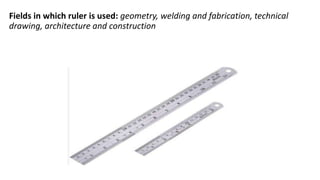
Steel rule-also called steel ruler.
A flat metallic tool with a calibrated surface.
Made from stainless steel.
Can either be flexible or rigid with different thickness.
Uses:
Measure length of an object or distance between 2 points.
To draw straight lines.
To guide cuts.
Fields in which ruler is used: geometry, welding and fabrication, technical
drawing, architecture and construction.
Fields in which ruler is used: geometry, welding and fabrication, technical
drawing, architecture and construction
TAPE MEASURE
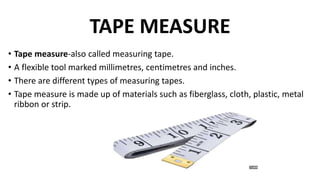
• Tape measure-also called measuring tape.
• A flexible tool marked millimetres, centimetres and inches.
• There are different types of measuring tapes.
• Tape measure is made up of materials such as fiberglass, cloth, plastic, metal
ribbon or strip.
TAPE MEASURE
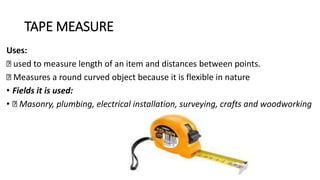
Uses:
used to measure length of an item and distances between points.
Measures a round curved object because it is flexible in nature
• Fields it is used:
• Masonry, plumbing, electrical installation, surveying, crafts and woodworking
SQUARE
• Square – it is a measuring device that consists of two straight edges set at right
angles to each other.
• There are different types of squares.
• Uses:
used to measure and ensure that two perpendicular surfaces are at a right
angle.
Used in different fields to ensure that joints and corners of objects are truly
square.
SQUARE
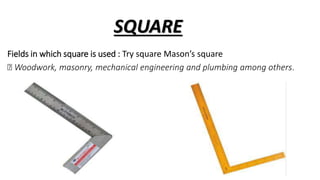
Fields in which square is used : Try square Mason’s square
Woodwork, masonry, mechanical engineering and plumbing among others.
CALIPERS
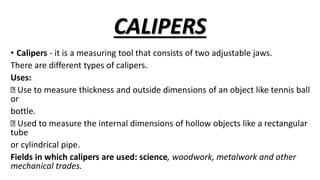
• Calipers - it is a measuring tool that consists of two adjustable jaws.
There are different types of calipers.
Uses:
Use to measure thickness and outside dimensions of an object like tennis ball
or
bottle.
Used to measure the internal dimensions of hollow objects like a rectangular
tube
or cylindrical pipe.
Fields in which calipers are used: science, woodwork, metalwork and other
mechanical trades.
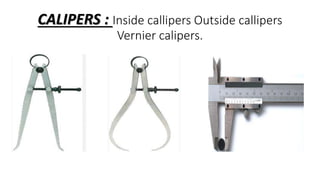
CALIPERS : Inside callipers Outside callipers
Vernier calipers.
MICROMETER SCREW GAUGE
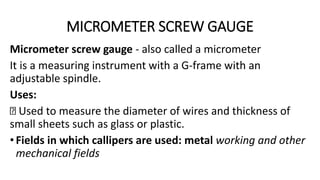
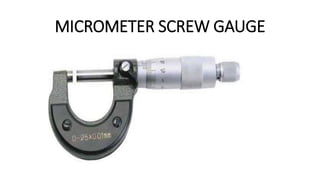
Micrometer screw gauge - also called a micrometer
It is a measuring instrument with a G-frame with an
adjustable spindle.
Uses:
Used to measure the diameter of wires and thickness of
small sheets such as glass or plastic.
•Fields in which callipers are used: metal working and other
mechanical fields
MICROMETER SCREW GAUGE
SPIRIT LEVEL
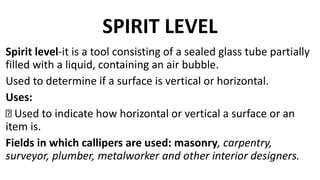
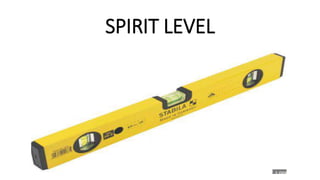
Spirit level-it is a tool consisting of a sealed glass tube partially
filled with a liquid, containing an air bubble.
Used to determine if a surface is vertical or horizontal.
Uses:
Used to indicate how horizontal or vertical a surface or an
item is.
Fields in which callipers are used: masonry, carpentry,
surveyor, plumber, metalworker and other interior designers.
SPIRIT LEVEL
THERMOMETER
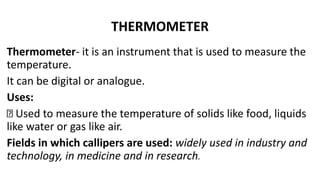
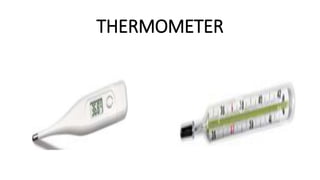
Thermometer- it is an instrument that is used to measure the
temperature.
It can be digital or analogue.
Uses:
Used to measure the temperature of solids like food, liquids
like water or gas like air.
Fields in which callipers are used: widely used in industry and
technology, in medicine and in research.
THERMOMETER
PLUMB BOB
Plumb bob – also called plummet
•It is a weight with a pointed tip on the bottom, which
can be suspended from a string to give a vertical line.
•Uses:
Used in construction industry to ensure that a vertical
installation such as a wall is perfectly vertical.
PLUMB BOB
Examples of real-life situations of uses of plumb bob include:
-ensuring a wall is vertical when constructing.
-ensuring fencing posts are vertical during fencing.
Fixing a foor fram.
Installation of ceiling lights or pot lights and hanging of
pictures.
Installing wallpapers.
Fields in which callipers are used : construction, masonry
MEASURING CYLINDER
Measuring cylinder-a calibrated glass or plastic cylinder.
Uses:
Used to measure volume of liquids and to determine volume of a
solid by
measuring displacement of a liquid.
• Fields in which callipers are used: laboratories, veterinary and
human services to measure drugs, chemicals and medicines.
MEASURING CYLINDER
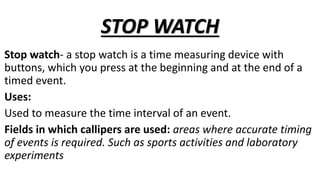
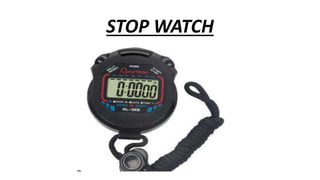
STOP WATCH
Stop watch- a stop watch is a time measuring device with
buttons, which you press at the beginning and at the end of a
timed event.
Uses:
Used to measure the time interval of an event.
Fields in which callipers are used: areas where accurate timing
of events is required. Such as sports activities and laboratory
experiments
STOP WATCH
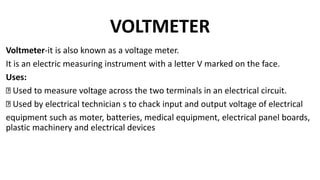
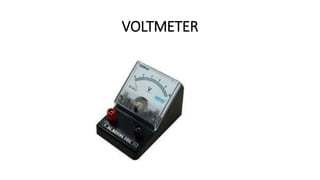
VOLTMETER
Voltmeter-it is also known as a voltage meter.
It is an electric measuring instrument with a letter V marked on the face.
Uses:
Used to measure voltage across the two terminals in an electrical circuit.
Used by electrical technician s to chack input and output voltage of electrical
equipment such as moter, batteries, medical equipment, electrical panel boards,
plastic machinery and electrical devices
VOLTMETER
AMMETER
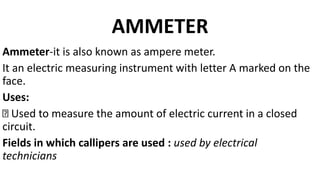
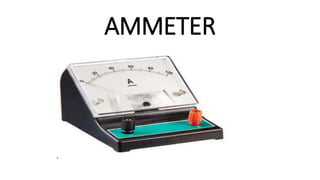
Ammeter-it is also known as ampere meter.
It an electric measuring instrument with letter A marked on the
face.
Uses:
Used to measure the amount of electric current in a closed
circuit.
Fields in which callipers are used : used by electrical
technicians
AMMETER
OHMMETER
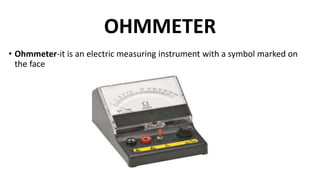
• Ohmmeter-it is an electric measuring instrument with a symbol marked on
the face
MULTIMETER
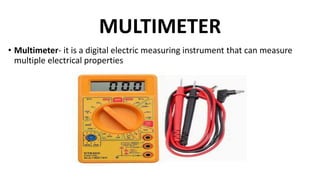
• Multimeter- it is a digital electric measuring instrument that can measure
multiple electrical properties
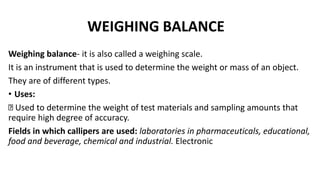
WEIGHING BALANCE
Weighing balance- it is also called a weighing scale.
It is an instrument that is used to determine the weight or mass of an object.
They are of different types.
• Uses:
Used to determine the weight of test materials and sampling amounts that
require high degree of accuracy.
Fields in which callipers are used: laboratories in pharmaceuticals, educational,
food and beverage, chemical and industrial. Electronic
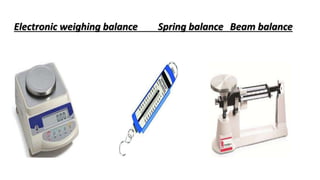
Electronic weighing balance Spring balance Beam balance
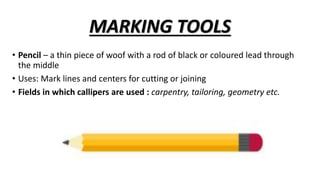
MARKING TOOLS
• Pencil – a thin piece of woof with a rod of black or coloured lead through
the middle
• Uses: Mark lines and centers for cutting or joining
• Fields in which callipers are used : carpentry, tailoring, geometry etc.
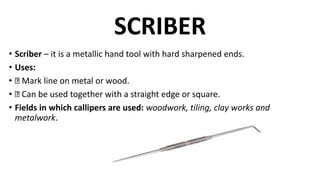
SCRIBER
• Scriber – it is a metallic hand tool with hard sharpened ends.
• Uses:
• Mark line on metal or wood.
• Can be used together with a straight edge or square.
• Fields in which callipers are used: woodwork, tiling, clay works and
metalwork.
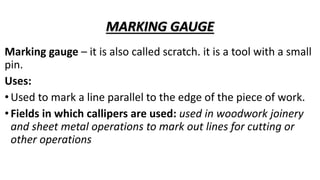
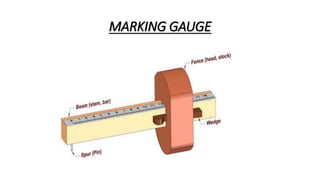
MARKING GAUGE
Marking gauge – it is also called scratch. it is a tool with a small
pin.
Uses:
• Used to mark a line parallel to the edge of the piece of work.
• Fields in which callipers are used: used in woodwork joinery
and sheet metal operations to mark out lines for cutting or
other operations
MARKING GAUGE
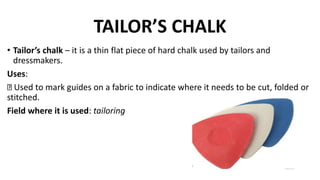
TAILOR’S CHALK
• Tailor’s chalk – it is a thin flat piece of hard chalk used by tailors and
dressmakers.
Uses:
Used to mark guides on a fabric to indicate where it needs to be cut, folded or
stitched.
Field where it is used: tailoring
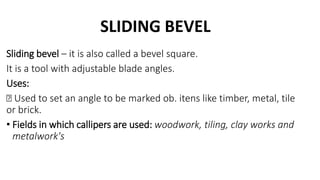
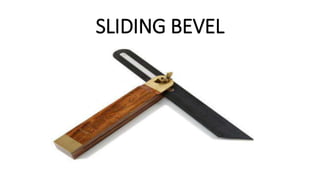
SLIDING BEVEL
Sliding bevel – it is also called a bevel square.
It is a tool with adjustable blade angles.
Uses:
Used to set an angle to be marked ob. itens like timber, metal, tile
or brick.
• Fields in which callipers are used: woodwork, tiling, clay works and
metalwork's
SLIDING BEVEL
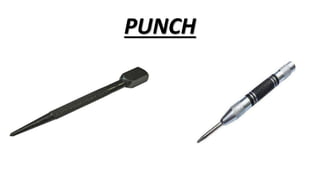
PUNCH
Punch – a punch is a shard sharp ended tool. There are two types of punches.
Centre punch and dot punch.
Uses:
• Can be used to make indent in materials such as metal, leather, rubber,
wood or plastics.
• It is used to show a point where a hole is to be drilled.
• Fields in which callipers are used: metalwork, woodwork and leatherwork.
PUNCH
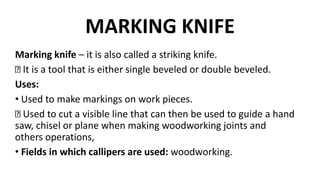
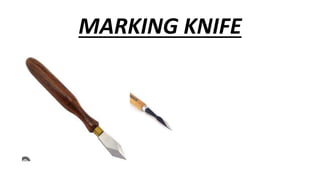
MARKING KNIFE
Marking knife – it is also called a striking knife.
It is a tool that is either single beveled or double beveled.
Uses:
• Used to make markings on work pieces.
Used to cut a visible line that can then be used to guide a hand
saw, chisel or plane when making woodworking joints and
others operations,
• Fields in which callipers are used: woodworking.
MARKING KNIFE
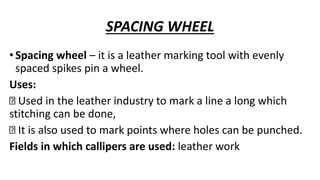
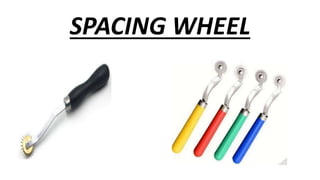
SPACING WHEEL
•Spacing wheel – it is a leather marking tool with evenly
spaced spikes pin a wheel.
Uses:
Used in the leather industry to mark a line a long which
stitching can be done,
It is also used to mark points where holes can be punched.
Fields in which callipers are used: leather work
SPACING WHEEL
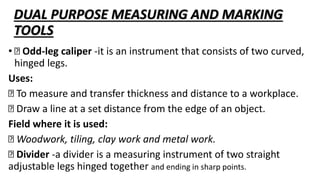
DUAL PURPOSE MEASURING AND MARKING
TOOLS
• Odd-leg caliper -it is an instrument that consists of two curved,
hinged legs.
Uses:
To measure and transfer thickness and distance to a workplace.
Draw a line at a set distance from the edge of an object.
Field where it is used:
Woodwork, tiling, clay work and metal work.
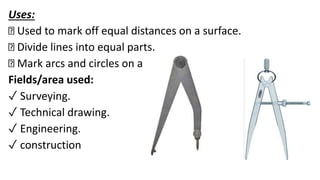
Divider -a divider is a measuring instrument of two straight
adjustable legs hinged together and ending in sharp points.
Uses:
Used to mark off equal distances on a surface.
Divide lines into equal parts.
Mark arcs and circles on a surface.
Fields/area used:
✓ Surveying.
✓ Technical drawing.
✓ Engineering.
✓ construction
TRAMMEL
Trammel – an instrument for drawing large arcs or circles on a surface.
It consists of a beam with two sliding parts.
uses:
✓ Used to transfer measurements.
✓ To mark arcs.
✓ Lay out circles that are too big for normal compass or dividers.
fields/area where It is used:
✓ Construction.
CARE FOR MEASURING AND MARKING
TOOLS.
• Caring for measuring and marking tools is the process of
keeping them in good working condition even when they are
not being used.
• Some of the ways of caring for measuring and marking tools
include the following:
• Clean the measuring and marking tools after every use.
• Lubricate instruments properly to avoid corrosion and wearing
out of the moving parts
CARE FOR MEASURING AND MARKING TOOLS.
• Ensure proper storage of the measuring and marking tools after
use. The store should be cool and dry, well organized without
staking tools directly on each other.
• Ensure proper handling of measuring and marking tools to avoid
rough and sudden shocks that could damage the tools or lead to
mis-calibration.
• Ensure measuring tools are only services by qualified and certified
professionals.
• Use the measuring and marking tools for their right purposes only.
What is the importance of measuring and
marking tools in the work environment?
•They allow for the accurate determination of lengths, widths,
diameters and other dimensions.
•✓ By accurately and measuring and checking dimensions,
workers can ensure that the items they make meet the
required standard and specifications. This leads to improved
quality and safety of the items produced.
•✓ Measuring and marking tools enable workers to produce
similar items with uniform size and capacity across the world.
For example, vehicle parts, building components . etc
What is the importance of measuring and
marking tools in the work environment?
• Use of measuring and marking tools ensures safety in many
practices e.g., in building construction where accurate
measurements and marking of the components helps to
ensure stability and loading capacity.
• Measuring and marking tools are useful in the designing and
planning of different items. Architects, engineers and interior
designers use these tools to measure spaces, create accurate
drawings and mark locations for different items and ensuring
they fit well.
PRODUCTION OF GOODS & SERVICES
•Meaning of Production in the Community.
•Production is the creation of goods or provision of
services to satisfy human needs and wants.
•It involves extraction, manufacturing, processing,
construction, trade and service provision.
IMPORTANCE OF PRODUCTION
•Goods and services are made available for members
of the community through production.
• Production provides employment for people in the
community.
• Workers who engage in production gain skills.
• The standard of living od people in the community
improves
GOODS AND SERVICES
MEANING OF GOODS AND SERVICES.
Goods are physical items or commodities that can
be touched and felt and used to satisfy human
wants.
Services are intangible activities which cannot be
touched and felt and do not deliver a tangible
commodity.
MEANING OF GOODS AND SERVICES.
A market is a place where buyers and sellers meet or interact
to buy goods and services
such as food market, supermarket, the stock market and bond
market.
Human beings require goods and services to satisfy
increasing human wants.
Great services lead to better customer loyalty, higher
revenues and lower costs
Types and importance of goods and services
found in the local market
Goods can be grouped into different types as follows.
❖ Free goods and economic goods.
Free goods are goods that are naturally provided like
sunshine, rain, oceans.
Economic goods are commodities which have money
value that can be used to satisfy human needs and
wants.
PRODUCER GOODS AND CONSUMER GOODS
•Producer goods are used in producing other
goods. They include machines, equipment and
tools.
• Consumer goods are final products that are
bought and used by consumers. They include
microwaves, fridges, t-shirts and candles.
PERISHABLE GOODS AND DURABLE GOODS
Perishable goods are goods that go bad easily unless
stored using very special facilities. These goods
include meat, milk and vegetable
Durable goods are goods that are used for a long
period of time for example radio,furniture or
building among others.
PUBLIC GOODS AND PRIVATE GOODS
•Public goods are goods that are enjoyable by all
citizens like roads, airports, rivers, public hospitals,
public parks, railway or churches.
• Private goods are goods that are owned by
individuals such as personal cars, private schools,
private land among others
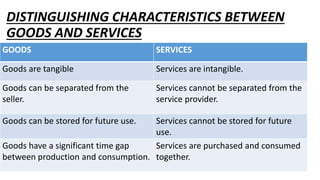
DISTINGUISHING CHARACTERISTICS BETWEEN
GOODS AND SERVICES
GOODS SERVICES
Goods are tangible Services are intangible.
Goods can be separated from the
seller.
Services cannot be separated from the
service provider.
Goods can be stored for future use. Services cannot be stored for future
use.
Goods have a significant time gap
between production and consumption.
Services are purchased and consumed
together.
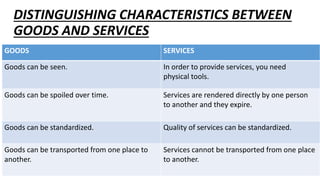
DISTINGUISHING CHARACTERISTICS BETWEEN
GOODS AND SERVICES
GOODS SERVICES
Goods can be seen. In order to provide services, you need
physical tools.
Goods can be spoiled over time. Services are rendered directly by one person
to another and they expire.
Goods can be standardized. Quality of services can be standardized.
Goods can be transported from one place to
another.
Services cannot be transported from one place
to another.
Factors of production, importance, characteristics and
rewards for the factors of production in the community.
Resources are used in production of goods and services.
These resources are called factors of production.
They payment for each factor of production is known as reward.
There are four factors of production namely:
✓ Land.
✓ Capital.
✓ Labour.
✓ Entrepreneurship.
•Land
It is defined as agricultural land, commercial real
estate and natural resources such as oil, gas etc.
Labour.
It is made up of the individuals who are responsible for
the development of goods and services.
Capital goods.
Such as tools, equipment and machinery are part of
the capital category
CHARACTERISTICS OF FACTORS OF PRODUCTION
LAND.
✓ Land is limited. Therefore, it cannot be increased.
✓ Land is a natural resource.
✓ Productivity of land can be increased.
✓ Land production quality varies.
✓ Land cannot be moved from one place to another.
LABOUR
• Labourers can move from one place to another.
• They have skills.
• Labour cannot be stored.
• Labour is a basic production factor.
CAPITAL.
•It is a human-made resources.
• They reduce with time when used.
• They can be improved with technology.
• They can be moved from one place to
another.
ENTREPRENEURSHIP.
•They hire employees.
• They start and control the business.
• They pay for all other factors of production.
• They take all risks that cone with the business.
Ethical and unethical practices in production of
goods and services. Ethical practices:
•✓ Transparency.
•✓ Safety.
•✓ Social and environmental responsibility.
•✓ Fairness etc.
•✓ Product quality.
UNETHICAL PRACTICES
Low quality of product-Poor quality products will lead to losing many
customers.
✓ Low quantity of products -Giving consumers less products than what
they paid for can lead to consumer concern.
✓ Overpricing -Putting higher prices to the commodities can lead to
consumers concerns.
✓ Hoarding -In some occasions, outlet hide products to create a
shortage so that prices can rise up. Therefore, affecting the price of
goods and services.
SAFETY OF PRODUCTS.
✓ Consumers are concerned about the safety of
the products that they buy.
✓ Outlets should ensure that goods and services
that they produce are good for consumer use.
✓ Harmful ingredients-Ingredients used in
production of goods and services should not be
harmful to the consumers.

STRAND 4- TOOLS & PRODUCTION.pptx FOR KIDS

  • 1.
    STRAND 4- TOOLS& PRODUCTION Measuring & Marking Tools
  • 2.
    MEASURING & MARKINGTOOLS •A measuring tool is a device used to measure a physical quantity such as length, time, weight, angle, volume and temperature. • A marking tool is a device used to indicate a point on a surface to obtain accurate size and shape. • Common measuring and marking tools are:
  • 3.
    MEASURING TOOLS Steel rule-alsocalled steel ruler. A flat metallic tool with a calibrated surface. Made from stainless steel. Can either be flexible or rigid with different thickness. Uses: Measure length of an object or distance between 2 points. To draw straight lines. To guide cuts. Fields in which ruler is used: geometry, welding and fabrication, technical drawing, architecture and construction.
  • 4.
    Fields in whichruler is used: geometry, welding and fabrication, technical drawing, architecture and construction
  • 5.
    TAPE MEASURE • Tapemeasure-also called measuring tape. • A flexible tool marked millimetres, centimetres and inches. • There are different types of measuring tapes. • Tape measure is made up of materials such as fiberglass, cloth, plastic, metal ribbon or strip.
  • 6.
    TAPE MEASURE Uses: used tomeasure length of an item and distances between points. Measures a round curved object because it is flexible in nature • Fields it is used: • Masonry, plumbing, electrical installation, surveying, crafts and woodworking
  • 7.
    SQUARE • Square –it is a measuring device that consists of two straight edges set at right angles to each other. • There are different types of squares. • Uses: used to measure and ensure that two perpendicular surfaces are at a right angle. Used in different fields to ensure that joints and corners of objects are truly square.
  • 8.
    SQUARE Fields in whichsquare is used : Try square Mason’s square Woodwork, masonry, mechanical engineering and plumbing among others.
  • 9.
    CALIPERS • Calipers -it is a measuring tool that consists of two adjustable jaws. There are different types of calipers. Uses: Use to measure thickness and outside dimensions of an object like tennis ball or bottle. Used to measure the internal dimensions of hollow objects like a rectangular tube or cylindrical pipe. Fields in which calipers are used: science, woodwork, metalwork and other mechanical trades.
  • 10.
    CALIPERS : Insidecallipers Outside callipers Vernier calipers.
  • 11.
    MICROMETER SCREW GAUGE Micrometerscrew gauge - also called a micrometer It is a measuring instrument with a G-frame with an adjustable spindle. Uses: Used to measure the diameter of wires and thickness of small sheets such as glass or plastic. •Fields in which callipers are used: metal working and other mechanical fields
  • 12.
  • 13.
    SPIRIT LEVEL Spirit level-itis a tool consisting of a sealed glass tube partially filled with a liquid, containing an air bubble. Used to determine if a surface is vertical or horizontal. Uses: Used to indicate how horizontal or vertical a surface or an item is. Fields in which callipers are used: masonry, carpentry, surveyor, plumber, metalworker and other interior designers.
  • 14.
  • 15.
    THERMOMETER Thermometer- it isan instrument that is used to measure the temperature. It can be digital or analogue. Uses: Used to measure the temperature of solids like food, liquids like water or gas like air. Fields in which callipers are used: widely used in industry and technology, in medicine and in research.
  • 16.
  • 17.
    PLUMB BOB Plumb bob– also called plummet •It is a weight with a pointed tip on the bottom, which can be suspended from a string to give a vertical line. •Uses: Used in construction industry to ensure that a vertical installation such as a wall is perfectly vertical.
  • 18.
    PLUMB BOB Examples ofreal-life situations of uses of plumb bob include: -ensuring a wall is vertical when constructing. -ensuring fencing posts are vertical during fencing. Fixing a foor fram. Installation of ceiling lights or pot lights and hanging of pictures. Installing wallpapers. Fields in which callipers are used : construction, masonry
  • 19.
    MEASURING CYLINDER Measuring cylinder-acalibrated glass or plastic cylinder. Uses: Used to measure volume of liquids and to determine volume of a solid by measuring displacement of a liquid. • Fields in which callipers are used: laboratories, veterinary and human services to measure drugs, chemicals and medicines.
  • 20.
  • 21.
    STOP WATCH Stop watch-a stop watch is a time measuring device with buttons, which you press at the beginning and at the end of a timed event. Uses: Used to measure the time interval of an event. Fields in which callipers are used: areas where accurate timing of events is required. Such as sports activities and laboratory experiments
  • 22.
  • 23.
    VOLTMETER Voltmeter-it is alsoknown as a voltage meter. It is an electric measuring instrument with a letter V marked on the face. Uses: Used to measure voltage across the two terminals in an electrical circuit. Used by electrical technician s to chack input and output voltage of electrical equipment such as moter, batteries, medical equipment, electrical panel boards, plastic machinery and electrical devices
  • 24.
  • 25.
    AMMETER Ammeter-it is alsoknown as ampere meter. It an electric measuring instrument with letter A marked on the face. Uses: Used to measure the amount of electric current in a closed circuit. Fields in which callipers are used : used by electrical technicians
  • 26.
  • 27.
    OHMMETER • Ohmmeter-it isan electric measuring instrument with a symbol marked on the face
  • 28.
    MULTIMETER • Multimeter- itis a digital electric measuring instrument that can measure multiple electrical properties
  • 29.
    WEIGHING BALANCE Weighing balance-it is also called a weighing scale. It is an instrument that is used to determine the weight or mass of an object. They are of different types. • Uses: Used to determine the weight of test materials and sampling amounts that require high degree of accuracy. Fields in which callipers are used: laboratories in pharmaceuticals, educational, food and beverage, chemical and industrial. Electronic
  • 30.
    Electronic weighing balanceSpring balance Beam balance
  • 31.
    MARKING TOOLS • Pencil– a thin piece of woof with a rod of black or coloured lead through the middle • Uses: Mark lines and centers for cutting or joining • Fields in which callipers are used : carpentry, tailoring, geometry etc.
  • 32.
    SCRIBER • Scriber –it is a metallic hand tool with hard sharpened ends. • Uses: • Mark line on metal or wood. • Can be used together with a straight edge or square. • Fields in which callipers are used: woodwork, tiling, clay works and metalwork.
  • 33.
    MARKING GAUGE Marking gauge– it is also called scratch. it is a tool with a small pin. Uses: • Used to mark a line parallel to the edge of the piece of work. • Fields in which callipers are used: used in woodwork joinery and sheet metal operations to mark out lines for cutting or other operations
  • 34.
  • 35.
    TAILOR’S CHALK • Tailor’schalk – it is a thin flat piece of hard chalk used by tailors and dressmakers. Uses: Used to mark guides on a fabric to indicate where it needs to be cut, folded or stitched. Field where it is used: tailoring
  • 36.
    SLIDING BEVEL Sliding bevel– it is also called a bevel square. It is a tool with adjustable blade angles. Uses: Used to set an angle to be marked ob. itens like timber, metal, tile or brick. • Fields in which callipers are used: woodwork, tiling, clay works and metalwork's
  • 37.
  • 38.
    PUNCH Punch – apunch is a shard sharp ended tool. There are two types of punches. Centre punch and dot punch. Uses: • Can be used to make indent in materials such as metal, leather, rubber, wood or plastics. • It is used to show a point where a hole is to be drilled. • Fields in which callipers are used: metalwork, woodwork and leatherwork.
  • 39.
  • 40.
    MARKING KNIFE Marking knife– it is also called a striking knife. It is a tool that is either single beveled or double beveled. Uses: • Used to make markings on work pieces. Used to cut a visible line that can then be used to guide a hand saw, chisel or plane when making woodworking joints and others operations, • Fields in which callipers are used: woodworking.
  • 41.
  • 42.
    SPACING WHEEL •Spacing wheel– it is a leather marking tool with evenly spaced spikes pin a wheel. Uses: Used in the leather industry to mark a line a long which stitching can be done, It is also used to mark points where holes can be punched. Fields in which callipers are used: leather work
  • 43.
  • 44.
    DUAL PURPOSE MEASURINGAND MARKING TOOLS • Odd-leg caliper -it is an instrument that consists of two curved, hinged legs. Uses: To measure and transfer thickness and distance to a workplace. Draw a line at a set distance from the edge of an object. Field where it is used: Woodwork, tiling, clay work and metal work. Divider -a divider is a measuring instrument of two straight adjustable legs hinged together and ending in sharp points.
  • 45.
    Uses: Used to markoff equal distances on a surface. Divide lines into equal parts. Mark arcs and circles on a surface. Fields/area used: ✓ Surveying. ✓ Technical drawing. ✓ Engineering. ✓ construction
  • 46.
    TRAMMEL Trammel – aninstrument for drawing large arcs or circles on a surface. It consists of a beam with two sliding parts. uses: ✓ Used to transfer measurements. ✓ To mark arcs. ✓ Lay out circles that are too big for normal compass or dividers. fields/area where It is used: ✓ Construction.
  • 47.
    CARE FOR MEASURINGAND MARKING TOOLS. • Caring for measuring and marking tools is the process of keeping them in good working condition even when they are not being used. • Some of the ways of caring for measuring and marking tools include the following: • Clean the measuring and marking tools after every use. • Lubricate instruments properly to avoid corrosion and wearing out of the moving parts
  • 48.
    CARE FOR MEASURINGAND MARKING TOOLS. • Ensure proper storage of the measuring and marking tools after use. The store should be cool and dry, well organized without staking tools directly on each other. • Ensure proper handling of measuring and marking tools to avoid rough and sudden shocks that could damage the tools or lead to mis-calibration. • Ensure measuring tools are only services by qualified and certified professionals. • Use the measuring and marking tools for their right purposes only.
  • 49.
    What is theimportance of measuring and marking tools in the work environment? •They allow for the accurate determination of lengths, widths, diameters and other dimensions. •✓ By accurately and measuring and checking dimensions, workers can ensure that the items they make meet the required standard and specifications. This leads to improved quality and safety of the items produced. •✓ Measuring and marking tools enable workers to produce similar items with uniform size and capacity across the world. For example, vehicle parts, building components . etc
  • 50.
    What is theimportance of measuring and marking tools in the work environment? • Use of measuring and marking tools ensures safety in many practices e.g., in building construction where accurate measurements and marking of the components helps to ensure stability and loading capacity. • Measuring and marking tools are useful in the designing and planning of different items. Architects, engineers and interior designers use these tools to measure spaces, create accurate drawings and mark locations for different items and ensuring they fit well.
  • 51.
    PRODUCTION OF GOODS& SERVICES •Meaning of Production in the Community. •Production is the creation of goods or provision of services to satisfy human needs and wants. •It involves extraction, manufacturing, processing, construction, trade and service provision.
  • 52.
    IMPORTANCE OF PRODUCTION •Goodsand services are made available for members of the community through production. • Production provides employment for people in the community. • Workers who engage in production gain skills. • The standard of living od people in the community improves
  • 53.
    GOODS AND SERVICES MEANINGOF GOODS AND SERVICES. Goods are physical items or commodities that can be touched and felt and used to satisfy human wants. Services are intangible activities which cannot be touched and felt and do not deliver a tangible commodity.
  • 54.
    MEANING OF GOODSAND SERVICES. A market is a place where buyers and sellers meet or interact to buy goods and services such as food market, supermarket, the stock market and bond market. Human beings require goods and services to satisfy increasing human wants. Great services lead to better customer loyalty, higher revenues and lower costs
  • 55.
    Types and importanceof goods and services found in the local market Goods can be grouped into different types as follows. ❖ Free goods and economic goods. Free goods are goods that are naturally provided like sunshine, rain, oceans. Economic goods are commodities which have money value that can be used to satisfy human needs and wants.
  • 56.
    PRODUCER GOODS ANDCONSUMER GOODS •Producer goods are used in producing other goods. They include machines, equipment and tools. • Consumer goods are final products that are bought and used by consumers. They include microwaves, fridges, t-shirts and candles.
  • 57.
    PERISHABLE GOODS ANDDURABLE GOODS Perishable goods are goods that go bad easily unless stored using very special facilities. These goods include meat, milk and vegetable Durable goods are goods that are used for a long period of time for example radio,furniture or building among others.
  • 58.
    PUBLIC GOODS ANDPRIVATE GOODS •Public goods are goods that are enjoyable by all citizens like roads, airports, rivers, public hospitals, public parks, railway or churches. • Private goods are goods that are owned by individuals such as personal cars, private schools, private land among others
  • 59.
    DISTINGUISHING CHARACTERISTICS BETWEEN GOODSAND SERVICES GOODS SERVICES Goods are tangible Services are intangible. Goods can be separated from the seller. Services cannot be separated from the service provider. Goods can be stored for future use. Services cannot be stored for future use. Goods have a significant time gap between production and consumption. Services are purchased and consumed together.
  • 60.
    DISTINGUISHING CHARACTERISTICS BETWEEN GOODSAND SERVICES GOODS SERVICES Goods can be seen. In order to provide services, you need physical tools. Goods can be spoiled over time. Services are rendered directly by one person to another and they expire. Goods can be standardized. Quality of services can be standardized. Goods can be transported from one place to another. Services cannot be transported from one place to another.
  • 61.
    Factors of production,importance, characteristics and rewards for the factors of production in the community. Resources are used in production of goods and services. These resources are called factors of production. They payment for each factor of production is known as reward. There are four factors of production namely: ✓ Land. ✓ Capital. ✓ Labour. ✓ Entrepreneurship.
  • 62.
    •Land It is definedas agricultural land, commercial real estate and natural resources such as oil, gas etc. Labour. It is made up of the individuals who are responsible for the development of goods and services. Capital goods. Such as tools, equipment and machinery are part of the capital category
  • 63.
    CHARACTERISTICS OF FACTORSOF PRODUCTION LAND. ✓ Land is limited. Therefore, it cannot be increased. ✓ Land is a natural resource. ✓ Productivity of land can be increased. ✓ Land production quality varies. ✓ Land cannot be moved from one place to another.
  • 64.
    LABOUR • Labourers canmove from one place to another. • They have skills. • Labour cannot be stored. • Labour is a basic production factor.
  • 65.
    CAPITAL. •It is ahuman-made resources. • They reduce with time when used. • They can be improved with technology. • They can be moved from one place to another.
  • 66.
    ENTREPRENEURSHIP. •They hire employees. •They start and control the business. • They pay for all other factors of production. • They take all risks that cone with the business.
  • 67.
    Ethical and unethicalpractices in production of goods and services. Ethical practices: •✓ Transparency. •✓ Safety. •✓ Social and environmental responsibility. •✓ Fairness etc. •✓ Product quality.
  • 68.
    UNETHICAL PRACTICES Low qualityof product-Poor quality products will lead to losing many customers. ✓ Low quantity of products -Giving consumers less products than what they paid for can lead to consumer concern. ✓ Overpricing -Putting higher prices to the commodities can lead to consumers concerns. ✓ Hoarding -In some occasions, outlet hide products to create a shortage so that prices can rise up. Therefore, affecting the price of goods and services.
  • 69.
    SAFETY OF PRODUCTS. ✓Consumers are concerned about the safety of the products that they buy. ✓ Outlets should ensure that goods and services that they produce are good for consumer use. ✓ Harmful ingredients-Ingredients used in production of goods and services should not be harmful to the consumers.