BY
VIKRAMA S
8TH SEMEEE
UVCE
 This circuit allows you to watch your favorite TV
programs late at night without disturbing other family
members.
 Most modern TVs are nowadays equipped with audio-
in/out and video-in/out RCA sockets. Using an RCA-to-RCA
cord, connect the audio output of your TV to the transmitter’s
input.
This transmitter draws only a few mill amperes of current and
doesn’t require on/off switch. It can be fabricated on a small
piece of strip board.
ABSTARCT
 To design and implement a WIRELESS AUDIO
TRANSMITTER FOR TV USING IR TRANSMITTER
AND RECEIVER
PROJECT BLOCK DIAGRAM
 TRANSFORMER OF SUITABLE RATING FOR
POWER SUPPLY
 TRANSISTORS BC548 AND BC 547
 IR TRANSMITTER AND RECEIVER
 RESISTORS AND CAPACITORS
 A HEADPHONE TO BE USED
TRANSISTOR
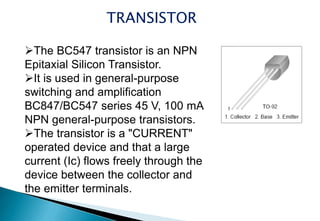
The BC547 transistor is an NPN
Epitaxial Silicon Transistor.
It is used in general-purpose
switching and amplification
BC847/BC547 series 45 V, 100 mA
NPN general-purpose transistors.
The transistor is a "CURRENT"
operated device and that a large
current (Ic) flows freely through the
device between the collector and
the emitter terminals.
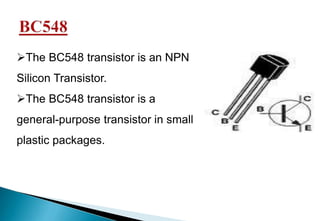
The BC548 transistor is an NPN
Silicon Transistor.
The BC548 transistor is a
general-purpose transistor in small
plastic packages.
It is used in general-purpose switching and
amplification BC848/BC548 series 45 V, 100
mA NPN general-purpose transistors.
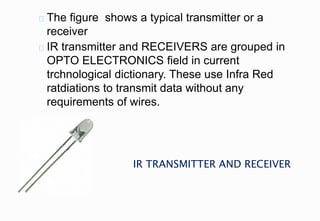
IR TRANSMITTER AND RECEIVER
The figure shows a typical transmitter or a
receiver
IR transmitter and RECEIVERS are grouped in
OPTO ELECTRONICS field in current
trchnological dictionary. These use Infra Red
ratdiations to transmit data without any
requirements of wires.
An infrared receiver , or IR receiver, is
hardware that sends information from an
infrared remote control to another device
by receiving and decoding signals.
In general, the receiver outputs a code to
uniquely identify the infrared signal that it
receives.
This code is then used in order to
convert signals from the remote control
into a format that can be understood by
the other device. It is the part of a device
that receives infrared commands from a
remote control.
It is a light emitting diode (LED) that is
used in order to transmit infrared signals
from a remote control.
The more they are in quantity and the
better the emitters are, the stronger and
wider the resulting signal is.
An IR emitter generates infrared light that
transmits information and commands from
one device to another.
Typically one device receives the signal
then passes the infrared (IR) signal through
the emitter to another device.
The working wireless audio transmitter can be
explained in the following slides, with the role of each
component being elaborated.
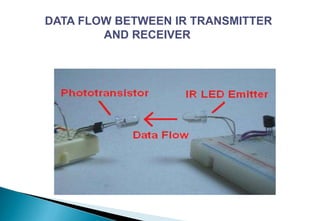
DATA FLOW BETWEEN IR TRANSMITTER
AND RECEIVER
Input to the sending end of the
transmitter is from a transformer, whose
rating is decided based on the design.
Typically the Output of the transformer
will be 12V.
The audio signal is coupled to the base of T1
by an audio transformer. The T1 pre amplifies
the signal
The transistor T2 drives the IR LED’s which
transmit the sound as IR beams.
The red LED provides fixed bias for theT2 as
well as a power on indication.
The photo transistor T3 receives the IR
signals.
The collector of IR is connected to base of T4
which amplifies the signal together with T5 to
regain the audio signal transmitted.
The transistor T6 drives the headphone to
reproduce the sound.
The received sound is reproduced and that
can sound can listened in the headphone.
Due to wireless transmission, cost is reduced.
This can be used not only in TV applications,
but also in portable music systems.
This can be used where noise volume has to
be reduced.
Can be used as an alternative to Bluetooth
technology, as this consumes lesser power.
Simple in construction.
Easy to maintain and repair.
Comparatively the operation cost is less.
Efficient and low cost design.
Low power consumption.
Alternative for Bluetooth
There might be disturbance in the output
during transmission via I.R due to external
factors.
For higher ranges, cost increases.
To connect more than one device is difficult.
This is an excellent way of reducing the
disturbances caused to others while
watching our favorite TV programs, so
this must be encouraged among the
people.
Wireless tv audio transmitter

Wireless tv audio transmitter

  • 1.
  • 2.
     This circuitallows you to watch your favorite TV programs late at night without disturbing other family members.  Most modern TVs are nowadays equipped with audio- in/out and video-in/out RCA sockets. Using an RCA-to-RCA cord, connect the audio output of your TV to the transmitter’s input. This transmitter draws only a few mill amperes of current and doesn’t require on/off switch. It can be fabricated on a small piece of strip board. ABSTARCT
  • 3.
     To designand implement a WIRELESS AUDIO TRANSMITTER FOR TV USING IR TRANSMITTER AND RECEIVER
  • 4.
  • 5.
     TRANSFORMER OFSUITABLE RATING FOR POWER SUPPLY  TRANSISTORS BC548 AND BC 547  IR TRANSMITTER AND RECEIVER  RESISTORS AND CAPACITORS  A HEADPHONE TO BE USED
  • 6.
    TRANSISTOR The BC547 transistoris an NPN Epitaxial Silicon Transistor. It is used in general-purpose switching and amplification BC847/BC547 series 45 V, 100 mA NPN general-purpose transistors. The transistor is a "CURRENT" operated device and that a large current (Ic) flows freely through the device between the collector and the emitter terminals.
  • 7.
    The BC548 transistoris an NPN Silicon Transistor. The BC548 transistor is a general-purpose transistor in small plastic packages.
  • 8.
    It is usedin general-purpose switching and amplification BC848/BC548 series 45 V, 100 mA NPN general-purpose transistors.
  • 9.
    IR TRANSMITTER ANDRECEIVER The figure shows a typical transmitter or a receiver IR transmitter and RECEIVERS are grouped in OPTO ELECTRONICS field in current trchnological dictionary. These use Infra Red ratdiations to transmit data without any requirements of wires.
  • 10.
    An infrared receiver, or IR receiver, is hardware that sends information from an infrared remote control to another device by receiving and decoding signals.
  • 11.
    In general, thereceiver outputs a code to uniquely identify the infrared signal that it receives. This code is then used in order to convert signals from the remote control into a format that can be understood by the other device. It is the part of a device that receives infrared commands from a remote control.
  • 12.
    It is alight emitting diode (LED) that is used in order to transmit infrared signals from a remote control. The more they are in quantity and the better the emitters are, the stronger and wider the resulting signal is.
  • 13.
    An IR emittergenerates infrared light that transmits information and commands from one device to another. Typically one device receives the signal then passes the infrared (IR) signal through the emitter to another device.
  • 14.
    The working wirelessaudio transmitter can be explained in the following slides, with the role of each component being elaborated.
  • 15.
    DATA FLOW BETWEENIR TRANSMITTER AND RECEIVER
  • 16.
    Input to thesending end of the transmitter is from a transformer, whose rating is decided based on the design. Typically the Output of the transformer will be 12V.
  • 17.
    The audio signalis coupled to the base of T1 by an audio transformer. The T1 pre amplifies the signal The transistor T2 drives the IR LED’s which transmit the sound as IR beams. The red LED provides fixed bias for theT2 as well as a power on indication.
  • 18.
    The photo transistorT3 receives the IR signals. The collector of IR is connected to base of T4 which amplifies the signal together with T5 to regain the audio signal transmitted. The transistor T6 drives the headphone to reproduce the sound.
  • 19.
    The received soundis reproduced and that can sound can listened in the headphone.
  • 20.
    Due to wirelesstransmission, cost is reduced. This can be used not only in TV applications, but also in portable music systems. This can be used where noise volume has to be reduced. Can be used as an alternative to Bluetooth technology, as this consumes lesser power.
  • 21.
    Simple in construction. Easyto maintain and repair. Comparatively the operation cost is less. Efficient and low cost design. Low power consumption. Alternative for Bluetooth
  • 22.
    There might bedisturbance in the output during transmission via I.R due to external factors. For higher ranges, cost increases. To connect more than one device is difficult.
  • 23.
    This is anexcellent way of reducing the disturbances caused to others while watching our favorite TV programs, so this must be encouraged among the people.