MICROCONTROLLERS
 A microcontroller is an integrated circuit (IC) that can be 
programmed to perform a set of functions to control a 
collection of electronic devices. 
 A self-contained system in which a processor, support, 
memory, and input/output (I/O) are all contained in a single 
package. 
 Being programmable is what makes the microcontroller 
unique.
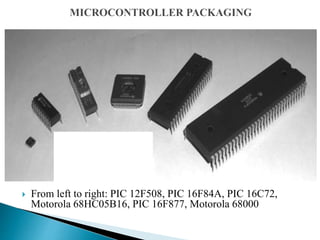
 From left to right: PIC 12F508, PIC 16F84A, PIC 16C72, 
Motorola 68HC05B16, PIC 16F877, Motorola 68000
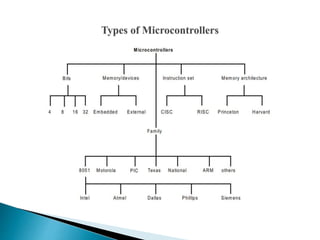
1 – ACCORDING TO BITS 
4-BIT MICROCONTROLLERS 
 ALU performs arithmetic and logical operations on a nibble 
(4-bits) at an instruction. 
 Internal bus width of 4-bit. 
 Small size, minimum pin count and low cost controllers. 
 Low power consumption and used for low end applications 
like LED & LCD display drivers, portable battery chargers. 
 Examples: Renasa M34501 256 and ATAM862 series from 
ATMEL.
8-BIT MICROCONTROLLER 
 ALU performs arithmetic and logical operations on a byte 
(8-bits) at an instruction. 
 Internal bus width of 8-bit. 
 Examples: Intel 8051 family and Motorola MC68HC11 
family.
16-BIT MICROCONTROLLER 
 ALU performs arithmetic and logical operations on a word 
(16-bits) at an instruction. 
 Internal bus width of 16-bit microcontroller is of 16-bit. 
 Enhanced performance, computing capability and greater 
precision as compared to the 8-bit microcontrollers. 
 Examples: Intel 8096 family, Motorola MC68HC12 and 
MC68332 families.
32-BIT MICROCONTROLLER 
 ALU performs arithmetic and logical operations on a double 
word (32-bits) at an instruction. 
 Internal bus width of 32-bit. 
 Much more enhanced performance, computing capability with 
greater precision as compared to 16-bit microcontrollers. 
 Examples: Intel 80960 family, Motorola M683xx and 
Intel/Atmel 251 family.
2 - ACCORDING TO MEMORY/DEVICES 
EMBEDDED MICROCONTROLLERS 
 An embedded system has a microcontroller unit that has all the 
functional blocks (including program as well as data memory) 
available on a the same chip. 
 Example: 8051 having Program & Data Memory, I/O Ports, 
Serial Communication, Counters and Timers and Interrupt 
Control logic on the chip.
EXTERNAL MEMORY MICROCONTROLLERS 
 An external system has a microcontroller unit that does not 
have all the functional blocks available on a chip. 
 All or part of the memory units are externally interfaced using 
an interfacing circuit called the glue circuit. 
 Example: 8031 has no program memory on the chip.
3 - ACCODING TO INSTRUCTION SET 
CISC (COMPLEX INSTRUCTION SET COMPUTER) 
ARCHITECTURE MICROCONTROLLERS 
 Has an instruction set that supports many addressing modes for 
the arithmetic and logical instructions, data transfer and 
memory accesses instructions. 
 Many of the instructions are macro like. 
 Allows the programmer to use one instruction in place of 
many simpler instructions. 
 Example: Intel 8096 family.
RISC (REDUCED INSTRUCTION SET COMPUTER) 
ARCHITECTURE MICROCONTROLLERS 
 Contains an instruction set that supports fewer addressing 
modes for the arithmetic and logical instructions and for data 
transfer instructions. 
 Allows simultaneous access of program and data. 
 Instruction pipelining increases execution speed 
 Allow each instruction to operate on any register or use any 
addressing mode. 
 Smaller chip and pin count. 
 Very low power consumption.
4 - ACCORDING TO MEMORY ARCHITECTURE 
 The architectures of microcontrollers differ in the way data and 
programs are stored and accessed. 
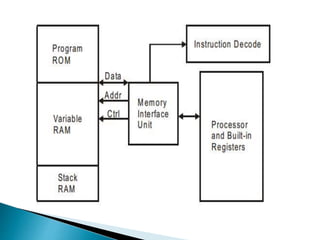
1. VON-NEUMAN /PRINCETON ARCHITECTURE 
 Single data bus that is used to fetch both instructions and data. 
 Program instructions and data are stored in a common main 
memory. 
When such a controller addresses main memory, it first fetches 
an instruction, and then it fetches the data to support the 
instruction.
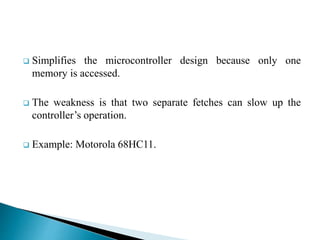
 Simplifies the microcontroller design because only one 
memory is accessed. 
 The weakness is that two separate fetches can slow up the 
controller’s operation. 
 Example: Motorola 68HC11.
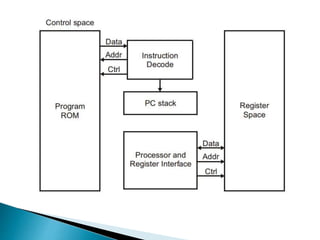
2. HARVARD ARCHITECTURE 
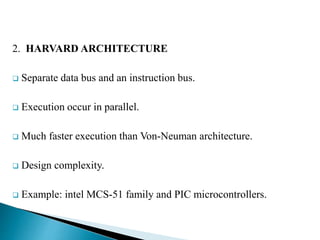
 Separate data bus and an instruction bus. 
 Execution occur in parallel. 
 Much faster execution than Von-Neuman architecture. 
 Design complexity. 
 Example: intel MCS-51 family and PIC microcontrollers.
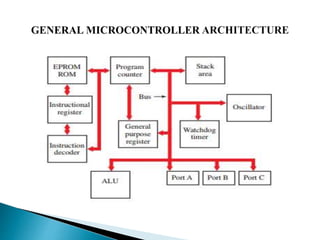
Central Processing Unit (CPU) 
 The central processing unit processes the program. It executes the 
instructions stored in the program memory pointed to by the 
program counter in synchronization with the clock signal. 
ALU 
 The arithmetic/logic unit (ALU) performs mathematical and logical 
operations on data. 
Oscillator 
 A complex digital device that generates steady pulse rate required 
for timing. All of the separate functions are controlled by one 
central timing system. The timing pulse provides the basis for 
proper sequence of all the separate sections of the microcontroller 
chip.
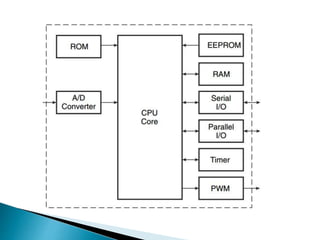
Read Only Memory (ROM) 
ROM holds the program instructions and the constant data. 
Microcontrollers use one or more of the following memory types 
for this purpose: 
 ROM (mask-programmed ROM), 
 PROM (one-time programmable ROM, which is not field 
programmable), 
 EPROM (field programmable and usually UV erasable), 
 EEPROM (field programmable, electrically erasable, byte 
erasable) and flash (similar to EEPROM technology). 
 Microcontrollers can have 4K, 8K and 16K, etc. of ROM
Random Access Memory (RAM) 
 is used to hold intermediate results and other temporary data 
during the execution of the program. Typically, microcontrollers 
have a few hundreds of bytes of RAM. 
Special-Function Registers 
 control various functions of a microcontroller. These are divided 
into two groups: 
 Registers wired into the CPU 
- Do not necessarily form part of addressable memory. 
- Used to control program flow and arithmetic functions. 
- Examples, status register, program counter, stack 
pointer, etc.
Registers 
 Register is used to hold the contents of data being 
manipulated. 
 Registers required by peripheral components 
- The contents of these registers include set a timer or enable 
serial communication. 
- Examples, a program counter, stack pointer, RAM address 
register, program address register and PC incrementer.
Peripheral Components 
 The analogue-to-digital converter - provides an interface 
between the microcontroller and the sensors that produce analogue 
electrical equivalents of the actual physical parameters to be 
controlled. 
 The digital-to-analogue converter - provides an interface 
between the microcontroller and the actuators that provide the 
control function. 
 I/O ports - provide an interface between the microcontroller and 
the peripheral I/O devices such as the keyboard, display, etc. 
 Counters/timers - are used to keep time and/or measure the time 
interval between events, count the number of events and generate 
baud rates for the serial ports.
Watchdog timer 
 A specialized program found as part of the microcontroller 
designed to prevent the microcontroller from halting or “locking 
up” because of a user-written program since the instructions are 
processed step-by-step. 
 Uses a routine that is based on timing. If a program has not been 
completed or repeated as a loop within a certain amount of time, 
the watchdog timer issues a reset command. 
 A system reset sets all the register values to zero. 
 The reset feature allows the controller to recover from the crash. 
It releases the program and sets the controller to start over again.
Stack Pointer and Program Counter 
 Stack pointer - keeps track of the last stack location used 
while the processor is busy manipulating data values, 
checking ports, or checking interrupts. 
 Program counter - is used to hold the address of the 
instruction to be executed next. 
Buses 
 Bus represents a physical connection used to carry a signal 
from one point to another inside a microcontroller. The signal 
carried by a bus may represent address, data, control signal, 
or power.
MODULE 
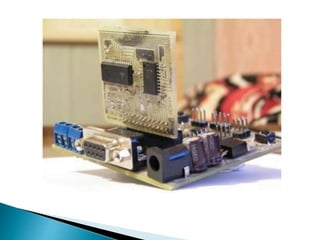
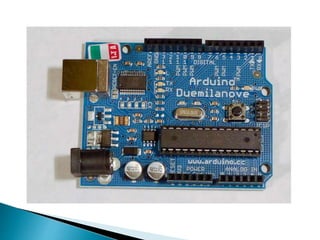
 When a microcontroller is mounted on a circuit board with 
other components function as a single unit, is referred as a 
module or a microcontroller board. 
 A microcontroller module typically consists of microcontroller, 
a power source, an interface for connecting to a programming 
device, I/O ports, and additional memory.
 A power source - powers the microcontroller and any 
accompanying components located on the printed circuit board. 
 An interface - communicate with the controller. 
 A set of input/output (I/O) ports - send and receive signals 
from the devices the microcontroller is designed to control. 
 I/O ports when programmed as an output pin, each pin can 
output digital signals. When programmed as an input pin, each 
pin can receive digital signals. 
 Digital-to-analog and analog-to-digital converters change the 
digital pulses into analog signals.
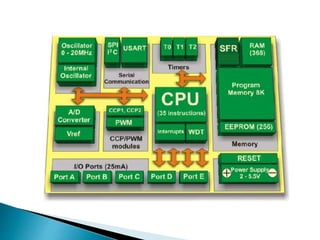
 The microcontroller consists of thousands of digital circuits that 
are combined into areas to provide specific functions. 
 The parts of the microcontroller are used to save data and 
programs, perform math and logic functions, and generate timing 
signals. 
 The different areas are connected by a bus system. The bus 
system contains tiny parallel circuits that carry the digital pulse 
patterns from section to section. 
 The ROM stores the program required for the microcontroller to 
function and controls how the chip components operate and how 
data and instructions flow through the chip. 
 RAM stores programs and data temporarily. 
 Ports and registers are special memory locations dedicated to a 
specific function such as a hardware location or a place to 
manipulate data.
ADVANTAGEOUS FEATURES 
 Easy to use and Programmable. 
 Reusable - Ability to reprogram using Flash, EEPROM or 
EPROM. 
 Flexibility and dependable. 
 Design and Simulation. 
 Energy efficient, small and cost effective. 
 Ports multifunctionality. 
 High Integration and can fit inside other devices. 
 Easy upgrade.
AREAS OF MICROCONTROLLER APPLICATION 
 Home monitoring system. 
 Automotive applications such as robotics. 
 Appliances such as microwave oven, refrigerators, television 
and VCRs, stereos. 
 Automobiles in engine control, diagnostics, climate control. 
 Environmental control in greenhouse, temperature, humidity, 
factory, home. 
 Instrumentation. 
 Aerospace.
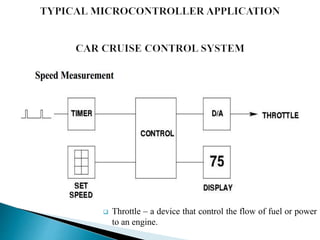
 Throttle – a device that control the flow of fuel or power 
to an engine.
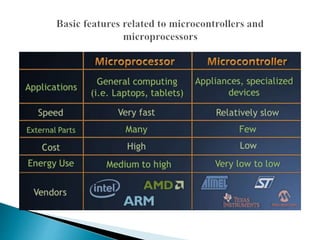
CRITERIA OF CHOOSINGA MICROCONTROLLER 
1 - Meeting the computing needs of the task at hand efficiently and 
cost effectively: 
 Speed 
 Packaging 
 Power consumption 
 The amount of RAM and ROM on chip 
 The number of I/O pins and the timer on chip 
 How easy to upgrade to higher performance or lower power-consumption 
versions 
 Cost per unit
2- Availability of software development tools, such as compilers, 
assemblers, and debuggers. 
3 -Wide availability and reliable sources of the microcontroller 
 Example: The 8051 family has the largest number of diversified 
(multiple source) suppliers 
 Intel (original) 
 Atmel 
 Philips/Signetics 
 AMD 
 Infineon (formerly Siemens) 
 Matra 
 Dallas Semiconductor/Maxim
END OF PRESENTAION 
THANK YOU
Microcontroller presentation

Microcontroller presentation

  • 1.
  • 2.
     A microcontrolleris an integrated circuit (IC) that can be programmed to perform a set of functions to control a collection of electronic devices.  A self-contained system in which a processor, support, memory, and input/output (I/O) are all contained in a single package.  Being programmable is what makes the microcontroller unique.
  • 3.
     From leftto right: PIC 12F508, PIC 16F84A, PIC 16C72, Motorola 68HC05B16, PIC 16F877, Motorola 68000
  • 5.
    1 – ACCORDINGTO BITS 4-BIT MICROCONTROLLERS  ALU performs arithmetic and logical operations on a nibble (4-bits) at an instruction.  Internal bus width of 4-bit.  Small size, minimum pin count and low cost controllers.  Low power consumption and used for low end applications like LED & LCD display drivers, portable battery chargers.  Examples: Renasa M34501 256 and ATAM862 series from ATMEL.
  • 6.
    8-BIT MICROCONTROLLER ALU performs arithmetic and logical operations on a byte (8-bits) at an instruction.  Internal bus width of 8-bit.  Examples: Intel 8051 family and Motorola MC68HC11 family.
  • 7.
    16-BIT MICROCONTROLLER ALU performs arithmetic and logical operations on a word (16-bits) at an instruction.  Internal bus width of 16-bit microcontroller is of 16-bit.  Enhanced performance, computing capability and greater precision as compared to the 8-bit microcontrollers.  Examples: Intel 8096 family, Motorola MC68HC12 and MC68332 families.
  • 8.
    32-BIT MICROCONTROLLER ALU performs arithmetic and logical operations on a double word (32-bits) at an instruction.  Internal bus width of 32-bit.  Much more enhanced performance, computing capability with greater precision as compared to 16-bit microcontrollers.  Examples: Intel 80960 family, Motorola M683xx and Intel/Atmel 251 family.
  • 9.
    2 - ACCORDINGTO MEMORY/DEVICES EMBEDDED MICROCONTROLLERS  An embedded system has a microcontroller unit that has all the functional blocks (including program as well as data memory) available on a the same chip.  Example: 8051 having Program & Data Memory, I/O Ports, Serial Communication, Counters and Timers and Interrupt Control logic on the chip.
  • 11.
    EXTERNAL MEMORY MICROCONTROLLERS  An external system has a microcontroller unit that does not have all the functional blocks available on a chip.  All or part of the memory units are externally interfaced using an interfacing circuit called the glue circuit.  Example: 8031 has no program memory on the chip.
  • 13.
    3 - ACCODINGTO INSTRUCTION SET CISC (COMPLEX INSTRUCTION SET COMPUTER) ARCHITECTURE MICROCONTROLLERS  Has an instruction set that supports many addressing modes for the arithmetic and logical instructions, data transfer and memory accesses instructions.  Many of the instructions are macro like.  Allows the programmer to use one instruction in place of many simpler instructions.  Example: Intel 8096 family.
  • 14.
    RISC (REDUCED INSTRUCTIONSET COMPUTER) ARCHITECTURE MICROCONTROLLERS  Contains an instruction set that supports fewer addressing modes for the arithmetic and logical instructions and for data transfer instructions.  Allows simultaneous access of program and data.  Instruction pipelining increases execution speed  Allow each instruction to operate on any register or use any addressing mode.  Smaller chip and pin count.  Very low power consumption.
  • 15.
    4 - ACCORDINGTO MEMORY ARCHITECTURE  The architectures of microcontrollers differ in the way data and programs are stored and accessed. 1. VON-NEUMAN /PRINCETON ARCHITECTURE  Single data bus that is used to fetch both instructions and data.  Program instructions and data are stored in a common main memory. When such a controller addresses main memory, it first fetches an instruction, and then it fetches the data to support the instruction.
  • 16.
     Simplifies themicrocontroller design because only one memory is accessed.  The weakness is that two separate fetches can slow up the controller’s operation.  Example: Motorola 68HC11.
  • 18.
    2. HARVARD ARCHITECTURE  Separate data bus and an instruction bus.  Execution occur in parallel.  Much faster execution than Von-Neuman architecture.  Design complexity.  Example: intel MCS-51 family and PIC microcontrollers.
  • 22.
    Central Processing Unit(CPU)  The central processing unit processes the program. It executes the instructions stored in the program memory pointed to by the program counter in synchronization with the clock signal. ALU  The arithmetic/logic unit (ALU) performs mathematical and logical operations on data. Oscillator  A complex digital device that generates steady pulse rate required for timing. All of the separate functions are controlled by one central timing system. The timing pulse provides the basis for proper sequence of all the separate sections of the microcontroller chip.
  • 23.
    Read Only Memory(ROM) ROM holds the program instructions and the constant data. Microcontrollers use one or more of the following memory types for this purpose:  ROM (mask-programmed ROM),  PROM (one-time programmable ROM, which is not field programmable),  EPROM (field programmable and usually UV erasable),  EEPROM (field programmable, electrically erasable, byte erasable) and flash (similar to EEPROM technology).  Microcontrollers can have 4K, 8K and 16K, etc. of ROM
  • 24.
    Random Access Memory(RAM)  is used to hold intermediate results and other temporary data during the execution of the program. Typically, microcontrollers have a few hundreds of bytes of RAM. Special-Function Registers  control various functions of a microcontroller. These are divided into two groups:  Registers wired into the CPU - Do not necessarily form part of addressable memory. - Used to control program flow and arithmetic functions. - Examples, status register, program counter, stack pointer, etc.
  • 25.
    Registers  Registeris used to hold the contents of data being manipulated.  Registers required by peripheral components - The contents of these registers include set a timer or enable serial communication. - Examples, a program counter, stack pointer, RAM address register, program address register and PC incrementer.
  • 26.
    Peripheral Components The analogue-to-digital converter - provides an interface between the microcontroller and the sensors that produce analogue electrical equivalents of the actual physical parameters to be controlled.  The digital-to-analogue converter - provides an interface between the microcontroller and the actuators that provide the control function.  I/O ports - provide an interface between the microcontroller and the peripheral I/O devices such as the keyboard, display, etc.  Counters/timers - are used to keep time and/or measure the time interval between events, count the number of events and generate baud rates for the serial ports.
  • 27.
    Watchdog timer A specialized program found as part of the microcontroller designed to prevent the microcontroller from halting or “locking up” because of a user-written program since the instructions are processed step-by-step.  Uses a routine that is based on timing. If a program has not been completed or repeated as a loop within a certain amount of time, the watchdog timer issues a reset command.  A system reset sets all the register values to zero.  The reset feature allows the controller to recover from the crash. It releases the program and sets the controller to start over again.
  • 28.
    Stack Pointer andProgram Counter  Stack pointer - keeps track of the last stack location used while the processor is busy manipulating data values, checking ports, or checking interrupts.  Program counter - is used to hold the address of the instruction to be executed next. Buses  Bus represents a physical connection used to carry a signal from one point to another inside a microcontroller. The signal carried by a bus may represent address, data, control signal, or power.
  • 29.
    MODULE  Whena microcontroller is mounted on a circuit board with other components function as a single unit, is referred as a module or a microcontroller board.  A microcontroller module typically consists of microcontroller, a power source, an interface for connecting to a programming device, I/O ports, and additional memory.
  • 30.
     A powersource - powers the microcontroller and any accompanying components located on the printed circuit board.  An interface - communicate with the controller.  A set of input/output (I/O) ports - send and receive signals from the devices the microcontroller is designed to control.  I/O ports when programmed as an output pin, each pin can output digital signals. When programmed as an input pin, each pin can receive digital signals.  Digital-to-analog and analog-to-digital converters change the digital pulses into analog signals.
  • 33.
     The microcontrollerconsists of thousands of digital circuits that are combined into areas to provide specific functions.  The parts of the microcontroller are used to save data and programs, perform math and logic functions, and generate timing signals.  The different areas are connected by a bus system. The bus system contains tiny parallel circuits that carry the digital pulse patterns from section to section.  The ROM stores the program required for the microcontroller to function and controls how the chip components operate and how data and instructions flow through the chip.  RAM stores programs and data temporarily.  Ports and registers are special memory locations dedicated to a specific function such as a hardware location or a place to manipulate data.
  • 34.
    ADVANTAGEOUS FEATURES Easy to use and Programmable.  Reusable - Ability to reprogram using Flash, EEPROM or EPROM.  Flexibility and dependable.  Design and Simulation.  Energy efficient, small and cost effective.  Ports multifunctionality.  High Integration and can fit inside other devices.  Easy upgrade.
  • 35.
    AREAS OF MICROCONTROLLERAPPLICATION  Home monitoring system.  Automotive applications such as robotics.  Appliances such as microwave oven, refrigerators, television and VCRs, stereos.  Automobiles in engine control, diagnostics, climate control.  Environmental control in greenhouse, temperature, humidity, factory, home.  Instrumentation.  Aerospace.
  • 36.
     Throttle –a device that control the flow of fuel or power to an engine.
  • 38.
    CRITERIA OF CHOOSINGAMICROCONTROLLER 1 - Meeting the computing needs of the task at hand efficiently and cost effectively:  Speed  Packaging  Power consumption  The amount of RAM and ROM on chip  The number of I/O pins and the timer on chip  How easy to upgrade to higher performance or lower power-consumption versions  Cost per unit
  • 39.
    2- Availability ofsoftware development tools, such as compilers, assemblers, and debuggers. 3 -Wide availability and reliable sources of the microcontroller  Example: The 8051 family has the largest number of diversified (multiple source) suppliers  Intel (original)  Atmel  Philips/Signetics  AMD  Infineon (formerly Siemens)  Matra  Dallas Semiconductor/Maxim
  • 40.