Dr. Vinod KhandharMS(ENT), MS(GEN SURG), DIPLOMA IN LASER SURGERY (SPAIN), LLB.INDIATELEMEDICINE PROJECTS IN INDIA
OUTLINEINTRODUCTION
BENEFITS/UTILITIES
TYPES
PRESENT DAY SCENARIO
INFRASTRUCTURE
GOALS
NEEDS
CHALLENGES
RESULTS
DISCUSSIONS
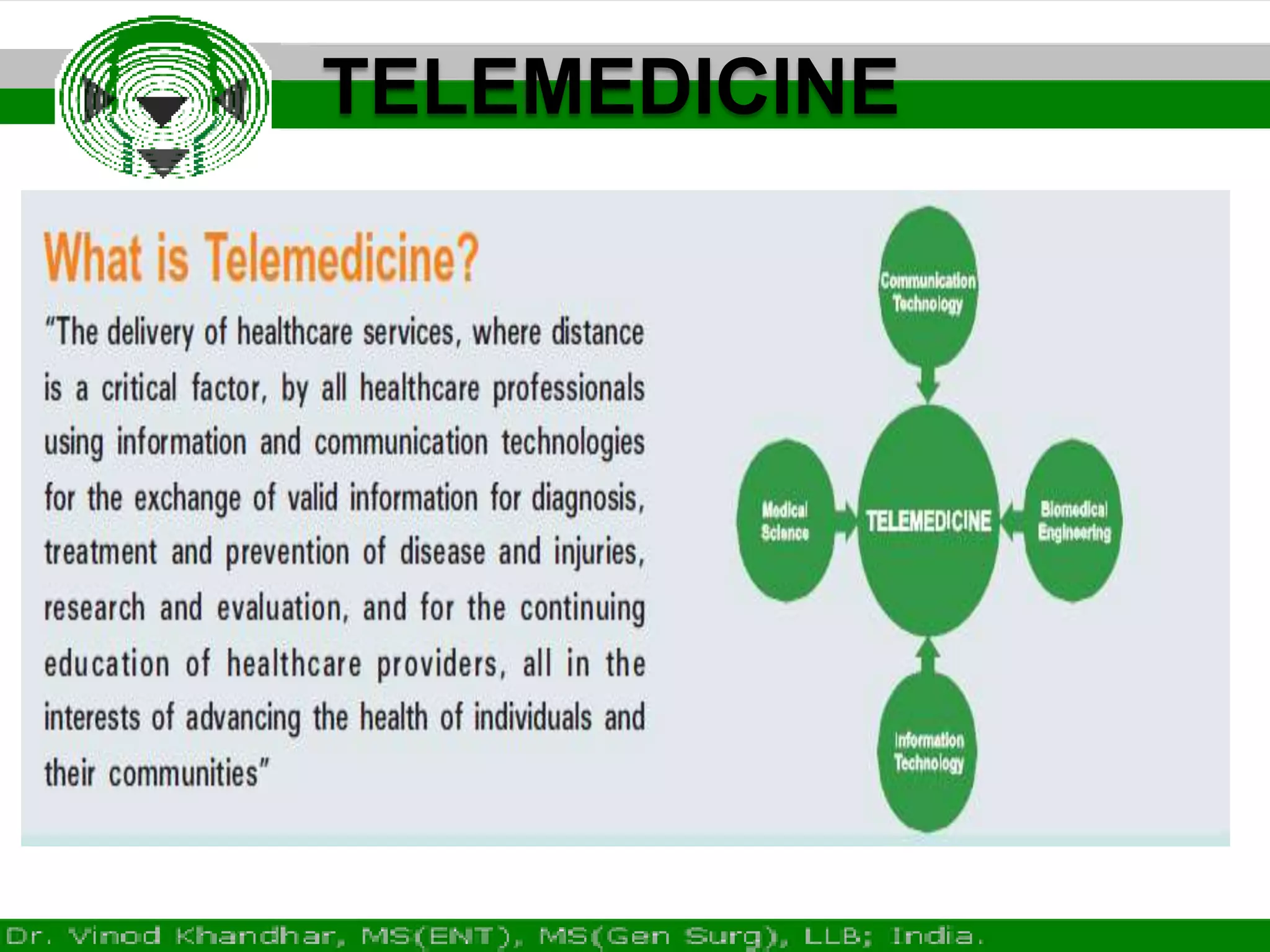
CONCLUSIONSTELEMEDICINE
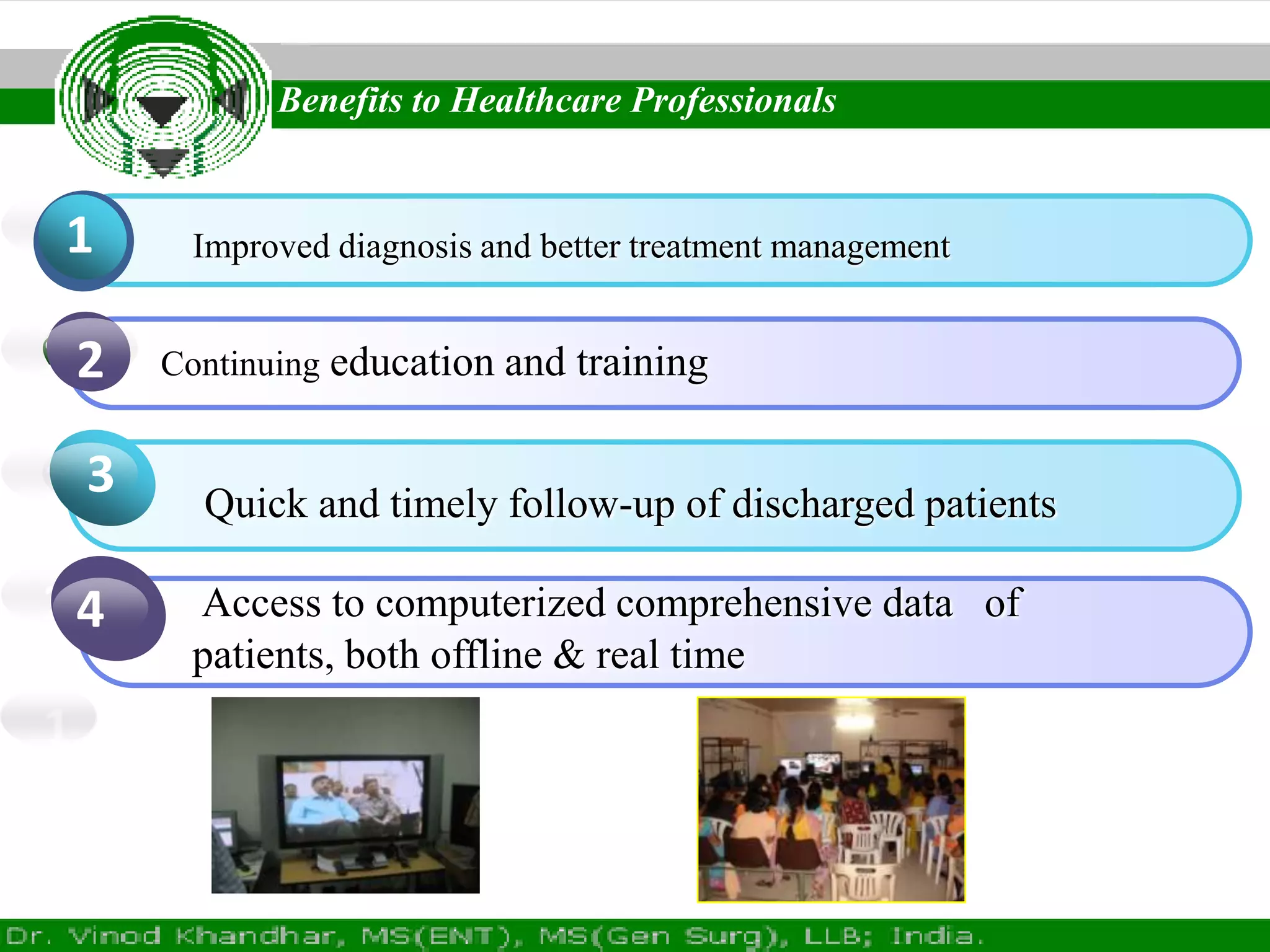
11Click to add TitleImproved diagnosis and better treatment management 22Click to add Title31Click to add Title Quick and timely follow-up of discharged patients24Click to add TitleAccess to computerized comprehensive data   of patients, both offline & real time1Benefits to Healthcare ProfessionalsContinuingeducation and training
Benefits to patientsAccess to specialized health care services to under-served rural, semi-urban and remote areasEarly diagnosis and treatmentAccess to expertise of Medical SpecialistsReduced physician’s fees and cost of medicine Reduced visits to specialty hospitalsReduced travel expensesEarly detection of diseaseReduced burden of morbidity
Benefits to Government
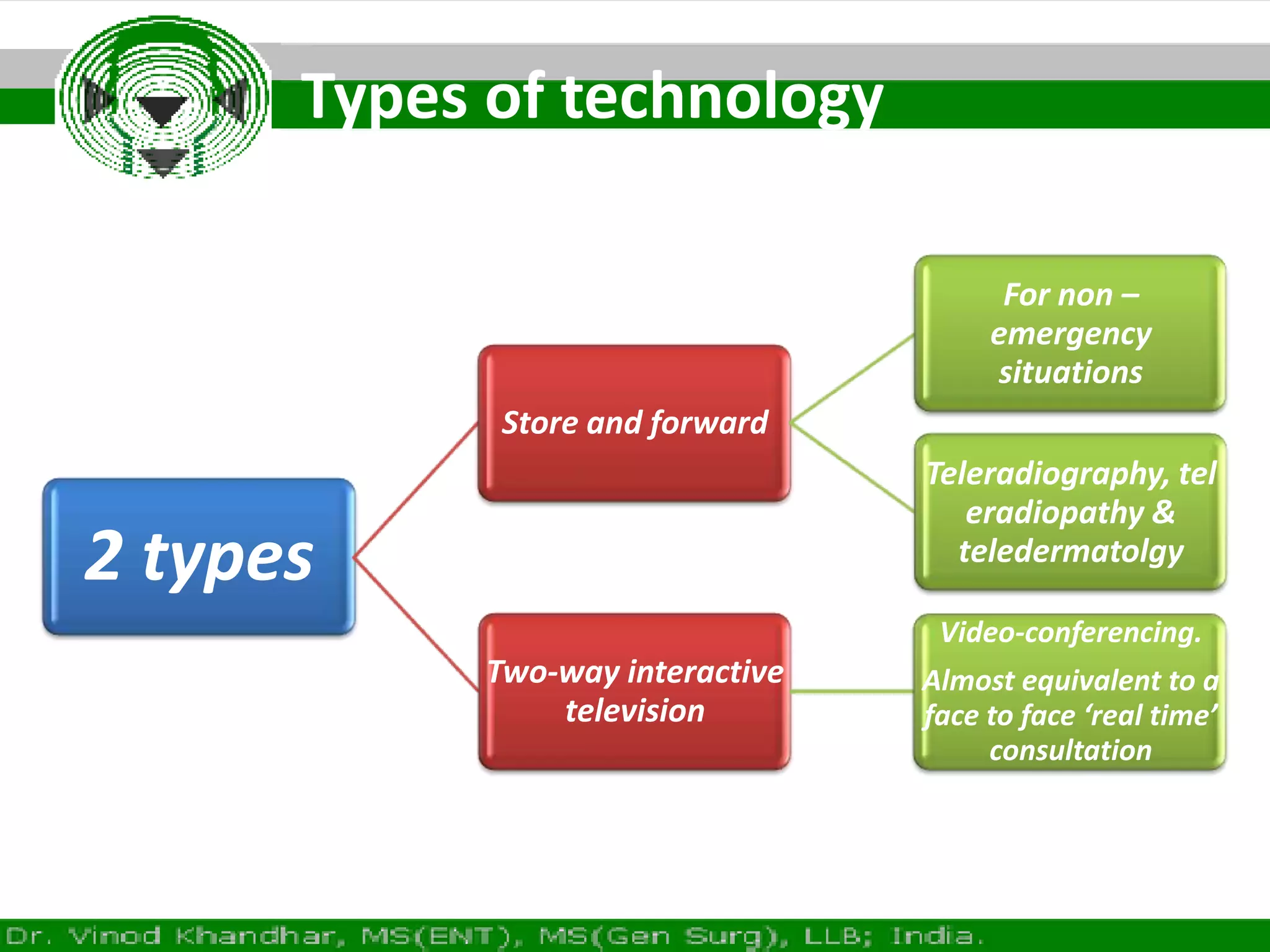
Types of technology
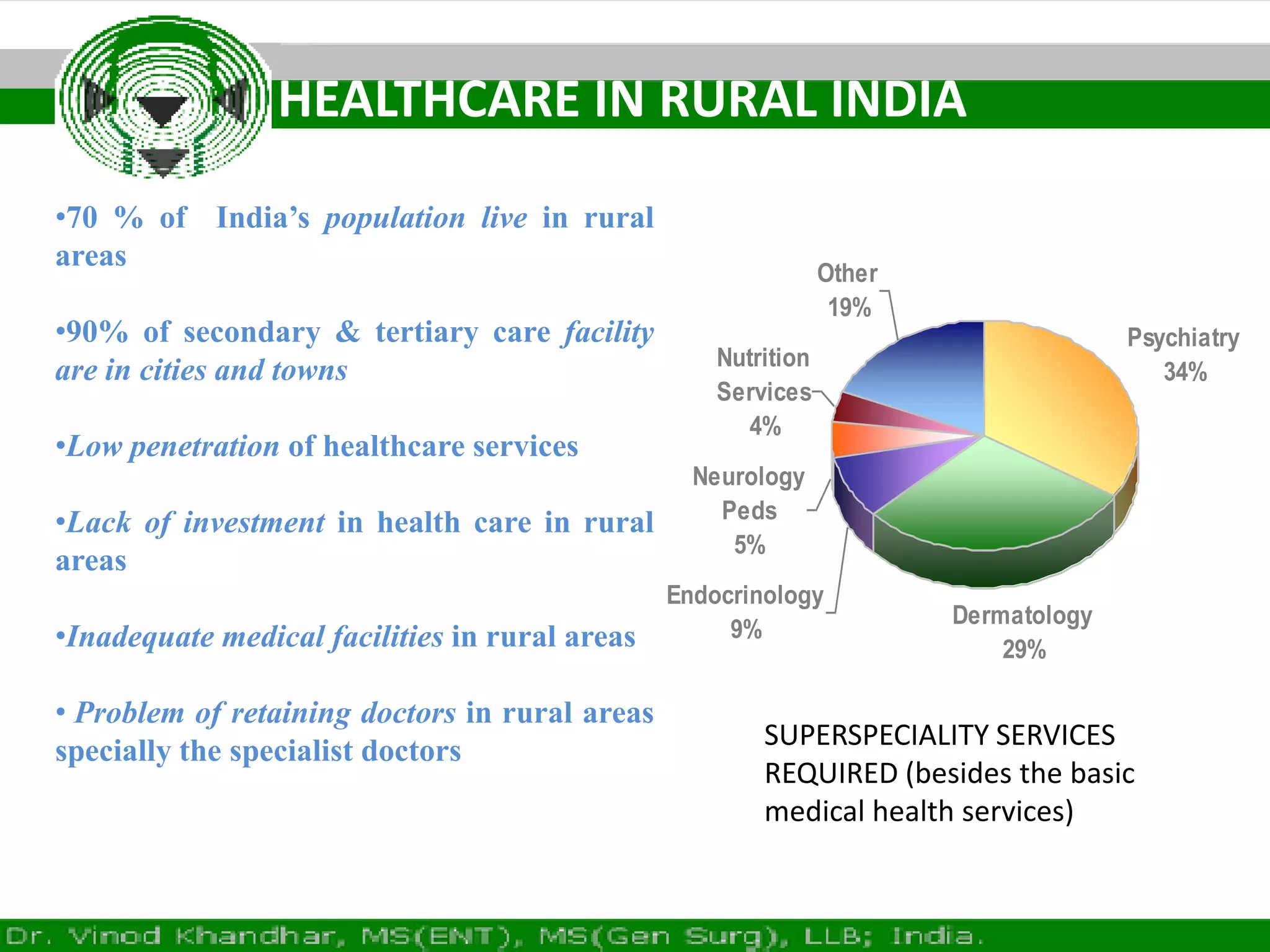
HEALTHCARE IN RURAL INDIA70 % of  India’s population live in rural areas
90% of secondary & tertiary care facility are in cities and towns
Low penetration of healthcare services
Lack of investment in health care in rural areas
Inadequate medical facilities in rural areas
Problem of retaining doctors in rural areas specially the specialist doctorsSUPERSPECIALITY SERVICES REQUIRED (besides the basic medical health services)
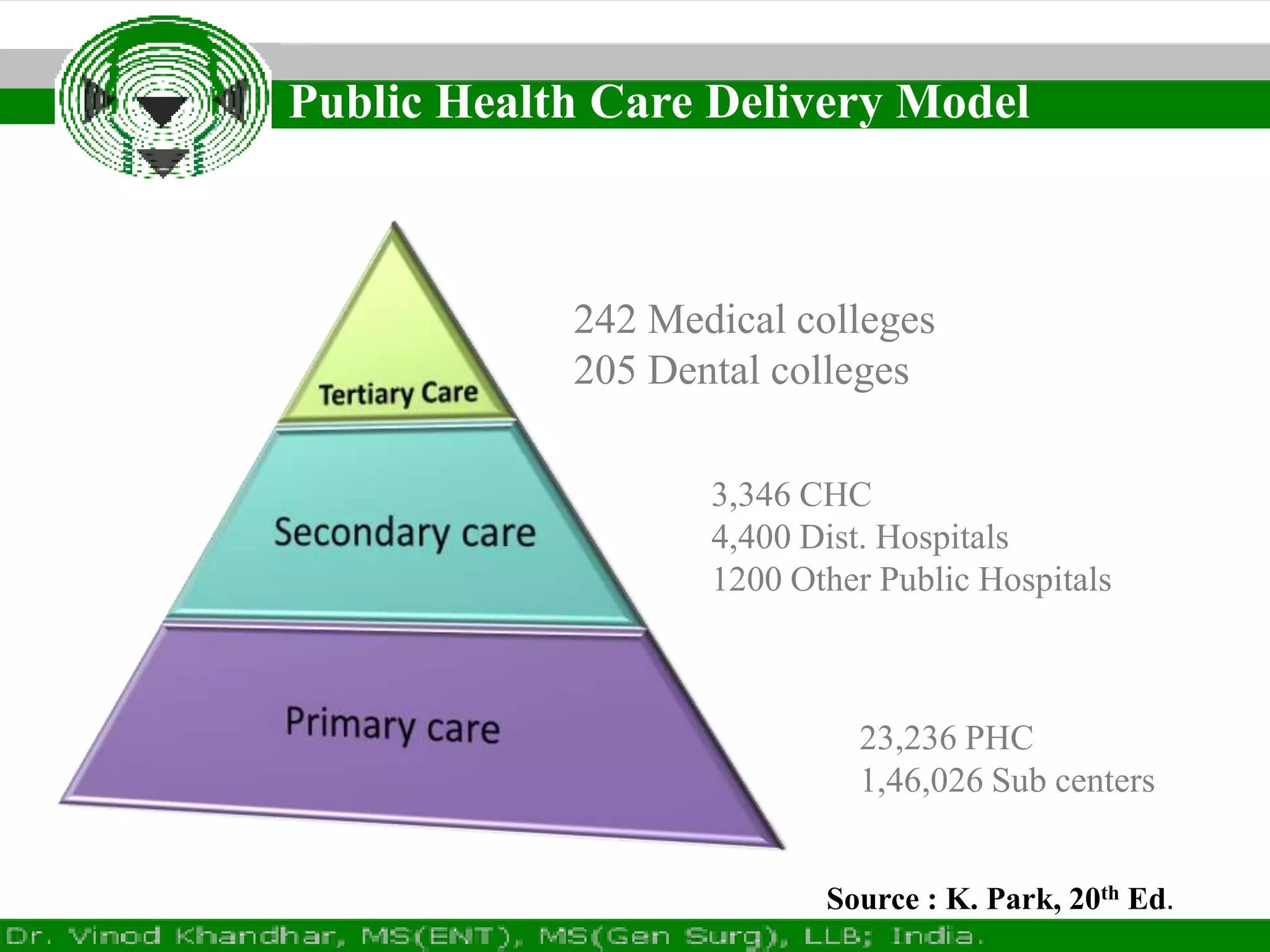
Public Health Care Delivery Model242 Medical colleges205 Dental colleges3,346 CHC4,400 Dist. Hospitals1200 Other Public Hospitals23,236 PHC1,46,026 Sub centersSource : K. Park, 20thEd.
Telemedicine: Ideal for IndiaArea : 32,87,268 Sq. Km.
Population : over 1 Billion
Urban Rural Divide
Inaccessible hilly regions, islands, desert, coasts, tribal areas
Strong Fiber Backbone

Telemedicine ppt

  • 1.
    Dr. Vinod KhandharMS(ENT),MS(GEN SURG), DIPLOMA IN LASER SURGERY (SPAIN), LLB.INDIATELEMEDICINE PROJECTS IN INDIA
  • 2.
  • 3.
  • 4.
  • 5.
  • 6.
  • 7.
  • 8.
  • 9.
  • 10.
  • 11.
  • 12.
  • 13.
    11Click to addTitleImproved diagnosis and better treatment management 22Click to add Title31Click to add Title Quick and timely follow-up of discharged patients24Click to add TitleAccess to computerized comprehensive data of patients, both offline & real time1Benefits to Healthcare ProfessionalsContinuingeducation and training
  • 14.
    Benefits to patientsAccessto specialized health care services to under-served rural, semi-urban and remote areasEarly diagnosis and treatmentAccess to expertise of Medical SpecialistsReduced physician’s fees and cost of medicine Reduced visits to specialty hospitalsReduced travel expensesEarly detection of diseaseReduced burden of morbidity
  • 15.
  • 16.
  • 17.
    HEALTHCARE IN RURALINDIA70 % of India’s population live in rural areas
  • 18.
    90% of secondary& tertiary care facility are in cities and towns
  • 19.
    Low penetration ofhealthcare services
  • 20.
    Lack of investmentin health care in rural areas
  • 21.
  • 22.
    Problem of retainingdoctors in rural areas specially the specialist doctorsSUPERSPECIALITY SERVICES REQUIRED (besides the basic medical health services)
  • 23.
    Public Health CareDelivery Model242 Medical colleges205 Dental colleges3,346 CHC4,400 Dist. Hospitals1200 Other Public Hospitals23,236 PHC1,46,026 Sub centersSource : K. Park, 20thEd.
  • 24.
    Telemedicine: Ideal forIndiaArea : 32,87,268 Sq. Km.
  • 25.
  • 26.
  • 27.
    Inaccessible hilly regions,islands, desert, coasts, tribal areas
  • 28.
  • 29.
  • 30.
  • 31.
    Pilot Projects withSuccessful outcomes
  • 32.
    SUPPORT In India, telemedicine programs are being actively supported by:Department of Information Technology (DIT)Indian Space Research OrganizationNEC Telemedicine program for North-Eastern statesApollo HospitalsAsia Heart FoundationState governmentsTelemedicine technology also supported by some other private organizations
  • 33.
  • 34.
    DIT INITIATIVESDIT hastaken following leads in Telemedicine: Development of Technology
  • 35.
    Initiation ofpilot schemes
  • 36.
    Selected Specialty e.g.Oncology, Tropical Diseases
  • 37.
    General telemedicine systemcovering all specialties
  • 38.
  • 39.
    Framework for buildingIT Infrastructure in healthNational Task Force on Telemedicine(2005)
  • 40.
    Benefits to patientsIncludes members from the following departments Health, Communication & Information Technology
  • 41.
  • 42.
    Indian Council ofMedical Research
  • 43.
  • 44.
    Center for Developmentof Advanced Computing
  • 45.
    Academic medical institutionsand corporate hospitalsBenefits for Health Care Delivery SystemUtility of NRTNBenefits to HealthCare Professionals
  • 46.
    PROPOSED OBJECTIVES OFNRTNTo provide access to timely and quality specialty medical care to the people living in rural & remote areas.
  • 47.
    To reduce ruralurban divide in delivery of medical care
  • 48.
    To improve diagnosisand treatment facilities in rural areas
  • 49.
    To mitigate theobstacles due to geographical isolation
  • 50.
    To providecontinuous medical education and training to the healthcare professionals working in rural/remote areas
  • 51.
  • 52.
  • 53.
    Selective medical andmedico-IT equipments, preferably IT compatible, with interface to Telemedicine and/or other software / hardware
  • 54.
    Computer hardware /software platform (PC, switch, etc.) and IT electronics equipments
  • 55.
    Mobile vans area part of telemedicine service
  • 56.
    Digital ECG4Digital Microscope& Camera 6Desktop PC platform with Laser Printer17IP Video Conferencing Kit2A3 Film Scanner53LEVEL-1:Software &Hardware Tele medicine softwareGlucometer & Haemogram analyzerNon-invasive Pulse & Blood Pressure unit8Connectivity device & Router9
  • 57.
    GOALS AND NEEDSLooking to the past experience for success of telemedicine:Video conferencing
  • 58.
    Accompanied by dataand image transfer (live)
  • 59.
    Common softwareusage at both ends, thus globalization of a single database software
  • 60.
    Role of trainedtechnical personnel is equally important and necessary at the patient end.
  • 61.
    Successful remuneration systemto attract private practitionersPlus pointsIt is feasible to set up a National Health Grid to be shared by healthcare providers, trainers & beneficiaries taking the advantage of a
  • 62.
  • 63.
  • 64.
  • 65.
    The ground workhas also been established by
  • 66.
  • 67.
  • 68.
  • 69.
  • 70.
    National Rural Telemedicinenetwork will help to provide quality healthcare where there is none and will improve healthcare where there is someCHALLENGESLow bandwidth
  • 71.
    Neither telephone linesnor electricity in rural areas
  • 72.
    International bandwidth ofRAFT countries is very limitedEnd 2004: 18 Mbps for the entire country, 1,34 bps/capita (Mali)Switzerland 2002: 66.000 Mbps, 9.040 bps per capita(Source: ITU World Telecommunication Indicators Database)Satellite transmission can help but is pricey
  • 73.
  • 74.
    Unstable electricitysupply. CHALLENGESPatients'fear and unfamiliarityFinancial unavailabilityLack of basic amenitiesLiteracy rate and diversity in languagesQuality aspectGovernment SupportPerspective of medical practitioners
  • 75.
    DISCUSSIONSPragmatism and therealism with tools adapted to the context must remain the rule.India is a booming economy Telemedicine is a new yet extremely lucrative conceptWith the right marketing and government approach, combined with hard efforts in the right direction, this can bea huge success!
  • 76.
    CONCLUSION Paraphrasing Neil Armstrong,“ Telemedicine: one small step for IT , a giant leap for Healthcare!”
  • 77.
    REFERENCES1. Brown N.A brief history of telemedicine. Telemedicine Information Exchange. 1995;105:833–5.2. Ganapathy K. Neurosurgeon, Apollo Hospitals, Chennai, Telemedicine in India-the Apollo experience, Neurosurgery on the Web. 2001. 3. Bashshur RL, Armstrong PA, Youssef ZI. Telemedicine: Explorations in the use of telecommunications in health care. Springfield, IL: Charles C Thomas; 1975. 4. Bashshur R, Lovett J. Assessment of telemedicine: Results of the initial experience. Aviation Space Environ Med. 1977;48:65–70.5. Bashshur R. Superintendent of Documents. Washington DC: US Government Printing Office; 1980. Technology serves the people: The story of a cooperative telemedicine project by NASA, the Indian Health Service and the Papago people.6. Watson DS. Telemedicine. Med J Aust. 1989;151:62–66. 8,71. [PubMed]7. Foote D, Hudson H, Parker EB. National Technical Information Service (NTIS) Springfield, VA: US Department of Commerce; 1976. Telemedicine in Alaska: The ATS-6 satellite biomedical demonstration.8. Allen A, Allen D. Telemedicine programs: 2nd annual review reveals doubling of programs in a year. Telemedicine Today. 1995;3(1):10–4.9. Report of the Technical Working Group on Telemedicine Standardization, Technical working group for Telemedicine Standardization Department of Information Technology (DIT), Ministry of Communications and Information Technology (MCIT), May 2003.10. Houtchens BA, Allen A, Clemmer TP, Lindberg DA, Pedersen S. Telemedicine protocols and standards: Development and implementation. J Med Sys. 1995;9(2):93–119.11. Balas EA, Jaffery F, Pinciroli F. Patient care from a distance: Analysis of evidence. Annu Meet Int Soc Technol Assess Health Care. 1996;12:17.12. Grigsby J, Schlenker RE, Kaehny MM, et al. Analytic framework for evaluation of telemedicine. Telemedicine J. 1995;1(1):31–39.13. Bedi BS. Telemedicine in India: Initiatives and Perspective, eHealth 2003: Addressing the Digital Divide-17th Oct. 2003. 14. Mexrich RS, DeMarco JK, Negin S, et al. Radiology on the information superhighway. Radiology. 1995;195(1):73–81. [PubMed]15. Brown N. Telemedicine coming of age. TIE. 1996 Sep 28;16. Wachter GW. Telecommunication, linking providers and patients. Telemedicine Information Exchange. 2000 Jun 30;17. Kopp S, Schuchman R, Stretcher V, Gueye M, Ledlow J, Philip T, et al. Telemedicine. Telemedicine J E-health. 2002;8:18.18. Grigsby B, Brown N. ATSP Report on US Telemedicine Activity: Portland; 1999 or Association of Telehealth Service Providers.
  • 78.