TOPOLOGY
NETWORK
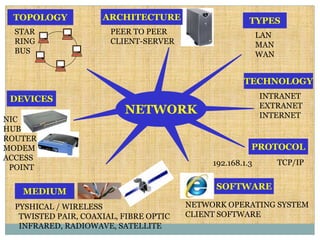
STAR
RING
BUS
PEER TO PEER
CLIENT-SERVER
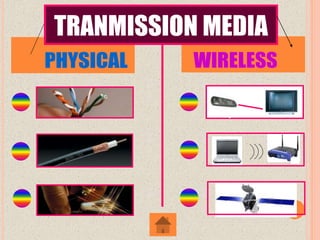
PYSHICAL / WIRELESS
TWISTED PAIR, COAXIAL, FIBRE OPTIC
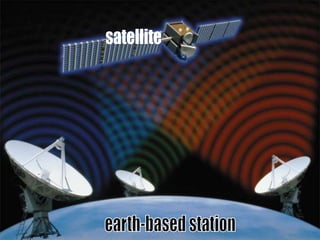
INFRARED, RADIOWAVE, SATELLITE
NIC
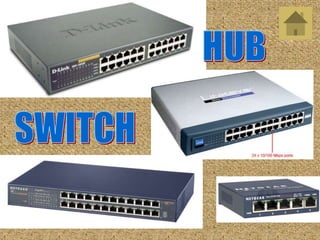
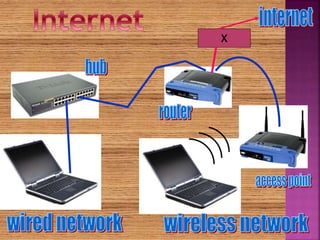
HUB
ROUTER
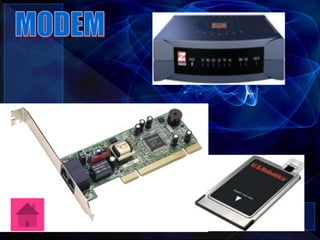
MODEM
ACCESS
POINT
LAN
MAN
WAN
INTRANET
EXTRANET
INTERNET
TCP/IP
NETWORK OPERATING SYSTEM
CLIENT SOFTWARE
ARCHITECTURE TYPES
TECHNOLOGY
PROTOCOL
SOFTWARE
MEDIUM
DEVICES
192.168.1.3
HUB
terminator
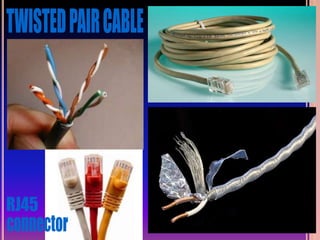
• Pair of twisted conductors
•Twisting reduces interference (two parallel wires constitute a
simple antenna; a twisted pair does not.)
•Cheap medium
•Commonly used for communications within buildings and in
telephone networks
•Produced in unshielded (UTP) and shielded (STP) forms, and in
different performance categories.
•Cables may hold hundreds of pairs. Neighbor pairs typically have
different twist lengths to reduce crosstalk.
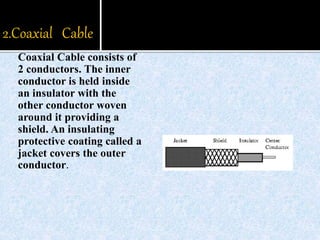
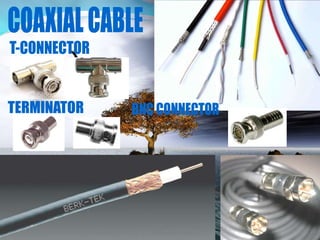
2.Coaxial Cable
Coaxial Cable consists of
2 conductors. The inner
conductor is held inside
an insulator with the
other conductor woven
around it providing a
shield. An insulating
protective coating called a
jacket covers the outer
conductor.
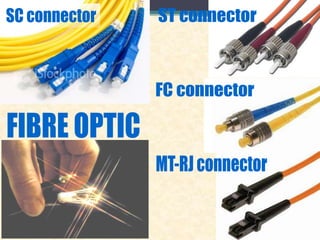
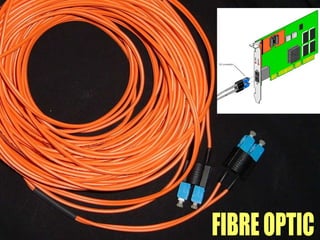
3. Optical Fiber
 Three components: light source, transmission system, and a detector .
 The detector generates an electric pulse when hit by light
 1-a pulse of light; 0-missing pulse of light.
 optical rays travel in glass or plastic core
 Light at shallow angles propagate along the fibre, and those that are less than critical angle are
absorbed in the jacket
 The cladding is a glass or plastic with properties that differ from those of the core
 Used in long distance communication, in locations having small amount of space, and with
reduction in price is starting to get also to LANs.
 Not affected by external electromagnetic fields, and do not radiate energy. Hence, providing
high degree of security from eavesdropping.
 Provide for multimode of propagation at different angles of reflections. Cause signal elements
to spread out in time, which limits the rate in which data can be accurately received.
 Reduction of the radius of the core implies less reflected angles. Single mode is achieved with
sufficient small radius.
 A multimode graded index transmission is obtained by varying the index of reflection of the
core to improve on the multi mode option without resolving to the cost of single mode. (index of
reflection=speed in vacuum / speed in medium.)
 1 Gbps is the current limitation, with the bottle neck in the conversion from electrical to optical
signals. Large improvements are expected.
 Here information is transmitted by sending
electromagnetic signals through free space and
hence the name unguided media, as the signals are
not guided in any specific direction or inside any
specific medium.
 All unguided media transmission are classified as
wireless transmission.
 Wireless transmission can be used as the medium
in both LAN and WAN environments.
Some of the types of
wireless media are:
RADIO WAVES
MICRO WAVES
INFRARED WAVES
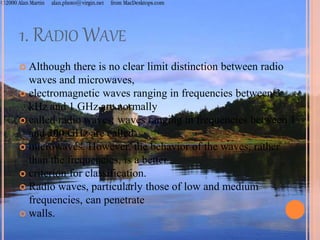
1. RADIO WAVE
 Although there is no clear limit distinction between radio
waves and microwaves,
 electromagnetic waves ranging in frequencies between 3
kHz and 1 GHz are normally
 called radio waves; waves ranging in frequencies between 1
and 300 GHz are called
 microwaves. However, the behavior of the waves, rather
than the frequencies, is a better
 criterion for classification.
 Radio waves, particularly those of low and medium
frequencies, can penetrate
 walls.
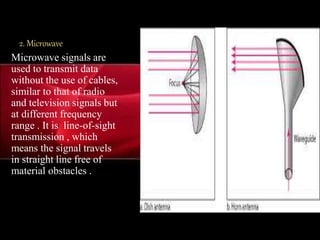
2. Microwave
Microwave signals are
used to transmit data
without the use of cables,
similar to that of radio
and television signals but
at different frequency
range . It is line-of-sight
transmission , which
means the signal travels
in straight line free of
material obstacles .
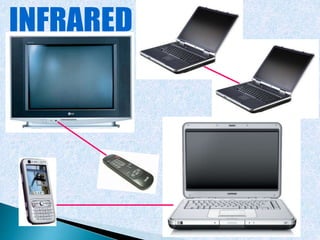
This type of transmission uses infrared light to send data. You can
see the use of this type of transmission in everyday life - TV
remotes, automotive garage doors, wireless speakers etc., all
make use of infrared as transmission media.
The infrared light transmits data through the air and can
propagate throughout a room(bouncing off surfaces), but will
not penetrate walls. The infrared transmission has become
common in PDAs(Personal digital assistants)e.g., hand held
devices like palm pilots etc.
X
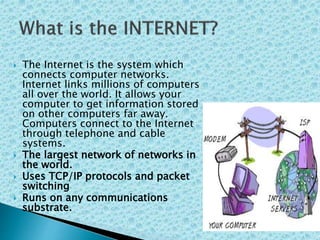
 The Internet is the system which
connects computer networks.
Internet links millions of computers
all over the world. It allows your
computer to get information stored
on other computers far away.
Computers connect to the Internet
through telephone and cable
systems.
 The largest network of networks in
the world.
 Uses TCP/IP protocols and packet
switching
 Runs on any communications
substrate.
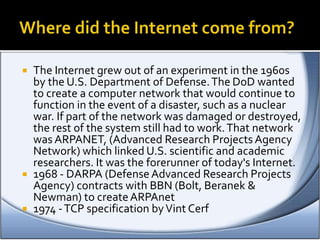
 The Internet grew out of an experiment in the 1960s
by the U.S. Department of Defense.The DoD wanted
to create a computer network that would continue to
function in the event of a disaster, such as a nuclear
war. If part of the network was damaged or destroyed,
the rest of the system still had to work.That network
was ARPANET, (Advanced Research Projects Agency
Network) which linked U.S. scientific and academic
researchers. It was the forerunner of today's Internet.
 1968 - DARPA (DefenseAdvanced Research Projects
Agency) contracts with BBN (Bolt, Beranek &
Newman) to createARPAnet
 1974 -TCP specification byVint Cerf
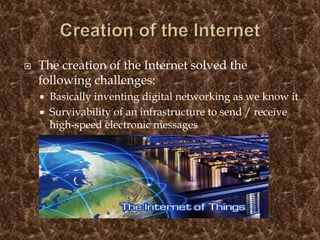
 The creation of the Internet solved the
following challenges:
 Basically inventing digital networking as we know it
 Survivability of an infrastructure to send / receive
high-speed electronic messages
 Reliability of computer messaging
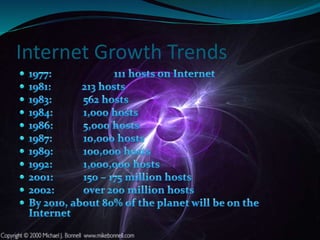
Internet Growth Trends
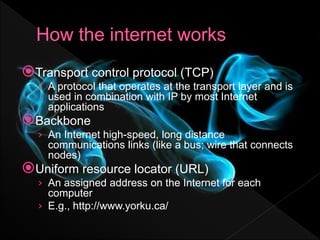
Transport control protocol (TCP)
› A protocol that operates at the transport layer and is
used in combination with IP by most Internet
applications
Backbone
› An Internet high-speed, long distance
communications links (like a bus; wire that connects
nodes)
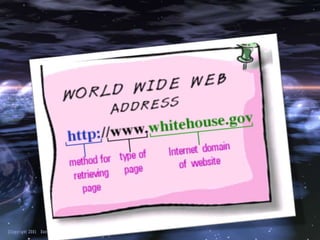
Uniform resource locator (URL)
› An assigned address on the Internet for each
computer
› E.g., http://www.yorku.ca/
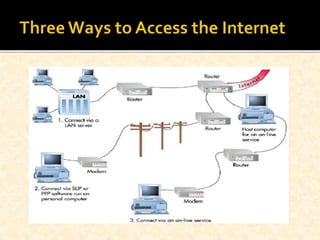
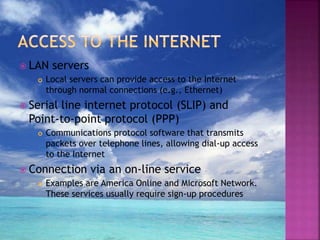
 LAN servers
 Local servers can provide access to the Internet
through normal connections (e.g., Ethernet)
 Serial line internet protocol (SLIP) and
Point-to-point protocol (PPP)
 Communications protocol software that transmits
packets over telephone lines, allowing dial-up access
to the Internet

 Connection via an on-line service
 Examples are America Online and Microsoft Network.
These services usually require sign-up procedures
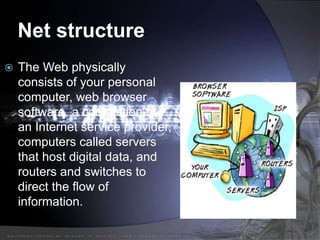
Net structure
 The Web physically
consists of your personal
computer, web browser
software, a connection to
an Internet service provider,
computers called servers
that host digital data, and
routers and switches to
direct the flow of
information.


Computer project
Computer project
Computer project
Computer project
Computer project

Computer project

  • 3.
    TOPOLOGY NETWORK STAR RING BUS PEER TO PEER CLIENT-SERVER PYSHICAL/ WIRELESS TWISTED PAIR, COAXIAL, FIBRE OPTIC INFRARED, RADIOWAVE, SATELLITE NIC HUB ROUTER MODEM ACCESS POINT LAN MAN WAN INTRANET EXTRANET INTERNET TCP/IP NETWORK OPERATING SYSTEM CLIENT SOFTWARE ARCHITECTURE TYPES TECHNOLOGY PROTOCOL SOFTWARE MEDIUM DEVICES 192.168.1.3
  • 5.
  • 11.
    • Pair oftwisted conductors •Twisting reduces interference (two parallel wires constitute a simple antenna; a twisted pair does not.) •Cheap medium •Commonly used for communications within buildings and in telephone networks •Produced in unshielded (UTP) and shielded (STP) forms, and in different performance categories. •Cables may hold hundreds of pairs. Neighbor pairs typically have different twist lengths to reduce crosstalk.
  • 13.
    2.Coaxial Cable Coaxial Cableconsists of 2 conductors. The inner conductor is held inside an insulator with the other conductor woven around it providing a shield. An insulating protective coating called a jacket covers the outer conductor.
  • 15.
    3. Optical Fiber Three components: light source, transmission system, and a detector .  The detector generates an electric pulse when hit by light  1-a pulse of light; 0-missing pulse of light.  optical rays travel in glass or plastic core  Light at shallow angles propagate along the fibre, and those that are less than critical angle are absorbed in the jacket  The cladding is a glass or plastic with properties that differ from those of the core  Used in long distance communication, in locations having small amount of space, and with reduction in price is starting to get also to LANs.  Not affected by external electromagnetic fields, and do not radiate energy. Hence, providing high degree of security from eavesdropping.  Provide for multimode of propagation at different angles of reflections. Cause signal elements to spread out in time, which limits the rate in which data can be accurately received.  Reduction of the radius of the core implies less reflected angles. Single mode is achieved with sufficient small radius.  A multimode graded index transmission is obtained by varying the index of reflection of the core to improve on the multi mode option without resolving to the cost of single mode. (index of reflection=speed in vacuum / speed in medium.)  1 Gbps is the current limitation, with the bottle neck in the conversion from electrical to optical signals. Large improvements are expected.
  • 18.
     Here informationis transmitted by sending electromagnetic signals through free space and hence the name unguided media, as the signals are not guided in any specific direction or inside any specific medium.  All unguided media transmission are classified as wireless transmission.  Wireless transmission can be used as the medium in both LAN and WAN environments.
  • 19.
    Some of thetypes of wireless media are: RADIO WAVES MICRO WAVES INFRARED WAVES
  • 20.
    1. RADIO WAVE Although there is no clear limit distinction between radio waves and microwaves,  electromagnetic waves ranging in frequencies between 3 kHz and 1 GHz are normally  called radio waves; waves ranging in frequencies between 1 and 300 GHz are called  microwaves. However, the behavior of the waves, rather than the frequencies, is a better  criterion for classification.  Radio waves, particularly those of low and medium frequencies, can penetrate  walls.
  • 21.
    2. Microwave Microwave signalsare used to transmit data without the use of cables, similar to that of radio and television signals but at different frequency range . It is line-of-sight transmission , which means the signal travels in straight line free of material obstacles .
  • 22.
    This type oftransmission uses infrared light to send data. You can see the use of this type of transmission in everyday life - TV remotes, automotive garage doors, wireless speakers etc., all make use of infrared as transmission media. The infrared light transmits data through the air and can propagate throughout a room(bouncing off surfaces), but will not penetrate walls. The infrared transmission has become common in PDAs(Personal digital assistants)e.g., hand held devices like palm pilots etc.
  • 26.
  • 27.
     The Internetis the system which connects computer networks. Internet links millions of computers all over the world. It allows your computer to get information stored on other computers far away. Computers connect to the Internet through telephone and cable systems.  The largest network of networks in the world.  Uses TCP/IP protocols and packet switching  Runs on any communications substrate.
  • 28.
     The Internetgrew out of an experiment in the 1960s by the U.S. Department of Defense.The DoD wanted to create a computer network that would continue to function in the event of a disaster, such as a nuclear war. If part of the network was damaged or destroyed, the rest of the system still had to work.That network was ARPANET, (Advanced Research Projects Agency Network) which linked U.S. scientific and academic researchers. It was the forerunner of today's Internet.  1968 - DARPA (DefenseAdvanced Research Projects Agency) contracts with BBN (Bolt, Beranek & Newman) to createARPAnet  1974 -TCP specification byVint Cerf
  • 30.
     The creationof the Internet solved the following challenges:  Basically inventing digital networking as we know it  Survivability of an infrastructure to send / receive high-speed electronic messages  Reliability of computer messaging
  • 31.
  • 32.
    Transport control protocol(TCP) › A protocol that operates at the transport layer and is used in combination with IP by most Internet applications Backbone › An Internet high-speed, long distance communications links (like a bus; wire that connects nodes) Uniform resource locator (URL) › An assigned address on the Internet for each computer › E.g., http://www.yorku.ca/
  • 34.
     LAN servers Local servers can provide access to the Internet through normal connections (e.g., Ethernet)  Serial line internet protocol (SLIP) and Point-to-point protocol (PPP)  Communications protocol software that transmits packets over telephone lines, allowing dial-up access to the Internet  Connection via an on-line service  Examples are America Online and Microsoft Network. These services usually require sign-up procedures
  • 35.
    Net structure  TheWeb physically consists of your personal computer, web browser software, a connection to an Internet service provider, computers called servers that host digital data, and routers and switches to direct the flow of information.
  • 37.